
How Indexed Annuities Work and Who Should Consider Them
How Indexed Annuities Work and Who Should Consider Them
Fixed Indexed Annuities (FIAs) are designed for people who want growth tied to the market — but without the risk of losing principal during downturns. Many pre-retirees and retirees find themselves stuck between two uncomfortable options: staying conservative in low-yield accounts that barely keep up with inflation, or remaining exposed to full market volatility just as they approach retirement. Learning how indexed annuities work can help bridge that gap. An FIA credits interest based on the performance of a market index — such as the S&P 500 index inside an annuity — while contractually guaranteeing that your principal will not decline due to negative market performance. In simple terms, you participate in a portion of the upside while avoiding the downside risk. That balance of growth potential and protection is why indexed annuities have become a core planning tool for conservative growth investors and retirement income planners alike.

Ensure you are receiving the absolute top rates
Current Fixed Annuity Rates
Compare today’s best fixed annuity rates from top carriers.
Current Bonus Annuity Rates
See which annuities offer the highest upfront bonus today.
Request an Annuity Quote
Submit our annuity request form to get personalized rate options.
Lifetime Income Calculator
Use our calculator to see how much guaranteed income your annuity can provide.
FIA vs. Variable Annuity vs. MYGA: Understanding the Differences
| Feature | Fixed Indexed Annuity (FIA) | Variable Annuity | MYGA (Fixed Annuity) |
|---|---|---|---|
| How Interest Is Determined | Linked to an external market index (S&P 500, Nasdaq-100, proprietary indices) via caps, participation rates, or spreads — but not directly invested in the market. | Directly invested in subaccounts (mutual fund-like portfolios). Performance tracks the subaccounts, including losses. | Declared fixed interest rate for a defined term — guaranteed and known upfront with no market linkage of any kind. |
| Principal Risk | None from market — 0% floor means account value never declines due to index performance. Principal is protected. | Full market risk — account value rises and falls directly with subaccount performance. Principal can decline significantly. | None — principal is fully guaranteed by the carrier. No market exposure of any kind. |
| Growth Potential | Moderate — higher than MYGA declared rates in favorable market years; lower than variable annuity in strong bull markets due to caps and participation limits. | Highest potential — unlimited upside tracking the full performance of subaccounts. Also unlimited downside. | Fixed and predictable — the declared rate is the exact growth for the full term. No upside beyond the stated rate. |
| Tax Treatment | Tax-deferred — no annual 1099 on credited interest. Growth compounds on a gross basis until withdrawal. | Tax-deferred — same as FIA. However, gains are taxable as ordinary income upon withdrawal regardless of the subaccount performance type. | Tax-deferred — same annual compounding advantage. See how annuities are taxed. |
| Fees | Generally no annual management fee on the base contract. Optional income rider fees typically 0.75%–1.25% annually if elected. See whether annuities have fees. | Typically the most expensive annuity type — mortality and expense (M&E) charges, administrative fees, subaccount management fees, and rider fees can total 2%–4%+ annually. | No management fees — the declared rate is a net rate with no additional charges deducted. |
| Income Rider Options | Optional GLWB income riders widely available across most FIA products — providing guaranteed lifetime income regardless of account performance. See how GLWBs work. | Income riders available but typically carry additional fees on top of already high base costs — reducing net performance further. | No income riders — income is accessed through annuitization of the accumulated value at maturity. See annuity free withdrawal rules. |
| Best For | Conservative investors who want growth potential beyond fixed rates without accepting market loss risk. Retirees seeking both accumulation and optional lifetime income. | Long-horizon investors comfortable with market volatility who prioritize maximum growth potential and are not near retirement. | Buyers who want absolute rate certainty and simplicity. Best suited for defined accumulation periods with clear exit timelines. |
How Fixed Indexed Annuities Work — The Core Mechanics
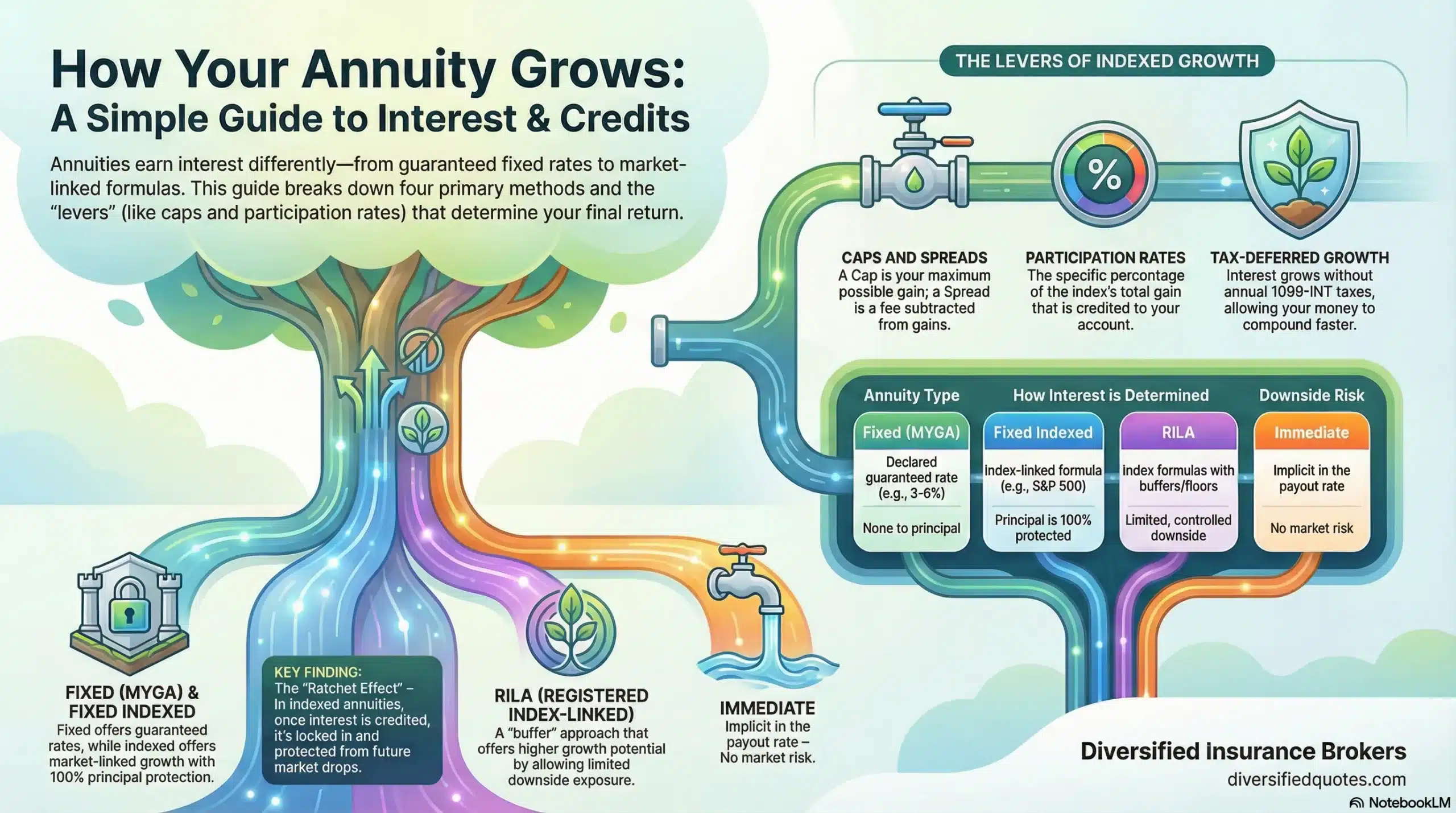
Unlike variable annuities, where funds are directly invested in subaccounts that rise and fall with the market, fixed indexed annuities protect against market downturns because they are not directly invested in the market at all. Instead, insurance companies use options-based hedging strategies to provide interest credits tied to index performance. If the index posts a positive return during the crediting period, your contract receives interest according to the terms — such as a cap rate, participation rate, or spread. If the index posts a negative return, your credited interest is simply 0% for that period, not a loss. This zero floor design creates a powerful long-term effect: your account compounds from prior gains without ever having to recover from a market crash. Over multiple market cycles, eliminating negative years can significantly improve stability and retirement confidence. Reviewing current annuity rates across different fixed and indexed products helps you compare how competitive today’s terms are before making a decision.
The Annual Reset — Why Zero Is Your Hero
The annual reset feature is one of the most structurally powerful elements of an FIA — and one of the least understood by first-time buyers. At each contract anniversary, the starting point for the next crediting period is set equal to the current account value, including all previously credited interest. Gains from prior years are permanently locked in and become the new protected base. This means the account never has to “recover” from a negative year before generating new growth. In a standard market investment, a 20% decline in one year requires a 25% gain just to break even — and during that recovery period, no actual net growth is occurring. In an FIA, there is no recovery period required. The 0% floor year is simply a pause, and the next year begins fresh from the locked-in value. Over a 10- to 15-year accumulation horizon that spans multiple market cycles, this stair-step growth pattern can produce meaningfully superior outcomes compared to riding through full market volatility even when the market’s average return is similar. Sequence-of-returns risk — the danger that a large loss early in a withdrawal period permanently damages long-term sustainability — is directly eliminated for the portion of assets held in an FIA with a 0% floor.
Crediting Methods Explained — Cap Rate, Participation Rate, and Spread
To understand whether an FIA fits your goals, it is essential to understand how crediting methods work — because the method determines how much of the index’s gain actually reaches your account. A cap rate sets the maximum interest you can earn during a term. If the S&P 500 returns 18% in a year and your cap is 9%, your credited interest is 9%. If the S&P 500 returns 6%, you receive 6%. The cap limits the upside in exchange for the 0% floor protection. A participation rate determines what percentage of the index gain you receive. If the index gains 12% and your participation rate is 70%, you receive 8.4%. Some carriers offer participation rates above 100% — meaning you receive more than the index’s raw gain — though typically on volatility-controlled proprietary indices that smooth performance. A spread subtracts a defined percentage from the index return before crediting. If the index gains 10% and the spread is 2.5%, you receive 7.5%. Understanding how these mechanisms interact is why comparing products on the marketed cap or participation rate alone can be misleading — the index methodology, volatility control mechanisms, and crediting period length all affect how much interest you actually receive over time. Our resource on index annuity crediting methods covers each mechanism in detail for buyers evaluating multiple products side by side.
FIA Accumulation vs. FIA Income — Two Distinct Strategies
Another important distinction is that FIAs can serve two very different purposes: pure accumulation and guaranteed income. Some investors use indexed annuities as protected growth vehicles, allowing interest to compound for 5 to 10 years before repositioning assets. Others attach an optional income rider designed to generate guaranteed lifetime income regardless of index performance. These riders create a separate income base that may grow at a fixed roll-up rate or through index-based calculations. Even if the accumulation value grows slowly during flat markets, the income base may continue building a larger future income stream.
Understanding how a GLWB works — the Guaranteed Lifetime Withdrawal Benefit — is critical before selecting a product, since rider structure determines future payout percentages and income flexibility. The income base and the accumulation value are different numbers that serve different purposes: the accumulation value is what you can surrender or leave as a death benefit, while the income base is used solely to calculate the guaranteed income withdrawal amount. Buyers who conflate these two figures often have unrealistic expectations about lump-sum access. For a comprehensive comparison of how income riders differ across FIA products, our resource on the best FIAs with lifetime income riders covers the leading products and structures side by side. And for buyers exploring whether to use an FIA for accumulation only or as an income vehicle, what an income rider is explains the structure from the ground up.
Who Should Consider a Fixed Indexed Annuity?
Many retirees are concerned about running out of money more than they are about missing maximum market gains. FIAs address that concern directly. When paired with lifetime income riders, they can create predictable retirement income that supplements Social Security and other guaranteed sources. Exploring lifetime income annuity strategies can clarify how indexed annuities transition from growth to reliable monthly income. This structure is especially powerful for individuals retiring during volatile periods, when withdrawing from market-based accounts could permanently damage long-term sustainability.
The buyers who benefit most from FIAs share a common profile: they are within 5 to 15 years of retirement or already retired; they have experienced at least one major market decline that affected their retirement timeline; they want growth potential beyond what bank CDs or fixed annuities offer but are not comfortable with the full volatility of equity markets; they have a defined accumulation period after which they will need income or liquidity; and they value principal protection as a non-negotiable feature rather than a nice-to-have. FIAs are less appropriate for buyers with very long investment horizons who can ride through market cycles and do not need downside protection, or for buyers who need immediate liquidity since surrender periods apply to most FIA contracts. Understanding the surrender charge structure and free withdrawal provisions is essential before committing to any FIA contract.
Tax Deferral and FIAs — The Compounding Advantage
One of the most underappreciated advantages of FIAs is tax deferral. Interest credited inside a fixed indexed annuity is not taxed in the year it is earned. Unlike a taxable brokerage account or a bank CD — where interest generates a 1099 each year regardless of whether funds are withdrawn — FIA interest compounds on a gross basis until distribution. For an investor in a 24% federal marginal tax bracket, tax-deferred compounding at the same stated rate produces meaningfully more accumulation than an equivalent taxable investment over a 10-year horizon because the full credited amount is reinvested rather than being reduced annually by tax payments. This advantage is most significant for non-qualified money — after-tax savings that are not already inside an IRA or 401(k) — where the tax deferral inside an FIA provides a deferral benefit not otherwise available without the annuity wrapper. For qualified money placed inside an FIA through a rollover, the tax deferral already exists from the IRA or 401(k) structure, and the FIA’s primary value is the protection and growth mechanic rather than additional tax deferral. Understanding how annuities are taxed at distribution — gains distributed as ordinary income, basis returned income-tax-free under the exclusion ratio for non-qualified annuities — helps buyers model the net after-tax value of the accumulation advantage before committing to a long surrender period.
Comparing FIAs to Other Conservative Options
It is also important to compare FIAs to other conservative options. If your primary goal is simply locking in a fixed rate with no index linkage, a MYGA may be more appropriate. Reviewing best fixed annuities for conservative investors can help determine whether the simplicity of a guaranteed fixed rate better fits your objectives. However, if you want growth potential beyond declared interest rates — without stepping back into full market exposure — FIAs provide a compelling middle ground. Many retirees use a combination of MYGAs and FIAs in a laddered structure: shorter-duration MYGAs handle the near-term accumulation with certainty, while longer-duration FIAs capture index-linked upside potential for the later portion of the retirement horizon. Our resource on the fixed annuity ladder strategy covers how to combine products across different terms and structures to create rolling liquidity and diversified growth approaches.
Fees are another important consideration. Many FIAs have no annual management fee on the base contract unless you add an optional rider. Carrier financial strength matters as well — indexed annuities are backed by the financial stability of the issuing insurance carrier, not the federal government. Whether you are considering carriers like Securian or other top-rated providers, reviewing AM Best ratings and company track records before making a selection is an essential due diligence step. For buyers funding FIAs through a 401(k) rollover, our guide on how to transfer a 401(k) to an annuity covers the mechanics of the rollover process and how to preserve tax deferral during the transfer. For those evaluating whether a bonus FIA makes sense in their situation, our resource on whether bonus annuities are right for you frames the net benefit analysis honestly. At Diversified Insurance Brokers, we represent over 75 carriers and focus on transparency — walking you through how your indexed annuity works before you ever sign, explaining caps, participation rates, rider costs, income projections, and surrender schedules in plain language.
Ready to compare indexed annuity options for your specific situation?
Request Your Personalized Indexed Annuity Comparison
Financial Protection Essentials
Compare the best multi-year guaranteed annuity (MYGA) rates by term length to match your retirement income timeline and interest strategy.
Talk With an Advisor Today
Choose how you’d like to connect—call or message us, then book a time that works for you.
Schedule here:
calendly.com/jason-dibcompanies/diversified-quotes
Licensed in all 50 states • Fiduciary, family-owned since 1980
Can I lose money in a fixed indexed annuity?
You cannot lose principal in a fixed indexed annuity due to negative market performance — the 0% floor contractually guarantees that. However, there are scenarios where your effective return could be negative in real terms. First, if you surrender the contract during the surrender charge period and withdraw more than the penalty-free allowance, surrender charges apply and can reduce the amount you receive below your original premium. Second, if you elect an optional income rider, the rider fee — typically 0.75% to 1.25% of the accumulation value annually — is deducted from the account even in years when the indexed credit is 0%. If the rider fee exceeds the credited interest in a given year, the accumulation value can decline slightly due to the fee. Third, inflation reduces the purchasing power of your accumulation value over time, even if the nominal dollar amount never decreases. The protection an FIA provides is against index-related market loss — not against surrender charges during the contract period, not against rider fees, and not against inflation. Understanding the complete fee structure and surrender schedule before purchasing any FIA is essential. Reviewing the full surrender charge schedule alongside the free withdrawal provisions gives a complete picture of the actual liquidity cost during the contract period.
How are caps and participation rates set, and can they change?
Caps and participation rates are declared by the insurance carrier at the beginning of each crediting period — typically annually. They are determined primarily by the carrier’s option budget, which is the amount of premium revenue available to purchase index options that fund the indexed crediting strategy. The option budget is directly influenced by the interest rate environment: when interest rates are higher, carriers earn more on their fixed income portfolio and can afford higher option budgets, which translate to more competitive caps and participation rates for policyholders. When interest rates fall, option budgets compress and caps and participation rates typically decline as well. Most FIA contracts specify a minimum guaranteed cap or participation rate below which the carrier cannot set the credited rate, even in very low interest rate environments — this minimum provides a contractual floor on how low the crediting parameters can go. However, the minimum caps guaranteed in most contracts are often low — sometimes as little as 1% to 2% — meaning that in an extremely low rate environment, the practical upside potential of the FIA can be significantly reduced even without any contractual violation. Confirming the minimum guaranteed cap or participation rate in the contract — and modeling what your expected income or accumulation looks like under the minimum guaranteed scenario rather than just the current illustrated rates — is essential due diligence before purchase.
Is a fixed indexed annuity the same as a variable annuity?
No — fixed indexed annuities and variable annuities are fundamentally different products with different risk profiles, regulatory classifications, and structural mechanics. A variable annuity is classified as a security by the SEC because your premium is directly invested in subaccounts — mutual fund-like investment portfolios — that fluctuate daily with the market. Variable annuity account values can decline significantly in market downturns. Variable annuities are sold by registered representatives holding securities licenses (Series 6 or Series 7) in addition to insurance licenses. A fixed indexed annuity is not a security — it is an insurance product that is regulated at the state level by insurance regulators rather than the SEC. Your premium is held in the insurance company’s general account and is not directly invested in the market. The indexed crediting is produced by options-based strategies funded by a portion of the carrier’s investment income, not by direct market investment. As a result, FIA account values cannot decline due to market performance — the 0% floor provides that protection. FIAs are sold by licensed insurance agents who do not need securities licenses to sell them, though some states impose additional suitability requirements. The fundamental difference is risk exposure: variable annuities carry full market risk, while FIAs protect principal from market loss while providing index-linked growth potential.
What happens to my FIA if the insurance company fails?
Fixed indexed annuities are backed by the financial strength of the issuing insurance carrier — not by the FDIC or any federal guarantee program. If an insurance carrier becomes insolvent, state guaranty associations provide a secondary backstop for policyholders. Each state has a guaranty association that provides coverage up to defined limits — typically $250,000 in annuity value per policyholder per insurer, though limits vary by state. This protection functions similarly to FDIC insurance for bank accounts, covering most individual policyholders fully at common retirement annuity amounts. To minimize the risk that guaranty association limits become relevant, buyers should prioritize carriers with strong AM Best financial strength ratings (A- or higher is the most common threshold recommended by financial advisors) and consider spreading larger balances across multiple carriers so the total with any single insurer stays within the state guaranty association limit. Regulatory oversight of insurance carriers is extensive — state insurance departments require carriers to maintain specific reserve levels and surplus ratios, and carriers are subject to financial examination on a defined schedule. The combination of strong AM Best ratings, regulatory oversight, and state guaranty association backstops makes the probability of a policyholder loss from carrier insolvency quite low — but it is not zero, which is why carrier selection is a meaningful part of any annuity evaluation.
How do I compare fixed indexed annuities across different carriers?
Comparing FIAs requires evaluating multiple dimensions simultaneously — not just the marketed cap or participation rate. The most important comparison factors are: (1) Current caps and participation rates for each indexed strategy on each product — these determine how much of the index’s gain reaches your account. (2) Minimum guaranteed caps or participation rates — these define the worst-case scenario if rates decline significantly after purchase. (3) Indexed strategy options and index methodology — volatility-controlled indices typically allow higher participation rates but may produce different performance than raw equity indices in various market environments. (4) Surrender charge schedule and free withdrawal provisions — longer surrender periods typically offer better crediting terms but require longer commitment. (5) Income rider structure and cost if lifetime income is a goal — roll-up rates, payout percentages by age, and rider fees vary significantly across products. (6) Carrier financial strength ratings — AM Best, S&P, and Fitch ratings provide independent assessments of the carrier’s claims-paying ability. (7) Bonus structures — premium bonuses can appear attractive but are often offset by lower caps or longer surrender periods. Our resource on whether bonus annuities are right for you covers the net benefit analysis. Working with an independent broker who can pull current illustrations from multiple carriers on the same day — using the same input assumptions — is the only reliable way to produce an apples-to-apples comparison across the FIA market.
About the Author:
Jason Stolz, CLTC, CRPC, DIA, CAA and Chief Underwriter at Diversified Insurance Brokers (NPN 20471358), is a senior insurance and retirement professional with more than 25 years of real-world experience helping individuals, families, and business owners protect their income, assets, and long-term financial stability. As a long-time partner of the nationally licensed independent agency Diversified Insurance Brokers, Jason provides trusted guidance across multiple specialties—including fixed and indexed annuities, long-term care planning, personal and business disability insurance, life insurance solutions, Group Health, Travel Medical and Evacuation Insurance, and short-term health coverage. Diversified Insurance Brokers maintains active contracts with over 100 highly rated insurance carriers, ensuring clients have access to a broad and competitive marketplace.
His practical, education-first approach has earned recognition in publications such as VoyageATL, and contributions from his agency featured in Kiplinger and GoBankingRates— highlighting his commitment to financial clarity and client-focused planning. Drawing on deep product knowledge and years of hands-on field experience, Jason helps clients evaluate carriers, compare strategies, and build retirement and protection plans that are both secure and cost-efficient. Visitors who want to explore current annuity rates and compare options across multiple insurers can also use this annuity quote and comparison tool.
Explore More Annuity Options: Browse our complete guide to What Is a Fixed Indexed Annuity? — covering FIA education, mechanics, crediting methods & indexed annuity strategies from 100+ carriers.
Last Reviewed: June 25, 2026 |
Reviewed by: Jason Stolz, CLTC, CRPC, DIA, CAA
Chief Underwriter, Diversified Insurance Brokers, Inc. | NPN: 20471358 | Diversified Insurance Brokers, Inc. — Licensed in all 50 states
Fact Checked by: Tonia Pettitt, CMIP©
Medicare Specialist, Diversified Insurance Brokers, Inc. | NPN: 14374308 | Diversified Insurance Brokers, Inc. — Licensed in all 50 states
Did you find this content helpful? Leave us a Google review — it helps others find trustworthy guidance too.
Editorial Standards: Diversified Insurance Brokers maintains rigorous editorial standards to ensure accuracy, clarity, and independence in all content. Learn more about our editorial standards and commitment to transparency.
