
Group Life Insurance
As an Independent Life Insurance Broker, we compare rates across 100+ carriers and prescreen every application before submission.
Group Life Insurance

Jason Stolz CLTC, CRPC, DIA, CAA
Group Life Insurance — What It Covers, Where It Falls Short, and How to Build a Plan That Stays Reliable
Group life insurance is the most widely distributed form of life insurance in the United States — offered through employers, associations, and professional organizations to eligible members without the individual underwriting process that personal life insurance policies require. For many employees, it is the first life insurance they ever hold, and for too many households it remains the only life insurance they hold without deliberate evaluation of whether it is sufficient. The core limitation of group life insurance is structural: it is tied to continued eligibility within the group. Employment changes, retirement, reduced hours, employer plan modifications, and age-based benefit reductions can all alter or terminate group life coverage at precisely the moments when the household most needs stability. At Diversified Insurance Brokers, Jason Stolz, CLTC, CRPC, DIA, CAA works with employees, business owners, and HR decision-makers across all 50 states to evaluate group life insurance structures — understanding what the employer plan provides, identifying the gaps it leaves, and designing the individual or supplemental coverage that fills those gaps reliably regardless of what happens to employment status or the employer’s benefits program. How much life insurance costs across individual policy types — term, whole life, and universal life — is the baseline comparison that makes group life insurance’s pricing and value proposition comprehensible relative to what the private market offers for equivalent or superior coverage.
What Group Life Insurance Actually Provides — and What It Does Not
Group life insurance typically provides a death benefit equal to either a flat dollar amount — commonly one to two times annual salary — or a defined multiple of salary that varies by benefit class or seniority. The premium for the basic employer-paid portion is either fully employer-funded or shared between employer and employee through payroll deduction. In most plans, the first tier of coverage is guaranteed issue — the employee can enroll during the initial eligibility window or open enrollment without providing evidence of insurability, meaning no medical exam, no health questions beyond basic eligibility confirmation, and no underwriting review. This guaranteed-issue enrollment window is one of group life’s genuine planning advantages: employees who have health conditions that would complicate individual life insurance underwriting can secure at least a baseline of coverage without health scrutiny during the guaranteed-issue period.
The limitations begin where the guaranteed-issue coverage ends. Coverage amounts available on a guaranteed-issue basis are often capped — commonly at three to five times salary or at a defined dollar threshold — and amounts above that threshold require evidence of insurability, meaning the employee must undergo individual underwriting to get the additional coverage. If health has changed since the initial enrollment window, this supplemental underwriting can produce declines, exclusions, or rated premiums that the employee did not anticipate when they assumed the plan would simply provide whatever coverage amount they elected. The more important limitation is portability: when employment ends, the group life coverage almost universally terminates with it. Most plans offer a conversion option — the ability to convert the group policy to an individual permanent policy without evidence of insurability — but the converted policy is typically whole life insurance at substantially higher premium, not the inexpensive group term the employee had been paying. Individual term life insurance through carriers like Assurity illustrates what fully underwritten individual coverage looks like — its premium structure, portability across employers and life situations, and the long-term reliability that group coverage cannot replicate. High-risk life insurance options address the coverage path for employees who discover during a benefits transition that individual underwriting is complicated by their health history — a situation that group life’s portability gap creates for many people who relied on it as their primary protection.
See Real-Term Rates Side by Side
Life Insurance Quoter
Group Life vs. Individual Life Insurance — The Differences That Matter for Planning
| Planning Dimension | Group Life Insurance | Individual Life Insurance |
|---|---|---|
| Ownership and portability | Owned by the employer or plan sponsor, not the employee; coverage terminates when employment ends or eligibility changes; portability options (conversion or continuation) are typically available for a limited window but often at substantially different cost and structure than the original group coverage | Owned by the individual policyholder; coverage remains in force regardless of employment status, employer benefit changes, or career transitions; the policy follows the insured through every employer, self-employment period, and retirement phase as long as premiums are paid |
| Underwriting and guaranteed issue | Guaranteed-issue amounts are available during initial enrollment and open enrollment for qualifying employees; amounts above the guaranteed-issue threshold require individual evidence of insurability; late entrants who miss the initial window typically must provide evidence of insurability for all amounts | Fully underwritten based on the individual’s health, lifestyle, occupation, and financial profile; healthy individuals often qualify for preferred rates that produce lower premiums per dollar of coverage than group rates; individuals with health conditions may receive rated or declined decisions, but the result reflects the actual underwriting rather than a blanket group assessment |
| Premium stability | Premium rates can change at plan renewal based on group demographics and claims experience; age-banded rates increase as employees age; employer contribution amounts can change at each benefits renewal; the employee has no control over the pricing factors that affect the cost of continued coverage | Level term policies lock in the premium for the selected term — commonly 10, 20, or 30 years — at the time of underwriting; the rate does not increase during the level term period regardless of health changes, aging, or external pricing factors; this premium certainty is one of the primary planning advantages of individual term over group coverage |
| Coverage amount control | Coverage amounts are defined by the employer’s plan design — either a flat amount or a salary multiple — with voluntary supplemental coverage available up to plan limits; employees cannot select coverage amounts outside the plan’s defined structure or add riders that the plan does not offer | The policyholder selects the coverage amount, term length, policy type, and optional riders at the time of purchase; coverage can be specifically sized to the household’s actual income replacement need, debt obligations, and financial planning objectives rather than constrained by what the employer plan offers |
| Age-based benefit reductions | Many group plans reduce the basic life benefit at defined age thresholds — commonly reducing to 65% or 50% of the original amount at age 65 or 70; this reduction occurs at precisely the period when the employee may most value coverage certainty and when individual underwriting becomes more expensive | The death benefit on a level term policy does not decrease during the term period regardless of age; the policyholder can select a term length that extends through the desired coverage period and the benefit remains at the elected amount until the term expires |
The five dimensions in the table establish the structural differences that make individual life insurance the reliable anchor in a complete life insurance plan, with group life as a cost-efficient supplement for the period of active employment. The best term life insurance policy — evaluated on premium, carrier financial strength, conversion provisions, and available riders — is the individual coverage component that most households should have in place independent of whatever group life their employer provides. How much life insurance a household actually needs — based on income replacement, debt obligations, dependent care responsibilities, and the specific financial risks the death benefit is designed to address — determines whether the group plan’s benefit amount, whatever it is, closes the gap or merely dents it.
Voluntary Group Life and Payroll Deduction Programs — What Makes Them Work and What to Watch
Voluntary life insurance offered through the workplace and collected through payroll deduction is a different category from employer-paid basic life — the employee pays the full premium, and the employer’s role is primarily administrative rather than financial. The appeal is convenience and the potential for guaranteed-issue amounts that might not be available through individual underwriting due to health history. A well-designed voluntary payroll deduction program can offer level term, return-of-premium, or whole life coverage options with optional riders for accelerated death benefits, children’s term coverage, and accidental death — all at rates negotiated for the group rather than individually underwritten. The planning advantage is access: employees whose health would complicate individual underwriting can use the guaranteed-issue enrollment window to secure coverage that would otherwise be unavailable or priced significantly higher.
The critical evaluation point for voluntary programs is portability. Some voluntary programs are truly portable — the employee owns the policy and continues paying premiums directly to the carrier after employment ends, with no change to coverage, premium, or terms. Others allow conversion only — the group term policy can convert to an individual permanent policy, but the new policy is typically whole life at a substantially higher premium per dollar of coverage. The difference between portable and conversion-only is significant for planning purposes: portable coverage retains its value and structure after employment ends, while conversion-only coverage may require the former employee to either pay a premium that no longer makes financial sense or let the coverage lapse. Evaluating the specific portability or conversion language in any voluntary program before enrolling is the due diligence step that prevents discovering those terms at the worst time. Life insurance with pre-existing conditions covers the complete underwriting landscape for individuals whose health history complicates individual coverage — the voluntary group program’s guaranteed-issue enrollment window is one of the most valuable planning tools for this population, and understanding how to use it effectively during the enrollment period is a decision that has long-term consequences. Life insurance after a heart attack addresses one of the most common impaired-risk scenarios that creates group-life dependency — buyers who experienced a cardiac event and now rely on group coverage because individual underwriting has become more difficult or expensive, and what options exist in the impaired-risk individual market that might provide more portable long-term protection.
Group Life for Business Owners — Key Person, Buy-Sell, and Executive Benefit Applications
For business owners and closely held companies, group life insurance serves a different set of purposes than it does for W-2 employees. Beyond the basic employee benefit function, business-owned life insurance provides the financial mechanism for several critical business continuity and succession planning applications. Key person life insurance is the most direct — the business purchases life insurance on an owner, partner, or employee whose death would create a significant financial disruption to operations, and the death benefit flows to the business to fund the transition, hire replacement talent, service debt obligations, or cover revenue losses during the rebuilding period. The specific benefits of key person insurance — lender security, investor confidence, and operational continuity funding — establish why this coverage is often required by lenders and investors as a condition of business financing rather than simply being a planning preference. Buy-sell life insurance for business funds the cross-purchase or entity-redemption agreement that governs what happens to an owner’s interest when a partner dies — the life insurance death benefit provides the surviving owners or the business entity with the liquidity to purchase the deceased owner’s share from their estate at the agreed-upon value, preventing the business from being disrupted by an involuntary transfer of ownership to the deceased’s heirs. Executive bonus plans under IRC Section 162 use employer-paid life insurance premiums as deductible compensation to key employees — the business pays the premium as a bonus, takes a business deduction, the employee owns the policy personally, and the coverage is portable from the first day of the arrangement. For business owners evaluating the complete employee benefits package, why group level funding makes sense as a health insurance structure for small and mid-sized employers addresses the broader benefits context within which group life decisions are made.
Disability Income Protection — The Coverage Group Life Does Not Provide
One of the most important planning gaps that group life discussion frequently obscures is disability income protection. Group life insurance addresses the financial consequences of death — but the statistically more likely event for working-age employees is a disability that prevents earning income while the employee remains alive. Bureau of Labor Statistics and insurance industry data consistently place the lifetime probability of a disability lasting 90 days or longer significantly higher than the probability of premature death during working years. A plan that provides group life insurance for the death scenario but no adequate income replacement for the disability scenario is incomplete — and many employer benefit packages fall into exactly this gap. Disability insurance for high earners and business owners covers the individual and business overhead disability coverage options that protect income and operations during a disability — a fundamentally different and often more urgent planning need than the death benefit that group life provides. Long-term disability insurance — how it is structured, how it coordinates with any employer-provided LTD benefit, and what the elimination period and benefit period terms mean for the household’s financial resilience — is the specific product that addresses the income replacement gap for disabilities extending beyond the short-term disability benefit period. Disability income insurance for key person employees and business overhead disability insurance address the business continuity dimensions of disability that are parallel to the key person and buy-sell life applications — covering the operating expenses of a business during an owner’s disability so the enterprise can continue even when the owner cannot work. Buy-sell disability insurance funds the ownership transition triggered by a partner’s disability rather than death — allowing the buy-sell agreement to execute on disability terms without requiring the disabled partner to maintain a business interest they can no longer actively manage. Group health insurance for two-person businesses and group health for charter schools illustrate how group benefits for small and specialized employer groups are structured — context relevant for understanding the complete employee benefits ecosystem within which group life and disability decisions are made. Short-term health insurance addresses the healthcare coverage dimension during employment transitions — the gap period between group coverage ending and new coverage beginning that often coincides with the group life coverage transition.
Building the Complete Individual Life Insurance Foundation Alongside Group Coverage
The planning recommendation for most households is not to replace group life with individual life insurance — it is to recognize what group life does well and supplement it with individual coverage that fills the gaps the group plan cannot reliably address. Group life fills the guaranteed-issue access function, provides cost-efficient basic coverage during active employment, and may offer voluntary amounts that are useful while the group relationship is intact. Individual term life insurance fills the portability function, the level-premium certainty function, and the benefit-amount adequacy function — ensuring that the household’s primary income protection remains in place regardless of what happens to the employer, the benefits program, or the employee’s eligibility status. Twenty-year term life insurance and thirty-year term are the most commonly selected term lengths for families with young children and mortgage obligations — the term period spans the financial responsibility window during which the death benefit is most needed to prevent lasting financial damage to the household. Life insurance for foreign nationals addresses the specific underwriting landscape for non-citizen employees and business owners whose group life coverage is also subject to employment-tied portability limitations. Life insurance for smokers covers the underwriting classification and premium implications for employees whose tobacco use affects individual policy pricing but who have group life coverage that does not distinguish by health status. Life insurance with a chronic illness rider provides the living benefit access that allows an accelerated death benefit in the event of a qualifying chronic illness — a feature increasingly common on individual life policies that most group plans do not replicate. Whether life insurance is still needed in retirement addresses the planning question that arises when group life benefits end at retirement — evaluating whether the household’s financial position at that point makes continued individual coverage necessary or whether the retirement income plan has made income replacement life insurance redundant. Life insurance options over 50 — available products, underwriting realities, and planning strategies for buyers in the decade most commonly associated with group life benefit reductions — establishes what the private market offers for employees approaching the age at which group plan reductions typically begin.
Review Your Group Life Coverage and Individual Life Options
We evaluate your existing group life benefit, identify the gaps, and show you individual coverage options across 100+ carriers — so you have a complete picture before your next enrollment decision or job change.
Request a Life Insurance Review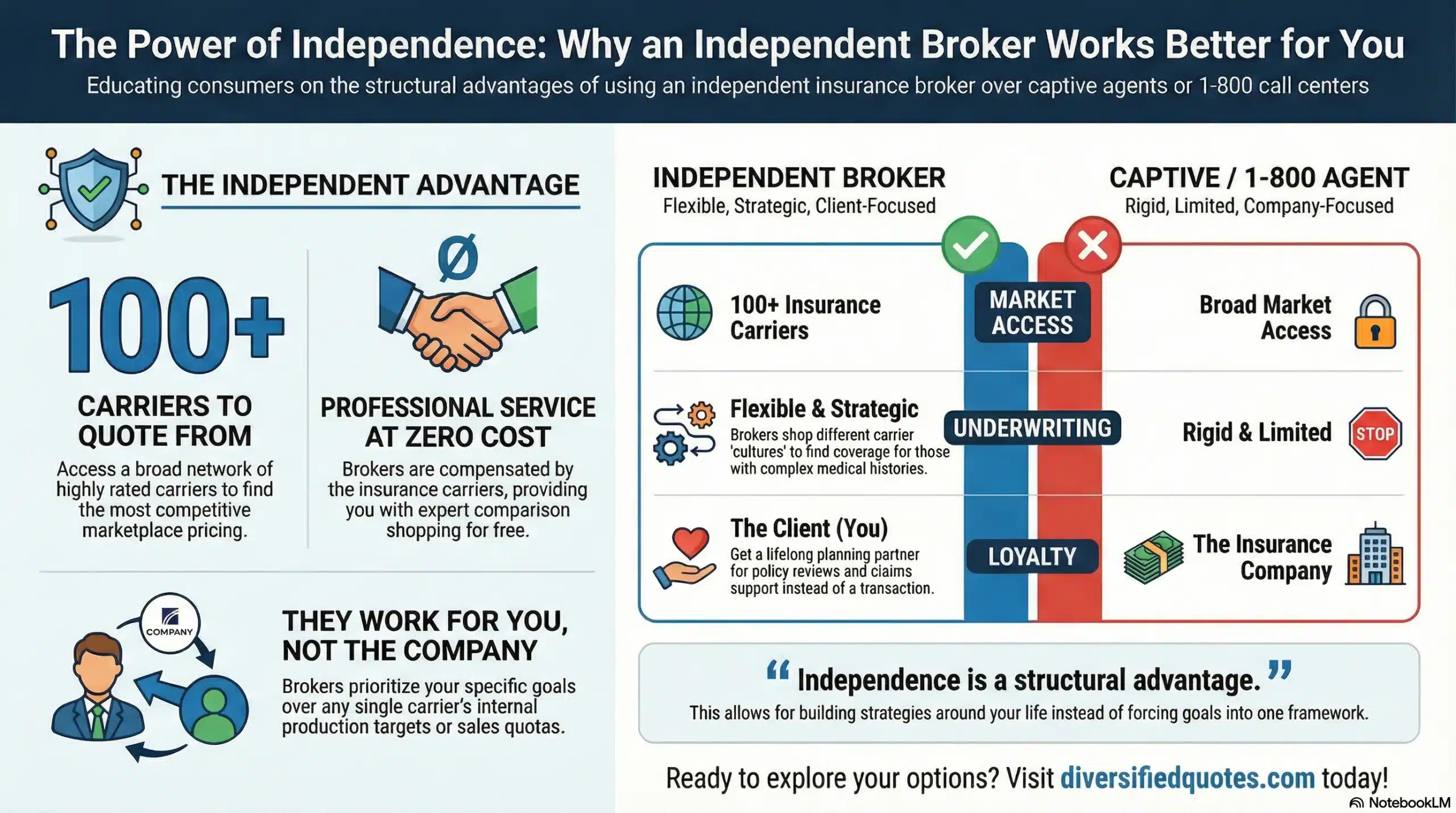
Talk With an Advisor Today
Choose how you’d like to connect—call or message us, then book a time that works for you.
Schedule here:
calendly.com/jason-dibcompanies/diversified-quotes
Licensed in all 50 states • Fiduciary, family-owned since 1980
FAQs: Group Life Insurance
What happens to my group life insurance if I leave my job?
In most cases, group life insurance terminates when employment ends or when eligibility for the benefit class changes. The coverage does not follow you to the next employer — the new employer’s plan, if offered, is a separate program with separate enrollment requirements. Most group plans provide a limited window — typically 31 days from the date coverage ends — during which the former employee can convert the group policy to an individual permanent policy without providing evidence of insurability. The conversion option is an important protection, but it has meaningful limitations: the converted policy is almost always whole life insurance, not the group term coverage the employee had been carrying, and the premium reflects the older-age whole life pricing rather than the group term rate.
Some plans also offer a portability provision — distinct from conversion — that allows the employee to continue the group term coverage after leaving employment by paying premiums directly to the insurance carrier. Portable coverage typically retains the term structure and is meaningfully less expensive than the conversion option, but it is not available on all group plans and the rates after portability may increase with age on a schedule that is less predictable than an individual level term policy purchased at a younger age. Reviewing the conversion and portability language of any group plan before relying on it as the household’s primary life insurance is the planning discipline that prevents discovering the limitations of those options under time pressure during a job transition.
Is my group life insurance enough, or do I need an individual policy too?
For most households with significant financial obligations — a mortgage, young children, a non-working or lower-earning spouse, or any dependent who would experience financial hardship from the loss of the primary earner’s income — group life insurance alone is rarely sufficient as a complete plan. The most common group plan benefit of one to two times annual salary replaces only one to two years of income — a period that may not be long enough for a surviving spouse with young children to stabilize financially, retrain for higher earnings, or eliminate the household’s primary debts. The calculation changes significantly when mortgage balances, childcare costs, and the full duration of financial dependency are included rather than just the immediate income replacement period.
The more fundamental planning issue is portability. Group life coverage exists only as long as the employment relationship does. An individual term policy purchased at a young, healthy age provides level-premium coverage that remains in force regardless of job changes, health changes, career transitions, or what the employer decides to do with the benefits program at the next renewal. For a 35-year-old with two children and a 30-year mortgage, a 30-year individual term policy purchased now locks in coverage and premium at the current health rating for the entire financial responsibility period — something no group plan can replicate. The recommendation for most families is to maintain group life for its cost-efficiency during active employment and to anchor the plan with an individually owned term policy that provides the portability, benefit adequacy, and premium certainty the group plan cannot guarantee.
Can I get more life insurance through my employer’s voluntary program than I could get individually?
For employees with health conditions that complicate individual underwriting, the guaranteed-issue enrollment window of an employer’s voluntary life program is genuinely one of the most valuable insurance planning opportunities available. During the initial eligibility period — typically when first hired or when first eligible for benefits — employees can often enroll in guaranteed-issue voluntary life coverage amounts without a medical exam and sometimes without health questions. If a health condition diagnosed after this window would make individual underwriting difficult or expensive, the amount secured on a guaranteed-issue basis during the window is coverage the employee could not easily replace through the individual market at an equivalent cost.
The planning implication is proactive: employees who are healthy at hire should consider whether enrolling in the maximum available guaranteed-issue voluntary coverage amount — even if they don’t feel they need all of it yet — secures access to coverage that protects against future uninsurability. The annual cost of maintaining that coverage during the years it may not be needed is typically much lower than the cost of the health event that would later make equivalent individual coverage unavailable. For employees who are considering this strategy, understanding the portability terms of the specific voluntary program is equally important — securing guaranteed-issue coverage that cannot be maintained after employment ends has limited long-term planning value compared to a portable policy that remains in force through any career transition.
How does group life insurance work for business owners and key employees?
For business owners and closely held companies, group life insurance can serve several distinct purposes beyond basic employee benefit coverage. Key person life insurance — where the business is both the policy owner and the beneficiary — provides the death benefit to the business entity when a critical employee or owner dies, funding the business’s financial recovery during the transition period. The benefit can be used to hire replacement talent, service debt, satisfy investor or lender requirements, or cover the revenue impact of the key person’s absence. Lenders and investors increasingly require key person coverage as a condition of business financing, treating it as a risk management tool rather than simply a benefit.
Buy-sell agreements funded by life insurance address the ownership transition scenario specifically — if a business partner dies, the surviving partners or the business entity needs liquidity to purchase the deceased’s ownership interest from their estate at the agreed valuation. Without the death benefit to fund that purchase, the surviving partners may be forced into an unwanted business relationship with the deceased’s heirs or into a distressed asset sale to generate the buyout capital. Section 162 executive bonus plans use employer-paid life insurance premiums as deductible compensation paid to key employees — the premium is a business expense, the employee owns the policy personally, and the coverage is portable from day one because it is an individual policy rather than a group plan. Each of these business applications requires specific design around the entity’s structure, the participants’ ages and health, and the valuation or coverage amount appropriate for the planning objective — all of which differ meaningfully from the standard group term benefit evaluation.
What should I do about life insurance when I retire and my group coverage ends?
The retirement life insurance question depends on what financial responsibilities remain at the point of retirement and what the household’s income security picture looks like. For retirees whose mortgage is paid, whose children are financially independent, whose spouse has adequate retirement income from Social Security, pension, or annuity, and whose primary financial goal has shifted from income replacement to estate planning — the need for large death benefit coverage is genuinely diminished, and the group life coverage ending at retirement may represent a reasonable natural transition rather than a planning gap that needs to be filled.
For retirees whose spouse depends on the retirement income stream for essential expenses, whose mortgage or other significant debt remains outstanding, or whose estate planning objectives require a death benefit to equalize inheritances or cover estate tax exposure, the group life ending at retirement is a planning event that requires proactive response. If an individual term or permanent policy was purchased and maintained during working years, the retirement group life ending simply means one component of a blended plan is being removed — the individual policy continues. If no individual policy was maintained and the group plan was the household’s primary life insurance, the retirement transition requires evaluating what is available in the private market at retirement age — which is more limited and more expensive than coverage purchased at younger ages, but not impossible for retirees in good health.
Does group life insurance cover disability?
Group life insurance does not cover disability — it pays a death benefit only. This is one of the most significant planning gaps in employer benefit packages that rely primarily on group life insurance as income protection. A disability that prevents an employee from working — whether from illness, injury, or chronic condition — creates an income replacement need that group life insurance cannot address because the insured is still alive. The statistical probability of experiencing a disability lasting 90 days or more during a working career is substantially higher than the probability of death during the same period, which means many households are better protected against the lower-probability event (death) than the higher-probability event (disability).
Many employers offer a group short-term disability and group long-term disability benefit alongside group life — but those benefits are often limited in the percentage of income replaced, in the maximum benefit duration, and in their definition of disability. Individual disability income insurance fills the gaps in employer-sponsored disability coverage by providing own-occupation definitions of disability, higher benefit amounts, and non-cancelable policies whose terms cannot be changed by the employer’s benefits decisions. For employees whose income is their household’s primary financial asset, evaluating the disability income coverage gap alongside the life insurance gap produces a more complete picture of the protection plan’s actual reliability than reviewing life insurance coverage in isolation.
About the Author:
Jason Stolz, CLTC, CRPC, DIA, CAA and Chief Underwriter at Diversified Insurance Brokers (NPN 20471358), is a senior insurance and retirement professional with more than 25 years of real-world experience helping individuals, families, and business owners protect their income, assets, and long-term financial stability. As a long-time partner of the nationally licensed independent agency Diversified Insurance Brokers, Jason provides trusted guidance across multiple specialties—including fixed and indexed annuities, long-term care planning, personal and business disability insurance, life insurance solutions, Group Health, Travel Medical and Evacuation Insurance, and short-term health coverage. Diversified Insurance Brokers maintains active contracts with over 100 highly rated insurance carriers, ensuring clients have access to a broad and competitive marketplace.
His practical, education-first approach has earned recognition in publications such as VoyageATL, and contributions from his agency featured in Kiplinger and GoBankingRates— highlighting his commitment to financial clarity and client-focused planning. Drawing on deep product knowledge and years of hands-on field experience, Jason helps clients evaluate carriers, compare strategies, and build retirement and protection plans that are both secure and cost-efficient. Visitors who want to explore current annuity rates and compare options across multiple insurers can also use this annuity quote and comparison tool.
Explore More Life Insurance Options: Browse our complete guide to Business Life Insurance — covering buy-sell agreements, key person, contract indemnity & group life from 100+ carriers.
Last Reviewed: June 9, 2026 |
Reviewed by: Jason Stolz, CLTC, CRPC, DIA, CAA
Chief Underwriter, Diversified Insurance Brokers, Inc. | NPN: 20471358 | Diversified Insurance Brokers, Inc. — Licensed in all 50 states
Fact Checked by: Tonia Pettitt, CMIP©
Medicare Specialist, Diversified Insurance Brokers, Inc. | NPN: 14374308 | Diversified Insurance Brokers, Inc. — Licensed in all 50 states
Did you find this content helpful? Leave us a Google review — it helps others find trustworthy guidance too.
Editorial Standards: Diversified Insurance Brokers maintains rigorous editorial standards to ensure accuracy, clarity, and independence in all content. Learn more about our editorial standards and commitment to transparency.
