
Group Health Insurance for Charter Schools
Group Health Insurance for Charter Schools

Jason Stolz CLTC, CRPC, DIA, CAA
Group Health Insurance for Charter Schools — Why Most Schools Are Overpaying and What to Do About It
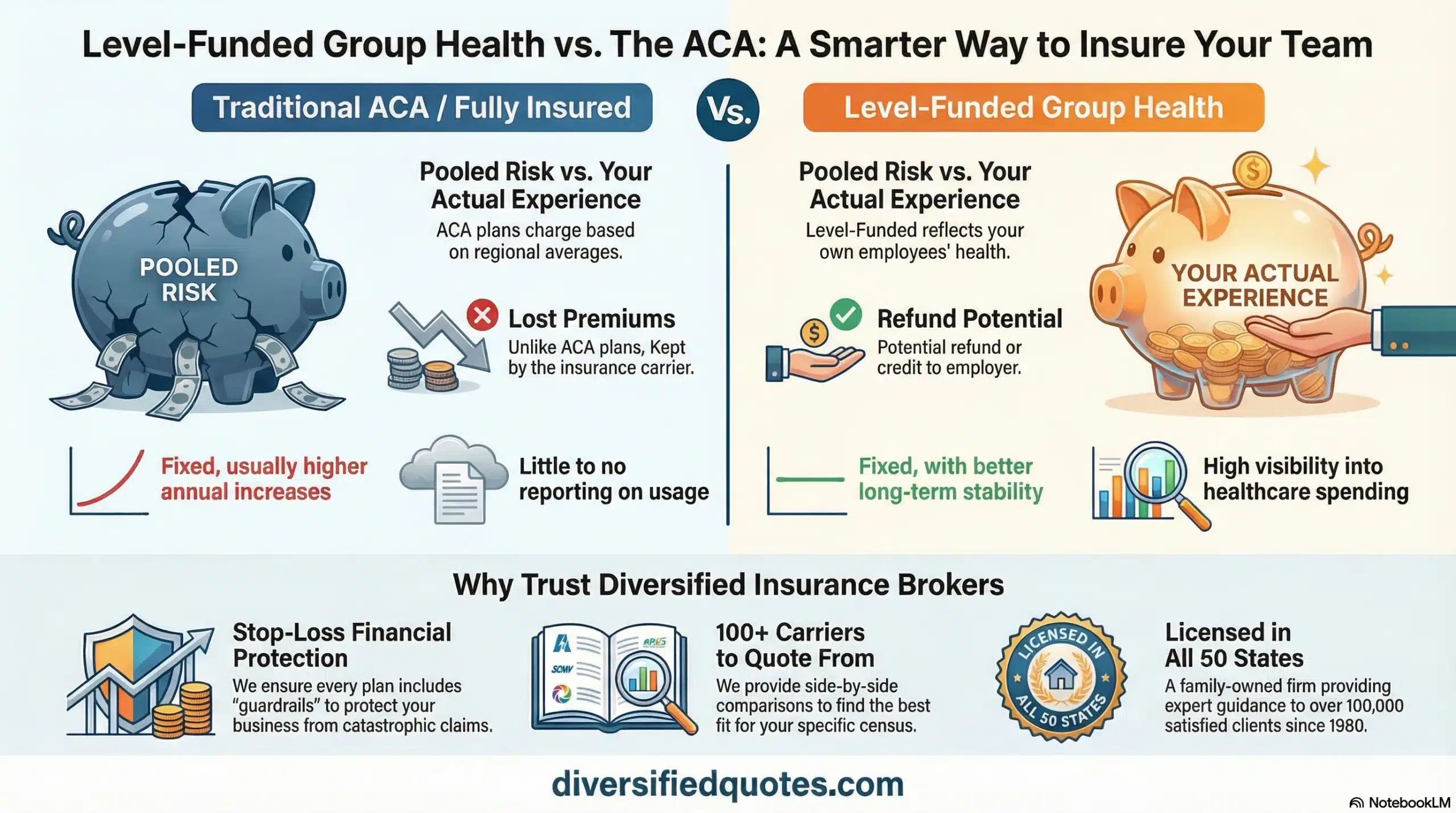
Most charter schools are buying group health insurance the same way they always have — fully insured, renewed annually with a carrier whose pricing reflects broad market assumptions rather than the school’s actual claims experience, with no visibility into what drove the renewal increase and no leverage to push back. The result is predictable: renewals running 10–20% above the prior year, a budget conversation that disrupts compensation planning, and a benefits package that costs more every year without getting better for staff. There is a better structure: level-funded group health insurance gives charter schools the budget predictability of a fully insured plan with the cost-control advantages of self-funding — including transparent claims reporting, stop-loss protection against catastrophic claims, and the potential for a year-end refund when the school’s workforce uses less care than the carrier projected. At Diversified Insurance Brokers, level funding is the approach we recommend to virtually every charter school that qualifies, because it consistently outperforms traditional fully insured coverage on cost, transparency, and long-term renewal stability. Jason Stolz, CLTC, CRPC, DIA, CAA works directly with charter school leadership and HR administrators to design level-funded plans that are ACA-compliant, competitive enough to support teacher recruitment, and structured to reduce the annual budget surprise that makes benefits planning so frustrating for school operators.
Why Fully Insured Is Costing Your Charter School More Than It Should
Fully insured group health coverage has one primary advantage: simplicity. You pay a monthly premium, the carrier pays claims, and the administrative burden is minimal. The problem is that your premium reflects the carrier’s margin, conservative actuarial assumptions about your group, and pooling with other groups whose claims experience may be far worse than yours. Charter schools with younger staff, lower average claims utilization, or favorable health demographics are subsidizing other groups in the carrier’s pool — paying rates calibrated to the pool’s average rather than the school’s own experience. When renewal comes, there is no data to contest the increase. The carrier presents a number, and the school either accepts it, shops to other fully insured carriers, or cuts benefits. Understanding how group health insurance is fundamentally structured makes clear why the funding model matters as much as the plan design — and why defaulting to fully insured without evaluating alternatives is a cost decision, not just an administrative one.
Level-funded health insurance breaks the relationship between the school’s premium and the broader market pool. Under a level-funded arrangement, the school’s monthly payment covers three specific components: a claims fund sized to the school’s expected utilization, a stop-loss insurance premium that protects against both individual high-cost claims and aggregate excess claims, and administrative costs. At year-end, if actual claims are lower than the claims fund, the school receives a refund of the unused portion — directly rewarding the school for its healthy workforce rather than subsidizing the carrier’s pool. If claims are unexpectedly high, stop-loss insurance absorbs the excess above the attachment point. The monthly cost is fixed and predictable — identical in administrative experience to a fully insured plan — while the economics align costs with reality rather than market averages. Group medical insurance explains how networks, cost-sharing, and funding models interact, which is the foundation for evaluating why the shift from fully insured to level-funded changes the school’s long-term cost trajectory.
See If Level Funding Is Right for Your Charter School
We model level-funded and fully insured structures side by side — showing what you would have paid, what you could save, and what the stop-loss protection covers.
How Level Funding Works — and Why It Fits Charter Schools
| Component | What It Is | Why It Matters for Charter Schools |
|---|---|---|
| Claims fund | The portion of the monthly payment allocated to pay employee claims, sized to the school’s expected utilization — not the carrier’s broad market pool average; unused balance is refunded to the employer at year-end | Charter schools with younger or healthier staff tend to under-use the claims fund relative to market pools — making the year-end refund real and recurring; that money stays with the school and can be reinvested in benefits, HSA contributions, or compensation |
| Stop-loss insurance | Specific stop-loss caps the school’s exposure per individual claimant; aggregate stop-loss caps total annual plan claims at a defined ceiling — typically 125% of projected claims; excess above either threshold is absorbed by the stop-loss carrier | Eliminates the “what if someone has a $500,000 claim” concern entirely; the school’s worst-case annual exposure is defined and budgetable; for most charter schools with 15–100 employees, the level-funded total monthly payment is competitive with or below the fully insured alternative once stop-loss is priced in |
| Administrative costs | Fixed, fully transparent fee covering claims processing, network access, member services, and reporting — unlike the embedded and invisible carrier margin inside a fully insured premium | Charter school boards want to know exactly what they are paying for; level-funded administrative costs are line-itemed and visible, making budget justification straightforward rather than requiring the school to accept an opaque premium and trust that the carrier’s pricing is fair |
| Claims reporting | Quarterly or annual utilization reports showing actual claims by category — pharmacy, specialist, inpatient, ER, preventive — without identifying individual employees; allows the school to see what drives costs and respond proactively | Fully insured plans provide no claims data; the school cannot know what drove its renewal increase or challenge it with evidence; level-funded reports make renewal conversations data-driven and allow targeted plan design or wellness responses to actual cost trends before they compound |
The four components work together to give the school what fully insured coverage never provides: costs aligned with actual utilization, bounded catastrophic claim exposure, and the data to manage costs proactively rather than reactively. The minimum employee thresholds for group health insurance — generally 10–15 enrolled employees for level-funded carriers — make this structure accessible for most charter schools. The transition should be evaluated as soon as enrollment supports it.
ACA Compliance — What Charter Schools Must Know
Charter schools with 50 or more full-time equivalent employees are Applicable Large Employers under the ACA and must offer minimum essential coverage to at least 95% of full-time employees, or face penalty exposure if any full-time employee obtains subsidized marketplace coverage. The coverage must meet the minimum value standard — paying at least 60% of covered services costs — and the 2026 affordability percentage of 9.96%, meaning the employee’s contribution for self-only coverage cannot exceed 9.96% of monthly income. The ACA out-of-pocket maximum for 2026 is $10,600 individual / $21,200 family. Level-funded plans satisfy all ACA requirements — the mandate attaches to plan design, not funding structure.
Charter schools with fewer than 50 FTEs are not subject to the mandate but should still offer group health insurance as a competitive necessity. Experienced teachers evaluating offers compare health coverage directly. Group coverage and individual market coverage are not equivalent in how candidates perceive them — a school directing employees to shop the individual marketplace is at a real disadvantage against one offering employer-sponsored benefits. Level funding’s cost advantages make competitive coverage financially feasible even for smaller schools. If the school is already offering a fully insured plan, getting a second opinion on the current group health quote — specifically comparing the existing renewal against a level-funded alternative — is the first concrete step.
Plan Design Inside a Level-Funded Structure
The level-funded funding model is compatible with virtually any plan design — PPO, HMO, HDHP, or a combination. From the employee’s perspective, a level-funded plan is identical to a fully insured plan: same ID card, same network, same copay structure, same member services. The funding model is invisible to staff. This means the school can offer whatever plan design best supports recruitment while structuring the economics to control costs.
For most charter schools, a two-plan design inside a level-funded structure produces the strongest combination of cost control and staff satisfaction. A value option — typically an HDHP paired with an employer HSA contribution — and a buy-up option — a richer PPO — gives employees a meaningful choice while the school anchors its contribution to the lower-cost option. HDHP enrollees tend to be lower utilizers, which directly benefits the claims fund and increases year-end refund potential. The employer HSA contribution bridges the gap between the HDHP’s lower premium and its higher first-dollar cost-sharing, making the value option genuinely attractive. For staff who primarily use preventive and primary care, the HDHP with employer HSA can produce lower total annual out-of-pocket costs than the richer plan — but only when staff understand how it works before open enrollment, not after they’re surprised by a first-quarter claim.
Voluntary Benefits That Complete the Package
Group life insurance at one to two times annual salary is commonly employer-funded and provides a death benefit baseline without complex underwriting at hire. Short-term and long-term disability insurance protects teacher income during illness or injury — particularly important because teachers cannot work remotely and income depends on being physically present. Disability insurance for higher-earning administrators addresses income replacement needs that standard group contracts often undercover. Hospital indemnity coverage and ER and urgent care indemnity benefits provide supplemental cash for out-of-pocket events — particularly valuable for HDHP enrollees facing first-dollar cost-sharing. For charter school founders and key administrators whose loss would materially affect school operations, key person life insurance is the organizational protection instrument that addresses institutional risk alongside individual employee benefits.
Supporting Staff Through the Full Career Lifecycle
A benefits partner that handles only the annual medical renewal leaves value on the table for staff at every career stage. Teachers and administrators approaching retirement frequently ask how employer benefits connect to their broader financial plan — particularly whether working past 65 affects Social Security benefits, including the earnings test, delayed retirement credits, and the critical question of when to enroll in Medicare at 65 relative to employer coverage. Higher-compensated administrators need to understand IRMAA surcharges that will affect Medicare premiums based on their final working years’ income. How Medicare works is the foundational knowledge gap for most employees transitioning from employer coverage to retirement.
The long-term care planning gap surfaces for staff in their 50s and 60s who want to know what happens after a serious health event: Medicare does not cover custodial long-term care, and addressing that gap before it arises — through long-term care insurance with shared spousal benefits or annuities with long-term care benefits — is meaningfully less expensive than addressing it after health changes make coverage harder to qualify for. Retirement income security matters equally: Social Security planning guidance and maximizing Social Security benefits are the income planning conversations long-tenured staff increasingly want from a benefits partner who understands the full picture. Annuities for conservative investors and guaranteed income from annuities provide the accumulation and distribution tools that complement Social Security for staff who want reliable retirement income. The annuity rescue plan process reviews existing savings and insurance positions to confirm everything is optimally structured as retirement approaches. Current fixed annuity rates near multi-year highs are a natural entry point for staff evaluating guaranteed accumulation options during higher-earning final working years. Personal protection planning matters across all ages: whether life insurance is still needed in retirement and burial insurance for seniors are the questions that arise for staff in the final years before retirement, and having a benefits partner who can address them directly deepens the relationship with the school’s most experienced staff. For staff who transition from the employer plan to Medicare Advantage at retirement, hospital indemnity for Medicare Advantage members fills the cost-sharing gaps that MA plans leave — a natural continuation of the indemnity coverage conversation that began during active employment.
Find Out What Level Funding Could Save Your Charter School
We model your current fully insured cost against a level-funded alternative — showing projected savings, stop-loss protection terms, year-end refund scenarios, and plan design options side by side.
Talk With an Advisor Today
Choose how you’d like to connect—call or message us, then book a time that works for you.
Schedule here:
calendly.com/jason-dibcompanies/diversified-quotes
Licensed in all 50 states • Fiduciary, family-owned since 1980
FAQs: Group Health Insurance for Charter Schools
What is level-funded health insurance and why is it better than fully insured for charter schools?
Level-funded health insurance combines the predictability of a fully insured plan — fixed monthly payments, no surprise invoices — with the cost-control advantages of self-funding. Under a level-funded arrangement, the school pays a fixed monthly amount covering three components: a claims fund sized to the school’s expected utilization, a stop-loss insurance premium protecting against high-cost individual or aggregate claims, and administrative costs. At year-end, if actual claims are lower than the claims fund, the school receives a refund of the unused balance — money that fully insured arrangements keep as carrier profit regardless of actual claims. If claims are unexpectedly high, stop-loss insurance absorbs the excess above the attachment point.
For charter schools specifically, level funding is better than fully insured for three reasons. First, most charter schools have younger, healthier staff whose actual claims run below broad-market pool averages — meaning they are overpaying in fully insured arrangements. Level funding lets the school’s good experience benefit the school rather than subsidize the carrier’s pool. Second, the quarterly or annual claims reports that come with level-funded plans give the school visibility into what is actually driving costs — data that is completely unavailable in a fully insured arrangement and that makes renewal conversations data-driven rather than reactive. Third, the alignment between what the school pays and what its employees use makes long-term renewal trajectories more predictable and defensible to school boards than fully insured renewals, which are opaque and often feel arbitrary.
What if one employee has a massive claim — how does the school stay protected?
This is the most common concern charter school administrators have about moving away from fully insured coverage, and it is completely addressed by the stop-loss insurance that is built into every level-funded arrangement. Specific stop-loss coverage protects the school against individual high-cost claimants — if a single employee’s claims exceed a defined per-person attachment point (commonly $25,000 to $50,000 per claimant per year, depending on the plan design), the stop-loss carrier pays the excess above that threshold. The school’s exposure to any single catastrophic claim is capped at the specific attachment point, not unlimited. Aggregate stop-loss provides a second layer of protection — if the school’s total annual claims across all employees exceed a defined ceiling (typically 125% of expected claims), the aggregate stop-loss absorbs the excess.
The combination of specific and aggregate stop-loss means the school’s worst-case annual exposure in a level-funded plan is clearly defined and budgetable — it is not an open-ended liability. The only scenario where stop-loss would not fully protect the school is if the school chose an attachment point that is too high relative to its budget capacity, which is a plan design decision that a good broker prevents by modeling appropriate attachment points for the school’s size and financial position. For most charter schools with 15–100 employees, stop-loss attachment points are available that provide comprehensive protection at a cost that makes the level-funded total monthly payment competitive with or lower than the fully insured alternative.
Does level funding look different to employees than a regular health plan?
No — from the employee’s perspective, a level-funded health plan is identical in experience to a fully insured plan. Employees receive the same type of ID card, access the same provider networks, use the same copay and cost-sharing structures, and interact with the same claims and member services systems. The funding model is an employer-level economic structure that determines how the school pays for and manages the plan — it is completely invisible to employees in their day-to-day use of the coverage. A teacher on a level-funded PPO plan has exactly the same experience going to the doctor, filling a prescription, or calling member services as a teacher on a fully insured PPO plan with the same network and design.
This means the school does not give anything up in the employee benefits experience by moving to level funding — it simply changes the economic structure of how it funds the plan. Employees do not need to know or understand the funding model, and there is no communication burden on HR to explain a different type of coverage. The benefit to the school — potential year-end refunds, claims transparency, better renewal leverage — is entirely on the employer side of the relationship.
How many employees does our charter school need to qualify for a level-funded plan?
Most level-funded carriers require a minimum of 10 to 15 enrolled employees to quote a level-funded plan, though specific minimums vary by carrier and market. Some carriers set the minimum as low as 5 enrolled, while others require 25 or more. Schools below the minimum for level-funded carriers remain in the fully insured small-group market, where the funding structure is not available regardless of the school’s preference. The transition to level funding should be evaluated as soon as enrollment approaches the qualifying threshold — typically when the school reaches 10–15 benefit-eligible employees who are enrolled — because the advantages of level funding begin compounding from the first year the arrangement is in place.
For charter schools that have grown beyond the small-group threshold but have not yet evaluated level-funded alternatives, the comparison exercise is particularly valuable because the school may be paying small-group-equivalent rates despite now qualifying for a structure that captures their favorable experience directly. The comparison is straightforward: model the level-funded monthly cost against the current or renewed fully insured premium, with the stop-loss attachment points and year-end refund scenario clearly illustrated, and let the numbers make the case. In most scenarios for charter schools with reasonably healthy workforces, the level-funded structure compares favorably.
Is our charter school required to offer health insurance under the ACA?
Charter schools with 50 or more full-time equivalent employees are Applicable Large Employers under the ACA and are subject to the employer shared responsibility provisions — the employer mandate. ALEs must offer minimum essential coverage to at least 95% of full-time employees or face potential penalty exposure if any full-time employee obtains subsidized marketplace coverage. The coverage must meet the minimum value standard (plan pays at least 60% of covered services costs) and the 2026 affordability percentage (employee contribution for self-only coverage does not exceed 9.96% of monthly income). Level-funded plans fully satisfy all ACA requirements — the mandate applies to plan design, not funding structure.
Charter schools with fewer than 50 FTEs are not subject to the mandate but should still evaluate offering group health insurance as a competitive necessity. In most education labor markets, experienced teachers and administrators expect employer-sponsored health coverage as a baseline compensation component, and schools that do not offer it compete at a material disadvantage for the candidates who will most improve student outcomes. The good news is that level funding’s cost advantages make it feasible for smaller charter schools to offer competitive coverage at lower employer cost than a comparable fully insured plan — reducing the financial barrier to offering benefits even when the mandate does not apply.
What plan designs work best inside a level-funded structure for charter schools?
The level-funded funding structure is compatible with virtually any plan design — PPO, HMO, HDHP, or a combination — so plan design decisions inside a level-funded arrangement are driven by staff demographics and recruitment priorities, not by limitations of the funding model. For most charter schools, a two-plan design with a value option and a buy-up option produces the best combination of cost control and employee satisfaction. The school anchors its contribution to the lower-cost option — typically an HDHP/HSA or leaner PPO — which controls total employer premium exposure, while giving employees the option to pay more for richer coverage if their family situation warrants it.
The HDHP/HSA option inside a level-funded structure is particularly compelling for charter schools because HDHP enrollees tend to be lower utilizers — which directly benefits the claims fund and increases the year-end refund potential. Pairing the HDHP with an employer HSA contribution sweetens the deal for employees who choose the value plan and bridges the gap between the lower premium and the higher first-dollar cost-sharing. For staff who primarily use preventive care and the occasional primary care visit, the HDHP with employer HSA contribution can actually result in lower total annual costs than a richer plan with higher premiums. The key is clear communication — staff need to understand how the deductible, HSA, and out-of-pocket maximum work before open enrollment so they can make informed choices rather than defaulting to the more expensive option out of uncertainty.
About the Author:
Jason Stolz, CLTC, CRPC, DIA, CAA and Chief Underwriter at Diversified Insurance Brokers (NPN 20471358), is a senior insurance and retirement professional with more than 25 years of real-world experience helping individuals, families, and business owners protect their income, assets, and long-term financial stability. As a long-time partner of the nationally licensed independent agency Diversified Insurance Brokers, Jason provides trusted guidance across multiple specialties—including fixed and indexed annuities, long-term care planning, personal and business disability insurance, life insurance solutions, Group Health, Travel Medical and Evacuation Insurance, and short-term health coverage. Diversified Insurance Brokers maintains active contracts with over 100 highly rated insurance carriers, ensuring clients have access to a broad and competitive marketplace.
His practical, education-first approach has earned recognition in publications such as VoyageATL, and contributions from his agency featured in Kiplinger and GoBankingRates— highlighting his commitment to financial clarity and client-focused planning. Drawing on deep product knowledge and years of hands-on field experience, Jason helps clients evaluate carriers, compare strategies, and build retirement and protection plans that are both secure and cost-efficient. Visitors who want to explore current annuity rates and compare options across multiple insurers can also use this annuity quote and comparison tool.
Explore More Group Health Insurance Options: Browse our complete guide to Group Health Insurance by Industry — covering law firms, consulting, construction, medical practices, schools & more from 100+ carriers.
Last Reviewed: June 9, 2026 |
Reviewed by: Jason Stolz, CLTC, CRPC, DIA, CAA
Chief Underwriter, Diversified Insurance Brokers, Inc. | NPN: 20471358 | Diversified Insurance Brokers, Inc. — Licensed in all 50 states
Fact Checked by: Tonia Pettitt, CMIP©
Medicare Specialist, Diversified Insurance Brokers, Inc. | NPN: 14374308 | Diversified Insurance Brokers, Inc. — Licensed in all 50 states
Did you find this content helpful? Leave us a Google review — it helps others find trustworthy guidance too.
Editorial Standards: Diversified Insurance Brokers maintains rigorous editorial standards to ensure accuracy, clarity, and independence in all content. Learn more about our editorial standards and commitment to transparency.
