
What is the Best Way to Use an Annuity
What is the Best Way to Use an Annuity

Jason Stolz CLTC, CRPC, DIA, CAA
Understanding the best way to use an annuity is one of the most consequential decisions a person approaching retirement will make. Annuities are among the most versatile financial tools available — capable of generating guaranteed lifetime income, protecting principal from market losses, deferring taxes on growth, funding long-term care expenses, and creating a financial legacy for heirs. But versatility cuts both ways. Using an annuity incorrectly — buying the wrong type, at the wrong time, for the wrong purpose — can result in unnecessary fees, reduced flexibility, and disappointing outcomes that could have been avoided with better upfront alignment between product and objective.
The best way to use an annuity depends entirely on what you are trying to accomplish. A retiree who needs guaranteed income to cover fixed monthly expenses has different needs than a pre-retiree looking to grow savings with principal protection. A person planning for long-term care has different objectives than someone focused on minimizing required minimum distributions. A household building a pension replacement income stream has a different planning horizon than one using an annuity as part of an estate transfer strategy. Matching the right annuity to the right purpose is the foundation of an effective annuity strategy — and it is exactly what Diversified Insurance Brokers helps clients accomplish across the full spectrum of retirement planning needs.
Find the Best Annuity Strategy for Your Goals
Compare top-rated annuity options across fixed, indexed, and lifetime income products from carriers we trust.
Ensure you are receiving the absolute top rates
Current Fixed Annuity Rates
Compare today’s best fixed annuity rates from top carriers.
Current Bonus Annuity Rates
See which annuities offer the highest upfront bonus today.
Request an Annuity Quote
Submit our annuity request form to get personalized rate options.
Lifetime Income Calculator
Use our calculator to see how much guaranteed income your annuity can provide.
Best Ways to Use an Annuity — Strategies by Goal
Because annuities serve so many different purposes, the best way to use one varies significantly based on the primary objective. The table below maps each major planning goal to the annuity type best suited to address it — with the left-column goals linked to deeper resources for each strategy. Use it as a starting framework, not a final prescription.
| Primary Goal | Best Annuity Type | Key Benefit | Key Planning Consideration |
|---|---|---|---|
| Guaranteed Lifetime Income | Fixed indexed annuity with GLWB income rider, or SPIA | Income that cannot be outlived regardless of market performance or how long you live | Size the annuity coverage to match the fixed expense gap between guaranteed income sources and non-discretionary monthly costs |
| Social Security Bridge | MYGA (Multi-Year Guaranteed Annuity) with predictable income during the delay years | Funds living expenses from early retirement to age 70, enabling a permanently higher Social Security benefit | Delaying Social Security from 62 to 70 increases the monthly benefit by approximately 77%; the bridge annuity cost is typically far exceeded by the lifetime income gain |
| Tax-Deferred Accumulation | Non-qualified fixed or fixed indexed annuity funded with after-tax dollars | Growth compounds without annual income tax; no IRS contribution limits unlike IRAs and 401(k) plans | Gains are taxed as ordinary income at withdrawal — not capital gains rates; benefit is most significant over long holding periods for high-bracket accumulators |
| Principal Protection | Fixed annuity (MYGA) or fixed indexed annuity | Zero market loss floor; growth occurs without exposure to equity or bond market volatility | Most critical in the 5-year window before and after retirement when sequence-of-returns risk is most damaging to portfolio sustainability |
| Long-Term Care Funding | Hybrid annuity with long-term care rider (PPA-compliant) | Withdrawals for qualifying care expenses received income-tax-free under Pension Protection Act; benefit pool often 2–3x the base annuity value | If care is never needed, the annuity continues as income and passes to heirs as a death benefit — unlike traditional LTC insurance which provides no return of premium if unused |
| RMD Management | QLAC (Qualified Longevity Annuity Contract) funded from pre-tax IRA or 401(k) assets | Up to $210,000 excluded from RMD calculations, reducing taxable income for years while guaranteeing future income activation up to age 85 | SECURE 2.0 removed the 25% of account balance limit; QLAC funds can now represent any amount up to $210,000 regardless of account size |
| Legacy and Wealth Transfer | Non-qualified deferred annuity with named beneficiary designations | Bypasses probate; death benefit transfers directly to heirs; income can fund life insurance premiums to convert taxable annuity into tax-free inheritance | Annuities do not receive a step-up in basis at death; beneficiaries owe ordinary income tax on the gain portion of inherited distributions |
The Best Way to Use an Annuity for Guaranteed Lifetime Income
For most retirees, the single most compelling reason to use an annuity is the one thing no other financial product can replicate: guaranteed income that cannot be outlived. This addresses the most fundamental financial risk of the modern retirement — longevity. Social Security replaces roughly 40% of pre-retirement income for the average worker. Pensions have largely disappeared from the private sector. That leaves a significant income gap between what guaranteed sources provide and what most retirees actually need to cover fixed monthly expenses — housing, utilities, food, healthcare, and transportation. An annuity with a Guaranteed Lifetime Withdrawal Benefit bridges that gap with income that is contractually guaranteed by the issuing insurance company, regardless of how long you live or what financial markets do.
Fixed indexed annuities with income riders are among the most popular vehicles for this purpose. They allow accumulation value to grow during a deferral period — often five to ten years — while simultaneously crediting a separate income base at a guaranteed rate. When income begins, the payout is calculated from the larger income base, often producing significantly more guaranteed monthly income than would be available from a portfolio withdrawal strategy applied to the same assets. Our guide on how indexed annuities work and who should consider them covers these mechanics in depth. For immediate lifetime income without a deferral period, a single premium immediate annuity converts a lump sum into a guaranteed lifetime income stream that begins within 30 days. The right structure depends on how soon income is needed and the role the annuity plays alongside other income sources. The income annuity calculator allows you to model the numbers for your specific situation before any conversation begins.
Using an Annuity as a Social Security Bridge Strategy
One of the most financially impactful ways to use an annuity is as a bridge to delay Social Security claiming. For every year you delay Social Security past full retirement age up to age 70, your monthly benefit increases by approximately 8% per year — a guaranteed, inflation-adjusted return that no investment can replicate with certainty. Delaying from age 62 to age 70 can increase the monthly benefit by approximately 77% according to SSA delayed retirement credit data. The challenge is that most retirees who leave the workforce at 62 or 63 cannot afford to wait until 70 without an income source to fill the gap.
A multi-year guaranteed annuity is ideally suited for this purpose. By moving a portion of retirement savings into a MYGA that produces predictable income during the bridge years, a retiree can cover living expenses from early retirement to age 70 without drawing Social Security prematurely. When the bridge period ends and Social Security begins at a dramatically higher monthly benefit, the financial advantage compounds for the rest of the retiree’s life — and the life of a surviving spouse. Current MYGA rates in the 5%–5.75% range for 5–7 year terms make the bridge math compelling: the annuity cost is typically far exceeded by the lifetime income gain from the higher Social Security benefit. Our resource on Social Security optimization for retirees explores this strategy in greater depth, and why more retirees are choosing MYGAs covers the product characteristics that make them well-suited for bridge strategies specifically.
The Best Way to Use an Annuity for Tax-Deferred Growth
Annuities are one of the few financial vehicles that allow after-tax dollars to grow on a completely tax-deferred basis with no annual contribution limits. This makes them a powerful tool for individuals who have already maxed out their 401(k) and IRA contributions and are looking for additional tax-sheltered growth capacity. In a non-qualified annuity — funded with after-tax money — interest and gains accumulate without generating a taxable event each year. Unlike a brokerage account where capital gains, dividends, and interest are taxed annually, the annuity allows the full value of those earnings to compound uninterrupted. Taxes are paid only when distributions are taken, and for many retirees, the tax rate at withdrawal is lower than the rate during peak earning years — making the deferral doubly advantageous.
For investors who have built substantial non-qualified annuity values over many years of deferral, managing the timing and method of distributions to control taxable income is an important planning consideration. Understanding how annuity cost basis is calculated and how annuity account value works are foundational concepts for anyone using an annuity as a tax-deferral vehicle — both determine how much of any distribution is taxable gain versus tax-free return of principal. For retirees concerned about required minimum distributions pushing them into higher tax brackets, a Qualified Longevity Annuity Contract funded with pre-tax IRA or 401(k) assets allows up to $210,000 to be excluded from RMD calculations — effectively reducing taxable income for years while guaranteeing a future income stream that activates at a date the owner selects, up to age 85.
Using an Annuity to Protect Principal in Volatile Markets
For investors with a low or moderate risk tolerance, the best way to use an annuity is as a principal protection tool — a financial foundation that grows without exposure to market loss. For retirees who cannot afford to absorb a major market correction in the years immediately before or after they stop working, sequence-of-returns risk is real and potentially devastating. Selling investments at depressed values to fund living expenses in a down market permanently impairs the portfolio’s ability to recover — and annuities are the primary tool for eliminating that risk within the portion of assets allocated to them.
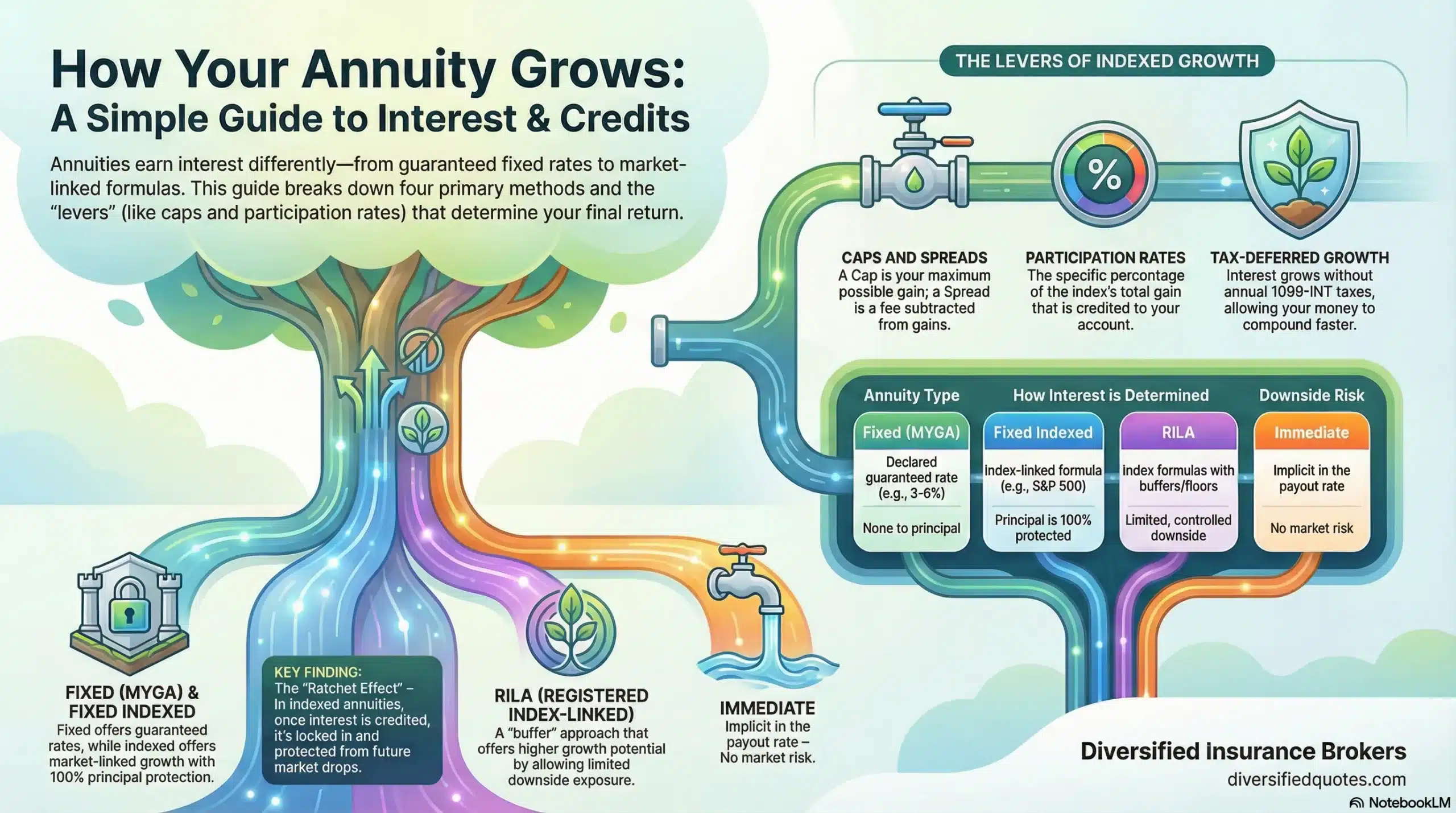
Fixed annuities and fixed indexed annuities eliminate market loss risk entirely. A fixed annuity grows at a guaranteed rate — no market exposure, no loss of principal. A fixed indexed annuity links interest crediting to a market index, capturing a portion of market gains during up years while crediting zero — not negative — in down years. The floor is always zero, meaning the annuity value never declines due to index performance. Our dedicated resources on why fixed annuities outperform in volatile markets and what makes fixed indexed annuities different from fixed products go deeper on both structures. The practical allocation approach: assign a portion of retirement assets to a fixed or fixed indexed annuity to create a protected base, and allow remaining assets in equities to ride market cycles without the pressure of funding immediate income needs. The annuity handles stability; the portfolio handles growth.
The Best Way to Use an Annuity for Long-Term Care Planning
One of the most underutilized and financially intelligent ways to use an annuity is as a funding vehicle for long-term care expenses. The Pension Protection Act of 2006 created a tax structure that makes annuities with long-term care riders uniquely efficient — allowing withdrawals used to pay qualifying long-term care expenses to be received completely free of income tax. For individuals who own non-qualified annuities with significant accumulated gains, this is a particularly powerful planning opportunity. Without a long-term care rider or a 1035 exchange into a PPA-compliant annuity, withdrawals used to pay care expenses are taxed as ordinary income on the gain portion — reducing the effective purchasing power of those dollars precisely when they are most needed. With a properly structured hybrid annuity, those same dollars flow out tax-free for qualifying care.
Beyond the tax efficiency, annuities with long-term care riders can dramatically increase the benefit pool available for care. A $200,000 annuity with a long-term care rider may provide $3,600 or more per month in care benefits — two to three times what the base annuity income alone would generate — once a qualifying care event occurs. And if care is never needed, the annuity continues to provide income and passes to heirs as a death benefit, unlike traditional long-term care insurance which provides no return of premium if unused. Our dedicated resource on fixed annuities that include long-term care benefits covers this strategy in full, and it pairs naturally with our resource on how much long-term care coverage is appropriate for establishing the right benefit level before purchasing.
Annuity Laddering — A Sophisticated Multi-Annuity Strategy
For retirees with larger asset pools, annuity laddering is one of the most effective ways to optimize both income and flexibility over a long retirement. The concept mirrors bond laddering: rather than allocating all funds to a single annuity at a single point in time, a laddering strategy spreads purchases across multiple annuities with staggered start dates, maturity dates, or income activation points. A practical ladder might involve purchasing a MYGA today to generate income for the next five years, a fixed indexed annuity with an income rider to begin distributions in ten years, and a deferred income annuity or QLAC designed to begin payments at age 80 or later — providing coverage deep into retirement when longevity risk is greatest and other assets may be depleted.
Annuity laddering captures different interest rate environments across purchase dates, avoids locking the full asset base into a single rate or product, and creates sequential income streams that replace one another as each contract matures or activates. It also enhances liquidity: rather than tying up an entire retirement asset in a single long-surrender-period contract, the ladder structure ensures a portion of assets is always approaching maturity or accessibility. For more on this approach, our resource on annuity strategies for early retirees provides a practical framework for designing ladder structures, and our guide on using a fixed indexed annuity for both growth and income covers the product most commonly used in ladder structures in depth.
Using an Annuity for Legacy and Wealth Transfer Goals
For legacy-minded retirees, the best way to use an annuity is as a tax-deferred accumulation vehicle that passes efficiently to named beneficiaries while bypassing probate. Annuities are contracts with designated beneficiaries — the death benefit transfers directly to heirs without going through the probate process, providing faster and cleaner asset transfer than assets that pass through a will. For retirees who have accumulated significant non-qualified annuity values and no longer need the funds for income, a repositioning strategy using annuity income to fund life insurance premiums can be particularly effective. The annuity generates tax-deferred income; that income funds a life insurance policy whose death benefit passes to heirs completely free of income tax — a legacy-multiplication technique that converts a taxable annuity into a tax-free inheritance. This approach is especially relevant for families exploring wealth transfer strategies used by affluent families and those who want to understand what sophisticated investors hold beyond the stock market.
Common Mistakes to Avoid When Using an Annuity
Understanding the best way to use an annuity also requires understanding what not to do. Over-allocating to annuities — placing so much of a retirement asset base into illiquid contracts that there is insufficient accessible capital for emergencies, healthcare costs, or unexpected opportunities — is one of the most frequent errors. The best annuity strategy always leaves meaningful liquid reserves outside of annuity surrender periods. Another common error is purchasing an annuity primarily for the bonus it advertises. Premium bonuses — which can range from 5% to 15% or more — are attractive on paper, but they are not free money. Understanding how annuity bonuses actually work and when bonus annuities genuinely make sense is essential before making a purchase based on a headline number — bonus annuities typically carry longer surrender periods, lower participation rates, or higher internal costs that reduce the net value delivered over time.
Buying the wrong annuity type for the stated objective is perhaps the most costly mistake. A retiree who needs liquidity and income flexibility should not be in a long-surrender-period deferred annuity. A conservative saver who wants principal protection should not be in a variable annuity with market exposure. Matching product to purpose — precisely and deliberately — is the work that a qualified independent annuity broker performs before any contract is signed. Our resource on the top annuity myths most people get wrong addresses several of the misconceptions that most frequently lead buyers toward poorly matched products.
How Diversified Insurance Brokers Helps You Find the Best Way to Use an Annuity
The annuity marketplace is vast, competitive, and filled with products that look similar on the surface but perform very differently over time and at the moment of income activation. Interest crediting methods, participation rates, cap rates, spread fees, income rider costs, surrender charge schedules, and carrier financial strength ratings all factor into which product is genuinely best for a given client’s situation. At Diversified Insurance Brokers, we are independent annuity brokers — we work for you, not for any single carrier. We compare products across dozens of top-rated insurance companies, identify the options that best match your goals, and explain the trade-offs clearly and honestly before any recommendation is made.
Whether you are just beginning to explore annuities, looking for a second opinion on an existing contract, or ready to move forward with a specific strategy, Diversified Insurance Brokers provides the breadth of carrier access and the independent perspective that annuity planning requires. For those who want to go deeper on specific questions before speaking with us, our resources on why annuities are the best pension replacement available today, the truth about annuities beyond the common myths, and how smart investors manage risk without sacrificing growth provide a comprehensive foundation. Annuities are not right for everyone, and not every annuity is right for every situation — but for the right person with the right objective, matched to the right product with the right structure, they represent a financial tool without equal in retirement income planning.
Related Pages
Talk With an Advisor Today
Choose how you’d like to connect—call or message us, then book a time that works for you.
Schedule here:
calendly.com/jason-dibcompanies/diversified-quotes
Licensed in all 50 states • Fiduciary, family-owned since 1980
FAQs: What Is the Best Way to Use an Annuity?
What is the best way to use an annuity in retirement?
The best way to use an annuity in retirement depends entirely on the primary objective. For most retirees, the most powerful use is to create guaranteed lifetime income that cannot be outlived — bridging the gap between what Social Security provides and what fixed monthly expenses require. Sizing the annuity coverage to exactly that income gap creates a guaranteed floor that makes the rest of the retirement portfolio far more resilient, because it eliminates the need to liquidate investments during market downturns to cover basic living costs. For pre-retirees with longer time horizons, the best use may be tax-deferred accumulation — allowing after-tax savings to compound without annual income tax — or principal protection through a fixed or fixed indexed annuity that eliminates sequence-of-returns risk in the critical window before and after retirement. For those with long-term care concerns, a hybrid annuity with a long-term care rider funded by the Pension Protection Act structure allows care withdrawals to be received completely tax-free — multiplying the effective value of those dollars. Matching the annuity to the specific planning problem it solves, rather than purchasing based on rates or bonuses in isolation, is the foundation of every effective annuity strategy.
How does the Social Security bridge strategy work with annuities?
The Social Security bridge strategy uses an annuity — most commonly a multi-year guaranteed annuity — to fund living expenses during the years between early retirement and age 70, when Social Security claiming produces the highest possible lifetime benefit. For every year Social Security is delayed past full retirement age, the monthly benefit increases by approximately 8%, and delaying from age 62 to age 70 can increase the monthly benefit by approximately 77% according to SSA delayed retirement credit data. Most retirees who leave the workforce at 62 or 63 cannot afford to wait until 70 without an income source to fill the gap — and that is precisely the role the bridge annuity plays. By placing a portion of retirement savings into a MYGA with a 5–7 year term, the retiree generates predictable income during the bridge period without drawing Social Security prematurely. When the bridge ends and Social Security begins at the dramatically higher monthly level, the income advantage compounds for the rest of the retiree’s life — and the surviving spouse’s life. Our resource on Social Security optimization for retirees covers the full analysis of this strategy including how to calculate the breakeven point where the bridge investment is recovered by the higher lifetime benefit.
What is a QLAC and how is it used to manage RMDs?
A Qualified Longevity Annuity Contract (QLAC) is a deferred income annuity that can be funded with pre-tax IRA or 401(k) assets and is specifically designed to address two retirement planning problems simultaneously: required minimum distribution management and late-life income protection. Assets allocated to a QLAC are excluded from required minimum distribution calculations, which can meaningfully reduce taxable income during the years between RMD beginning age and the QLAC income start date. This exclusion effectively lowers the annual taxable income from the IRA, which can reduce Medicare premium surcharges, keep more Social Security benefits from being taxable, and maintain favorable tax brackets during the mid-retirement years. The QLAC then begins paying guaranteed lifetime income at a future date the owner selects — anywhere from age 71 to age 85 under current rules. The SECURE 2.0 Act removed the prior limitation that capped QLAC funding at 25% of the account balance, raising the contribution limit to $210,000 in 2025 regardless of account size. This makes the QLAC one of the most targeted tools available for managing the RMD/tax interaction that can significantly affect retirement cash flow in later years.
What are the most common mistakes people make when using an annuity?
The most common mistakes in annuity usage cluster around three categories. The first is over-allocation — placing so much of a retirement asset base into illiquid annuity contracts that insufficient liquid capital remains for emergencies, healthcare costs, or unexpected opportunities. The best annuity strategies always maintain meaningful liquid reserves outside of surrender periods. The second is purchasing based on the advertised bonus rather than the total value delivered. Premium bonuses of 5%–15% are attractive, but they typically come with longer surrender periods, lower participation rates, or higher internal costs that reduce the net outcome — understanding how annuity bonuses actually work before purchasing is essential. The third and most costly mistake is buying the wrong product type for the stated objective — placing a retiree who needs liquidity and income flexibility into a long-surrender-period deferred annuity, or placing a conservative saver who wants principal protection into a variable annuity with full market exposure. Working with an independent annuity broker who compares across dozens of carriers and starts with objective before product selection prevents all three of these errors — and is the single most effective way to ensure the annuity strategy actually serves the retirement plan it is meant to support.
About the Author:
Jason Stolz, CLTC, CRPC, DIA, CAA and Chief Underwriter at Diversified Insurance Brokers (NPN 20471358), is a senior insurance and retirement professional with more than 25 years of real-world experience helping individuals, families, and business owners protect their income, assets, and long-term financial stability. As a long-time partner of the nationally licensed independent agency Diversified Insurance Brokers, Jason provides trusted guidance across multiple specialties—including fixed and indexed annuities, long-term care planning, personal and business disability insurance, life insurance solutions, Group Health, Travel Medical and Evacuation Insurance, and short-term health coverage. Diversified Insurance Brokers maintains active contracts with over 100 highly rated insurance carriers, ensuring clients have access to a broad and competitive marketplace.
His practical, education-first approach has earned recognition in publications such as VoyageATL, and contributions from his agency featured in Kiplinger and GoBankingRates— highlighting his commitment to financial clarity and client-focused planning. Drawing on deep product knowledge and years of hands-on field experience, Jason helps clients evaluate carriers, compare strategies, and build retirement and protection plans that are both secure and cost-efficient. Visitors who want to explore current annuity rates and compare options across multiple insurers can also use this annuity quote and comparison tool.
Explore More Annuity Options: Browse our complete guide to Annuities 101 — covering annuity education, planning guides, pros & cons, how to choose & buy from 100+ carriers.
Last Reviewed: June 19, 2026 |
Reviewed by: Jason Stolz, CLTC, CRPC, DIA, CAA
Chief Underwriter, Diversified Insurance Brokers, Inc. | NPN: 20471358 | Diversified Insurance Brokers, Inc. — Licensed in all 50 states
Fact Checked by: Tonia Pettitt, CMIP©
Medicare Specialist, Diversified Insurance Brokers, Inc. | NPN: 14374308 | Diversified Insurance Brokers, Inc. — Licensed in all 50 states
Did you find this content helpful? Leave us a Google review — it helps others find trustworthy guidance too.
Editorial Standards: Diversified Insurance Brokers maintains rigorous editorial standards to ensure accuracy, clarity, and independence in all content. Learn more about our editorial standards and commitment to transparency.
