
Why More Retirees Are Choosing Multi-Year Guaranteed Annuities (MYGAs)
Why More Retirees Are Choosing Multi-Year Guaranteed Annuities (MYGAs)
As market volatility becomes more frequent and unpredictable, many retirees and pre-retirees are rethinking how much risk they truly want in their portfolios. While stocks and bonds still play an important role in long-term growth strategies, a growing number of investors are carving out a portion of their savings specifically for stability, predictability, and contractually guaranteed returns. This shift in mindset has led to increased interest in Multi-Year Guaranteed Annuities (MYGAs), which provide a fixed, declared interest rate for a defined period — often two to ten years — without exposure to market fluctuations. For individuals who have grown weary of watching account balances swing based on headlines, interest rate policy, or geopolitical uncertainty, MYGAs offer something increasingly rare: clarity. You know your rate on day one. You know how long it is guaranteed. You know that your principal is protected from market downturns. That simplicity has powerful psychological and financial value in retirement planning.

Ensure you are receiving the absolute top rates
Current Fixed Annuity Rates
Compare today’s best fixed annuity and MYGA rates from top carriers.
Lifetime Income Calculator
Explore how guaranteed income strategies can fit into your long-term plan.
MYGAs vs. CDs vs. Bonds vs. Fixed Indexed Annuities
| Feature | MYGA (Fixed Annuity) | Bank CD | Investment-Grade Bond / Fund | Fixed Indexed Annuity (FIA) |
|---|---|---|---|---|
| Interest / Return | Declared fixed rate for the full term — known on day one and locked in regardless of rate movements during the contract period. | Declared fixed rate — similar structure to MYGA but typically lower yields. Banks use shorter-duration instruments that generate less yield than insurance carriers’ portfolios. | Coupon rate set at issuance — but total return varies with price movements. Bond funds have no fixed return — NAV fluctuates daily with rate and credit movements. | Index-linked credit — potentially higher than MYGA in strong market years; zero (not negative) in down years. No declared rate known in advance. |
| Principal Protection | Full — principal and declared interest guaranteed if held to term. Backed by carrier financial strength and state guaranty associations. | Full — FDIC insured up to $250,000 per depositor per bank. | None — bond prices fall when rates rise. Long-duration bond funds can lose 15%–25%+ in rapid rate-increase environments. | Full — 0% floor prevents market-related losses. Principal is guaranteed regardless of index performance. |
| Tax Treatment | Tax-deferred — no annual 1099. Full credited rate compounds on a gross basis until withdrawal, enhancing net accumulation vs. taxable alternatives. | Taxable annually — generates a 1099 each year regardless of whether funds are withdrawn. Tax drag reduces net compounding every year. | Generally taxable annually on coupon/interest payments. Capital gains or losses taxable on sale. Municipal bonds may be tax-exempt. | Tax-deferred — same annual compounding advantage as the MYGA. Gains taxable as ordinary income when distributed. |
| Interest Rate Risk | None — declared rate is locked for the full term. Rising rates do not reduce the MYGA’s value. No mark-to-market pricing. | None — principal protected regardless of rate movements. CD rates at renewal reflect the new rate environment. | Significant — bond prices move inversely to rates. Duration determines the magnitude of price impact. Rising rates cause real portfolio losses. | None — no mark-to-market risk. Rate environment affects future cap and participation rates but not the existing contract’s accumulated value. |
| Liquidity | 10% annual free withdrawal on most contracts. Surrender charges on excess during the term. Health waivers typically available. Full access at maturity. | Early withdrawal penalty (typically 90–180 days of interest) before CD maturity. Full access at maturity. | Fully liquid — bonds and bond funds can be sold at any time, but at market value which may be below purchase price. | 10% annual free withdrawal on most contracts, similar to MYGA. Surrender charges during the contract period. Health-related waivers available. |
| Complexity | Lowest of the four — declared rate, defined term, no market tracking, no caps or participation rates. The simplest annuity structure available. | Very low — similar simplicity to MYGAs. Rate, term, FDIC limit. No insurance structure complexity. | Moderate to high — duration, credit quality, yield to maturity, price/rate relationship, and fund-specific factors. Bond funds add NAV volatility and management cost. | Moderate — caps, participation rates, spreads, index methodology, and optional rider structures require evaluation. More moving parts than MYGAs. |
| Best For | Conservative investors who want the highest guaranteed yield with principal protection and tax-deferred compounding for a defined term. Laddering strategies. Parking capital between investment decisions. | Buyers who want FDIC protection as the backstop rather than state guaranty associations. Very short-term holding periods. Balances above state guaranty association limits who prefer federal insurance. | Long-horizon investors comfortable with mark-to-market volatility who do not need guaranteed principal. Those who need the liquidity of daily tradable assets. | Conservative investors who want principal protection with upside potential beyond a declared fixed rate. Those interested in optional lifetime income riders. Those with longer time horizons willing to evaluate crediting mechanics. |
How MYGAs Work — The Core Mechanics
In many ways, MYGAs function similarly to certificates of deposit, but with one key structural advantage: interest grows tax-deferred inside the annuity contract. Instead of paying taxes annually on earned interest, growth compounds uninterrupted until withdrawals begin. Over multiple years, this compounding effect can meaningfully enhance your effective yield compared to taxable bank products. Investors evaluating conservative strategies often compare MYGAs directly against bank CDs, Treasuries, or short-term bond funds, only to discover that insurance carriers frequently offer more competitive guaranteed rates because they invest in longer-duration, higher-yield assets and pass a portion of that yield advantage through to contract holders. Understanding how MYGAs work in full detail covers the rate-setting mechanics, renewal options, and typical term structures available in the current marketplace.
Why MYGAs Are Gaining Ground — Five Structural Reasons
For those approaching retirement, MYGAs can serve multiple purposes simultaneously. They act as a volatility buffer within a diversified portfolio — eliminating the mark-to-market anxiety that bond funds create when rates move against the position. They function as a capital preservation vehicle for funds earmarked for near-term spending that cannot tolerate principal loss. They serve as a parking place for cash following a business sale, real estate transaction, or portfolio rebalancing event where the proceeds need to earn a competitive guaranteed return for a defined period. They can be strategically laddered across different maturities to create rolling liquidity while maintaining competitive yields. And they can replace underperforming savings accounts that are earning minimal interest with a defined-term, contractually guaranteed rate that meaningfully exceeds typical bank savings rates.
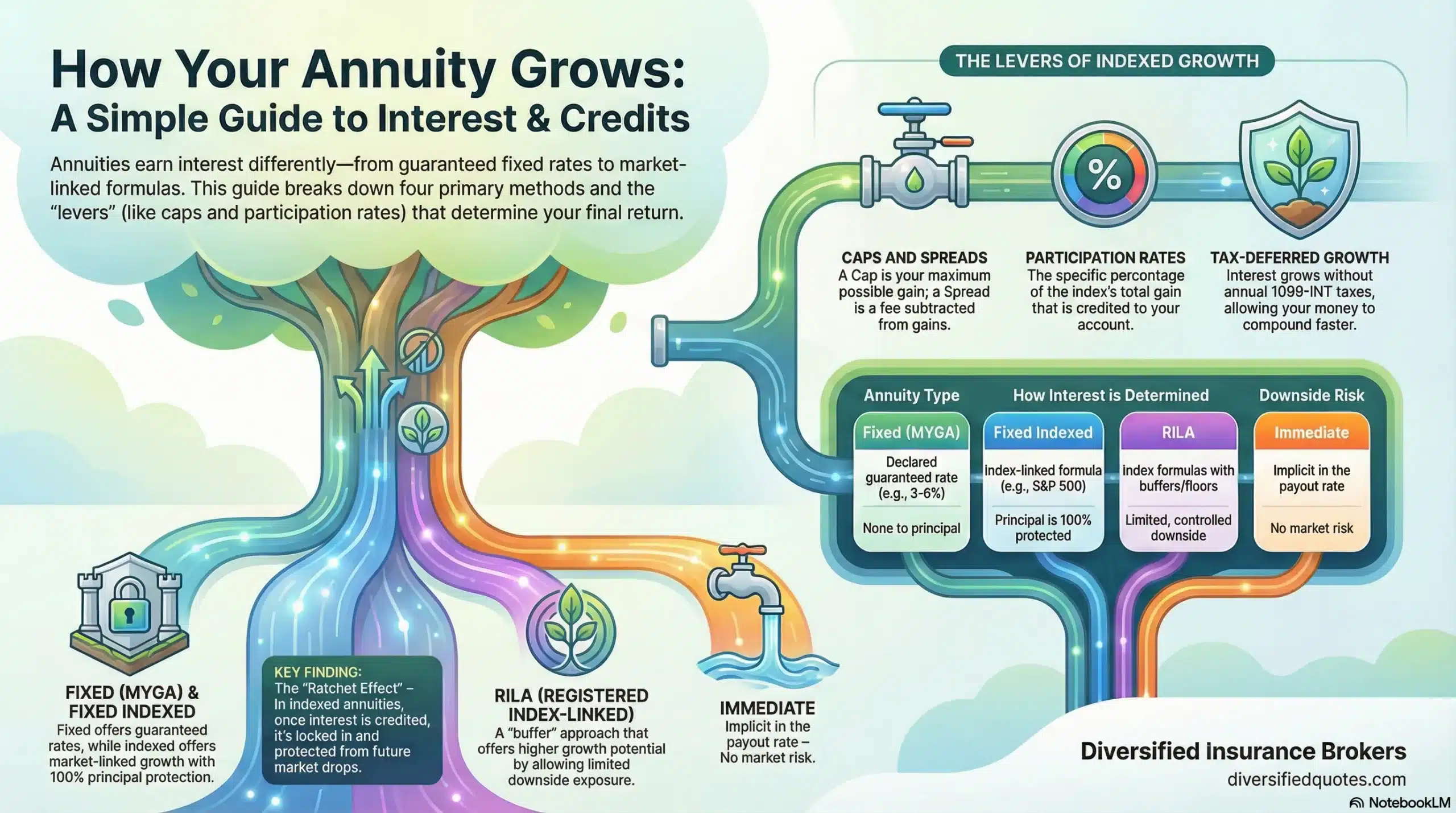
Unlike indexed or variable annuities, MYGAs are intentionally straightforward. There are no market indexes to track, no participation rates to analyze, no caps, spreads, or complex riders to evaluate. The carrier declares a rate for a specified term, and that rate is locked in for the entire guarantee period. This simplicity is often what makes MYGAs attractive to conservative investors who want certainty rather than upside potential. For those who want to understand where MYGAs fit within the broader annuity spectrum — and whether simplicity or growth-linked potential better aligns with their objectives — our resource on how fixed indexed annuities work covers the comparison from the FIA side of the spectrum. For MYGA-specific rate comparisons, our guides on the best MYGA rates by term and best short-term MYGA options show what the current marketplace offers across different holding period preferences.
Rate Locking — The MYGA Advantage in Changing Rate Environments
Another reason MYGAs continue to gain traction is the shifting interest rate environment. When rates rise, insurance carriers often respond by increasing guaranteed yields on new contracts. Locking in an attractive rate for three, five, or seven years can provide meaningful insulation from future rate declines. Conversely, when rates eventually fall, investors who secured higher guarantees during peak cycles maintain those returns throughout the entire contract period. This rate-locking feature can be particularly appealing for retirees seeking predictable returns without the need to actively manage bond portfolios. Monitoring current annuity rates helps determine whether the timing is favorable for securing longer-term guarantees. When comparing MYGAs across carriers, even small differences in declared rates can produce meaningful long-term results. A quarter-percent difference compounded over five to seven years can represent thousands of dollars in additional accumulation, particularly for larger premium amounts. That is why independent comparison across multiple insurance companies is critical — rather than defaulting to a single carrier relationship, reviewing offerings from a broad marketplace increases the likelihood of securing the strongest guarantee for your desired term. At Diversified Insurance Brokers, MYGA options are compared across more than 75 top-rated carriers, ensuring that conservative capital is positioned as efficiently as possible.
Tax Deferral — The Compounding Advantage Over Taxable Alternatives
Tax deferral remains one of the most compelling structural advantages of MYGAs. Interest earned inside the contract compounds without annual taxation, allowing the full credited rate to work on your behalf. Over multi-year periods, this creates a significant difference compared to taxable fixed-income instruments. A MYGA earning 4.5% with tax deferral produces more net accumulation than a CD earning 4.5% that generates an annual 1099 — because the full 4.5% is reinvested each year in the MYGA, while a portion of the CD’s credited interest is paid as taxes before it can compound. Understanding how annuities are taxed — gains distributed as ordinary income, basis returned tax-free under the exclusion ratio for non-qualified contracts — ensures the net after-tax comparison is modeled correctly before committing funds to any fixed-income alternative. MYGAs can be funded with both qualified (IRA, 401(k) rollover) and non-qualified after-tax dollars, making them flexible tools for various account types. Exploring tax-deferred annuity strategies further clarifies how MYGAs integrate into comprehensive financial planning for investors in different tax situations. For affluent investors allocating larger amounts to MYGAs, our resource on MYGA strategies for affluent individuals covers multi-carrier laddering, guaranty association limit management, and optimization across qualified and non-qualified accounts.
MYGAs as a Transition Tool — From Accumulation to Income
MYGAs integrate well with broader retirement income strategies. While they are primarily accumulation vehicles, many investors eventually reposition MYGA funds into income-producing annuities when guaranteed lifetime cash flow becomes a priority. This staged approach allows retirees to preserve principal during early retirement while delaying income activation to potentially increase payout percentages later. Reviewing how annuities can provide income for life illustrates how accumulation-focused contracts like MYGAs can transition into income strategies when needed. In some cases, investors use MYGAs as interim positioning tools before executing a 1035 exchange into income-oriented contracts when the MYGA matures — the tax-free exchange preserves the accumulated gain and repositions it into a GLWB income structure without a taxable event. For individuals concerned about sequence-of-returns risk, using MYGAs during volatile early retirement years can reduce pressure on equity allocations while preserving optionality for future income planning.
Liquidity, Surrender Schedules, and Laddering
Liquidity provisions deserve careful review before committing to any MYGA. Most MYGAs include surrender schedules that decline over time along with annual free withdrawal allowances — often around 10% of contract value — beginning after the first contract year. Understanding annuity free withdrawal rules helps ensure that funds remain accessible within acceptable parameters. Some investors intentionally stagger MYGA maturities in a laddering approach so that a portion of funds becomes fully accessible each year. Exploring the fixed annuity ladder strategy and laddering annuities illustrates how structured maturities provide both competitive yield and defined liquidity windows — using each MYGA rung for what it does best without overextending any single contract’s surrender period. Although MYGAs are conservative by design, they are not necessarily permanent holdings. In some cases, investors use them as interim positioning tools before reassessing at maturity. The key is ongoing evaluation rather than set-it-and-forget-it complacency — insurance markets evolve, rates change, and retirement goals shift over time.
Ultimately, MYGAs are not designed to replace growth assets entirely, nor are they intended to compete with aggressive investment strategies. They serve a specific role: protecting capital while earning a competitive, guaranteed rate with tax-deferred compounding. For conservative segments of a portfolio — or for individuals who prioritize certainty over upside potential — MYGAs provide a disciplined, transparent solution. When integrated thoughtfully alongside equities, income annuities, and other retirement tools, they can reduce volatility, improve predictability, and enhance overall financial confidence.
Ready to compare MYGA rates across 75+ top-rated carriers?
Request Your Personalized MYGA Comparison
Financial Protection Essentials
Understand annuity guarantees, interest rate examples by investment size, and how retirement income strategies work in practice.
Talk to an Advisor or Request Your Annuity Quote
Ready to explore this annuity in more detail—or compare it with other carriers to see if even higher rates are available? With guaranteed income, principal protection, and long-term growth potential on the line, making the right choice is essential. The experienced advisors at Diversified Insurance Brokers will guide you through the options and design a strategy tailored to your retirement goals.
Schedule here:
calendly.com/jason-dibcompanies/diversified-quotes
Licensed in all 50 states • Fiduciary, family-owned since 1980
How is a MYGA different from a regular fixed annuity?
A Multi-Year Guaranteed Annuity (MYGA) and a traditional fixed annuity are the same category of product — MYGA is simply the more specific term used to describe a fixed annuity that guarantees the declared interest rate for the full contract term. Traditional “fixed annuity” is the broader category; “MYGA” specifies that the rate is locked in for multiple years rather than subject to annual repricing. In practice, the terms are used interchangeably by most carriers and advisors. The defining features are the same: a declared interest rate for a defined term, principal protection, tax deferral, and a surrender charge schedule during the contract period. The key distinction within the MYGA category is the term length — 2-year, 3-year, 5-year, 7-year, and 10-year are the most common options, with longer terms typically offering higher declared rates. Some shorter-duration products exist as well, and our resource on best short-term MYGA annuities covers what is available for buyers with near-term liquidity needs who still want the yield and tax deferral advantage over bank alternatives.
What happens at the end of a MYGA’s guarantee period?
At the end of the MYGA’s guarantee period — the maturity date — the contract enters a renewal period (typically 30 to 60 days) during which you can access the full contract value without surrender charges, take the funds as a lump sum or income stream, transfer the balance to a new MYGA or annuity through a 1035 exchange, or simply allow the carrier to renew the contract at its current declared rate for a new term. If you take no action during the renewal window, most carriers automatically renew at their current rate — which may be higher or lower than the original rate, for a new term that may differ from the original term. The automatic renewal provision means that failing to review a maturing MYGA can result in an unintended recommitment to terms you did not actively select. Setting a calendar reminder 45 to 60 days before the maturity date — to allow time to compare current rates from multiple carriers against the renewal offer — is the most important ongoing management task for MYGA holders. At maturity, you have complete flexibility to compare the full market without any surrender charge pressure, which is the optimal time to ensure the next contract captures the best available rate for your next holding period.
Are MYGAs safe if the insurance company fails?
MYGAs are backed by the financial strength of the issuing insurance carrier — not by the FDIC or any federal guarantee program. However, each state has a guaranty association that provides a secondary backstop for insurance policyholders, typically up to $250,000 in annuity value per policyholder per insurer (limits vary by state). This protection functions similarly to FDIC insurance for bank accounts, covering most individual MYGA holders fully at typical retirement allocation amounts. For buyers with large balances — above the state guaranty association limit — spreading across multiple carriers captures separate guaranty association coverage for each insurer, similar to how larger CD holders spread across multiple FDIC-insured banks. The practical risk reduction strategy: prioritize carriers with strong AM Best financial strength ratings (A- or higher is the most commonly used threshold) and limit the balance at any single carrier to within your state’s guaranty association limit. Insurance carriers are subject to extensive state regulatory oversight requiring defined reserve levels and surplus ratios, reducing the probability of insolvency significantly. The combination of carrier selection discipline and state guaranty association protection provides a robust safety structure for most MYGA holders.
Can I put my IRA funds into a MYGA?
Yes — MYGAs are frequently used inside IRAs, and the combination works well for specific planning objectives. When a MYGA is held inside a traditional IRA, the tax deferral is technically redundant — both the IRA structure and the MYGA contract defer taxation. The primary value of the MYGA inside an IRA is therefore the principal protection and guaranteed rate, not additional tax deferral beyond what the IRA already provides. For IRA holders who want to eliminate market risk from a portion of their retirement portfolio without reducing the tax-deferred status of those assets, a MYGA inside the IRA achieves that objective efficiently. The critical coordination point: the MYGA’s surrender period must be compatible with your required minimum distribution obligations. If you are at or near the RMD start age, ensure the free withdrawal provision on the MYGA accommodates the expected annual RMD without triggering surrender charges. Many MYGA carriers offer RMD-friendly provisions on qualified contracts. Confirm the specific RMD treatment before placing qualified funds in any MYGA, and review how the distributions interact with your overall RMD calculation in the context of tax-deferred annuity strategies for your specific account structure.
What term length should I choose for a MYGA?
The right MYGA term depends on three factors: when you need full access to the funds, your view on interest rate direction, and whether you are building a laddered structure or making a single allocation. If you need full access to the funds in three years — for a planned expense, a portfolio rebalancing target, or a transition into income — a 3-year MYGA aligns the surrender period with the actual holding need. If you do not have a near-term liquidity need and believe rates may decline, locking in a 5-year or 7-year MYGA captures competitive current rates for a longer period before that potential decline. Longer terms typically offer higher declared rates to compensate for the extended commitment, but if rates rise significantly during the term, you would be earning below the new market rate while still inside the surrender period. The most common practical solution for buyers uncertain about timing is a laddering strategy — dividing the allocation across 2-year, 3-year, and 5-year MYGAs so that a portion matures at each interval, providing ongoing reassessment opportunities and rolling access without full commitment to a single rate environment. Our resource on the fixed annuity ladder strategy covers how to structure the allocation across terms for different planning objectives and balance sizes.
About the Author:
Jason Stolz, CLTC, CRPC, DIA, CAA and Chief Underwriter at Diversified Insurance Brokers (NPN 20471358), is a senior insurance and retirement professional with more than 25 years of real-world experience helping individuals, families, and business owners protect their income, assets, and long-term financial stability. As a long-time partner of the nationally licensed independent agency Diversified Insurance Brokers, Jason provides trusted guidance across multiple specialties—including fixed and indexed annuities, long-term care planning, personal and business disability insurance, life insurance solutions, Group Health, Travel Medical and Evacuation Insurance, and short-term health coverage. Diversified Insurance Brokers maintains active contracts with over 100 highly rated insurance carriers, ensuring clients have access to a broad and competitive marketplace.
His practical, education-first approach has earned recognition in publications such as VoyageATL, and contributions from his agency featured in Kiplinger and GoBankingRates— highlighting his commitment to financial clarity and client-focused planning. Drawing on deep product knowledge and years of hands-on field experience, Jason helps clients evaluate carriers, compare strategies, and build retirement and protection plans that are both secure and cost-efficient. Visitors who want to explore current annuity rates and compare options across multiple insurers can also use this annuity quote and comparison tool.
Browse More Resources: Return to our complete MYGA & Fixed Annuity Products guide — covering MYGA and fixed annuity products from top carriers.
Last Reviewed: June 25, 2026 |
Reviewed by: Jason Stolz, CLTC, CRPC, DIA, CAA
Chief Underwriter, Diversified Insurance Brokers, Inc. | NPN: 20471358 | Diversified Insurance Brokers, Inc. — Licensed in all 50 states
Fact Checked by: Tonia Pettitt, CMIP©
Medicare Specialist, Diversified Insurance Brokers, Inc. | NPN: 14374308 | Diversified Insurance Brokers, Inc. — Licensed in all 50 states
Did you find this content helpful? Leave us a Google review — it helps others find trustworthy guidance too.
Editorial Standards: Diversified Insurance Brokers maintains rigorous editorial standards to ensure accuracy, clarity, and independence in all content. Learn more about our editorial standards and commitment to transparency.
