
How do Annuities Earn Interest
As an Independent Annuity Broker, we compare rates across 100+ carriers and 1,000 different annuities— not just one company’s product offerings — to find the best fit for your goals.
How do Annuities Earn Interest

Jason Stolz CLTC, CRPC, DIA, CAA
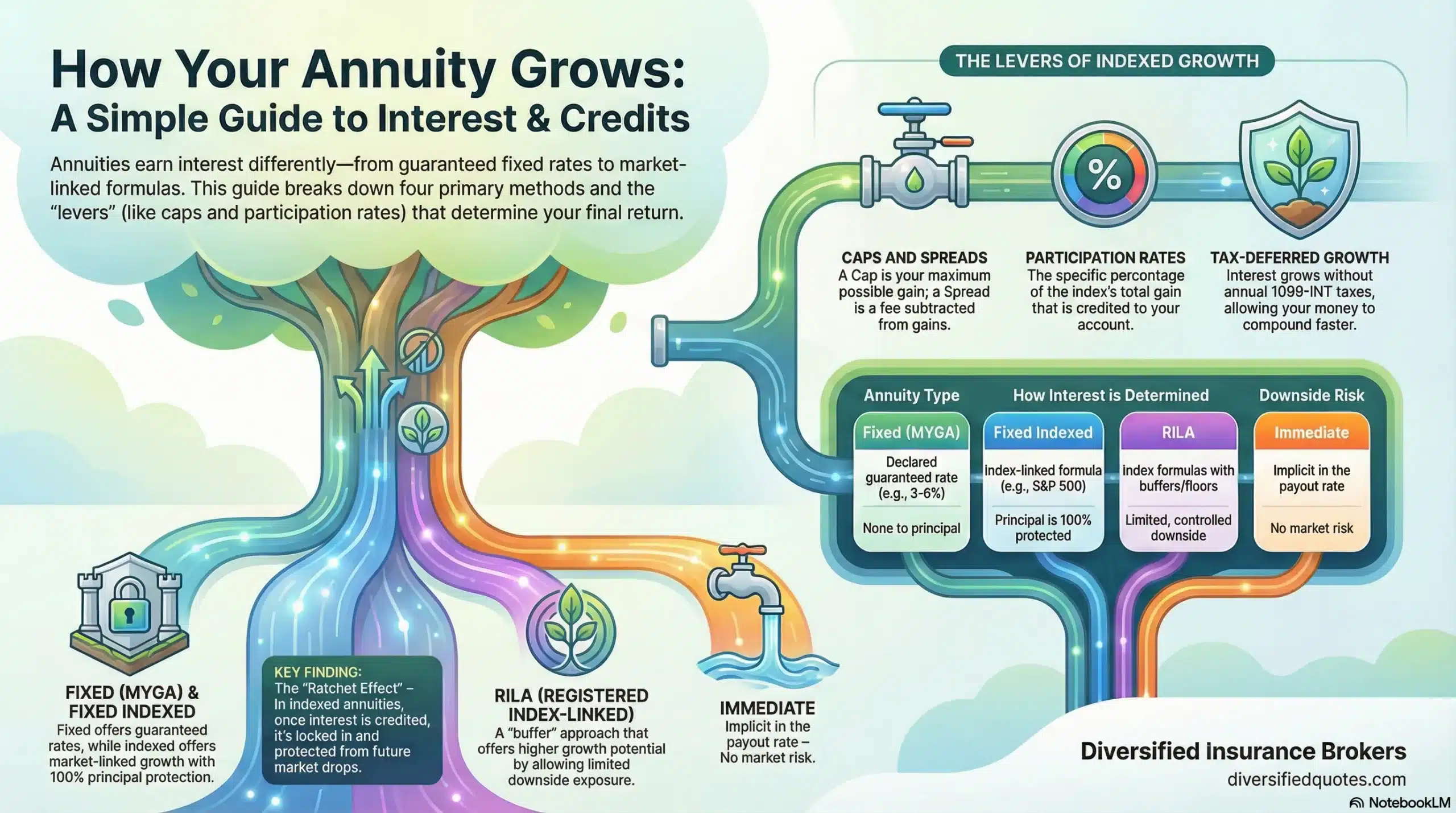
When someone asks how do annuities earn interest, what they are really asking is how insurance companies transform deposited premium into credited growth without exposing the contract owner to the same risks found in traditional market investing. The answer depends on the type of annuity selected, the crediting structure built into the contract, and the economic environment at the time of issue and renewal. A traditional fixed annuity credits a declared rate for a set term — very similar in concept to a bank CD but issued by an insurance carrier, typically offering higher rates, and growing on a tax-deferred basis. A fixed indexed annuity links potential interest credits to the performance of an external index while protecting principal from market loss, applying contractual tools such as caps, participation rates, and spreads to determine how much of the index movement is credited. Immediate and income annuities embed an internal rate of return within their payout calculation, converting a lump sum into guaranteed payments. Understanding these distinctions is essential before comparing products side by side or evaluating enhanced designs such as bonus annuities that offer upfront premium credits with their own vesting dynamics.
Insurance carriers earn money by investing their general account assets — primarily in high-quality bonds and other conservative instruments — and then pass a portion of that yield back to contract owners through declared rates or index crediting formulas. In a multi-year guaranteed annuity (MYGA), the insurer locks in a specific interest rate for a defined period — commonly three to ten years — creating predictable accumulation with annual compounding and no exposure to market volatility. In a fixed indexed annuity, interest is credited based on how an index performs over a measurement period, but the contract prevents negative credits during downturns, meaning a bad market year typically results in a zero percent credit rather than a loss of principal. The trade-off for that protection is that the full upside of the index is not credited; instead, the insurer applies a cap, participation rate, or spread to limit the maximum credit. These mechanisms allow the carrier to hedge market exposure while still offering growth potential.
Over time, credited interest compounds, and in indexed designs, previously locked-in gains cannot be taken away in future downturns — creating a ratchet effect that steadily builds protected value. For investors who prioritize safety and predictable yield, reviewing today’s top annuity rates can provide clarity on guaranteed terms, while those seeking growth potential with downside protection often compare indexed structures and examine how indexed annuity rates change at renewal. Tax treatment further enhances long-term growth because interest inside an annuity is not taxed annually — it compounds until withdrawn, which can significantly increase net accumulation over decades compared to taxable alternatives. Renewal dynamics also matter: while a MYGA locks a rate for its full term, indexed annuities reset caps and participation rates periodically within contractual minimum guarantees, meaning long-term performance depends not only on initial illustrations but also on the carrier’s financial strength and renewal philosophy.
Ultimately, annuities earn interest through disciplined insurer investment management combined with contractual crediting formulas that define how much of that yield is passed to policyholders. The structure you choose determines whether your priority is certainty, growth potential with protection, or immediate income conversion, and the right choice depends on time horizon, liquidity needs, and income goals. For a foundational overview of each major annuity type before going deeper, our resource on multi-year guaranteed annuities for retirees and our guide to what a fixed indexed annuity is provide the structural context that makes the interest crediting mechanics much easier to understand.
Ensure you are receiving the absolute top rates
Current Fixed Annuity Rates
Compare today’s best fixed annuity rates from top carriers.
Current Bonus Annuity Rates
See which annuities offer the highest upfront bonus today.
Request an Annuity Quote
Submit our annuity request form to get personalized rate options.
Lifetime Income Calculator
Use our calculator to see how much guaranteed income your annuity can provide.
Compare Today’s Fixed Annuity Rates
Review competitive MYGA terms and guaranteed rates from top carriers nationwide.
The General Account: Where Annuity Interest Actually Comes From
To understand how annuities earn interest, it helps to understand the mechanism behind the credit — the insurer’s general account. When you deposit a premium into a fixed or fixed indexed annuity, the insurance company does not hold your money in a segregated account like a brokerage. Instead, your premium is combined with other policyholders’ premiums in the insurer’s general account, which is then invested primarily in high-quality, investment-grade bonds, mortgage-backed securities, and other conservative fixed-income instruments. The income generated by those general account investments is the raw material from which all annuity interest credits are ultimately derived.
The insurer earns a yield on the general account portfolio — say, 5.5 to 6.5 percent in a typical rate environment — and then allocates a portion of that yield to contractholder credits after covering operating expenses, profit margin, reserve requirements, and the cost of the guarantees embedded in the contract. In a fixed annuity, the declared credited rate is directly set by how much of the general account yield the carrier is willing to pass through. In a fixed indexed annuity, the carrier uses the available yield to purchase options on the reference index — most commonly the S&P 500 — and the performance of those options during the measurement period determines how much interest, if any, is credited to the account.
This general account structure is also what makes annuities fundamentally different from market investments. Your annuity principal is not invested directly in stocks or bonds that could decline in value. Instead, it sits in the general account earning a yield based on the insurer’s underlying portfolio performance, with the crediting formula translating that yield into the interest you receive. The insurer assumes the investment risk in exchange for the premiums it collects, and the contractual terms define exactly how you benefit from or are protected against the resulting performance. Understanding how a fixed annuity works at the structural level provides the foundation for evaluating any annuity crediting formula in the market.
How Fixed Annuities (MYGAs) Credit Interest
A fixed annuity — including the multi-year guaranteed annuity structure most commonly used today — credits interest at a declared rate that is guaranteed for the full contract term. This is the most straightforward of all annuity crediting mechanisms. When you purchase a five-year MYGA at a 4.85 percent declared rate, for example, that 4.85 percent is credited to your account value every year for five years, without adjustment based on any external index, market condition, or carrier discretion during the term. The rate is contractually locked from the day you sign.
The highest guaranteed annuity rates available at any given time reflect the current interest rate environment and the carrier’s own investment capabilities. When bond yields are high, carriers can offer more competitive declared rates because the underlying general account portfolio is earning more. When yields are low, declared rates compress accordingly. This is why shopping across carriers — and working with an independent broker who has access to rates from dozens of insurers simultaneously — is so important. Two carriers with similarly strong financial ratings can offer meaningfully different declared rates on the same term length simply because of differences in their investment portfolios, operating efficiencies, and competitive positioning. Our resource on the best MYGA annuity rates provides a current marketplace overview across term lengths and carriers.
It is also worth noting that fixed annuities and traditional bank CDs are structurally similar — both offer a guaranteed rate for a defined term — but they are not identical. Annuities are issued by insurance companies rather than banks, they are not FDIC-insured, they offer tax-deferred growth that CDs do not, and they typically offer higher rates than comparable CD terms from most banks. Our detailed comparison in the fixed annuities versus CDs guide covers the key differences, and our overview of how MYGAs compare to CDs provides a current-market perspective on the rate and feature differences between the two instruments.
Simple vs. Compound Interest in Fixed Annuities
Most multi-year guaranteed annuities compound interest annually, which means the credited interest in each year is added to the account value and earns additional interest in subsequent years. This is fundamentally different from a simple interest arrangement where only the original principal earns interest — in a compounding contract, interest earns interest, and the growth accelerates over time. The distinction matters enormously over multi-year accumulation periods.
Consider a $200,000 premium earning 5 percent annually. Under simple interest, the account earns $10,000 per year and reaches $300,000 after ten years. Under annual compounding, the account value grows to approximately $325,779 over the same period — a difference of nearly $26,000 from the same premium at the same rate, simply because of compounding. Over longer periods, this difference becomes even more dramatic. The complete analysis of how this works in annuity contracts specifically — including how compounding interacts with rider fees, surrender charges, and withdrawal provisions — is covered in our dedicated resource on simple versus compound interest in annuities.
How Fixed Indexed Annuities Credit Interest
Fixed indexed annuities take a fundamentally different approach to interest crediting. Rather than declaring a fixed rate at the outset, the carrier credits interest based on the measured performance of an external reference index — most commonly the S&P 500 or the NASDAQ — over a defined measurement period. The key structural innovation of the fixed indexed annuity is that it captures a portion of the index’s upside when the market performs well, while completely protecting principal and previously credited gains when the market performs poorly. Understanding how a fixed indexed annuity works in mechanical detail reveals why this structure has become one of the most widely used retirement accumulation vehicles in the market.
The interest crediting process in a fixed indexed annuity works as follows: at the start of each measurement period (typically one year), the insurer records the starting value of the reference index. At the end of the period, it measures the ending value and calculates the percentage change. If the index gained 10 percent and the contract has a 6 percent cap, the credited rate is 6 percent. If the index gained only 3 percent, the credited rate is 3 percent. If the index lost 15 percent, the credited rate is 0 percent — not negative. The floor prevents any reduction in the account value due to index decline, preserving the full account balance at the end of the period and allowing subsequent positive measurement periods to build on that preserved base.
What makes this possible? The carrier uses a portion of the general account yield to purchase call options on the reference index. When the index rises, the options have value and the carrier has the margin to credit index-linked interest. When the index falls, the options expire worthless but the carrier’s bond portfolio still produces its baseline yield, covering the 0 percent credit promise and preserving principal. The caps, participation rates, and spreads that limit the upside credit are the mechanism by which the carrier manages the cost of purchasing those options relative to the available yield. To understand what happens specifically in negative markets, our resource on what happens to an indexed annuity if the market goes down walks through the floor mechanics in full.
Understanding Index Crediting Methods
Not all fixed indexed annuities use the same method to measure index performance, and the crediting method chosen can significantly affect how much interest is credited in different market environments. The most common crediting method is the annual point-to-point, which compares the index value at the start of the measurement period to its value exactly one year later. The percentage change between those two dates — subject to the applicable cap, spread, or participation rate — is the credited rate for that period.
Other crediting methods include the monthly sum, which adds up monthly index changes throughout the year (with each month potentially capped independently) and credits the total if positive; the monthly average, which averages the index values at the end of each month throughout the year; and multi-year point-to-point arrangements that measure performance over two, three, or five years rather than annually. Each method responds differently to various market patterns — trending markets, volatile markets, flat markets — and the right choice depends on your expectations for market behavior and your preference for how interest accumulates. Our comprehensive guide to index annuity crediting methods covers each approach with examples and explains which environments tend to favor which method. For retirees specifically interested in how the S&P 500 is used as a reference index, our resource on what the S&P 500 index means in an annuity provides the foundational context.
Explore Every Crediting Strategy
Browse by measurement period, crediting method, or rate formula.
Measurement Period — How Long Before Interest Is Calculated
Crediting Method — How the Index Is Measured
Rate Formula — How Much of the Gain You Keep
See the Full Menu Overview →Caps, Participation Rates, and Spreads Explained
The three primary limiting mechanisms in fixed indexed annuity crediting are the cap rate, the participation rate, and the spread. Understanding these three tools is essential for evaluating any indexed annuity illustration and comparing products across carriers, because headline descriptions of indexed annuities often focus on one of these parameters while obscuring how the others affect the net credited interest.
A cap rate is exactly what it sounds like: a maximum ceiling on the interest that can be credited in a given measurement period, regardless of how well the index performs. If the index gains 18 percent and the cap is 7 percent, the credit is 7 percent. Caps are the most visible parameter in indexed annuity marketing and the most frequently quoted. Our dedicated resource on what an annuity cap rate is explains how caps are set and how they can change at renewal.
A participation rate defines the percentage of the index gain that is credited to the account. A 60 percent participation rate on a 10 percent index gain produces a 6 percent credit. Some contracts offer participation rates above 100 percent — meaning the account is credited more than the index itself gained — often in exchange for no cap or as a feature of a premium bonus contract. Our resource on what an annuity participation rate is covers the mechanics and trade-offs of participation-rate-based crediting compared to cap-based structures.
A spread — also called a margin or asset fee — is a fixed percentage subtracted from the index gain before the remainder is credited. If the index gains 9 percent and the spread is 2.5 percent, the credited rate is 6.5 percent. Spreads are less commonly used than caps and participation rates but are found in certain products and crediting strategies, particularly on more exotic indices. Understanding what an annuity spread rate is helps prevent confusion when comparing products that use different limiting mechanisms to achieve similar net outcomes.
The Zero-Percent Floor and Principal Protection
The zero-percent floor is arguably the most important structural feature in fixed indexed annuity design. It guarantees that regardless of how badly the reference index performs in any given measurement period, the credited interest cannot be negative — the account value cannot decline due to index performance. In a year when the S&P 500 falls 30 percent, the indexed annuity credits zero percent and the account value at the end of that year is identical to the account value at the beginning. The previous year’s credited gains are fully intact.
This guarantee means that fixed indexed annuities carry no market loss exposure to principal when held per contract terms. They are not risk-free instruments — there are surrender charges if funds are withdrawn early, and opportunity cost exists when index performance greatly exceeds the cap — but they are genuinely protected from the kind of principal erosion that stock market investments can produce. Our resource on whether you can lose money in an annuity addresses the specific scenarios where loss can and cannot occur across different annuity types, and our overview of how fixed indexed annuities protect against market downturns provides the structural context for why this protection exists and how it is maintained across multiple market cycles.
The ratchet effect that results from this protection is one of the most compelling features of indexed annuity accumulation. Each positive measurement period locks in new gains that cannot be taken away in subsequent negative periods. Over a ten or fifteen year accumulation horizon, this creates a staircase pattern of growth that combines meaningful upside participation in favorable years with full preservation of prior gains in unfavorable ones — a pattern fundamentally different from the volatility of direct market investment and appealing to retirees for whom capital preservation is as important as growth. Our resource on the pros and cons of fixed indexed annuities provides a balanced assessment of where this structure excels and where its limitations matter.
How Different Annuities Credit Interest
| Annuity Type | How Interest Is Credited | Market Loss Exposure | Best For |
|---|---|---|---|
| Fixed (MYGA) | Declared guaranteed rate for a set term (3–10 years) | None if held to term | CD alternative, stable accumulation |
| Fixed Indexed | Index-linked formula with cap, spread, or participation rate; 0% floor in down years | No principal loss (0% floor typical) | Growth with downside protection |
| Variable | Sub-account returns based on chosen investment options; no floor on losses | Full market risk applies | Investors comfortable with market volatility |
| Immediate / Income | Premium converted to guaranteed payments; internal rate embedded at purchase | No market exposure | Lifetime paycheck creation |
Variable Annuities: The Market-Exposure Alternative
Variable annuities operate on a fundamentally different interest crediting model than fixed or fixed indexed contracts. In a variable annuity, the premium is allocated to sub-accounts that function like mutual funds — investing directly in equity markets, bond markets, or balanced strategies selected by the annuity owner. The account value rises and falls with the performance of those sub-accounts. There is no declared rate, no index cap, and no zero-percent floor: the account can grow substantially in strong markets and can decline significantly in poor ones.
Variable annuities typically include an array of optional riders — guaranteed minimum income benefits, guaranteed minimum withdrawal benefits, and death benefit guarantees — that add a layer of contractual protection to the market-exposed account. These riders carry fees that can be substantial, and the overall cost structure of variable annuities is generally higher than fixed or fixed indexed alternatives. For retirees who want market exposure within an annuity wrapper, the variable structure is the relevant option. For those who want growth potential with principal protection, the comparison between fixed indexed annuities and variable annuities clarifies where each structure excels and where its limitations are most consequential.
Bonus Annuities: Upfront Credits and How They Work
Bonus annuities add an immediate premium credit — typically ranging from 5 to 40 percent of the deposited premium depending on the carrier and product structure — to the account value or income base at the time of purchase. This upfront credit can meaningfully accelerate the starting point for accumulation or income calculation. Understanding the pros and cons of bonus annuities is essential before pursuing them, because the bonus is always accompanied by trade-offs that must be evaluated in context.
Premium bonuses are funded by the carrier through a combination of somewhat lower ongoing declared rates, longer surrender periods, or adjusted crediting parameters compared to non-bonus products. A contract with a 20 percent upfront bonus may carry a 10-year surrender period versus a 7-year period on a comparable non-bonus contract, or it may credit a lower cap rate in the indexed strategy component. Whether the bonus improves the long-term net outcome depends on how long the contract is held, how crediting performs, and whether the surrender schedule aligns with the owner’s liquidity needs. Our resource on what an annuity income bonus is specifically covers the subset of bonuses that apply to the income base rather than the cash value — a common feature in income rider contracts where the bonus accelerates the starting point for lifetime withdrawal calculations.
For those evaluating the best bonus structures currently available, our guide to the best upfront bonus annuities and our overview of current annuity rates across both fixed and indexed categories provide a market-wide perspective on how bonus structures compare to non-bonus alternatives on the basis of total long-term value.
Tax Deferral: The Hidden Interest Multiplier
One of the most significant ways annuities build value is not through interest crediting mechanics at all — it is through tax deferral. Interest credited inside an annuity accumulates without being subject to annual income tax. This is in contrast to a bank CD, a brokerage money market account, or a taxable bond portfolio, where interest income is taxed in the year it is earned. The difference in long-term accumulation between a taxable and a tax-deferred vehicle at the same gross rate of return can be substantial over a decade or more.
Consider a $200,000 investment earning 5 percent annually over 20 years. In a taxable account with a 24 percent effective tax rate on interest, the annual net yield is 3.8 percent, and the ending balance is approximately $409,000. In a tax-deferred annuity earning the same 5 percent, interest compounds without annual tax leakage, and the ending balance reaches approximately $530,000 before any tax on withdrawal. That difference — more than $120,000 on the same starting amount at the same gross rate — is the compound effect of tax deferral alone. Our dedicated resource on how tax deferral creates generational compounding walks through these calculations in greater depth and explains why tax deferral is often called the most underappreciated feature of annuity accumulation.
Tax treatment at the time of withdrawal also matters. Understanding how annuities are taxed in retirement — including the distinction between qualified and non-qualified contracts, the exclusion ratio for non-qualified annuities, and the LIFO rules that govern partial withdrawals — is an essential part of planning around annuity crediting. The strategies available for managing this tax exposure are covered in our guide to tax-deferred annuity strategies.
Renewal Mechanics: What Happens After the Term
Understanding how annuity interest continues to be credited after the initial guarantee period is an important dimension of any long-term evaluation. In a multi-year guaranteed annuity, the declared rate is locked for the full contract term. When that term ends — whether it is three, five, seven, or ten years — the carrier declares a new renewal rate for the next period. The renewal rate reflects current interest rates and the carrier’s competitive positioning at that time. It may be higher than the original rate if market rates have risen, or lower if they have fallen.
Most MYGA contracts include a surrender-free window at the renewal date — typically 30 days — during which the owner can withdraw the full account value without penalty, exchange it to a new annuity via a 1035 exchange, or accept the renewal rate and continue the contract for another term. This renewal optionality is one of the reasons MYGAs have become popular alternatives to rolling CDs: you get competitive initial rates, tax-deferred growth, and the flexibility to shop the market at renewal without a penalty window if rates have improved elsewhere. Our resource on fixed indexed annuities with guaranteed rates explains how contractual minimums protect owners in indexed contracts, ensuring that even in a low-rate renewal environment, the carrier cannot reset the cap or participation rate below a contractually guaranteed floor.
For fixed indexed annuities, the renewal process is somewhat different. At the start of each new measurement period — annually in most point-to-point designs — the carrier sets the cap, participation rate, or spread that will apply for the upcoming term. These parameters can change at each renewal within the minimum guarantees specified in the contract. The carrier’s financial strength, investment performance, and competitive philosophy all influence renewal crediting parameters, which is why evaluating insurer quality is as important as evaluating headline rates when selecting a fixed indexed annuity. Our guide to how to get the best annuity rates covers what to look for in both initial and renewal rate environments.
Fixed vs. Fixed Indexed: How the Crediting Philosophies Differ
The choice between a fixed (MYGA) crediting structure and a fixed indexed crediting structure is not a choice between safe and risky. Both offer principal protection and both operate within the insurer’s general account framework. The difference is in how the available yield is delivered to the contract owner. In a fixed annuity, the carrier delivers yield as a guaranteed declared rate — certain, predictable, and immune to market performance. In a fixed indexed annuity, the carrier delivers yield through index-option purchases — giving the owner the chance at higher credits in strong market years in exchange for accepting lower or zero credits in flat or declining years.
Over time, fixed indexed annuities have historically credited meaningfully more than their declared-rate counterparts in favorable equity market environments, while protecting principal in negative environments. But the relationship is not consistent year to year: a fixed annuity’s 4.5 percent annual declared rate may outperform a fixed indexed annuity in a flat or modestly negative index year, while the indexed structure may dramatically outperform in a strong trending market. Our resource on fixed annuities versus fixed indexed annuities provides the full analytical comparison between these two structures, and our guide to what makes fixed indexed annuities different from fixed annuities focuses specifically on the crediting philosophy differences that make each one appropriate in different situations.
Income Riders and the Separate Roll-Up Rate
For many retirees, the question of how annuities earn interest extends to a second rate that appears in income rider designs: the roll-up rate on the income base. This is distinct from the cash value crediting discussed above and deserves clear separate treatment because conflating the two is one of the most common sources of confusion in annuity evaluations.
When a fixed indexed annuity includes an income rider, the contract maintains two separate values: the account value (which grows through index crediting, can be accessed as a lump sum subject to surrender terms, and serves as the death benefit) and the income base (which grows at the roll-up rate specified in the rider and is used only to calculate the guaranteed income amount at withdrawal). The roll-up rate — often 5 to 8 percent depending on the carrier and rider design — applies only to the income base during the deferral period and does not represent money that can be withdrawn as cash. It is a calculation driver, not an accessible balance. Understanding how annuity income riders work — and specifically how the roll-up rate on the income base differs from the index crediting rate on the account value — prevents the misunderstanding of thinking the income base represents a large accessible cash balance. Our resource on lifetime income annuities provides the full picture of how credited growth ultimately converts into guaranteed lifetime income.
From Credited Interest to Retirement Income
As retirement approaches, many individuals transition from accumulation analysis to income planning, examining how credited growth can later convert into guaranteed withdrawals. The interest crediting that occurred during the deferral phase directly determines the account value and income base available when income begins. This is why the crediting structure chosen during accumulation has compounding implications for retirement income — not just for the growth it produces, but for the income it ultimately supports.
For retirees exploring how today’s credited growth translates into future guaranteed income, our fixed indexed annuity with income rider resource covers the full accumulation-to-income pathway. Those who want to compare fixed annuity accumulation alternatives specifically should review the best fixed annuities for retirees seeking guaranteed growth and secure income. And for those exploring how bonus structures interact with long-term income, the executive bonus plan resource covers how employer-sponsored annuity designs coordinate with income goals in business planning contexts.
Explore Bonus Annuity Opportunities
See how premium bonuses and enhanced crediting structures compare in today’s market.
Related Pages
Continue exploring annuity crediting structures, rate comparisons, and income planning strategies.
Financial Protection Essentials
Carrier reviews, senior burial planning, high-risk underwriting guidance, and final expense planning tools.
Talk With an Advisor Today
Choose how you’d like to connect—call or message us, then book a time that works for you.
Schedule here:
calendly.com/jason-dibcompanies/diversified-quotes
Licensed in all 50 states • Fiduciary, family-owned since 1980
Frequently Asked Questions: How Do Annuities Earn Interest?
Do fixed annuities compound at a guaranteed rate?
Yes. Multi-year guaranteed annuities (MYGAs) and other fixed deferred annuities credit a declared rate that compounds over the guarantee term. Annual compounding means that interest credited in year one becomes part of the account value that earns interest in year two, producing accelerating growth over time. At the end of the guarantee term, the contract typically enters a renewal window during which the owner can withdraw funds without penalty, exchange the annuity to a new product, or accept a new declared rate and continue accumulating.
The compounding distinction matters significantly in long-term accumulation comparisons. A $200,000 premium earning 5 percent simple interest reaches $300,000 after ten years. The same premium earning 5 percent compounded annually reaches approximately $325,779 — a difference that grows larger as the holding period extends. Our resource on simple vs. compound interest in annuities covers this distinction in full, and the highest guaranteed annuity rates available today provide a starting point for evaluating the compounding advantage at current market rates.
Can fixed indexed annuities lose money in a down market?
No — not due to index performance. Fixed indexed annuities include a zero-percent floor that prevents negative interest credits when the reference index declines. In a year where the S&P 500 falls 20 percent, the indexed annuity credits zero percent rather than a negative amount, leaving the account value fully intact at its prior year-end level. Previously credited gains are locked in and cannot be taken back due to subsequent market declines. This floor structure is what makes fixed indexed annuities genuinely different from direct market investment — the principal protection is contractual, not conditional on market performance remaining above a threshold.
There are scenarios where account value can be reduced outside of index performance — specifically surrender charges if funds are withdrawn before the surrender period ends, rider fees if an income rider is attached, and state premium taxes in applicable states. But these reductions are contractual and disclosed at purchase, not market-driven. For a full accounting of all scenarios where value can and cannot be affected, our resource on whether you can lose money in an annuity addresses each type by annuity structure. And our guide specifically on the downside of a fixed indexed annuity provides an honest accounting of the trade-offs alongside the protection features.
What is the difference between a cap, spread, and participation rate?
These are three distinct mechanisms that fixed indexed annuity carriers use to define how much of an index’s gain is credited to the contract. A cap rate is a maximum ceiling: if the index gains 14 percent and the cap is 7 percent, the credit is 7 percent. A participation rate is a multiplier on the index gain: if the index gains 10 percent and the participation rate is 60 percent, the credit is 6 percent. A spread is a subtraction from the index gain: if the index gains 9 percent and the spread is 2 percent, the credit is 7 percent. These mechanisms serve the same purpose — allowing the carrier to offer index-linked participation while managing the cost of the options it purchases to deliver that participation — but they produce different outcomes across different market environments.
A contract with a high participation rate and no cap may outperform a capped contract in a very strong market year, but a contract with a moderate cap and a lower participation rate may outperform in a moderately positive market year. Understanding which parameter is most advantageous requires modeling specific scenarios based on your assumptions about future index performance, which is why comparing products on a single headline parameter is often misleading. Our resources on annuity cap rates, participation rates, and spread rates each cover one of these three mechanisms in full detail.
How do rider roll-ups relate to interest earnings?
Income rider roll-up rates are separate from the interest crediting that affects the contract’s account value. When a fixed indexed annuity includes an income rider, the contract maintains two distinct values: the account value, which grows through index crediting (and can be accessed as cash subject to contract terms), and the income base, which grows at the roll-up rate specified in the rider and is used exclusively to calculate the guaranteed lifetime withdrawal amount. The roll-up rate — commonly 5 to 8 percent annually depending on the carrier and rider — applies only to the income base during the deferral period.
This distinction is critically important because the income base growing at 7 percent does not mean the account has 7 percent in accessible cash. It means the calculation base for future guaranteed income payments is growing at 7 percent, which will eventually produce a higher guaranteed income amount when withdrawals begin. The account value itself may grow at a different rate through index crediting, and the two values may diverge significantly over the deferral period. Understanding how annuity income riders work in this dual-value structure is essential for interpreting any illustrated income projection accurately. Our resource on fixed indexed annuities with guaranteed rates covers how rate floors apply to both the crediting and rider components of these contracts.
Where can I compare today’s crediting options?
The best starting point for comparing today’s annuity crediting options across fixed, indexed, and bonus structures is our annuity rates and options page, which provides an overview of current market structures from over 100 carriers. For specific rate comparisons by term length, our best annuity rates today resource provides current MYGA and fixed annuity rate information across competitive carriers. For indexed structures, reviewing the available fixed indexed annuities with income riders alongside the standalone crediting-focused options helps frame the full spectrum of what the indexed marketplace offers.
Because annuity rates change frequently and the best rate from one carrier this month may be surpassed by another carrier next month, working with an independent advisor who monitors rates across the full market is the most reliable way to ensure you are securing the most competitive crediting structure available at the time of purchase. Our common annuity myths resource also addresses several misconceptions about how annuity rates are set and what “competitive” actually means in the context of the insurer’s general account yield environment, which provides useful context for evaluating any rate comparison.
How does tax deferral affect long-term annuity accumulation?
Tax deferral is one of the most powerful but least visible contributors to long-term annuity accumulation. Because interest credited inside an annuity is not subject to annual income tax, the full credited amount compounds each year rather than a reduced after-tax amount. In a taxable account, interest income is taxed in the year it is earned, which reduces the compounding base and slows accumulation over time. The longer the accumulation period and the higher the effective tax rate, the larger the difference between taxable and tax-deferred growth on the same gross credited rate.
Over a 20-year accumulation period, the difference between a taxable and tax-deferred account at the same 5 percent gross rate and a 24 percent effective tax rate amounts to more than $120,000 on a $200,000 starting balance — without any difference in the underlying credited rate. This compounding advantage is the reason annuities are so frequently used as a tax-advantaged savings vehicle for amounts above annual IRA and 401(k) contribution limits. Our resource on tax-deferred annuity strategies covers how to structure annuity accumulation for maximum after-tax efficiency, and how annuities are taxed in retirement addresses the withdrawal-phase tax treatment that is the counterpart to the deferral advantage during accumulation.
What happens to crediting at annuity renewal?
Renewal mechanics differ between fixed and indexed annuities. In a multi-year guaranteed annuity, the declared rate is locked for the full contract term. When the term ends, the carrier declares a new renewal rate based on prevailing interest rates and competitive positioning. The owner typically has a 30-day penalty-free window to accept the renewal rate, withdraw the full balance, or exchange to a new product. If the renewal rate is not competitive, the owner can access the annuity’s full value during this window and reallocate without penalty.
In a fixed indexed annuity, the carrier resets the cap, participation rate, or spread at the start of each new measurement period within minimums guaranteed in the contract. These contractual minimums — typically much lower than current market rates — provide a floor below which the carrier cannot reduce the crediting parameters. Whether actual renewal crediting parameters remain competitive depends on the carrier’s financial health, investment portfolio performance, and competitive strategy. This is why evaluating carrier quality alongside product features is important — a carrier that consistently renews at strong parameters provides better long-term value than one with an attractive initial offer but poor renewal history. Our guide to how fixed indexed annuity rates change covers the renewal dynamic in full, and the best upfront bonus annuities addresses how bonus structures interact with renewal term lengths.
About the Author:
Jason Stolz, CLTC, CRPC, DIA, CAA and Chief Underwriter at Diversified Insurance Brokers (NPN 20471358), is a senior insurance and retirement professional with more than 25 years of real-world experience helping individuals, families, and business owners protect their income, assets, and long-term financial stability. As a long-time partner of the nationally licensed independent agency Diversified Insurance Brokers, Jason provides trusted guidance across multiple specialties—including fixed and indexed annuities, long-term care planning, personal and business disability insurance, life insurance solutions, Group Health, Travel Medical and Evacuation Insurance, and short-term health coverage. Diversified Insurance Brokers maintains active contracts with over 100 highly rated insurance carriers, ensuring clients have access to a broad and competitive marketplace.
His practical, education-first approach has earned recognition in publications such as VoyageATL, and contributions from his agency featured in Kiplinger and GoBankingRates— highlighting his commitment to financial clarity and client-focused planning. Drawing on deep product knowledge and years of hands-on field experience, Jason helps clients evaluate carriers, compare strategies, and build retirement and protection plans that are both secure and cost-efficient. Visitors who want to explore current annuity rates and compare options across multiple insurers can also use this annuity quote and comparison tool.
Explore More Annuity Options: Browse our complete guide to Common Annuity Myths — covering annuity mechanics, rules, fees, riders, cap rates & participation rates explained from 100+ carriers.
Last Reviewed: September 3, 2026 |
Reviewed by: Jason Stolz, CLTC, CRPC, DIA, CAA
Chief Underwriter, Diversified Insurance Brokers, Inc. | NPN: 20471358 | Diversified Insurance Brokers, Inc. — Licensed in all 50 states
Fact Checked by: Tonia Pettitt, CMIP©
Medicare Specialist, Diversified Insurance Brokers, Inc. | NPN: 14374308 | Diversified Insurance Brokers, Inc. — Licensed in all 50 states
Did you find this content helpful? Leave us a Google review — it helps others find trustworthy guidance too.
Editorial Standards: Diversified Insurance Brokers maintains rigorous editorial standards to ensure accuracy, clarity, and independence in all content. Learn more about our editorial standards and commitment to transparency.
