
Can You Lose Money in an Annuity?
As an Independent Annuity Broker, we compare rates across 100+ carriers and 1,000 different annuities— not just one company’s product offerings — to find the best fit for your goals.
Can You Lose Money in an Annuity?

Jason Stolz CLTC, CRPC, DIA, CAA
Whether you can lose money in an annuity is not a single yes or no question — it is five separate questions, each with a different answer depending on which type of annuity is under discussion and which definition of “loss” applies. The short version: with a fixed annuity or fixed indexed annuity, your principal cannot be reduced by market performance — that protection is contractual, not conditional on market timing. With a variable annuity, market loss is entirely possible and has occurred for many contract holders. With any annuity, surrender charges can reduce the amount you receive if you withdraw funds beyond allowed limits during the surrender period. With any fixed-rate contract, inflation over time can erode purchasing power in a way that feels like a loss even when the nominal dollar amount has not decreased. And with any annuity, misunderstanding the difference between the account value and the benefit base of an income rider can create confusion that looks like a loss but is a structural misunderstanding instead. Our resource on do you lose your principal in an indexed annuity addresses that specific question for the fixed indexed annuity product type, and our resource on what is the safest type of annuity covers the full safety comparison across product types.
The frequency with which people ask “can you lose money in an annuity” reflects a genuine and reasonable confusion about a product category that uses one word — annuity — to describe contracts that occupy completely different positions on the risk spectrum. A fixed MYGA (multi-year guaranteed annuity) that credits 5.20% annually for five years, backed by a carrier with an AM Best A rating and state guaranty association protection, is not the same risk profile as a variable annuity with subaccounts allocated to small-cap equity and emerging market funds. Both are annuities. Both are sold by insurance companies. Both are tax-deferred accumulation vehicles. But their relationship to market risk, principal protection, and the possibility of seeing a lower account value than the premium paid are fundamentally different. Our resources on are annuities guaranteed, are annuities FDIC insured, and are annuities insured cover the protection framework that applies across all annuity types, and our resource on state guaranty association covers the insurance company insolvency protection system that backstops annuity contracts in the event of carrier failure.
The most important practical guidance before evaluating any annuity’s loss potential is to identify the product type precisely — fixed or MYGA, fixed indexed (FIA), or variable — and then evaluate the specific risks within that type rather than applying a generic “annuities are safe” or “annuities are risky” framework. The risks that exist within any of these products — surrender charges, market value adjustments, fee drag, inflation, and carrier solvency — are not hidden; they are disclosed in the contract. But they require deliberate attention to understand before purchase. Our resource on what is a fixed indexed annuity covers the FIA product structure, and our resource on what is a variable annuity covers the variable product structure where market loss is a genuine possibility.
Ensure you are receiving the absolute top rates
Current Fixed Annuity Rates
Compare today’s best fixed annuity rates from top carriers.
Current Bonus Annuity Rates
See which annuities offer the highest upfront bonus today.
Request an Annuity Quote
Submit our annuity request form to get personalized rate options.
Lifetime Income Calculator
Use our calculator to see how much guaranteed income your annuity can provide.
Annuity Type Loss Risk Matrix — Where Each Product Stands
The table below maps each major annuity type against the five specific forms of loss that are relevant to annuity ownership. Use it as a starting framework before diving into the detailed explanations for each risk category.
| Risk Type | Fixed / MYGA | Fixed Indexed Annuity (FIA) | Variable Annuity |
|---|---|---|---|
| Market / principal loss | None — principal is contractually guaranteed; growth credited at a fixed rate regardless of market performance | None — 0% floor means negative index performance credits zero, not a reduction in principal; principal is contractually protected | Yes — subaccounts invested in market-linked funds can decline; account value can fall below premium paid without protective riders |
| Surrender charge / early withdrawal loss | Yes — withdrawals above the free-withdrawal allowance (typically 10%/year) during the surrender period (commonly 3-10 years) trigger charges that can reduce surrender value | Yes — surrender periods typically 7-10 years; same free-withdrawal allowance structure; MVA (market value adjustment) may apply at some carriers in addition to surrender charges | Yes — surrender charges apply to excess withdrawals during the surrender period; most variable annuities also carry mortality and expense (M&E) fees annually |
| Fee drag reducing account value | Minimal for pure MYGA/fixed — no ongoing rider fees on accumulation-only contracts; income riders if added cost 0.75-1.25% annually from account value | Moderate — income rider fees (typically 0.95-1.25% annually) reduce account value if elected; no M&E charges typical in most FIAs; rider fees are optional | High — M&E charges (0.5-1.5%), fund management fees, administrative fees, and rider fees can combine to 2-4%+ annually, materially reducing account value over time |
| Inflation / purchasing power erosion | Yes — a locked-in fixed rate may not outpace inflation in extended high-inflation environments; nominal dollar amount does not decrease but real purchasing power does | Lower — index-linked credits in strong markets can outpace inflation; 0% floor years do not compound the problem but also provide no inflation hedge in flat/down markets | Depends on allocation — equity-linked subaccounts historically outpace inflation over long periods; the tradeoff is the market loss risk described above |
| Carrier insolvency risk | Low — state guaranty associations cover $100,000-$500,000 per annuitant per carrier (varies by state); AM Best A-rated carriers have strong insolvency track record | Low — same state guaranty association protection structure; same AM Best rating evaluation applies | Variable subaccount assets are technically held separately from carrier general account — they are not subject to carrier insolvency in the same way as fixed products; insurance wrapper has its own carrier risk |
The matrix above reflects general market patterns for standard annuity structures. Specific contract terms, fee amounts, surrender schedules, and guaranty association limits vary by carrier, product, and state. Review the contract and consult a licensed professional before any annuity purchase decision. Guarantees are backed by the claims-paying ability of the issuing insurance company.
Fixed and MYGA Annuities — Why Principal Cannot Be Lost to Market Decline
A fixed annuity or multi-year guaranteed annuity credits a contractually defined interest rate for a defined term. The rate is not linked to stock market performance in any way. When the S&P 500 declines 30%, your MYGA does not decline — it credits its stated rate as if the market event did not occur. This is not a marketing claim; it is the contractual and operational reality of how fixed annuities are structured. The insurance carrier accepts the investment risk internally by placing reserves in its general account, and commits to paying the contractual rate regardless of investment performance. The practical implication is absolute: you cannot lose principal due to market volatility in a fixed or MYGA annuity. Current rates for fixed annuities are available in our resource on best MYGA annuity rates. Our resource on how fixed annuities help protect against market volatility covers the structural mechanics behind this protection, and our resource on safe fixed annuity options covers the product landscape for conservative investors prioritizing principal protection. Our resource on what is a fixed annuity covers the product fundamentals.
Fixed Indexed Annuities — The 0% Floor, Upside Limits, and Where Loss Is Still Possible
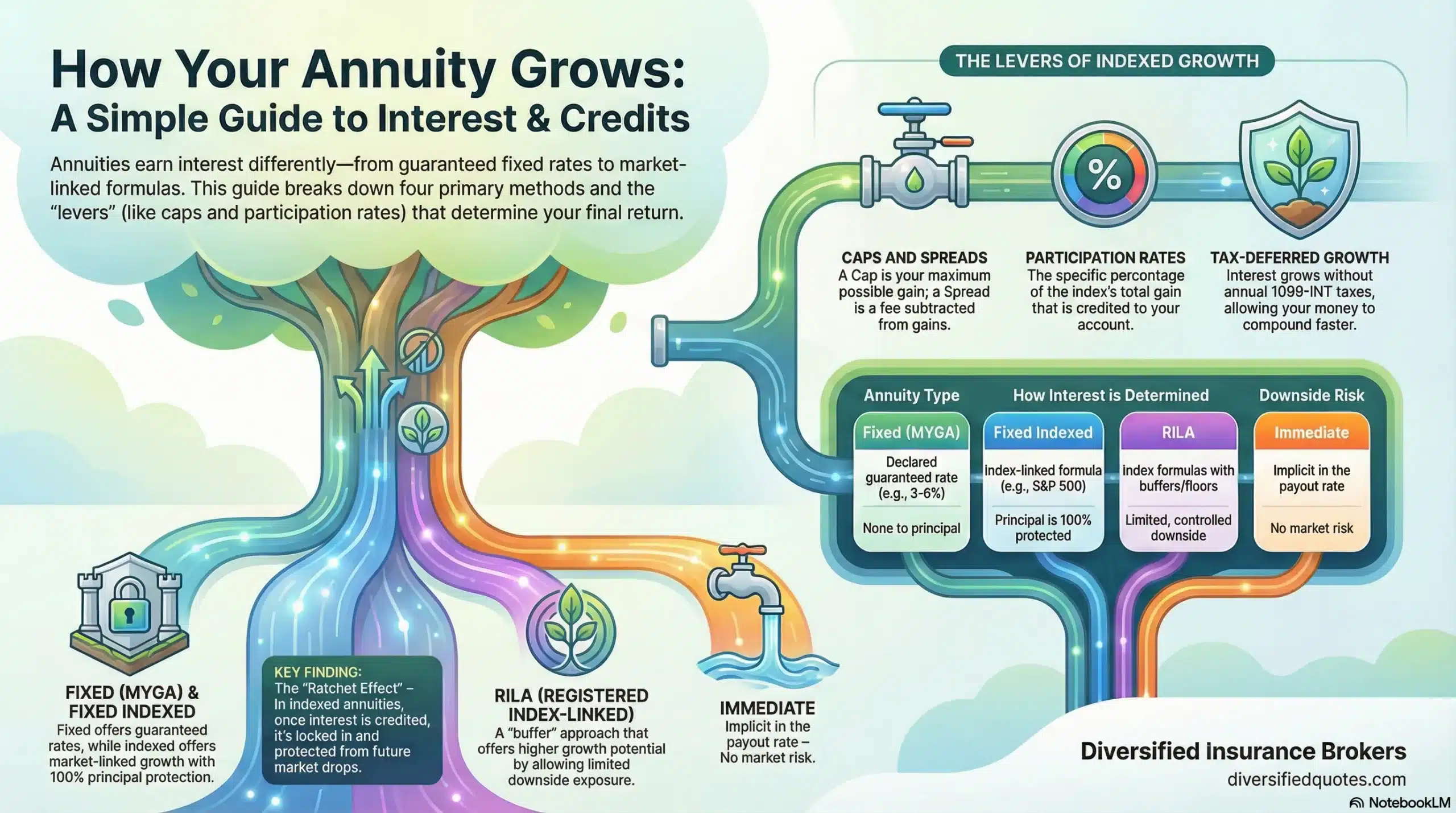
Fixed indexed annuities occupy a distinct position: interest is credited based on the performance of an external index like the S&P 500, but the crediting is subject to a 0% floor — meaning that in any year the index performs negatively, the annuity credits zero rather than a negative number. This means the account value cannot decline due to market performance. You are not invested in the index; you are credited based on a formula tied to the index’s movement, and that formula has a contractual floor at zero. The tradeoff for this downside protection is that upside participation is limited. Cap rates, participation rates, and spread rates define how much of a positive index return is credited to the contract in any given year. A cap rate of 9% means that if the index returns 20%, the contract credits 9%. This is not a loss — but it is a meaningful limitation on growth potential that every prospective FIA buyer must understand before purchase. Our resources on what is an annuity cap rate, what is an annuity participation rate, and what is an annuity spread rate cover the three primary crediting limiters in detail. Our resource on what is the downside of a fixed indexed annuity covers the full risk picture honestly, including the cap reset risk that many buyers overlook: a 12% cap today can be reset to 9% next year if Treasury yields decline. Our resource on fixed indexed annuity myths debunked covers the most common misconceptions about this product type, and our resource on is an indexed annuity safe addresses the safety question directly.
Variable Annuities — The Product Type Where Loss Is Genuinely Possible
Variable annuities are the category of the annuity market where the answer to “can you lose money” is an unambiguous yes — without qualification. Variable annuity contracts allocate premiums to subaccounts that function similarly to mutual funds and are invested directly in market-linked securities. When those investments decline in value, the account value declines. A variable annuity purchased at $200,000 that loses 25% of its value in a down market is worth $150,000. The contractual “insurance wrapper” of a variable annuity does not prevent that loss; it provides other features — tax deferral, death benefits, and optional income guarantees — but the core investment risk is identical to market-linked investing outside the annuity. The fees on variable annuities compound the market risk: M&E charges, fund management fees, and rider fees can total 2-4% annually, meaning the variable annuity account must generate positive returns simply to maintain its value before the policyholder sees any net growth. Our resource on what is a variable annuity covers the product structure, and our resource on fixed indexed annuities vs. variable annuities covers the direct comparison between the two product types for buyers evaluating which structure is appropriate for their situation.
Surrender Charges — The Most Common Real-World Source of Annuity Loss
For buyers of fixed and fixed indexed annuities — where market loss is not possible — surrender charges are the most common real-world mechanism through which money is lost. Surrender charges are contractual fees assessed when withdrawals exceed the permitted free-withdrawal allowance during the surrender period. Most annuity contracts allow a 10% penalty-free withdrawal annually; amounts above that trigger a surrender charge that typically starts at 7-10% of the excess and steps down each year until it reaches zero at the end of the surrender period. A buyer who withdraws $50,000 from a $200,000 contract in year two when the surrender charge is 9% and no free withdrawal amount remains is assessed a charge of approximately $4,500 — a direct, contractual reduction of the received amount below what was contributed. The surrender charge structure is not hidden; it is disclosed in the contract and should be reviewed against the liquidity needs of the buyer before any purchase commitment. Our resource on annuity surrender charges explained covers the full mechanics, and our resource on annuity free withdrawal rules covers what is and is not accessible without triggering charges. The solution to surrender charge risk is matching the contract’s surrender period to the buyer’s genuine liquidity horizon — our resource on annuities for conservative investors covers how to structure this match.
Market Value Adjustment — An Additional Surrender Variable
Some fixed and indexed annuity contracts include a Market Value Adjustment in addition to the surrender charge schedule. An MVA is an interest-rate-based adjustment applied to the surrender value when the contract is surrendered or when excess withdrawals are taken during the surrender period. When current interest rates have risen since the contract was issued, an MVA typically reduces the surrender value; when rates have fallen, it typically increases it. The MVA is not a penalty in the same sense as a surrender charge — it is a mechanism that adjusts the contract value to reflect the current interest rate environment at the time of early exit, similar to how bond prices move inversely to rates. The net effect can be that a contract owner who surrenders in a rising-rate environment receives less than the account value shows before the MVA is applied. Understanding whether a contract includes an MVA, and how it is calculated, is an important part of pre-purchase disclosure review. Our resource on what is a market value adjustment covers the mechanics in detail.
Carrier Solvency and State Guaranty Protection
Annuities are not bank products and are not FDIC insured. They are insurance products backed by the claims-paying ability of the issuing insurance company. In the event of carrier insolvency — which is rare for AM Best A-rated insurers but not theoretically impossible — the policyholder protection mechanism is the state guaranty association system. Every state has a life and health insurance guaranty association that provides coverage for annuity contract values up to specified limits when a licensed insurer becomes insolvent. Coverage limits vary by state but commonly range from $100,000 to $500,000 per annuitant per insolvent carrier. This means that annuity buyers with balances above the applicable state limit at any single carrier have a portion of their balance that is not covered by the guaranty association. The practical guidance is to evaluate carrier financial strength ratings (AM Best A- or better is the standard benchmark) and to consider distributing balances across multiple carriers when large sums are involved. Our resources on are annuities insured and state guaranty association cover this protection system, and our resource on are annuities FDIC insured addresses that specific misconception directly.
The Benefit Base vs. Account Value — The Most Common Source of Perceived Loss
One of the most consistent sources of confusion and perceived “loss” in annuity ownership is not a loss at all — it is a misunderstanding of the two-value structure of annuities with income riders. The account value is the cash value of the contract — what you own, what can be surrendered, what earns interest, what is reduced by rider fees, and what passes to beneficiaries. The benefit base (also called the income account value) is a separate, larger calculation value used only to determine the size of guaranteed lifetime income withdrawals. It cannot be cashed out. When a contract owner expects to access the full benefit base as a lump sum and discovers the account value is significantly lower, the reaction is frequently “I lost money.” In most cases, no loss occurred — the benefit base was never a cash value to begin with. Our resource on what is an annuity account value covers this distinction directly, and our resource on common annuity myths covers this and other structural misunderstandings that create confusion for annuity owners. Our resource on what are the drawbacks of annuities covers the genuine limitations and downsides honestly, and our resource on the truth about annuities — breaking down common myths covers the broader landscape of annuity misconceptions that affect purchase and ownership decisions. Our resource on get a 2nd opinion on your annuity quote covers the review process for buyers who want to validate a proposed contract against the full market before committing.
Talk With an Advisor Today
Choose how you’d like to connect—call or message us, then book a time that works for you.
Schedule here:
calendly.com/jason-dibcompanies/diversified-quotes
Licensed in all 50 states • Fiduciary, family-owned since 1980
FAQs: Can You Lose Money in an Annuity?
Can you lose money in a fixed annuity or MYGA?
You cannot lose principal due to market performance in a fixed annuity or MYGA. The interest rate is contractually guaranteed and applied regardless of market conditions. You can receive less than you contributed if you withdraw funds beyond the free-withdrawal allowance during the surrender period, because surrender charges reduce the amount received. In a rising-rate environment, an MVA (market value adjustment) can also reduce the surrender value on some contracts. And in a high-inflation environment, the real purchasing power of the fixed-rate proceeds may be less than the nominal dollar amount suggests — but the nominal dollar amount will not decrease due to market activity.
Can you lose money in a fixed indexed annuity?
You cannot lose principal due to market performance in a fixed indexed annuity. The 0% floor means that in any year the index performs negatively, the contract credits zero rather than a negative amount. Your principal is contractually protected from market decline. You can still experience loss from surrender charges if you withdraw excess funds during the surrender period, from income rider fees that reduce account value annually if an income rider is elected, and from the opportunity cost of capped upside in strong market years. But the account value itself cannot decline due to index performance.
Can you lose money in a variable annuity?
Yes — variable annuities are the one major annuity product type where market loss is a genuine possibility. Variable annuity subaccounts are invested in market-linked funds, and when those investments decline, the account value declines. A $200,000 premium in a variable annuity that experiences a 25% market decline becomes a $150,000 account value, with no contractual protection against that reduction unless the contract includes a specific minimum benefit guarantee rider (which adds annual fees). Variable annuities also carry higher ongoing fees than fixed or indexed products — M&E charges, fund management fees, and rider fees can total 2-4% or more annually, which compounds the market loss risk.
What is a surrender charge and how does it affect my annuity value?
A surrender charge is a contractual fee assessed when withdrawals exceed the free-withdrawal allowance during the surrender period. Most annuities allow 10% of the account value annually without penalty; amounts above that are subject to a surrender charge that typically starts at 7-10% and steps down each year until it reaches zero at the end of the surrender period. If you need to withdraw a large portion of your annuity balance within the first several years, the surrender charge can reduce the amount you receive below what you contributed. The solution is to match the contract’s surrender period to your genuine liquidity horizon before purchasing — not to plan for large withdrawals from an annuity during its surrender period.
What happens to my annuity if the insurance company goes bankrupt?
Every state has a life and health insurance guaranty association that provides coverage for annuity contract values up to specified limits when a licensed insurer becomes insolvent. Coverage limits vary by state but commonly range from $100,000 to $500,000 per annuitant per insolvent carrier. Annuity holders with balances above the applicable state limit at any single carrier have a portion that is not covered by the guaranty association. The practical guidance is to buy from financially strong carriers (AM Best A- or better) and to distribute large balances across multiple carriers when the total exceeds the applicable state limit. Carrier insolvency for highly rated insurers is historically rare, but it is a real risk that deserves attention for large annuity balances.
My annuity has a large income benefit base but a smaller account value. Did I lose money?
In most cases, no — this is a structural feature of income rider contracts, not a loss. Annuities with guaranteed lifetime withdrawal benefit riders operate on a two-value structure: the account value (actual cash value, reducible by rider fees, accessible subject to surrender terms) and the benefit base (a larger hypothetical calculation value used only to determine income payment amounts, which cannot be cashed out). The benefit base may grow much larger than the account value through roll-up credits and is designed to produce a guaranteed income stream — not to be accessible as a lump sum. If you expected to surrender the contract and receive the benefit base value as cash, that expectation reflects a misunderstanding of the contract design rather than an actual financial loss.
About the Author:
Jason Stolz, CLTC, CRPC, DIA, CAA and Chief Underwriter at Diversified Insurance Brokers (NPN 20471358), is a senior insurance and retirement professional with more than 25 years of real-world experience helping individuals, families, and business owners protect their income, assets, and long-term financial stability. As a long-time partner of the nationally licensed independent agency Diversified Insurance Brokers, Jason provides trusted guidance across multiple specialties—including fixed and indexed annuities, long-term care planning, personal and business disability insurance, life insurance solutions, Group Health, Travel Medical and Evacuation Insurance, and short-term health coverage. Diversified Insurance Brokers maintains active contracts with over 100 highly rated insurance carriers, ensuring clients have access to a broad and competitive marketplace.
His practical, education-first approach has earned recognition in publications such as VoyageATL, and contributions from his agency featured in Kiplinger and GoBankingRates— highlighting his commitment to financial clarity and client-focused planning. Drawing on deep product knowledge and years of hands-on field experience, Jason helps clients evaluate carriers, compare strategies, and build retirement and protection plans that are both secure and cost-efficient. Visitors who want to explore current annuity rates and compare options across multiple insurers can also use this annuity quote and comparison tool.
Browse More Resources: Return to our complete Fixed Indexed Annuity Products & Education guide — covering FIA products and education from top carriers.
Last Reviewed: June 4, 2026 |
Reviewed by: Jason Stolz, CLTC, CRPC, DIA, CAA
Chief Underwriter, Diversified Insurance Brokers, Inc. | NPN: 20471358 | Diversified Insurance Brokers, Inc. — Licensed in all 50 states
Fact Checked by: Tonia Pettitt, CMIP©
Medicare Specialist, Diversified Insurance Brokers, Inc. | NPN: 14374308 | Diversified Insurance Brokers, Inc. — Licensed in all 50 states
Did you find this content helpful? Leave us a Google review — it helps others find trustworthy guidance too.
Editorial Standards: Diversified Insurance Brokers maintains rigorous editorial standards to ensure accuracy, clarity, and independence in all content. Learn more about our editorial standards and commitment to transparency.
