
Are Annuities FDIC Insured?
As an Independent Annuity Broker, we compare rates across 100+ carriers and 1,000 different annuities— not just one company’s product offerings — to find the best fit for your goals.
Are Annuities FDIC Insured?

Jason Stolz CLTC, CRPC, DIA, CAA
Are annuities FDIC insured? No. Annuities are not covered by the Federal Deposit Insurance Corporation because they are insurance contracts, not bank deposits — and the FDIC only insures deposit accounts held at FDIC-member banking institutions. This is a factual answer to a common question, but it is only the starting point of a genuinely useful response, because the absence of FDIC labeling does not mean annuities are unprotected, unregulated, or unsafe. Are annuities FDIC insured represents the wrong question to ask when evaluating how an annuity is backed. The right question is: how are annuities protected? The answer involves a layered system of insurance company reserves, state regulatory oversight, financial strength ratings, and state guaranty associations — a protection architecture that has been in place for over a century and has a strong historical track record of protecting policyholders, even in cases of carrier insolvency.
The confusion about are annuities FDIC insured is understandable. Banks have spent decades conditioning consumers to associate the FDIC label with safety, and that conditioning is so thorough that many savers reflexively reach for it as their primary safety benchmark regardless of the product category. But FDIC insurance is a specific protection mechanism designed for a specific product type — bank deposits — and it does not translate to insurance products any more than it would translate to Treasury bonds or corporate paper. The fact that Treasury bonds are not FDIC insured does not make them unsafe; it means they are backed by a different protection structure. The same logic applies to annuities. Our resource on whether annuities are guaranteed covers the contractual guarantee structure in detail, and our resource on how annuities are insured covers the state-level protection framework specifically.
At Diversified Insurance Brokers, when clients ask are annuities FDIC insured, we use the question as the starting point for a comprehensive conversation about how different financial products are protected, how to evaluate carrier strength before making a purchase, and how the layered insurance protection system compares in practical terms to FDIC coverage. This resource covers that complete picture: what FDIC insurance is and is not, how annuity protection actually works, what state guaranty associations do, how to evaluate carrier financial strength, how different annuity types compare on safety, and how to structure an annuity portfolio that maximizes the existing protection framework. Our resource on what the safest type of annuity is covers the safety spectrum across product types, and our overview of best fixed annuities for conservative investors covers the carrier and product landscape for safety-first purchasers.
Ensure you are receiving the absolute top rates
Current Fixed Annuity Rates
Compare today’s best fixed annuity rates from top carriers.
View Current RatesCurrent Bonus Annuity Rates
See which annuities offer the highest upfront bonus today.
View Bonus RatesRequest an Annuity Quote
Submit our annuity request form to get personalized rate options.
Quote Request FormLifetime Income Calculator
Use our calculator to see how much guaranteed income your annuity can provide.
What FDIC Insurance Covers — and Why Annuities Don’t Qualify
Understanding precisely what FDIC insurance covers is essential context for the are annuities FDIC insured question, because much of the confusion arises from applying the FDIC framework to products it was never designed to cover. The Federal Deposit Insurance Corporation was created by the Banking Act of 1933 in response to the wave of bank failures during the Great Depression, which wiped out the deposit accounts of millions of ordinary Americans. The FDIC’s mandate is specific: to insure deposits held at participating banking institutions against bank failure, protecting depositors’ funds up to applicable limits per depositor, per bank, per ownership category.
The products FDIC insurance covers are exclusively deposit products: checking accounts, savings accounts, money market deposit accounts, certificates of deposit, and certain other deposit instruments held at FDIC-member banks. What the FDIC explicitly does not cover — and states clearly in its own consumer materials — includes: stocks, bonds, mutual funds, money market funds, life insurance policies, and annuities. This is not an oversight or a regulatory gap. It is a structural feature. Annuities are insurance contracts issued by insurance companies, not deposit obligations of banking institutions, and the FDIC was never intended to cover them.
When a bank fails, the FDIC liquidates the bank’s assets and makes depositors whole up to the coverage limits. This is possible because bank deposits are relatively simple, standardized obligations. Annuities are complex, long-duration insurance contracts with guaranteed interest, mortality features, withdrawal provisions, and survivor benefits — obligations that require a completely different regulatory and solvency framework to manage. The insurance industry has its own version of the FDIC in the form of state guaranty associations, but the protection architecture is fundamentally different in ways that matter for evaluating the are annuities FDIC insured question accurately.
Are Annuities FDIC Insured? The Three-Layer Protection System That Actually Applies
Because are annuities FDIC insured has a negative answer, understanding what protection does exist is the essential next step. Annuities are protected through a three-layer system that, when functioning as designed, provides robust protection for policyholders — particularly those who purchase from financially strong, well-regulated carriers.
| Protection Layer | What It Does | Who Manages It | Primary Strength | Primary Limitation |
|---|---|---|---|---|
| Layer 1: Carrier Reserves and Capital | Statutory reserves maintained to meet all contractual obligations; surplus capital as additional buffer | Insurance company; monitored by state regulators | Direct contractual backing; first line of policyholder protection | Only as strong as the carrier’s own financial management |
| Layer 2: State Regulatory Oversight | Ongoing solvency monitoring, capital adequacy requirements, market conduct oversight, and intervention authority | State insurance departments; NAIC coordination | Early intervention before insolvency; rehabilitation authority; proactive monitoring | Regulatory quality varies somewhat by state |
| Layer 3: State Guaranty Associations | Post-insolvency backstop funded by industry assessments; covers policyholder claims up to statutory limits | State guaranty associations; funded by surviving insurers | Covers most policyholders in full for ordinary amounts; strong historical track record | Coverage limits (typically $250,000–$500,000 depending on state and product type) may not cover very large balances |
This three-layer system is the actual answer to are annuities FDIC insured. The protection is not FDIC — it is a combination of contractual reserves, regulatory oversight, and statutory guaranty protection that has operated continuously for decades. Our resource on state guaranty associations covers the specific coverage limits and mechanics of Layer 3 in detail, including how coverage amounts vary by state and product type.
State Guaranty Associations: The Insurance Industry’s Answer to FDIC
When people ask are annuities FDIC insured and learn the answer is no, the natural follow-up is whether any government-backed or industry-backed protection exists. The answer is yes — state life and health insurance guaranty associations serve precisely this function for annuity holders, and they are one of the most important and least understood consumer protections in the insurance industry.
Every state maintains a life and health insurance guaranty association that all licensed life and annuity carriers must join as a condition of doing business in that state. These associations are funded not by taxpayer money or government appropriations but by assessments on the surviving member insurers in the event of a carrier insolvency. When a carrier becomes insolvent, the guaranty association steps in to assume the carrier’s obligations to policyholders, pay claims, and either transfer the affected policies to a solvent carrier or continue servicing them directly — all up to the applicable coverage limits.
Coverage limits for annuity contracts vary by state, but most states provide at least $250,000 in coverage per policyholder per insolvent insurer for annuity accumulation values. Some states provide $300,000 or more. Importantly, coverage is per insurer — so an annuity holder with $250,000 at Carrier A and $250,000 at Carrier B has $500,000 of total guaranty protection across two carriers in a state with a $250,000 per-insurer limit. This carrier diversification principle is one of the most practical implications of the are annuities FDIC insured analysis for holders of larger annuity balances. Our resource on how annuities are insured covers the state-by-state coverage landscape in more detail.
The historical record of state guaranty associations is strong. When life and annuity carriers have become insolvent in the United States — an event that is historically rare but has occurred — policyholders within coverage limits have consistently been protected. No annuity policyholder within applicable coverage limits has lost their principal or guaranteed interest because of a carrier insolvency that activated the guaranty association system. This track record does not mean the system is perfect or that risk is zero, but it does mean the practical outcome for most policyholders has been the same whether or not they knew the answer to are annuities FDIC insured.
How Insurance Company Regulation Creates Solvency Stability
The second layer of the annuity protection system — state insurance regulation — operates before any insolvency occurs, and it is one reason why the are annuities FDIC insured question is somewhat less consequential in practice than it might seem. Insurance companies are among the most heavily regulated financial institutions in the United States, subject to requirements that are designed specifically to prevent insolvencies rather than simply respond to them.
Statutory reserves are the foundation of insurance company solvency requirements. State insurance codes require life and annuity carriers to maintain actuarially calculated reserves sufficient to pay all projected future claims and benefits under their outstanding contracts — even under conservative stress scenarios. Reserve adequacy is assessed annually and carriers that fall below required reserve levels face immediate regulatory intervention. This prospective reserve requirement is fundamentally different from banking regulation, which focuses more on current capital ratios than on future obligation coverage.
Risk-based capital requirements add another layer. The NAIC (National Association of Insurance Commissioners) maintains a risk-based capital framework that requires carriers to hold surplus capital proportional to their risk exposures — investment risk, insurance risk, interest rate risk, and business risk. Carriers whose risk-based capital ratios fall below action levels face escalating regulatory responses, from company action plans to mandatory regulatory intervention. This graduated response system is designed to catch solvency deterioration before it becomes an insolvency event.
State insurance departments conduct regular financial examinations — on-site reviews of carrier financial records, investment portfolios, reserve adequacy, and management practices — typically every three to five years. Between formal examinations, ongoing financial surveillance monitors key ratios and early warning indicators. Carriers showing financial stress can be placed under regulatory control, required to file remediation plans, or have their license to write new business suspended — all before policyholders are at risk. This preventive regulatory architecture is one of the reasons why asking are annuities FDIC insured, while technically accurate in its negative answer, overstates the practical risk difference between FDIC-covered products and well-regulated insurance products.
AM Best Ratings and Financial Strength Evaluation
The third dimension of the annuity safety evaluation — independent financial strength ratings — is the most accessible tool for individual consumers and the most practical application of the are annuities FDIC insured insight. Because annuity safety depends partly on the financial strength of the issuing carrier, choosing carriers with strong independent financial strength ratings is the most direct way to improve the practical safety profile of an annuity purchase.
AM Best is the most widely used independent rating agency for insurance carriers, providing ratings that assess the carrier’s ability to meet its ongoing obligations to policyholders. The rating system runs from A++ (Superior) at the top through lower grades, with most highly recommended annuity carriers holding A or better ratings. Our resource on what an insurance company’s AM Best rating means covers the rating scale and methodology in detail. Moody’s, Standard & Poor’s, and Fitch also rate insurance carriers, and cross-referencing multiple rating agencies for the most important carriers provides the most complete picture.
Selecting carriers with strong AM Best ratings does not guarantee immunity from future financial stress, but it substantially reduces the probability of exposure to a carrier whose reserves are inadequate or whose financial management practices create insolvency risk. Most annuity advisors recommend limiting purchases to carriers with A- or better AM Best ratings, and many recommend focusing on A or better for larger purchases. For very large annuity balances, spreading across multiple highly rated carriers adds an additional layer of diversification protection that complements both the rating-based selection and the per-insurer guaranty association coverage limits.
Fixed Annuities vs CDs: A Direct Safety Comparison
The most common practical version of the are annuities FDIC insured question is how fixed annuities compare to bank CDs as conservative savings instruments, specifically on safety. This comparison is worth making explicitly because it reveals both the real differences and the real similarities between the two products.
A bank CD provides a declared fixed interest rate for a defined term, with FDIC insurance on the deposit up to applicable limits. The interest is taxable in the year it is earned, which means the net after-tax yield is lower than the quoted rate for taxable investors. Early withdrawal typically incurs a penalty expressed in months of interest. CDs are simple, familiar, and carry the FDIC label that many savers find reassuring.
A fixed annuity provides a declared fixed interest rate for a defined term, with contractual guarantees backed by the carrier’s reserves and supported by state guaranty association coverage up to applicable limits. The interest compounds tax-deferred until withdrawal, which can produce materially higher net accumulation over multi-year periods compared to taxable alternatives. Surrender charges typically apply during an initial period, but liquidity provisions allow penalty-free access to a defined percentage annually. Our resource on fixed annuities versus CDs covers this comparison in comprehensive detail, and our resource on how tax deferral creates generational compounding quantifies the long-run value of tax-deferred growth versus annual taxation.
From a safety comparison standpoint: for balances within FDIC limits at a member bank and within guaranty association limits at a highly rated carrier, the practical safety of both products is strong — the primary difference is the mechanism of protection rather than the outcome. For balances that would exceed FDIC limits at a single bank, the CD’s safety advantage over the annuity actually diminishes, because both require the holder to think about diversification across institutions. The are annuities FDIC insured question matters most for very large balances where the specific coverage mechanics are consequential — and at those levels, both products require careful attention to exposure limits. Our resource on whether you can lose money in an annuity addresses the loss-risk question directly for different annuity types.
Fixed Indexed Annuities and Principal Protection: Safety Beyond FDIC
Fixed indexed annuities add a dimension of protection that bank products cannot replicate, which is relevant context for the are annuities FDIC insured discussion. The principal protection feature of a fixed indexed annuity guarantees that the contract value cannot decline due to negative index performance — meaning market downturns do not reduce the policyholder’s account value.
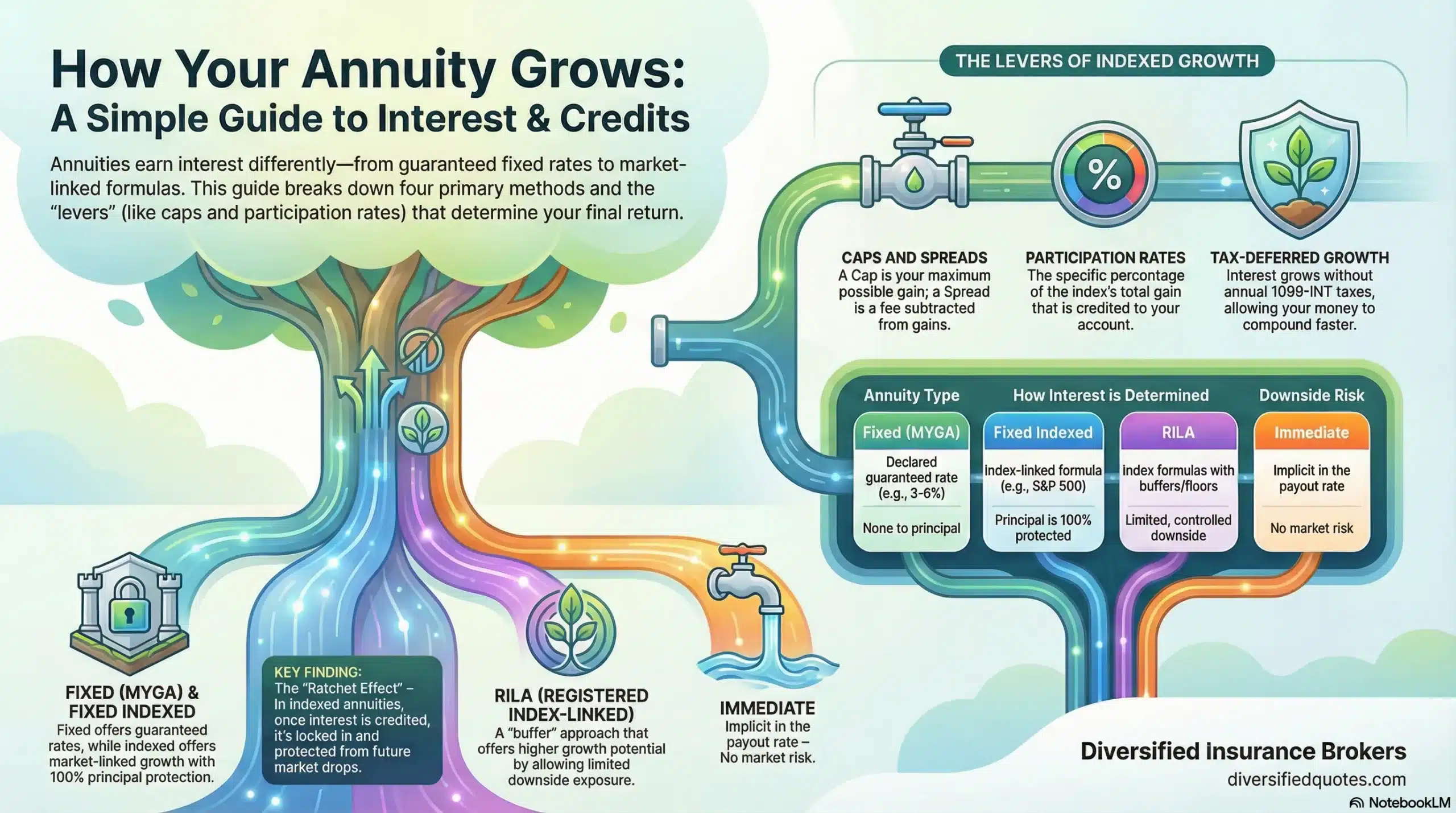
The mechanics are straightforward: a fixed indexed annuity credits interest based on the performance of an external index (such as the S&P 500) subject to a participation rate, cap rate, or spread — but the contract includes a contractual floor of zero, meaning the worst credited interest in any index period is 0% (or in some designs, a small guaranteed minimum). If the index falls 30% in a year, the annuity credits 0% for that period. The account value does not fall. This is a contractual guarantee from the carrier, enforceable as an obligation of the insurance company and supported by the same state guaranty association system described above.
Our resource on what happens to a fixed indexed annuity if the market goes down covers this protection mechanism specifically. Our resource on whether an indexed annuity is safe addresses the overall safety profile of the product category. For conservative investors who want market-linked upside potential without the principal risk of direct market exposure, the combination of market protection and contractual guarantees in a fixed indexed annuity addresses a concern that bank products — including FDIC-insured CDs — cannot address, because CDs provide no market upside at all. Our resource on how fixed annuities protect against market volatility covers the broader volatility protection story.
Variable Annuities and Why the Are Annuities FDIC Insured Answer Matters More There
Not all annuities are created equal from a safety standpoint, and the are annuities FDIC insured question has genuinely different implications depending on the specific annuity type being considered. For fixed and fixed indexed annuities, the absence of FDIC insurance is largely offset by the contractual and regulatory protections described above. For variable annuities, the situation is meaningfully different.
Variable annuities invest the policyholder’s premium in separate account sub-accounts that function similarly to mutual funds. The account value rises and falls with the performance of these sub-accounts, and the policyholder bears full market risk within the variable sub-accounts. There is no zero floor — a variable annuity’s account value can decline significantly in a severe market downturn, just as a mutual fund would. The separate account assets are segregated from the carrier’s general account assets, which provides some insulation from carrier insolvency, but the investment risk is entirely the policyholder’s.
Variable annuities are often sold with living benefit riders — guaranteed minimum withdrawal benefit riders (GMWBs), guaranteed lifetime withdrawal benefit riders (GLWBs), or guaranteed minimum accumulation benefit riders (GMABs) — that provide contractual guarantees over the sub-account performance. Our resource on how GLWB riders work covers these guarantees in detail. The guarantees in variable annuity riders are obligations of the carrier’s general account, not the separate account, and they are subject to the same carrier solvency and guaranty association protections as fixed annuities. The are annuities FDIC insured question matters most for variable annuity holders because the investment component carries genuine market risk — and neither FDIC insurance (which never applied) nor the guaranty association system (which covers the contractual guarantees) protects against investment losses in the sub-accounts.
How to Evaluate Annuity Safety Before Purchasing
For a consumer who has processed the are annuities FDIC insured question and wants to make a genuinely informed annuity purchase from a safety standpoint, the evaluation process involves four practical steps that collectively address the protections available to annuity policyholders.
The first step is carrier selection based on financial strength ratings. Limiting purchases to carriers with A- or better AM Best ratings — and ideally A or better for larger purchases — is the most direct way to reduce the probability of exposure to a financially stressed carrier. Rating agencies update ratings regularly, and checking current ratings before any purchase (rather than relying on a rating from months or years earlier) ensures the most current picture. Our resource on what AM Best ratings mean and our overview of annuities for conservative investors both incorporate carrier quality as a central selection criterion.
The second step is understanding your state’s guaranty association coverage limits. Most states provide at least $250,000 per policyholder per insolvent insurer for annuity accumulation values, but limits vary and the specific coverage may differ for different benefit types within the same contract. Knowing your state’s limits is practical planning information that directly informs the third step.
The third step is diversifying across multiple highly rated carriers if your total annuity allocation exceeds the guaranty association per-insurer limit. Because guaranty association coverage applies per insurer, spreading $500,000 across two $250,000 annuities with two different highly rated carriers doubles the total guaranty association protection compared to a single $500,000 contract with one carrier. Our resource on laddering annuities covers how this multi-carrier approach can also serve income and liquidity planning goals simultaneously.
The fourth step is selecting the annuity type that matches your actual risk tolerance and goals. For maximum safety of principal, fixed annuities and fixed indexed annuities with strong carriers provide contractual principal protection alongside the guaranty association backstop. For retirees who need lifetime income, income annuities provide the additional protection of longevity insurance — a contractual guarantee to pay income regardless of how long you live, which is a protection that no bank product offers. Our resource on whether annuities are a good investment frames this evaluation in broader planning terms.
Lifetime Income: The Protection Annuities Offer That FDIC Never Can
The are annuities FDIC insured conversation typically focuses on safety of principal and accumulated value — the dimensions where FDIC provides the clearest protection for bank deposits. But there is a dimension of financial protection that annuities provide and that FDIC-insured bank products categorically cannot: guaranteed lifetime income regardless of how long you live.
This longevity protection is the core value proposition of income annuities and deferred annuities with income riders. A CD, regardless of its FDIC insurance, is a finite pool of assets. Once the principal and interest are consumed, the money is gone. An annuity structured to pay lifetime income continues paying regardless of account balance — because the payment obligation is backed by the carrier’s contractual guarantee and funded by actuarial pooling across many policyholders. No FDIC-insured product has ever guaranteed that its owner will never run out of income for life. That is a promise unique to insurance-based solutions.
For retirees planning 20, 25, or 30-year retirements, the risk of outliving savings is statistically significant and financially catastrophic if it occurs. A lifetime income annuity converts that open-ended longevity risk into a defined, managed obligation of the insurance carrier. Our resource on how to not run out of money in retirement covers the longevity risk framework and how guaranteed income addresses it. Our resource on lifetime income planning covers the full spectrum of guaranteed income strategies within a complete retirement income architecture.
Tax Treatment: Another Advantage Beyond the FDIC Question
The are annuities FDIC insured question almost never surfaces the tax dimension, but tax treatment is one of the most practically significant advantages of annuities over bank deposits for long-term retirement savings — one that compounds over time in ways that offset or exceed the safety differential most savers are worried about when they ask the question.
Interest earned inside a fixed or fixed indexed annuity grows tax-deferred — meaning no annual tax on credited interest until withdrawal. For a CD, interest is taxable in the year it is earned regardless of whether it is distributed, which means the government effectively participates in the compounding by capturing a share of returns each year. Over multi-year holding periods, this tax drag on CD interest is a real cost that should be incorporated into any honest yield comparison between CDs and annuities. Our resource on how tax deferral creates generational compounding quantifies this advantage with specific examples, and our resource on the annuity exclusion ratio covers the tax treatment of non-qualified annuity distributions specifically.
When distributions are taken from a non-qualified annuity — one purchased with after-tax dollars — a portion of each payment is excluded from income tax as a return of principal (the cost basis), and only the gain portion is taxable as ordinary income. This is fundamentally different from the taxation of CD interest, where the entire interest amount is ordinary income each year. The exclusion ratio mechanism means that non-qualified annuity distributions are often taxed more favorably than equivalent withdrawals from taxable bank accounts, particularly when the distribution is partly principal recovery. Our resource on whether annuity death benefits are taxable covers the tax treatment of what beneficiaries receive, which is another planning consideration beyond the are annuities FDIC insured question.
Using the Are Annuities FDIC Insured Insight in a Complete Retirement Strategy
The most productive use of the are annuities FDIC insured knowledge is as a prompt to build a more sophisticated understanding of how different financial products are protected, how they interact in a complete retirement portfolio, and how safety and protection can be optimized across the complete asset structure rather than evaluated product by product in isolation.
Many retirees benefit from maintaining both FDIC-insured deposits and annuities within a coordinated strategy. FDIC-insured bank accounts provide immediate liquidity and simple day-to-day account access for operating expenses. Fixed annuities or multi-year guaranteed annuities (MYGAs) provide higher guaranteed yields with tax deferral for the portion of savings not needed in the near term. Fixed indexed annuities provide principal protection with upside potential linked to market performance. Income annuities provide guaranteed lifetime income as a foundation layer. Our resource on understanding MYGAs covers the specific structure of multi-year guaranteed annuity products that most directly compete with CDs on yield, and our overview of the pre-retirement checklist covers how all these elements fit within the complete retirement planning process.
The are annuities FDIC insured question, properly understood, is not a reason to avoid annuities — it is an invitation to understand how annuities are protected and why that protection structure is appropriate for insurance products. For most retirees and pre-retirees with conservative savings goals, the combination of contractual guarantees from strong carriers, state regulatory oversight, state guaranty association protection, and financial strength ratings creates a protection system that is robust, tested, and appropriate for the role annuities play in a retirement income strategy. Our resource on safe fixed annuity options and our broader overview at annuities cover the complete product landscape for conservative savers evaluating their options.
Compare Annuity Options From Top-Rated Carriers
We’ll help you understand how guarantees work, which carriers have the strongest financial strength ratings, and how to structure an annuity allocation that optimizes both yield and safety.
Request a Personalized Annuity AnalysisRelated Annuity Safety and Planning Pages
Explore annuity protection structures, product safety, carrier evaluation, and conservative retirement income strategies.
Financial Protection Essentials
Coordinate annuity planning with Medicare, long-term care, and comprehensive retirement income strategies.
Talk With an Advisor Today
Choose how you’d like to connect—call or message us, then book a time that works for you.
Schedule here:
calendly.com/jason-dibcompanies/diversified-quotes
Licensed in all 50 states • Fiduciary, family-owned since 1980
Frequently Asked Questions: Are Annuities FDIC Insured?
Are annuities FDIC insured?
No. Annuities are not FDIC insured because they are insurance contracts, not bank deposits. The Federal Deposit Insurance Corporation insures only deposit accounts — checking accounts, savings accounts, money market deposit accounts, and CDs — held at FDIC-member banking institutions. Annuities are issued by insurance companies and are protected through a different system: the carrier’s own statutory reserves and capital, state insurance department oversight, and state life and health insurance guaranty associations that provide coverage for policyholders when a carrier becomes insolvent.
The absence of FDIC insurance does not mean annuities are unsafe or unprotected. It means they operate under a different regulatory and protection framework appropriate to their nature as insurance contracts rather than bank deposits. For most policyholders purchasing from highly rated carriers and keeping balances within guaranty association limits, the practical protection is strong. Our resource on how annuities are insured covers the protection framework in detail.
How are annuities protected if they are not FDIC insured?
Annuities are protected through three layers: the carrier’s own statutory reserves and capital maintained to cover all contractual obligations; ongoing state insurance department oversight monitoring solvency, capital adequacy, and financial management; and state life and health insurance guaranty associations that step in if a carrier becomes insolvent, covering policyholders up to statutory limits (typically at least $250,000 per policyholder per insolvent insurer in most states, though limits vary).
This layered system has a strong historical track record — annuity policyholders within applicable coverage limits have consistently been protected in the rare cases of carrier insolvency that have occurred. Our resource on state guaranty associations covers the coverage mechanics and limits for each state.
Are fixed annuities safer than CDs?
Fixed annuities and CDs are both conservative financial instruments, but their safety structures are different rather than directly comparable. CDs are protected by FDIC insurance (up to $250,000 per depositor per bank) and pay interest that is taxable each year. Fixed annuities are protected by the carrier’s reserves and state guaranty associations (typically up to $250,000 per policyholder per carrier) and grow tax-deferred until withdrawal. For balances within each product’s respective coverage limits, both provide strong protection — the mechanism differs, not the outcome for most holders. Fixed annuities often offer higher guaranteed yields than CDs of comparable terms, and the tax deferral can produce materially better net accumulation over multi-year periods.
What are state guaranty associations and what protection do they provide?
State life and health insurance guaranty associations are mandatory industry-funded backstops that protect policyholders when a licensed insurer becomes insolvent. Every state has one, and all life and annuity carriers licensed in a state must be members as a condition of doing business. If a carrier becomes insolvent, the guaranty association steps in to pay claims, transfer policies to solvent carriers, or continue servicing obligations — up to statutory coverage limits that vary by state but typically provide at least $250,000 per policyholder per insolvent insurer for annuity accumulation values. Because coverage is per insurer, policyholders with large balances can expand total protection by diversifying across multiple highly rated carriers.
Do all annuities guarantee the return of principal?
No. Fixed annuities and fixed indexed annuities provide contractual principal protection — the account value cannot decline due to interest rate changes or market performance. A fixed annuity guarantees the stated interest rate for the term; a fixed indexed annuity guarantees a zero floor, meaning no negative index-year credits. Variable annuities, however, invest in market-linked sub-accounts that can lose value, and principal is not guaranteed in the sub-accounts. The specific contractual guarantees in any annuity are obligations of the issuing carrier and subject to the protection framework described above — not FDIC insurance. Our resource on whether you can lose money in an annuity covers the principal protection question across annuity types.
How should I evaluate carrier safety before buying an annuity?
The most practical steps for evaluating carrier safety are: check the carrier’s current AM Best rating (most advisors recommend A- or better; A or better for large purchases); verify the carrier’s rating with at least one other independent agency (Moody’s, S&P, or Fitch); confirm your state’s guaranty association coverage limits; and for balances exceeding those limits, spread purchases across multiple highly rated carriers to stay within per-insurer coverage thresholds. Our resource on what AM Best ratings mean covers the rating scale and how to interpret ratings for purchase decisions.
What tax advantages do annuities have that CDs do not?
Annuity interest grows tax-deferred — no annual tax on credited growth until withdrawal, regardless of whether the interest is distributed. CD interest, by contrast, is taxable as ordinary income each year whether or not it is withdrawn, which creates annual tax drag that reduces net compounding. Over multi-year holding periods, this tax deferral difference can produce meaningfully higher net accumulation in an annuity compared to a CD with the same pre-tax yield. For non-qualified (after-tax) annuity purchases, distributions also benefit from the exclusion ratio — a portion of each payment representing return of principal is excluded from income tax, potentially making annuity distributions more tax-efficient than equivalent bank account withdrawals. Our resource on how tax deferral creates generational compounding quantifies this advantage with specific examples.
Can annuities guarantee lifetime income in a way FDIC-insured products cannot?
Yes. This is one of the most fundamental distinctions between annuities and bank products, and it represents a form of financial protection that no FDIC-insured product can offer. An annuity structured as a lifetime income stream — whether an immediate annuity, a deferred income annuity, or a deferred annuity with a guaranteed lifetime withdrawal benefit rider — contractually guarantees income payments for as long as the annuitant lives, regardless of account balance. A CD or savings account is a finite pool; once the money is spent, it is gone. A lifetime income annuity converts longevity risk into a managed contractual obligation of the insurance carrier. For retirees concerned about outliving their savings, this longevity protection is a form of financial security that FDIC insurance, by its nature as a deposit protection mechanism, cannot replicate.
About the Author:
Jason Stolz, CLTC, CRPC, DIA, CAA and Chief Underwriter at Diversified Insurance Brokers (NPN 20471358), is a senior insurance and retirement professional with more than 25 years of real-world experience helping individuals, families, and business owners protect their income, assets, and long-term financial stability. As a long-time partner of the nationally licensed independent agency Diversified Insurance Brokers, Jason provides trusted guidance across multiple specialties—including fixed and indexed annuities, long-term care planning, personal and business disability insurance, life insurance solutions, Group Health, Travel Medical and Evacuation Insurance, and short-term health coverage. Diversified Insurance Brokers maintains active contracts with over 100 highly rated insurance carriers, ensuring clients have access to a broad and competitive marketplace.
His practical, education-first approach has earned recognition in publications such as VoyageATL, and contributions from his agency featured in Kiplinger and GoBankingRates— highlighting his commitment to financial clarity and client-focused planning. Drawing on deep product knowledge and years of hands-on field experience, Jason helps clients evaluate carriers, compare strategies, and build retirement and protection plans that are both secure and cost-efficient. Visitors who want to explore current annuity rates and compare options across multiple insurers can also use this annuity quote and comparison tool.
Explore More Annuity Options: Browse our complete guide to What Is a Fixed Annuity? — covering fixed annuities, MYGAs, laddering strategies & conservative growth options from 100+ carriers.
Last Reviewed: May 23, 2026 |
Reviewed by: Jason Stolz, CLTC, CRPC, DIA, CAA
Chief Underwriter, Diversified Insurance Brokers, Inc. | NPN: 20471358 | Diversified Insurance Brokers, Inc. — Licensed in all 50 states
Fact Checked by: Tonia Pettitt, CMIP©
Medicare Specialist, Diversified Insurance Brokers, Inc. | NPN: 14374308 | Diversified Insurance Brokers, Inc. — Licensed in all 50 states
Did you find this content helpful? Leave us a Google review — it helps others find trustworthy guidance too.
Editorial Standards: Diversified Insurance Brokers maintains rigorous editorial standards to ensure accuracy, clarity, and independence in all content. Learn more about our editorial standards and commitment to transparency.
