
Fixed Indexed Annuities vs. Variable Annuities
Fixed Indexed Annuities vs. Variable Annuities

Jason Stolz CLTC, CRPC, DIA, CAA
Fixed Indexed Annuities vs. Variable Annuities — The Core Difference That Determines Which One Belongs in Your Plan
The fundamental difference between a fixed indexed annuity and a variable annuity is principal protection: a fixed indexed annuity contractually guarantees that market index declines cannot reduce your account value, while a variable annuity invests your premium directly in subaccounts that expose your account value to full market losses with no floor unless you pay extra for a protective rider. Every other difference — the fee structures, the income rider mechanics, the upside potential, the regulatory framework, the sales process — flows from that single structural distinction. If you cannot afford to lose principal in retirement, a fixed indexed annuity is almost always the more appropriate instrument. If you are willing to accept full market risk inside an annuity wrapper in exchange for uncapped upside potential and tax-deferred growth, a variable annuity may serve a specific purpose within a diversified retirement portfolio. The two products are not competing solutions to the same problem — they are solutions to different problems, and the planning error is treating them as interchangeable rather than as instruments whose suitability depends entirely on the specific risk tolerance, income needs, and timeline of the individual buyer. At Diversified Insurance Brokers, Jason Stolz, CLTC, CRPC, DIA, CAA works through this comparison with every client evaluating annuities for retirement income or accumulation — examining the actual cost structure, the income rider mechanics, the behavior of each product in adverse market conditions, and how each fits within the client’s complete retirement income architecture before any recommendation is made. How annuity contracts work as insurance company agreements — and specifically how the legal and regulatory structure differs between FIAs as state-regulated insurance products and variable annuities as federally regulated securities — is foundational context for understanding why the two products operate under entirely different compliance frameworks.
How Each Product Is Actually Structured — And Why It Matters
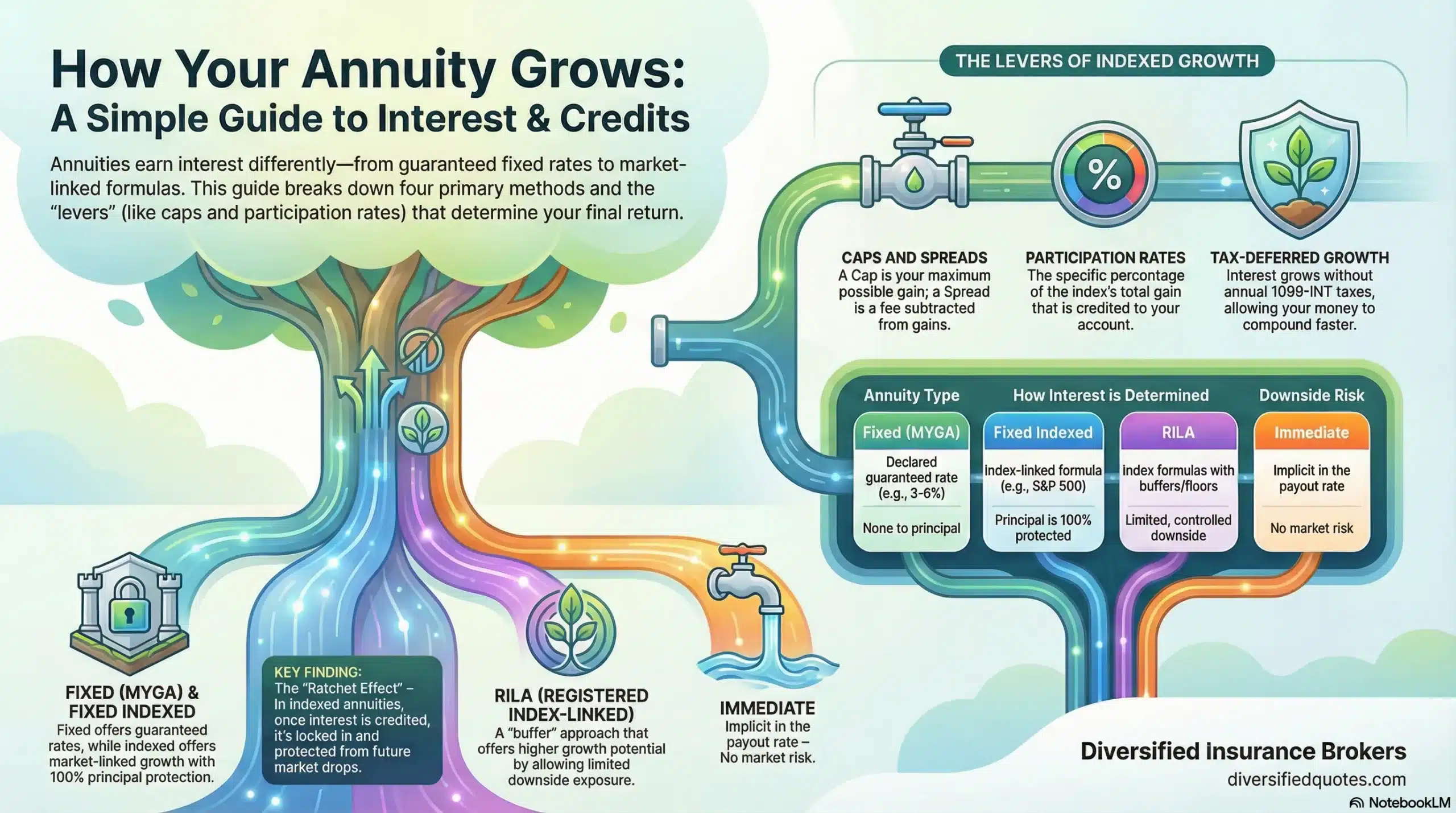
A fixed indexed annuity does not invest your premium in the stock market. The carrier places the premium primarily in its fixed income investment portfolio, earns a yield on those assets, and uses a portion of that yield to purchase index options — typically one-year call options on a market index such as the S&P 500. If the index rises during the crediting period, the options gain value and the carrier credits the gain to the policyholder’s account, subject to the cap rate, participation rate, or spread defined in the contract. If the index falls during the crediting period, the options expire worthless, and the carrier credits zero percent — not a negative number, zero. The policyholder’s account value does not decline due to market performance. This mechanism is not magic — it is insurance economics. The carrier accepts the downside risk of bad index years in exchange for the upside limitation defined by the crediting formula. The tradeoff is transparent: capped upside in exchange for eliminated downside. Whether an annuity can lose money and under what specific circumstances is the foundational risk question, and the answer differs completely between FIAs and variable annuities. How the fixed indexed annuity crediting mechanism works in detail — the options budget, annual reset, and cap rate setting process — is the technical explanation that makes the 0% floor understandable as an insurance product feature rather than as an unexplained guarantee.
A variable annuity takes a fundamentally different approach. The premium is allocated to investment subaccounts — investment vehicles that function like mutual funds within the annuity wrapper — and the account value rises and falls directly with the performance of those subaccounts. If the S&P 500 subaccount drops 30% in a bear market year, the account value drops 30%. There is no 0% floor on a base variable annuity contract. The upside is uncapped — in a strong year, the account value captures the full subaccount return minus fees. The downside is full — in a bad year, the account value absorbs the full subaccount loss. Variable annuities are registered as securities with the Securities and Exchange Commission, require a prospectus that can run 100 pages or more, and can only be sold by agents who hold a Series 6 or Series 7 securities license in addition to a state insurance license. The prospectus requirement and securities registration reflect the investment risk the product carries — because the policyholder bears direct market exposure rather than receiving a contractual principal protection guarantee from the insurance carrier. What annuity guarantees mean — and specifically the distinction between the FIA’s contractual 0% floor as a principal protection guarantee versus the variable annuity’s optional rider-based protections that require additional cost — is the guarantee structure comparison that determines which product’s risk profile is appropriate for any specific retirement situation.
Ensure you are receiving the absolute top rates
Current Fixed Annuity Rates
Compare today’s best fixed annuity rates from top carriers.
Current Bonus Annuity Rates
See which annuities offer the highest upfront bonus today.
Request an Annuity Quote
Submit our annuity request form to get personalized rate options.
Lifetime Income Calculator
Use our calculator to see how much guaranteed income your annuity can provide.
Side-by-Side Comparison — The Dimensions That Matter Most in Retirement Planning
| Planning Dimension | Fixed Indexed Annuity (FIA) | Variable Annuity (VA) |
|---|---|---|
| Principal protection | Permanent 0% floor — the index’s negative return in any crediting period produces zero credited interest, not a reduction in account value; principal is contractually protected from market-caused losses for the full life of the contract without any additional rider or cost | No built-in principal protection — account value rises and falls directly with subaccount performance; optional guaranteed minimum accumulation benefit (GMAB) or similar riders can provide a conditional floor but require additional cost and typically apply only after a defined holding period |
| Upside potential | Capped — crediting formulas include cap rates, participation rates, or spreads that limit the maximum credited interest in any given crediting period; the cap is the mechanism that funds principal protection; over historical 10-year periods with a 10% annual cap on the S&P 500, average annual FIA crediting has been approximately 6–7% | Uncapped before fees — subaccounts capture full index or fund return in strong market years without a ceiling; after fees, the net return is reduced by the total cost layer including mortality and expense charges, administrative fees, subaccount management expenses, and any optional rider costs |
| Fee structure | Base FIA: no explicit annual fee; costs are embedded in the crediting rate structure (the spread between index performance and credited interest); income rider if elected: typically 0.75–1.25% of the benefit base annually, deducted from account value; total explicit annual cost with a rider is generally 0.75–1.25% | Multiple layered fees: mortality and expense (M&E) charges, administrative fees, subaccount investment management expenses, and optional rider charges; total annual costs commonly range from 2–4% and can exceed 4% when multiple riders are added; these fees compound over time and directly erode net return regardless of market performance |
| Regulatory framework | State-regulated insurance product — sold by state-licensed insurance agents; not registered with the SEC; no prospectus required; state insurance regulators govern product design, reserve requirements, and suitability standards; state guarantee associations provide insolvency protection up to defined limits | SEC-registered security — must be sold by a licensed insurance agent who also holds a Series 6 or Series 7 securities license; a full prospectus is required and provided at sale; subject to SEC and FINRA oversight in addition to state insurance regulation; SIPC does not cover variable annuities; state guarantee association limits apply to the insurance wrapper |
| Income rider mechanics | GLWB benefit base grows at a guaranteed roll-up rate (typically 5–8% annually) independent of actual index performance — the benefit base continues growing even in years when the index credits zero; income activation and payout percentage are predictable from contract terms at purchase | GLWB benefit base on most VA contracts is tied to subaccount performance with step-up provisions — strong market years increase the benefit base; weak market years may leave it flat if account value falls below the benefit base; the income guarantee protects the withdrawal rate but the underlying benefit base trajectory is less predictable than an FIA’s guaranteed roll-up |
| Sequence of returns risk | Substantially eliminated for the account value — the 0% floor means a bear market early in retirement does not reduce the account value from which income will eventually be drawn; the income rider’s benefit base is further isolated from market performance by the guaranteed roll-up mechanism | Full exposure without an income rider — a retiree drawing income from a variable annuity during a bear market faces the combination of declining subaccount values and ongoing withdrawal reductions that can accelerate account depletion permanently; income riders provide some protection but income base step-ups may be missed during prolonged downturns |
The comparison table establishes the six most consequential dimensions for retirement planning purposes. The complete fee structure of annuity contracts — and specifically how layered variable annuity fees compound over time to reduce net return even in positive market years — is the cost analysis that most buyers underestimate before purchasing a variable annuity. How FIAs protect against market downturns in specific market scenarios — not just in theory but in terms of the actual account value behavior during historical bear markets — is the practical illustration of the 0% floor’s real-world value for retirees in the distribution phase.
The Fee Comparison That Changes the Net Return Picture
The upside potential comparison between FIAs and variable annuities looks significantly different before and after fees are applied — and the before-fees comparison is the one most commonly cited by variable annuity proponents. Before fees, a variable annuity’s subaccounts can capture full market returns in strong years with no upside cap, while an FIA’s crediting is limited by cap rates and participation rates. This comparison is accurate but incomplete. After fees, a variable annuity earning 8% gross in a moderate market year nets approximately 4.5–6% after a total annual cost layer of 2–3.5% across M&E charges, administrative fees, subaccount management expenses, and a GLWB rider charge. A fixed indexed annuity crediting 5.5% in the same market year with a 1% income rider fee nets approximately 4.5%. The net outcomes converge — and in many scenarios the FIA’s lower fee structure produces better net results despite its lower gross crediting ceiling, particularly when the benefit of the 0% floor in down years is factored into the multi-year return calculation. Research on this comparison consistently finds that a typical FIA crediting 4–6% net of rider fees frequently outperforms a typical variable annuity earning 7–9% gross before fees when the full multi-year return is calculated across complete market cycles that include both up and down years. Surrender charges on both product types are a shared liquidity consideration — most contracts allow approximately 10% annual free withdrawals during the surrender period, and both types impose declining surrender charges for excess withdrawals before the surrender period ends. The annuity free withdrawal rules for both product types establish the practical annual liquidity available without charge during the accumulation period. Products like the Lincoln OptiBlend and the ClearSprings Vistar FIA illustrate how principal protection and competitive crediting can be packaged within FIA structures that carry no explicit base contract fees — the carrier profiles for Lincoln Financial and Delaware Life establish the financial strength context for evaluating these products.
Income Riders on FIAs vs. Variable Annuities — Where the Difference in Predictability Lives
Both FIAs and variable annuities can include guaranteed lifetime withdrawal benefit (GLWB) income riders — and at first glance the income guarantee sounds functionally equivalent across both product types. The critical difference is in how the benefit base that calculates the guaranteed income amount grows during the deferral period. On most fixed indexed annuity income rider designs, the benefit base grows at a guaranteed roll-up rate — typically 5–8% annually — that applies regardless of actual index performance. In a year when the index credits zero percent, the FIA’s benefit base still grows at the full guaranteed roll-up rate. The income calculation foundation is insulated from market volatility and grows on a predictable trajectory that the owner can project from the contract terms at purchase. On most variable annuity GLWB designs, the benefit base grows through step-up provisions tied to subaccount performance — the benefit base is reset to the higher account value on contract anniversaries when the subaccounts perform well. During bear markets or prolonged flat periods, the step-up does not occur, and the benefit base growth may stall until the subaccounts recover. The income guarantee protects the withdrawal rate on the benefit base that was locked in, but the benefit base level itself depends on when the most recent step-up occurred relative to market cycles. For retirees who want to know at the time of purchase approximately what their guaranteed monthly income will be at a defined activation age, the FIA’s predictable roll-up trajectory provides that clarity far more precisely than the variable annuity’s market-dependent step-up structure. How the GLWB works in detail — and specifically how the benefit base grows through roll-ups and step-ups on FIA contracts — is the income mechanics explanation that makes this distinction concrete. Fixed indexed annuities with income riders as a planning category establishes the full landscape of product options available for combining principal protection with guaranteed lifetime income. Products specifically designed around the income objective include the AIG Power Series, the Corebridge Power Series, and the Atlantic Coast Life Income Navigator — each offering a different design approach to the income rider structure within the FIA’s principal-protected framework. American National’s carrier profile and the American National Strategy Indexed Annuity Plus 10 illustrate how indexed growth and built-in income safety can be combined in a single FIA contract design. The North American BenefitSolutions 10 takes the income rider concept further by incorporating built-in long-term care benefits alongside the lifetime income structure — addressing two separate retirement risk dimensions in one contract. Atlantic Coast Life’s financial profile establishes the carrier context for the income guarantee backing these products.
When a Variable Annuity Still Makes Sense — and When to Consider a 1035 Exchange
A variable annuity is not inherently wrong — it is specifically wrong for buyers whose retirement plan cannot withstand principal loss and for buyers whose fee awareness is insufficient to evaluate whether the cost layer is justified by the specific guarantees and features provided. For a buyer with a long investment horizon, high risk tolerance, and a specific planning need that is only available within the variable annuity’s subaccount structure — such as access to a specific subaccount strategy or a legacy benefit design not available in the FIA market — a variable annuity may be the appropriate instrument. The variable annuity is most defensible when the cost layer is low (investment-only variable annuities with minimal M&E charges exist for buyers who do not need the insurance riders), when the buyer has a long time horizon to recover from market drawdowns, and when the specific planning objective genuinely requires direct market exposure rather than index-linked crediting with a floor. For the broad population of pre-retirees and retirees who purchased variable annuities during accumulation years when high risk tolerance was appropriate and who are now approaching or in the distribution phase with reduced risk tolerance, the mismatch between the variable annuity’s market exposure and the current planning objective is the most common scenario requiring evaluation. The 1035 exchange — a tax-free transfer of the existing variable annuity’s accumulated value to a new contract — provides the mechanism for repositioning into a fixed indexed annuity without triggering ordinary income tax on the accumulated gain in the existing contract. How the tax treatment of annuity exchanges works — and specifically how the 1035 exchange preserves tax deferral during the repositioning — is the tax mechanics foundation for evaluating whether a 1035 exchange from a variable annuity to an FIA makes financial sense in a specific situation. The comparison between annuities and 401k plans for retirement accumulation provides the broader asset allocation context within which both FIA and variable annuity positioning decisions are made. How Social Security and annuities coordinate in a retirement income plan is the income architecture context that determines how much of the total retirement income the annuity component needs to provide — which affects whether principal protection or maximum growth potential is the more critical feature. Guaranteed income from annuities as a planning concept encompasses both the FIA GLWB approach and the variable annuity GLWB approach within the same income planning framework. Lifetime income annuities across all structures — immediate, deferred, FIA-based, and variable — provide the comprehensive category comparison for retirement income planning. Annuity income as a monthly retirement income source establishes the practical cash flow dimension that determines how much monthly guaranteed income any specific annuity structure will produce. The annuity rescue plan process at Diversified Insurance Brokers evaluates existing variable annuity contracts specifically — reviewing the current fee structure, the income rider terms and benefit base, the 1035 exchange opportunity, and the comparison between staying in the existing contract versus repositioning to a current FIA or MYGA that may produce better net outcomes — and provides a documented side-by-side analysis before any recommendation to exchange is made. The best annuity for lifetime income from any individual’s specific situation is identified through this full market comparison rather than through a preference for either product category as an abstract rule. Fixed indexed annuities as the hidden gem of retirement planning makes the full case for the FIA’s role in the retirement income and accumulation architecture when evaluated on appropriate terms — not as a replacement for all other instruments but as the specific solution for the risk-managed growth and guaranteed income objectives that the retirement phase demands.
Get a Side-by-Side FIA vs. Variable Annuity Comparison
We run personalized illustrations comparing fee structures, income rider designs, benefit base projections, and net return scenarios across 100+ FIA carriers — so you can see exactly how each product type performs for your specific age, premium, and retirement timeline.
Talk With an Advisor Today
Choose how you’d like to connect—call or message us, then book a time that works for you.
Schedule here:
calendly.com/jason-dibcompanies/diversified-quotes
Licensed in all 50 states • Fiduciary, family-owned since 1980
FAQs: Fixed Indexed Annuities vs. Variable Annuities
Can a variable annuity with a GLWB rider provide the same income security as a fixed indexed annuity with an income rider?
Both products can guarantee that the annual withdrawal amount continues for life even if the account value reaches zero — that specific guarantee is equivalent in structure. The income amounts, however, are not guaranteed to be equivalent, and the predictability of the income projection differs significantly between the two products. On a fixed indexed annuity, the benefit base grows at a contractually guaranteed roll-up rate regardless of market performance — a buyer can project the approximate guaranteed income at a defined activation age from the contract terms at purchase with meaningful accuracy. On a variable annuity, the benefit base typically grows through step-up provisions tied to subaccount performance — the benefit base increases when subaccounts hit new highs but may stall or grow slowly during bear markets or flat periods when the step-up conditions are not met.
The practical implication is that in favorable market environments, a variable annuity’s income rider may produce a larger benefit base and therefore higher guaranteed income than the FIA’s fixed roll-up would generate over the same period — because uncapped subaccount growth can drive step-ups well above the FIA’s guaranteed floor. In adverse market environments or prolonged flat periods, the FIA’s guaranteed roll-up continues building the benefit base predictably while the variable annuity’s step-up mechanism may not trigger. For a pre-retiree who wants to know at the time of purchase what their minimum guaranteed income will be at retirement, the FIA provides that certainty more reliably than the variable annuity’s market-dependent step-up structure. For a buyer who is willing to accept some uncertainty in the benefit base trajectory in exchange for the possibility of larger income in strong market cycles, the variable annuity’s GLWB may be appropriate — at the cost of higher fees and the risk of lower income if markets underperform during the accumulation period.
What happens to a variable annuity’s account value in a major market downturn?
In a major market downturn, a variable annuity’s account value declines proportionally with the performance of the subaccounts in which the premium is invested — just as a mutual fund account would decline. A 30% subaccount decline in a bear market year produces approximately a 30% decline in the account value, net of any fees that were charged during the period. There is no 0% floor on a base variable annuity contract. If the subaccounts drop 40% in a severe market decline, the account value drops approximately 40%. The account value can fall well below the original premium paid if market declines are large enough and fees continue to be charged on the declining balance.
Optional riders on variable annuities — guaranteed minimum accumulation benefits, guaranteed minimum income benefits, or guaranteed minimum withdrawal benefits — can provide conditional protections, but these riders add cost and typically apply only under specific conditions. A GMAB rider might guarantee the account value will not be less than the original premium after a 10-year holding period, but it does not prevent the account value from declining below the premium during those 10 years, and it requires the owner to remain in the contract for the full protection period to benefit from the guarantee. For retirees who are already drawing income from a variable annuity when a major market decline occurs, the combination of declining subaccount values and ongoing withdrawal deductions can create a particularly severe depletion dynamic — withdrawals taken from a declining account reduce the balance available for market recovery, and the recovery must overcome both the market loss and the continued withdrawal impact to restore the account to its pre-decline value.
Are the fees in a variable annuity worth what they cost?
Whether variable annuity fees are worth their cost depends entirely on whether the specific features those fees fund are genuinely needed for the buyer’s planning objectives — and whether those same features could be obtained at lower cost through alternative structures. The variable annuity’s fee layers — M&E charges, administrative fees, subaccount management expenses, and optional rider costs — total 2–4% or more annually in many contracts, and those fees are charged on the account value whether markets are up or down. In a flat or declining market year, the fee deduction further reduces the account value; in a strong year, the fee deduction reduces the net return below the subaccount’s gross return. The compounded effect of a 3% annual fee over 20 years on a $300,000 account is a reduction of hundreds of thousands of dollars in potential accumulated value.
For a buyer who genuinely needs the specific combination of features a variable annuity provides — direct subaccount market exposure, tax deferral, and a GLWB income guarantee — the fees may be justified. For a buyer who primarily needs principal protection, tax-deferred growth, and guaranteed lifetime income, the FIA typically delivers those same objectives at a fraction of the cost. For a buyer who primarily needs tax-deferred market exposure without the insurance features, an investment-only variable annuity with minimal M&E charges may be more appropriate than either a standard VA or an FIA. The fee analysis should always start with the question of which specific features are actually needed for the planning objective — and whether those features are available at lower cost in a different product structure — before accepting the variable annuity’s layered cost as a given.
If I already own a variable annuity, should I consider exchanging it for a fixed indexed annuity?
Whether a 1035 exchange from an existing variable annuity to a fixed indexed annuity makes financial sense depends on a comparison of the existing contract’s remaining value versus the new contract’s projected outcomes — and that comparison requires specific analysis of the existing contract’s terms, the current surrender charge status, the existing income rider’s benefit base and terms if one is in place, and the new contract’s cap rates, income rider design, and surrender schedule. A blanket recommendation to exchange or not exchange without that specific analysis would be incomplete at best and harmful at worst.
The most common scenario where a 1035 exchange from a variable annuity to an FIA is worth evaluating is when the existing variable annuity’s surrender charge period has expired or nearly expired, the fee structure is high relative to the benefits actually being used, the owner’s risk tolerance has decreased as retirement approaches or begins, and a current FIA with a competitive income rider would provide better guaranteed income per dollar of premium than the existing variable annuity contract’s GLWB design at the current benefit base level. The 1035 exchange allows the full accumulated value — including deferred earnings — to transfer to the new contract without triggering ordinary income tax. The analysis must confirm that the new contract’s projected income and accumulation outcomes justify forfeiting any remaining features of the existing contract and committing to the new contract’s surrender schedule. Diversified Insurance Brokers conducts this comparison through the annuity rescue plan process, providing a documented side-by-side comparison before any exchange recommendation is made.
Do FIAs and variable annuities have the same tax treatment?
Yes — both FIAs and variable annuities provide tax-deferred growth during the accumulation phase, meaning earnings are not taxed annually and only become taxable income when withdrawn. For non-qualified contracts funded with after-tax dollars, the LIFO (last-in-first-out) rule applies to both product types — early withdrawals are treated as earnings first and taxed as ordinary income before the tax-free cost basis is returned. The 10% IRS early withdrawal penalty for distributions before age 59½ applies to both product types in non-qualified contracts. Required minimum distribution rules apply to both when held in qualified accounts such as IRAs.
The primary tax distinction between non-qualified FIAs and variable annuities at distribution is the exclusion ratio: for non-qualified annuities paying through an annuitization or structured income stream, a defined portion of each payment is returned as tax-free cost basis recovery under the exclusion ratio calculation. Both products can use the exclusion ratio if distributions are structured as annuity payments rather than lump-sum withdrawals. For the GLWB systematic withdrawal approach used by most income rider holders, the LIFO rule applies and withdrawals are taxed as earnings first before cost basis recovery. The tax treatment does not differ between FIAs and variable annuities in any way that would create a significant planning advantage for either product type — both grow tax-deferred, both are taxed the same at distribution under the same rules, and both can use the 1035 exchange to transfer accumulated value tax-free to a new contract of the same type.
Is a fixed indexed annuity appropriate for someone with a long investment horizon who doesn’t retire for 20 years?
Yes — a 20-year accumulation horizon is actually one of the strongest arguments for an FIA with an income rider, not an argument against it. The income rider’s benefit base grows at a guaranteed roll-up rate throughout the deferral period — a 20-year accumulation window allows the benefit base to compound at the guaranteed rate for the full period before income is activated, producing a benefit base that can be two to four times the original premium depending on the specific roll-up rate and compounding method. The longer the deferral period before income activation, the larger the benefit base and the higher the guaranteed annual income at activation. A buyer who purchases at age 45 with a planned income start at 65 gets 20 full years of guaranteed benefit base growth — a runway that a buyer purchasing at 63 cannot replicate regardless of how competitive the current market offerings are.
The principal protection feature is also valuable over a 20-year horizon precisely because it removes the sequence of returns risk that would otherwise affect both the accumulation phase and the transition into distribution. A portfolio fully exposed to market risk during the 20 years before retirement can suffer a significant drawdown in the final years of accumulation — when account size is largest and the damage from a bear market is proportionally greatest in dollar terms. An FIA with the 0% floor prevents that scenario: even a severe bear market in the years immediately before the planned retirement date produces zero credited interest in those years rather than a permanent reduction in the accumulation base. For buyers with 20-year horizons, the FIA is a legitimate accumulation and income pre-positioning vehicle, not just a product for people already in retirement.
About the Author:
Jason Stolz, CLTC, CRPC, DIA, CAA and Chief Underwriter at Diversified Insurance Brokers (NPN 20471358), is a senior insurance and retirement professional with more than 25 years of real-world experience helping individuals, families, and business owners protect their income, assets, and long-term financial stability. As a long-time partner of the nationally licensed independent agency Diversified Insurance Brokers, Jason provides trusted guidance across multiple specialties—including fixed and indexed annuities, long-term care planning, personal and business disability insurance, life insurance solutions, Group Health, Travel Medical and Evacuation Insurance, and short-term health coverage. Diversified Insurance Brokers maintains active contracts with over 100 highly rated insurance carriers, ensuring clients have access to a broad and competitive marketplace.
His practical, education-first approach has earned recognition in publications such as VoyageATL, and contributions from his agency featured in Kiplinger and GoBankingRates— highlighting his commitment to financial clarity and client-focused planning. Drawing on deep product knowledge and years of hands-on field experience, Jason helps clients evaluate carriers, compare strategies, and build retirement and protection plans that are both secure and cost-efficient. Visitors who want to explore current annuity rates and compare options across multiple insurers can also use this annuity quote and comparison tool.
Browse More Resources: Return to our complete Fixed Indexed Annuity Products & Education guide — covering FIA products and education from top carriers.
Last Reviewed: June 9, 2026 |
Reviewed by: Jason Stolz, CLTC, CRPC, DIA, CAA
Chief Underwriter, Diversified Insurance Brokers, Inc. | NPN: 20471358 | Diversified Insurance Brokers, Inc. — Licensed in all 50 states
Fact Checked by: Tonia Pettitt, CMIP©
Medicare Specialist, Diversified Insurance Brokers, Inc. | NPN: 14374308 | Diversified Insurance Brokers, Inc. — Licensed in all 50 states
Did you find this content helpful? Leave us a Google review — it helps others find trustworthy guidance too.
Editorial Standards: Diversified Insurance Brokers maintains rigorous editorial standards to ensure accuracy, clarity, and independence in all content. Learn more about our editorial standards and commitment to transparency.
