
What is an Annuity Participation Rate
As an Independent Annuity Broker, we compare rates across 100+ carriers and 1,000 different annuities— not just one company’s product offerings — to find the best fit for your goals.
What is an Annuity Participation Rate

Jason Stolz CLTC, CRPC, DIA, CAA
An annuity participation rate is the percentage of an index’s gain that is used to calculate your credited interest for a given crediting period in a fixed indexed annuity. If the index rises 10% and your participation rate is 60%, the starting point for credited interest is 6% — before other contract rules like caps, spreads, or strategy-specific formulas are applied. Participation rates are one of the main crediting levers insurers use — alongside caps and spreads — to create a defined trade-off: principal protection in exchange for limited upside. Fixed indexed annuity sales exceeded $128 billion in 2025 according to LIMRA industry data, reflecting broad market recognition of this trade-off as a genuine retirement planning solution — but “linked to the market” is not the same as “equivalent to the market,” and participation rates are one of the clearest reasons why.
Participation rates can be deceptively simple. A higher participation rate sounds better than a lower one, but in real contracts the participation rate is only one part of the system. The same annuity may offer multiple strategies with different participation rates, caps, and terms. Another annuity may offer a lower participation rate but no cap at all. A third may offer 100% participation but apply a spread that reduces the credited amount in modest gain years. And once you add optional rider fees — especially if lifetime income is part of the plan — the highest participation rate on paper can become irrelevant if the net outcome is weaker than a contract with a lower posted participation rate but a better overall design. Understanding how a fixed indexed annuity works and how annuities earn interest provides the foundation that makes participation rate comparisons meaningful rather than superficial.
Ensure you are receiving the absolute top rates
Current Fixed Annuity Rates
Compare today’s best fixed annuity rates from top carriers.
Current Bonus Annuity Rates
See which annuities offer the highest upfront bonus today.
Request an Annuity Quote
Submit our annuity request form to get personalized rate options.
Lifetime Income Calculator
Use our calculator to see how much guaranteed income your annuity can provide.
Participation Rate vs. Cap vs. Spread — The Three Crediting Levers
Before examining how participation rates work in detail, the table below maps all three primary crediting levers against their mechanics, how they interact with one another, and the planning considerations that matter most when choosing between strategies. Note the linked row headers — each represents a concept with its own dedicated resource for deeper exploration.
| Crediting Lever | How It Works | Example (Index Gains 10%) | Best Market Environment | Key Planning Consideration |
|---|---|---|---|---|
| Participation Rate (FIA) | Credits a defined percentage of the index gain; no hard ceiling on upside in uncapped participation designs | 60% participation → credited 6%; 80% participation → credited 8%; 120% participation → credited 12% | Works well when index produces strong, consistent gains above the participation breakeven; less advantageous in flat or modest gain years where the reduced percentage produces minimal credit | Participation rates can be renewed annually; evaluate minimum guaranteed participation alongside current rate; common on volatility-controlled proprietary indices |
| Cap Rate (FIA) | Sets a ceiling on credited interest for the term; any index gain above the cap is not credited to the account | 8% cap → credited 8% (cap limits the full 10%); if index gains 6%, credited 6% (below cap, full amount credited) | Works well in moderate gain years where the index stays below the cap; underperforms participation strategies in very strong years where uncapped designs would credit more | Most transparent and intuitive structure; evaluate current cap vs. minimum guaranteed cap; caps also renewable annually |
| Spread Rate (FIA) | Subtracts a fixed percentage from the index gain before crediting; if the result is positive you receive it; if negative you receive 0% | 2% spread → credited 8% (10% minus 2%); if index gains 1.5% and spread is 2%, credited 0% — spread consumes the full gain | Favors strong market years where the index gain substantially exceeds the spread; can produce 0% in modest gain years in a way that cap and participation strategies would not | Often paired with volatility-controlled or uncapped index strategies; small spread differences compound over multi-year holding periods |
| Income Rider (GLWB) | Optional rider that grows a separate income benefit base at a guaranteed roll-up rate independent of index performance; payout factors determine lifetime withdrawal amount | Participation rate affects account value growth; income base grows by the guaranteed roll-up rate regardless of what the index credits; step-ups may occur if account value outperforms | Participation rate matters most for account value growth and step-up frequency; income base and payout factors drive the guaranteed income amount | Annual rider fee (typically 0.90%–1.25%) is deducted from account value; evaluate net account growth after rider fee, not just gross participation rate |
| Fixed Rate (MYGA) | Declares a specific guaranteed interest rate for the full contract term; no index linkage, no participation rate, no variability | 5% declared rate → credited exactly 5% regardless of index performance; no upside above the declared rate, but also no risk of crediting 0% in a flat year | Works consistently in any market environment; the known rate is the actual outcome for the term with no renewal variability during the guarantee period | Best for clients who want a known rate rather than a rate that could be higher but is not guaranteed; no caps, participation rates, or spreads to evaluate |
| Surrender Schedule (All Types) | Defines the penalty period and charges for withdrawals above the free withdrawal allowance during the contract’s surrender period; applies to all annuity types | Most contracts allow 10% free withdrawal annually; amounts above that trigger surrender charges during the penalty period, commonly 6–10 years | Not affected by market performance; purely a contract liquidity and penalty structure | Surrender schedule length and charges should be matched to the intended holding period; a high participation rate in a restrictive surrender structure may not fit if liquidity needs arise early |
How an Annuity Participation Rate Works
A participation rate tells you what percentage of an index’s positive performance will be used to calculate your credited interest during a crediting period. The most common crediting period is one year, but some strategies measure returns over two years or use monthly calculation methods. The participation rate is applied to the measured index gain, and then the contract applies whatever additional rules govern that specific strategy — caps, spreads, or method limits — to arrive at the final credited interest for the period.
The simplest way to think about it: the index has a gain, the participation rate determines how much of that gain you participate in, and the annuity credits interest based on that computed amount subject to any other contract rules. If the index is flat or negative for the period, most indexed annuities credit 0% for that term. That 0% floor is not a marketing phrase — it is a core contract feature that defines why participation rates exist in the first place. Insurers are pricing the cost of providing downside protection against the cost of delivering upside potential, and the participation rate is the lever that reflects what that balance supports at current market and interest rate conditions. Understanding whether you can lose principal in an indexed annuity is the foundational concept before evaluating what any specific participation rate means for growth potential.
Participation rates can also exceed 100% on some strategies — particularly those using volatility-controlled proprietary indices. A strategy may show 110%, 120%, or even 140% participation, which sounds like receiving more than the index returned. But this does not mean you get full market performance. Volatility-controlled indices are designed to reduce volatility compared to a standard price-return index like the S&P 500 — which means the underlying index itself produces lower but smoother returns, and the above-100% participation is what makes the credited interest on that reduced index gain competitive. Current market data shows uncapped volatility-controlled strategies offering participation rates of roughly 55% to 75%, while traditional S&P 500 point-to-point cap strategies top out at 9%–12% in today’s environment — illustrating that direct comparisons require the same index and method to be meaningful.
Participation Rate, Cap, and Spread — The Three Levers in Practice
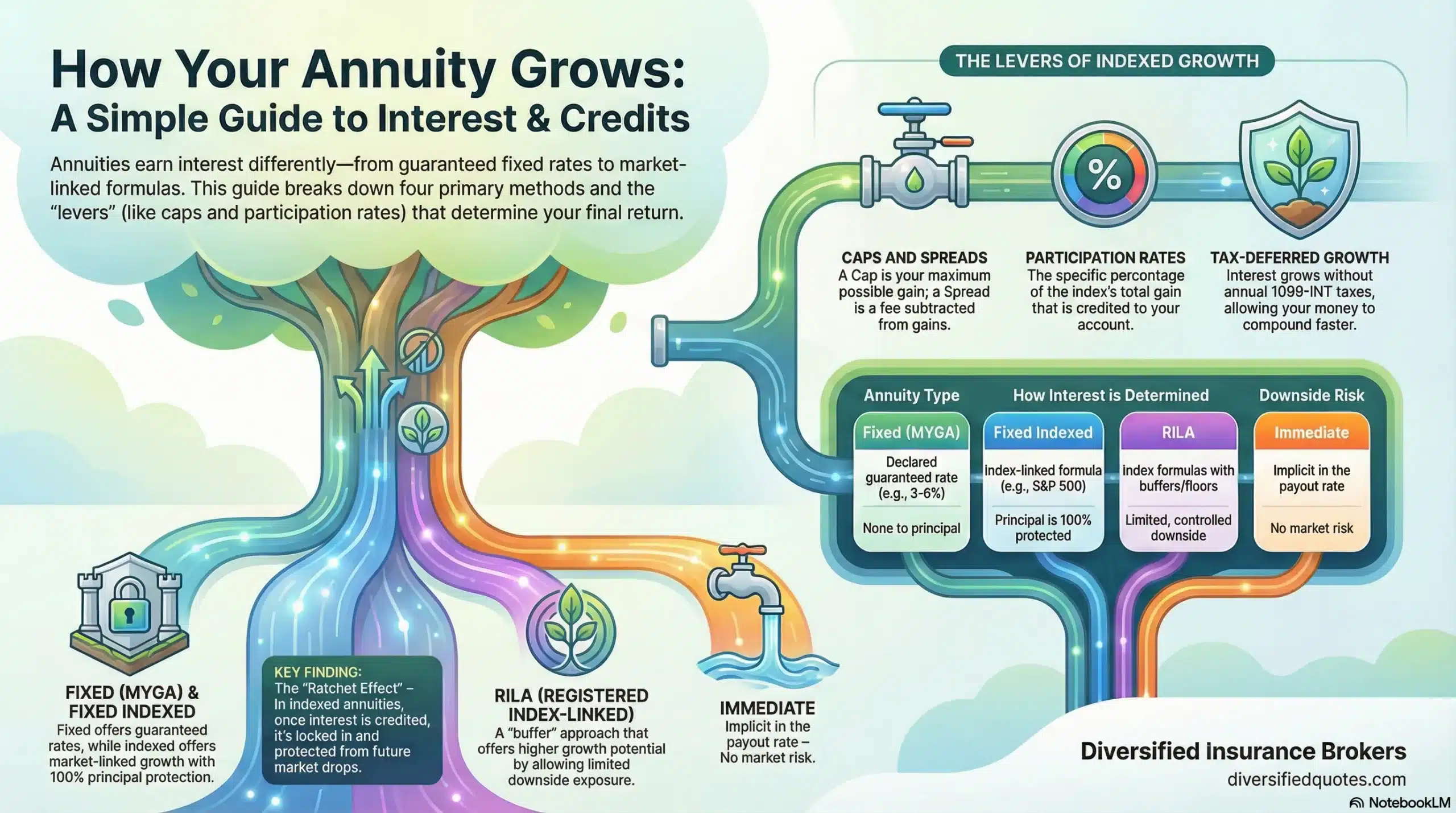
Fixed indexed annuities use one or more of three main tools to determine credited interest. Understanding how these tools interact is the difference between rate-shopping superficially and making a genuinely informed strategy decision. A participation rate credits a percentage of the index gain. If participation is 60% and the index gains 10%, the starting credit is 6% — with no ceiling if no cap applies. A cap rate sets a maximum ceiling on credited interest for the period regardless of how far the index rises. A spread rate subtracts a fixed percentage from the index gain before crediting — if the spread is 3% and the index gains 10%, credited interest is 7%.
Some strategies use only one of these tools. Many use combinations. You might see 100% participation with an 8% cap — in which case the participation rate is irrelevant in strong years where the cap limits the outcome anyway. Or 65% participation with no cap — where the full 65% of any gain credits, however large. Or a spread strategy with neither cap nor participation rate. The right question is not “which tool is best?” The right question is which structure is most likely to produce the outcome you want given your time horizon, the market environments you expect, and the role the annuity plays in your broader retirement plan. Many of the most common misunderstandings about these mechanics are addressed directly in our resource on fixed indexed annuity myths debunked.
Crediting Methods Matter as Much as the Participation Rate
Participation rate strategies appear inside specific crediting methods, and the method can change how the participation rate translates into real credited interest — sometimes more significantly than the participation rate itself. The most common and consumer-friendly method is annual point-to-point, where the index is measured from the start of the term to the end of the term and the gain (if positive) is multiplied by the participation rate. But several other methods behave differently in the same market environment even with an identical participation rate.
A monthly sum strategy adds monthly gains — often subject to a monthly cap — and may ignore monthly losses depending on the contract design. In volatile markets that move sharply up and down within the year, monthly sum methods can produce meaningfully different results than annual point-to-point strategies with the same participation rate. A monthly average strategy averages index values over the term and compares them to a starting point — which can reduce the impact of a late-year spike, meaning a high participation rate on a monthly average strategy may credit less than expected if a strong year-end pushed annual returns well above the rolling average. Multi-year point-to-point strategies measure returns over two or more years; the participation rate may be different, the pricing is different, and gains are locked in at the end of the full term rather than annually. All three of these differences affect the crediting experience in ways that make a per-strategy comparison essential — and why starting with how annuities earn interest across different methods provides the foundation that makes participation rate numbers interpretable.
Why Participation Rates Change Over Time
Participation rates are priced numbers, not permanent contractual guarantees. Insurers use a hedging budget — funded by the spread between what the general account earns and what principal protection requires — to purchase index options or similar instruments that create the index-linked growth potential. When market conditions shift, the cost to hedge changes, and participation rates change accordingly. Higher interest rate environments generally support more generous crediting terms because the general account yields produce a larger hedging budget. Higher market volatility increases option costs and can pressure participation rates and cap rates downward. The relationship is not always simple or linear — different carriers price risk differently, use different indices, and structure their option strategies differently, which is why two products can react differently to the same interest rate environment.
Because participation rates can be changed at renewal — typically at each contract anniversary — understanding the minimum guaranteed participation rate is as important as understanding the current rate. Not every contract guarantees a meaningful minimum on every strategy, and when minimums exist, they can be far below the current participation rate. A contract with a 90% current participation rate and a 10% guaranteed minimum could theoretically decline to 10% at renewal, while a contract with a 70% current rate and a 40% minimum carries far less renewal risk. Two products with similar current participation rates can carry dramatically different long-term planning risk depending on the floor built into the contract. Reviewing current annuity rates and current fixed annuity rates as a benchmark context helps calibrate what a “competitive” participation rate looks like relative to what fixed-rate alternatives offer in the same environment.
Participation Rate and Income Planning — Two Different Questions
Participation rates are often discussed as growth mechanics, but many people purchase fixed indexed annuities primarily for future income — not just accumulation. When an income rider is involved, participation rates become a second-order variable rather than the primary planning driver. Income riders such as a GLWB typically grow an income benefit base using a guaranteed roll-up rate that is contractually defined and independent of what the index credits in any given year. In those designs, the income you receive is ultimately determined by the rider’s payout factors at the age you begin withdrawals — not by the participation rate in isolation.
The participation rate still matters in income-focused designs, but its influence is indirect: it affects the account value growth track, which in turn determines whether step-up provisions are triggered (if the contract offers step-ups to the income base when account value outperforms) and what the residual account value looks like if the plan changes. But participation rates do not directly guarantee income. For income planning, the core comparison is which rider structure produces the best guaranteed paycheck for your timeline — a question better answered by reviewing what the best retirement income annuity looks like and which fixed indexed annuities for income are most competitive — rather than by finding the highest participation rate in the market.
Check Today’s Fixed & Bonus Annuity Options
Participation rates are one lever. Compare them alongside fixed-rate and bonus-focused designs to see which strategy fits your plan.
When a Participation Rate Strategy Can Be a Good Fit
A participation rate strategy can make sense when you want principal protection with a structured path to growth, and you are comfortable with the idea that upside is defined by contract rules rather than market performance. Many people use participation-based strategies as part of the conservative or “safe money” portion of retirement assets — especially when the goal is to reduce the risk of large market drawdowns as they approach the sequence-of-returns risk window around retirement, where a severe portfolio decline is hardest to recover from. In that context, a participation-based FIA can function as a stability component that grows in positive markets, protects in negative ones, and reduces the overall volatility of the distribution phase — helping address the challenge of not running out of money in retirement.
Participation strategies also appeal to people who prefer a transparent rule. With a defined participation rate, the concept is easy to understand: you receive a percentage of gains and avoid losses to principal in negative years. That clarity can reduce decision fatigue and help investors stay committed to the plan through market volatility instead of reacting to short-term headlines. They can also be used as part of a diversified annuity approach — mixing different crediting methods across different buckets. Some clients combine fixed-rate or MYGA annuities for known interest with indexed participation strategies for higher potential in favorable market environments, diversifying the income engine rather than relying on any single crediting style.
When Participation Rates May Not Be the Best Tool
Participation rates may not be ideal if your planning style is “I want to know the exact rate I’ll earn each year in advance.” If predictability and certainty matter more than the possibility of a higher return, a fixed-rate MYGA structure will feel more aligned with those priorities. Participation rates can also be less appropriate when liquidity is the main priority, since annuities have surrender schedules designed for longer time horizons, and a high participation rate in a restrictive surrender structure creates friction if unexpected access is needed.
They may also be less appealing for investors seeking uncapped market participation. If you want full market exposure and are comfortable with full market downside, an indexed annuity will feel limiting — participation rates exist precisely because the insurer is managing the upside exposure while providing downside protection. If you don’t want the protection and you do want the full upside, a different vehicle fits better. A comprehensive view of the full trade-off spectrum — what each annuity type gives up and what it provides — is covered in our broader annuity overview.
Questions You Should Ask Before Choosing a Participation Strategy
If you are evaluating an annuity with a participation rate strategy, the questions that reveal how the contract actually behaves over time matter more than the headline participation number. What is the crediting method — is it one-year point-to-point, monthly sum, monthly average, or a multi-year term? How are returns measured and when are gains locked in? Is there also a cap or a spread applied, and if so, how does it interact with the participation rate in strong versus moderate gain years? Can the participation rate change at renewal, and if so what are the minimum guaranteed participation rates, if any? Are you adding an income rider, and if so what does the rider cost annually and how does that affect net account value growth? What does the plan look like if markets are flat for one or two years — participation strategies often do best when there are meaningful positive index years, and the plan should be stress-tested against environments where the index is choppy or near zero. Understanding how simple versus compound interest works in annuities provides additional context for evaluating how credited interest accumulates within the specific crediting structure being considered.
A Participation Rate Is One Lever — The Plan Is the Goal
A participation rate is one of the core mechanics that determines how a fixed indexed annuity credits interest. But it is not a standalone score. A participation rate only matters in the context of the crediting method, any caps or spreads that apply within the same strategy, the renewal discretion and minimum guarantees in the contract, and whether the annuity is being used primarily for accumulation or primarily for income. When participation strategies are compared correctly — by focusing on the outcome the strategy produces in realistic market environments and the role the annuity plays in the overall retirement plan — the right choice becomes more obvious and the marketing noise becomes less powerful.
At Diversified Insurance Brokers, we compare participation rate strategies across multiple carriers, evaluate how caps and spreads interact with the participation mechanics, model behavior under different market environments, and align the strategy to whether the plan needs a growth engine, an income floor, or both. The goal is never to win the participation rate race. The goal is to build a plan that works without requiring perfect market timing or ideal index performance in every year.
Want Us to Compare Participation Strategies for You?
Tell us your age, state, timeline, and whether you want growth or income — we’ll compare strategies across carriers and show the trade-offs clearly.
Related Topics to Explore
Indexed Annuity Mechanics & Strategy Comparisons
Use these pages to go deeper on how FIA strategies are built and how participation interacts with other crediting levers.
Talk With an Advisor Today
Choose how you’d like to connect—call or message us, then book a time that works for you.
Schedule here:
calendly.com/jason-dibcompanies/diversified-quotes
Licensed in all 50 states • Fiduciary, family-owned since 1980
FAQs: What Is an Annuity Participation Rate?
What is an annuity participation rate and how does it determine credited interest?
An annuity participation rate is the percentage of an index’s positive gain that is used to calculate credited interest in a fixed indexed annuity for a given crediting period. If the index gains 10% and the participation rate is 60%, the starting point for credited interest is 6% — before any additional contract rules like caps or spreads are applied. If the index gains 10% and the participation rate is 100%, the starting point is 10%. If the index is negative for the period, most indexed annuities credit 0% and protect the principal from the decline. The participation rate exists because the insurer is pricing the cost of providing that downside protection — using a hedging budget funded by general account yields — against the cost of delivering upside potential. The participation rate is the lever that reflects what that pricing balance supports at current market and interest rate conditions. It is not a fixed number for life — most participation rates can be renewed at each contract anniversary subject to contractual minimum guarantees.
Is a higher participation rate always better than a lower one?
Not necessarily — and this is one of the most important nuances in comparing fixed indexed annuity strategies. A higher participation rate sounds better in isolation, but it must be evaluated in the context of the complete strategy structure. A contract with 90% participation and an 8% cap may produce less credited interest in very strong market years than a contract with 70% participation and no cap — because the cap limits the outcome once the index exceeds a certain gain level, while the uncapped 70% participation continues crediting above that threshold. The index being used also matters significantly: many high participation rates above 100% appear on volatility-controlled proprietary indices that are designed to produce lower, smoother returns than a standard price-return index — which can make the effective credited interest lower than it appears. Additionally, any optional rider fees deducted annually from the account value reduce the net accumulation benefit of the participation rate. The right comparison is always by complete strategy outcome across realistic market scenarios, not by the participation rate number alone. Our resource on how annuities earn interest explains how these mechanics interact across different crediting structures.
Can my participation rate change after I purchase the annuity?
Yes — in most fixed indexed annuities, participation rates can be renewed at each contract anniversary based on prevailing interest rates, hedging costs, and carrier-specific pricing decisions. This means the participation rate you receive at purchase may not be the participation rate that applies in year three, five, or eight of the contract. This is why evaluating the minimum guaranteed participation rate — the contractual floor below which the carrier cannot reduce the rate — is as important as evaluating the current posted rate. Two contracts with similar current participation rates can carry dramatically different long-term risk if one has a meaningful guaranteed minimum and the other does not. A contract with 90% current participation and a 10% guaranteed minimum could theoretically decline to 10% at renewal. A contract with 70% current participation and a 40% guaranteed minimum carries far less renewal risk for a long-term holder. Before committing to any participation-based strategy, ask specifically about both the current rate and the contractual minimum, and confirm how often the carrier has exercised its renewal discretion in recent years — a carrier’s renewal history is more informative than the current marketing rate. Reviewing how annuity cap rates work alongside participation rates provides useful comparative context for evaluating both types of renewal risk.
How does the crediting method affect what the participation rate actually produces?
The crediting method determines how and when index performance is measured, and it can change the credited interest outcome dramatically — sometimes more so than the participation rate itself. In an annual point-to-point strategy, the index is measured from the start of the term to the end and the gain is multiplied by the participation rate. This is straightforward and the most common design. In a monthly sum strategy, monthly gains subject to a monthly cap are accumulated and monthly losses may or may not be ignored — which can produce very different results from annual point-to-point in a volatile year where the market has large swings in both directions. In a monthly average strategy, index values are averaged over the term rather than measured at a single end point — which can reduce the credited amount in years where the index has a strong year-end but spent most of the year below that level. Multi-year strategies measure returns over two or more years, meaning the participation rate applies to a longer measurement window with a different pricing structure. The same participation rate applied to these different methods will produce different credited interest in the same market environment. This is why comparing participation strategies across carriers requires alignment on both the index and the crediting method — otherwise the comparison is not measuring the same thing. Our resource on how fixed indexed annuities work covers these method differences in the broader FIA context.
Does the participation rate determine how much guaranteed income I receive in retirement?
No — not directly. When a fixed indexed annuity includes a GLWB income rider, the guaranteed income you receive is determined primarily by the rider’s income benefit base growth mechanics (typically a guaranteed roll-up rate) and the payout factors that apply at the age income begins — not by the participation rate. The participation rate affects the account value growth track, which can influence whether step-up provisions are triggered if the contract allows the income base to increase when account value outperforms. But the participation rate does not guarantee income. A contract with a modest participation rate and a strong rider payout structure can produce more guaranteed income than a contract with a high participation rate and a weaker rider design. For income-focused planning, the core comparison is which rider structure produces the best guaranteed paycheck for your timeline — a question that requires evaluating the roll-up rate, payout factors, and the net account value track after annual rider fees, not just the participation rate in isolation. Our resources on the best fixed indexed annuities for income and the best retirement income annuity provide frameworks for making that income-specific comparison across carriers.
About the Author:
Jason Stolz, CLTC, CRPC, DIA, CAA and Chief Underwriter at Diversified Insurance Brokers (NPN 20471358), is a senior insurance and retirement professional with more than 25 years of real-world experience helping individuals, families, and business owners protect their income, assets, and long-term financial stability. As a long-time partner of the nationally licensed independent agency Diversified Insurance Brokers, Jason provides trusted guidance across multiple specialties—including fixed and indexed annuities, long-term care planning, personal and business disability insurance, life insurance solutions, Group Health, Travel Medical and Evacuation Insurance, and short-term health coverage. Diversified Insurance Brokers maintains active contracts with over 100 highly rated insurance carriers, ensuring clients have access to a broad and competitive marketplace.
His practical, education-first approach has earned recognition in publications such as VoyageATL, and contributions from his agency featured in Kiplinger and GoBankingRates— highlighting his commitment to financial clarity and client-focused planning. Drawing on deep product knowledge and years of hands-on field experience, Jason helps clients evaluate carriers, compare strategies, and build retirement and protection plans that are both secure and cost-efficient. Visitors who want to explore current annuity rates and compare options across multiple insurers can also use this annuity quote and comparison tool.
Explore More Annuity Options: Browse our complete guide to Common Annuity Myths — covering annuity mechanics, rules, fees, riders, cap rates & participation rates explained from 100+ carriers.
Last Reviewed: June 20, 2026 |
Reviewed by: Jason Stolz, CLTC, CRPC, DIA, CAA
Chief Underwriter, Diversified Insurance Brokers, Inc. | NPN: 20471358 | Diversified Insurance Brokers, Inc. — Licensed in all 50 states
Fact Checked by: Tonia Pettitt, CMIP©
Medicare Specialist, Diversified Insurance Brokers, Inc. | NPN: 14374308 | Diversified Insurance Brokers, Inc. — Licensed in all 50 states
Did you find this content helpful? Leave us a Google review — it helps others find trustworthy guidance too.
Editorial Standards: Diversified Insurance Brokers maintains rigorous editorial standards to ensure accuracy, clarity, and independence in all content. Learn more about our editorial standards and commitment to transparency.
