
Top Annuity Rates as of Today
As an Independent Annuity Broker, we compare rates across 100+ carriers and 1,000 different annuities— not just one company’s product offerings — to find the best fit for your goals.
Top Annuity Rates as of Today

Jason Stolz CLTC, CRPC, DIA, CAA
Top annuity rates as of today span three distinct product structures — and a buyer who searches for “top annuity rates” without understanding which structure they need is likely to compare incomparable numbers. A 6.35% MYGA declared rate, a 34% bonus FIA credit, and a 6.5% fixed indexed annuity cap rate are all legitimate “top rates” in their respective categories — but they serve fundamentally different planning purposes and behave completely differently for accumulation, income, and liquidity. This page provides a comprehensive view of where the top rates are across all three structures and a cross-structure comparison table to orient the evaluation, the detailed MYGA rate benchmark across term lengths, and the practical guidance needed to convert a benchmark into a confirmed offer that fits your specific retirement plan. At Diversified Insurance Brokers, we work with more than 100 carriers across every annuity structure category — MYGA, fixed indexed, and bonus FIA — so our rate comparisons reflect the full competitive market rather than a limited carrier set. If you are orienting yourself to annuities broadly before evaluating specific rates, our annuities overview and Annuities 101 guide provide the foundational context. For the specific question of whether annuities are the right structure for your situation, our resource on whether annuities are a good investment provides an honest evaluation framework.
Understanding why today’s top annuity rates across all three structures are competitive by historical standards requires context. The interest rate environment since 2022 has produced investment-grade fixed income yields at levels not seen in more than a decade. Insurance carriers invest policyholder premiums primarily in investment-grade bonds and structured credit products — the yield on those investments directly funds the declared rates, bonus credits, and crediting options they can offer. When bond yields are elevated, carriers have more capacity to offer attractive features across all annuity structures. A 5-year MYGA at 6.35%, a 15-year bonus FIA at 34%, and a competitive FIA with a 6%+ cap on a major index strategy are all products of this higher-yield environment. The practical implication for buyers evaluating top rates today is that these rates reflect a market environment that has not been as favorable since the early 2010s — and locking any of these structures for a defined term captures today’s economics regardless of what happens to rates during the contract period. Our dedicated resources on current annuity rates, current fixed annuity rates, and current bonus annuity rates provide the detailed market view for each structure category.
The most common mistake when searching for top annuity rates is treating the search as a single-dimensional exercise — finding the highest number and stopping there. The highest declared MYGA rate is not the most important rate for a buyer whose goal is lifetime income. The highest bonus FIA percentage is not the most important figure for a buyer who wants flexible access to funds within five years. And the highest FIA cap rate is not the primary metric for a buyer whose primary value is certainty of outcome. What makes a rate “top” for any specific buyer is the combination of rate level, structure fit, contract provisions, and carrier strength — evaluated together against the buyer’s actual goal and timeline. Our resource on the primary reasons people buy annuities provides useful framing for this goal-identification step, and our resource on common annuity myths addresses the rate-related misconceptions that most frequently lead buyers to the wrong product.
Ensure you are receiving the absolute top rates
Current Fixed Annuity Rates
Compare today’s best fixed annuity rates from top carriers.
View Current RatesCurrent Bonus Annuity Rates
See which annuities offer the highest upfront bonus today.
View Bonus RatesRequest an Annuity Quote
Submit our annuity request form to get personalized rate options.
Quote Request FormLifetime Income Calculator
Use our calculator to see how much guaranteed income your annuity can provide.
Top Annuity Rates Across All Structures — The Complete Market View (October 2026)
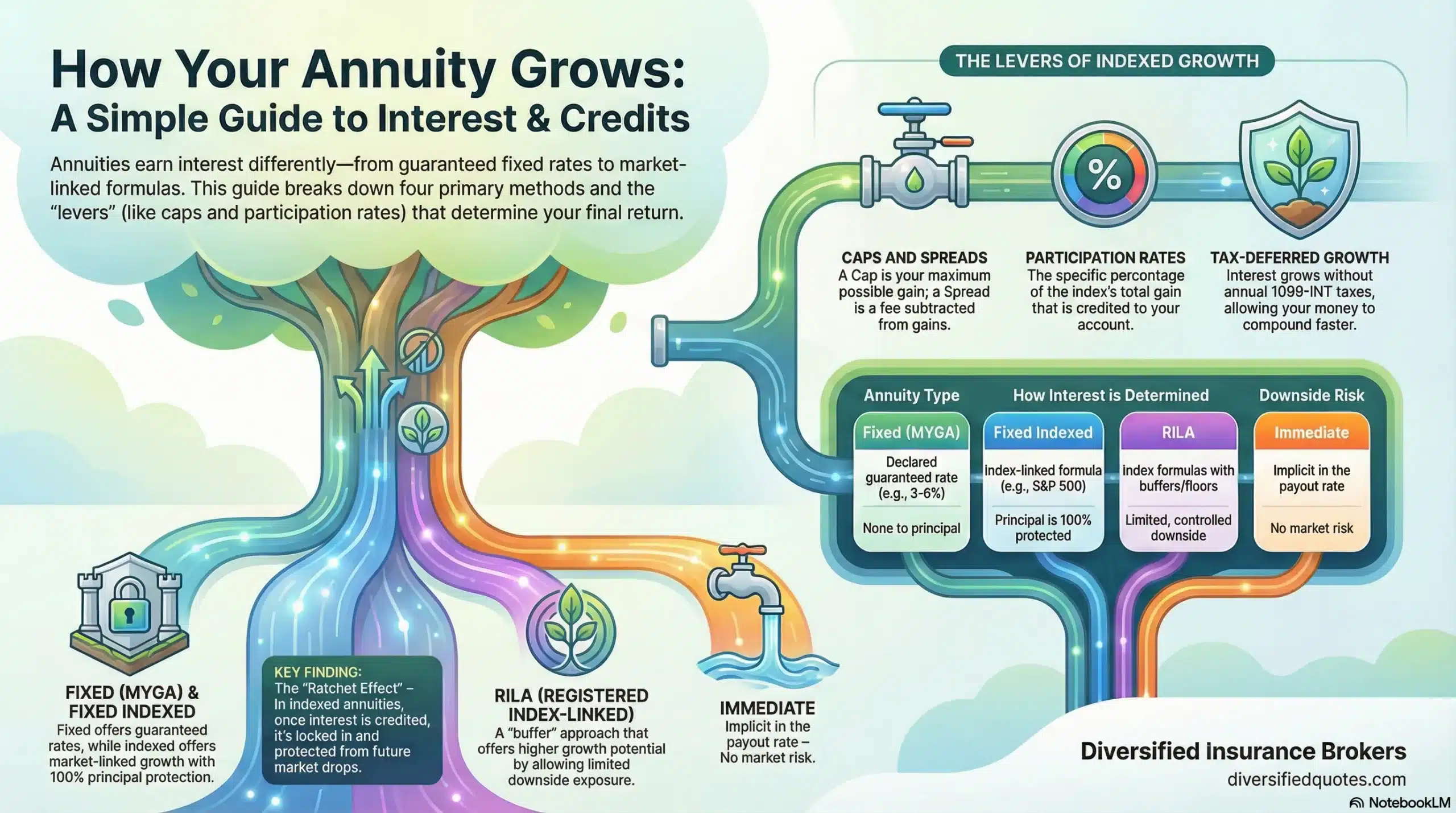
Before narrowing to a specific rate category, the following comparison table provides an orientation across all three primary annuity structures. This cross-structure view is intended to help buyers identify which category of “top rate” is relevant to their goal before spending time on product-level detail. The three categories are not interchangeable — the comparison is structured to show the different features that make each type of rate meaningful, not to suggest a hierarchy of one structure over another.
| Feature | MYGA (Fixed Rate) | Bonus Fixed Indexed Annuity | Non-Bonus Fixed Indexed Annuity |
|---|---|---|---|
| Top Rate Today | 6.30% declared (5-year) | 34% upfront bonus (15-year) + index crediting | 10%+ annual cap on major index (8–10 year) |
| Principal Protection | 100% — contractually guaranteed | 100% — zero floor on index credits | 100% — zero floor on index credits |
| Growth Certainty | Fully guaranteed — same rate every year | Bonus guaranteed; index credits variable | Variable — depends on index performance |
| Best For | Conservative accumulation, CD alternative, predictable outcome | Income planning with long deferral horizon, large rollovers | Protected upside potential, accumulation with index participation |
| Typical Term Length | 1–10 years | 5–15 years | 5–10 years |
| Where to Learn More | Current Fixed Rates | Highest Bonus FIA Rates | Best FIA Options |
💰 Top MYGA Rates by Term (1–10 Years) as of October 2026
The table below represents competitive fixed annuity declared rates across the full 1-to-10-year term spectrum. These are today’s benchmark rates for new MYGA contracts — the guaranteed return you lock in for the full selected term, regardless of market movements during the contract period. Click any rate to request a live quote for your specific state, age, and premium amount. Note that some of the highest rates in this table come from carriers with B-range AM Best ratings; A-rated alternatives are available at slightly lower declared rates for buyers who prioritize financial strength above rate maximization. We work with carriers across the full rating spectrum and can provide a complete comparison that includes both segments.
| Term | Rate | Provider | Product | AM Best |
|---|---|---|---|---|
| 1 Year | 3.90% | GCU Life | 1+4 Choice | A- |
| 2 Years | 5.25% | Mountain Life | Secure Summit | B |
| 3 Years | 6.10% | Mountain Life | Secure Summit | B+ |
| 4 Years | 6.05% | Mountain Life | Secure Summit | B |
| 5 Years | 6.45% | Oxford Life | Multi Select Annuity | A |
| 6 Years | 6.35% | Oxford Life | Multi Select Annuity | A |
| 7 Years | 6.25% | Sentinel Security | Personal Choice | B |
| 8 Years | 6.45% | Oxford Life | Multi Select Annuity | A |
| 9 Years | 6.30% | Oxford Life | Multi Select Annuity | A |
| 10 Years | 6.35% | Oxford Life | Multi Select Annuity | A |
Rates change frequently and may vary by state, age, and premium band. Larger deposits can qualify for tiered rates. A-rated carrier alternatives are available at slightly lower declared rates — contact us to compare both segments.
Annuity Interest Rate Examples by Deposit Size
See how annuity interest and income potential can vary depending on the size of your investment.
What Makes a Rate “Top” — Three Criteria Beyond the Headline Number
A rate benchmark table shows you the market. Three additional criteria determine whether any specific rate from that table is actually “top” for your situation. Evaluating all three before selecting a product avoids the most common annuity decision mistakes.
Criterion 1 — Term Alignment With Your Actual Plan
A 6.25% 10-year MYGA is a top rate in the absolute sense — but it is not a top rate for a 72-year-old who expects to need the funds within three years for estate planning purposes, or for a buyer who is unsure whether they will need access within the surrender period. The term must align with the money’s job. A 3-year MYGA at 6.00% serves a buyer with a 3-year liquidity horizon far better than a 10-year MYGA at a marginally higher rate. The rate ranking that matters is the ranking within the term length that is actually appropriate for your plan — not the ranking across all term lengths. For buyers evaluating specific short-term options, our resource on best short-term MYGA annuities provides the focused analysis. For buyers evaluating the full range of conservative accumulation options within their timeline, our annuities for conservative investors guide provides the broader evaluation framework.
Criterion 2 — Carrier Financial Strength Relative to Premium Size
The declared rate is the return, but the carrier’s financial strength is what makes the return credible across the full contract period. For a $50,000 non-qualified MYGA at a 3-year term, a B-rated carrier’s higher declared rate may represent a perfectly reasonable trade — the premium is within state guaranty association protection limits, the commitment period is short, and the carrier’s financial profile is adequate for a 3-year guarantee. For a $600,000 IRA rollover into a 10-year MYGA, the carrier’s financial strength profile becomes a more meaningful evaluation factor — the premium is well above typical guaranty association limits, and the 10-year commitment extends the counterparty relationship significantly. The “top rate” for the larger premium buyer may be slightly lower in declared rate but from a stronger carrier. Our dedicated resource on what an AM Best rating means provides the full context for evaluating carrier strength as part of the rate selection decision.
Criterion 3 — Access Provisions That Match Real-Life Needs
The free-withdrawal provision, the market value adjustment (MVA) applicability, and the RMD accommodation in qualified account contracts are the access features that determine how much flexibility the buyer actually has during the term. A 6.35% MYGA with a 5% annual free withdrawal and an MVA is not the same product for a buyer who needs periodic cash flow as a 6.10% MYGA with a 10% annual free withdrawal and no MVA. Understanding what a market value adjustment is and how it affects early access decisions is a required step before selecting any MYGA contract. The top rate for a buyer who needs meaningful annual withdrawals is the highest rate paired with the access provisions that support the expected withdrawal pattern — not the highest rate in the table without consideration of access terms.
Real Dollar Examples — What Today’s Top Rates Produce
Abstract rate percentages become meaningful when translated into dollar outcomes for specific premium amounts. The following examples use today’s top MYGA rates to illustrate what buyers at different premium levels and term selections can expect from the current market — providing a concrete sense of what “top rate” means in practical terms before requesting a live quote.
A $250,000 deposit into today’s top 5-year MYGA at 6.35% annual interest compounds to approximately $340,000 at the end of five years — a gain of $90,000 in guaranteed tax-deferred growth on a fully principal-protected position. A $500,000 deposit at the same rate produces approximately $680,000 — a $180,000 guaranteed gain over five years. A $1,000,000 deposit produces approximately $1,361,000 — a $361,000 gain. None of these results depends on market performance; they are contractually defined outcomes that the buyer locks in at issuance. The contrast with a money market or savings account that reprices monthly is significant: the MYGA buyer locked 6.35% for five full years, while the savings account holder faces repricing risk that can compress the yield at any point during the period. For buyers also evaluating whether a MYGA or an FIA with index-linked growth potential serves their accumulation goal better, our resource on the best fixed indexed annuity options provides the comparative framework including current cap rates and crediting term analysis.
For buyers whose primary goal is guaranteed lifetime income rather than accumulation, the relevant calculation is different. A $300,000 deposit into today’s top 10-year bonus FIA (26% income base bonus, 7% roll-up rate, income activation at year 10) produces an income base at year 10 of approximately $708,000. At a 5.5% payout factor, that generates approximately $38,940 per year in guaranteed lifetime income. Compare that to a $300,000 MYGA at 6.35% that matures to approximately $440,000 over 10 years — which, if then converted to a SPIA at age 75, might produce approximately $28,000–$32,000 per year depending on the payout rate available at that time. The income-planning buyer’s “top rate” is not the MYGA declared rate — it is the bonus FIA’s income base mechanics combined with the roll-up rate and payout factor. Our resource on how much income an annuity pays provides a comprehensive income benchmarking guide, and our lifetime income annuity options resource covers the full spectrum of income-generating structures in the current market. The annuity payout calculator provides a practical tool for estimating income outcomes before requesting carrier illustrations.
The Timing Question — Are Today’s Top Rates Worth Acting On Now?
A common source of delay in annuity decisions is the question of timing — whether today’s rates are high enough, or whether waiting might produce better rates. This question deserves a direct answer. Today’s MYGA rates of 6%+ at 3-to-7-year terms represent levels not seen since the early 2010s. Buyers who deferred action during the low-rate era of 2015–2021 while waiting for rates to improve correctly anticipated that rates would eventually rise — but they also forfeited years of guaranteed tax-deferred growth at 2%–3% rates that could have been captured productively. The lesson is that rate timing is a poor primary driver for annuity decisions. The more useful framework is this: if the buyer’s planning situation is clear — the purpose of the funds is defined, the term aligns with the plan, and the carrier financial strength is adequate — then acting on today’s competitive rates is almost always superior to deferring in anticipation of higher rates that may or may not materialize. Every month of deferral on a $500,000 MYGA at 6.35% represents approximately $2,646 in forgone guaranteed tax-deferred interest — a real, calculable cost of waiting that should be weighed against the speculative benefit of potentially higher future rates.
The MYGA Ladder: Using Today’s Top Rates Across Multiple Terms
Most retirees do not need to place all their conservative savings into a single term. The ladder strategy — dividing a premium across multiple MYGA terms simultaneously — allows buyers to capture today’s competitive rates at multiple points on the yield curve while creating scheduled liquidity windows every few years. Today’s rate landscape is well-suited to ladder construction because competitive declared rates are available at nearly every term from 3 to 10 years, with rates ranging from 6.00% to 6.35% across that span. A practical 3-5-7 ladder on $300,000 might allocate $100,000 to each term: the 3-year portion matures in 2029 at approximately $119,000, creating a liquidity window to evaluate rates and options at that date; the 5-year portion matures in 2031 at approximately $134,000; and the 7-year portion matures in 2033 at approximately $153,000. Across all three tiers, the full $300,000 earns competitive guaranteed rates while providing built-in flexibility at three future decision points. The ladder also diversifies across carriers and potentially across different contract structures — reducing concentration in any single carrier or surrender schedule. Comparing fixed annuities vs. CDs for the ladder approach specifically highlights the MYGA’s tax deferral advantage for non-qualified money, which compounds meaningfully over ladder periods compared to CDs that generate annual taxable interest regardless of withdrawal timing.
Top Rates in Rollover and Retirement Transition Planning
The most common scenario where buyers actively compare top annuity rates is a retirement account rollover — the repositioning of a 401(k), traditional IRA, pension lump sum, or TSP account at or near retirement. In this context, both the MYGA rate table and the bonus FIA rate landscape are relevant, and the choice between them should be driven by the buyer’s primary objective for the rolled-over funds. For buyers whose primary objective is capital preservation with a predictable outcome — knowing exactly what the balance will be at a specific future date — today’s top MYGA rates provide the clearest answer. For buyers whose primary objective is maximizing guaranteed lifetime income at a specific future age — building the highest possible guaranteed monthly paycheck — today’s top bonus FIA rates (particularly at the 10-to-15-year tier with income riders) frequently produce a better outcome than MYGA rates for that specific goal. Our resources on what to do with a 401(k) after retiring and what to do with an IRA after retiring provide the full rollover decision framework for buyers navigating this transition. For buyers who received a pension lump sum and are evaluating whether to use today’s top MYGA rates or a bonus FIA as the foundation for their retirement income, the pension alternative strategy provides the specific analysis that applies to this decision. Our resource on whether an annuity or 401(k) is better for retirement addresses the fundamental question that precedes any specific rate selection for buyers who have not yet decided whether an annuity is the right vehicle for their rollover funds.
Tax Treatment of Today’s Top Annuity Rates
The after-tax value of today’s top MYGA rates depends critically on whether the contract is funded with qualified or non-qualified money. For qualified money (traditional IRA, 401(k), 403(b), TSP): interest accumulates tax-deferred and all distributions are taxed as ordinary income — the same treatment as any qualified account investment. The MYGA does not add or subtract tax benefit relative to other qualified account vehicles; the tax deferral comes from the account type. For non-qualified money (after-tax personal savings): the MYGA credits interest without generating an annual 1099, allowing the full pre-tax balance to compound throughout the selected term. The tax on accrued interest is deferred until distributions begin — at which point the IRS applies LIFO ordering (earnings first as ordinary income, original premium last as tax-free basis return). This tax deferral advantage can add meaningful after-tax value to today’s declared rates for buyers in higher income tax brackets compared to a CD at the same declared rate. Our resource on non-qualified annuities and the annuity exclusion ratio guide cover the full distribution tax mechanics. For buyers doing a 1035 exchange from an existing non-qualified annuity to a new MYGA to capture today’s top rates, the annuity rescue plan resource addresses the evaluation process for determining whether an exchange genuinely improves the buyer’s position. For the qualified money tax mechanics including RMD interactions with MYGA contracts, our qualified annuity taxation guide provides the comprehensive treatment.
What to Confirm Before Locking Any Top Rate
Converting today’s rate benchmark into a confirmed contract requires five verification steps that protect the buyer from the most common post-purchase surprises. First, confirm state availability for the exact product — not all products in the rate table are approved in all states, and state-specific filings may produce different terms than what is advertised nationally. Second, confirm the premium band — your specific deposit amount may qualify for a higher or lower rate than the benchmark, particularly at $100K, $250K, and $500K thresholds. Third, confirm the free-withdrawal provision — the annual percentage, when it begins (after year one in most products), and whether any special conditions apply (including RMD accommodation for qualified accounts). Fourth, confirm whether the contract includes an MVA and how it would affect partial or full surrender if your circumstances change unexpectedly during the term. Fifth, confirm the rate-lock policy — many carriers lock the rate for 30 to 60 days after application or fund receipt, protecting against rate changes during the processing period. Getting all five confirmations before signing the application turns a “top rate” in a benchmark table into a confirmed product selection that serves your retirement plan reliably through the full contract period.
Lock In a Top Rate Today
Compare carriers side by side and secure guaranteed growth for your timeline. We confirm availability, rate-lock timing, and the highest yield you qualify for across 100+ carriers.
Talk With an Advisor Today
Choose how you’d like to connect—call or message us, then book a time that works for you.
Schedule here:
calendly.com/jason-dibcompanies/diversified-quotes
Licensed in all 50 states • Fiduciary, family-owned since 1980
FAQs: Top Annuity Rates as of Today
What types of annuities offer the top rates today and how do they differ?
Today’s top annuity rates span three structures. MYGAs (multi-year guaranteed annuities) offer declared rates of up to 6.35% at 5 years — guaranteed, predictable, CD-like accumulation for a defined term. Bonus fixed indexed annuities offer upfront credits of up to 34% on 15-year products, paired with index-linked crediting potential — best for income planning with long deferral horizons. Non-bonus fixed indexed annuities offer competitive caps (6%+ on major indexes at 8-to-10-year terms) with index-linked growth potential and no surrender charge required for the bonus credit. These three structures serve different planning purposes: MYGAs for certainty of outcome; bonus FIAs for income maximization; non-bonus FIAs for protected upside potential. The top rate for any specific buyer is the rate in the structure that best serves their goal, not the highest number across all three categories.
How often do top annuity rates change and can I hold a rate while moving funds?
Carriers update declared rates on new MYGA contracts frequently — sometimes weekly — based on changes in interest rate markets, investment portfolio yields, and competitive positioning. Bonus FIA terms can also change, though often on a monthly cycle. Once a contract is issued, the terms are locked for the full selected period. Most carriers offer a rate-lock window — typically 30 to 60 days — after application submission or fund receipt, during which the rate is protected even if the carrier subsequently changes pricing for new applications. For buyers doing rollovers or trustee-to-trustee transfers that may take two to four weeks, confirming the rate-lock window before beginning the transfer ensures the rate you selected is the rate you receive at contract issue.
Why might today’s top rate not be my best fit even if the number looks attractive?
Three scenarios where the top rate is not the best choice: First, if the term does not align with your plan — a 10-year top rate is not the best fit for a buyer who expects to need the funds in four years, regardless of how attractive the declared rate appears. Second, if the carrier’s financial strength profile does not match your premium size — a B-rated carrier’s higher rate may be appropriate for a $75,000 deposit within guaranty association limits but requires more scrutiny for a $700,000 rollover that significantly exceeds those limits. Third, if the access provisions create restrictions that don’t match your expected withdrawal pattern — a top rate paired with an MVA and restrictive free-withdrawal terms may produce a worse real-world outcome than a slightly lower rate with more flexible access for a buyer who expects to take meaningful annual withdrawals.
Are today’s top MYGA rates like CDs?
Yes in the core concept — both guarantee a declared rate for a defined term — but with meaningful structural differences. MYGAs are backed by the insurance carrier’s claims-paying ability and state guaranty association protections rather than FDIC insurance. For non-qualified (after-tax) money, MYGAs provide tax-deferred growth: no annual 1099 on accrued interest, unlike CDs which generate taxable interest annually regardless of withdrawal. In the current market, competitive MYGA declared rates consistently exceed comparable-term national bank CD rates. The tax deferral advantage on non-qualified money can add the after-tax equivalent of 0.25%–0.75% or more to the MYGA’s effective annual return compared to a same-declared-rate CD in higher income tax brackets. CDs retain the FDIC insurance advantage, which is the primary reason some buyers maintain a mix of both types of conservative savings vehicles.
What happens at maturity when my top-rate MYGA term ends?
At the end of the selected term, most MYGA contracts provide a penalty-free window — typically 30 days — during which the buyer can withdraw all or part of the funds without surrender charges, transfer to a new MYGA from the same or a different carrier, or convert to a different annuity structure. If no action is taken during the maturity window, most contracts auto-renew into a new term at the carrier’s then-current declared rate, which may be meaningfully different from the original rate depending on the interest rate environment at renewal. Understanding these maturity window mechanics before purchasing is important — knowing your decision window in advance allows you to act intentionally rather than defaulting into whatever renewal the carrier applies automatically. We provide advance notice to clients approaching their maturity windows and present current market options for comparison so the reinvestment decision is made from a position of current market information.
Is today a good time to lock in a top annuity rate, or should I wait?
Today’s top MYGA rates of 6%+ at 3-to-7-year terms are historically attractive — significantly above the 2%–3% levels available during the low-rate era of 2015–2021. Buyers who locked MYGAs during that period correctly accepted the rates available at the time because the alternative was leaving money in even lower-yielding liquid accounts while waiting for an uncertain rate improvement. The same logic applies today in reverse: buyers who defer action while waiting for potentially higher future rates carry the real cost of forgoing today’s guaranteed rates on the capital they are holding. On a $300,000 position at 6.35%, every month of deferral represents approximately $1,588 in foregone guaranteed tax-deferred interest. Unless there is a specific, credible reason to believe rates will rise materially in the near term and that the buyer has adequate liquidity to wait, the prudent approach for buyers whose planning situation is clear is to act on today’s competitive market rather than speculate on future rate movements.
How does a MYGA ladder work with today’s top rates?
A MYGA ladder divides a total premium across multiple contracts at different term lengths simultaneously, creating staggered maturity dates every few years. Today’s rate environment supports ladder construction because competitive rates (6.00%–6.35%) are available across a broad span of terms from 3 to 7 years. A 3-5-7 ladder on $300,000 — allocating $100,000 to each term — captures today’s rates at all three tiers while creating maturity windows in 2029, 2031, and 2033. Each maturity provides a decision point: reinvest at then-current rates, withdraw for a planned purpose, or convert to a different structure. If rates rise further, the shorter-term ladders reinvest at higher rates at maturity. If rates decline, the longer-term portions continue earning today’s locked-in rates through their full terms. The ladder reduces reinvestment risk while maintaining periodic flexibility — making it one of the most practical applications of today’s competitive MYGA rate environment.
What is the difference between a top MYGA rate and a top bonus FIA rate — and which one is relevant for me?
A top MYGA declared rate (6.35% at 5 years) and a top bonus FIA credit (34% at 15 years) serve fundamentally different planning purposes and should not be compared as if they represent the same kind of return. The MYGA’s 6.35% is a guaranteed annual rate that applies every year for the full 5-year term regardless of market conditions — predictable, certain, and compounding on the full balance annually. The bonus FIA’s 34% is an upfront credit to the income base or accumulation value, paired with index-linked crediting that varies annually based on index performance. For buyers whose goal is predictable accumulation over a defined short-to-medium term, the MYGA’s declared rate is the relevant metric. For buyers whose goal is maximizing guaranteed lifetime income with a long deferral horizon, the bonus FIA’s income mechanics — bonus credit plus roll-up rate plus payout factor — are the relevant metrics. The correct answer depends entirely on what the buyer is trying to accomplish, which is why goal identification is the required first step in any top annuity rate evaluation.
Can I use a 401(k) or IRA to capture today’s top annuity rates?
Yes. Both MYGAs and bonus FIAs accept qualified retirement account funding — 401(k), traditional IRA, 403(b), 457, TSP, and SEP-IRA — through direct rollover or trustee-to-trustee transfer without triggering a taxable event. The carrier credits the advertised declared rate (or bonus, in the case of a bonus FIA) on the transferred premium subject to minimum premium requirements and state availability. RMD rules continue to apply at the required beginning date — confirm that any specific MYGA or FIA you select accommodates RMD withdrawals without surrender charges before funding, particularly if you are at or near the age where RMDs will apply during the contract term.
What five things should I verify before locking any top annuity rate?
Before signing any application: (1) Confirm state availability — the product in the rate table may not be approved in your state or may carry different terms under your state’s specific filing. (2) Confirm the premium band — your specific deposit amount may qualify for a tiered rate higher or lower than the benchmark, particularly at $100K, $250K, and $500K thresholds. (3) Confirm the free-withdrawal provision — the annual percentage, when it begins, and any special conditions for qualified accounts. (4) Confirm MVA applicability — whether the contract includes a market value adjustment on withdrawals above free amounts and how it could affect early exit scenarios. (5) Confirm the rate-lock policy — when the rate is locked (application date, funding date, or issue date) and for how long, to ensure the rate you selected is the rate you receive after any transfer period.
About the Author:
Jason Stolz, CLTC, CRPC, DIA, CAA and Chief Underwriter at Diversified Insurance Brokers (NPN 20471358), is a senior insurance and retirement professional with more than 25 years of real-world experience helping individuals, families, and business owners protect their income, assets, and long-term financial stability. As a long-time partner of the nationally licensed independent agency Diversified Insurance Brokers, Jason provides trusted guidance across multiple specialties—including fixed and indexed annuities, long-term care planning, personal and business disability insurance, life insurance solutions, Group Health, Travel Medical and Evacuation Insurance, and short-term health coverage. Diversified Insurance Brokers maintains active contracts with over 100 highly rated insurance carriers, ensuring clients have access to a broad and competitive marketplace.
His practical, education-first approach has earned recognition in publications such as VoyageATL, and contributions from his agency featured in Kiplinger and GoBankingRates— highlighting his commitment to financial clarity and client-focused planning. Drawing on deep product knowledge and years of hands-on field experience, Jason helps clients evaluate carriers, compare strategies, and build retirement and protection plans that are both secure and cost-efficient. Visitors who want to explore current annuity rates and compare options across multiple insurers can also use this annuity quote and comparison tool.
Explore More Annuity Options: Browse our complete guide to Current Annuity Rates — covering current fixed, bonus, MYGA & income annuity rates by term from top carriers from 100+ carriers.
Last Reviewed: October 1, 2026 |
Reviewed by: Jason Stolz, CLTC, CRPC, DIA, CAA
Chief Underwriter, Diversified Insurance Brokers, Inc. | NPN: 20471358 | Diversified Insurance Brokers, Inc. — Licensed in all 50 states
Fact Checked by: Tonia Pettitt, CMIP©
Medicare Specialist, Diversified Insurance Brokers, Inc. | NPN: 14374308 | Diversified Insurance Brokers, Inc. — Licensed in all 50 states
Did you find this content helpful? Leave us a Google review — it helps others find trustworthy guidance too.
Editorial Standards: Diversified Insurance Brokers maintains rigorous editorial standards to ensure accuracy, clarity, and independence in all content. Learn more about our editorial standards and commitment to transparency.
