
What is the Interest Rate on a $8 Million Annuity
As an Independent Annuity Broker, we compare rates across 100+ carriers and 1,000 different annuities— not just one company’s product offerings — to find the best fit for your goals.
What is the Interest Rate on a $8 Million Annuity

Jason Stolz CLTC, CRPC, DIA, CAA
High-net-worth retirees often ask how a large sum of money can be positioned to generate stable income while still growing over time. One of the most common questions in that category is: what interest rate can a $8 million annuity earn? The interest rate itself is not determined by the size of the investment, but the dollar value of interest earned becomes significant when large sums are involved.
Annuities are insurance contracts designed to provide tax-deferred growth and, in many cases, predictable retirement income. Investors who place substantial assets into annuities are often seeking stability and long-term income rather than pure market growth. A $8 million annuity may serve as a cornerstone of a retirement income strategy, providing consistent earnings while protecting principal from market volatility depending on the annuity structure.
Insurance companies that issue annuities invest premiums in diversified portfolios that typically include high-quality bonds and other income-producing assets. These investments generate the returns used to support annuity interest crediting. Because the underlying investments are largely tied to the bond market, annuity rates often move with broader interest rate trends.
Investors evaluating annuities frequently consider them alongside broader retirement planning strategies. Decisions involving how to allocate wealth after retirement, such as what to do with savings after leaving the workforce, often include evaluating stable income products like annuities.
Understanding how annuity interest works helps investors determine whether allocating a portion of a large portfolio to annuities may improve long-term financial security.
Ensure you are receiving the absolute top rates
Current Fixed Annuity Rates
Compare today’s best fixed annuity rates from top carriers.
Current Bonus Annuity Rates
See which annuities offer the highest upfront bonus today.
Request an Annuity Quote
Submit our annuity request form to get personalized rate options.
Lifetime Income Calculator
Use our calculator to see how much guaranteed income your annuity can provide.
Compare Multi-Year Guaranteed Annuity Rates
Explore the best annuity rates by term length to find the option that fits your timeline and income strategy.
How Interest Is Credited to an $8 Million Annuity
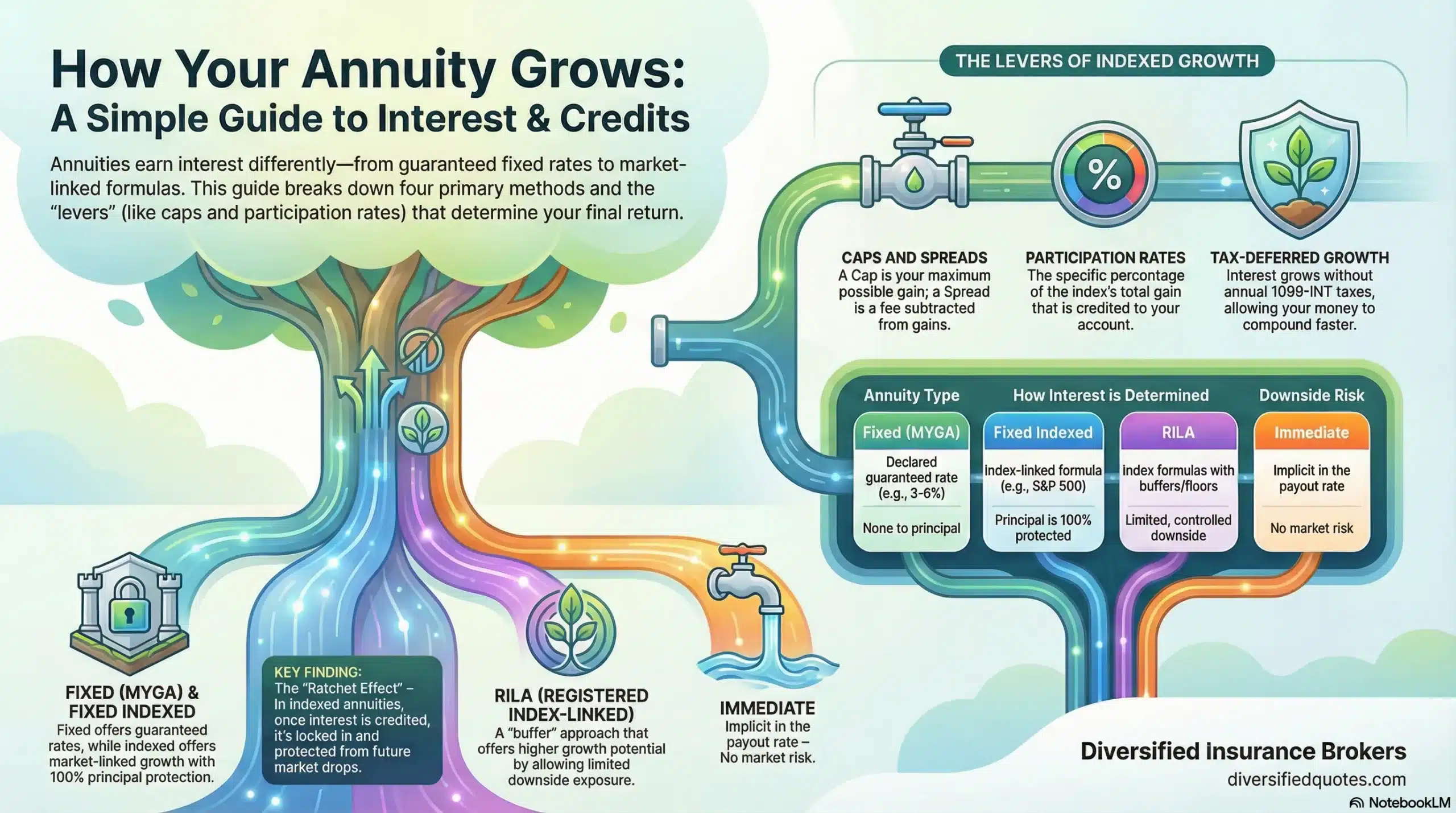
Annuity interest rates depend on the structure of the contract rather than the size of the investment. Fixed annuities typically offer guaranteed interest rates for a specified period of time. Indexed annuities credit interest based on market index performance while protecting the principal from market losses.
The insurance company manages a diversified investment portfolio to support the annuity. This portfolio often includes government bonds, corporate bonds, and other fixed-income securities that generate stable returns over time.
Because these investments are tied closely to interest rates in the bond market, annuity rates tend to increase when bond yields rise and decline when yields fall.
Investors with significant retirement assets frequently compare annuities with other income-generating strategies. For example, understanding how annuity payouts are calculated can help illustrate how account values convert into income.
Some individuals also evaluate whether repositioning retirement plans could improve income stability. Strategies such as transferring a Solo 401k to an annuity or exploring Keogh plan annuity rollovers can be part of broader retirement planning.
Example Growth of an $8 Million Annuity
The following example demonstrates how an $8 million annuity might grow over time using a hypothetical interest rate. These numbers are illustrative examples designed to show how compounding can influence long-term growth.
| Year | Account Value (Example 6%) | Interest Earned |
|---|---|---|
| 1 | $8,480,000 | $480,000 |
| 5 | $10,706,376 | $606,000 |
| 10 | $14,327,358 | $811,000 |
| 15 | $19,172,382 | $1,086,000 |
| 20 | $25,655,180 | $1,452,000 |
This example demonstrates how compound interest can dramatically increase the value of large annuity investments over long periods of time. Because annuity earnings typically grow on a tax-deferred basis, the full account value continues compounding each year.
Economic Factors That Influence Annuity Rates
Annuity interest rates are primarily influenced by the bond market and broader economic conditions. Insurance companies invest annuity premiums into fixed-income securities that generate stable returns. When bond yields increase, insurers often have the ability to offer higher annuity crediting rates. Conversely, when bond yields decline, annuity interest rates may also decrease.
Another factor that influences annuity rates is the contract structure. Longer surrender periods can allow insurance companies to invest funds over longer time horizons, which sometimes allows them to offer higher crediting rates.
Optional features such as income riders may also influence the annuity structure. Investors researching annuity guarantees often review topics such as how income riders affect annuity contracts when comparing products.
High-net-worth retirees may also consider tax planning strategies when allocating retirement assets. For example, understanding Roth conversion timing strategies can influence how retirement assets are structured alongside annuity income.
How an $8 Million Annuity Can Produce Retirement Income
While interest accumulation is important, many individuals purchase annuities primarily for income. Annuities can convert accumulated savings into predictable income streams that may last for a specified number of years or for the lifetime of the annuitant.
The amount of income produced by an annuity depends on several factors including age, payout structure, interest rates, and the contract value accumulated during the growth phase. Larger annuity balances can produce substantial income streams that help cover retirement expenses.
Retirees often combine annuity income with other financial resources such as Social Security benefits, pensions, and withdrawals from investment accounts. Diversifying income sources helps reduce reliance on any single financial asset.
When integrated into a comprehensive retirement plan, annuities can provide a stable financial foundation while other investments continue pursuing long-term growth.
Request a Quote
Related Pages
Talk With an Advisor Today
Choose how you’d like to connect—call or message us, then book a time that works for you.
Schedule here:
calendly.com/jason-dibcompanies/diversified-quotes
Licensed in all 50 states • Fiduciary, family-owned since 1980
How does an annuity actually compare to a certificate of deposit (CD)?
Both are designed for principal safety, but the protection mechanisms and tax treatment differ. A CD is backed by FDIC insurance up to standard federal limits and pays interest that’s typically taxed annually as it’s earned, regardless of whether it’s withdrawn. A fixed annuity is backed by the issuing insurance company and, secondarily, by state guaranty association protection rather than FDIC insurance, but its earnings generally grow tax-deferred until withdrawn. Annuities also typically commit funds for longer periods with surrender charges for early access, whereas a CD’s term is usually shorter and its penalty structure simpler.
What is a charitable gift annuity, and how is it different from a retirement annuity?
A charitable gift annuity is a distinct arrangement in which a donor transfers an asset, often cash or appreciated securities, directly to a charitable organization in exchange for the charity’s promise to pay the donor a fixed income for life. A portion of the original gift is generally treated as a charitable donation for tax purposes, and whatever remains at the donor’s death goes to the charity rather than to a personal beneficiary. This is fundamentally different from a retirement annuity purchased from a commercial insurance company, since the charity itself, not an insurer, is the party making the income promise.
Are insurance agents required to recommend annuities that are actually suitable for the buyer?
Yes. Most states have adopted a version of a model suitability regulation requiring that anyone recommending an annuity have a reasonable basis to believe the specific product fits the consumer’s financial situation, needs, and objectives before the sale is made. This generally requires documenting the consumer’s financial background, existing coverage, and goals as part of the recommendation process, and it applies specifically to annuity sales as a category, reflecting how central and consequential these decisions tend to be for retirement security.
What happens to an annuity contract during a divorce?
An annuity purchased during a marriage is generally treated as marital property subject to division like other financial assets, though the specific mechanics depend on whether the annuity is held inside a qualified retirement account or as a non-qualified contract. Division might involve transferring ownership of the contract itself, splitting it into two separate contracts, or offsetting its value against other assets in the settlement. Because transferring or dividing an annuity can carry tax consequences depending on how it’s structured, this is generally handled with specific attention to the contract’s own terms rather than treated identically to dividing a simple bank account.
If a rider is advertised as “free,” is it really adding no cost to the contract?
Rarely, if ever, in any meaningful sense. A feature marketed as included at no additional charge is still funded somehow, typically through a reduced cap rate, a lower participation rate, or a less favorable rate elsewhere in the contract compared to a version without that feature. Insurance companies don’t add guaranteed benefits without pricing for them somewhere in the overall structure. Comparing the full contract terms, cap rates included, against a version without the “free” feature is the only way to see the actual trade-off being made.
Can only part of an annuity be annuitized, or is it all-or-nothing?
Many contracts allow partial annuitization, meaning only a portion of the account value is converted into a stream of income payments while the remaining balance stays in the accumulation phase, continuing to earn interest and remaining accessible under the contract’s normal withdrawal terms. This gives an owner more flexibility than an all-or-nothing decision, allowing a portion of a large balance to start generating guaranteed income while the rest continues growing or stays available for other needs.
Does annuity income affect how much of Social Security is taxed?
It can. The taxable portion of annuity income counts toward the “combined income” calculation the IRS uses to determine how much, if any, of a recipient’s Social Security benefits are subject to tax. Adding a meaningful stream of taxable annuity income to a retiree’s overall income picture can push a larger share of Social Security benefits into taxable territory than would otherwise apply. This interaction is worth factoring into the broader tax picture when deciding when annuity income should begin, rather than evaluating the annuity’s tax treatment in isolation.
Can ownership of an annuity be transferred or gifted to someone else during the owner’s lifetime?
Some contracts allow this through a process called assignment, though it’s more restricted than simply retitling an ordinary asset. For a non-qualified annuity, transferring ownership to anyone other than a spouse is generally treated as a taxable event similar to a withdrawal, since the IRS treats the transfer as if the original owner had received the gain in the contract at that point. Because of this tax treatment, lifetime transfers of annuity ownership are far less common than simply naming a beneficiary to receive the contract at death, which doesn’t trigger the same immediate tax consequence.
About the Author:
Jason Stolz, CLTC, CRPC, DIA, CAA and Chief Underwriter at Diversified Insurance Brokers (NPN 20471358), is a senior insurance and retirement professional with more than 25 years of real-world experience helping individuals, families, and business owners protect their income, assets, and long-term financial stability. As a long-time partner of the nationally licensed independent agency Diversified Insurance Brokers, Jason provides trusted guidance across multiple specialties—including fixed and indexed annuities, long-term care planning, personal and business disability insurance, life insurance solutions, Group Health, Travel Medical and Evacuation Insurance, and short-term health coverage. Diversified Insurance Brokers maintains active contracts with over 100 highly rated insurance carriers, ensuring clients have access to a broad and competitive marketplace.
His practical, education-first approach has earned recognition in publications such as VoyageATL, and contributions from his agency featured in Kiplinger and GoBankingRates— highlighting his commitment to financial clarity and client-focused planning. Drawing on deep product knowledge and years of hands-on field experience, Jason helps clients evaluate carriers, compare strategies, and build retirement and protection plans that are both secure and cost-efficient. Visitors who want to explore current annuity rates and compare options across multiple insurers can also use this annuity quote and comparison tool.
Explore More Annuity Options: Browse our complete guide to How Much Does an Annuity Pay? — covering annuity payout calculators, income amounts & interest rates by investment size from 100+ carriers.
Last Reviewed: September 1, 2026 |
Reviewed by: Jason Stolz, CLTC, CRPC, DIA, CAA
Chief Underwriter, Diversified Insurance Brokers, Inc. | NPN: 20471358 | Diversified Insurance Brokers, Inc. — Licensed in all 50 states
Fact Checked by: Tonia Pettitt, CMIP©
Medicare Specialist, Diversified Insurance Brokers, Inc. | NPN: 14374308 | Diversified Insurance Brokers, Inc. — Licensed in all 50 states
Did you find this content helpful? Leave us a Google review — it helps others find trustworthy guidance too.
Editorial Standards: Diversified Insurance Brokers maintains rigorous editorial standards to ensure accuracy, clarity, and independence in all content. Learn more about our editorial standards and commitment to transparency.
