
Is Brighthouse a Good Insurance Company?
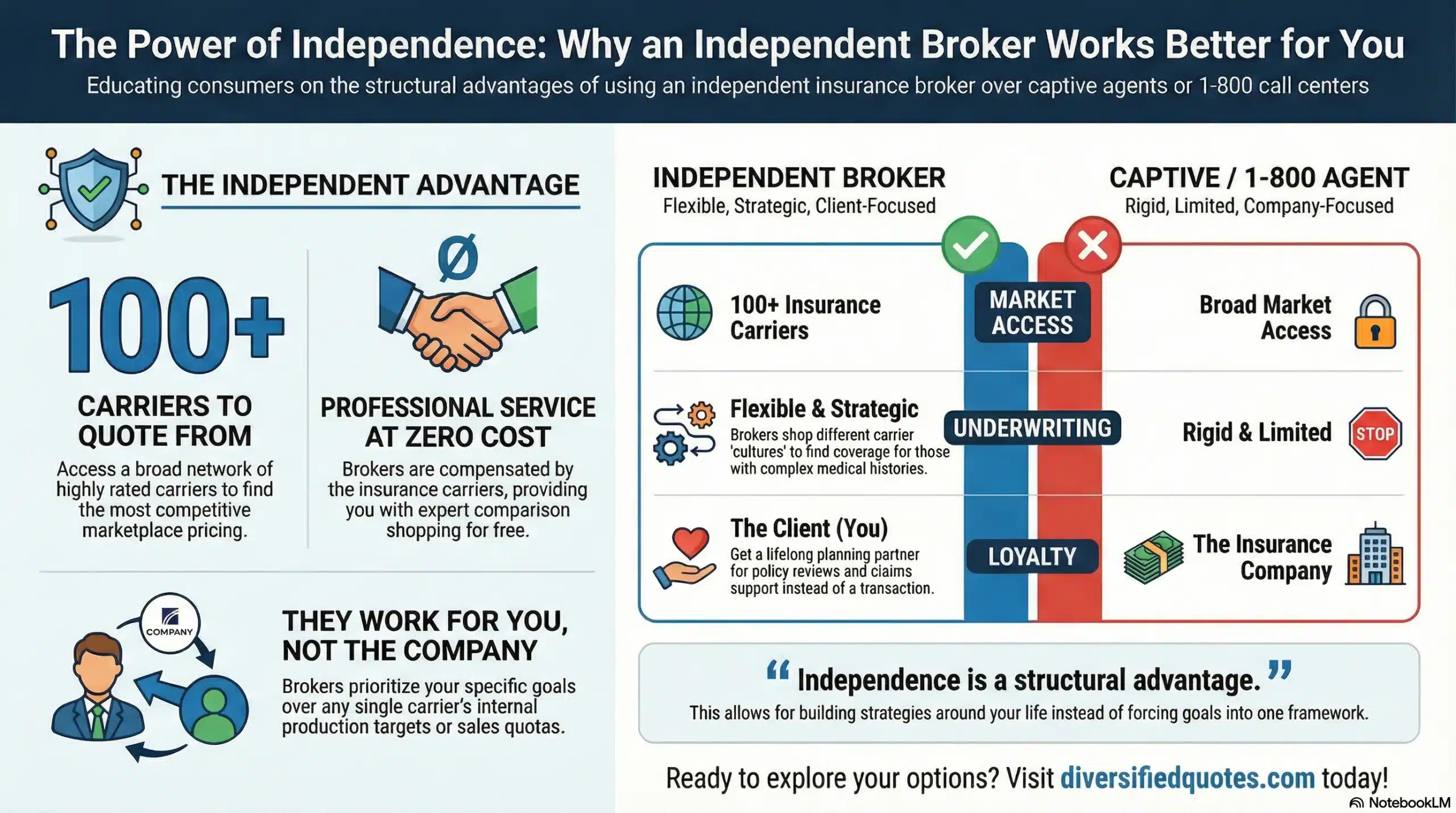
View the table near the end of the page to see why working with an independent insurance broker provides you the best possible rates.
Is Brighthouse a Good Insurance Company?

Jason Stolz CLTC, CRPC, DIA, CAA
Brighthouse Financial is one of the largest providers of annuities and life insurance in the United States — ranked by 2024 admitted assets among the top U.S. life and health insurers. The company was spun off from MetLife in 2017 and has spent the years since building a product lineup centered on retirement income, particularly its Shield index-linked annuity series and fixed indexed annuity products. If you are researching Brighthouse, there is one development you need to know about before anything else: in November 2025, Aquarian Capital — a private equity-backed insurance holding company — announced a $4.1 billion all-cash acquisition of Brighthouse Financial. Stockholders approved the deal in February 2026 and it is pending regulatory approval as of this writing, with closing expected sometime in 2026. That pending acquisition is the lens through which everything else about Brighthouse currently needs to be evaluated. At Diversified Insurance Brokers, Jason Stolz, CLTC, CRPC, DIA, CAA, helps clients understand what carrier changes like this mean for existing policyholders and for anyone evaluating Brighthouse products today.
Ensure you are receiving the absolute top rates
Current Fixed Annuity Rates
Compare today’s best fixed annuity rates from top carriers.
Current Bonus Annuity Rates
See which annuities offer the highest upfront bonus today.
Request an Annuity Quote
Submit our annuity request form to get personalized rate options.
Lifetime Income Calculator
Use our calculator to see how much guaranteed income your annuity can provide.
Company Snapshot
| Category | Details |
|---|---|
| Founded | 2017, spun off from MetLife; headquartered Charlotte, North Carolina |
| AM Best Rating | A (Excellent) — currently under review with negative implications due to pending Aquarian Capital acquisition (November 2025) |
| S&P Rating | A (revised from A+ in July 2025) — on CreditWatch with negative implications as of November 2025 |
| RBC Ratio | 456% at year-end 2025 — above the company’s 400–450% target range; statutory combined total adjusted capital $5.3 billion |
| Ownership (Pending) | Aquarian Capital acquisition announced November 2025; stockholders approved February 2026; regulatory approval pending; expected to close 2026 |
| Size | One of the largest US annuity and life insurance providers by admitted assets; over 2 million customers |
| Products | Shield index-linked annuities (RILA), variable annuities, SecureKey fixed indexed annuity, fixed rate annuities, income annuity, SmartCare hybrid life/LTC, SmartGuard Plus, term life |
| Availability | All 50 states; sold through financial professionals and independent agents — not directly to consumers online |
The Aquarian Acquisition: What It Means Right Now
This is the part of the Brighthouse story that matters most for anyone evaluating the carrier today. In November 2025, Brighthouse Financial announced it had entered into a merger agreement with Aquarian Capital LLC — an all-cash deal valued at approximately $4.1 billion, or $70 per share, representing a roughly 35% premium over Brighthouse’s pre-announcement stock price. Stockholders approved the transaction in February 2026 and it is pending insurance regulatory approvals as of this writing, with closing expected sometime during 2026. Brighthouse will continue operating under its current name and brand, headquartered in Charlotte.
The ratings agencies responded to the announcement with concern — not because of Brighthouse’s current financial position, which AM Best describes as strong with strong operating performance, but because of transaction and execution risk associated with an acquisition of this size. AM Best placed its ratings under review with negative implications in November 2025. S&P had already revised Brighthouse’s financial strength rating from A+ to A in July 2025, then placed it on CreditWatch with negative implications after the acquisition announcement. Fitch downgraded its ratings. These are not solvency concerns — Brighthouse ended 2025 with an RBC ratio of 456% and $5.3 billion in statutory combined total adjusted capital, which are robust numbers. The concern is forward-looking: what happens to product strategy, renewal rates, and operational priorities once a private equity-backed buyer takes full control of a $5+ billion insurance enterprise. For anyone placing a long-duration annuity with Brighthouse today, that question is worth asking explicitly. Our resource on state guaranty association protections covers the safety net that applies to annuity contracts regardless of carrier ownership changes.
Brighthouse’s Products: What They Actually Do
Brighthouse has historically been known for two product categories that set it apart from many competitors. The first is its Shield annuity series — registered index-linked annuities (RILAs), also called buffer annuities — which are a structure that sits between a traditional fixed indexed annuity and a variable annuity. Unlike a standard FIA that provides a 0% floor (you cannot lose money from index performance), a Shield annuity uses a “buffer” — typically absorbing the first 10%, 15%, or 20% of index losses — while allowing greater upside participation than most FIAs provide with caps. The tradeoff is that losses beyond the buffer are possible, meaning some downside risk exists. The Shield Level II and Shield Level Pay Plus II are the current generation of these products. For clients who want more growth potential than a typical FIA provides and are willing to accept some downside exposure below the buffer threshold, this structure can be compelling in the right context.
The second distinctive product is SmartCare — a hybrid indexed universal life insurance policy that combines a death benefit with long-term care benefit provisions. For clients who want a single contract to address both life insurance needs and the potential cost of extended care, SmartCare is a structure worth understanding. It is not a traditional standalone LTC policy — the LTC benefit is accessed through acceleration of the death benefit — but for clients who have been declined for or priced out of standalone LTC insurance due to health, it can represent an alternative path. Our resource on annuities with long-term care benefits covers the broader hybrid product category, and our resource on long-term care insurance services covers how traditional LTC options compare for clients evaluating all their options.
Beyond the Shield series and SmartCare, Brighthouse offers the SecureKey fixed indexed annuity with ReadyPay — a more conventional FIA with an income rider designed to produce guaranteed lifetime withdrawal income — along with variable annuities, fixed rate annuities, an income annuity for immediate conversion, and SmartGuard Plus term life insurance. The FIA and income annuity products are where Brighthouse competes most directly with carriers like Allianz, Athene, and North American in the independent annuity channel. Our resources on what an income rider is and how a GLWB works cover the income mechanics that matter most when evaluating any FIA with a guaranteed withdrawal benefit.
The Honest Assessment: Who Brighthouse Is and Is Not Right For
If you are interested in a buffer/RILA-style annuity — the Shield structure — Brighthouse has historically been one of the most recognized and accessible carriers for that product type in the independent market. It is a genuinely differentiated product that does not have a direct equivalent among traditional FIA carriers, and for the right client profile (comfortable with some downside exposure below the buffer in exchange for higher upside participation) it has performed the job it was designed for. That said, the pending acquisition changes the calculus on very long-duration commitments. Placing a 10-year product with a carrier whose ownership, investment strategy, and product philosophy are in active transition is a different decision than placing the same product with a stable, long-tenured carrier. For clients weighing that question, a side-by-side comparison against Allianz, Athene, and North American — all of which offer strong FIA and income products without a pending ownership transition — is worth completing before committing. Our resource on getting a second opinion on your annuity quote is the right starting point for any client who has been shown a Brighthouse illustration and wants to see how it benchmarks against the current full market.
For clients already holding a Brighthouse contract, the short-term practical answer is straightforward: existing contractual guarantees are legally binding obligations that do not change as a result of ownership changes. The guaranteed rates, income rider mechanics, death benefit terms, and surrender schedules in your contract were set at issue and remain in force. What can change post-acquisition is new business product design, renewal rates on non-guaranteed elements, and service infrastructure — which is why the pending acquisition deserves attention for new purchases rather than causing alarm for existing policyholders. Our resource on the annuity rescue plan covers options for existing annuity holders who want to evaluate whether repositioning makes sense given their current contract terms and market alternatives. For the broader retirement income planning framework — how an annuity fits alongside Social Security and other income sources — our resource on how Social Security and annuities work together covers the coordination strategy most clients are navigating when an annuity evaluation is on the table.
Talk With an Advisor Today
Choose how you’d like to connect—call or message us, then book a time that works for you.
Schedule here:
calendly.com/jason-dibcompanies/diversified-quotes
Licensed in all 50 states • Fiduciary, family-owned since 1980
Frequently Asked Questions: Is Brighthouse a Good Insurance Company?
What is Brighthouse Financial’s current AM Best rating?
Brighthouse Financial currently holds an AM Best financial strength rating of A (Excellent), but that rating is under review with negative implications as of November 2025. The negative review was triggered by the announcement of the Aquarian Capital acquisition — not by any current financial weakness. AM Best describes Brighthouse’s balance sheet as strong, with strong operating performance and appropriate enterprise risk management. The concern is forward-looking: transaction and execution risk associated with a private equity-backed firm acquiring an insurance enterprise of Brighthouse’s size. S&P similarly revised its financial strength rating from A+ to A in July 2025, then placed it on CreditWatch with negative implications after the acquisition announcement. Fitch downgraded its ratings as well. These agencies are essentially saying: we are watching to see what Aquarian does with this business before confirming where the ratings land post-close. For existing policyholders, the current financial position remains strong — RBC ratio of 456% at year-end 2025, well above the company’s 400–450% target range.
What is the Aquarian Capital acquisition and should it concern me?
Aquarian Capital LLC — a private equity-backed insurance holding company — announced an agreement to acquire Brighthouse Financial in November 2025 for approximately $4.1 billion in cash, or $70 per share. Stockholders approved the transaction in February 2026 and it is pending insurance regulatory approvals, with closing expected during 2026. Brighthouse will continue operating under its existing name and brand, headquartered in Charlotte. For existing policyholders, existing contractual guarantees — guaranteed rates, income rider mechanics, surrender schedules, and death benefit terms — are legally binding obligations that do not change as a result of ownership changes. What can change post-acquisition is new business product design, renewal rates on non-guaranteed elements, and operational direction. For new purchasers evaluating a long-duration Brighthouse contract today, the pending ownership transition is a legitimate factor to weigh, particularly in comparison to carriers without active ownership uncertainty. For shorter-duration products or immediate income annuities, the practical impact is more limited since the contractual terms are fixed at issue.
What is a Shield annuity and how does it work?
A Shield annuity is a registered index-linked annuity (RILA) — a product structure that sits between a traditional fixed indexed annuity and a variable annuity. Instead of providing a 0% floor like a standard FIA (meaning you can never lose money from index performance), a Shield annuity uses a “buffer” that absorbs losses up to a defined threshold — typically 10%, 15%, or 20% depending on the elected strategy. In exchange for accepting that potential downside below the buffer, the contract offers higher upside participation than most FIA products provide. In years when the index declines by less than the buffer amount, the contract absorbs the full loss and the account value does not decrease. In years when the index declines by more than the buffer — say a 25% decline with a 10% buffer — the contract absorbs the first 10% and the annuitant bears the remaining 15% loss in account value. The Shield is a product for clients who want more growth potential than a traditional FIA provides and are genuinely comfortable with the possibility of some account value loss in severe market downturns. It is not appropriate for clients who cannot accept any loss in account value under any circumstance, which is the profile that makes a standard FIA or MYGA the better fit.
What is Brighthouse SmartCare and who is it designed for?
SmartCare is Brighthouse’s hybrid indexed universal life insurance product — a single contract that combines a death benefit with long-term care benefit provisions. Rather than a standalone LTC insurance policy, SmartCare is structured as a life insurance contract where the LTC benefit is accessed by accelerating the death benefit when qualifying long-term care needs arise. For clients who want one contract to address both life insurance and potential long-term care costs, or for clients who have been declined for or priced out of standalone LTC insurance due to health history, SmartCare can provide a path to LTC benefit coverage that standalone underwriting would not allow. The tradeoff is that accessing the LTC benefit reduces or eliminates the death benefit — the two benefits share the same pool of money rather than being additive. Clients who need maximum death benefit for income replacement should evaluate whether a hybrid structure or separate policies better serve the overall plan. Our resource on annuities with long-term care benefits covers similar hybrid structures from the annuity side of the market, which are worth comparing alongside SmartCare for clients who have both retirement income and LTC planning objectives.
Should I compare Brighthouse against other carriers before deciding?
Yes — and particularly given the pending ownership transition, a thorough multi-carrier comparison is more important for Brighthouse today than it would be in a period of carrier stability. For the Shield (RILA/buffer annuity) product category specifically, Brighthouse has historically been one of the most prominent carriers, but several competitors now offer similar buffer structures — so the comparison should include product terms, buffer levels, upside participation caps, and surrender schedules across all available options. For FIA and income annuity products, the comparison against carriers like Allianz, Athene, and North American routinely surfaces differences in income rider design, payout rates, and crediting strategy flexibility that are material to the outcome. For clients who have already been shown a Brighthouse illustration, our second opinion on your annuity quote service provides a structured multi-carrier comparison against current market alternatives — using the same age, premium, and income objective — so the evaluation is based on measurable outcomes rather than carrier name recognition.
I already have a Brighthouse annuity. What does the Aquarian acquisition mean for me?
If you currently hold a Brighthouse annuity contract, your existing contractual guarantees are legally binding and do not change as a result of a change in ownership. The guaranteed interest rate, income rider mechanics, free withdrawal provisions, surrender schedule, and death benefit terms were established at the time of purchase and remain in force regardless of who owns the parent company. What ownership changes can affect over time are new business product design, renewal rates on non-guaranteed elements (such as indexed crediting caps and participation rates that the carrier declares annually), and operational service quality. The most important near-term question for existing holders is whether the non-guaranteed elements of their contract — particularly renewal rates and crediting parameters — are competitive relative to what could be obtained by repositioning. If you are in a surrender-charge-free window or approaching one, evaluating a repositioning through a 1035 exchange is worth doing regardless of the acquisition, and our resource on the annuity rescue plan covers that evaluation process in detail.
About the Author:
Jason Stolz, CLTC, CRPC, DIA, CAA and Chief Underwriter at Diversified Insurance Brokers (NPN 20471358), is a senior insurance and retirement professional with more than 25 years of real-world experience helping individuals, families, and business owners protect their income, assets, and long-term financial stability. As a long-time partner of the nationally licensed independent agency Diversified Insurance Brokers, Jason provides trusted guidance across multiple specialties—including fixed and indexed annuities, long-term care planning, personal and business disability insurance, life insurance solutions, Group Health, Travel Medical and Evacuation Insurance, and short-term health coverage. Diversified Insurance Brokers maintains active contracts with over 100 highly rated insurance carriers, ensuring clients have access to a broad and competitive marketplace.
His practical, education-first approach has earned recognition in publications such as VoyageATL, and contributions from his agency featured in Kiplinger and GoBankingRates— highlighting his commitment to financial clarity and client-focused planning. Drawing on deep product knowledge and years of hands-on field experience, Jason helps clients evaluate carriers, compare strategies, and build retirement and protection plans that are both secure and cost-efficient. Visitors who want to explore current annuity rates and compare options across multiple insurers can also use this annuity quote and comparison tool.
Review More Carrier Reviews: Browse our complete Annuity Company Reviews — covering Allianz, Athene, Jackson National, North American, and more annuity carriers.
Review More Carrier Reviews: Browse our complete Life Insurance Company Reviews — covering Banner Life, Lincoln Financial, Protective, Transamerica, and more life insurance carriers.
Last Reviewed: September 29, 2026 |
Reviewed by: Jason Stolz, CLTC, CRPC, DIA, CAA
Chief Underwriter, Diversified Insurance Brokers, Inc. | NPN: 20471358 | Diversified Insurance Brokers, Inc. — Licensed in all 50 states
Fact Checked by: Tonia Pettitt, CMIP©
Medicare Specialist, Diversified Insurance Brokers, Inc. | NPN: 14374308 | Diversified Insurance Brokers, Inc. — Licensed in all 50 states
Did you find this content helpful? Leave us a Google review — it helps others find trustworthy guidance too.
Editorial Standards: Diversified Insurance Brokers maintains rigorous editorial standards to ensure accuracy, clarity, and independence in all content. Learn more about our editorial standards and commitment to transparency.
