
Are Annuities a Smart Move When Interest Rates Are High?
As an Independent Annuity Broker, we compare rates across 100+ carriers and 1,000 different annuities— not just one company’s product offerings — to find the best fit for your goals.
Are Annuities a Smart Move When Interest Rates Are High?
Rising interest rates can be a double-edged sword in retirement planning. They usually make borrowing more expensive, but they can also create a major opportunity for conservative savers — especially inside fixed annuities and Multi-Year Guaranteed Annuities (MYGAs). In higher-rate environments, many insurers can credit stronger guaranteed rates, which can make annuities more compelling for people who want stability, principal protection, and a clearer plan for retirement income.

Ensure you are receiving the absolute top rates
Current Fixed Annuity Rates
Compare today’s best fixed annuity rates from top carriers.
Current Bonus Annuity Rates
See which annuities offer the highest upfront bonus today.
Request an Annuity Quote
Submit our annuity request form to get personalized rate options.
Lifetime Income Calculator
Rates matter, but retirement is ultimately about income. Use our calculator to explore how different annuity designs can translate savings into guaranteed lifetime income.
How Different Annuity Types Respond to Rising Interest Rates
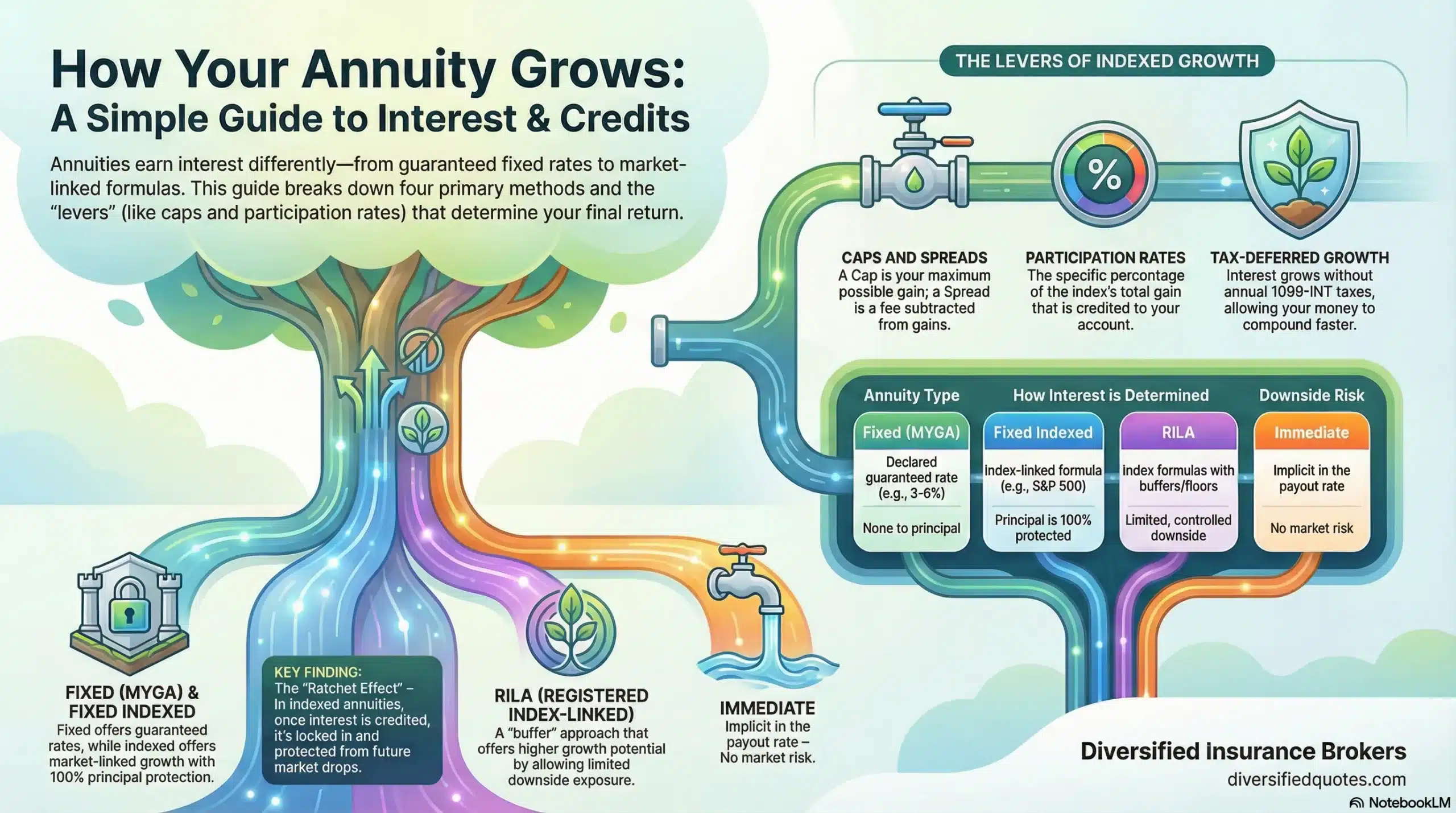
| Annuity Type | Impact of Rising Rates | Principal Risk | Tax Treatment | Best Use in High-Rate Environment |
|---|---|---|---|---|
| MYGA (Fixed Annuity) | Most directly and immediately responsive — carriers reprice new contracts quickly when their investment portfolio yields improve. Higher declared rates translate directly to better guaranteed accumulation per dollar invested. | None from market movements — principal and declared interest guaranteed if held to term. No mark-to-market pricing. | Tax-deferred — no annual 1099. Full credited rate compounds on a gross basis until withdrawal. Significant advantage over CDs in higher tax brackets. | Locking in competitive 3–7 year rates while they are elevated. Laddering multiple terms to capture rates across different maturities. Parking capital from rollovers or asset sales. |
| Fixed Indexed Annuity (FIA) | Positive but indirect — higher rates improve the carrier’s option budget, allowing more competitive cap rates and participation rates on index crediting strategies. The improvement in FIA terms often follows a rate rise with a slight lag as contracts reprice. | None from market — 0% floor prevents index-related losses regardless of rate or equity market movements. Principal is protected. | Tax-deferred — same annual compounding advantage as MYGAs. Optional GLWB rider fees reduce effective accumulation but provide guaranteed income as a trade-off. | Capturing improved cap rates and participation rates in the higher-rate environment while still participating in index-linked upside. Adding an income rider to build a future guaranteed paycheck alongside the rate-capture strategy. |
| Variable Annuity | Mixed and often negative — variable annuity subaccounts are directly invested in equity and bond markets. Rising rates cause bond fund subaccounts to decline in value. Equity subaccounts may be affected by rate-driven market volatility. | Full market risk — account value rises and falls directly with subaccount performance. No floor or principal protection on the base contract without an expensive guaranteed benefit rider. | Tax-deferred — but the high annual M&E fees and subaccount management costs reduce the effective yield available for compounding, diminishing the tax deferral advantage relative to lower-cost alternatives. | Generally the weakest annuity type in a rising rate environment — bond subaccounts lose value while competing fixed alternatives offer better guaranteed rates with principal protection. |
| SPIA / Income Annuity | Very positive — single premium immediate annuity payout rates improve significantly in higher-rate environments because carriers can invest the premium at better yields. More income per dollar is available to buyers at the same age compared to low-rate periods. | No accumulation risk — principal converts to guaranteed income stream. The “risk” is giving up liquidity and capital access in exchange for the lifetime income guarantee. | Favorable — for non-qualified contracts, each payment includes a return-of-principal portion excluded from income under the exclusion ratio. For qualified contracts, all payments are ordinary income. | Converting a lump sum to guaranteed lifetime income when payout rates are elevated — the higher the rate environment at purchase, the more monthly income per dollar of premium. Excellent for retirees building an income floor in a high-rate window. |
Why Higher Rates Can Improve Fixed Annuity and MYGA Value
Fixed annuities and MYGAs are often most attractive when insurers can invest new premiums into higher-yielding fixed-income portfolios. Insurance carriers primarily invest premium income in investment-grade corporate bonds, commercial mortgages, and other longer-duration fixed-income instruments. When interest rates rise, these instruments generate higher yields, and carriers can offer better credited rates on new annuity contracts. For conservative savers, that can mean higher guaranteed accumulation over a set term without stock market exposure — and with contract terms that are straightforward to understand compared to many market-based strategies.
In practical terms, the higher-rates story matters most for people who want a bond-like alternative with insurance-style guarantees. Many retirees who are uncomfortable with market volatility or sequence-of-returns risk use fixed annuities to create stability — particularly for money they do not want exposed to drawdowns. If you are evaluating where annuities fit in the bigger retirement picture, it is worth reading whether annuities are worth it and whether annuities are a good investment in retirement to frame the decision around outcomes rather than marketing. Understanding the full benefits of annuities — beyond the rate itself — ensures the contract is evaluated for its complete value proposition.
Tax Deferral — Why It Matters More in High-Rate Environments
Another advantage annuities can offer compared to bank products is tax treatment — especially for non-qualified money. Unlike CDs, annuities generally grow tax-deferred, meaning interest can compound without annual taxation until you take withdrawals. In a higher-rate environment, this tax deferral advantage is amplified because the credited rate itself is higher. A MYGA earning 4.5% with tax deferral does not just produce more nominal interest than a CD earning 3.0% — it also produces more after-tax accumulation than a CD earning the same 4.5%, because the CD’s credited interest generates a 1099 each year while the MYGA’s interest compounds without reduction. Understanding how annuities are taxed at withdrawal — gains as ordinary income, basis returned tax-free under the exclusion ratio for non-qualified contracts — ensures the net comparison against taxable alternatives is modeled correctly before committing to any annuity contract.
Why It Is Not Enough to Just Grab the Highest Rate
Rate shopping is smart — but rate-only shopping is where people get burned. Two annuities can post similar rates and still behave very differently when you actually need to use the money. That is why comparing the full structure of the contract matters, not just the top-line crediting number. The items that most directly affect real-world outcomes are: the surrender charge period, the free-withdrawal provisions, any waivers such as nursing home or terminal illness access, how interest is credited, and whether you want a future income option. Reviewing all of these before committing ensures you are not simply chasing a headline rate and finding yourself locked into a structure that does not align with your actual liquidity needs and retirement timeline.
For fixed indexed annuities, there is another layer: some terms can change at renewal — like caps, participation rates, or spreads — within the contract’s rules. That does not automatically make FIAs a poor choice, but it does mean you should understand what can adjust and what is contractually guaranteed. If you are comparing indexed strategies, it is also helpful to understand how an annuity spread rate works and why it matters for the effective credited interest you actually receive after the spread is subtracted.
Rate-Locking Strategy — When to Lock Long and When to Stay Short
One of the most consequential decisions in a higher-rate environment is the term length — how many years to lock in the current rate. The fundamental tension: longer terms offer higher declared rates but commit the full allocation to that rate for a longer period. If rates continue to rise after you lock in, you are earning below the new market rate while still inside the surrender period. Shorter terms offer more flexibility but typically at lower rates. The most common resolution is a laddering approach — dividing the conservative allocation across multiple terms so that a portion matures in the near term for reinvestment if rates move further, while longer-duration contracts capture the elevated rates that longer commitments command. Our resource on the fixed annuity ladder strategy covers how to structure the allocation across terms to balance rate capture and ongoing flexibility.
For retirees doing rollover planning from a 401(k) or IRA, the annuity decision is typically connected to other accounts and rules — like required minimum distributions, tax brackets, and beneficiary planning. Understanding what to do with a 401(k) after retirement frames the broader rollover context that the annuity fits within. Clear beneficiary structure is also one of the most overlooked parts of a good annuity decision — understanding how annuity beneficiary death benefits work ensures the contract’s legacy provisions align with the overall estate plan before any funds are committed.
How to Use Higher Rates in a Smarter Retirement Strategy
In a higher-rate environment, a common approach is to treat fixed annuities and MYGAs as the “sleep-well” portion of the portfolio — the allocation meant to be stable and predictable. That does not mean putting everything into an annuity. It usually means identifying the portion of assets meant to provide certainty and then structuring that piece to support the retirement income plan, while growth assets remain in equities or other accumulation vehicles. For some retirees, that means using a MYGA to lock a guaranteed rate for a set term while maintaining planned liquidity at maturity. For others, it means using an annuity that can later be converted into guaranteed lifetime income. For others, it is a blend — some money positioned for fixed-rate stability, and some positioned for income or bonus design.
The best structure depends on what you need the money to do, how soon you need income, and how much flexibility you want to maintain. With over 1,000 annuity products across the market, the most common frustration is not knowing which contracts are actually taking advantage of the current rate environment and which are lagging behind. Some carriers move quickly, some move slowly, and some products are designed more for income or bonuses than for pure fixed-rate accumulation. At Diversified Insurance Brokers, we shop top annuity carriers to help you secure the best available rates and structures while they are competitive — comparing simple fixed-rate options, bonus-focused options when they make sense, and income-focused designs when the goal is to create predictable retirement paychecks. Understanding how MYGAs work at a foundational level helps frame what to look for when evaluating carrier options in the current rate environment.
Ready to compare current fixed annuity and MYGA rates across 75+ top carriers?
Request Your Personalized Annuity Comparison
Financial Protection Essentials
Understand annuity guarantees, interest rate examples by investment size, and how retirement income strategies work in practice.
Talk to an Advisor or Request Your Annuity Quote
Ready to explore this annuity in more detail—or compare it with other carriers to see if even higher rates are available? With guaranteed income, principal protection, and long-term growth potential on the line, making the right choice is essential. The experienced advisors at Diversified Insurance Brokers will guide you through the options and design a strategy tailored to your retirement goals.
Schedule here:
calendly.com/jason-dibcompanies/diversified-quotes
Licensed in all 50 states • Fiduciary, family-owned since 1980
Are fixed annuity rates always higher when interest rates are high?
Generally yes, though not always immediately and not uniformly across all carriers. When the Federal Reserve raises its benchmark rate, market interest rates across the fixed-income spectrum typically follow — corporate bond yields, Treasury yields, and commercial mortgage rates all respond. Insurance carriers that invest premium income in these instruments generate higher yields, and can pass a portion of that improvement through to new annuity contracts as higher declared rates. However, the responsiveness varies significantly by carrier and product type. Some carriers reprice aggressively and quickly when rates improve, while others move more slowly — either because of how their existing portfolio is positioned, their competitive strategy, or the specific product type. Additionally, MYGA rates on new contracts respond more quickly than FIA cap and participation rates, because MYGA rates are set directly by the carrier’s investment yield while FIA caps are set by the options market, which incorporates multiple variables including equity market volatility. The practical implication: comparing rates across multiple carriers at any given point in time is essential, because the variation in declared rates for the same term length can be meaningful even when all carriers are operating in the same interest rate environment.
Should I lock in a long-term annuity rate now or wait to see if rates go higher?
This is one of the most common questions in a rising or elevated rate environment, and the honest answer is that no one can predict with certainty whether rates will go higher, stay flat, or decline. Market timing of interest rates has proven difficult even for professional investors. The practical framework most advisors use: if current rates are materially competitive relative to alternatives — CDs, bond funds, short-term instruments — and the annuity’s surrender period aligns with your actual holding intention, locking in a portion of the conservative allocation now captures the available rate without requiring further rate predictions. The risk of waiting is that rates could decline, leaving you wishing you had locked in the current rate. The risk of locking is that rates could rise further, leaving you earning below the new market rate during the surrender period. A laddering approach — allocating across multiple terms rather than committing the full amount to one term — splits the difference and provides ongoing reinvestment opportunities as shorter-duration rungs mature. This structure eliminates the all-or-nothing rate timing decision while still capturing meaningful guaranteed yields on the longer rungs.
How does a high-rate environment affect annuity income riders and payout rates?
Higher interest rate environments can improve income annuity payout rates, particularly for immediate income annuities (SPIAs and DIAs), because the carrier invests the premium at higher yields and can provide more income per dollar. For GLWB income riders on FIAs and fixed annuities, the improvement is less direct — GLWB payout percentages are set by the carrier’s product design and actuarial assumptions, not mechanically by the prevailing interest rate. However, improved investment yields may allow some carriers to offer more competitive GLWB roll-up rates or payout percentages on new contracts. The most direct beneficiaries of a high-rate environment for income planning are buyers who want to purchase a single premium immediate annuity to convert a lump sum to lifetime income — the monthly income per dollar of premium is meaningfully higher when rates are elevated than during low-rate periods, which is why some retirees who delayed purchasing income annuities during low-rate cycles find that elevated rates create a compelling window to execute that transition.
Are annuities a better choice than bonds in a rising rate environment?
For many conservative investors in or near retirement, yes — and the comparison often favors MYGAs over bonds and bond funds specifically in a rising rate environment for three structural reasons. First, bond prices fall when interest rates rise — a bond fund or individual bond position purchased at lower rates loses market value as rates increase, creating paper losses in what many investors assumed was their “safe” allocation. MYGAs have no mark-to-market pricing and cannot decline in value due to rate movements. Second, bond fund investors who sell during rising rate periods to reposition realize actual losses; MYGA holders simply wait for the surrender period to end and then reinvest at the new higher rates at maturity. Third, MYGAs typically offer higher declared rates than equivalent-term Treasury or investment-grade corporate bonds on an after-tax basis when the tax deferral advantage is factored in. The primary advantage bonds maintain is liquidity — bonds and bond funds can be sold at market value at any time, while MYGAs have surrender charge periods limiting full access. For investors with a defined holding period that aligns with the MYGA’s surrender schedule, the MYGA typically provides better guaranteed outcomes than a bond allocation of equivalent credit quality in a rising rate environment.
What should I watch out for when comparing annuities in a high-rate environment?
The most important watchout is rate-only comparison — evaluating annuities solely on the declared rate without reviewing the full contract structure. Several common traps in high-rate shopping: bonus annuities that appear to offer a higher effective rate through a premium bonus but pair that bonus with longer surrender periods or lower declared rates that offset the bonus over time; carriers with aggressive marketing rates that are only available for a brief initial period before rolling to a lower rate; products with very high declared rates that come paired with very long surrender periods that may not be appropriate for your age or liquidity needs; and FIAs with high caps or participation rates at issue that cannot contractually be maintained at that level if market conditions change. In a competitive rate environment, some carriers use aggressive short-term rate promotions to attract assets that may not provide competitive long-term outcomes. Comparing the minimum guaranteed rate — the lowest the carrier can set the credited rate under any circumstances — alongside the current declared rate gives a more complete picture of what the contract guarantees versus what it currently offers. Working with an independent broker who can compare the full structure of contracts across multiple carriers, not just the headline rate, is the most reliable path to a contract that performs as expected.
About the Author:
Jason Stolz, CLTC, CRPC, DIA, CAA and Chief Underwriter at Diversified Insurance Brokers (NPN 20471358), is a senior insurance and retirement professional with more than 25 years of real-world experience helping individuals, families, and business owners protect their income, assets, and long-term financial stability. As a long-time partner of the nationally licensed independent agency Diversified Insurance Brokers, Jason provides trusted guidance across multiple specialties—including fixed and indexed annuities, long-term care planning, personal and business disability insurance, life insurance solutions, Group Health, Travel Medical and Evacuation Insurance, and short-term health coverage. Diversified Insurance Brokers maintains active contracts with over 100 highly rated insurance carriers, ensuring clients have access to a broad and competitive marketplace.
His practical, education-first approach has earned recognition in publications such as VoyageATL, and contributions from his agency featured in Kiplinger and GoBankingRates— highlighting his commitment to financial clarity and client-focused planning. Drawing on deep product knowledge and years of hands-on field experience, Jason helps clients evaluate carriers, compare strategies, and build retirement and protection plans that are both secure and cost-efficient. Visitors who want to explore current annuity rates and compare options across multiple insurers can also use this annuity quote and comparison tool.
Explore More Annuity Options: Browse our complete guide to What Is a Fixed Annuity? — covering fixed annuities, MYGAs, laddering strategies & conservative growth options from 100+ carriers.
Last Reviewed: June 25, 2026 |
Reviewed by: Jason Stolz, CLTC, CRPC, DIA, CAA
Chief Underwriter, Diversified Insurance Brokers, Inc. | NPN: 20471358 | Diversified Insurance Brokers, Inc. — Licensed in all 50 states
Fact Checked by: Tonia Pettitt, CMIP©
Medicare Specialist, Diversified Insurance Brokers, Inc. | NPN: 14374308 | Diversified Insurance Brokers, Inc. — Licensed in all 50 states
Did you find this content helpful? Leave us a Google review — it helps others find trustworthy guidance too.
Editorial Standards: Diversified Insurance Brokers maintains rigorous editorial standards to ensure accuracy, clarity, and independence in all content. Learn more about our editorial standards and commitment to transparency.
