
Are You Leaving Social Security Benefits on the Table?
Are You Leaving Social Security Benefits on the Table?
Social Security retirement benefits represent the single most consequential financial decision most Americans make at retirement — yet fewer than one in ten retirees ever receives a comprehensive analysis of their claiming options before filing. The decision of when to claim, how to coordinate with a spouse, which benefit to collect first, and how to structure Social Security alongside other income sources can change lifetime household income by hundreds of thousands of dollars. These are not marginal improvements — they are structural differences that compound for the rest of a retiree’s life. A benefit claimed at 62 is permanently reduced from what it would have been at full retirement age. A benefit delayed to age 70 is permanently increased above what it would have been at full retirement age. A survivor benefit that is maximized through strategic timing can protect a spouse’s income for decades after the higher-earning spouse passes. Understanding and acting on these mechanics before filing is one of the highest-return financial planning steps available to any near-retiree. Our resources on when you should start taking Social Security benefits and how to maximize Social Security benefits cover the core decision framework, and our Social Security services page covers the full range of planning assistance available for evaluating your specific situation.

The challenge is that Social Security’s rules are complex, interact with each other in non-obvious ways, and are affected by factors most people don’t think to evaluate: earnings history across 35 working years, marital status and the age difference between spouses, prior divorce from a long-term marriage, government pensions that may affect benefits, plans to continue working before full retirement age, provisional income levels that determine how much of the benefit is taxed, and the timing of Medicare enrollment. No single rule — not “always delay to 70” and not “claim early to get your money sooner” — applies universally. The optimal strategy is always personal, always household-specific, and always best evaluated within the context of the full retirement income plan rather than in isolation. Our resource on Social Security income limits covers the earnings test mechanics for retirees who plan to continue working, and our resources on Social Security benefits for the self-employed, does working past 65 affect Social Security, and claiming strategies for widows cover specific situations that require different analysis than the standard retirement filing scenario.
The opportunity cost of filing without proper analysis is not theoretical — it is calculable and, in many cases, irreversible. Once you file for Social Security, your claiming decision is locked in for life with limited exceptions. You cannot go back and “undo” an early claim that locked in a permanently reduced benefit for both you and your surviving spouse. You cannot retroactively capture delayed retirement credits you forfeited by filing at 62. The window for informed decision-making is the period before you file, and the quality of that decision is determined by whether you have modeled your specific situation — including claiming age comparison, spousal coordination, survivor protection analysis, and integration with tax planning — rather than relying on general rules or the choice that most of your peers happened to make. This page covers the core mechanics, the most common missed opportunities, and the framework for building a Social Security strategy that actually fits your household plan.
Request Your Personalized Social Security Review
We model claiming scenarios, spousal coordination strategies, survivor benefit protection, and tax integration — based on your actual earnings record, age, marital status, and retirement income plan.
Start Your Social Security ReviewClaiming Age Comparison — The Three Most Common Filing Ages
The table below compares the three most commonly evaluated filing ages — 62 (the earliest eligibility age), the full retirement age (FRA, currently age 67 for most workers born in 1960 or later), and age 70 (the latest age at which delaying produces any additional benefit) — across the key dimensions that determine which option is best for a given household.
| Dimension | Claim at 62 | Claim at Full Retirement Age (67) | Claim at 70 |
|---|---|---|---|
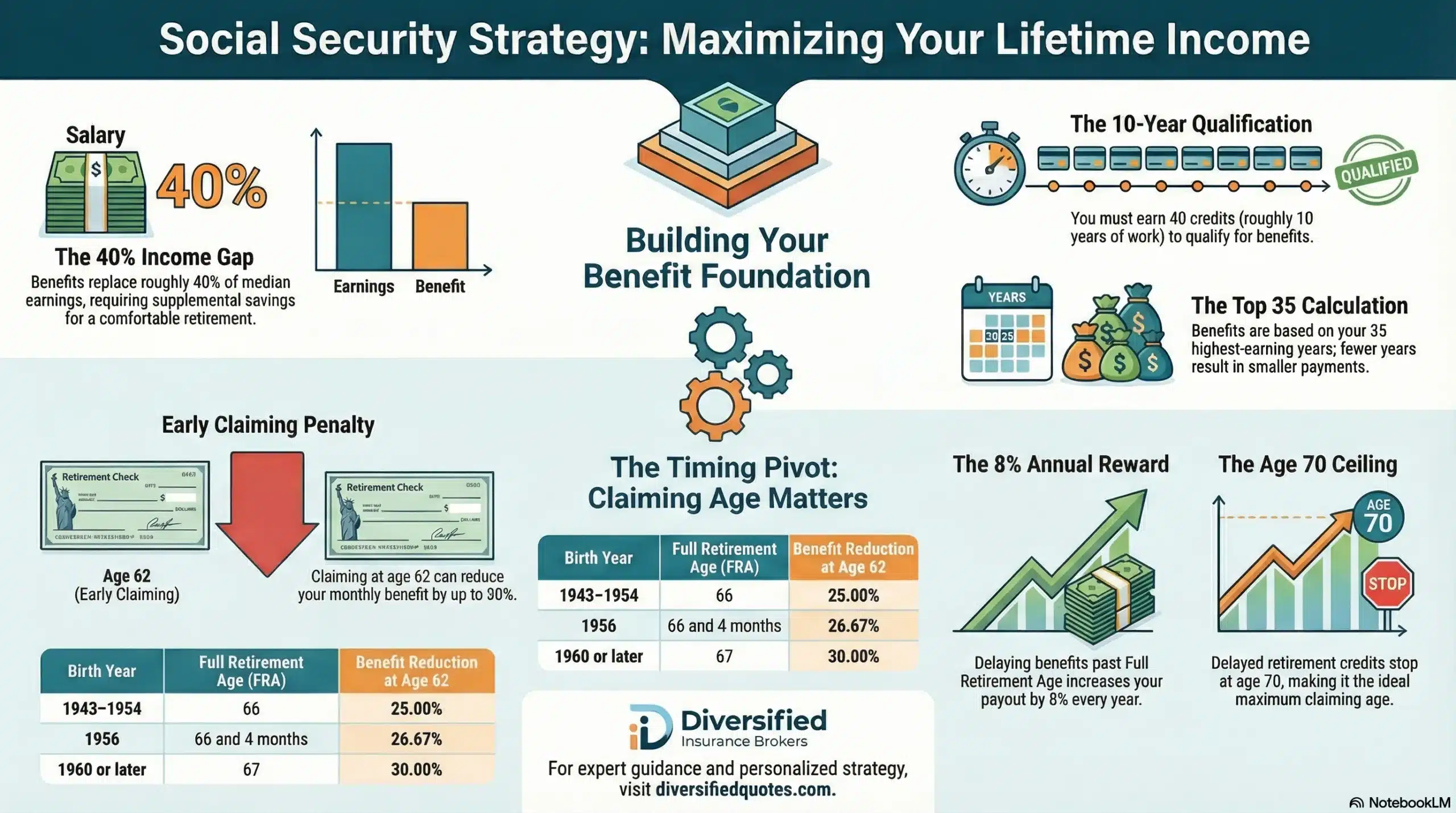
| Monthly Benefit Amount | Permanently reduced by up to 30% compared to FRA benefit (the exact percentage depends on how many months before FRA you claim) | Full Primary Insurance Amount (PIA) — the baseline benefit calculated from your 35-year earnings record; no reduction, no increase | Permanently increased by 24% above FRA benefit (8% per year × 3 years from age 67 to 70 for workers with FRA of 67) |
| Earnings Test Exposure | Applies if you continue working before FRA — benefits may be temporarily withheld if earnings exceed the SSA annual limit; withheld amounts are credited back at FRA as a higher monthly benefit | Earnings test no longer applies at FRA — you can earn any amount from work without any benefit reduction | No earnings test — you can work and earn any amount without impact on Social Security benefits |
| Survivor Benefit Impact | Surviving spouse receives the permanently reduced benefit — early claiming by the higher earner locks in a lower survivor benefit for potentially decades after death | Surviving spouse receives the full FRA benefit — a meaningful improvement over the early-claim scenario for survivor protection | Surviving spouse receives the maximum benefit — the 24% increase above FRA provides the highest possible ongoing income for a surviving spouse; often the most important reason for a higher earner to delay |
| Break-Even Age (vs. claiming at 62) | N/A — baseline for comparison | Typically around age 78-80 — if you live past this age, the FRA claimant collects more in lifetime total than the age-62 claimant despite starting 5 years later | Typically around age 80-82 — if you live past this age, the age-70 claimant collects more in lifetime total than the age-62 claimant despite starting 8 years later |
| Best Planning Fit | Households with limited other retirement income, significant health concerns that reduce life expectancy, single individuals without survivor considerations, or cases where immediate income is required to avoid drawing down investment accounts at an unfavorable time | Households seeking a clean, default option without complexity; single claimants near average life expectancy; situations where some delay was not feasible but full early claiming was also undesirable | Higher earners in married couples where survivor protection is paramount; individuals with above-average life expectancy; retirees with other income sources (pension, annuity, investment withdrawals) that can bridge the gap to age 70 without financial stress |
FRA is currently age 67 for workers born in 1960 or later. Workers born 1955–1959 have FRA between 66 and 67 — verify your specific FRA at SSA.gov. Benefit percentages reflect SSA rules as applied to the FRA schedule for workers born 1960 and after. Break-even ages are approximations based on general SSA methodology; your actual break-even depends on your exact benefit amount and the SSA’s recalculation at FRA. This table is for educational purposes; consult SSA.gov and a retirement planning professional for your specific figures.
How Your Benefit Is Calculated — The 35-Year Earnings Record
Your Social Security retirement benefit is not arbitrary — it is calculated from your actual earnings history using a specific formula. The Social Security Administration indexes your wages from each year you worked, takes the 35 highest-earning indexed years, and calculates the Average Indexed Monthly Earnings (AIME). That AIME is then run through a progressive formula at defined income thresholds (called “bend points”) to produce your Primary Insurance Amount (PIA) — the benefit you would receive if you claimed exactly at your full retirement age. The progressivity of the formula means that lower-wage workers receive a higher percentage replacement of their pre-retirement income than higher-wage workers, but everyone’s actual benefit reflects their own earnings history. The 35-year floor is important: if you worked fewer than 35 years, the SSA inserts zeros for the missing years, which reduces the AIME and the resulting benefit. Working an additional year at a meaningful income can replace a zero year or a low-income year, which can increase the benefit even for workers who are already past FRA. Your personal earnings history and projected benefit estimates are available at SSA.gov under “my Social Security” — reviewing this statement before making any claiming decision is strongly recommended, both to verify the accuracy of the earnings record and to understand the specific dollar impact of different claiming ages on your projected benefit.
The Early Claiming Penalty — Understanding What Permanent Reduction Means
Filing for Social Security before your full retirement age results in a permanent reduction to every monthly payment you receive for the rest of your life. The reduction is calculated based on the number of months before FRA you claim: for the first 36 months before FRA, the benefit is reduced by 5/9 of one percent per month; for each additional month before FRA beyond the first 36, the reduction is 5/12 of one percent per month. For workers with FRA at 67 who claim at 62 — the earliest eligible age — the combined reduction produces a benefit that is approximately 30% lower than the FRA benefit. If your FRA benefit would have been $2,000 per month, claiming at 62 locks in approximately $1,400 per month — and that $600 monthly difference persists for every month you live, adjusted each year by the cost-of-living adjustment (COLA) at the reduced baseline. The cumulative difference over a 25-year retirement is significant in absolute dollar terms regardless of what any break-even analysis shows, and it is a permanent election that cannot be reversed after the 12-month withdrawal period has passed. The emotional pull of “getting my money sooner” or “getting it before the system changes” can be powerful, but it should be weighed against this specific, quantified permanent reduction.
Delayed Retirement Credits — The 8% Annual Growth After FRA
For every month you delay claiming Social Security after your full retirement age — up to age 70 — the SSA credits your record with delayed retirement credits that increase the eventual monthly benefit. The rate is 2/3 of one percent per month, which produces 8% per year. For a worker with FRA at 67 who delays to age 70, the three-year delay generates a 24% permanent increase above the FRA benefit. If the FRA benefit would have been $2,000 per month, the age-70 benefit is approximately $2,480 per month — and that higher baseline persists for every month of retirement, also receiving the annual COLA adjustment at the higher level. This 8% annual return on delayed claiming is often described as an exceptionally guaranteed return compared to what most fixed-income investments can offer — because it is backed by the U.S. government, adjusted for inflation through COLAs, and lasts for the claimant’s lifetime plus the survivor’s lifetime. Beyond age 70, there is no additional increase from delaying — the benefit reaches its maximum at 70 regardless of whether you claim at 70, 71, or later. There is no financial incentive to delay claiming past age 70.
Spousal Benefits — The 50% Entitlement and Its Limits
A married individual who has limited or no Social Security earnings record of their own may be entitled to a spousal benefit based on the working spouse’s record. The spousal benefit is up to 50% of the working spouse’s Primary Insurance Amount (PIA) — meaning the FRA benefit, not the early-claiming reduced amount and not the delayed-credit-enhanced amount. A key nuance that is frequently misunderstood: spousal benefits do not receive delayed retirement credits. If the working spouse delays to age 70 and receives a 24% increase above their PIA, the spousal benefit is still calculated at 50% of the PIA — not 50% of the age-70 enhanced benefit. This means that delaying claiming benefits the working spouse’s own benefit significantly but does not additionally benefit the spousal benefit itself. The strategic implication is that spousal benefit calculations should focus on the FRA benefit of the working spouse, not on the age-70 enhanced benefit that would otherwise motivate delay. A lower-earning spouse can also claim a reduced spousal benefit before their FRA — with the same type of permanent reduction that applies to claiming your own benefit early — or can claim at their own FRA for the full 50% entitlement. The SSA compares your own earned benefit to the spousal benefit and pays whichever is higher; you cannot receive both.
Survivor Benefits — The Most Consequential and Overlooked Strategy for Married Couples
When one spouse dies, the surviving spouse receives the higher of their own Social Security benefit or the deceased spouse’s benefit — not both. This single rule is the foundation of the most important Social Security coordination decision for most married couples: because the higher-earning spouse’s benefit becomes the survivor benefit after their death, maximizing the higher earner’s benefit through delayed claiming is the most direct way to protect the financial security of the surviving spouse for what may be many years or even decades. If a higher-earning spouse claims at 62 and locks in a 30% reduction, that reduced benefit becomes the permanent survivor benefit when they pass — reducing the surviving spouse’s income by a potentially catastrophic amount at exactly the time when the household has lost one income stream. If the same higher-earning spouse delays to age 70 and establishes the maximum possible benefit, the surviving spouse inherits that maximum benefit regardless of when the higher earner dies after filing. Our resource on strategies for claiming Social Security for widows covers the survivor benefit framework in detail, including when a surviving spouse can claim survivor benefits versus their own benefit, and how to time each to maximize lifetime household income. For many married couples, the higher earner delaying to 70 functions as the most cost-effective form of longevity insurance available — the additional survivor income is guaranteed, inflation-adjusted, and costs nothing beyond the discipline of delaying the filing date.
Divorced Spouse Benefits — An Often-Unknown Entitlement
Many divorced Americans are entitled to Social Security benefits based on a former spouse’s earnings record and are unaware of this entitlement. A divorced individual may claim spousal benefits on an ex-spouse’s record if the marriage lasted at least 10 years, the claimant is currently unmarried, and both parties are at least age 62. Importantly, the ex-spouse’s filing status does not affect the divorced spouse’s eligibility — a divorced individual can claim on the ex-spouse’s record even if the ex-spouse has not yet filed, provided both are at least age 62 and the divorce occurred at least two years ago. The benefit available is the same as for a current spouse: up to 50% of the ex-spouse’s PIA. The ex-spouse’s own benefits are not reduced by the divorced spouse claiming on their record. Divorced survivor benefits follow a similar structure when the ex-spouse has died — a divorced individual may be eligible for survivor benefits based on the ex-spouse’s record, subject to the 10-year marriage requirement and other eligibility conditions. Reviewing divorced spouse eligibility before claiming on your own record is an important planning step for anyone who was married for a decade or more, because the divorced spousal benefit may exceed the individual’s own earned benefit, particularly if there was a significant earnings disparity during the marriage.
The Earnings Test — What Happens If You Claim Early and Keep Working
If you claim Social Security before your full retirement age and continue working, the SSA applies an earnings test that may temporarily reduce your benefits. For each dollar you earn above the SSA’s annual earnings threshold (set each year by the SSA — verify the current limit at SSA.gov before planning), approximately 50 cents of Social Security benefits is withheld. This is not a tax and it is not a permanent reduction — the SSA recalculates your benefit at FRA to credit you for the months when benefits were withheld, producing a slightly higher monthly payment going forward. However, the recalculation does not typically make you whole on a dollar-for-dollar basis for all withheld benefits, and the complexity of managing withheld benefits while also managing income and tax exposure before FRA makes early claiming while working full-time a difficult strategy to optimize. For most workers who intend to continue working at meaningful income levels before FRA, the cleaner strategy is to delay claiming until FRA (or beyond), avoid the earnings test entirely, and collect the full benefit without the complexity of withholding and recalculation. Our resource on Social Security income limits covers the earnings test mechanics in detail, and our resource on does working past 65 affect Social Security benefits covers the specific planning implications for workers who continue past traditional retirement age. For self-employed individuals, our resource on Social Security benefits for the self-employed covers how net earnings from self-employment interact with both the earnings test and the benefit calculation.
Taxation of Benefits — Up to 85% May Be Taxable
Social Security benefits are subject to federal income tax for many retirees — and the percentage that is taxable depends on what the IRS calls “provisional income” (also called combined income), which is calculated as adjusted gross income plus any nontaxable interest plus 50% of Social Security benefits. When provisional income falls below the lower threshold (for an individual filer), no Social Security benefits are taxable. Between the lower and upper thresholds, up to 50% of benefits may be taxable. Above the upper threshold, up to 85% of benefits may be taxable. Per IRS Publication 915, which covers the taxation of pensions and annuity income including Social Security, this threshold structure has not been adjusted for inflation since it was set — meaning an increasing proportion of retirees now find that their benefits are partially or fully taxable at the 85% level as their total income has grown. The practical planning implication is that the sources and timing of retirement income withdrawals can significantly affect how much of Social Security is exposed to taxation. Strategic Roth conversions before claiming, timing of IRA withdrawals relative to Social Security, and use of annuity income structured to reduce provisional income can all affect the net after-tax value of Social Security benefits. The interaction between Social Security taxation and Medicare Income-Related Monthly Adjustment Amounts (IRMAA) adds another layer: higher provisional income can increase Medicare Part B and Part D premiums for two years following the higher-income year. Treating Social Security as an isolated benefit rather than as part of a coordinated income and tax plan systematically produces worse after-tax outcomes than a plan that integrates all income sources deliberately.
Medicare Timing — The Coordination Requirement
Medicare eligibility begins at age 65 regardless of when you claim Social Security. For retirees who plan to delay Social Security past age 65, Medicare enrollment still requires separate action at the age-65 eligibility window. Failing to enroll during the Initial Enrollment Period (IMP) surrounding your 65th birthday can result in a late enrollment penalty for Medicare Part B that lasts for the rest of your life, and in a gap in health coverage that can be expensive to manage through private alternatives. Retirees who are still covered by an employer group health plan through active employment can often delay Medicare without penalty until that coverage ends, but the conditions are specific and must be verified. The key planning rule is: do not assume that delaying Social Security automatically delays Medicare — the two systems are related but governed by separate rules and enrollment timelines. Verifying both timelines with SSA.gov and Medicare.gov before the 65th birthday is strongly recommended for anyone planning to delay Social Security past age 65.
WEP and GPO — Eliminated for Affected Government Workers
Two provisions that previously reduced Social Security benefits for certain government workers — the Windfall Elimination Provision (WEP) and the Government Pension Offset (GPO) — were eliminated effective January 2025 under the Social Security Fairness Act. WEP had reduced the Social Security benefits of workers who received pensions from jobs not covered by Social Security (such as certain state and local government positions), while GPO had reduced spousal and survivor Social Security benefits for individuals receiving government pensions from non-covered employment. The elimination of these provisions significantly increased Social Security benefits for affected workers and their spouses. For retired or near-retired government workers who received pension income from non-covered employment and may have previously been advised that their Social Security benefits would be reduced or eliminated by these provisions, the elimination means a meaningful increase in available Social Security income. If you or your spouse worked in a position covered by a government pension rather than Social Security, reviewing your current benefit eligibility with SSA.gov or a Social Security planning professional is an important step to confirm that any applicable adjustments to your benefit have been processed correctly.
Integrating Social Security With Other Retirement Income Sources
The most significant improvement in Social Security outcomes typically comes not from optimizing Social Security in isolation but from integrating it with the rest of the retirement income plan. Social Security is one income stream among several — typically alongside IRA and 401(k) withdrawals, pension income, annuity income, investment income, and potentially earned income from part-time work. The optimal timing of Social Security is influenced by how these other sources are structured. For example, a retiree who has both an annuity providing guaranteed monthly income and a traditional IRA may benefit from using the annuity income to cover living expenses while deliberately delaying Social Security to 70 — allowing the benefit to grow while the annuity provides the income floor that would otherwise require early Social Security claims. Our resources on pension alternative strategies and lifetime income services cover the annuity structures that most commonly bridge the gap between retirement and delayed Social Security claiming — allowing the higher earner to delay without income stress. Our resources on what interest a $1 million annuity pays and what interest a $3 million annuity pays cover the annuity income potential at various premium sizes that can serve as the bridge income. Our resource on how life expectancy is calculated covers the longevity framework that underlies the break-even analysis, and our resource on are annuities good or bad covers the annuity role in retirement income planning in the broader planning context. Our resource on how fixed annuities help protect against market volatility covers the accumulation and income role of fixed annuities that often complement a delayed Social Security strategy. The integration point matters: Social Security grows at 8% per year during the delay window, and the question is always whether you have reliable income to bridge that gap without selling investment assets at a potential market bottom or drawing from tax-advantaged accounts faster than optimal.
Common Mistakes That Leave Benefits on the Table
The most common and costly Social Security mistakes share a common root: filing without analysis. Claiming at 62 because “that’s when most people do it” or because you’re concerned about the program’s long-term funding is an emotional decision, not a planning decision — and the permanent reduction it locks in for both the claimant and the surviving spouse can cost tens or hundreds of thousands of dollars in lifetime benefits. Failing to coordinate spousal strategies is the second most common error: many couples file independently based on each person’s own benefit without modeling the combined household outcome across different claiming scenarios. Filing for spousal benefits without checking whether your own earned benefit would be higher is a third common error that the SSA corrects automatically but that illustrates how little analysis many filers bring to the decision. Failing to check divorced spouse eligibility after a long marriage is a missed benefit that affects a meaningful portion of divorced retirees who assume their Social Security benefit is based only on their own record. Claiming before FRA while working full-time and then navigating the earnings test complexity unnecessarily is another avoidable complication. And failing to integrate the Social Security timing decision with tax planning — particularly provisional income management and Medicare premium thresholds — leaves net after-tax income lower than it could be for years of retirement.
Talk With an Advisor Today
Choose how you’d like to connect—call or message us, then book a time that works for you.
Schedule here:
calendly.com/jason-dibcompanies/diversified-quotes
Licensed in all 50 states • Fiduciary, family-owned since 1980
FAQs: Are You Leaving Social Security Benefits on the Table?
What does it mean to “leave Social Security benefits on the table”?
Leaving Social Security benefits on the table means filing in a way that produces permanently lower lifetime income than your record would have allowed — typically through claiming too early without understanding the permanent reduction, failing to coordinate spousal and survivor benefits, overlooking divorced spouse eligibility, or missing the tax planning that maximizes after-tax benefit value. Because Social Security benefits are permanent elections with limited ability to change after filing, the cost of suboptimal decisions compounds over decades of retirement and cannot be undone. The most common form of leaving benefits on the table is claiming at 62 without modeling how the permanent reduction affects both the claimant and the surviving spouse over a 20-30 year retirement horizon.
How much does claiming at 62 vs. 70 actually affect my monthly benefit?
For workers whose full retirement age (FRA) is 67 — which applies to most workers born in 1960 or later — claiming at 62 permanently reduces the monthly benefit by approximately 30% compared to the FRA benefit. Delaying to age 70 permanently increases the monthly benefit by 24% above the FRA benefit (8% per year × 3 years from age 67 to 70). The total range from the minimum (claiming at 62) to the maximum (claiming at 70) is therefore approximately 54% of the FRA benefit — meaning the age-70 benefit is roughly 74% higher per month than the age-62 benefit for the same worker. Over a 20-25 year retirement, the difference in total lifetime benefits between age-62 and age-70 claiming can be substantial for workers with higher earnings records, and the difference persists through the survivor benefit for a surviving spouse.
Why do survivor benefits make Social Security timing especially important for married couples?
When a spouse dies, the surviving spouse receives the higher of their own benefit or the deceased spouse’s benefit — not both. This means that if the higher-earning spouse claimed early and locked in a permanently reduced benefit, that reduced amount becomes the permanent survivor benefit for the surviving spouse, potentially for many years or decades. Conversely, if the higher earner delayed to age 70 and established the maximum possible benefit, the surviving spouse inherits that maximum — providing substantially higher income through widowhood. For many married couples, the survivor protection argument for delaying the higher earner’s claim to 70 outweighs all other considerations, because the surviving spouse’s financial security can depend on this single decision for 20+ years after the higher earner passes.
Are Social Security benefits taxable?
Yes — up to 85% of Social Security benefits may be subject to federal income tax depending on your “provisional income” (also called combined income), which is calculated as your adjusted gross income plus nontaxable interest plus 50% of your Social Security benefits. Per IRS Publication 915, the thresholds at which benefits become taxable have not been adjusted for inflation since they were established, meaning an increasing share of retirees now fall into the taxable range. State income tax treatment of Social Security benefits varies by state. Effective tax planning — including strategic timing of IRA withdrawals, Roth conversion decisions, and coordination of other income sources — can meaningfully reduce how much of the Social Security benefit is subject to taxation each year, increasing the effective after-tax value of the benefit without changing the filing age.
Can I receive Social Security benefits based on a former spouse’s record?
Yes — if you were married to a former spouse for at least 10 years, you are currently unmarried, and you are at least age 62, you may be eligible for a divorced spousal benefit of up to 50% of your ex-spouse’s Primary Insurance Amount (PIA). You can claim this benefit even if the ex-spouse has not yet filed, provided you meet the eligibility conditions and have been divorced for at least two years. The ex-spouse’s benefits are not reduced or affected by your claim. If the ex-spouse has passed away, divorced survivor benefits may also be available. Divorced spouse benefits are one of the most frequently unclaimed Social Security entitlements — reviewing your eligibility before filing on your own record is an important planning step for anyone married for 10 or more years.
What happened to the Windfall Elimination Provision (WEP) and Government Pension Offset (GPO)?
Both the WEP and GPO were eliminated effective January 2025 under the Social Security Fairness Act. The WEP had previously reduced Social Security benefits for workers who also received pensions from jobs not covered by Social Security (such as certain state and local government positions). The GPO had reduced Social Security spousal and survivor benefits for individuals receiving government pensions from non-covered employment. Their elimination significantly increased Social Security benefits for affected workers and their spouses. If you or your spouse worked in a position covered by a government pension rather than Social Security, you should verify with SSA.gov that your current benefit or future eligibility correctly reflects the elimination of these provisions.
What is the earnings test and how does it affect early Social Security claims?
If you claim Social Security before your full retirement age and continue working, the SSA applies an earnings test that temporarily withholds a portion of benefits if your earnings exceed the annual SSA earnings limit (check the current limit at SSA.gov, as it is adjusted annually). Approximately 50 cents of Social Security benefits is withheld for each dollar earned above the limit. Withheld benefits are not permanently lost — the SSA recalculates your benefit at FRA to credit you for the months of withheld benefits, producing a slightly higher monthly payment going forward. However, for most workers who are earning substantially above the limit before FRA, the complexity of managing the earnings test makes it simpler to delay claiming until FRA (or beyond), eliminating the earnings test entirely while also collecting a higher permanent benefit.
How does delaying Social Security interact with Medicare enrollment?
Medicare eligibility begins at age 65 regardless of when you claim Social Security. Delaying Social Security past 65 does not delay Medicare eligibility, and failing to enroll in Medicare during your Initial Enrollment Period (a 7-month window surrounding your 65th birthday) can result in a permanent Part B late enrollment penalty unless you have qualifying employer group health coverage from active employment. If you delay Social Security past 65, you must still take separate action to enroll in Medicare at the appropriate time — the two programs are related but governed by separate enrollment rules. Verifying your Medicare enrollment timeline at Medicare.gov before your 65th birthday is essential for anyone planning to delay Social Security beyond that age.
About the Author:
Jason Stolz, CLTC, CRPC, DIA, CAA and Chief Underwriter at Diversified Insurance Brokers (NPN 20471358), is a senior insurance and retirement professional with more than 25 years of real-world experience helping individuals, families, and business owners protect their income, assets, and long-term financial stability. As a long-time partner of the nationally licensed independent agency Diversified Insurance Brokers, Jason provides trusted guidance across multiple specialties—including fixed and indexed annuities, long-term care planning, personal and business disability insurance, life insurance solutions, Group Health, Travel Medical and Evacuation Insurance, and short-term health coverage. Diversified Insurance Brokers maintains active contracts with over 100 highly rated insurance carriers, ensuring clients have access to a broad and competitive marketplace.
His practical, education-first approach has earned recognition in publications such as VoyageATL, and contributions from his agency featured in Kiplinger and GoBankingRates— highlighting his commitment to financial clarity and client-focused planning. Drawing on deep product knowledge and years of hands-on field experience, Jason helps clients evaluate carriers, compare strategies, and build retirement and protection plans that are both secure and cost-efficient. Visitors who want to explore current annuity rates and compare options across multiple insurers can also use this annuity quote and comparison tool.
Explore All Social Security Planning Guides: Browse our complete Social Security Planning guide — covering filing strategies, spousal benefits, survivor benefits, taxes, WEP, GPO & more.
Last Reviewed: June 3, 2026 |
Reviewed by: Jason Stolz, CLTC, CRPC, DIA, CAA
Chief Underwriter, Diversified Insurance Brokers, Inc. | NPN: 20471358 | Diversified Insurance Brokers, Inc. — Licensed in all 50 states
Fact Checked by: Tonia Pettitt, CMIP©
Medicare Specialist, Diversified Insurance Brokers, Inc. | NPN: 14374308 | Diversified Insurance Brokers, Inc. — Licensed in all 50 states
Did you find this content helpful? Leave us a Google review — it helps others find trustworthy guidance too.
Editorial Standards: Diversified Insurance Brokers maintains rigorous editorial standards to ensure accuracy, clarity, and independence in all content. Learn more about our editorial standards and commitment to transparency.
