
Social Security Income Limits
Social Security Income Limits

Social Security income limits — formally called the Retirement Earnings Test — are one of the most misunderstood rules in retirement planning. The confusion is understandable: the term “income limits” sounds like a hard cutoff that permanently reduces your benefit, but the mechanics are more nuanced than that. The Retirement Earnings Test applies only if you claim Social Security retirement benefits before your Full Retirement Age (FRA) while still earning wages or self-employment income above annually-set thresholds. When earnings exceed those thresholds, the Social Security Administration can temporarily withhold a portion of your benefit — but “withheld” is the operative word. Per the SSA’s own Program Explainer on the Retirement Earnings Test, benefits withheld during this period are not permanently lost. Instead, SSA recalculates your monthly benefit when you reach FRA to credit the months that were withheld, effectively increasing your permanent benefit going forward. Understanding this credit mechanism transforms the earnings test from a feared penalty into a timing system with predictable, plannable mechanics.
Three distinct phases govern how the earnings test applies, and which phase you are in determines both the withholding formula and the threshold that triggers it. These structural formulas — $1 withheld for every $2 earned above the threshold before FRA, and $1 for every $3 above a higher threshold in the year you reach FRA — are permanent features of the Social Security system. The specific dollar thresholds change annually and are announced by SSA each October alongside the COLA adjustment for the upcoming year. Because those numbers update regularly, this page focuses on the structural rules and the mechanics you need to understand — and directs you to SSA.gov for the current-year specific figures before you set any earning or filing plan. Our resource on maximizing Social Security benefits covers the broader filing strategy framework, and our resource on Social Security planning strategies covers how the earnings test fits into comprehensive claiming decisions.
Two separate but frequently confused topics are layered into the phrase “Social Security income limits”: the Retirement Earnings Test (which governs whether SSA withholds benefit payments before FRA based on earnings) and the IRS taxation rules (which govern what portion of your Social Security benefits is included in your taxable income regardless of when you filed). These are separate systems with different rules and different definitions of what “income” counts. Understanding which question you’re answering — “Will SSA withhold my checks if I keep working?” versus “How much of my Social Security benefit will the IRS tax?” — is the foundation for clear planning. Both are covered on this page. Our resource on reducing taxes on Social Security covers the IRS taxation dimension in greater depth, and our resource on the income gap covers the retirement income planning context within which Social Security decisions most effectively fit.
Review Your Filing Strategy Before You Earn More
We’ll help you model your filing month, work income, and claiming sequence to minimize withholding surprises — and coordinate with taxes and Medicare.
Request a Social Security ReviewOr call us directly: 800-533-5969
The Three Phases of the Retirement Earnings Test
The earnings test operates in three distinct phases based on your relationship to Full Retirement Age. The phase you are in determines the withholding formula, the applicable threshold, and which of your earnings months even count. Getting the phase right — especially in the year you actually reach FRA — is where most planning errors occur.
| Phase | Who It Applies To | Withholding Formula | Which Earnings Count | Key Planning Note |
|---|---|---|---|---|
| Under FRA the Entire Year | You claim benefits and will not reach FRA at any point during the calendar year | $1 withheld for every $2 earned above the lower annual threshold (threshold changes annually — verify at SSA.gov) | All wages and net self-employment earnings for the full calendar year | SSA typically withholds by holding entire monthly checks — not by taking a fraction from each — which creates cash-flow surprises if not anticipated |
| The Year You Reach FRA | You will reach Full Retirement Age at some point during the calendar year — even if it’s in December | $1 withheld for every $3 earned above the higher annual threshold (the threshold is approximately 2.5–3× the lower threshold; verify at SSA.gov) | Only earnings in months before your FRA birth month — earnings in your FRA month and after are completely excluded from the test, even if you are still working | The month-by-month earnings cutoff is the most commonly misunderstood element; knowing your exact FRA birth month matters for correctly calculating exposure in this phase |
| After Full Retirement Age | You have reached or passed your Full Retirement Age | No withholding — no test. You can earn any amount from any source without SSA reducing your retirement benefits | Not applicable — earnings do not affect benefits after FRA | Taxes on benefits are still possible after FRA (the IRS taxation rules continue regardless of the earnings test ending). SSA also continues to check your record annually for potential upward benefit recalculation |
The earnings thresholds are updated annually by the Social Security Administration. The structural formulas ($1-for-$2 and $1-for-$3) are established by statute and are stable features of the program. Always verify current-year thresholds at SSA.gov — the specific dollar amounts on this page would date quickly and are intentionally omitted in favor of directing you to the authoritative source.
What Counts as Earnings Toward the Limit — and What Does Not
The Retirement Earnings Test is specifically about earned income — not total income. This distinction matters enormously for retirees who receive income from multiple sources, because many common retirement income streams do not trigger the earnings test at all. According to the SSA, the earnings test counts wages (gross wages including bonuses, commissions, and vacation pay) and net earnings from self-employment after allowable business deductions. For employees, earnings are generally counted when paid, not when earned — meaning a bonus paid in January for work done in December counts in the year it is paid. For self-employed individuals, net self-employment income after business deductions is what counts.
The following sources typically do not count toward the Retirement Earnings Test: investment income, interest, dividends, capital gains; pension income; IRA and 401(k) withdrawals; annuity income; rental income (unless the rental activity rises to the level of an active self-employment business); veteran’s benefits; and most other government or military retirement benefits. This is an important planning point for retirees who have shifted from wages to portfolio income. If your income in retirement is primarily from Social Security, pension, investment accounts, and annuities — rather than wages — you may face no earnings test exposure at all, even if you claimed early. Our resource on Social Security benefits for the self-employed covers the specific mechanics of how self-employment income is counted and how business structure and expense deductions can affect the calculation for business owners.
How Withholding Actually Works — Why It Feels Like Surprise
One of the most important practical facts about the earnings test is how SSA administers the withholding. Rather than taking a small fraction from each monthly check throughout the year, SSA typically withholds entire monthly benefit checks until the total calculated withholding amount has been satisfied. This means a retiree who exceeds the annual threshold may receive normal checks for several months and then receive nothing — a full stop on payments — until SSA has collected the required withholding amount. The mathematical result is the same as spreading the withholding across all months, but the cash-flow experience is dramatically different. The stop-and-start pattern is the source of most “Where is my check?” calls to SSA offices, and it explains why even people who understood the earnings test in the abstract are surprised by what the mechanics feel like in practice.
The best protection against cash-flow surprises is proactive communication with SSA. If your expected earnings for the year will exceed the threshold, you can report the anticipated amount to SSA before or early in the year. SSA will then factor that into your benefit payment schedule — adjusting the payment stream to anticipate the withholding rather than delivering a mid-year surprise. If your earnings turn out to be different from what you reported, SSA will reconcile the difference. Our resource on how to apply for Social Security covers the reporting and communication processes with SSA, and our resource on delayed retirement credits covers how delaying the filing date avoids the earnings test entirely — often the cleanest solution for retirees who plan to continue working for several more years.
Withheld Benefits Are Not Lost — The FRA Recalculation
The aspect of the Retirement Earnings Test that is most frequently misunderstood — and that most significantly changes the planning calculus — is what happens to withheld benefits. Many retirees who had checks withheld believe those months of benefits were permanently surrendered. The SSA’s Program Explainer on the Retirement Earnings Test directly addresses this: benefits withheld while you continue to work are not lost. When you reach Full Retirement Age, SSA recalculates your monthly benefit to give you credit for months during which benefits were fully withheld. The mechanism is equivalent to treating you as if you had filed later for the months that were withheld — which increases your permanent monthly benefit going forward. This is the same logic as delayed retirement credits: each month you do not collect a benefit, for any reason, can translate into a higher permanent monthly amount when you do collect.
The precise calculation is nuanced — the increase at FRA reflects the structure of actuarial reduction adjustments, not a simple dollar-for-dollar credit — but the directional result is consistent: retirees who had benefits withheld before FRA generally see a permanent upward recalculation in their monthly benefit amount when they reach FRA. The correct planning question is therefore not simply “Will they withhold my benefit?” but rather: “What is the net effect on cash flow before FRA and permanent benefit level after FRA — and how does that compare to the alternative of filing later or working less?” Our resource on delayed retirement credits and Social Security payout increases covers the benefit growth mechanics that give the long-term context for evaluating any early-filing-plus-earnings-test scenario. Our resource on Social Security annual recomputation covers the separate but related mechanism by which continued work can also increase your benefit through updated earnings records.
The Grace Year Monthly Test — The Rule Most People Miss
There is a special rule available in the first year you claim benefits that many retirees either do not know about or incorrectly assume does not apply to them. Per SSA’s Benefits Planner (SSA.gov), in the first year you receive Social Security benefits, you may qualify for a monthly earnings test rather than being subject only to the annual threshold. Under this monthly test, SSA will pay your full benefit for any month in which your earnings fall below the monthly equivalent of the annual limit — regardless of whether your total annual earnings exceed the yearly threshold. This is particularly valuable for workers who retire mid-year after having earned significant income earlier in the year, since their annual earnings would normally disqualify them from receiving any benefits for the remainder of the year. The monthly test allows them to receive benefits in the months they are genuinely retired, even if the annual total is high.
The monthly test only applies in the first year of benefit receipt — it is a grace-year provision specifically designed for the mid-year retirement scenario. In subsequent years, the annual threshold governs. For employees, the monthly test considers whether earnings in that month were below the monthly limit and does not involve more than 45 hours of self-employment work. For self-employed individuals, the test also requires that they did not perform substantial services in self-employment, which SSA defines as more than 45 hours per month in a business (or between 15 and 45 hours in a highly skilled occupation). The grace year monthly test is one of the most valuable mechanics available to mid-year retirees — and one of the reasons careful filing-month selection can meaningfully improve first-year outcomes.
The IRS Side — How Social Security Benefits Are Taxed
The Retirement Earnings Test and the IRS taxation of Social Security benefits are separate systems with different income definitions, different thresholds, and different consequences. The earnings test governs whether SSA withholds benefit checks before FRA based on earned income. The IRS taxation rules govern how much of your Social Security benefit is included in your federal taxable income — and they apply regardless of when you filed and regardless of whether you are still working. Per IRS Publication 915, which is the authoritative reference for Social Security benefit taxation, the taxable portion of your benefits is determined by your “combined income” (also called provisional income), which the IRS defines as adjusted gross income plus nontaxable interest plus one-half of your Social Security benefits. This combined income figure is then compared against statutory thresholds to determine what percentage — up to 85% — of your benefits may be subject to federal income tax.
The critical distinction from the earnings test is the definition of income: the IRS combined income formula includes investment income, IRA and 401(k) withdrawals, interest, and other non-wage sources that do not count for the earnings test at all. A retiree who has no earned income (and therefore no earnings test exposure) may still have a substantial portion of their Social Security benefits taxed by the IRS if their combined income from retirement accounts, investments, and other sources is above the IRS thresholds. This is why the phrase “income limits” requires careful context: the limits for SSA benefit withholding and the limits for IRS benefit taxation are different numbers measuring different things. The IRS thresholds are set by statute and, unlike the earnings test limits, have not been indexed to inflation — meaning more retirees fall into taxable ranges over time simply due to income growth. Consulting IRS Publication 915 and your tax professional for the current-applicable thresholds and your specific situation is the appropriate path for the taxation dimension. Our resource on how to reduce taxes on Social Security covers strategies including Roth conversions, income sequencing, and timing decisions that can reduce the taxable portion of benefits. Our Roth conversions insight covers one of the most commonly used tools for managing combined income before Social Security begins.
How Earnings Limits Interact With Medicare and Your Broader Retirement Plan
Medicare is a third system that intersects with Social Security income planning — and a third set of rules that uses a different income definition. Medicare Part B and Part D premiums can be subject to Income-Related Monthly Adjustment Amounts (IRMAA) surcharges when your modified adjusted gross income exceeds certain thresholds. These IRMAA thresholds are set and adjusted by the Centers for Medicare and Medicaid Services and use a different income base than either the SSA earnings test or the IRS Social Security taxation formula. The practical intersection is that decisions affecting your taxable income — when to take IRA withdrawals, when to do Roth conversions, how to sequence income from different sources — can simultaneously affect your Social Security taxability under the IRS rules and your Medicare premium surcharges under IRMAA. Planning these three systems together rather than in isolation is the approach that produces the best after-tax, after-premium retirement cash flow. Our Medicare calculator covers the Medicare side of the income picture, and our resource on how to protect your funds in retirement covers the broader asset protection and income sequencing framework. For couples navigating survivor benefit planning alongside earnings test coordination, our resources on Social Security spousal benefits after divorce, survivor benefits for disabled adults, and understanding Social Security survivor benefits for children cover the related benefit structures. Our resource on pension alternative strategies covers how annuities can fill the guaranteed income floor that coordinates cleanly with Social Security — particularly when the earnings test creates temporary Social Security income gaps that need bridging. And our resource on what is a non-spousal inherited IRA covers the retirement account inheritance considerations that often arise alongside Social Security planning for surviving spouses.
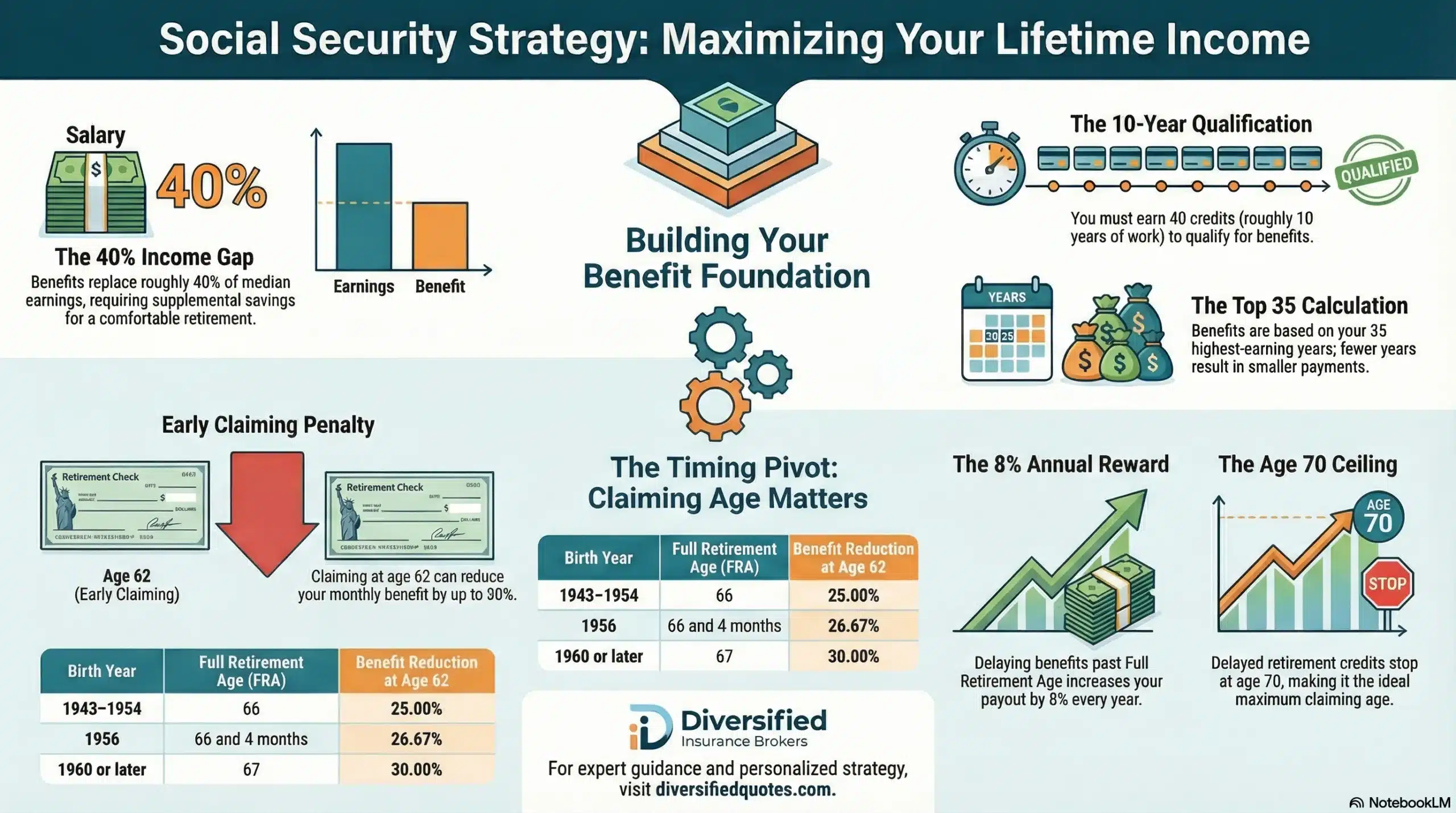
FAQs: Social Security Income Limits
What are Social Security income limits?
Social Security income limits refer primarily to the Retirement Earnings Test — the set of rules that allows SSA to temporarily withhold a portion of your benefit if you claim retirement benefits before your Full Retirement Age (FRA) while earning wages or self-employment income above annually-set thresholds. The structural formulas are $1 withheld for every $2 earned above the lower threshold (when you are under FRA for the full year) and $1 for every $3 above a higher threshold (in the year you reach FRA, counting only earnings before your FRA birth month). After FRA, the earnings test ends and you can earn any amount without SSA reducing your benefits. The specific dollar thresholds are updated annually — always verify current figures at SSA.gov before setting any work or filing plan.
What types of income count toward the earnings limit?
For the Retirement Earnings Test, SSA counts wages (including bonuses, commissions, and vacation pay) and net self-employment earnings after business deductions. What does not count: investment income, interest, dividends, capital gains, pension income, IRA and 401(k) withdrawals, annuity income, rental income (unless an active business), veteran’s benefits, and most government or military retirement benefits. This distinction is significant for retirees whose income comes primarily from investment portfolios, pensions, or annuities — those sources generally carry no earnings test exposure even if the retiree claimed benefits early.
If Social Security withholds my benefits, are those payments gone forever?
No. Per the SSA’s own Program Explainer on the Retirement Earnings Test, benefits withheld while you continue to work are not permanently lost. When you reach Full Retirement Age, SSA recalculates your monthly benefit to give you credit for the months during which benefits were withheld. This adjustment increases your permanent monthly benefit going forward — equivalent to treating you as if you had filed later for those months. The increase at FRA reflects the structure of actuarial reduction adjustments rather than a perfect dollar-for-dollar return, but the directional effect is a permanent upward recalculation of your ongoing monthly benefit.
What is the “grace year” monthly earnings test?
In the first calendar year you receive Social Security benefits, a special monthly rule may apply. Per SSA.gov, you can receive your full benefit for any month in which your earnings fall below the monthly equivalent of the annual limit — regardless of whether your total annual earnings exceed the yearly threshold. This is especially valuable for workers who retire mid-year after having earned substantial wages earlier in the year. Without the monthly test, their full-year earnings would typically disqualify them from receiving any benefits for the remainder of the year. The monthly test allows them to receive benefits in the months they are effectively retired. The monthly test applies only in the first year of benefit receipt and requires different documentation for employees versus self-employed individuals.
How does the earnings test work in the year I reach Full Retirement Age?
The year you reach FRA is a distinct phase with its own higher threshold and gentler withholding formula. Instead of $1-for-$2, only $1 is withheld for every $3 earned above the higher threshold. Critically, only earnings in the months before your FRA birth month count — earnings in your FRA month and every month after are completely excluded from the test, even if you are still working full-time. This means someone born in August who reaches FRA that August has only January through July earnings counted, even if they continue earning the same salary through December. Getting the birth month right in planning calculations for this phase prevents significant miscalculation of actual withholding exposure.
How is Social Security taxed by the IRS — and how is that different from the earnings test?
The earnings test and the IRS taxation of Social Security benefits are separate systems. The earnings test governs whether SSA withholds your checks based on earned income before FRA. The IRS taxation rules — governed by IRS Publication 915 — determine what portion of your Social Security benefits is included in federal taxable income. Per IRS guidelines, up to 85% of benefits may be taxable depending on your combined income, which the IRS defines as adjusted gross income plus nontaxable interest plus one-half of your Social Security benefits. Unlike the earnings test, the IRS combined income calculation includes investment income, IRA and 401(k) withdrawals, and other non-wage sources. The IRS thresholds are set by statute and have not been indexed to inflation, meaning more retirees fall into taxable ranges as incomes grow. These rules apply regardless of when you filed and regardless of whether the earnings test applies to you.
Can working after I start Social Security actually increase my benefit?
Yes, in two separate ways. First, through the FRA recalculation after the earnings test: months of withheld benefits are credited as delayed filing months, permanently increasing your monthly benefit when SSA recalculates at FRA. Second, through SSA’s annual recomputation process: each year you work and pay Social Security taxes, SSA checks whether your new earnings replace a lower-earning year in your 35-year benefit calculation record. If they do, your benefit is automatically increased to reflect the higher lifetime average. This recalculation is automatic — you do not need to file a request. The increase from replacing a low-earning year is typically modest unless the year being replaced was significantly below your current earnings, but it represents a real benefit increase for people who continue working at high earnings levels after beginning Social Security.
Do the earnings limits change each year?
Yes. The SSA announces updated earnings thresholds each October, typically alongside the annual COLA (Cost-of-Living Adjustment) announcement for the upcoming year. The thresholds generally track wage growth in the national economy. The structural formulas — $1 withheld for every $2, and $1 withheld for every $3 in the FRA year — are established by statute and are stable features of the program. Only the specific dollar amounts that trigger those formulas change annually. Because the dollar figures that control your actual withholding exposure update each year, always verify the current-year thresholds directly at SSA.gov before setting your work plan or filing month for any given year.
About the Author:
Jason Stolz, CLTC, CRPC, DIA, CAA and Chief Underwriter at Diversified Insurance Brokers (NPN 20471358), is a senior insurance and retirement professional with more than 25 years of real-world experience helping individuals, families, and business owners protect their income, assets, and long-term financial stability. As a long-time partner of the nationally licensed independent agency Diversified Insurance Brokers, Jason provides trusted guidance across multiple specialties—including fixed and indexed annuities, long-term care planning, personal and business disability insurance, life insurance solutions, Group Health, Travel Medical and Evacuation Insurance, and short-term health coverage. Diversified Insurance Brokers maintains active contracts with over 100 highly rated insurance carriers, ensuring clients have access to a broad and competitive marketplace.
His practical, education-first approach has earned recognition in publications such as VoyageATL, and contributions from his agency featured in Kiplinger and GoBankingRates— highlighting his commitment to financial clarity and client-focused planning. Drawing on deep product knowledge and years of hands-on field experience, Jason helps clients evaluate carriers, compare strategies, and build retirement and protection plans that are both secure and cost-efficient. Visitors who want to explore current annuity rates and compare options across multiple insurers can also use this annuity quote and comparison tool.
Explore All Social Security Planning Guides: Browse our complete Social Security Planning guide — covering filing strategies, spousal benefits, survivor benefits, taxes, WEP, GPO & more.
Last Reviewed: June 3, 2026 |
Reviewed by: Jason Stolz, CLTC, CRPC, DIA, CAA
Chief Underwriter, Diversified Insurance Brokers, Inc. | NPN: 20471358 | Diversified Insurance Brokers, Inc. — Licensed in all 50 states
Fact Checked by: Tonia Pettitt, CMIP©
Medicare Specialist, Diversified Insurance Brokers, Inc. | NPN: 14374308 | Diversified Insurance Brokers, Inc. — Licensed in all 50 states
Did you find this content helpful? Leave us a Google review — it helps others find trustworthy guidance too.
Editorial Standards: Diversified Insurance Brokers maintains rigorous editorial standards to ensure accuracy, clarity, and independence in all content. Learn more about our editorial standards and commitment to transparency.
