
How To Apply For Social Security
How To Apply For Social Security

Applying for Social Security sounds like a straightforward administrative task until you realize the decision you are making in the application determines your monthly payment for the rest of your life. The filing process itself — creating a my Social Security account at ssa.gov, selecting a benefit type, entering employment and personal information, and submitting documents — can be completed in an hour or two for straightforward retirement claims. The planning work that should happen before the application is submitted is where most families either leave money on the table or lock in a reduction they did not need to accept. Choosing the wrong benefit type, filing in the wrong month, misunderstanding how working income affects benefits before Full Retirement Age, or failing to coordinate Medicare enrollment timing correctly are the most common sources of preventable cost in the Social Security filing process. At Diversified Insurance Brokers, Jason Stolz, CLTC, CRPC, DIA, CAA, and our advisors work with households nationwide to build a filing-ready plan before anyone clicks submit — confirming the right benefit type, modeling the timing decision across the full retirement horizon, and ensuring Medicare enrollment coordinates correctly with Social Security claiming.
The average Social Security retirement benefit in 2026 is approximately $2,071 per month. The lifetime value of a single year of additional delayed retirement credits — 8% per year past Full Retirement Age, up to age 70 — applied to that average benefit is over $22,000 over a twenty-year retirement. A couple where one spouse delays from age 67 to 70 and the other strategically times a spousal or survivor benefit claim can generate meaningfully more lifetime income than a couple that files simultaneously at the earliest available age without modeling the long-term outcome. The application itself is the last step. The planning that precedes it is where the financial outcome is actually determined.
Talk With a Social Security Planning Expert
We confirm which benefit you qualify for, map the optimal filing month, and coordinate Medicare timing — before you submit a single application.
Explore Social Security ServicesUnderstanding Which Benefit You Are Filing For
The single most important pre-application step is confirming which Social Security benefit type you are actually claiming — and whose earnings record the benefit is based on. Many filing errors and processing delays originate from applicants choosing the wrong benefit path, often because they were unaware that a more favorable option existed. The six primary benefit categories most households navigate are retirement benefits (based on the applicant’s own earnings record, available starting at 62 with a permanently reduced payment or at Full Retirement Age for the full benefit); spousal benefits (based on a living spouse’s record, providing up to 50% of the spouse’s Primary Insurance Amount at Full Retirement Age); divorced-spouse benefits (based on an ex-spouse’s record, available if the marriage lasted at least ten years, the applicant is unmarried, and both parties are at least 62); survivor benefits (available to widows, widowers, and qualifying divorced survivors based on a deceased spouse’s record, starting as early as 60 or 50 with a disability); disability benefits under SSDI (requiring both medical eligibility and sufficient work credits); and Medicare enrollment (which operates on its own timeline and must be coordinated separately with Social Security retirement claiming). Our resource on Social Security services covers the full benefit type framework, and our resource on the income gap covers how Social Security fits into the broader retirement income picture alongside annuities and other income sources.
The Timing Decision: Age 62, Full Retirement Age, or Age 70
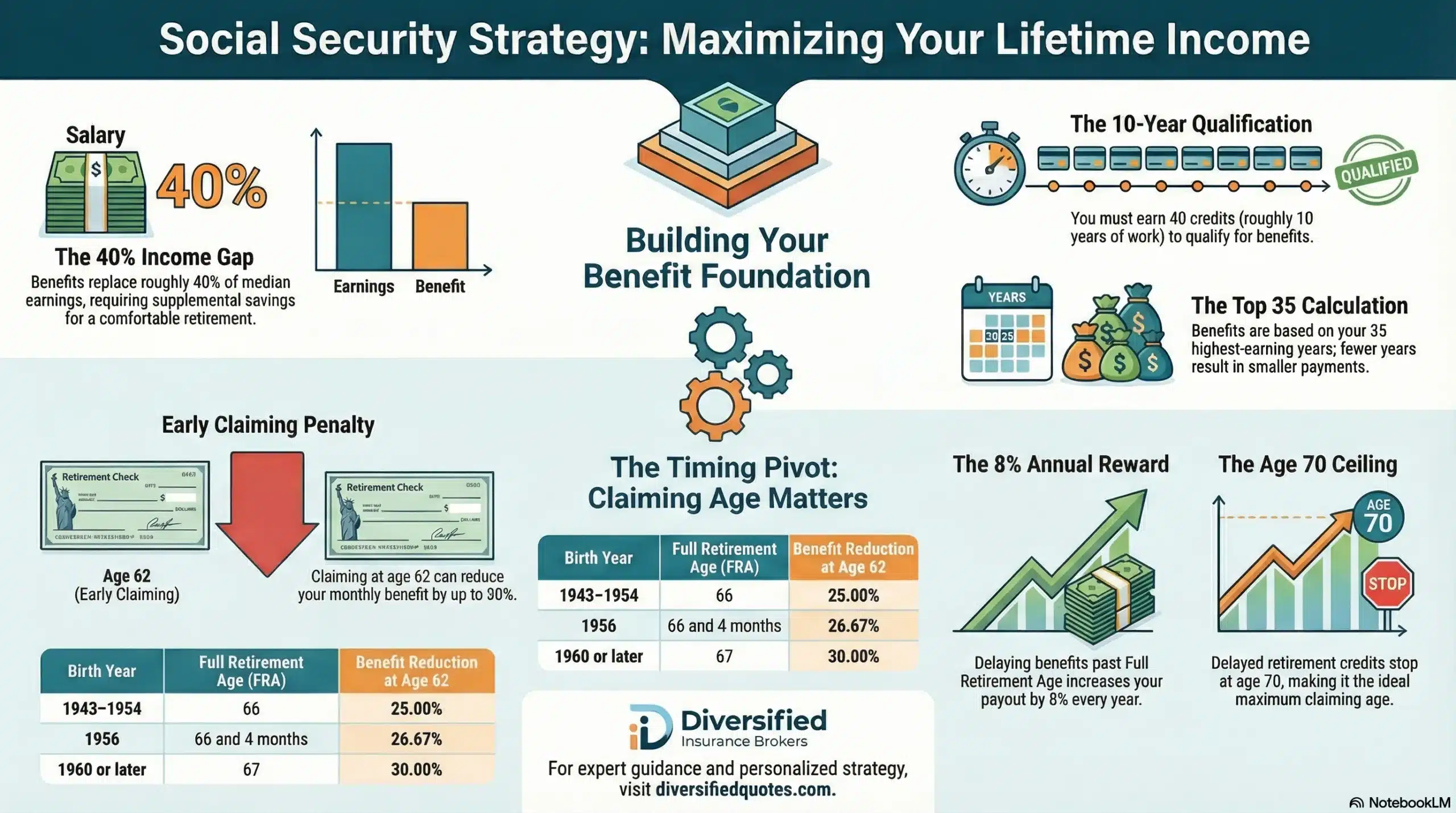
The Social Security claiming age decision is the most financially significant retirement timing choice most households make. For individuals born in 1960 or later — which encompasses most people currently approaching retirement — the Full Retirement Age is 67. Filing at 62, the earliest eligible age, permanently reduces the retirement benefit by 30% compared to the FRA amount. Filing at 70, the latest age at which delayed retirement credits accrue, increases the benefit by 32% above the FRA amount (8% per year for four years past FRA of 67). The difference between filing at 62 and filing at 70 for someone with an FRA benefit of $2,000 per month is $600 per month ($1,400 at 62 versus $2,640 at 70) — a difference that compounds over a long retirement and has significant survivor benefit implications for a married couple.
The breakeven analysis — the age at which the cumulative lifetime benefits from delaying surpass the cumulative benefits from early filing — typically falls around age 80 to 81 for most benefit levels and claiming age comparisons. For individuals with reasonable longevity expectations and no urgent income need at 62, delay is usually the mathematically superior strategy. For those with immediate income needs, health concerns that suggest shorter life expectancy, or specific survivor benefit planning considerations, earlier filing may be appropriate. The correct answer is not universal — it depends on health, household income needs, spousal benefit coordination, tax exposure on Social Security benefits, Medicare IRMAA implications, and the availability of other retirement income sources to bridge a delay. Our resource on in-service 401(k) transfer strategies covers one approach for creating an income bridge that supports delaying Social Security, and our resource on annuities for monthly retirement income covers the guaranteed income floor that many households use to support a claiming delay.
Key Social Security Thresholds and Rules for 2026
| Rule / Threshold | 2026 Amount or Detail | Planning Implication |
|---|---|---|
| Full Retirement Age (born 1960 or later) | Age 67 | FRA is the baseline for benefit calculations; early filing reduces, late filing increases |
| Early filing reduction (age 62, FRA of 67) | 30% permanent reduction to own retirement benefit; 35% reduction to spousal benefit | Reduction is permanent and affects survivor benefits payable to a spouse |
| Delayed retirement credits (past FRA to 70) | 8% per year; maximum 32% increase at age 70 | Credits stop accruing at 70; filing after 70 provides no additional benefit |
| Earnings test — under FRA all year | $24,480 annual limit; $1 withheld per $2 earned above | Withheld benefits are returned as a higher monthly payment at FRA — not permanently lost |
| Earnings test — year reaching FRA | $65,160 limit for months before FRA birthday; $1 per $3 over | More favorable withholding rate applies only to months before FRA birthday that year |
| Maximum spousal benefit at FRA | 50% of the worker spouse’s Primary Insurance Amount | Spousal benefit cannot exceed 50% of worker’s PIA regardless of when filed; reduced if claimed before FRA |
| Work credits required for retirement benefit | 40 credits (approximately 10 years of qualifying work); $1,890 per credit in 2026 | Workers with fewer than 35 years of earnings have zero-filled years that reduce their benefit |
| Average 2026 retirement benefit | ~$2,071 per month | Individual benefit varies significantly based on earnings history and claiming age |
Working While Collecting: The Earnings Test Explained
One of the most consistently misunderstood Social Security rules is the retirement earnings test — the mechanism that temporarily reduces benefits for individuals who claim before Full Retirement Age and continue earning employment income above set thresholds. In 2026, the earnings test threshold for individuals under FRA for the full year is $24,480 in annual wages or self-employment income. For every $2 of earnings above that threshold, Social Security withholds $1 in benefits. In the calendar year an individual reaches FRA, a higher limit applies to the months before the FRA birthday — $65,160 in 2026, with $1 withheld per $3 over the limit for those months only. After the FRA birthday month, the earnings test disappears entirely — no amount of earned income reduces Social Security payments.
The crucial point that most people do not understand: benefits withheld under the earnings test are not permanently lost. When the individual reaches Full Retirement Age, Social Security recalculates the monthly benefit to credit the months during which benefits were withheld. This recalculation permanently increases the monthly benefit, effectively returning the withheld amounts over time as a higher payment. A person who worked aggressively below FRA and had substantial earnings test withholding will see a meaningfully higher monthly benefit at FRA than the reduction at time of filing implied. This recalculation mechanics makes the earnings test far less punitive than most people assume — the withholding is a deferral, not a forfeiture. Our resources on lifetime income annuities and annuities as a pension alternative cover the guaranteed income tools that reduce reliance on Social Security during the pre-FRA period when the earnings test applies, allowing some households to defer Social Security claiming without financial strain.
Spousal, Divorced-Spouse, and Survivor Benefits: The Rules That Change Everything for Couples
For married and formerly married individuals, Social Security planning involves coordinating multiple benefit streams across two earnings records — and the sequencing of who claims what, and when, has a larger impact on lifetime household income than any other variable in the analysis. The spousal benefit provides up to 50% of the working spouse’s Primary Insurance Amount at the claiming spouse’s Full Retirement Age. Claiming the spousal benefit before FRA permanently reduces it — at age 62 the reduction is 35% below the full 50%, producing approximately 32.5% of the worker’s PIA. The spousal benefit does not earn delayed retirement credits past FRA — there is no financial incentive to delay a spousal benefit past age 67 for those with FRA of 67.
Divorced-spouse benefits follow similar rules: the marriage must have lasted at least ten years, the claiming spouse must be at least 62 and currently unmarried, and the ex-spouse must be at least 62 (though the ex-spouse does not need to have filed for benefits for the divorced spouse to claim based on their record). Importantly, the ex-spouse’s own benefit is not affected by the divorced-spouse claim — both parties can collect simultaneously without reducing the other’s benefit. Our resources on life insurance services and survivorship joint whole life insurance cover the life insurance planning decisions that coordinate with Social Security survivor benefit maximization for couples — specifically how the higher-earning spouse’s death benefit decision interacts with the survivor benefit the lower-earning spouse will eventually receive.
Survivor benefits are among the most financially significant and least-understood Social Security benefit types. A widow or widower can claim survivor benefits as early as age 60 (or 50 with a qualifying disability), collecting based on the deceased spouse’s record while allowing their own retirement benefit to continue growing — then switching to their own higher retirement benefit at 70 if that strategy produces better lifetime income. This two-step sequencing (survivor benefit first, own benefit later) is one of the most powerful claiming strategies available to surviving spouses whose own earnings record is lower than the deceased spouse’s. Our resources on strategies for claiming Social Security for widows and Social Security spousal benefits after divorce cover both survivor and divorced-spouse claiming strategies in detail. The resource on how remarriage affects Social Security spousal benefits covers the remarriage rules that affect survivor and divorced-spouse benefit eligibility.
The Medicare Timing Trap in the Social Security Application
For individuals turning 65, the Social Security application includes the option to simultaneously apply for Medicare — and this coordination point is where one of the most common costly mistakes occurs. If you are already receiving Social Security benefits when you turn 65, Medicare Parts A and B enrollment is automatic and you receive enrollment materials without needing to separately apply. If you are not yet receiving Social Security at 65 — because you delayed claiming — you must actively enroll in Medicare yourself during your Initial Enrollment Period. Failing to recognize that Medicare enrollment is not automatic when Social Security has not been claimed is one of the primary reasons people miss their Initial Enrollment Period and trigger permanent Medicare Part B late enrollment penalties. Our resources on how to avoid Medicare late enrollment penalties and how to get Medicare while working cover the enrollment mechanics for both situations. The broader resource on how to choose the right Medicare plan covers the plan selection decision that follows correct enrollment timing.
Schedule an Appointment with a Social Security Expert
We’ll confirm your best filing month, verify which benefit type you should claim, and coordinate your plan with work income and Medicare timing.
Frequently Asked Questions: How to Apply for Social Security
When should I apply for Social Security — and how far in advance?
Apply approximately two to three months before the month you want benefits to begin. Social Security retirement applications can be submitted up to four months before the planned start date. For straightforward retirement claims, the application is typically processed within a few weeks; for claims involving disability, survivor benefits, multiple marriages, or government pension history, processing time may be longer. Applying too early (more than four months before the intended start date) is not allowed for retirement claims. Applying too late (after the desired start month) means you may miss that month’s payment entirely or receive it retroactively depending on the benefit type. The planning decision of when to file — age 62, Full Retirement Age at 67, or up to 70 for maximum delayed retirement credits — should be made months or years before the application is actually submitted, not in the weeks before filing. Our resource on the income gap covers the broader retirement income architecture that should inform the Social Security timing decision well in advance.
What documents do I need to apply for Social Security?
Core documents required for most retirement claims: your Social Security number or card; your original birth certificate or other acceptable proof of age (original or agency-certified — photocopies and notarized copies are not accepted); proof of U.S. citizenship or lawful immigration status if not born in the U.S.; bank account routing and account number for direct deposit. Additional documents required for specific benefit types include marriage certificates and divorce decrees for spousal, divorced-spouse, or survivor claims; death certificate for survivor claims; and work history and medical documentation for disability (SSDI) claims. The SSA explicitly states: do not delay your application if you are missing some documents. Apply with what you have and provide missing documents during the processing period — the SSA can help obtain some documents and will work with you on verification. The application can be saved and returned to before final submission.
Can I earn income while collecting Social Security before Full Retirement Age?
Yes — but the earnings test may temporarily reduce your benefit if your earned income exceeds the annual threshold. In 2026, the threshold for individuals under Full Retirement Age for the entire year is $24,480. For every $2 earned above that limit, Social Security withholds $1 from benefits. In the calendar year you reach FRA, a higher limit applies to the months before your FRA birthday — $65,160 in 2026, with $1 withheld per $3 over. After the FRA birthday month, the earnings test disappears completely — no amount of earned income reduces benefits. The most important fact about the earnings test: withheld benefits are not permanently lost. When you reach Full Retirement Age, Social Security recalculates your monthly benefit upward to credit the months when benefits were withheld. This recalculation effectively returns the withheld amounts as a permanently higher monthly payment. The earnings test is a deferral mechanism, not a forfeiture. Our resource on annuities for monthly retirement income covers how guaranteed income can reduce the financial pressure that often pushes people to claim Social Security before their optimal filing age despite the earnings test exposure.
How much is the spousal Social Security benefit and when can I claim it?
The maximum spousal benefit is 50% of the working spouse’s Primary Insurance Amount (PIA) — the benefit they would receive at Full Retirement Age — claimed at or after the claimant’s own Full Retirement Age. Claiming the spousal benefit before FRA reduces it: at age 62, the spousal benefit is approximately 32.5% of the worker’s PIA (a 35% reduction from the full 50%). Unlike the worker’s own retirement benefit, the spousal benefit does not earn delayed retirement credits past FRA — there is no financial incentive to delay the spousal benefit beyond age 67 for those with FRA of 67. The spousal benefit requires that the worker spouse have filed for their own retirement benefit. For divorced-spouse benefits, the ex-spouse does not need to have filed — both parties simply need to be eligible (at least 62, marriage of at least 10 years, and the claiming spouse must be currently unmarried). The divorced-spouse claim does not affect the ex-spouse’s own benefit. Our resource on Social Security spousal benefits after divorce covers the divorced-spouse rules, and our resource on survivorship joint whole life insurance covers the life insurance coordination with spousal and survivor benefit planning.
What is a survivor benefit and what strategy should a widow or widower consider?
A Social Security survivor benefit pays up to 100% of the deceased spouse’s benefit to a qualifying widow or widower who has reached Full Retirement Age for survivor benefits. Survivor benefits can begin as early as age 60 (or 50 with a qualifying disability) at a reduced rate. The most powerful survivor benefit strategy for widows and widowers whose own earnings record will produce a higher benefit at age 70 is to claim the survivor benefit at 60 (or as early as eligible) while allowing their own retirement benefit to continue earning delayed retirement credits until 70 — then switching to their own higher retirement benefit at 70. This two-step approach produces more lifetime income than either claiming only the survivor benefit for life or claiming only the own retirement benefit early. Conversely, a widow whose own retirement benefit is lower than the survivor benefit for the rest of her life may maximize by collecting her own benefit early and switching to the higher survivor benefit at FRA. The correct sequencing requires comparing both benefit streams across the expected remaining lifetime. Our resource on Social Security strategies for widows covers both scenarios in detail.
Does filing for Social Security automatically enroll me in Medicare?
Only if you are already receiving Social Security benefits when you turn 65 — in that case, Medicare Parts A and B enrollment is automatic and you receive enrollment materials approximately three months before your 65th birthday. If you are not yet receiving Social Security at 65 because you delayed claiming, Medicare enrollment is NOT automatic. You must actively sign up through Social Security during your Initial Enrollment Period — the seven-month window centered on your 65th birthday month. Failing to recognize this distinction and missing the IEP triggers permanent Part B late enrollment penalties of 10% per year of unjustified delay for life. For individuals who are working past 65 with qualifying employer coverage, the rules for delaying Medicare without penalty are separate from and independent of the Social Security claiming decision. You can delay Social Security past 65 and enroll in Medicare at 65, or you can delay both under qualifying circumstances — but the rules governing each decision are different. Our resources on how to avoid Medicare late enrollment penalties and how to get Medicare while working cover both scenarios.
Can I undo a Social Security application after I file?
Yes — but only within a narrow window. The SSA allows a one-time withdrawal of a Social Security retirement application within 12 months of the first payment. All benefits received must be repaid in full, including any Medicare premiums that were withheld. After the 12-month window, the withdrawal option is no longer available and the claiming decision is permanent. A separate option — benefit suspension — is available between Full Retirement Age and age 70. Suspending benefits allows the monthly payment to stop while delayed retirement credits continue accruing, effectively providing a restart mechanism for those who claimed early and later regret the timing. Suspended benefits earn 2/3 of 1% per month (8% annually) in additional delayed credits during the suspension period. Importantly, a one-time withdrawal requires repaying all received benefits; suspension does not require repayment but only future credits accumulate. Before filing, modeling the long-term outcome of different claiming ages is the most reliable way to avoid regret. Our resource on Roth conversion strategies covers the adjacent tax planning that often accompanies the Social Security claiming decision — particularly for households who delay SS and use Roth conversions to reduce future taxable income in the years before RMDs begin.
How do I verify my Social Security earnings record before filing?
Create or log in to your my Social Security account at ssa.gov to view your complete earnings history and benefit estimate. Your Social Security benefit is calculated based on your 35 highest-earning indexed years — if you worked fewer than 35 years, the SSA uses zero for each missing year, which reduces the benefit calculation. Reviewing your earnings record before filing allows you to identify and correct any errors — years where reported earnings are incorrect or missing can significantly reduce your calculated benefit. Corrections are made by contacting the SSA directly with documentation of the actual earnings (W-2s, pay stubs, or tax records for the relevant years). Errors in earnings records are easier to correct before filing than after, and some corrections require employer records that may be harder to obtain years after the employment relationship ended. In 2026, one Social Security work credit equals $1,890 in wages — the maximum of four credits per year can be earned with approximately $7,560 in annual qualified wages. Forty credits (approximately ten years of qualifying work) is the minimum required for retirement benefit eligibility. Our resource on Social Security annual recomputation covers how SSA updates benefit calculations annually for individuals still working, which affects those who continue earning after filing.
About the Author:
Jason Stolz, CLTC, CRPC, DIA, CAA and Chief Underwriter at Diversified Insurance Brokers (NPN 20471358), is a senior insurance and retirement professional with more than 25 years of real-world experience helping individuals, families, and business owners protect their income, assets, and long-term financial stability. As a long-time partner of the nationally licensed independent agency Diversified Insurance Brokers, Jason provides trusted guidance across multiple specialties—including fixed and indexed annuities, long-term care planning, personal and business disability insurance, life insurance solutions, Group Health, Travel Medical and Evacuation Insurance, and short-term health coverage. Diversified Insurance Brokers maintains active contracts with over 100 highly rated insurance carriers, ensuring clients have access to a broad and competitive marketplace.
His practical, education-first approach has earned recognition in publications such as VoyageATL, and contributions from his agency featured in Kiplinger and GoBankingRates— highlighting his commitment to financial clarity and client-focused planning. Drawing on deep product knowledge and years of hands-on field experience, Jason helps clients evaluate carriers, compare strategies, and build retirement and protection plans that are both secure and cost-efficient. Visitors who want to explore current annuity rates and compare options across multiple insurers can also use this annuity quote and comparison tool.
Explore All Social Security Planning Guides: Browse our complete Social Security Planning guide — covering filing strategies, spousal benefits, survivor benefits, taxes, WEP, GPO & more.
Last Reviewed: June 11, 2026 |
Reviewed by: Jason Stolz, CLTC, CRPC, DIA, CAA
Chief Underwriter, Diversified Insurance Brokers, Inc. | NPN: 20471358 | Diversified Insurance Brokers, Inc. — Licensed in all 50 states
Fact Checked by: Tonia Pettitt, CMIP©
Medicare Specialist, Diversified Insurance Brokers, Inc. | NPN: 14374308 | Diversified Insurance Brokers, Inc. — Licensed in all 50 states
Did you find this content helpful? Leave us a Google review — it helps others find trustworthy guidance too.
Editorial Standards: Diversified Insurance Brokers maintains rigorous editorial standards to ensure accuracy, clarity, and independence in all content. Learn more about our editorial standards and commitment to transparency.
