
Social Security Spousal Benefits after Divorce
Social Security Spousal Benefits after Divorce

Social Security spousal benefits after divorce can be one of the most valuable “hidden” opportunities in retirement — especially if you spent years in a marriage where your ex-spouse earned significantly more. In the right scenario, a divorced spouse can receive up to 50% of an ex-spouse’s Primary Insurance Amount (PIA) at Full Retirement Age. The challenge is that the rules are precise, the timing decisions are difficult to undo, and filing the wrong way can permanently reduce lifetime income. At Diversified Insurance Brokers, we help clients turn the rules into a clear plan: what you qualify for, the best month to claim, and how to coordinate divorced spousal benefits with survivor planning, work income, and taxes. If you want the big-picture framework before diving into divorce-specific rules, start here: maximize Social Security benefits.
Get Your Divorced Spousal Strategy
We’ll verify eligibility, estimate your benefit on both records, and map optimal timing — including restricted application and survivor coordination.
What “Divorced Spousal Benefits” Actually Mean
Divorced spousal benefits are Social Security benefits you may be able to claim on an ex-spouse’s work record while your ex is still living. This is different from divorced survivor benefits, which apply after an ex-spouse passes away and can be as high as the ex’s full benefit amount depending on timing. Many people hear “spousal benefits” and assume it only applies to current marriages. Social Security has a separate path for divorced spouses — but you must meet eligibility rules and file correctly. It’s also important to know what divorced spousal benefits are not: they do not reduce your ex-spouse’s benefit, do not impact your ex’s current spouse, and do not require your ex-spouse’s permission. If you qualify, Social Security pays a divorced spouse benefit based on prior marriage history and an ex-spouse’s earnings record, independently of what that ex-spouse receives.
Who Qualifies for Social Security Spousal Benefits After Divorce?
In most situations, you may qualify to claim on an ex-spouse’s record if the marriage lasted 10 years or longer, you are age 62 or older, and you are currently unmarried. Social Security also generally pays the benefit only when it provides you a higher amount than what you would receive on your own record at that time — if your own retirement benefit is higher, you typically receive your own benefit instead. One rule that surprises many people is that your ex doesn’t always have to be collecting yet. If you’ve been divorced for at least two years, you can often claim a divorced spouse benefit as long as your ex is eligible to claim — even if they haven’t started benefits. That “independently entitled divorced spouse” concept can create opportunities when one person wants income earlier and the ex plans to delay, since the filing is independent of the ex’s own decisions.
Timing drives outcomes significantly. Before choosing a filing month, understanding how filing age changes the benefit amounts is essential. If you want a clear explanation of how waiting can increase your own retirement benefit through delayed retirement credits, our resource on delayed retirement credits covers how each year of delay adds to your own benefit. And if you want to understand how applying for one benefit can trigger receipt of others — a critical issue called deemed filing — our resource on deemed filing rules for Social Security is essential reading before submitting any application.
How Much Can You Receive as a Divorced Spouse?
At Full Retirement Age, a divorced spousal benefit can be up to 50% of your ex-spouse’s PIA — the ex-spouse’s benefit at their own FRA, not necessarily what they’re receiving if they claimed early or delayed. If you claim a divorced spousal benefit before your FRA, the spousal portion is reduced, sometimes significantly. One key planning distinction: unlike your own retirement benefit, divorced spousal benefits do not earn delayed retirement credits after FRA. Waiting beyond FRA increases your own benefit up to age 70, but it does not increase the spousal portion above the 50% ceiling. That’s why the “best” plan often comes down to which benefit will be the long-term winner — your own record or the ex-spouse spousal amount — and that comparison requires modeling both against your specific timeline.
Many divorced filers also have a work record of their own. Social Security often pays your own retirement benefit first, then adds a “top-off” spousal amount if you qualify for more. That is exactly why deemed filing matters — once you apply, the system may treat you as applying for all benefits you’re eligible for at that time. If your benefit amount changes over time as new earnings replace lower-earning years in your record, our resource on Social Security annual recomputation explains how that mechanism works and how it can affect the combined benefit you receive over time.
Timing Strategies: How to Avoid Permanent Reductions
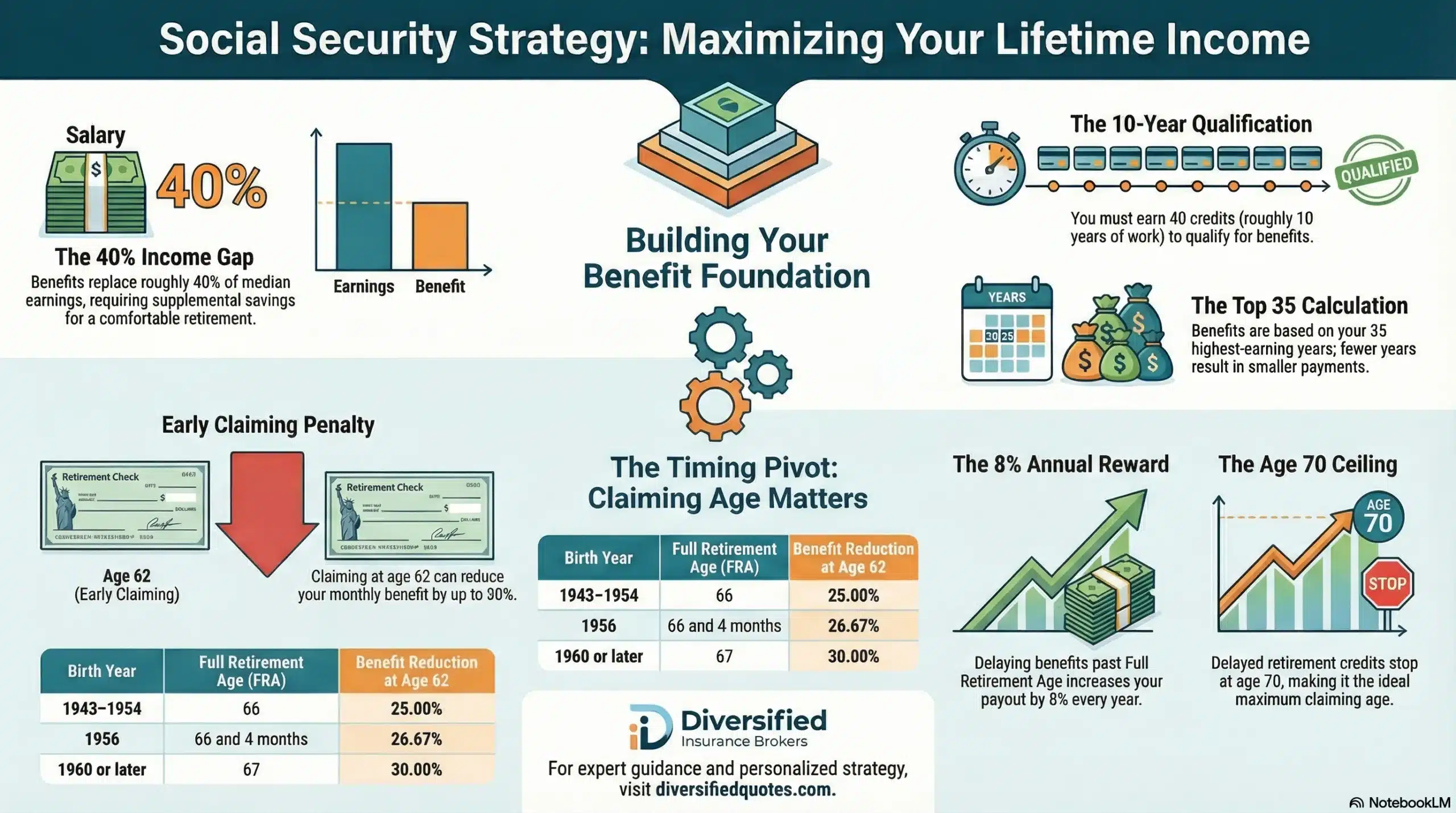
Most divorced-spouse strategy comes down to one question: should you claim at 62, at FRA, or later? Claiming at 62 can create income sooner but permanently reduces your retirement benefit — and it reduces the divorced spousal portion as well. Claiming at FRA preserves the maximum divorced spousal benefit at up to 50% of the ex’s PIA. Delaying beyond FRA can be valuable when your own retirement benefit will ultimately be larger, because your own amount can increase up to age 70 through delayed retirement credits that do not apply to the spousal portion.
Some people may benefit from a “collect one benefit earlier, switch later” approach — but whether that is available depends heavily on birth year and eligibility rules that changed in 2016. If you think you might qualify for the older spousal-only filing approach, our resource on restricted application eligibility explains who can still access this strategy and what the filing requirements are. For a broader guide comparing 62, FRA, and 70 with real trade-offs including breakeven analysis and longevity assumptions, our resource on when to start Social Security benefits provides the decision framework. Work income can also change the best plan — if you claim before FRA and continue working, the earnings test can temporarily withhold benefits and alter the optimal filing month. If you expect to work while collecting, our resource on Social Security income limits explains how the earnings test works and when withheld benefits are recredited.
Remarriage Rules: Spousal vs. Survivor (Not the Same)
Remarriage is one of the most important forks in the road after divorce. In general, remarriage ends eligibility for divorced spousal benefits on an ex-spouse’s record while the later marriage is in effect. If that later marriage ends through death, divorce, or annulment, eligibility on the prior record may be restored if the other requirements are still met. Survivor benefits are different and the remarriage rules are more flexible. If your ex-spouse has passed away, divorced survivor benefits can be available — and remarriage after age 60 typically does not disqualify divorced survivor benefits (age 50 if disabled). This distinction matters enormously because survivor benefits can be much larger than divorced spousal benefits, and a plan that ignores survivor rules can leave significant lifetime income on the table. Coordinating spousal and survivor benefit strategies together — particularly in how and when to claim — can materially change lifetime Social Security income for divorced individuals.
Government Offsets That Can Reduce Divorced Spousal Benefits
If you have a pension from work where you did not pay into Social Security — certain teacher systems, some police and fire systems, and other non-covered government employment — you may be affected by the Windfall Elimination Provision (WEP) or the Government Pension Offset (GPO). WEP can reduce your own retirement benefit. GPO can reduce spousal or survivor benefits — in some cases significantly, potentially eliminating the divorced spousal benefit entirely depending on the pension amount. These rules create some of the biggest “surprise reductions” we see in Social Security planning, and discovering them after you’ve already filed creates a situation that cannot be undone. Our resources on the Windfall Elimination Provision (WEP) and the Government Pension Offset (GPO) provide the detailed explanation of how these provisions work and how they interact with divorced spousal benefit calculations. Even if you are unsure whether your pension is “covered” or “non-covered,” verifying before you file is essential — when offsets apply, the best claiming sequence can change dramatically.
Step-by-Step: How to Claim as a Divorced Spouse
Social Security decisions are often difficult to undo, so the cleanest approach is to treat your claim like a checklist and confirm the key facts before submitting anything. The complete filing walk-through can be found at our resource on how to apply for Social Security. The divorce-specific steps below confirm you’re taking the correct entitlement path.
Step 1: Confirm the 10-year rule and your exact divorce date. Have your marriage certificate and divorce decree accessible. If you don’t have your ex’s Social Security number, you can still file, but having identifying information can reduce processing delays.
Step 2: Confirm your Full Retirement Age and list your best start-month options. FRA anchors the maximum spousal amount and determines how work income interacts with benefits. If you may work while collecting, review the Social Security income limits for the earnings test implications.
Step 3: Compare your own benefit vs. the divorced spousal top-off. Often it’s a combination — your own benefit plus an added amount if the spousal benefit is higher. Deemed filing can restrict future options, so understand it before filing: deemed filing rules.
Step 4: Model taxes before you lock in a filing date. Social Security can become taxable depending on other income sources. Timing can influence which years are the most tax-expensive, especially when coordinating retirement account withdrawals or part-time income. Our resource on reducing taxes on Social Security covers the key strategies. For retirees managing IRMAA exposure alongside Social Security income, our resource on IRMAA planning for retirees covers how large income events in specific years can affect Medicare premium surcharges two years later.
Step 5: File with the correct entitlement path and keep your confirmation details. Your application should clearly reflect divorced spouse eligibility. Save confirmation numbers, screenshots, and the selected start month so you can verify the final award letter matches expectations.
Step 6: Re-check switching opportunities later. As your own benefit grows — or if your earnings record changes due to additional work — switching can become attractive. If your ex-spouse passes away, divorced survivor benefits may become available and can change the best strategy. For context on how working past 65 can continue to affect Social Security benefit calculations, our resource on does working past 65 affect Social Security benefits explains the ongoing earnings record dynamic.
Case Example: How the Best Choice Can Change
Maria is 62 and divorced after a 15-year marriage. Her FRA is 67. Her ex’s PIA is $3,200, so her maximum divorced spousal benefit at FRA could be up to $1,600. If she claims at 62, she locks in a permanently reduced amount below $1,600. If she waits to FRA, she preserves the maximum divorced spousal amount. But Maria also has her own earnings record. If she delays her own retirement benefit, it can grow through delayed retirement credits up to age 70. If her age-70 benefit would exceed $1,600, then the long-term winner may be her own record — the best plan might involve bridging income from another source early while preserving the largest lifetime check for maximum delayed growth. Coordinating this decision also includes modeling taxes (Social Security income can become taxable depending on other income), how the divorced spousal claim interacts with any future survivor benefit if the ex-spouse predeceases her, and whether the income gap before FRA can be bridged through other retirement assets. For a decision framework that helps evaluate longevity assumptions and breakeven points across different claiming ages, our resource on when to start Social Security benefits is the right starting point.
Financial Protection Essentials
Social Security planning resources for divorced spouses, benefit timing, earnings test rules, government offset provisions, and retirement income coordination.
Related Social Security Pages
Deemed Filing Rules for Social Security
Restricted Application Eligibility
Delayed Retirement Credits
Social Security Income Limits
Reduce Taxes on Social Security
Windfall Elimination Provision (WEP)
Government Pension Offset (GPO)
Does Working Past 65 Affect Social Security Benefits?
Maximize Social Security Benefits
Schedule a Free Consultation
We’ll review your filing age, work income, and start month—then help you avoid earnings-test surprises and coordinate taxes and Medicare.
Prefer to talk first? Call 800-533-5969
FAQs: Social Security Spousal Benefits after Divorce
You generally qualify for Social Security divorced spousal benefits if: your marriage lasted 10 years or longer; you are currently age 62 or older; you are currently unmarried; and your own Social Security retirement benefit is lower than the divorced spousal amount you would receive based on your ex-spouse’s record. If you have been divorced for at least two years, you can often claim independently — meaning your ex does not need to have started their own benefits yet, only to be eligible to claim. Social Security will calculate your benefit as the higher of your own retirement benefit or the divorced spousal amount, and will pay accordingly. Deemed filing rules mean that applying for one benefit generally triggers review for others you may be eligible for at the same time, so understanding how those rules apply to your specific situation before filing is important. Our resource on deemed filing rules explains this mechanism clearly.
At your Full Retirement Age, you can receive up to 50% of your ex-spouse’s Primary Insurance Amount (PIA) — the benefit the ex-spouse would receive at their own FRA, not necessarily what they’re currently collecting if they claimed early or are delaying. If you claim your divorced spousal benefit before your own FRA, the spousal portion is permanently reduced based on how many months early you claim. One important distinction: unlike your own retirement benefit, divorced spousal benefits do not earn delayed retirement credits after FRA. Your own benefit can increase up to age 70 by waiting, but the divorced spousal benefit maxes out at 50% of the ex’s PIA at your FRA and does not increase further by waiting beyond that point. Many divorced filers also have their own earnings record — Social Security typically pays your own benefit first and adds a top-off spousal amount if the combined total would be higher. Modeling both records against your specific claiming age is the right way to determine what you will actually receive.
Remarriage generally ends eligibility for a divorced spousal benefit on your ex’s record while the later marriage is in effect. If the later marriage ends through death, divorce, or annulment, eligibility on the prior ex-spouse’s record may be restored provided the other eligibility requirements are still met. Survivor benefits have different remarriage rules that are more favorable: if your ex-spouse has passed away and you are eligible for divorced survivor benefits, remarriage after age 60 typically does not disqualify you from those survivor benefits (age 50 if disabled). This distinction matters because survivor benefits can be much larger than divorced spousal benefits — the survivor benefit can be as high as the full benefit your ex was receiving, depending on timing and age — so a plan that ignores the survivor benefit dimension can significantly underestimate lifetime Social Security income for a divorced individual.
In narrow circumstances, yes — but this strategy is only available to people born on or before January 1, 1954. If you were born on or before that date and are at or past your Full Retirement Age, you may still be able to file a restricted application that claims only the divorced spousal benefit while allowing your own retirement benefit to continue growing through delayed retirement credits up to age 70. When you reach 70, you could then switch to your own larger retirement benefit. For people born after January 1, 1954, the restricted application strategy is generally not available due to rules changes that went into effect for this birth cohort — deemed filing applies and Social Security will pay whichever benefit is higher at the time of application. Our resource on restricted application eligibility explains in detail who can still access this strategy and what the specific filing requirements are.
To apply for divorced spousal benefits, you will generally need proof of your age and identity (such as a birth certificate and government-issued ID), your original marriage certificate documenting the marriage that lasted 10 or more years, your divorce decree documenting the finalization of that marriage, and your ex-spouse’s identifying information — ideally their Social Security number, but at minimum their full name and date of birth. If you don’t have your ex’s Social Security number, you can still file and Social Security will work to locate the correct earnings record based on the identifying information you provide, though having the SSN can reduce processing time. It can also be helpful to have your own Social Security statement showing your projected own retirement benefit at different claiming ages, which allows comparison with the divorced spousal benefit estimate before you commit to a filing date. We help clients prepare a complete, organized submission and flag any documentation gaps before the application is submitted.
Work income can temporarily reduce divorced spousal benefits if you claim before your Full Retirement Age and continue working. The earnings test withholds $1 in benefits for every $2 of earnings above the annual limit (the limit adjusts each year). Withheld benefits are not permanently lost — they are recredited to your record as an increase to your monthly benefit once you reach FRA — but the withholding does change the effective timing and amount of benefits received in the years before FRA. After FRA, the earnings test no longer applies and you can work and collect full benefits simultaneously. Our resource on Social Security income limits explains the earnings test in detail. For government pensions from work not covered by Social Security — certain teacher, police, fire, and other government positions — the Government Pension Offset can reduce divorced spousal benefits significantly. Our resource on the Government Pension Offset (GPO) covers how this provision works and how to factor it into your claiming strategy before filing.
About the Author:
Jason Stolz, CLTC, CRPC, DIA, CAA and Chief Underwriter at Diversified Insurance Brokers (NPN 20471358), is a senior insurance and retirement professional with more than 25 years of real-world experience helping individuals, families, and business owners protect their income, assets, and long-term financial stability. As a long-time partner of the nationally licensed independent agency Diversified Insurance Brokers, Jason provides trusted guidance across multiple specialties—including fixed and indexed annuities, long-term care planning, personal and business disability insurance, life insurance solutions, Group Health, Travel Medical and Evacuation Insurance, and short-term health coverage. Diversified Insurance Brokers maintains active contracts with over 100 highly rated insurance carriers, ensuring clients have access to a broad and competitive marketplace.
His practical, education-first approach has earned recognition in publications such as VoyageATL, and contributions from his agency featured in Kiplinger and GoBankingRates— highlighting his commitment to financial clarity and client-focused planning. Drawing on deep product knowledge and years of hands-on field experience, Jason helps clients evaluate carriers, compare strategies, and build retirement and protection plans that are both secure and cost-efficient. Visitors who want to explore current annuity rates and compare options across multiple insurers can also use this annuity quote and comparison tool.
Explore All Social Security Planning Guides: Browse our complete Social Security Planning guide — covering filing strategies, spousal benefits, survivor benefits, taxes, WEP, GPO & more.
Last Reviewed: June 16, 2026 |
Reviewed by: Jason Stolz, CLTC, CRPC, DIA, CAA
Chief Underwriter, Diversified Insurance Brokers, Inc. | NPN: 20471358 | Diversified Insurance Brokers, Inc. — Licensed in all 50 states
Fact Checked by: Tonia Pettitt, CMIP©
Medicare Specialist, Diversified Insurance Brokers, Inc. | NPN: 14374308 | Diversified Insurance Brokers, Inc. — Licensed in all 50 states
Did you find this content helpful? Leave us a Google review — it helps others find trustworthy guidance too.
Editorial Standards: Diversified Insurance Brokers maintains rigorous editorial standards to ensure accuracy, clarity, and independence in all content. Learn more about our editorial standards and commitment to transparency.
