
Does Working Past 65 Affect Social Security Benefits?
Does Working Past 65 Affect Social Security Benefits?

Does Working Past 65 Affect Social Security Benefits? The Direct Answer
Working past 65 affects Social Security benefits in several ways depending on whether you have already claimed benefits, how much you earn, and how old you are relative to your Full Retirement Age. If you have not yet claimed Social Security and are still working at 65, continuing to work increases your eventual benefit in two ways: it can replace lower-earning years in your 35-year earnings record, and it allows the benefit to grow through delayed retirement credits if you delay claiming past Full Retirement Age. If you have already claimed Social Security and are working before reaching Full Retirement Age, the earnings test may temporarily reduce your monthly benefit if your earnings exceed the annual threshold — though those withheld benefits are not permanently lost and are recalculated at FRA to produce a higher payment going forward. If you have already reached Full Retirement Age, you can earn any amount without any benefit reduction — the earnings test no longer applies. At Diversified Insurance Brokers, Jason Stolz, CLTC, CRPC, DIA, CAA coordinates Social Security timing decisions with employment income, Medicare enrollment, tax planning, and retirement income strategy — because the interaction between these dimensions determines the optimal approach for each specific household’s situation rather than a single universal rule. Social Security planning guidance at Diversified covers the full landscape of claiming decisions, delay strategies, spousal benefit coordination, and survivor benefit optimization that together determine the total lifetime Social Security income the household receives.
Age 65 vs. Full Retirement Age — The Distinction That Drives Everything
Age 65 is widely associated with retirement because it is the Medicare eligibility age — but it is not a significant milestone in the Social Security system. Social Security operates around Full Retirement Age, which is the age at which a worker can collect their full, unreduced Primary Insurance Amount. For workers born between 1943 and 1954, FRA was 66. For workers born between 1955 and 1959, FRA increases by two months per birth year, ranging from 66 and 2 months to 66 and 10 months. For workers born in 1960 or later — the majority of the current pre-retirement workforce — FRA is 67. This means a worker who turns 65 in a given year is still two years from Full Retirement Age and two years from the point where earnings no longer affect their benefit if they have already claimed. Understanding this gap between the Medicare-eligibility age and Social Security’s Full Retirement Age is the foundational context for every decision about working past 65. Maximizing Social Security benefits through optimal claiming strategy is the income planning decision that most directly determines total lifetime Social Security income — and delayed claiming past FRA through age 70 produces delayed retirement credits of 8% per year, permanently increasing the monthly benefit by up to 32% for workers who delay from FRA 67 to age 70.
Coordinate Your Social Security Strategy With Income Planning
We help you evaluate the earnings test, delayed credits, Medicare enrollment timing, and tax implications of working past 65 as part of a complete retirement income plan.
Social Security Planning ServicesThe Four Ways Working Past 65 Interacts With Social Security
| Interaction | How It Works | Who It Affects |
|---|---|---|
| Earnings record improvement | Social Security calculates the Primary Insurance Amount using the 35 highest-earning years of the worker’s record, indexed for inflation. Additional working years that produce higher earnings than the lowest-earning years in the existing 35-year record will replace those lower years, increasing the average indexed monthly earnings and therefore the benefit amount | Most beneficial for workers who had gaps in employment, career interruptions, or early-career low-earnings years that are currently anchoring down the 35-year average; workers with a full 35 years of high earnings see little or no increase from additional working years |
| Earnings test (before FRA) | If a worker has claimed Social Security before FRA and earns above the annual threshold, SSA withholds $1 of benefit for every $2 earned above the limit; in 2026 the threshold is $23,400 for workers under FRA for the full year; in the year the worker reaches FRA, the threshold increases substantially and the withholding drops to $1 for every $3 above that higher limit; the withheld benefits are not permanently lost — SSA recalculates the benefit at FRA to account for the withheld months, resulting in a higher monthly payment going forward | Workers who claimed Social Security before FRA and continue working with earnings above the threshold; does not apply to workers who have reached FRA; does not apply to workers who have not yet claimed — only triggers when both claiming and working before FRA simultaneously |
| Delayed retirement credits | For each month past FRA that a worker delays claiming Social Security up to age 70, the monthly benefit increases by a delayed retirement credit of approximately 8% per year (two-thirds of 1% per month); a worker with FRA 67 who delays to age 70 receives a benefit 24% higher than the FRA benefit; after age 70, no additional credits accrue and there is no further benefit to delaying | All workers who continue working or who can defer claiming past FRA; particularly valuable for the higher earner in a married couple because the delayed higher benefit also maximizes the surviving spouse’s survivor benefit after the higher earner’s death |
| Taxability of benefits | Social Security benefits may be partially taxable when combined income (adjusted gross income plus non-taxable interest plus half of Social Security benefits) exceeds $25,000 for single filers or $32,000 for married filing jointly; up to 50% of benefits are taxable above the lower threshold; up to 85% are taxable above $34,000 single / $44,000 married; employment income adds to combined income and can push more of the Social Security benefit into the taxable range | Workers who are both collecting Social Security and earning employment income simultaneously — particularly those who claimed early and are still working; the combined income of the employment income, Social Security benefits, and any other retirement income determines the taxability |
The table establishes the four distinct mechanics through which working past 65 interacts with Social Security — each operates independently and can apply simultaneously. A worker who is 66, still employed with high earnings, and has not yet claimed Social Security is building delayed retirement credits while also improving their 35-year earnings record and deferring the taxability question entirely. A worker who claimed at 62 and is still working part-time at 65 must navigate the earnings test and the taxability of combined income simultaneously. How Social Security and annuities coordinate in a retirement income plan is the income architecture context within which all of these decisions are made — the interaction between guaranteed Social Security income, annuity income, and portfolio withdrawals determines both tax efficiency and income floor adequacy throughout retirement.
The Medicare Enrollment Question — Why Working Past 65 Creates a Critical Decision Point
Age 65 triggers Medicare eligibility regardless of employment or Social Security claiming status — and the decision about when to enroll in Medicare while still working is one of the most consequential and most misunderstood interactions between continued employment and retirement benefit planning. The core rule is: if you have qualifying employer coverage through an active employer (generally an employer with 20 or more employees), you may delay Medicare Part B enrollment without penalty while that employer coverage is in effect, and you have an eight-month Special Enrollment Period after the employer coverage ends or employment terminates to enroll in Part B without penalty. If the employer has fewer than 20 employees, Medicare becomes primary at 65 even if employer coverage continues, and delaying Part B enrollment will result in a permanent late enrollment penalty of 10% per year for each 12-month period of delay.
The Auto-Enrollment Trap and Medicare Part A
Medicare Part A — hospital insurance — is typically premium-free for workers with 40 or more quarters of Medicare-covered earnings, and most workers who begin collecting Social Security are automatically enrolled in Part A and Part B. Workers who delay Social Security past 65 are not automatically enrolled in Medicare and must actively enroll during their Initial Enrollment Period (the three months before, the month of, and three months after their 65th birthday) or during a qualifying Special Enrollment Period if employer coverage delays are applicable. Missing these windows without a qualifying employer coverage exception produces permanent premium penalties for Part B and Part D that continue for as long as the beneficiary remains enrolled. Medicare enrollment planning at 65 covers the specific enrollment windows, the Special Enrollment Period rules for employer coverage delays, and the steps required to enroll correctly when Social Security and Medicare timelines diverge. How Medicare works establishes the complete Part A, Part B, Part C, and Part D structure that any worker approaching 65 needs to understand before making any Social Security timing decision. The Medicare cost calculator helps project the actual premium costs under different enrollment scenarios, including the IRMAA surcharge impact that high-income workers face.
IRMAA and the High-Earning Worker’s Medicare Cost
Workers who continue earning high incomes past 65 face an additional Medicare cost consideration: the Income-Related Monthly Adjustment Amount (IRMAA), which adds surcharges to Medicare Part B and Part D premiums for beneficiaries whose Modified Adjusted Gross Income exceeds defined thresholds. In 2026, IRMAA applies to single filers whose 2024 MAGI exceeded $109,000 and married filers whose 2024 MAGI exceeded $218,000. The surcharge is tiered — the highest income brackets pay Part B premiums well above $500 per month rather than the standard $206.50 (2026). Because IRMAA uses a two-year look-back rule — the 2026 IRMAA determination is based on 2024 income — workers who retire at 65 or 66 will face elevated Medicare premiums in their first one to two years of Medicare enrollment based on their still-high pre-retirement earnings. A qualifying life change such as retirement can be reported to SSA to request an IRMAA recalculation using more recent income — reducing the premium surcharge from the current lower retirement income rather than the higher prior employment income. IRMAA planning strategies cover the income smoothing approaches and appeal process that reduce Medicare premium surcharges for high-income workers transitioning into retirement. Medicare supplement plan options address the cost-sharing structure that applies once Medicare enrollment is established. Getting a second opinion on Medicare coverage confirms that the enrollment structure and supplement plan chosen are optimally suited to the specific situation.
Integrating the Working-Past-65 Decision With Retirement Income Planning
The decision to continue working past 65 is not primarily a Social Security decision — it is a complete retirement income decision that involves Social Security timing, Medicare enrollment, tax management, annuity accumulation, and the transition from building assets to drawing income. Each dimension interacts with the others, and optimizing one in isolation without considering the others frequently produces outcomes that are inferior to a coordinated approach. Continuing to work while delaying both Social Security and Medicare Part B (under qualifying employer coverage) allows earned income to continue funding retirement savings, delayed retirement credits to compound, and the household’s asset base to grow — all while deferring the Medicare premium cost and Social Security taxability question. The comparison between annuities and 401k plans for retirement accumulation establishes where additional working years’ savings are most productively deployed. What to do with an IRA after retirement is the specific IRA decision that frequently arises during the transition from employment to full retirement — whether market-exposed IRA assets should be repositioned as the distribution phase begins. In-service 401k transfers address the specific strategy of repositioning a portion of 401k assets while still employed, creating a more balanced income portfolio before full retirement occurs.
Annuities for conservative investors and current fixed annuity rates are the income planning tools that can be funded during the additional working years to build a guaranteed income base that supplements Social Security when the decision to claim is ultimately made. Guaranteed income from annuities and lifetime income annuities establish the full spectrum of annuity-based income options available to coordinate with Social Security. Annuity income as a monthly retirement cash flow source and the best annuity for guaranteed retirement income provide the specific product comparison process. Fixed indexed annuities in retirement provide principal-protected accumulation during the additional working years with index-linked growth potential — building a retirement income base without market principal risk during the pre-retirement accumulation window. How tax deferral creates compounding advantage is the accumulation-phase rationale for using annuity structures during working years to build tax-deferred retirement income. How 1035 exchanges work provides the tax-free repositioning mechanism when existing annuity contracts need to be restructured as retirement approaches. Annuity strategies for early retirees addresses the specific planning considerations for workers who retire before traditional retirement age — where the gap between employment income ending and Social Security beginning creates the most acute income planning challenge. Whether Medicare covers long-term care and whether Medicare covers nursing home care establish the care cost planning dimensions that exist alongside the Social Security timing decision for workers approaching retirement age. Annuities with long-term care benefits, LTC insurance with shared spousal benefits, and non-qualified long-term care annuities address the care cost planning that must be in place before retirement income decisions are finalized. Annuities 101, what annuity guarantees mean, and how FIAs protect against market downturns complete the foundational annuity knowledge for workers evaluating the role of annuities in their post-employment income plan. Whether life insurance is still needed in retirement, life insurance options over 50, burial insurance for seniors, and final expense whole life insurance address the life insurance and final expense dimensions that complete the senior protection portfolio alongside the Social Security and Medicare planning decisions. Hospital indemnity for Medicare Advantage members provides the supplemental healthcare cost coverage that many workers switching from employer coverage to Medicare choose to add alongside their Medicare plan. Disability insurance addresses the income protection dimension during the continued working years before retirement is complete — protecting the income that funds retirement savings and delays Social Security claiming. The annuity rescue plan reviews all existing annuity and insurance positions together to confirm the complete financial architecture is optimized as the transition from employment to retirement income approaches.
Coordinate Your Social Security and Retirement Income Strategy
We evaluate Social Security timing alongside Medicare enrollment, annuity income, tax management, and long-term care planning — building a coordinated retirement income strategy rather than optimizing each decision in isolation.
Social Security Planning Services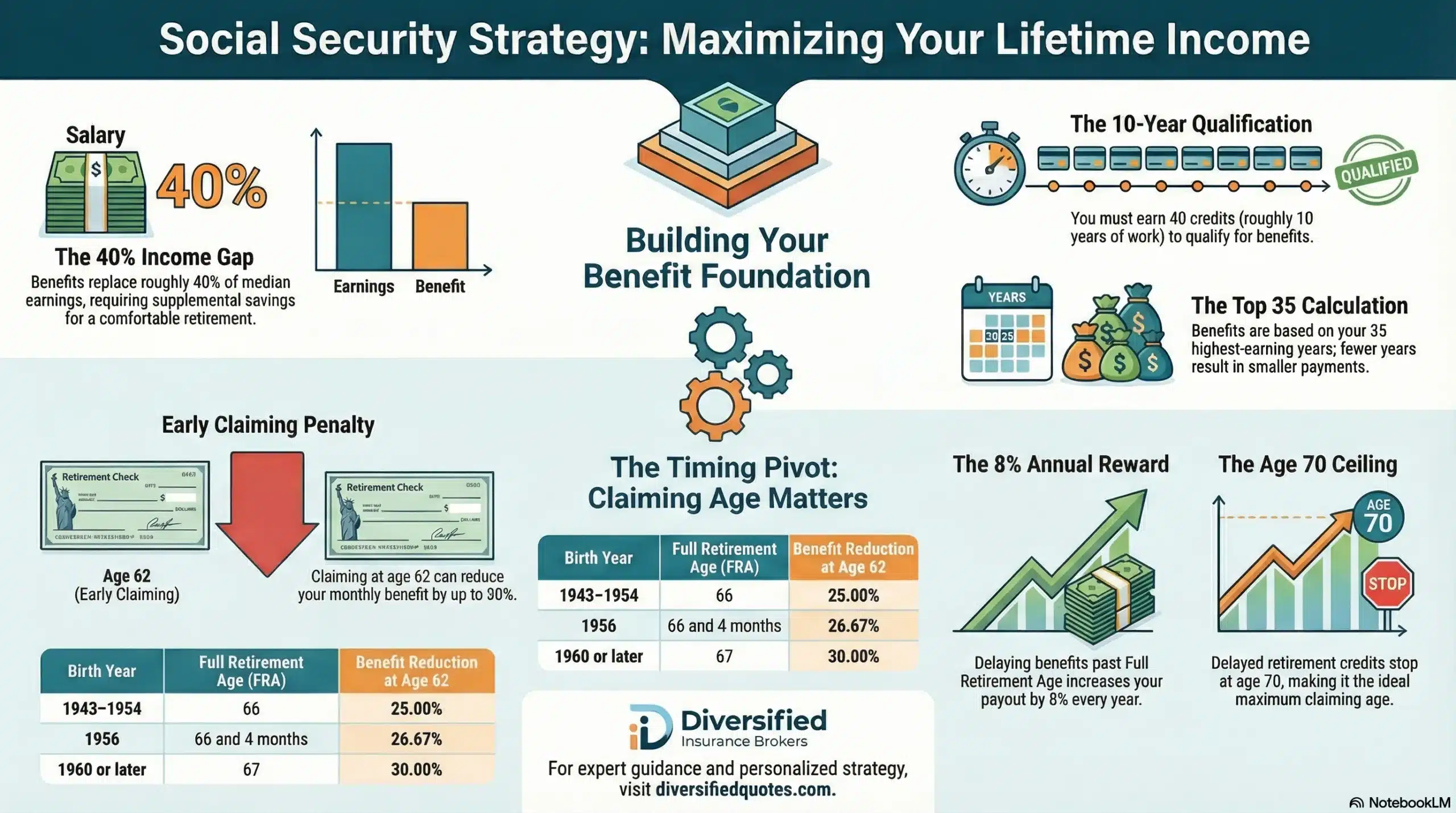
Schedule a Free Social Security Consultation
We’ll review your work income, claiming month options, Medicare timing, and tax impact—so you can file with confidence.
FAQs: Does Working Past 65 Affect Social Security Benefits?
I’m 65, still working, and haven’t claimed Social Security yet. Is there any reason to claim now rather than wait?
If you are still working with meaningful employment income and have not yet reached Full Retirement Age, there are very few scenarios where claiming Social Security at 65 makes financial sense. Before FRA, the earnings test applies — if your employment income exceeds $23,400 in 2026, SSA withholds $1 of benefit for every $2 earned above that threshold. For a worker earning $80,000 annually, the excess over the threshold is approximately $56,600, which produces a benefit withholding of approximately $28,300 per year. Most of that benefit is returned through recalculation at FRA, but the administrative complexity and the interaction with taxability make early claiming during high-income working years rarely advantageous.
More importantly, every month past FRA that you do not claim Social Security adds delayed retirement credits — approximately two-thirds of 1% per month, or 8% per year, up to age 70. If your FRA is 67 and you delay to 70, your monthly benefit is 24% higher than it would have been at FRA for the rest of your life. For the higher earner in a married couple, this delay also increases the surviving spouse’s survivor benefit — a planning consideration that often justifies delay even when the individual’s own financial picture might argue for earlier claiming.
If Social Security withholds benefits because of my earnings, do I lose that money permanently?
No — benefits withheld due to the earnings test are not permanently lost. When you reach Full Retirement Age, the Social Security Administration recalculates your monthly benefit to account for the months during which benefits were fully or partially withheld. The recalculation effectively treats the withheld months as if you had delayed claiming for those periods — your monthly benefit at FRA is adjusted upward to reflect the months where you did not receive payment due to the earnings test. The recalculation does not happen immediately in a lump sum; rather, the higher monthly payment begins at FRA and continues for life, gradually paying back the withheld amounts over time through the higher monthly payment.
The practical implication is that the earnings test does not permanently damage the lifetime Social Security value for most workers — it defers some of the value to later, after FRA, in the form of a higher monthly payment. For workers who live to average life expectancy or beyond, the total lifetime Social Security income is roughly equivalent whether the earnings test withheld some pre-FRA benefits or not. The scenario where the earnings test produces a worse outcome is when the worker claims early, has benefits withheld due to the earnings test, and then dies before receiving the full benefit of the FRA recalculation — which is an argument for not claiming early in the first place for workers who are still earning significant income.
Can I delay Medicare enrollment if I’m still covered by my employer’s health plan at 65?
Yes — if you are covered by an employer group health plan through your own active employment (or your spouse’s active employment) at a company with 20 or more employees, you may delay Medicare Part B enrollment without incurring the late enrollment penalty. You have a Special Enrollment Period of eight months after you lose the employer coverage or stop working — whichever comes first — to enroll in Part B without penalty. Medicare Part A is generally premium-free if you have 40+ quarters of work history, and enrolling in Part A while still covered by employer insurance typically does not cause problems because Part A is secondary to employer coverage for hospital claims. However, if you have an HSA, enrolling in any part of Medicare — including premium-free Part A — ends your HSA contribution eligibility.
Two critical caveats: COBRA coverage is not qualifying employer coverage for the purpose of delaying Medicare without penalty — if you retire and continue coverage through COBRA at 65, you must enroll in Medicare to avoid penalties. Retiree health coverage from a former employer is also not qualifying active employer coverage for this purpose. The exception applies only to coverage through active current employment. Confirming with the employer’s HR department and with SSA that the coverage qualifies before relying on the delay exception is an important verification step to avoid an inadvertent late enrollment penalty.
Does continuing to work past 65 increase my Social Security benefit?
Continuing to work past 65 can increase your Social Security benefit in two ways, but whether it meaningfully does depends on your specific earnings history. Social Security calculates the Primary Insurance Amount based on the 35 highest-earning years of your record, each indexed for inflation to current wage levels. If you have 35 or more years of high earnings already — at or near the Social Security taxable maximum in most years — adding more working years is unlikely to increase the benefit because the new years cannot displace any of the 35 already-high years. If you have gaps in your work history, fewer than 35 working years, or some years of low earnings that are currently in your 35-year average, additional working years at a higher wage can replace those low years and increase the average indexed monthly earnings that determine the benefit amount.
The second way continued work increases the benefit is through delayed retirement credits — if you delay claiming past FRA while still working, the benefit grows at approximately 8% per year up to age 70. This increase is independent of earnings and applies to all workers regardless of their earnings history. The delayed credit increase is often larger and more predictable than the earnings record improvement, making delayed claiming the primary benefit increase strategy for most workers past FRA. Requesting your Social Security statement from SSA.gov, which shows your current benefit estimate at different claiming ages, allows you to see whether additional working years would meaningfully change the benefit estimate compared to claiming on the current record.
How does working past 65 affect my Medicare premiums through IRMAA?
IRMAA — the Income-Related Monthly Adjustment Amount — adds surcharges to Medicare Part B and Part D premiums for beneficiaries whose Modified Adjusted Gross Income exceeds defined thresholds. The 2026 IRMAA determination uses 2024 income — the two-year look-back means the income you earned while still working two years ago determines whether you pay surcharges today. A worker who retires at 65 and enrolls in Medicare will face IRMAA in their first year or two of Medicare enrollment based on their pre-retirement high income, even though their current retirement income is much lower.
In 2026, IRMAA applies to single filers whose 2024 MAGI exceeded $109,000 and married filers whose 2024 MAGI exceeded $218,000. The surcharge tiers increase with income — at the highest income tier, Part B premiums can exceed $500 per month rather than the standard $206.50. Workers retiring from high-income positions should anticipate IRMAA in their first one to two years of Medicare enrollment and can file SSA Form-44 to request a new IRMAA determination based on a qualifying life-changing event — such as retirement — that reduced income below the prior year’s level. Proactive IRMAA management, including income smoothing strategies in the years before Medicare enrollment and the appeal process when income drops, can reduce Medicare premium costs significantly for high earners transitioning to retirement.
I’m 67 (FRA) and still working. Should I claim Social Security now or keep waiting?
At FRA, the earnings test no longer applies — you can collect Social Security and earn any amount from employment without any benefit reduction. The decision of whether to claim at FRA or continue delaying is now purely a question of whether the delayed retirement credits from continued delay (approximately 8% per year up to age 70) are worth the cost of forgoing the monthly benefit payments you could be receiving. At FRA 67, delaying three more years to 70 increases the monthly benefit by 24% — a significant permanent increase that continues for life and also increases your surviving spouse’s future survivor benefit.
The break-even age analysis — the age at which total lifetime benefits from delayed claiming exceed total lifetime benefits from earlier claiming — typically falls between ages 80 and 83 for most claiming age comparisons. If you expect to live past 82 or 83, delaying past FRA typically produces more total lifetime Social Security income. If health factors or other considerations suggest a shorter life expectancy, claiming at or near FRA may produce better total lifetime outcomes. For married couples, the higher earner’s delay decision is especially consequential because the survivor receives the higher of the two benefit amounts — maximizing the higher earner’s benefit through delayed claiming directly maximizes the couple’s survivor protection. The combination of your health, your spouse’s benefit situation, your current income needs, and your total retirement income plan all factor into this decision — making coordination with a financial planner or Social Security specialist the most reliable way to identify the optimal claiming strategy for your specific situation.
About the Author:
Jason Stolz, CLTC, CRPC, DIA, CAA and Chief Underwriter at Diversified Insurance Brokers (NPN 20471358), is a senior insurance and retirement professional with more than 25 years of real-world experience helping individuals, families, and business owners protect their income, assets, and long-term financial stability. As a long-time partner of the nationally licensed independent agency Diversified Insurance Brokers, Jason provides trusted guidance across multiple specialties—including fixed and indexed annuities, long-term care planning, personal and business disability insurance, life insurance solutions, Group Health, Travel Medical and Evacuation Insurance, and short-term health coverage. Diversified Insurance Brokers maintains active contracts with over 100 highly rated insurance carriers, ensuring clients have access to a broad and competitive marketplace.
His practical, education-first approach has earned recognition in publications such as VoyageATL, and contributions from his agency featured in Kiplinger and GoBankingRates— highlighting his commitment to financial clarity and client-focused planning. Drawing on deep product knowledge and years of hands-on field experience, Jason helps clients evaluate carriers, compare strategies, and build retirement and protection plans that are both secure and cost-efficient. Visitors who want to explore current annuity rates and compare options across multiple insurers can also use this annuity quote and comparison tool.
Explore All Social Security Planning Guides: Browse our complete Social Security Planning guide — covering filing strategies, spousal benefits, survivor benefits, taxes, WEP, GPO & more.
Last Reviewed: June 9, 2026 |
Reviewed by: Jason Stolz, CLTC, CRPC, DIA, CAA
Chief Underwriter, Diversified Insurance Brokers, Inc. | NPN: 20471358 | Diversified Insurance Brokers, Inc. — Licensed in all 50 states
Fact Checked by: Tonia Pettitt, CMIP©
Medicare Specialist, Diversified Insurance Brokers, Inc. | NPN: 14374308 | Diversified Insurance Brokers, Inc. — Licensed in all 50 states
Did you find this content helpful? Leave us a Google review — it helps others find trustworthy guidance too.
Editorial Standards: Diversified Insurance Brokers maintains rigorous editorial standards to ensure accuracy, clarity, and independence in all content. Learn more about our editorial standards and commitment to transparency.
