
Disability Insurance for Respiratory Therapists
As an Independent Disability Insurance Broker, we have access to exclusive discounts and negotiated pricing most captive agents can’t offer — see the full breakdown near the end of this page.
Disability Insurance for Respiratory Therapists

Jason Stolz CLTC, CRPC, DIA, CAA
Disability insurance for respiratory therapists is an essential and frequently underutilized financial protection for a healthcare profession that the American Association for Respiratory Care’s own survey found had nearly 80% of its members reporting some level of professional burnout — one of the highest burnout prevalence figures documented in any clinical healthcare profession. Respiratory therapists are the specialists who manage the full spectrum of respiratory care across the hospital: mechanical ventilation in the ICU, emergency airway management including intubation, bronchodilator and aerosol medication delivery, neonatal respiratory care in the NICU, pulmonary rehabilitation, and the diagnostic and therapeutic procedures that make respiratory therapists indispensable in every high-acuity clinical environment. The Bureau of Labor Statistics reports a median annual wage of $80,450 for respiratory therapists in May 2024, with hospital-based RTs earning an average of $80,660, the top 10% earning above $108,820, and 12% projected job growth from 2024 to 2034 — among the fastest-growing healthcare occupations. This income, generated through demanding credential education and sustained through high-intensity clinical work across overnight shifts, ICU environments, and the full spectrum of respiratory emergency care, deserves the income protection that disability insurance provides against the documented occupational health risks respiratory therapy careers carry. At Diversified Insurance Brokers, we help respiratory therapists design disability coverage that reflects their specific occupational risk profile, income level, and career planning considerations. For foundational disability insurance context, our disability insurance services overview provides essential background, and our resource on why people buy disability insurance explains the core protection logic that applies with particular force in high-exposure clinical environments.
Protect Your Income as a Respiratory Therapist
Compare disability insurance options designed for respiratory therapists across hospital, ICU, NICU, and pulmonary rehabilitation settings.
Request Disability Insurance OptionsQuestions? Call 800-533-5969
What Respiratory Therapists Do and Why Their Work Creates Serious Disability Risk
Respiratory therapists are the clinical specialists responsible for the assessment, treatment, and management of patients with breathing and cardiopulmonary disorders across the full spectrum of hospital care — from emergency airways to long-term mechanical ventilation to pulmonary rehabilitation for patients with chronic respiratory disease. Their practice scope in the acute hospital setting is broad and genuinely high-stakes: emergency endotracheal intubation when a patient loses airway patency, management of mechanically ventilated patients in the ICU including ventilator weaning and extubation decisions, delivery of bronchodilator and inhaled medication therapies across all patient populations, pulmonary function testing, sputum induction and airway clearance procedures, arterial blood gas analysis, neonatal respiratory care in the NICU for premature and critically ill newborns, and the management of oxygen therapy, non-invasive ventilation, and high-flow nasal cannula systems that are increasingly central to acute respiratory care.
This broad and high-acuity clinical scope creates the disability risk profile that makes respiratory therapy one of the healthcare occupations most urgently in need of income protection. The combination of infectious disease exposure from aerosol-generating procedures, musculoskeletal demands from patient handling and equipment management, chemical and medication exposure from inhaled drug delivery systems, the psychological burden of sustained ICU and critical care work, and shift work including overnight coverage creates a multi-dimensional occupational health exposure that few other allied health professions match. NIOSH has identified respiratory therapists as carrying among the highest rates of occupational injury exposure in the clinical workforce — a designation that reflects the real and documented risks of the environment respiratory therapists inhabit every working day.
Burnout: The Most Prevalent Disability Risk
The AARC survey finding that nearly 80% of respiratory therapists reported some level of professional burnout is among the highest burnout prevalence figures documented in any healthcare profession — placing respiratory therapy in the most extreme burnout-affected tier of the clinical workforce. The drivers of this burnout are structural and deeply embedded in the profession’s working conditions. Staffing shortages that worsened dramatically during the COVID-19 pandemic and have not fully recovered force individual respiratory therapists to manage patient loads that exceed safe capacity, creating the persistent gap between what good care requires and what the staffing reality permits — a daily source of moral injury that research has identified as a powerful independent burnout driver.
Long shifts including overnight coverage, high patient mortality in the ICU and NICU settings where respiratory therapists provide their most intensive care, sustained exposure to patients in respiratory failure and end-of-life respiratory management, and the physical and emotional exhaustion of high-acuity clinical work without adequate recovery time between shifts compound the burnout burden. Respiratory therapists in the NICU carry the particular emotional weight of neonatal critical illness — managing mechanical ventilation for premature infants, some of whom will not survive, while developing professional relationships with families during extended NICU stays that generate secondary traumatic stress at documented rates.
The COVID-19 pandemic was a defining inflection point for respiratory therapy burnout. Respiratory therapists were at the absolute front line of COVID care — managing the mechanical ventilation of the sickest COVID patients, performing the aerosol-generating procedures that created the highest infectious exposure risk, and doing so during a period when protective equipment was inadequate and patient outcomes were catastrophic. Research published during and after the pandemic found burnout rates at or above 79%, confirming that the pandemic experience pushed an already-elevated burnout baseline to extreme levels from which the profession has not fully recovered.
When burnout reaches clinical severity — producing major depressive disorder, PTSD-spectrum conditions from sustained exposure to critical illness and death, or anxiety disorder that impairs the sustained attention and clinical judgment that ventilator management and emergency airway care require — it constitutes genuine occupational disability. Disability insurance with mental health coverage without a 24-month benefit period limitation is therefore a foundational requirement for respiratory therapists, not an optional feature. Most employer group LTD policies apply this 24-month mental health cap as standard, meaning a respiratory therapist whose disabling burnout-driven depression may require 3 or more years of recovery finds group benefits terminated at exactly 24 months. Our resource on disability insurance riders explained covers how mental health provisions are structured across policy types, and our resource on why working with an independent disability insurance broker matters explains how carrier-specific mental health provision knowledge drives better coverage outcomes for allied health applicants.
Infectious Disease Exposure: A Defining Occupational Hazard
Respiratory therapists have greater occupational exposure to infectious respiratory pathogens than virtually any other healthcare professional — because their clinical role centers on the procedures that generate the highest levels of infectious aerosol. Endotracheal intubation, manual bag-mask ventilation, bronchoscopy assistance, sputum induction, and high-flow oxygen delivery are the core of what respiratory therapists do clinically — and they are the procedures that create the conditions under which respiratory pathogens are most efficiently transmitted. These are not occasional interventions for respiratory therapists; they are performed daily across the sickest patients in the hospital.
The COVID-19 pandemic made this exposure reality viscerally clear. Respiratory therapists were among the healthcare workers with the highest documented infectious exposure — performing aerosol-generating procedures on patients with severe COVID pneumonia in settings where protective protocols were still developing. But this infectious exposure predates COVID and will continue after it: tuberculosis exposure from performing procedures on patients with undiagnosed pulmonary TB, influenza and other respiratory viral exposure during seasonal peaks, sustained exposure to patients with hospital-acquired and ventilator-associated pneumonia in the ICU, and exposure to aerosolized medications including certain antibiotics and antifungals that can cause respiratory sensitization and occupational asthma with prolonged clinical exposure are the year-round occupational reality of respiratory therapy practice.
A respiratory therapist who acquires an occupational respiratory infection requiring treatment that prevents clinical work has experienced a disability event that disability insurance covers through income replacement — regardless of whether the employer or workers’ compensation system acknowledges the occupational origin. The critical planning requirement is that the policy must be in place before any such diagnosis is documented. Our resource on disability insurance with preexisting conditions explains why early application — before any occupational exposure-related health events — produces the most comprehensive coverage for respiratory therapists in high-exposure clinical environments.
Musculoskeletal Injuries From Patient Handling and Equipment Management
Musculoskeletal injuries represent the second major disability pathway for respiratory therapists — and a well-documented occupational health challenge across the hospital settings where patient physical handling is routine. Respiratory therapists in the ICU participate in prone positioning of mechanically ventilated patients — placing critically ill, heavily sedated patients face-down to improve oxygenation, a procedure requiring multiple providers to lift and turn patients who cannot participate in their own movement. The physical demands of pronation generate documented acute lumbar, shoulder, and upper extremity injury risk among ICU staff including respiratory therapists who regularly perform these procedures.
Outside the ICU, respiratory therapists move oxygen and ventilator equipment across all hospital floors, position patients for pulmonary function testing, manage portable ventilator and aerosol equipment, and support patients during pulmonary rehabilitation exercise sessions. The cumulative musculoskeletal loading from these tasks across a full career of hospital respiratory therapy practice produces the spinal and upper extremity conditions — lumbar disc conditions, shoulder injuries, wrist conditions — that generate disability claims in physically demanding healthcare roles. A respiratory therapist whose lumbar condition prevents the patient handling and equipment management that clinical respiratory work requires has experienced genuine occupational disability even when cognitive capacity is entirely intact. Our resource on own-occupation disability insurance explains why the policy definition must protect the specific physical demands of respiratory therapy practice, not just the generic ability to perform healthcare work.
Chemical and Medication Exposure
Respiratory therapists administer inhaled medications across their patient populations — bronchodilators, corticosteroids, mucolytics, and in specialized settings inhaled antibiotics including tobramycin and colistin for cystic fibrosis and drug-resistant infections, and antifungals — through nebulization systems that create fine medication aerosols in the patient’s immediate environment. Sustained occupational exposure to these aerosolized medications during administration creates potential for respiratory sensitization in respiratory therapists who inhale medication aerosols during patient treatment sessions, particularly in settings without adequate exhaust ventilation or consistent appropriate respiratory protection. Occupational asthma from aerosolized medication exposure has been documented in healthcare workers in the clinical literature — a condition that, once developed, can prevent continued work in the clinical environment where the sensitizing agents are regularly administered.
Chemical exposure from high-level disinfection agents used to maintain respiratory equipment — particularly glutaraldehyde and other chemical sterilants used for bronchoscopes and ventilator circuits — represents an additional occupational chemical exposure pathway documented to produce respiratory sensitization, contact dermatitis, and systemic health effects in respiratory therapists with sustained exposure. Disability insurance covering occupational illness addresses these chemical and medication exposure pathways when they produce qualifying disability under the policy definition.
Income Structure and the Financial Exposure of Disability
The BLS reports a median annual wage of $80,450 for respiratory therapists in May 2024, with hospital-based RTs averaging $80,660 and the top 10% earning above $108,820. Specialty credentials — the Registered Respiratory Therapist (RRT) designation, neonatal/pediatric specialty certification, adult critical care specialty certification, and sleep disorders specialty certification — increase earning potential meaningfully above the median for credentialed practitioners in high-demand settings. Many hospital-based respiratory therapists earn substantially above their base rate through overtime and shift differential pay, particularly during seasonal respiratory illness peaks and in institutions managing persistent staffing shortages.
The financial exposure of disability across this income range is meaningful and compounding. A respiratory therapist earning $83,000 annually who develops disabling burnout-driven major depression at age 34 and requires three years of treatment and recovery before return to full clinical function faces over $249,000 in direct income loss during that period — plus the downstream effects on retirement contributions, mortgage or rent payments, student loan service for the associate’s or bachelor’s degree education the career required, and household financial stability that three years without income severely disrupts. Against this exposure, disability insurance premiums represent a small and straightforwardly justified investment. Our resource on whether disability insurance is worth it provides the value framework, and our resource on how much disability insurance you need helps translate specific income and financial obligations into appropriate benefit amounts.
Employer Group Coverage Gaps for Respiratory Therapists
Most hospital-employed respiratory therapists receive employer group LTD coverage as part of their benefits package — and the systematic limitations of that coverage create real financial exposure gaps that individual disability insurance must address. The 60% of base salary benefit cap excludes overtime and shift differential pay that many RTs earn regularly — income components that can represent 15% to 25% or more of actual annual compensation in hospital settings with chronic staffing shortages that generate consistent overtime opportunities. A respiratory therapist whose actual total annual income is $95,000 including overtime but whose base salary is $75,000 has a group policy that calculates benefits on $75,000 — leaving both the overtime premium and a portion of base income unprotected.
The 24-month own-occupation to any-occupation definition transition is the most dangerous group policy limitation for a profession whose primary disability pathway runs through burnout and mental health conditions. An any-occupation standard could deny benefits for a respiratory therapist with ongoing major depression who retains theoretical capacity for some non-clinical healthcare role — even when the specific clinical demands of respiratory therapy practice cannot be safely performed. Group policies also end when employment ends, which matters for RTs who change hospital employers, take travel assignments, or move to per-diem arrangements. Individual disability insurance maintaining own-occupation coverage for the full benefit period with no 24-month mental health limitation, supplementing the group policy’s income gap including overtime, and providing portable coverage through any employment change is the standard of adequate protection. Our resource on guaranteed issue group disability insurance explains how group coverage is structured at the plan level.
Designing a Disability Policy for Respiratory Therapists
Effective disability insurance for respiratory therapists integrates the profession’s burnout risk, infectious disease exposure, musculoskeletal demands, and income structure into a policy built around realistic disability scenarios rather than worst-case-only coverage.
The own-occupation definition must apply for the full benefit period and protect the specific clinical functions of respiratory therapy practice — including the patient handling, aerosol procedure performance, equipment management, and critical care responsibilities that generate clinical income. The mental health provision must carry no 24-month benefit period limitation, confirmed explicitly in the policy contract language rather than assumed. The benefit amount must reflect actual total compensation including overtime and shift differential pay — not just base salary — using prior year tax returns to establish documented income. The benefit period must extend to age 65: a burnout-driven disability occurring at age 35 represents a 30-year income gap that a 5-year benefit period addresses only briefly.
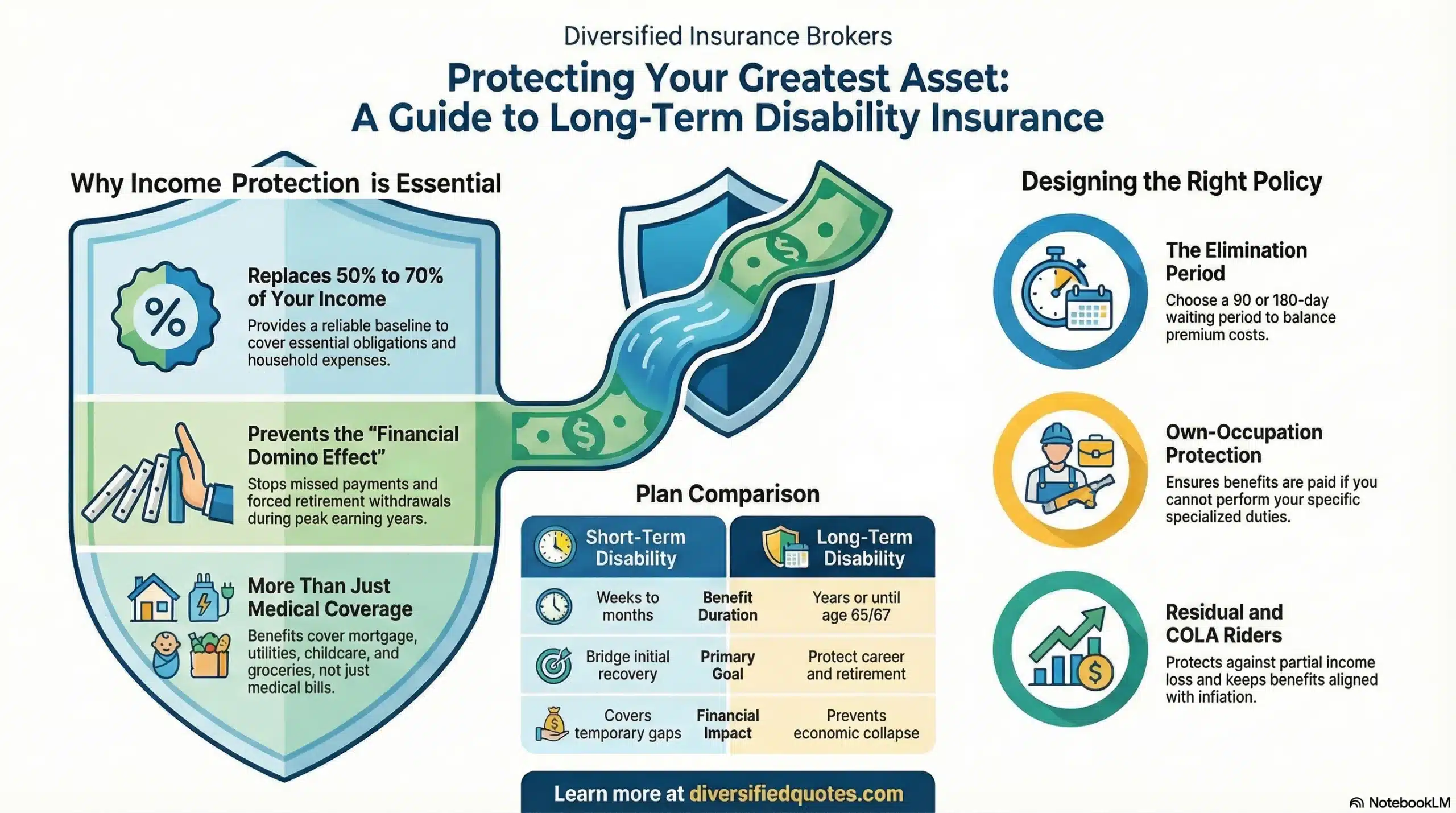
The residual disability rider pays proportionately when a condition reduces but does not eliminate clinical capacity — addressing the realistic scenario where a musculoskeletal condition limits patient handling duties or reduces to part-time work without meeting total disability threshold. Our resource on residual disability insurance benefits explained covers how this works. The elimination period should reflect actual financial reserves — our resource on disability insurance elimination periods explained provides the calibration framework. The future increase option allows coverage to expand as specialty credentials and experience increase income without new medical underwriting — our resource on disability insurance future insurability riders covers how this protection works. The COLA rider maintains benefit purchasing power across long-duration claims — our resource on disability income insurance with COLA explains this protection. For respiratory therapists with existing coverage, our disability insurance second opinion service provides an independent review against the full market of available options.
When to Apply: Earlier Is Always Better
The optimal time for a respiratory therapist to apply for disability insurance is immediately upon completing their credential program and obtaining their CRT or RRT — before clinical work has begun producing the burnout treatment documentation, infectious disease health history, or musculoskeletal conditions that complicate underwriting. An RT applying at age 23 from their program obtains the lowest locked-in lifetime premium at the cleanest health history point, with the broadest available coverage terms and no exclusion riders limiting the most likely future disability scenarios. Every year of delay in a profession with nearly 80% burnout prevalence and documented highest-level infectious exposure risk increases both the premium at a future application and the probability that documented health history will limit the coverage available. Our resource on disability insurance for new professionals addresses the specific planning considerations for allied health professionals at career entry, and our resource on how to get the best disability insurance rates explains all the factors that determine coverage quality and cost across the market of available options.
Get Disability Insurance Quotes for Respiratory Therapists
We compare options across carriers for respiratory care professionals to find the right combination of mental health coverage, own-occupation definition, and value.
Request Disability Insurance OptionsQuestions? Call 800-533-5969
Financial Protection Essentials
Income protection resources and disability insurance planning tools for respiratory therapists and allied health professionals.
Talk With an Advisor Today
Choose how you’d like to connect—call or message us, then book a time that works for you.
Schedule here:
calendly.com/jason-dibcompanies/diversified-quotes
Licensed in all 50 states • Fiduciary, family-owned since 1980
Frequently Asked Questions: Disability Insurance for Respiratory Therapists
An AARC survey found nearly 80% of respiratory therapists reported some level of professional burnout — one of the highest burnout prevalence figures in any healthcare profession. The structural drivers include chronic staffing shortages forcing individual RTs to manage unsafe patient loads, sustained ICU and NICU exposure to critically ill and dying patients, overnight shift work, and the moral injury of knowing care quality is compromised by inadequate staffing. The COVID-19 pandemic drove these burnout rates to extreme levels as RTs managed the mechanical ventilation of the sickest COVID patients through maximum-aerosol-exposure procedures during a period of catastrophic patient mortality and inadequate protective equipment.
For disability planning, this burnout prevalence is the primary disability risk pathway for respiratory therapists. When burnout progresses to clinical major depression, PTSD from sustained critical illness exposure, or anxiety disorder that impairs the sustained attention and judgment that ventilator management requires, it constitutes genuine occupational disability. Disability insurance without a 24-month mental health benefit period limitation is therefore foundational — not optional. Most group LTD policies apply this 24-month cap as standard, making individual disability insurance without it the essential protection. Our resource on disability insurance with preexisting conditions explains why applying before any burnout treatment is documented is the optimal approach for RTs in high-stress clinical settings.
Respiratory therapists have greater occupational exposure to infectious respiratory pathogens than virtually any other healthcare professional because their clinical role centers on the procedures that generate the highest levels of infectious aerosol: endotracheal intubation, manual bag-mask ventilation, bronchoscopy assistance, sputum induction, and high-flow oxygen delivery. These are not occasional interventions for RTs — they are the core of daily clinical function, performed across the sickest patients in the hospital. This means respiratory therapists perform the procedures with the highest pathogen transmission risk as routine work rather than rare specialized tasks.
A respiratory therapist who acquires an occupational respiratory infection requiring treatment preventing clinical work has experienced a disability event that disability insurance covers through income replacement — provided the policy was in place before the diagnosis was documented. The infectious disease exposure pathway also includes occupational asthma from aerosolized medication exposure and chemical sensitization from high-level disinfection agents used on respiratory equipment. All of these coverage implications reinforce the urgency of establishing a policy before any exposure-related health event occurs. Our resource on whether disability insurance is worth it provides the framework for evaluating this protection relative to the documented exposure risk RTs face every working day.
Respiratory therapists face significant musculoskeletal injury risk from patient handling and equipment management throughout their clinical environments. In the ICU, RTs participate in prone positioning of mechanically ventilated patients — a procedure requiring multiple providers to lift and turn critically ill, heavily sedated patients who cannot assist in their own movement. The biomechanical demands of prone positioning generate documented acute lumbar, shoulder, and upper extremity injury risk. Outside the ICU, respiratory therapists manage portable ventilator equipment, position patients for pulmonary function testing, handle oxygen delivery systems across hospital floors, and support patients during pulmonary rehabilitation sessions.
The cumulative musculoskeletal loading from these tasks across a full career of hospital respiratory therapy practice produces the spinal and upper extremity conditions — lumbar disc conditions, shoulder injuries, wrist conditions — that generate disability claims in physically demanding healthcare roles. A respiratory therapist whose lumbar condition prevents the patient handling and equipment management that clinical respiratory work requires has experienced genuine occupational disability even with fully intact cognitive and communication capacity. The own-occupation definition must protect these specific physical demands. Our resource on own-occupation disability insurance explains how this definition applies to the specific clinical function of respiratory therapy practice in real claim scenarios.
For most respiratory therapists, employer group disability coverage leaves meaningful and consequential gaps. The 60% of base salary benefit cap excludes overtime and shift differential pay that many hospital-based RTs earn regularly — income components that can represent 15% to 25% or more of actual annual compensation in institutions with persistent staffing shortages and consistent overtime opportunities. A respiratory therapist whose actual total annual income is $95,000 including overtime but whose base salary is $75,000 has group benefits calculated on $75,000 — leaving both the overtime premium and a portion of base income completely unprotected.
The 24-month own-occupation to any-occupation definition transition is the most dangerous group policy limitation for a profession whose primary disability pathway runs through mental health conditions. An any-occupation standard could deny benefits for a respiratory therapist with ongoing major depression who retains theoretical capacity for some non-clinical healthcare role — even when the specific demands of respiratory therapy cannot be safely performed. Group policies also end when employment ends, which matters for RTs who change hospital employers or take travel positions. Individual disability insurance maintaining own-occupation coverage for the full benefit period with no 24-month mental health limitation, covering actual total compensation including overtime, and portable through any employment change is the standard of adequate protection. Our resource on guaranteed issue group disability insurance explains group coverage structure and where individual coverage fills the consistent gaps.
Given the profession’s primary disability risk pathways, five policy provisions are most important. First: own-occupation definition for the full benefit period protecting the specific clinical function of respiratory therapy — including the aerosol procedures, patient handling, equipment management, and critical care responsibilities that generate clinical income. Second: mental health coverage without a 24-month benefit period limitation — with nearly 80% burnout prevalence, any policy capping mental health benefits at 24 months directly fails the primary disability pathway. Third: benefit amount reflecting actual total compensation including overtime and shift differential, not just base salary. Fourth: residual disability rider paying proportionately when a condition reduces but does not eliminate clinical capacity — particularly important for musculoskeletal scenarios where partial capacity generates partial income. Fifth: future increase option allowing coverage to expand as RRT certification and specialty credentials increase income without new medical underwriting.
Our resource on residual disability insurance benefits explained covers how partial disability benefits work in practice, and our resource on disability insurance future insurability riders explains how the future increase option preserves insurability as career income grows. For respiratory therapists with existing coverage, our disability insurance second opinion service provides an independent review against the full market of available options.
The optimal time is immediately upon completing the credential program and obtaining CRT or RRT credentials — before clinical work has produced the burnout treatment documentation, infectious disease health history, or musculoskeletal conditions that complicate underwriting. This early timing matters because both primary disability pathways — mental health conditions from burnout and infectious disease exposure consequences — can generate documented health history that limits coverage if application is delayed. A respiratory therapist applying at age 23 from their RT program obtains the lowest locked-in lifetime premium at the cleanest health history point, with the broadest available coverage terms and no exclusion riders limiting the most likely future disability scenarios.
Every year of delay in a profession with nearly 80% burnout prevalence and documented highest-level infectious exposure risk increases both the premium at future application and the probability that documented health history will limit available coverage terms. A respiratory therapist applying at 23 versus 40 may face premium differences of 40% to 60% annually for identical coverage, compounded across every premium payment for the remainder of a 40-year career. Our resource on disability insurance for new professionals addresses the specific planning considerations for allied health professionals at career entry, and our resource on how to get the best disability insurance rates explains all the factors that determine coverage quality and cost across the market.
About the Author:
Jason Stolz, CLTC, CRPC, DIA, CAA and Chief Underwriter at Diversified Insurance Brokers (NPN 20471358), is a senior insurance and retirement professional with more than 25 years of real-world experience helping individuals, families, and business owners protect their income, assets, and long-term financial stability. As a long-time partner of the nationally licensed independent agency Diversified Insurance Brokers, Jason provides trusted guidance across multiple specialties—including fixed and indexed annuities, long-term care planning, personal and business disability insurance, life insurance solutions, Group Health, Travel Medical and Evacuation Insurance, and short-term health coverage. Diversified Insurance Brokers maintains active contracts with over 100 highly rated insurance carriers, ensuring clients have access to a broad and competitive marketplace.
His practical, education-first approach has earned recognition in publications such as VoyageATL, and contributions from his agency featured in Kiplinger and GoBankingRates— highlighting his commitment to financial clarity and client-focused planning. Drawing on deep product knowledge and years of hands-on field experience, Jason helps clients evaluate carriers, compare strategies, and build retirement and protection plans that are both secure and cost-efficient. Visitors who want to explore current annuity rates and compare options across multiple insurers can also use this annuity quote and comparison tool.
Explore More Disability Insurance Options: Browse our complete guide to Disability Insurance for Nursing, Therapy & Allied Health — covering nurses, therapists, dental hygienists, pharmacists, lab techs & allied health professionals from 100+ carriers.
Last Reviewed: June 8, 2026 |
Reviewed by: Jason Stolz, CLTC, CRPC, DIA, CAA
Chief Underwriter, Diversified Insurance Brokers, Inc. | NPN: 20471358 | Diversified Insurance Brokers, Inc. — Licensed in all 50 states
Fact Checked by: Tonia Pettitt, CMIP©
Medicare Specialist, Diversified Insurance Brokers, Inc. | NPN: 14374308 | Diversified Insurance Brokers, Inc. — Licensed in all 50 states
Did you find this content helpful? Leave us a Google review — it helps others find trustworthy guidance too.
Editorial Standards: Diversified Insurance Brokers maintains rigorous editorial standards to ensure accuracy, clarity, and independence in all content. Learn more about our editorial standards and commitment to transparency.
