
Disability Insurance for Nannies
As an Independent Disability Insurance Broker, we have access to exclusive discounts and negotiated pricing most captive agents can’t offer — see the full breakdown near the end of this page.
Disability Insurance for Nannies

Jason Stolz CLTC, CRPC, DIA, CAA
Disability insurance for nannies is a financial protection that the overwhelming majority of childcare professionals never obtain — and one that becomes urgently, immediately relevant the moment an injury or illness prevents them from working. Nannies are the primary caregivers for children in private homes: responsible for the physical safety, emotional wellbeing, developmental stimulation, daily routine management, and in many households the nutritional, educational, and transportation needs of the children entrusted to their care. According to Zippia’s industry data, the average nanny earns $40,262 annually as of late 2025. Care.com’s 2025 data places the average U.S. nanny at approximately $21.01 per hour — or $3,536 per month based on a 40-hour week. UrbanSitter’s January 2026 booking data shows the national average has climbed to $26.24 per hour, with an average annual salary of approximately $55,000 — reflecting an 11% increase over 2025 figures as demand for qualified in-home childcare continues to outpace supply. In major urban markets the picture is even more pronounced: nannies in New York City average $30 to $45 per hour for experienced, full-time positions, and Glassdoor’s 2026 survey data places average nanny compensation at $43,954 nationally, with bonuses and additional compensation bringing total packages to nearly $48,000 for many positions.
This income — whether $40,000 or $55,000 or more — generates real and ongoing household financial obligations: rent or mortgage payments, utilities, car payments and insurance, food, health insurance premiums, student loan service for the associate’s or bachelor’s degree in early childhood education that many nannies hold, and in many cases family financial obligations that the nanny’s income supports in whole or in part. Yet this income is almost universally unprotected against the disability risks that nanny work genuinely creates. The nanny who slips on a wet kitchen floor and fractures a wrist has no employer disability policy in the background. The nanny who develops a lumbar disc condition from years of lifting and carrying toddlers has no group LTD claim to file. The nanny who undergoes surgery and requires 10 weeks of recovery has nothing between their depleted savings and their stack of monthly bills. At Diversified Insurance Brokers, we help nannies and childcare professionals design disability coverage that reflects the specific financial and occupational realities of household employment — including the income documentation considerations, the complete absence of employer group coverage, and the physical demands that make income protection genuinely urgent in this profession. For foundational disability insurance context, our disability insurance services overview provides essential background, and our resource on why people buy disability insurance explains the core protection logic that applies with particular force to independent workers without employer safety nets.
Protect Your Income as a Nanny
Compare disability insurance options designed for nannies and childcare professionals — no employer group coverage required.
Request Disability Insurance Options
Questions? Call 800-533-5969
What Nannies Do and Why Their Work Is More Physically Demanding Than Most People Realize
Nannies are professional childcare specialists who provide the full spectrum of in-home childcare and household support that families with children depend on. The scope of a nanny’s daily responsibilities is genuinely broad: managing infant feeding, diapering, and sleep routines; supervising and engaging toddlers through the sustained, high-energy, physically interactive play that developmental health requires; transporting children to schools, activities, appointments, and playdates; preparing nutritious meals and snacks across multiple age groups; managing homework supervision, reading, and educational activities for school-age children; maintaining the order and cleanliness of the areas where children live and play; and providing the emotional attunement and responsive caregiving that healthy child development research consistently identifies as the most critical component of quality early childhood care.
This daily scope generates physical demands that are both more sustained and more physically intensive than most people outside the profession recognize. Nanny work is not office work. It is not sedentary work. It involves continuous movement through the physical environment of a residential home, sustained attention to fast-moving children whose safety depends on the nanny’s constant awareness, and the direct physical interaction with children — lifting, carrying, supporting, chasing, bending, kneeling, reaching — that constitutes the core of infant and toddler care. An experienced nanny managing the care of an infant and a toddler simultaneously may perform 50 or more lifting and carrying movements in a single working day, most of them from awkward bent-forward positions that concentrate load directly on the lumbar spine and shoulders. This is not an exaggeration of the physical reality of nanny work — it is the documented occupational demand that makes musculoskeletal injury among the most common reasons nannies are unable to work.
Specialty nannies add further professional dimensions to this core role. Newborn care specialists — often called night nannies or newborn specialists — work overnight shifts supporting new parents through the sleep-disrupting early weeks of a new infant’s life, managing feeding schedules, sleep training, and overnight care that requires sustained alertness and physical capability through unusual hours. Special needs nannies provide care for children with physical, developmental, or medical complexity that requires additional physical support, behavioral management skills, and emotional resilience. Nanny-housekeepers combine childcare with household management responsibilities that add physical demands including cleaning, laundry, grocery shopping, and home organization. Each specialization adds to the physical and emotional complexity of the role and to the income that disability insurance must protect when that role cannot be performed.
The Unique Financial Vulnerability of Nanny Employment
The financial vulnerability of nannies during a disability event is more acute than for most employed professionals because of the specific structure of household employment. Almost every nanny works for a single family employer — which means income is entirely binary. When an injury or illness prevents a nanny from working, income stops immediately and completely. There is no employer group disability policy running silently in the background. There is no HR department processing a short-term disability claim on the nanny’s behalf. There is no sick leave balance that can be drawn on for weeks before financial pressure begins to build. There is no corporate short-term disability program that automatically replaces 60% of salary from day one of a qualifying condition. There is simply the nanny’s own financial resources — whatever savings exist — standing between the household financial obligations that continue and the paycheck that has stopped.
This structure is fundamentally different from the employment experience of professionals in larger organizations, where disability events generate a complex administrative response but rarely produce the immediate and total income cessation that a nanny experiences. A corporate employee who undergoes surgery on a Monday typically has sick leave that begins covering the absence that week, a short-term disability claim submitted to HR, and a group LTD policy as a backstop for extended recovery. A nanny who undergoes the same surgery on the same Monday has none of those layers — just whatever is in their bank account and the hope that recovery is fast enough to get back to work before that runs out.
The financial consequences of even a moderately significant disability are therefore disproportionately severe for nannies relative to their income level. A nanny earning $50,000 annually who requires 10 weeks of surgical recovery loses approximately $9,600 in income during that period — roughly 19% of annual income — while simultaneously incurring medical costs, paying the same rent, car payment, and loan service that existed before the disability, and potentially losing the position entirely if the family cannot hold it open through the recovery period. For a nanny with limited savings — which describes the majority, since building savings on an average nanny salary in a high-cost-of-living market is genuinely difficult — this is a financial crisis on top of a health challenge. Disability insurance addresses this vulnerability directly by replacing a meaningful percentage of monthly income during the recovery period, allowing the nanny to focus on recovering rather than managing a financial emergency simultaneously with a medical one. Our resource on whether disability insurance is worth it provides the full cost-benefit framework for evaluating this protection relative to the actual financial exposure a disability creates at any income level.
Physical Disability Risks: Back Injuries, the Most Common Career Threat
Back injuries from lifting and carrying children are the most prevalent and most career-threatening physical disability risk in nanny work. The mechanism is well-understood in occupational health: repeated lifting of loads from bent-forward positions — exactly the posture a nanny must adopt dozens of times daily when picking up a child from the floor, a crib, a car seat, or a high chair — generates the intervertebral disc compression and cumulative spinal loading that produces lumbar disc herniation, disc degeneration, and the paravertebral muscle and ligament conditions that cause chronic lower back pain and functional limitation. Healthcare and caregiving workers who perform patient or client lifting as a core job function consistently appear among the highest-risk occupational groups for musculoskeletal injury in occupational health research, and nanny work shares the essential physical mechanism of that risk.
The weight of children being lifted increases over time while the frequency of lifting remains essentially constant, creating a compounding physical exposure that many nannies manage for years without a significant acute injury — until one lift, on one day, at the wrong angle or after accumulated fatigue, produces the acute disc herniation or muscle tear that ends the ability to work. A lumbar disc herniation requiring conservative management — rest, physical therapy, pain management — can produce 6 to 12 weeks of inability to perform the lifting and physical childcare functions that nanny work requires. A disc herniation requiring surgical intervention produces recovery timelines of 3 to 6 months or more before return to the physical demands of full nanny work is medically appropriate. These are not rare catastrophic scenarios — they are documented outcomes of the physical occupational demands that nanny work places on the spine, documented in occupational health research on caregiving professions with comparable physical demands.
The shoulder is the second most common musculoskeletal injury site for nannies after the lumbar spine. Overhead lifting of children — picking a toddler up off the ground and placing them in a high chair, crib, or car seat that requires lifting above waist height or with reaching — generates the rotator cuff loading that produces shoulder impingement, rotator cuff tears, and shoulder labral conditions that can require months of treatment and in some cases surgical repair. A nanny whose shoulder condition prevents the overhead lifting and carrying that infant and toddler care requires has experienced genuine occupational disability even when all other physical and cognitive functions are intact. Wrist and hand conditions — including carpal tunnel syndrome from the gripping and carrying demands of childcare, and de Quervain’s tenosynovitis (a painful tendon condition at the base of the thumb) from the specific pinching and lifting mechanics of infant holding — round out the upper extremity occupational injury picture for nannies in regular infant and toddler care.
Slip and Fall Injuries: A Serious and Underappreciated Hazard
Slip and fall injuries represent the second significant physical hazard category for nannies, and one that the residential work environment makes genuinely difficult to eliminate. Nannies work in private homes — environments that are not subject to the workplace safety inspections, signage requirements, and hazard mitigation protocols that apply to commercial workplaces. Wet kitchen and bathroom floors, cluttered toy-strewn living areas, stairs without adequate handrails, uneven exterior walkways and driveways in ice and snow, loose area rugs on hardwood floors, and the inherent unpredictability of moving quickly to follow or catch active toddlers all generate the fall risk that produces acute fractures, sprains, and head injuries in residential environments.
According to occupational health research published by the National Institutes of Health, slips and trips causing falls account for 20% to 40% of disabling occupational injuries across all work settings. In a residential caregiving environment where the nanny is simultaneously moving through the home, managing children, and performing household tasks across multiple functional areas, the fall hazard is persistent and real. A nanny who fractures an ankle falling on a wet bathroom floor after a bath time with toddlers faces the same 8 to 12 week non-weight-bearing recovery that any ankle fracture requires — a recovery period during which she literally cannot chase, carry, or respond to the fast physical demands of active childcare. A nanny who sustains a wrist fracture catching herself on a stairway fall faces the same extended recovery from a fracture that is functionally incompatible with infant carrying and childcare. These are not remote scenarios — they are the documented acute injury consequences of performing physically active caregiving work in the inherent physical environment of a private home.
The workers’ compensation situation for nanny injuries adds an important layer of context here. Workers’ compensation requirements for household employers vary dramatically by state — some states require coverage for household employees working above specified hour or wage thresholds, while others make it voluntary. In states where coverage is not required or not provided by the employer family, a work-related injury produces an injury the nanny bears the full financial consequences of on their own — without any employer-side workers’ compensation benefits to cover medical costs and partial wage replacement. Individual disability insurance that covers income loss from the disability regardless of where the injury occurred and regardless of employer-side coverage status is the protection that fills this gap completely. Our resource on short-term vs. long-term disability insurance explains how the two protection layers work together to cover both the early and extended phases of income interruption.
Illness, Surgery, and the No-Work, No-Pay Reality
Beyond acute physical injury, any illness or medical condition significant enough to prevent a nanny from safely performing childcare duties produces immediate income loss — because there is no such thing as “working from home” for a nanny, and there is no employer framework that provides paid sick leave in the vast majority of household employment arrangements. A nanny who contracts a significant respiratory illness cannot work around children who could be infected. A nanny recovering from an abdominal surgery cannot perform the physical lifting and childcare functions the job requires. A nanny managing a significant mental health episode cannot provide the emotional attunement and professional caregiving that children need and families depend on. In all of these scenarios, the income stops — immediately and completely — and whatever personal financial resources exist must absorb the gap.
Common surgical procedures with recovery timelines that fall squarely within the window disability insurance is designed to cover include: gallbladder surgery (typical recovery 2 to 6 weeks), appendectomy (2 to 4 weeks), hernia repair (3 to 6 weeks), knee surgery including meniscus repair or ACL reconstruction (8 to 12 weeks or more for a physically active return), shoulder surgery (3 to 6 months), and spinal surgery (6 to 12 months). Any of these procedures — performed on a nanny who has no employer disability coverage, no sick leave, and no income protection — produces a financial crisis of proportional severity to the income level and the duration of recovery. A nanny earning $50,000 annually whose herniated disc requires lumbar surgery and a 5-month recovery loses over $20,000 in income during that period. Against a disability insurance premium that might cost $60 to $100 per month for a well-structured individual policy, the protection value is straightforwardly compelling.
Mental health conditions represent an increasingly important disability consideration for nannies as well. The emotional demands of professional childcare — sustained patience and emotional attunement with children across long working days, management of the behavior challenges and developmental difficulties of the children in care, the professional isolation of working alone in a private home without the collegial adult interaction that most workplaces provide, and in some positions the boundary challenges and emotional demands of close relationships with employer families — generate the occupational stress burden that can progress to clinical anxiety disorder or depression when insufficient support and recovery resources exist. When a mental health condition reaches clinical severity that prevents the emotional and functional demands of professional childcare, it constitutes disability that income replacement insurance must address. Confirming that any disability policy covers mental health conditions without a 24-month benefit period limitation is an important evaluation step. Our resource on disability insurance riders explained covers how mental health provisions are structured across different policy types.
The Complete Absence of Employer Coverage: Why Individual Insurance Is the Only Option
The most important structural fact about disability insurance planning for nannies is that individual disability insurance is not a supplement to employer coverage for this profession — it is the entire protection structure. Unlike employees of corporations, healthcare organizations, law firms, or virtually any other employer of more than a handful of workers, nannies almost universally receive no employer-sponsored group disability insurance coverage of any kind.
The IRS classifies nannies as household employees — not independent contractors — and household employers are legally required to pay the employer portion of FICA taxes once the annual wage threshold is crossed. But being classified as a household employee for tax purposes does not translate into receiving the group benefits packages that employees of larger organizations receive. Group health insurance, group disability insurance, group life insurance, paid sick leave, and paid time off are standard employment benefits at companies with 50 or more employees — but they are rare exceptions in household employment. The family employing a nanny is a household employer managing a single worker, not a business with an HR department and a group benefits program. The practical reality is that almost no household employer provides group disability insurance to their nanny — which means almost no nanny has any disability income protection in place at all.
In five states — California, Hawaii, New Jersey, New York, and Rhode Island — household employers are required by state law to make payroll deductions for state disability insurance programs that provide short-term benefits for non-work-related disabilities. These state programs provide a baseline of short-term protection for nannies in those states, typically covering 60% to 67% of wages for a limited duration (commonly up to 52 weeks in California, shorter in other states) subject to weekly maximum benefit limits. This state-mandated short-term coverage is genuinely valuable for nannies in the covered states — but it is short-term only, covers only non-work-related conditions, is subject to waiting periods, and provides weekly maximums that may fall well below a well-compensated nanny’s actual earnings. For nannies in the 45 states without mandated household employer disability programs, and for long-duration disabilities exceeding state program benefit periods in states with programs, individual disability insurance is the only protection available.
This absence of any employer baseline means that the decision for a nanny is not “how much additional coverage do I need above my group policy?” — it is “do I have any protection at all?” Without an individual policy, the nanny has nothing. This is the foundational reason why disability insurance is more urgently necessary for nannies than for most employees: not because nanny work is uniquely dangerous, but because nanny work is uniquely unprotected. Our resource on disability insurance for independent contractors covers coverage considerations for independent workers without employer benefits, and our resource on disability insurance for the self-employed addresses income documentation and policy design for workers outside traditional employment benefit structures.
Income Documentation and How It Affects Coverage
One practical consideration that distinguishes disability insurance applications for nannies from those of W-2 employees in traditional workplaces is income documentation. Disability insurance benefit amounts are based on documented income — the income that the policy is designed to replace when disability prevents work. For nannies, income documentation varies significantly depending on the employment structure in place.
Nannies who are paid as formal household employees with proper W-2 reporting — which is the legally required arrangement when annual wages exceed the FICA threshold of $2,800 in 2025 — have clean, straightforward income documentation through their W-2 forms, tax returns, and pay stubs. This documentation clearly establishes the income base for disability insurance benefit calculations and allows coverage at the full benefit level appropriate for documented earnings. Nannies in this situation face no unusual documentation challenges in the disability insurance application process.
Nannies who have historically been paid in cash without formal household employment reporting — a common but technically non-compliant arrangement that many families maintain to avoid the administrative complexity of household payroll — face a more complex income documentation situation. Without W-2s, tax returns reflecting self-employment income, or other formal income documentation, establishing documented income for disability insurance purposes is difficult, and benefit amounts available without income verification under simplified-issue programs may be lower than the nanny’s actual earnings. The practical advice is direct: formalizing the employment arrangement through proper W-2 household payroll creates both federal and state tax compliance and the clean income documentation that enables full disability insurance coverage at a benefit level that genuinely replaces actual earnings. Several payroll services — including HomePay, GTM Payroll Services, and Poppins Payroll — specialize in household employment payroll and make this formalization straightforward and inexpensive.
For nannies with informal or variable income documentation who want to establish baseline disability protection quickly, simplified-issue disability insurance programs provide an accessible path. Many simplified-issue programs allow qualifying applicants to obtain coverage up to specified benefit limits — commonly $3,000 to $6,000 per month depending on age and employment type — without producing extensive income documentation. Our resource on no-exam disability insurance explains how these simplified-issue programs work, what the benefit limits are, and how the streamlined approval process differs from traditional disability underwriting.
Designing the Right Disability Policy for a Nanny
Effective disability insurance for nannies integrates the profession’s physical injury risk, the absence of any employer coverage safety net, the income structure of household employment, and the financial planning considerations of a career where immediate and total income cessation is the disability scenario that needs to be addressed.
The benefit amount is the most critical design element — it must be set to cover essential monthly financial obligations during a disability period: housing costs, utilities, food, transportation, minimum debt service, and health insurance premiums. The benefit amount should reflect actual documented income rather than an arbitrary round number, and should account for the tax-free nature of disability benefits paid on individually purchased policies with after-tax premiums. Because disability benefits on personally purchased policies are typically received tax-free when premiums are paid with after-tax dollars, the benefit replaces a larger share of spendable income than the same gross dollar amount of taxable income would — meaning a $3,000 per month disability benefit may effectively replace more lifestyle spending power than $3,000 per month of pre-disability taxable wages would have. Our resource on how much disability insurance you need provides the framework for this calculation. For context on the tax treatment, our resource on whether disability insurance payments are taxable explains the rules clearly.
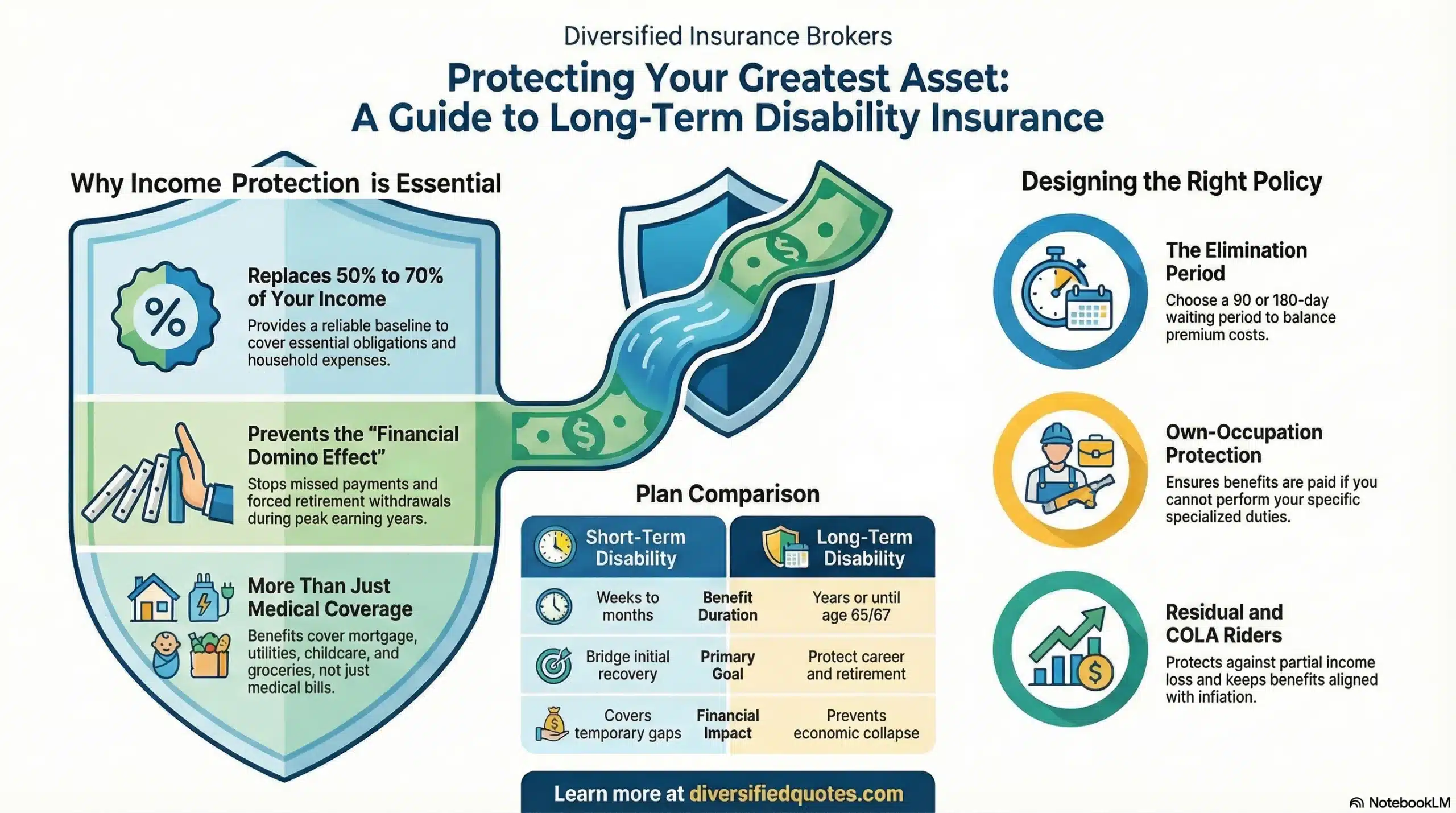
The elimination period — the waiting period before benefits begin — should be calibrated to actual financial reserves. For a nanny with limited savings, a 30-day or 60-day elimination period ensures that benefits begin before financial reserves are exhausted. For a nanny with stronger savings, a 90-day elimination period reduces the premium cost while still protecting against the extended disabilities that create the most severe financial consequences. The elimination period is not a deductible — it is a waiting period, and matching it to actual financial cushion rather than choosing the longest available period purely to minimize premium is the responsible design choice. Our resource on disability insurance elimination periods explained provides the full calibration framework.
The benefit period should reflect the income risk window being protected. A 2-year benefit period addresses surgical recoveries and moderate-length disability scenarios. A 5-year benefit period addresses longer recoveries and the more serious disability scenarios that back surgery and spinal conditions can produce. A benefit period to age 65 addresses the largest possible risk — a disabling condition occurring at age 30 that prevents return to full childcare work for an extended period or permanently — at the cost of a higher but still manageable premium for a profession with relatively modest average income levels. For most nannies, a 2-year or 5-year benefit period represents the practical sweet spot between coverage adequacy and affordability.
The own-occupation definition matters for nannies who want the strongest available protection. Under a true own-occupation definition, a nanny is disabled when their condition prevents them from performing the material and substantial duties of their specific occupation as a nanny — including the lifting, carrying, physical interaction with children, and sustained physical childcare demands that the role requires — even if they could theoretically perform some sedentary employment. A nanny whose back condition prevents childcare work but who could theoretically perform office administrative work would receive benefits under an own-occupation policy and potentially not under a strict any-occupation standard. Our resource on own-occupation disability insurance explains how this definition works in practice. The residual disability rider addresses partial-capacity scenarios — a nanny who can return to part-time work during recovery but cannot resume full-time duties receives proportionate benefits for the income reduction. Our resource on residual disability insurance benefits explained covers how this rider functions. For nannies with existing coverage who want an independent evaluation, our disability insurance second opinion service provides a carrier-neutral review.
Live-In Nannies: Additional Financial Considerations
Live-in nannies — nannies who reside in the employer family’s home as part of their employment arrangement — face an additional financial vulnerability layer that distinguishes their situation from that of live-out nannies. When a live-in nanny becomes unable to work, they lose not only their income but in many cases their housing as well — because the housing is provided as part of the employment arrangement and ends when the employment must be paused for a disability recovery. The simultaneous loss of income and housing creates a financial crisis that is more acute and more immediate than the income loss alone that a live-out nanny faces during the same disability period.
Live-in nannies often earn somewhat lower hourly rates than live-out nannies in recognition of the in-kind housing benefit — but this trade-off means they typically have lower cash savings relative to their effective total compensation. When disability ends both the cash income and the housing simultaneously, the live-in nanny must address both income replacement and emergency housing in parallel. A well-structured disability insurance policy with a benefit amount that covers both income replacement and potential housing costs during a recovery period is therefore especially important for live-in nannies. The elimination period calibration is also especially critical — a live-in nanny who loses housing simultaneously with income needs benefits to begin as quickly as possible rather than after a 90-day wait that assumes substantial savings exist to bridge the gap.
Specialized Nannies: Higher Income, Higher Stakes
As nanny specialization and credentials increase, so does compensation — and so do the financial stakes of disability. Newborn care specialists with formal NCS credentials routinely command $25 to $35 per hour in standard markets and $35 to $60 per hour or more in major urban markets, with some full-time positions generating annual incomes of $60,000 to $80,000 or higher. Special needs nannies with specialized training in developmental disabilities, autism spectrum care, or medically complex child management command premium compensation reflecting the advanced skills their work requires. Nannies in affluent urban markets who hold early childhood education degrees, fluency in additional languages, first aid and pediatric CPR certification, and extensive specialized experience can command total compensation packages — including salary, health insurance contributions, and annual bonuses — that place them firmly in the income range where disability insurance protection is not a marginal financial decision but a clearly necessary planning move.
For a specialized nanny earning $75,000 annually, a 4-month disability producing $25,000 in lost income represents a financial disruption that can take years to fully recover from in terms of savings depletion, debt accumulation, and retirement contribution interruption. Against a disability insurance premium that might be $80 to $120 per month for a well-structured individual policy at a younger age, the protection-to-cost ratio is straightforwardly favorable. Our resource on why young professionals need disability coverage addresses the financial urgency argument for early-career workers at all income levels.
When to Apply: The Earlier the Better
The optimal time for a nanny to apply for disability insurance is as early in their caregiving career as possible — ideally upon completing any formal childcare training and beginning professional work, before the physical demands of nanny work have produced any documented health history in medical records. The argument for early application is compelling on multiple dimensions simultaneously. First, age is the primary driver of disability insurance premium, and the premium locked in at age 23 upon starting a childcare career will be substantially lower — 30% to 50% lower in many cases — than the premium paid for identical coverage at age 35 or 40. Second, the early years of a nanny career are typically the years before any back conditions, wrist conditions, or shoulder conditions from the physical demands of childcare have appeared in medical records. These documented conditions at the time of application can produce exclusion riders that limit the coverage available for the conditions most likely to cause a future disability claim. Third, a disability insurance policy obtained early and maintained consistently builds a claims history and policy relationship that provides stable coverage regardless of health changes that may occur during the working years.
For nannies already established in their careers without disability coverage in place, the urgency for immediate action increases with each year of delay. Every year of active physical childcare work increases the probability that a back condition, shoulder condition, or wrist condition will appear in medical records and complicate a future application. The nanny who applies at 35 after 10 years of nanny work may find that the lumbar findings from a back strain episode three years ago, the shoulder tendinitis treated with physical therapy last year, or the carpal tunnel symptoms documented at a recent primary care visit are now factors in the underwriting process that limit coverage or add exclusion riders. Applying before any such documentation exists is always the superior outcome. Our resource on disability insurance for new professionals addresses early-career planning, and our resource on how to get the best disability insurance rates explains all the factors that determine coverage quality and cost for applicants at any career stage.
Get Disability Insurance Quotes for Nannies
We compare options across carriers for childcare professionals to find coverage that fits your income, employment structure, and budget — with no employer group coverage required.
Request Disability Insurance Options
Questions? Call 800-533-5969
Financial Protection Essentials
Income protection resources and disability insurance planning tools for nannies and childcare professionals.
Talk With an Advisor Today
Choose how you’d like to connect—call or message us, then book a time that works for you.
Schedule here:
calendly.com/jason-dibcompanies/diversified-quotes
Licensed in all 50 states • Fiduciary, family-owned since 1980
FAQs: Disability Insurance for Nannies
Do nannies qualify for disability insurance?
Yes — nannies qualify for individual disability insurance as household employees or self-employed childcare workers. The key requirement is documented income. Nannies who receive W-2 wages from household employers have straightforward income documentation through tax returns and pay stubs. Nannies paid informally in cash face a more complex documentation situation, but formalizing the employment arrangement with proper W-2 reporting creates both tax compliance and the documented income base that enables full disability insurance coverage. Simplified-issue programs that do not require extensive income documentation up to specified benefit limits are also available and are often the most accessible path for nannies to establish baseline income protection quickly. Our resource on no-exam disability insurance explains these simplified-issue options in detail.
Why is disability insurance especially important for nannies without employer coverage?
For nannies, disability insurance is not a supplement to existing protection — it is the entire protection structure. Most nannies receive no employer-sponsored group disability coverage of any kind. Household employers are not required to provide group benefits, and in practice almost none do. This means that when illness or injury prevents a nanny from working, income stops completely and immediately — there is no group LTD policy in the background, no sick leave bank, no HR department processing a disability claim. The only income protection a nanny has is whatever they have personally arranged. Individual disability insurance is therefore the entire safety net between a disabling event and financial crisis. Our resource on whether disability insurance is worth it provides the value framework for evaluating this protection relative to the real financial exposure it addresses.
What physical injuries are most common for nannies?
Back injuries from lifting and carrying children are the most prevalent physical disability risk in nanny work. Infants and toddlers must be lifted from cribs, car seats, high chairs, and the floor dozens of times daily, often from bent-forward postures that generate concentrated lumbar loading. As children grow from infancy through toddlerhood, the weight of each lift increases while frequency remains high — generating cumulative physical loading that produces lumbar disc conditions, shoulder injuries, and wrist conditions over months and years of caregiving work. Slip and fall injuries represent the second significant physical hazard — nannies work in residential environments including stairs, wet bathroom floors, cluttered play areas, and outdoor surfaces in weather conditions that generate acute fall risk. A significant back injury or a fractured wrist from a fall can produce 8 to 12 weeks of inability to work, during which disability insurance income replacement keeps financial obligations manageable.
Does disability insurance cover illness that prevents a nanny from working?
Yes — disability insurance covers income loss when illness prevents a nanny from performing their work duties for the elimination period and beyond. A nanny cannot typically work while significantly ill because of the infection risk to children in their care and the physical demands of active childcare that illness makes difficult. A respiratory illness requiring two weeks of recovery, post-surgical recovery requiring 6 to 10 weeks, or a more serious illness requiring extended treatment all constitute disability events that income replacement insurance addresses. The elimination period — the waiting period before benefits begin — should align with whatever financial reserves exist to cover the early phase of income loss. Our resource on disability insurance elimination periods explained helps calibrate this choice to actual financial reserves.
How much disability insurance does a nanny need?
The right benefit amount for a nanny is the monthly income replacement that covers essential financial obligations during a disability recovery period — housing, utilities, food, transportation, minimum debt payments, and any family financial responsibilities. The benefit amount should reflect actual documented income rather than a round number, and should account for the fact that disability insurance benefits paid on personally purchased individual policies are typically tax-free when premiums are paid with after-tax dollars — meaning the benefit effectively replaces a larger share of spendable income than a taxable income source of the same gross dollar amount would. Our resource on how much disability insurance you need provides the framework for translating specific income and monthly obligations into the right benefit amount for a nanny’s actual financial situation.
When is the best time for a nanny to apply for disability insurance?
The best time is as early in the caregiving career as possible — before any documented back conditions, wrist injuries, or other physical health history from the physical demands of childcare have appeared in medical records. A nanny who applies at age 24 early in their career obtains the lowest available lifetime premium at the cleanest health history point, with the broadest coverage terms and no exclusion riders limiting the conditions most likely to produce a future claim. Every year of delay increases the premium at future application and, in a physically demanding occupation, increases the probability that documented health history will limit the coverage available. Our resource on how to get the best disability insurance rates explains all the factors that determine coverage quality and cost for applicants in physically demanding occupations.
About the Author:
Jason Stolz, CLTC, CRPC, DIA, CAA and Chief Underwriter at Diversified Insurance Brokers (NPN 20471358), is a senior insurance and retirement professional with more than 25 years of real-world experience helping individuals, families, and business owners protect their income, assets, and long-term financial stability. As a long-time partner of the nationally licensed independent agency Diversified Insurance Brokers, Jason provides trusted guidance across multiple specialties—including fixed and indexed annuities, long-term care planning, personal and business disability insurance, life insurance solutions, Group Health, Travel Medical and Evacuation Insurance, and short-term health coverage. Diversified Insurance Brokers maintains active contracts with over 100 highly rated insurance carriers, ensuring clients have access to a broad and competitive marketplace.
His practical, education-first approach has earned recognition in publications such as VoyageATL, and contributions from his agency featured in Kiplinger and GoBankingRates— highlighting his commitment to financial clarity and client-focused planning. Drawing on deep product knowledge and years of hands-on field experience, Jason helps clients evaluate carriers, compare strategies, and build retirement and protection plans that are both secure and cost-efficient. Visitors who want to explore current annuity rates and compare options across multiple insurers can also use this annuity quote and comparison tool.
Explore More Disability Insurance Options: Browse our complete guide to Disability Insurance for Food, Hospitality, Arts & Entertainment — covering chefs, musicians, actors, bartenders, hospitality workers & entertainment professionals from 100+ carriers.
Last Reviewed: May 14, 2026 |
Reviewed by: Jason Stolz, CLTC, CRPC, DIA, CAA
Chief Underwriter, Diversified Insurance Brokers, Inc. | NPN: 20471358 | Diversified Insurance Brokers, Inc. — Licensed in all 50 states
Fact Checked by: Tonia Pettitt, CMIP©
Medicare Specialist, Diversified Insurance Brokers, Inc. | NPN: 14374308 | Diversified Insurance Brokers, Inc. — Licensed in all 50 states
Did you find this content helpful? Leave us a Google review — it helps others find trustworthy guidance too.
Editorial Standards: Diversified Insurance Brokers maintains rigorous editorial standards to ensure accuracy, clarity, and independence in all content. Learn more about our editorial standards and commitment to transparency.
