
Life Insurance for Entire Family
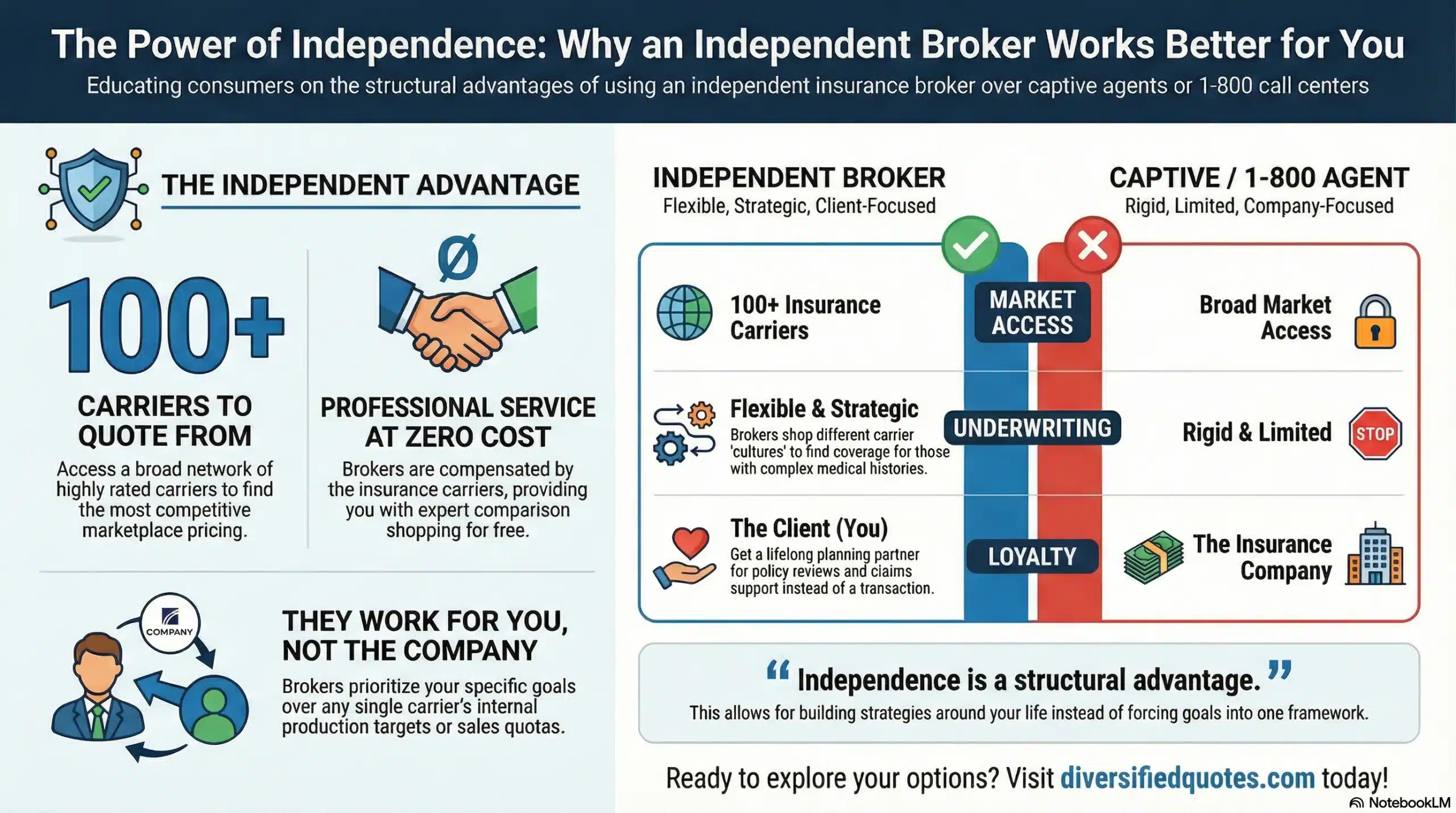
As an Independent Life Insurance Broker, we compare rates across 100+ carriers and prescreen every application before submission.
Life Insurance for Entire Family

Jason Stolz CLTC, CRPC, DIA, CAA
When families come to us asking about life insurance for the entire family, there are really two ways to get everyone protected, and the right one depends on what the family values most. At Diversified Insurance Brokers, we can write an entire family under a single policy for simplicity and savings, or quote each family member individually to match each person to the best policy for their specific situation. Both approaches protect your family; they simply optimize for different things. The single-policy approach centers on one policy — typically on a parent — with riders added to extend limited coverage to a spouse and to the children, all under one contract and one premium. It is convenient, economical, and gets everyone covered quickly. The individual approach quotes each family member separately, matching each person to the carrier and product whose underwriting and features best fit their age, health, and needs, which generally produces stronger, more flexible, more portable coverage for each person. Neither approach is universally “best” — a young family on a budget may be perfectly served by one policy with riders, while a family focused on maximizing each person’s protection and long-term flexibility may be better served by individual policies. Understanding the trade-offs is what lets you choose well, and that is exactly what this guide is designed to help you do.
Not sure whether one policy or individual policies is right for your family?
Contact Us to Compare Both Options
It helps to start with a common misconception. A “family life insurance policy” sounds like a single contract that covers everyone equally, but that is not how life insurance actually works. Most products marketed to families are built from an ordinary term or whole life policy on one adult, then customized with riders to extend some coverage to other family members. So “family life insurance” describes an approach to covering your household, not a single one-size-fits-all product. That distinction matters, because it means you always have a choice about how to structure the coverage: how much goes on each adult, whether children are covered by a rider or their own policy, and whether to keep everything under one contract or spread it across individually optimized policies. The best structure flows from a simple question — who in your family would create a financial hardship for others if they died, and what would that family member need the coverage to accomplish? Answering that for each person is the foundation of good family coverage, and our guidance on protecting your family with the right policy and on how much life insurance you need works through it in detail.
See Real-Term Rates Side by Side
Life Insurance Quoter
Approach One — One Policy Covering the Whole Family
The single-policy approach builds all of your family’s coverage around one base policy, usually on one parent, with riders that extend protection to the rest of the household. The base policy is a standard term life or whole life policy on the primary insured, sized to that person’s income-replacement and family-protection needs. Onto it you add two common riders. A spouse rider (sometimes called an additional-insured rider) extends a set amount of coverage to your spouse or partner without a separate policy; it is typically more affordable than a standalone policy, though the coverage amount is usually limited and it generally ends when the base policy ends or the spouse reaches a certain age. A children’s term rider is often the most appealing piece of this structure: a single rider covers all of your children — commonly including children yet to be born, who are added automatically once they reach a couple of weeks old — for one flat premium, with no additional charge per child. The children’s rider provides a modest amount of coverage per child, generally intended for final expenses rather than income replacement, and covers children up to an age set by the carrier, often somewhere between 18 and 25. Its standout feature is that it typically can be converted to a permanent policy for the child later, without evidence of insurability — which locks in your child’s future ability to buy coverage even if they develop a health condition that would otherwise make them hard to insure. The appeal of this whole approach is clear: it is convenient (one policy, one premium, one renewal), it is economical (riders cost less than separate policies), and it gets the entire family protected in a single step.
One Policy vs. Individual Policies at a Glance
| Consideration | One Policy With Riders | Individual Policies Per Person |
|---|---|---|
| Simplicity | Highest — one contract, one premium, one renewal for the whole family. | More to manage — separate policies, premiums, and renewals per person. |
| Cost | Riders cost less than standalone policies for the same family members. | Higher combined premium, but each dollar buys optimized coverage. |
| Coverage Amount | Spouse and child riders are usually capped at limited amounts. | Each person can carry the full amount their situation calls for. |
| Underwriting Fit | All tied to one carrier’s underwriting of the primary insured. | Each person placed with the carrier that best fits their health. |
| Portability & Independence | Rider coverage generally ends if the base policy lapses, ends, or on divorce. | Each policy is independently owned and stays in force on its own. |
| Children’s Coverage | One rider covers all children (incl. future ones); often convertible to permanent. | A standalone child policy allows larger amounts if desired. |
Approach Two — Individual Policies Matched to Each Person
The individual approach treats each family member’s coverage as its own decision, quoting each person separately and placing them with the carrier and product whose underwriting and features best fit their specific age, health, and needs. This is the approach most advisors recommend when the priority is maximizing protection rather than minimizing complexity, and it has real advantages. Each adult can carry the full coverage amount their situation calls for, rather than the limited amount a rider allows — which matters enormously when the goal is genuine income replacement, mortgage payoff, and long-term family security rather than a modest supplemental benefit. Each policy is independently owned and stays in force on its own, so one person’s coverage does not disappear because another person’s policy lapsed, ended, or because the couple divorced — a real risk with rider-based coverage, since riders generally terminate when the base policy does and spouse riders typically end on divorce. And critically, individual quoting lets us match each person to the carrier that underwrites their profile most favorably, which is the single biggest lever on price and approval. One spouse might get the best rate from a carrier known for a particular strength, while the other spouse — with a different health history, age, or build — is best served by an entirely different company. A rider forces everyone onto the primary insured’s carrier; individual policies let each person win their own best rate. This is exactly where working with an independent broker pays off, because we can shop the whole market for each family member rather than accepting one carrier’s terms for all. Our guidance on the best life insurance rates and on getting coverage with health issues reflects this person-by-person optimization.
Don’t Overlook the Stay-at-Home Parent
One of the most common and costly mistakes families make is insuring only the primary wage earner. Life insurance is no less important for a spouse who stays at home, works part-time, or is a secondary earner, because that parent provides services the family genuinely could not do without — childcare, household management, transportation, meal preparation, and more. If a stay-at-home parent died, the surviving spouse would face real, ongoing costs to replace all of that labor, often while continuing to work full-time, and life insurance on the stay-at-home parent exists to cover exactly those expenses. The economic value of a stay-at-home parent’s work is substantial when you add up what it would cost to hire out each of those roles, which is why coverage on that parent should be sized to reflect the true replacement cost of their contributions rather than treated as an afterthought. This is a case where either approach can work: a spouse rider can provide a limited amount of coverage on a stay-at-home parent affordably, but if the family would need substantial funds to replace years of childcare and household support, an individual policy on that parent — sized properly and independently owned — is usually the stronger choice. Families raising children should think carefully about protecting both parents, and our resource on life insurance for parents with young children addresses both earners directly.
Covering the Children — What It’s Really For
Life insurance on children serves a different purpose than coverage on parents, and understanding that difference helps you decide how to handle it. Because children do not provide income, their coverage is not about income replacement; it is about two other things. The first is protecting the family from the very real costs that arise if a child dies — funeral and final expenses, medical bills, and the ability to take time away from work to grieve without financial pressure. The second, and often more valuable long-term, is locking in the child’s future insurability. Coverage purchased on a child while they are young and healthy — whether through a children’s term rider or a small standalone policy — can typically be converted to permanent coverage when they reach adulthood, guaranteeing they will have life insurance later even if they develop a health condition that would otherwise make them difficult or expensive to insure. That guaranteed-insurability benefit is a meaningful gift to give a child. For most families, the children’s term rider is the simplest and most economical way to accomplish both goals, since one rider covers all children for one premium. Some families prefer a small standalone children’s whole life policy when they want a larger amount or permanent coverage from the start. And for a child with special needs, coverage requires additional planning to protect benefit eligibility, which our guidance on life insurance for a special needs child addresses specifically.
A Note on Joint Policies
Some families consider a joint policy covering two spouses, and it is worth understanding honestly how these differ from the two main approaches. A first-to-die joint policy pays a benefit when the first spouse dies and then coverage ends — which costs less than two separate policies but leaves the surviving spouse with no coverage at exactly the moment they may find it hardest or most expensive to obtain new coverage, since they are now older. For that reason, first-to-die policies generally provide limited value for families whose main goal is protecting each other. A second-to-die (survivorship) policy pays only after both spouses have died, which makes it a tool for estate planning and leaving a legacy rather than for income replacement, and our overview of survivorship joint whole life insurance explains where it fits. For most couples focused on protecting one another and their children, either individual policies or a base-plus-rider structure serves better than a first-to-die joint policy — which is why we generally steer families toward the two approaches this page focuses on unless there is a specific estate-planning reason for survivorship coverage.
Ready to protect your whole family the right way?
Contact Us About Family Life Insurance
Financial Protection Essentials
Explore disability coverage and specialty protection options across a range of caregiving, service, and professional occupations.
Talk With an Advisor Today
Choose how you’d like to connect—call or message us, then book a time that works for you.
Schedule here:
calendly.com/jason-dibcompanies/diversified-quotes
Licensed in all 50 states • Fiduciary, family-owned since 1980
Can my whole family really be covered under one life insurance policy?
Yes, a family can be covered through a single policy — but it is important to understand how that actually works, because a “family policy” is not one contract that insures everyone equally. Instead, it is built from a standard term or whole life policy on one adult (usually a parent), with riders added to extend limited coverage to a spouse and to the children, all under that one contract and one premium. A spouse rider covers your partner for a set, usually limited amount, and a single children’s term rider covers all of your children — including children born later, who are added automatically — for one flat premium with no per-child charge. This single-policy approach is genuinely convenient and economical: one policy, one premium, one renewal, and the whole family is protected in one step. The trade-off is that the rider coverage amounts are usually capped at limited levels, and the riders generally depend on the base policy staying in force. So one policy absolutely can cover your family, and for many families it is a great fit — but whether it is the best fit depends on whether the limited rider amounts are enough for your family’s real needs, or whether some members would be better served by their own individual coverage. Our overview of life insurance with a child rider explains the rider structure in detail, and comparing it against individual policies is exactly the decision this page is meant to help you make.
Is it better to get one family policy or separate policies for each person?
Neither is universally better — it depends on what your family values most, which is why we quote both ways. A single policy with riders wins on simplicity and cost: one contract, one premium, and lower cost than insuring each person separately, which makes it attractive for young families on a budget who want everyone covered quickly. Individual policies win on strength, flexibility, and optimization: each adult can carry the full coverage amount their situation actually requires rather than the limited amount a rider allows, each policy is independently owned so it stays in force on its own, and each person can be placed with the carrier whose underwriting fits their specific health and age best — which is the biggest factor in getting the best rate. There is also an important durability point: rider coverage generally ends if the base policy lapses or expires, and spouse riders typically end on divorce, which can leave a family member suddenly uninsured, whereas separate policies each stand on their own. Most advisors lean toward separate policies for the two adults when genuine income replacement is the goal, precisely because of those higher limits and independence, while a children’s rider is often the most efficient way to cover the kids regardless of how the parents are insured. The right answer for your family comes down to weighing convenience and cost against coverage amount and flexibility — a comparison an independent broker can lay out for you side by side, as our guidance on choosing the right policy describes.
How does a children’s life insurance rider work?
A children’s term rider is an add-on to a parent’s life insurance policy that covers the children, and it has a few features that make it especially efficient for families. The biggest is that one rider covers all of your children under a single flat premium — you do not pay a separate charge for each child, and in most cases children born after you add the rider are covered automatically once they reach a couple of weeks old. The coverage amount per child is modest, typically intended to handle final expenses rather than to replace income, since children do not provide income. Coverage generally lasts until the child reaches an age set by the carrier, often somewhere between 18 and 25. The rider’s most valuable long-term feature is that it can usually be converted to a permanent policy for the child when they reach adulthood, without evidence of insurability — meaning your child is guaranteed the ability to have life insurance as an adult even if they develop a health condition that would otherwise make them difficult or costly to insure. That guaranteed future insurability is genuinely valuable and is one of the main reasons parents add the rider. For families who want a larger amount of coverage on a child or permanent coverage from the outset, a small standalone children’s whole life policy is an alternative. For most families, though, the rider is the simplest and most economical way to protect the children and lock in their insurability, and its conversion feature is what makes it a lasting benefit rather than just temporary coverage.
Does a stay-at-home parent need life insurance?
Yes, and this is one of the most overlooked needs in family life insurance. It is easy to assume that only the income-earning parent needs coverage, but a stay-at-home parent provides services that would be genuinely expensive to replace — childcare, household management, transportation, meal preparation, and more. If a stay-at-home parent died, the surviving spouse would face substantial ongoing costs to replace all of that labor, frequently while continuing to work full-time, and life insurance on the stay-at-home parent exists precisely to cover those costs. The coverage should be sized to reflect the real replacement value of everything that parent does, which is significant when you add up the cost of hiring out each of those roles over the years the children are at home. This applies equally to a parent who works part-time or is a secondary earner. Either structure can cover a stay-at-home parent: a spouse rider can provide a limited amount affordably, but if the family would need substantial funds to replace years of childcare and household support, an individual policy on that parent — properly sized and independently owned — is usually the stronger choice, because rider limits are often too low to cover the true need. The key point is simply not to skip coverage on a non-earning parent; their economic contribution to the family is real, and protecting it matters. Our guidance on life insurance for parents with young children addresses both earning and non-earning parents.
What happens to family coverage if we divorce or the main policy lapses?
This is one of the most important practical differences between the two approaches, and it is worth understanding before you decide. With rider-based coverage, a family member’s protection is tied to the primary insured’s base policy. If that base policy lapses because premiums were not paid, or when it expires at the end of its term, the attached spouse and child riders generally end along with it — which can leave family members suddenly without coverage. Spouse riders additionally tend to terminate in the event of divorce, since the rider covers a spouse specifically. This means that relying on riders can leave a family member with no life insurance after a change in circumstances, sometimes at an age or health status where getting new coverage is harder and more expensive. Individual policies do not share this vulnerability: because each policy is separately owned and stands on its own, one person’s coverage continues regardless of what happens to another person’s policy or to the marriage, giving each family member durable, independent protection. This durability is a major reason many families choose individual policies for the adults even when a rider would be cheaper. If your family circumstances change — a divorce, in particular — it is important to review your coverage and beneficiary designations, and in some cases a court order may require maintaining specific coverage; our guidance on life insurance after divorce covers what to check. The takeaway is that if durability and independence matter to you, individual policies protect against exactly the scenarios where rider coverage can quietly disappear.
About the Author:
Jason Stolz, CLTC, CRPC, DIA, CAA and Chief Underwriter at Diversified Insurance Brokers (NPN 20471358), is a senior insurance and retirement professional with more than 25 years of real-world experience helping individuals, families, and business owners protect their income, assets, and long-term financial stability. As a long-time partner of the nationally licensed independent agency Diversified Insurance Brokers, Jason provides trusted guidance across multiple specialties—including fixed and indexed annuities, long-term care planning, personal and business disability insurance, life insurance solutions, Group Health, Travel Medical and Evacuation Insurance, and short-term health coverage. Diversified Insurance Brokers maintains active contracts with over 100 highly rated insurance carriers, ensuring clients have access to a broad and competitive marketplace.
His practical, education-first approach has earned recognition in publications such as VoyageATL, and contributions from his agency featured in Kiplinger and GoBankingRates— highlighting his commitment to financial clarity and client-focused planning. Drawing on deep product knowledge and years of hands-on field experience, Jason helps clients evaluate carriers, compare strategies, and build retirement and protection plans that are both secure and cost-efficient. Visitors who want to explore current annuity rates and compare options across multiple insurers can also use this annuity quote and comparison tool.
Explore More Life Insurance Options: Browse our complete guide to Life Insurance Ownership & Policy Management — covering reviewing, selling & understanding your existing policy, riders, taxes & claims from 100+ carriers.
Last Reviewed: July 10, 2026 |
Reviewed by: Jason Stolz, CLTC, CRPC, DIA, CAA
Chief Underwriter, Diversified Insurance Brokers, Inc. | NPN: 20471358 | Diversified Insurance Brokers, Inc. — Licensed in all 50 states
Fact Checked by: Tonia Pettitt, CMIP©
Medicare Specialist, Diversified Insurance Brokers, Inc. | NPN: 14374308 | Diversified Insurance Brokers, Inc. — Licensed in all 50 states
Did you find this content helpful? Leave us a Google review — it helps others find trustworthy guidance too.
Editorial Standards: Diversified Insurance Brokers maintains rigorous editorial standards to ensure accuracy, clarity, and independence in all content. Learn more about our editorial standards and commitment to transparency.
