
Brighthouse Financial SmartCare Hybrid Life-Long Term Care Insurance
As an Independent Long Term Care Insurance Broker, we compare traditional, hybrid, and partnership-qualified policies across dozens of carriers to find the structure that actually fits your situation.
Brighthouse Financial SmartCare Hybrid Life-Long Term Care Insurance
With most hybrid long-term care policies, the long-term care benefit you buy is the benefit you get, unless you pay extra for a fixed inflation rider. SmartCare Hybrid Life-Long Term Care Insurance, issued by Brighthouse Financial, is built on indexed universal life insurance, and its Indexed LTC option lets the long-term care benefit grow with the performance of market indices such as the S&P 500, up to an annual maximum, while never dropping below the original amount. Paired with a cash indemnity benefit that pays without receipts, that growth potential is the defining feature of SmartCare, and everything else on this page sits on top of it.

Jason Stolz, CLTC, CRPC, DIA, CAA, is Chief Underwriter at Diversified Insurance Brokers, and Brighthouse SmartCare is one our office places regularly for clients who want long-term care protection, a death benefit for their family, and the potential for their coverage to grow over time. As an independent long-term care insurance broker representing Brighthouse alongside more than one hundred other carriers, our office can show you exactly how SmartCare compares with other hybrid and traditional policies and help you decide whether it is the strongest fit for your situation, rather than assuming one well-known carrier is automatically the right answer.
Considering a hybrid life and long-term care policy with growth potential?
Request Your LTC Quote
Brighthouse SmartCare at a Glance
| Feature | Details |
|---|---|
| Policy Type | Indexed universal life insurance with long-term care benefits provided by riders |
| Issuer | Brighthouse Life Insurance Company, Charlotte, North Carolina (a separate company issues the New York version) |
| LTC Coverage Options | Indexed LTC (grows with index performance), Fixed Growth LTC (3% or 5% compound), or Level LTC |
| How the LTC Benefit Works | Up to 98% of the face amount accelerated over the first 2 years of a claim, then 2 or 4 more years from the extension rider; size your need with our long-term care insurance calculator |
| Total LTC Benefit Period | 4 or 6 years, based on electing the maximum benefit amount |
| Benefit Payment | Cash indemnity, with no receipts required once eligible |
| Elimination Period | 90 calendar days after eligibility requirements are met |
| Premium Payment | Single premium, or annual payments for 2, 3, 4, 5, or 10 years (10 years only with Fixed Growth or Level LTC) |
| Index Options | S&P 500, Russell 2000, and MSCI EAFE, plus a fixed account, with a 0% minimum floor |
| Return of Premium | Surrender benefit rider (at least 75% of premiums) and death benefit rider (at least 100% of premiums), each reduced by loans and LTC payments |
| Underwriting | Simple Underwriting for ages 40 to 75 and face amounts up to $1 million; learn whether LTC insurance requires a medical exam |
What Brighthouse SmartCare Actually Is
Brighthouse SmartCare is a hybrid life insurance and long-term care policy. The base policy is indexed universal life insurance, which means its cash value earns interest tied to the performance of market indices, up to a cap, while being protected from market losses by a 0% floor. Long-term care coverage is added through riders that let the death benefit be paid out for care while you are living, and then continue benefits after the death benefit portion is used. Our comparison of indexed versus variable universal life explains how indexed crediting works and how it differs from policies that invest directly in the market.
Brighthouse describes SmartCare as providing four things: a guaranteed death benefit, guaranteed long-term care protection with monthly benefit payments and no receipts required, the ability to grow long-term care benefits if the Indexed LTC or a Fixed Growth LTC option is chosen, and protection during market downturns with the ability to grow cash value through index participation. You can read Brighthouse’s own overview on its Brighthouse SmartCare product page.
SmartCare is issued by Brighthouse Life Insurance Company in Charlotte, North Carolina, and in New York by Brighthouse Life Insurance Company of NY. The New York version is structured as a life insurance policy that accelerates the death benefit for qualified long-term care services rather than as a long-term care insurance policy under New York law, and it does not qualify for the New York State Partnership for Long-Term Care Program. New York residents should confirm the specific design available to them.
The hybrid structure means the policy pays in one form or another no matter how life unfolds. If you need long-term care, it pays a monthly cash benefit. If you never need care, your beneficiaries receive the death benefit. And the policy’s cash value remains available through loans or a full surrender, with return of premium riders adding a guaranteed floor on what you get back.
Why Long-Term Care Planning Matters
The odds of needing care are higher than most people assume. According to the federal government’s LongTermCare.gov guidance, someone turning 65 today has almost a 70% chance of needing some type of long-term care services and supports in their remaining years. Women need care longer on average, about 3.7 years, compared with about 2.2 years for men, and roughly 20% of today’s 65-year-olds will need care for longer than five years.
There are several ways to pay for that care, and each has limits. Medicare typically covers short-term medical or rehabilitative care after a medical event, not care on a long-term basis. Medicaid covers long-term care for people who qualify physically and financially, but assets above the government limit may need to be spent down first, and program options can limit your choices. Self-funding relies on personal assets and income and can force changes to retirement and estate plans. Relying on family can strain relationships and the caregivers’ own finances.
Traditional long-term care insurance covers care costs directly, but if you never need care, you may never see a benefit from the premiums paid, and premiums on traditional policies are generally not guaranteed. We review two leading traditional policies on our pages for Thrivent long-term care insurance and Mutual of Omaha MutualCare coverage. Hybrid products like SmartCare take a different approach, pairing care coverage with a death benefit and cash value. Our comparison of hybrid life versus traditional LTC covers how to weigh the two.
Three Ways Your LTC Benefit Can Be Designed
The long-term care benefit is set at application, and SmartCare gives you three ways for it to behave over time. With the Indexed LTC option, the long-term care benefit amounts have the potential to increase with market gains, up to an annual maximum growth rate, but will never drop below the policy’s original amounts. You can choose to track one or more of three indices: the S&P 500 (large U.S. companies), the Russell 2000 (smaller U.S. companies), or the MSCI EAFE (international developed markets). A fixed account is also available.
With the Fixed Growth LTC option, the long-term care benefit grows at a guaranteed 3% or 5% annual compound rate, depending on your selection. With the Level LTC option, the long-term care benefit stays the same for the life of the policy. Each option carries different rider charges, and if the amount of long-term care coverage increases, the rider charges increase as well.
The choice comes down to how you want to handle inflation risk. Fixed Growth offers certainty: you know exactly how the benefit will grow. Indexed LTC offers potential for higher growth in strong markets, with a floor that prevents the benefit from ever shrinking, and Brighthouse notes the ability to lock in long-term care benefits at any time. The trade-off is that growth under the Indexed LTC option depends on index crediting being high enough to cover policy charges, so in weak years the benefit may not grow at all. Level LTC is the least expensive but leaves the benefit exposed to rising care costs, which is more reasonable for older buyers whose claim is likely to come sooner.
For buyers in their forties or fifties, some form of growth is usually worth serious consideration, because a claim may be twenty or thirty years away. Illustrating the same premium under all three options side by side is the clearest way to see how each might play out, and our office can prepare that comparison before you apply.
How Indexed Crediting Works Inside SmartCare
SmartCare does not invest your premium directly in the stock market. Instead, the policy tracks the performance of one or more market indices and credits interest to the cash value based on that performance, up to a cap rate. Brighthouse defines the cap rate as the maximum market performance the policy owner can earn according to a predetermined percentage. In a year when the chosen index rises, the policy is credited interest up to the cap. In a year when the index falls, the guaranteed minimum floor rate of 0% means the policy is not credited a negative return, so policy values are never reduced because of market loss.
That protection has an important qualification. The floor applies to the crediting rate, not to the policy’s overall value. Policy charges continue to be deducted each year, so if crediting is low or zero for a stretch of years, those charges can reduce the cash value. The same mechanism determines whether the Indexed LTC option grows your long-term care benefit, because that growth relies on the indexed crediting rate being sufficient to cover policy charges.
The three index choices give you some control over the kind of market performance you track. The S&P 500 follows large U.S. companies, the Russell 2000 follows smaller U.S. companies, and the MSCI EAFE follows developed international markets. You can use one or more of them, and a Fixed Account is also available for money you would rather not tie to an index. Current cap rates, and any guaranteed minimums that apply, appear in the policy illustration and should be reviewed there rather than assumed from marketing material.
Jason can show how the same premium performs under different allocations in a current illustration, including a scenario where crediting stays at the floor for several years, so you can see how the guarantees hold up in a weak market as well as a strong one.
Want to compare Indexed, Fixed Growth, and Level LTC side by side for your age?
Compare LTC Options
How the Long-Term Care Benefit Is Built
SmartCare includes two riders that determine how long benefits last once a claim begins. The Long-Term Care Acceleration of Death Benefit Rider lets up to 98% of the policy’s face amount be accessed early for long-term care expenses, and it pays benefits for the first two years of a claim. Payments under that rider reduce the death benefit dollar for dollar, while other policy values are reduced proportionally. Our guide to how accelerated death benefit riders work explains the acceleration concept.
Once the acceleration benefits have been used, the Extension of Benefits Rider continues paying for 2 or 4 additional years, depending on your selection, for a combined payout period of 4 or 6 years when the maximum benefit amount is elected. Payments from the extension rider do not reduce policy values. Any growth in the monthly long-term care benefit that relates to the acceleration rider is paid out during the acceleration period, and growth beyond that is paid from the extension rider.
The maximum lifetime benefit amount is determined at the time of the first claim, which is important if you chose the Indexed or Fixed Growth option, because the benefit you have built up by that point sets the total available. When monthly payments equal that maximum, the rider ends. Choosing between a four-year and six-year total benefit period is one of the most important design decisions. Given that roughly 20% of people turning 65 will need care for more than five years, the six-year option offers meaningful protection against the longer claims. Understanding how a benefit period actually works is the starting point for deciding which fits you.
Cash Indemnity: Benefits Without Receipts
SmartCare pays long-term care benefits through cash indemnity rather than reimbursement. Once you are eligible to receive benefits, you can access your maximum available benefit each month regardless of your actual cost of care, with no receipts or tracked expenses required. Brighthouse notes that the monthly payments may exceed your actual long-term care expenses, and that many other carriers use reimbursement models that track expenses with receipts and may not fully cover actual costs.
That flexibility lets you control how the money is used. Brighthouse gives examples such as housing, utilities, housekeeping services, family caregiver support, and medical costs not covered by health insurance. Home health care can be provided by a home health care agency, by skilled or unskilled individuals, and by family members. For families who want to keep care at home and involve people they already trust, that is a significant advantage, and our overview of what in-home care services include shows how varied those needs can be.
Covered services include adult day care, assisted living care, home health care, hospice care, intermediate care, and nursing home care. Cash indemnity is a design SmartCare shares with some of the other hybrids we have reviewed, including Securian SecureCare coverage and Nationwide CareMatters hybrid coverage, which makes those policies natural comparisons for families who value that freedom.
Qualifying for Benefits and the Elimination Period
To file a long-term care claim, a physician must certify that the insured is chronically ill: unable to perform two of the six activities of daily living (bathing, continence, dressing, eating, toileting, and transferring) or suffering from a severe cognitive impairment. A plan of care prescribed by a physician must be in place, and the insured must be receiving qualified long-term care services.
After those eligibility requirements are met, there is a 90-calendar-day elimination period before benefit payments begin. Some competing hybrids pay the elimination period retroactively once it is satisfied, and SmartCare’s published materials do not describe that feature, so it is worth planning to cover the first three months of care from other resources and confirming the details in your illustration. Because the period is counted in calendar days, it does not depend on how many days of paid care you receive during that time.
Once a claim begins, Brighthouse suspends policy charges, except for the percent of premium charge, while claims are being paid. That waiver of policy charges protects the policy’s values during the period when you are least able to manage them.
What Happens When You File a Claim
It helps to walk through a claim from start to finish, because the order of events shows how SmartCare’s riders work together. A claim begins when a physician certifies that the insured cannot perform two of the six activities of daily living or has a severe cognitive impairment. A physician-prescribed plan of care must be in place, and the insured must be receiving covered services such as home health care, adult day care, assisted living, or nursing home care. From that point, the 90-calendar-day elimination period runs, and care during those three months is paid from other resources.
Once the elimination period is satisfied, monthly cash benefits begin under the Long-Term Care Acceleration of Death Benefit Rider. The maximum lifetime benefit amount is determined at the time of this first claim, which locks in whatever growth the Indexed LTC or Fixed Growth LTC option has produced up to that point. During the acceleration period, which covers the first two years of benefits, each payment reduces the death benefit dollar for dollar and reduces other policy values proportionally. While claims are being paid, policy charges other than the percent of premium charge are suspended.
When the acceleration benefits have been used, the Extension of Benefits Rider takes over for the additional two or four years you selected, and those payments do not reduce policy values. The rider terminates once the monthly payments received equal the maximum lifetime benefit amount. Because SmartCare pays on a cash indemnity basis, you can access the maximum available monthly benefit regardless of the actual cost of care that month, and direct it toward the care arrangement that works for your family.
A claim may need to be filed at a stressful time, sometimes by a spouse or adult child rather than the insured. Jason can walk you and your family through these requirements before care is ever needed, so the people who may have to file on your behalf know what to expect and what documentation a physician will need to provide.
Premium Payment Options and Lapse Protection
SmartCare can be funded with a single premium or with annual payments over 2, 3, 4, 5, or 10 years. The 10-year schedule is available only with the Fixed Growth LTC and Level LTC options. A single premium suits people repositioning savings already set aside for emergencies or care, such as money in a savings account or certificate of deposit. Shorter payment schedules finish the obligation quickly, while the 10-year option spreads the cost for buyers who would rather pay from income.
The policy includes a Lapse Prevention Benefit, which guarantees that the policy will not lapse as long as the required premiums are paid. That matters with an indexed universal life policy, because policy values can otherwise be reduced if interest crediting is not sufficient to cover policy charges. If a policy loan is taken, additional funding to pay the loan balance may be needed to keep the lapse prevention benefit in place.
The guarantees in SmartCare, including the death benefit and long-term care protection, assume premiums have been paid to keep the policy in force. Paying premiums as scheduled and avoiding loans unless there is a clear reason are the simplest ways to keep every guarantee intact.
Return of Premium Riders and Access to Cash Value
Two return of premium riders address the concern that you might pay into the policy and walk away with little. The Return of Premium Surrender Benefit Rider guarantees that the amount paid on surrender will never be less than 75% of premiums paid, up to the sum of all premiums due, reduced for policy loans and any long-term care benefit payments. The Return of Premium Death Benefit Rider guarantees that the amount paid at death will never be less than 100% of premiums paid, again reduced for loans and long-term care payments. Our overview of LTC insurance with return of premium explains how refund features compare across policies.
Beyond those riders, the policy’s cash value can be accessed through policy loans at any time or through a full surrender for the cash surrender value. Partial withdrawals are not allowed, which is a meaningful difference from some universal life designs. Surrendering the policy may be taxable to the extent of any gain, and if the policy is a modified endowment contract, a loan or surrender before age 59½ may be taxable and subject to a 10% tax penalty. Loans also reduce policy values and the death benefit.
In practice, SmartCare works best when the premium is money you are comfortable committing for the long term. The return of premium riders provide a safety net, but the policy’s full value comes from keeping it in force.
Where the Premium Can Come From
Many buyers fund a hybrid policy by repositioning money they have already set aside rather than adding a new ongoing expense. Savings held for emergencies or for a possible care need are a common source, because a single premium or short payment schedule can turn that money into a death benefit, long-term care protection, and cash value at the same time. Others prefer to pay from income over a longer schedule, up to 10 years with the Fixed Growth or Level options, so that savings stay liquid. The right answer depends on how much of your savings you want to keep immediately accessible, since SmartCare allows policy loans and full surrender but not partial withdrawals.
Cash value in an existing life insurance policy is another possible source. Federal tax law generally allows one life insurance policy to be exchanged for another through a Section 1035 exchange without current taxation of the gain, and the Pension Protection Act extended similar treatment to exchanges involving qualified long-term care coverage. Whether a particular exchange into SmartCare is accepted, and how it would fit the available premium schedules, should be confirmed with Brighthouse before any existing coverage is changed. The existing policy’s surrender charges, guarantees, and death benefit also need to be compared carefully, because replacing a policy is not always an improvement.
Funding speed also affects taxes. Policies funded with a single premium or over a short schedule are more likely to be classified as modified endowment contracts, which changes the tax treatment of loans and surrenders during your lifetime, though not the tax treatment of the death benefit. The illustration will show whether a proposed design is a modified endowment contract, and a tax professional can explain what that means for your situation.
The Terminal Illness Benefit
SmartCare includes a terminal illness benefit. If a physician diagnoses the insured with a terminal illness with a life expectancy of less than 12 months, the policy provides a one-time payout of up to the lesser of $250,000 or 50% of the policy’s face amount. That payout reduces the death benefit and policy values, and it terminates the policy’s long-term care riders.
That last point is important. Because taking the terminal illness benefit ends long-term care coverage, it is a decision to make carefully and usually with professional guidance, particularly if long-term care needs are likely in the final months. Receipt of accelerated death benefits may also affect eligibility for public assistance programs and may be taxable. Our overview of life insurance with living benefits explains how terminal and chronic illness features compare across policies.
It also helps to understand how the terminal illness benefit differs from the long-term care benefit. Long-term care payments require a physician’s certification of chronic illness and a plan of care, are paid monthly after the elimination period, and can continue through the extension rider. The terminal illness benefit is a single payment tied to a limited life expectancy, and it is capped well below the full face amount, with the remaining death benefit still payable to beneficiaries.
Understanding the Policy Charges
Because SmartCare is an indexed universal life policy, its costs are visible as charges rather than bundled into a single premium. A percent of premium charge applies to each premium paid. An annual deduction is taken from the policy’s cash value and includes a cost of insurance charge, based on the policy’s net amount at risk, an administrative charge based on the face amount, and rider charges that fund the long-term care and other rider benefits.
These charges matter for two reasons. First, while the 0% floor means policy values will never be reduced by market losses, they can be reduced if interest crediting is not sufficient to cover policy charges. Second, growth in the long-term care benefit under the Indexed LTC option depends on crediting being high enough to cover those charges. Reviewing an illustration that shows both guaranteed and non-guaranteed values is the best way to understand how the policy may perform in different conditions.
This is where a careful review pays off. Jason can walk through the guaranteed values, the illustrated values, and the assumptions behind them, so the decision is based on what the policy guarantees rather than on the most optimistic projection.
Brighthouse Simple Underwriting
For applicants ages 40 to 75 choosing a face amount up to $1 million, Brighthouse offers Simple Underwriting, which is designed to be faster and less invasive than traditional underwriting. Underwriting still applies to both the life insurance policy and the long-term care riders, and coverage may require a medical exam in some cases.
| Requirement | Ages 40 to 65 | Ages 66 to 75 |
|---|---|---|
| Labs or Exams | None, unless there is no evidence of medical care | None, unless there is no evidence of medical care |
| Medical Records | For significant medical conditions only | Required |
| Interview | None | Cognitive screening |
| Initial Decision | Generally within 24 hours of receiving completed requirements | Generally within 24 hours of receiving completed requirements |
A fast process does not replace careful preparation. Jason reviews a client’s health history before any application is submitted, so the design you see is one you are likely to be approved for, and so any concerns, such as a condition that would trigger records or a cognitive screening, are understood before underwriting begins rather than after a decision comes back.
Two details in Brighthouse’s requirements are worth knowing in advance. First, labs and exams are required only if an applicant has no evidence of medical care, so someone who has not seen a doctor in years may be asked for an exam even under Simple Underwriting. Second, every applicant age 66 or older completes a cognitive screening and has medical records reviewed. Knowing both ahead of time helps applicants in their late sixties and early seventies plan the timing of an application.
Tax Treatment
SmartCare’s long-term care riders are intended to provide qualified long-term care insurance under Section 7702B(b) of the Internal Revenue Code. Benefits paid under the riders are intended to be income tax-free as accident and health benefits, but they may be taxable in certain circumstances, for example when the total long-term care benefits received under the riders and any other policies or riders exceed the federal per diem limit. Because SmartCare pays cash indemnity benefits that may exceed actual expenses, that limit is worth understanding before choosing a very large benefit.
The death benefit paid to beneficiaries is generally received income tax-free, and the tax treatment of loans and surrenders depends on whether the policy is a modified endowment contract. Brighthouse recommends consulting a tax professional before purchasing and before exercising any right to receive long-term care or accelerated benefits. Our guide to the tax advantages of hybrid LTC policies explains how these rules generally apply.
Want to see how SmartCare compares with other hybrid policies for your age and health?
Run My Comparison
Financial Strength and Ownership
Brighthouse Financial describes itself as one of the largest providers of annuities and life insurance in the United States. According to Brighthouse Financial’s ratings page, Brighthouse Life Insurance Company is rated A by AM Best, A by S&P, A3 by Moody’s, and A- by Fitch. Those are solid ratings, but they sit below the top-tier ratings of several other carriers in our long-term care series.
There is also an important development to understand. Brighthouse Financial has agreed to be acquired by an affiliate of Aquarian Capital, and Brighthouse has said it will continue to operate as a standalone company under its own name and headquarters. In connection with that transaction, AM Best placed its ratings under review with negative implications, S&P placed its rating on CreditWatch negative, and Moody’s placed its rating under review for downgrade, while Fitch’s outlook is stable. A review is not a downgrade, and ratings can be affirmed when a review concludes, but the status is worth knowing before committing to a policy whose guarantees may need to hold for decades.
Our office checks current ratings and the status of any ownership changes before finalizing a recommendation, and we are glad to walk through how Brighthouse’s ratings compare with other carriers offering similar coverage. For clients who place financial strength at the top of their priorities, comparing SmartCare side by side with more highly rated carriers is a sensible step.
How SmartCare Compares With Other Hybrids
We have reviewed several hybrid policies, and a side-by-side view makes the structural differences clear. Each has real strengths, and the right one depends on what you value most.
| Feature | Brighthouse SmartCare | Securian SecureCare IV | Nationwide CareMatters II | OneAmerica Asset Care |
|---|---|---|---|---|
| Base Policy | Indexed universal life | Whole life | Universal life | Whole life |
| LTC Benefit Growth | Indexed, 3% or 5% compound, or level | 3% or 5%, simple or compound | 3% for 20 years or life, or 5% for life | Inflation options available |
| Benefit Duration | 4 or 6 years | 4 to 8 years | 2 to 8 years | Up to lifetime |
| Benefit Payment | Cash indemnity | Cash indemnity | Cash indemnity | Cash benefit option for informal care |
| Elimination Period | 90 calendar days | 90 days, paid retroactively | 90 days, paid retroactively | Varies by design |
| AM Best Rating | A (under review) | A+ | A+ | A+ |
SmartCare’s clearest advantages are its indexed growth potential for the long-term care benefit, its fast Simple Underwriting process, and its return of premium riders. Securian and Nationwide stand out for paying the elimination period retroactively and for stronger ratings, and OneAmerica, covered on our OneAmerica Asset Care and Annuity Care page, stands out for its lifetime benefit option. None is universally better, which is why pricing several options side by side is worth doing before you commit.
It also helps to compare hybrids against traditional coverage. Traditional policies such as the Thrivent and MutualCare designs we review often deliver more long-term care benefit for each premium dollar, while hybrids like SmartCare trade some of that leverage for a death benefit, cash value, and more predictable costs. Seeing both types priced for the same age and health usually makes the right choice clear.
Important Information About This Policy
Brighthouse SmartCare is an indexed universal life insurance policy with long-term care riders issued by Brighthouse Life Insurance Company, Charlotte, North Carolina, and in New York by Brighthouse Life Insurance Company of NY. All guarantees, including optional benefits, are subject to the claims-paying ability and financial strength of the issuing company. The policy has exclusions, limitations, reductions of benefits, and terms under which it may be continued in force or discontinued. It may not be available in all states or through all firms.
Long-term care rider payments reduce the death benefit and policy values, and the terminal illness benefit, if paid, ends the long-term care riders. Policy values can be reduced if interest crediting is not sufficient to cover charges, and loans reduce policy values and the death benefit. SmartCare is not a deposit, is not FDIC insured, is not insured by any federal government agency, is not guaranteed by any bank or credit union, and may lose value. This information is educational and is not tax, legal, or investment advice.
Questions to Ask Before You Apply
A few questions sharpen almost any SmartCare decision. The first is which LTC coverage option fits your age and your view of inflation. A buyer in their forties or fifties has decades for benefits to compound, so Fixed Growth or Indexed LTC deserves a close look, while a buyer in their seventies may reasonably favor the lower cost of Level LTC. The second is whether a four-year or six-year total benefit period fits your family history, your other assets, and the kind of care you expect to want.
The third question is how you would cover the 90-day elimination period, since SmartCare’s published materials do not describe retroactive payment of that period. The fourth is whether the Return of Premium riders are worth their cost to you, which depends on how likely you are to surrender the policy and how much certainty you want for your heirs. The fifth is how you plan to fund the premium, and whether that design would be a modified endowment contract.
The last questions concern the company. Brighthouse’s ratings are solid but under review, and the Aquarian ownership transaction is a factor that some buyers weigh heavily and others do not. Comparing SmartCare with at least one more highly rated hybrid and one traditional policy, using the same benefit amount and benefit period, makes the value of each trade-off visible. Jason can prepare that comparison and explain the differences in plain terms, so the final decision rests on your priorities rather than on a single illustration.
Who Fits SmartCare, and Who Does Not
SmartCare tends to fit people who want long-term care protection with the potential for their benefit to grow, a death benefit for their family, and a cash benefit they can use without receipts, including to pay family caregivers. It is a strong match for buyers ages 40 to 75 who value a fast, low-intrusion underwriting process, for buyers who want the certainty of Fixed Growth or the upside of Indexed LTC, and for people who want return of premium protection on both surrender and death.
It is a weaker fit for buyers who want benefits longer than six years or for life, for those who place the highest priority on carrier ratings while Brighthouse’s ratings are under review, and for anyone who needs flexible access to cash value, since partial withdrawals are not allowed. And because it is an indexed universal life policy, buyers who are uncomfortable with policy charges and non-guaranteed crediting may prefer a whole life-based hybrid with fully guaranteed values.
How We Help
Jason and our office help clients decide between SmartCare, other hybrid policies, and traditional long-term care insurance from the first conversation. That starts with reviewing your health history and your goals, then illustrating SmartCare’s Indexed, Fixed Growth, and Level options alongside other carriers, so you can see the real trade-offs between growth potential, guarantees, carrier strength, and cost for your age.
Because we are independent, we are not obligated to recommend Brighthouse or any other carrier. If a different policy fits your health, your budget, or your priorities better, that is the policy we will recommend. Our guide to why an independent LTC broker matters explains why that independence is especially valuable when hybrid designs differ as much as they do.
To make the first review productive, it helps to have a list of your current medications and doctors, a rough idea of how much you would like to commit and whether you prefer a single premium or payments over time, and any existing life insurance or long-term care policies you already own. With that information, Jason can narrow the field quickly and show you the designs most likely to be approved at the best available rate class.
Ready to find out whether SmartCare is the right long-term care solution for you?
Start My LTC Review
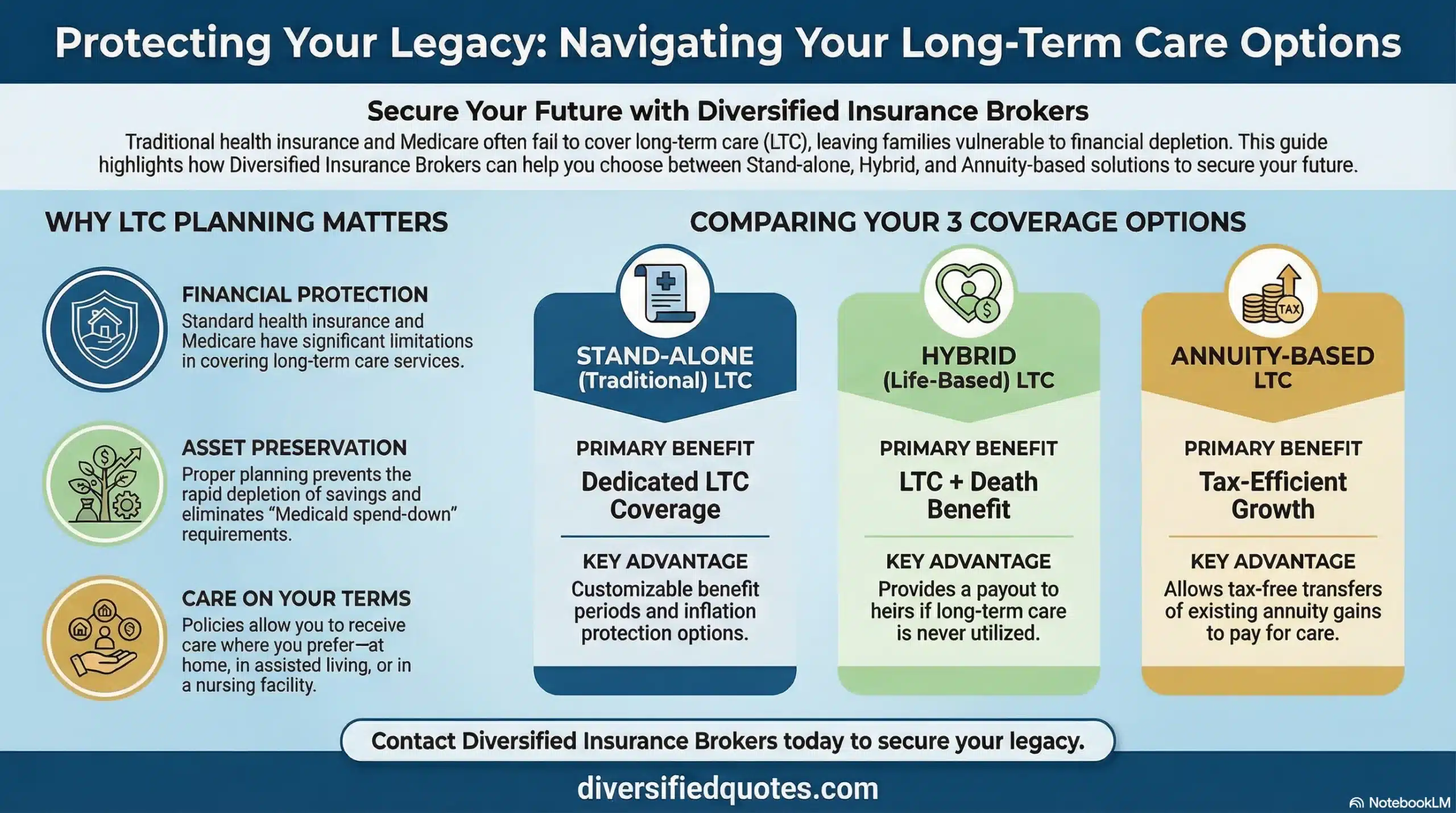
Financial Protection Essentials
Explore self-funding, annuity-based care options, and the estate planning decisions that pair with long-term care coverage.
Talk to an Advisor or Request Your Annuity Quote
Ready to explore this annuity in more detail—or compare it with other carriers to see if even higher rates are available? With guaranteed income, principal protection, and long-term growth potential on the line, making the right choice is essential. The experienced advisors at Diversified Insurance Brokers will guide you through the options and design a strategy tailored to your retirement goals.
Schedule here:
calendly.com/jason-dibcompanies/diversified-quotes
Licensed in all 50 states • Fiduciary, family-owned since 1980
Frequently Asked Questions
What kind of policy is Brighthouse SmartCare?
Brighthouse SmartCare is an indexed universal life insurance policy with long-term care riders, often called a hybrid or linked-benefit policy. It pays a death benefit to your beneficiaries, can build cash value, and can pay monthly cash benefits if you need qualified long-term care. Our overview of hybrid long-term care insurance explains how this category works.
What happens to my money if I never need long-term care?
If you never use the long-term care benefits, your beneficiaries receive the death benefit, and you can access cash value through policy loans or surrender the policy for its cash surrender value. Optional Return of Premium riders can set a floor of at least 75% of premiums on surrender or at least 100% of premiums at death, reduced by loans and long-term care payments. Our guide on whether long-term care insurance is worth the cost covers how to weigh that trade-off.
How long can SmartCare pay long-term care benefits?
The Long-Term Care Acceleration of Death Benefit Rider can accelerate up to 98% of the face amount over the first two years of a claim, and the Extension of Benefits Rider can add two or four more years, for a total of four or six years when the maximum benefit is elected. Your maximum lifetime benefit is set when you file your first claim. Our guide to how much long-term care insurance you need helps match the benefit period to your plans.
Can SmartCare pay a family member who provides my care?
Yes, for home health care. SmartCare pays on a cash indemnity basis, so once you qualify and satisfy the 90-day elimination period, it pays the available monthly benefit without requiring receipts, and Brighthouse states that home health care can be provided by unskilled individuals, including family members. The insured must still meet the benefit eligibility requirements and have a plan of care in place.
Are SmartCare long-term care benefits taxable?
The long-term care riders are intended to be qualified long-term care insurance under Internal Revenue Code Section 7702B(b), so benefits are generally intended to be income tax free. Benefits may be taxable in certain circumstances, such as when total payments from all your long-term care policies and riders exceed the federal per diem limit. See our overview of whether long-term care benefits are taxable, and confirm your situation with a tax professional.
Doesn’t Medicare cover long-term care?
No. Medicare generally covers short-term medical or rehabilitative care after a hospital stay or other medical event, not ongoing custodial care such as help with bathing, dressing, or supervision for cognitive impairment. That custodial care is what most long-term care consists of. Our guide to what Medicare covers for long-term care explains the gap in detail.
Can I buy SmartCare in my sixties or seventies?
Brighthouse Simple Underwriting is available for applicants ages 40 to 75 who choose a face amount up to $1 million. Applicants ages 66 to 75 should expect medical records and a cognitive screening as part of the process, and approval is not guaranteed at any age. Our guide on getting LTC insurance after age 60 covers the options available later in life.
Is it hard to qualify for SmartCare?
For applicants ages 40 to 65, Simple Underwriting generally requires no labs or exams unless there is no evidence of medical care, medical records only for significant conditions, and no interview, with an initial decision generally within 24 hours of receiving completed requirements. Underwriting still applies to both the policy and the riders, and approval is not guaranteed. Our guide to LTC insurance with preexisting conditions explains how health history affects your options.
I already have a SmartCare illustration. Can your office review it?
Yes. Our office can review the design you were shown, including the LTC coverage option, the benefit duration, the premium schedule, the Return of Premium riders, and the index assumptions, and compare it with other hybrid and traditional carriers on the same benefits. You can request a second opinion on your LTC quote before you apply.
About the Author:
Jason Stolz, CLTC, CRPC, DIA, CAA and Chief Underwriter at Diversified Insurance Brokers (NPN 20471358), is a senior insurance and retirement professional with more than 25 years of real-world experience helping individuals, families, and business owners protect their income, assets, and long-term financial stability. As a long-time partner of the nationally licensed independent agency Diversified Insurance Brokers, Jason provides trusted guidance across multiple specialties—including fixed and indexed annuities, long-term care planning, personal and business disability insurance, life insurance solutions, Group Health, Travel Medical and Evacuation Insurance, and short-term health coverage. Diversified Insurance Brokers maintains active contracts with over 100 highly rated insurance carriers, ensuring clients have access to a broad and competitive marketplace.
His practical, education-first approach has earned recognition in publications such as VoyageATL, and contributions from his agency featured in Kiplinger and GoBankingRates— highlighting his commitment to financial clarity and client-focused planning. Drawing on deep product knowledge and years of hands-on field experience, Jason helps clients evaluate carriers, compare strategies, and build retirement and protection plans that are both secure and cost-efficient. Visitors who want to explore current annuity rates and compare options across multiple insurers can also use this annuity quote and comparison tool.
Explore More Long Term Care Insurance Options: Browse our complete guide to Hybrid & Annuity LTC Policies — covering hybrid life insurance, annuities with LTC benefits & linked benefit policies from top carriers.
Last Reviewed: September 29, 2026 |
Reviewed by: Jason Stolz, CLTC, CRPC, DIA, CAA
Chief Underwriter, Diversified Insurance Brokers, Inc. | NPN: 20471358 | Diversified Insurance Brokers, Inc. — Licensed in all 50 states
Fact Checked by: Tonia Pettitt, CMIP©
Medicare Specialist, Diversified Insurance Brokers, Inc. | NPN: 14374308 | Diversified Insurance Brokers, Inc. — Licensed in all 50 states
Did you find this content helpful? Leave us a Google review — it helps others find trustworthy guidance too.
Editorial Standards: Diversified Insurance Brokers maintains rigorous editorial standards to ensure accuracy, clarity, and independence in all content. Learn more about our editorial standards and commitment to transparency.
