
Thrivent Financial Long Term Care Insurance
As an Independent Long Term Care Insurance Broker, we compare traditional, hybrid, and partnership-qualified policies across dozens of carriers to find the structure that actually fits your situation.
Thrivent Financial Long Term Care Insurance
Thrivent’s Long-Term Care Insurance policy is a federally tax-qualified, guaranteed renewable, dividend-eligible traditional LTC contract — and after reviewing it against the current field for this page, it’s one we’re comfortable recommending with real confidence. It covers the full range of qualified long-term care services: nursing home care, assisted living, adult day care, hospice, home health care, homemaker services, respite care, caregiver training, equipment and home modification, and international care. It’s currently available in every state except New York.

Thrivent has paid out more than $300 million in long-term care claims in a single recent year alone, across more than 100,000 LTC policies currently in force, backed by an A++ (Superior) rating from AM Best — its highest possible rating category. That combination of claims-paying track record and top-tier financial strength is genuinely the most important fact to understand before evaluating this policy against anything else on the market. Everything else on this page — the benefit design, the riders, the pricing — sits on top of that foundation.
Jason Stolz, CLTC, CRPC, DIA, CAA, is Chief Underwriter at Diversified Insurance Brokers, and Thrivent’s Long-Term Care Insurance is one our office places regularly for clients who want a traditional, health-underwritten LTC contract from a top-rated carrier. As an independent broker representing Thrivent alongside more than one hundred other carriers, our office can walk through exactly how this policy compares to the rest of the traditional LTC market and help you determine whether it’s genuinely the strongest fit for your situation, rather than assuming one well-known carrier is automatically the right answer.
Considering long-term care coverage and want the real numbers for your age and state?
Request Your LTC Quote
What follows is a full breakdown of how the contract actually works — underwriting, benefit design, riders, exclusions, and, since pricing is usually the first question anyone asks, real illustrative cost scenarios pulled directly from carrier-published pricing data. If long-term care planning is new territory for you, our long-term care insurance overview is a good place to start before diving into the specifics of any one carrier’s contract.
Ready to See Your Numbers?
Get a personalized illustration for Thrivent’s Long-Term Care Insurance based on your actual age, state, and health class.
Request Your LTC QuoteProduct Highlights
| Feature | Details |
|---|---|
| Product Type | Tax-qualified, reimbursement-based traditional long-term care insurance |
| State Availability | Available in every state except New York |
| Issue Ages | 18–79 |
| Underwriting Classes | Preferred, Standard, Class 1 (125% of Standard), Class 2 (150% of Standard); gender-distinct pricing in most states |
| Payment Options | Lifetime Pay or 10-Pay (10 annual payments regardless of billing frequency) |
| Monthly Benefit Range | $1,500–$15,000, in $100 increments |
| Benefit Periods | 24, 36, 48, 60, or 96 months |
| Elimination Periods | 30, 90, or 180 days (one day of care in a week credits the full week) |
| Rate Guarantee | 5 years from issue on both payment options (not available in Florida) |
| Dividends | Yes — not guaranteed, applied to reduce premium only |
| Partnership Eligible | Yes, subject to state-specific requirements |
| Right to Cancel | 30-day free look period |
Who Qualifies, and How Underwriting Class Sets Your Price
Issue ages run 18 to 79, and applicants are placed into one of four risk classes: Preferred, Standard, Class 1 (125% of Standard premium), or Class 2 (150% of Standard premium). Pricing is gender-distinct in most states — a structural fact worth understanding since it means a man and woman of the same age and health class won’t see identical premiums. Getting placed correctly matters more on a health-rated product like this than it does on guaranteed-issue long-term care coverage, since your underwriting class is what actually determines your rate for the life of the policy. If you’re wondering what it generally takes to qualify for long-term care insurance, or whether a medical exam is part of the process, those are exactly the kinds of questions worth walking through with us before you apply — the honest answer depends on your specific health history, and we’d rather tell you where you’re likely to land before you go through underwriting than after.
Benefit Amounts and How the Available Benefit Pool Works
You select a Monthly Benefit Amount anywhere from $1,500 to $15,000, in $100 increments, and a Benefit Multiplier of 24, 36, 48, 60, or 96 months — a meaningfully longer maximum than most traditional carriers currently offer, and one of the more useful things about this particular product. Your Available Benefit, the total pool of money the policy will pay out over your lifetime for qualified care, is simply your Monthly Benefit Amount multiplied by your Benefit Multiplier. That pool grows if you elect a benefit increase option, and shrinks as covered expenses are reimbursed. Benefits pay on a reimbursement basis, up to your maximum monthly benefit, until the pool is exhausted. If you’re trying to figure out what multiplier and monthly amount actually make sense for your situation, understanding how a benefit period actually functions is the right starting point before you pick numbers.
To actually qualify for benefits, you need to be certified as chronically ill — either through a physical impairment expected to last at least 90 days that prevents you from performing at least two of six activities of daily living without substantial assistance (bathing, continence, dressing, eating, transferring, and toileting), or through a cognitive impairment comparable to Alzheimer’s disease or a similar irreversible dementia, measured by clinical evidence and standardized testing, that requires continual supervision. Once you satisfy your elimination period — 30, 90, or 180 days, with one day of service in a week crediting the full week — benefits begin. Understanding exactly how elimination periods are satisfied matters more than most applicants realize, since it directly affects how quickly a claim actually starts paying.
Waiver of Premium, Alternate Care, and Bed Reservation
Once you’re receiving qualified long-term care services and your elimination period is satisfied, premiums are waived automatically for as long as you continue to meet the definition of benefit-eligible — this is built into the base contract, not an optional add-on, and ancillary benefits alone don’t trigger it. If you’ve elected the Shared Care Benefit rider, a double waiver of premium applies, meaning both insureds’ premiums are waived even if only one of you is actually receiving benefits. An Alternate Care provision is also included, which helps ensure access to emerging care services that aren’t specifically identified in the contract today but may develop over time — a meaningful detail given how much the delivery of long-term care has changed even in the last decade. A Bed Reservation benefit allows up to 60 days per calendar year to hold your spot in a facility during a temporary absence, such as a hospital stay, without losing your place or your coverage continuity.
Optional Riders Worth Understanding
Several riders can be added at issue to customize the contract. Benefit Increase Options let you keep pace with rising care costs: a Flexible Increase Benefit at a flat 5% compounded annually, or an Annual Increase Benefit at 1%, 2%, 3%, or 5% compounded annually, depending on how aggressively you want your benefit pool to grow over time. A Cash Benefit rider is also available, paying an additional cash benefit on top of the standard monthly reimbursement once you’re receiving care — the exact percentage add-on depends on your current rate sheet, so ask us for the specifics for your state and age before assuming a number.
A Non-forfeiture Benefit rider preserves some paid-up coverage if you ever lapse the policy after paying premiums for a period of time, rather than losing everything. Return of Premium Upon Death returns a portion of premiums paid if you pass away without having used the benefit (this rider isn’t available if you’ve also elected Shared Care). The Shared Care Benefit rider lets spouses or partners pool their two benefit amounts into a single shared reservoir, so one partner needing extended care can draw on both policies’ benefit pools rather than being capped at their own individually — genuinely one of the more valuable riders available on a traditional LTC contract when you’re insuring a couple, and something we’d encourage most couples to at least seriously evaluate given how shared spousal LTC benefits actually work in practice. A Survivorship Benefit rider (not available alongside 10-Pay or the Flexible Increase Benefit rider) can waive the surviving spouse’s future premiums after the first spouse dies, provided both had coverage in force for a specified period. Finally, a Waiver of Elimination Period rider is available for Home Care and Adult Day Care specifically (in California, this is styled as a Waiver of Elimination Period for Home and Community-Based Care), letting benefits for those specific care settings begin without first satisfying the standard elimination period.
Couples Discounts
Two discount tiers are available for couples and partners. A 20% discount applies when both individuals apply and are approved for coverage, or when one individual already holds existing coverage issued by Thrivent Financial, AAL, or LB and the other is newly applying. A 5% discount applies when both apply but only one is approved, or when only one individual applies in the first place. Montana runs a different structure, with 25% and 10% discount tiers instead. All discounts are subject to the eligibility rules in Thrivent’s Field Resource Guide, so confirm your exact scenario with us before assuming which tier applies.
International Coverage That Actually Goes Somewhere
This is a feature that gets glossed over on a lot of LTC comparisons, and it shouldn’t be: the policy includes an International Care Benefit paying up to two times your monthly benefit as a lifetime limit for nursing home, assisted living, adult day care, hospice, and home health care received outside the United States. There’s no restriction on which countries qualify, aside from sanctioned countries or territories. If travel or eventual relocation abroad is part of your retirement picture at all, that’s worth knowing about now — you can read more on how long-term care coverage applies when you’re overseas generally, since most traditional LTC contracts handle this very differently, and some don’t address it at all.
Ancillary Benefits and Home Modification Coverage
Beyond the core benefit, the contract includes respite care paying up to two times your current monthly benefit per calendar year — coverage designed to give a family caregiver a break without burning through the primary benefit pool. Equipment and home modification coverage also pays up to two times your maximum monthly benefit for eligible items and changes: therapeutic equipment like hospital beds, wheelchairs, crutches, or walkers; safety-related equipment including medical alert systems; home safety checks; accessibility changes such as ramps, chairlifts, or bathroom and kitchen alterations to accommodate a wheelchair; and safety modifications like grab bars or railings. Caregiver training is included as well, which can matter enormously for a family member taking on informal caregiving duties without a clinical background.
If you hold more than one Thrivent contract or rider covering the same qualified expense, Coordination of Coverage rules apply — the earliest-issued contract pays first, and this contract’s payout is reduced by whatever another Thrivent contract already paid for that same expense, subject to state variations and Medicare non-duplication rules. It’s a detail that mostly matters if you’re layering multiple Thrivent products, and something to flag with us directly if that applies to you.
Competitive Pricing Scenarios: What This Coverage Actually Costs
Rather than talk in the abstract about whether traditional LTC coverage is “expensive,” here’s real premium data for a consistent, apples-to-apples underwriting scenario: a $4,500 monthly (or $150 daily) benefit, a 3-year benefit period, 3% compound inflation protection, a 90-day elimination period, the Waiver of Home Care Elimination Period rider, and Standard health class, priced as Lifetime Pay. The numbers below reflect this specific scenario in most states (ICC-compliant states) and are shown against Mutual of Omaha’s MutualCare Custom Solution for direct comparison, since that’s a policy we’re frequently asked to compare it against.
| Scenario | Age | Thrivent (Lifetime Premium) | Competitor B (Lifetime Premium) |
|---|---|---|---|
| Male, Married — 1 partner applying | 50 | $1,738 | $2,165 |
| 55 | $2,058 | $2,394 | |
| 60 | $2,333 | $2,732 | |
| 65 | $3,026 | $3,401 | |
| Female, Married — 1 partner applying | 50 | $2,927 | $3,548 |
| 55 | $3,425 | $3,993 | |
| 60 | $3,932 | $4,639 | |
| 65 | $5,132 | $5,687 | |
| Combined — Both Applying | 50M / 45F | $3,696 | $4,804 |
| 55M / 50F | $4,198 | $5,317 | |
| 60M / 55F | $4,849 | $6,017 | |
| 65M / 60F | $5,859 | $7,193 |
Figures shown are lifetime premium totals (Lifetime Pay) for the specific benefit design and assumptions described above, rounded to the nearest dollar, for illustration purposes only — they are not a quote. Combined-applicant figures reflect the couples discount. California and Florida pricing differs from the general scenario shown here, and National Guardian Life’s EssentialLTC pricing is also available for comparison in those two states. Your actual premium depends on your age, health class, state, and the specific benefit options you select — request a personalized illustration for exact numbers using the button above.
Two structural reasons this pricing tends to land where it does: benefit periods here top out at 96 months, well past what several competitors currently offer, and the underlying cost drivers behind LTC pricing generally reward that kind of longer benefit design with lower relative premium per dollar of coverage. If you want to see how far your budget can be stretched, getting your rate structured correctly from the start — the right underwriting class, elimination period, and inflation rider combination for your actual budget — makes a bigger difference than most people expect.
Financial Strength You Can Verify Yourself
Thrivent currently carries an A++ (Superior) rating from AM Best — the highest financial strength rating category AM Best issues — which we independently confirmed is current via Thrivent’s own announcement, not just a wholesaler’s sales sheet. Moody’s Investors Service separately rates Thrivent Aa2 (Excellent), one of the higher ratings in Moody’s own scale, and Thrivent has been named to the Fortune 500. On the claims side, Thrivent has paid out over $300 million in long-term care claims in a single recent year alone, across more than 100,000 LTC policies currently in force, with an average claim length of nearly 32 months — real numbers that back up the rating rather than just a marketing line. Ratings are opinions about claims-paying ability, not a guarantee, and they can change — always confirm the current rating directly with the rating agency before making a final decision.
You can also read Thrivent’s own description of its long-term care strategy directly at Thrivent’s official long-term care planning page, which is worth a look alongside everything above.
Tax Treatment
Because this is a federally tax-qualified contract, benefits received are generally received income tax-free, and premiums may be deductible subject to IRS age-based limits if you itemize and your total medical expenses exceed the applicable threshold — the specifics depend on your individual tax situation, so we’d point you toward a qualified tax advisor for the exact numbers that apply to you rather than guessing here. For a fuller walkthrough of how this works generally, see the tax advantages of long-term care insurance before you assume a specific deduction amount.
What’s Excluded
Like every LTC contract, this one has defined exclusions worth knowing upfront rather than discovering at claim time. The policy does not pay benefits for: charges billed by a doctor or for prescription drugs; services received outside the United States, its territories, and possessions, except as covered under the International Care Benefit described above; services necessitated by a suicide attempt or an intentionally self-inflicted injury; treatment for alcoholism or drug addiction; care provided by an immediate family member, unless that family member is a regular employee of a licensed facility or agency providing the care, the facility or agency itself receives payment for the service, and the family member has no ownership or financial interest in that facility or agency; or any expense for which benefits are payable under state or federal workers’ compensation, employer’s liability, or occupational disease law.
Reinstatement, Grace Period, and Coverage Continuity
You have a 60-day grace period to catch up on a premium that’s gone into default before coverage lapses. If the policy does lapse, reinstatement is available within 6 months under two paths: if you’re chronically ill at the time, you’ll need to provide proof of chronic illness and pay all back premiums due; if you’re not chronically ill, you’ll need to submit a reinstatement application and pay all back premiums due. Florida has one notable exception — reinstated coverage there only applies to a covered loss arising after the actual date of reinstatement, not retroactively.
Is This the Right LTC Policy for You?
This product tends to be the strongest fit for someone who wants a traditional, health-underwritten LTC contract from a top-rated carrier, values a genuinely long maximum benefit period (up to 96 months) over a shorter one, is insuring as a couple and wants access to Shared Care, or cares about meaningful international coverage most competitors don’t build in at all. It’s less of a fit if you can’t pass full underwriting and need a guaranteed-issue alternative instead, or if you’d rather combine life insurance and LTC into a single hybrid contract rather than carry a standalone policy. Either way, we’ll walk you through exactly where you land before you apply — not after.
Financial Protection Essentials
Explore how long-term care planning fits alongside self-funding, estate planning, and the rest of your broader coverage picture.
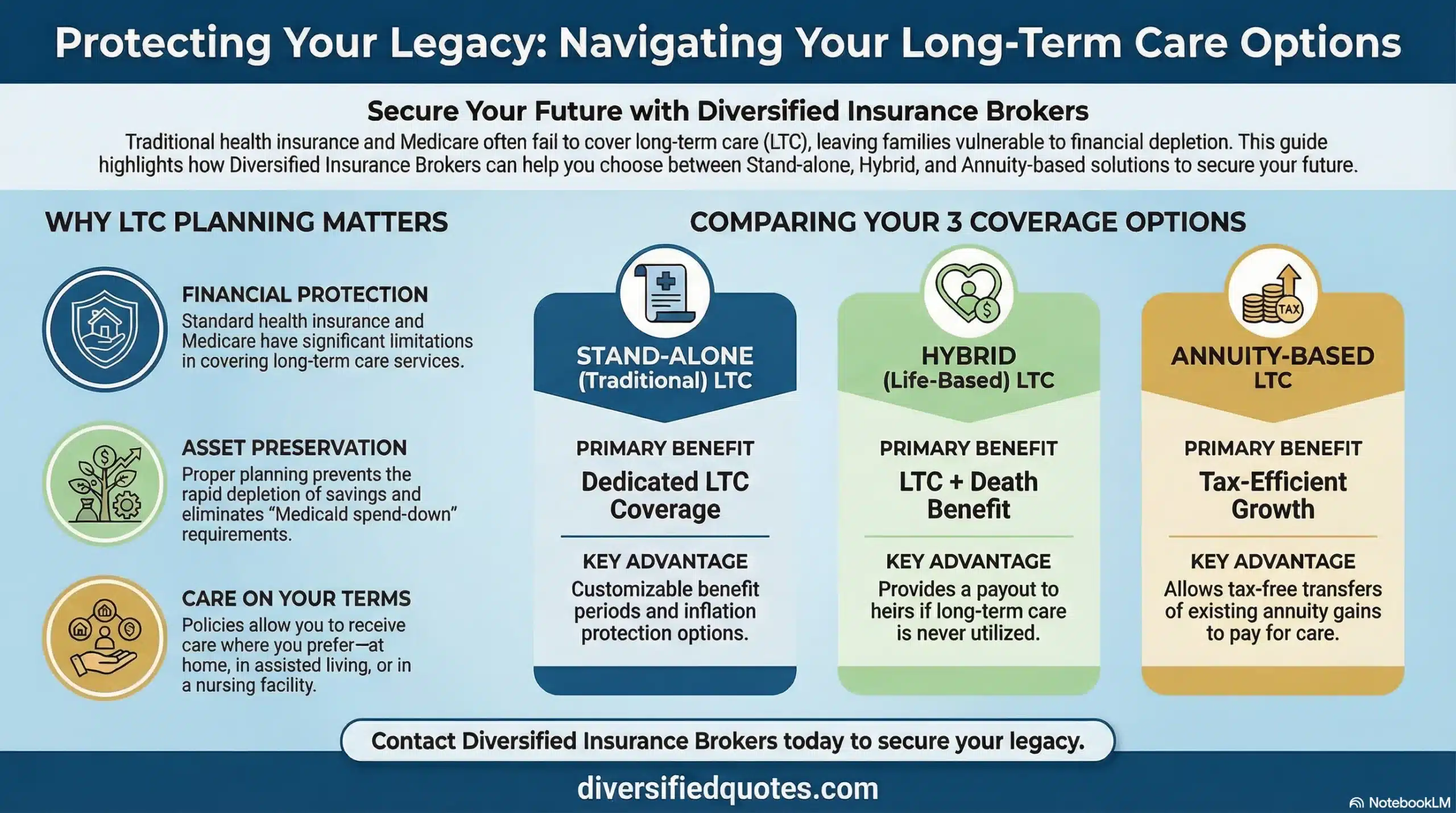
Talk to an Advisor or Request Your Annuity Quote
Ready to explore this annuity in more detail—or compare it with other carriers to see if even higher rates are available? With guaranteed income, principal protection, and long-term growth potential on the line, making the right choice is essential. The experienced advisors at Diversified Insurance Brokers will guide you through the options and design a strategy tailored to your retirement goals.
Schedule here:
calendly.com/jason-dibcompanies/diversified-quotes
Licensed in all 50 states • Fiduciary, family-owned since 1980
Frequently Asked Questions
Is Thrivent’s long-term care insurance expensive compared to other carriers?
It depends heavily on your age, health class, and the benefit design you choose, but in the illustrative scenarios above, Thrivent priced meaningfully lower than a leading competitor at every age and gender combination shown. Whether that holds for your specific situation is a fair question — what actually drives LTC insurance cost up or down is worth understanding before comparing quotes.
How much long-term care coverage do I actually need?
This depends on your local cost of care, how much you’re comfortable self-funding versus insuring, and whether you’re planning around a spouse’s coverage too. We walk through how to size your coverage correctly as part of every quote request rather than defaulting you into a generic benefit amount.
I’m over 60 — can I still get approved for this policy?
Yes, issue ages run all the way to 79, so being over 60 doesn’t rule you out. Your underwriting class and premium will reflect your current health and age at application, and it’s still worth understanding what changes about qualifying after 60 before you apply, since underwriting does get more detailed at older ages.
My spouse and I are both applying — does that change anything?
Yes, in two ways: you’re eligible for a couples discount (20% if both are approved, 5% if only one is), and you can add the Shared Care Benefit rider so you’re drawing from one combined pool rather than two separate ones. It’s worth reading how LTC insurance works specifically for couples before deciding whether to apply together or separately.
Are the benefits I receive from this policy taxable?
Because this is a federally tax-qualified contract, benefits are generally received income tax-free, within IRS per-diem limits. Premiums may also be deductible depending on your age and how much you itemize. For the general rules, see how LTC benefits are typically taxed, and confirm your specific situation with a tax advisor.
Doesn’t Medicare already cover long-term care?
No, and this is one of the most common misconceptions we run into. Medicare covers only limited, short-term skilled nursing care under specific conditions — it does not pay for ongoing custodial care, which is what most long-term care actually is. See exactly what Medicare does and doesn’t cover for long-term care before assuming you’re protected.
How do I know if this is the right LTC policy for me specifically?
It comes down to your health (whether you’ll qualify for a good underwriting class), your budget, and what features matter most to you — benefit period length, international coverage, and shared care access are all real differentiators here. We can walk you through how to choose the right LTC policy for your specific circumstances rather than a one-size-fits-all recommendation.
What does “Partnership eligible” mean for this policy?
Partnership-qualified LTC policies allow you to protect a corresponding amount of personal assets from Medicaid spend-down requirements if you ever exhaust your policy’s benefits and need to apply for Medicaid, subject to your state’s specific Partnership program rules. Read more on how Partnership-qualified LTC coverage works to see whether it matters for your state and situation.
About the Author:
Jason Stolz, CLTC, CRPC, DIA, CAA and Chief Underwriter at Diversified Insurance Brokers (NPN 20471358), is a senior insurance and retirement professional with more than 25 years of real-world experience helping individuals, families, and business owners protect their income, assets, and long-term financial stability. As a long-time partner of the nationally licensed independent agency Diversified Insurance Brokers, Jason provides trusted guidance across multiple specialties—including fixed and indexed annuities, long-term care planning, personal and business disability insurance, life insurance solutions, Group Health, Travel Medical and Evacuation Insurance, and short-term health coverage. Diversified Insurance Brokers maintains active contracts with over 100 highly rated insurance carriers, ensuring clients have access to a broad and competitive marketplace.
His practical, education-first approach has earned recognition in publications such as VoyageATL, and contributions from his agency featured in Kiplinger and GoBankingRates— highlighting his commitment to financial clarity and client-focused planning. Drawing on deep product knowledge and years of hands-on field experience, Jason helps clients evaluate carriers, compare strategies, and build retirement and protection plans that are both secure and cost-efficient. Visitors who want to explore current annuity rates and compare options across multiple insurers can also use this annuity quote and comparison tool.
Explore More Long Term Care Insurance Options: Browse our complete guide to LTC Insurance Costs, Rates & Planning — covering how much it costs, best rates, calculators, planning strategies & is it worth it from top carriers.
Last Reviewed: September 24, 2026 |
Reviewed by: Jason Stolz, CLTC, CRPC, DIA, CAA
Chief Underwriter, Diversified Insurance Brokers, Inc. | NPN: 20471358 | Diversified Insurance Brokers, Inc. — Licensed in all 50 states
Fact Checked by: Tonia Pettitt, CMIP©
Medicare Specialist, Diversified Insurance Brokers, Inc. | NPN: 14374308 | Diversified Insurance Brokers, Inc. — Licensed in all 50 states
Did you find this content helpful? Leave us a Google review — it helps others find trustworthy guidance too.
Editorial Standards: Diversified Insurance Brokers maintains rigorous editorial standards to ensure accuracy, clarity, and independence in all content. Learn more about our editorial standards and commitment to transparency.
