
Is Thrivent a Good Insurance Company?
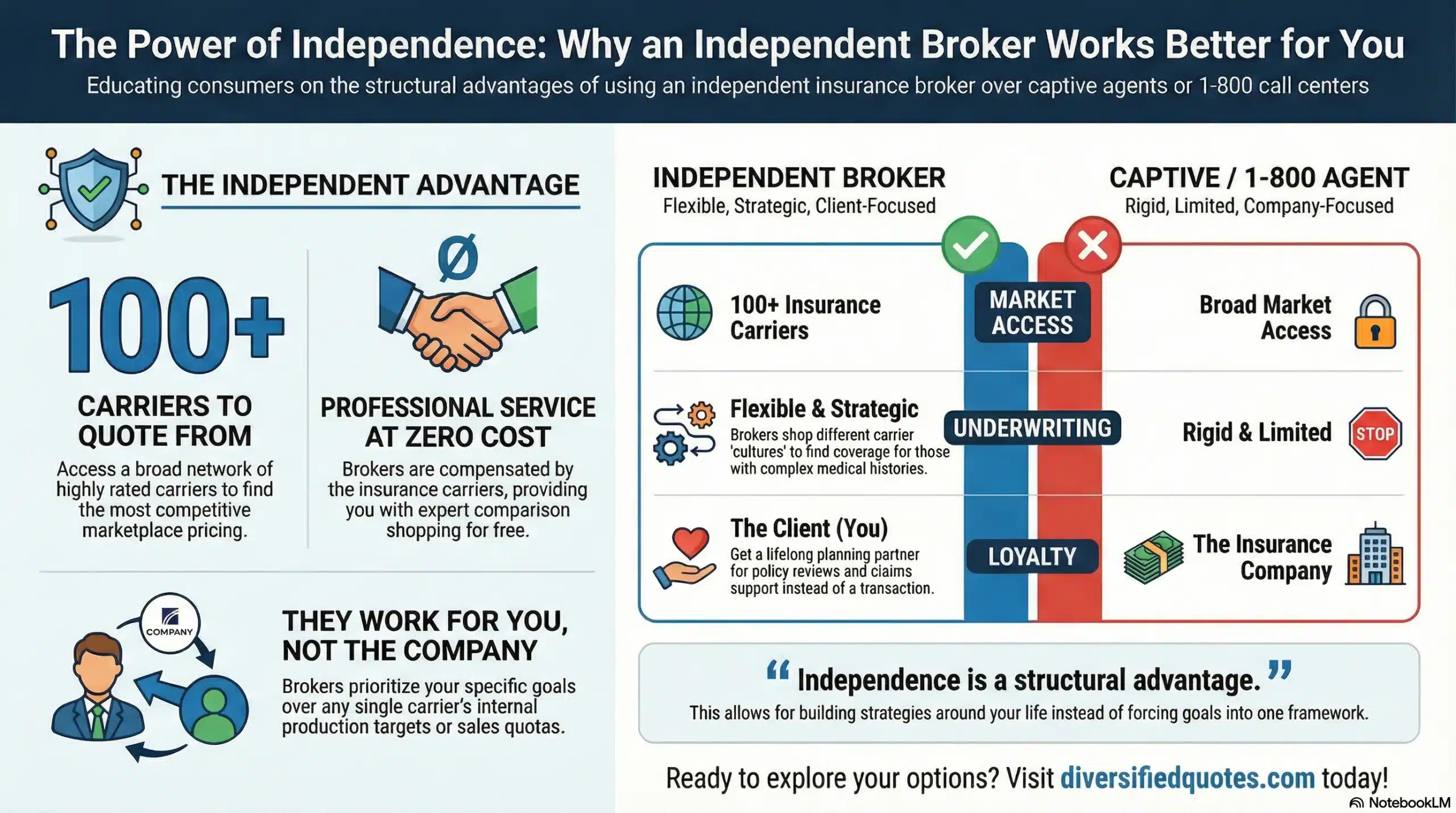
View the table near the end of the page to see why working with an independent insurance broker provides you the best possible rates.
Is Thrivent a Good Insurance Company?

Jason Stolz CLTC, CRPC, DIA, CAA
Thrivent is unlike any other carrier in this review series — not because of marketing language, but because of legal structure. Thrivent Financial for Lutherans is a fraternal benefit society, a category of organization defined under US tax and insurance law that is distinct from both stock insurers and traditional mutual companies. It is not-for-profit, member-owned, and operates with an explicit Christian values orientation embedded in its corporate identity, its charitable programs, and its membership eligibility requirement. That membership requirement — applicants must be Christian, or the spouse of a Christian, and sign a statement of faith at the time of purchase — is the defining eligibility filter that separates Thrivent from every other carrier evaluated here and makes it either irrelevant or exceptionally well-suited depending entirely on the buyer. For those who qualify, the financial credentials are at the absolute top of the US insurance market: With a Comdex composite score of 100 (Up from 99, which is also extremely high!), S&P AA+, Moody’s Aa2, $194 billion in assets, and a 2026 policyholder dividend of $590 million — the largest in company history — continuing an unbroken payout record stretching back to 1913. The NAIC complaint ratio stands at 17% of expected complaints — meaning Thrivent generates 83% fewer regulatory complaints than average for a company of its size, a figure that places it among the most operationally clean carriers in the market. Ethisphere has recognized Thrivent as one of the World’s Most Ethical Companies for 15 consecutive years. For qualifying buyers evaluating long-term care insurance specifically, Thrivent consistently ranks among the top one or two carriers in the independent LTC specialist market — offering traditional standalone LTC coverage with competitive pricing at the A++ level and a 20-plus-year record of rate stability. At Diversified Insurance Brokers, Jason Stolz, CLTC, CRPC, DIA, CAA, provides the Thrivent evaluation in full context: the financial strength case is genuinely exceptional, the eligibility gate is real and must be understood before any other analysis proceeds, and the captive-only distribution means that a Thrivent rate cannot be compared against the independent channel in a single broker conversation.
See Real-Term Rates Side by Side
Life Insurance Quoter
Ensure you are receiving the absolute top rates
Current Fixed Annuity Rates
Compare today’s best fixed annuity rates from top carriers.
Current Bonus Annuity Rates
See which annuities offer the highest upfront bonus today.
Request an Annuity Quote
Submit our annuity request form to get personalized rate options.
Lifetime Income Calculator
Use our calculator to see how much guaranteed income your annuity can provide.
Thrivent — At a Glance
| Evaluation Dimension | Thrivent Profile | What It Means for Buyers |
|---|---|---|
| Financial Strength | AM Best A++ (Superior) — affirmed November 10, 2025; stable; S&P AA+; Moody’s Aa2; Comdex 99; $194 billion assets; $17.8 billion adjusted surplus | Highest possible AM Best rating; among the five or six US insurers that hold A++ simultaneously with AA+ or better from S&P and Aa2 or better from Moody’s; balance sheet assessed as “strongest” by AM Best |
| Consumer Experience | NAIC complaint ratio: 17% of expected — 83% below industry average; Ethisphere World’s Most Ethical Companies: 15 consecutive years | Exceptionally clean operational record; regulatory complaints extremely rare relative to market size; ethics recognition reflects institutional culture, not just policyholder mechanics |
| Structure | Fraternal benefit society — not-for-profit, member-owned; Fortune 500 at #405; formed 2002 (AAL + Lutheran Brotherhood merger); roots to 1902; dual HQ Minneapolis, MN and Appleton, WI; ~2.5 million members | No shareholders — surplus flows to members as dividends and charitable programs; $590 million 2026 dividend (record); dividends paid since 1913; faith-mission embedded in corporate identity |
| Membership Requirement | Christian membership required — or spouse of a Christian; statement of faith signed at purchase; all Christian denominations eligible; membership is automatic upon product purchase | The eligibility gate that defines whether Thrivent is available to a given buyer; non-Christians cannot purchase insurance or annuity products; once a policy is issued, coverage is guaranteed regardless of future belief changes |
| Products | Term life; whole life (participating, dividends); universal life; IUL; disability income; long-term care insurance (traditional and hybrid); annuities (MYGA, FIA, immediate); IRAs; investments; Thrivent Bank; trust services | One of the most comprehensive product lineups among captive distributors; LTC is a genuine competitive strength; full retirement planning capability from accumulation through income |
| Distribution & Availability | Captive — Thrivent Financial Professionals only; rates not on public feeds; no independent broker access; not available in New York | Comparison shopping against independent channel carriers requires a separate broker engagement; New York residents need alternatives regardless of eligibility |
The Membership Requirement: The First Question to Answer
Before evaluating Thrivent’s financial strength, products, or pricing, the threshold question is whether you are eligible to purchase. Thrivent’s insurance and annuity products are available exclusively to members of the fraternal benefit society, and membership requires signing a statement of faith affirming that you are “a Christian, seeking to live out your faith, or the spouse of a Christian who seeks to live out his or her faith.” This requirement is not a formality — it is legally integral to Thrivent’s structure as a fraternal benefit society under US tax and insurance law, which requires a common bond among members. The practical eligibility scope is broad: Thrivent extended membership beyond Lutherans to all Christians in 2013, and the 2.5 million current members span Protestant, Catholic, Evangelical, and other Christian denominations. Non-Christians cannot purchase Thrivent insurance or annuity products, regardless of financial need or planning rationale. The eligibility barrier has no workaround, and buyers who do not meet the membership criteria should evaluate the independent channel carriers across this review series for equivalent financial strength options. For Christians evaluating coverage alongside a complete financial plan, our resources on beneficiary designation mistakes and how retirement accounts are taxed cover foundational planning that applies regardless of which carrier ultimately provides the insurance.
A++ Financial Strength: The Case for Thrivent Across Long-Duration Commitments
AM Best affirmed Thrivent’s A++ (Superior) rating with a stable outlook on November 10, 2025 — the same month State Farm’s P/C group was downgraded from A++ to A+. Thrivent’s press release quoted AM Best directly: balance sheet strength categorized as “strongest,” supported by strong operating performance, a favorable business profile, very strong enterprise risk management, high-quality statutory capital structure, and well-diversified investment portfolio. The Comdex composite score of 99 — placing Thrivent in the 99th percentile of all rated insurers globally — reflects the combined weight of the A++ from AM Best, AA+ from S&P, and Aa2 from Moody’s across the major rating agencies. The practical significance of A++ versus A+ matters most for long-duration commitments: a long-term care policy potentially claimed 20 years after purchase, a participating whole life policy designed to last to age 121, or an annuity whose income payments must continue for three decades. At those time horizons, the carrier’s financial permanence is not abstract — it is the mechanism behind every guarantee in the contract. Thrivent’s $17.8 billion in adjusted surplus and $194 billion in assets provide the capital infrastructure for those guarantees. For buyers who have previously seen the A++ tier only through Northwestern Mutual’s captive model, Thrivent represents a meaningful alternative that reaches the same financial strength ceiling with a different product breadth, different organizational mission, and a comparable captive distribution structure. Our resource on Is Northwestern Mutual a Good Insurance Company covers the comparison between the two A++ carriers in the captive distribution space.
Long-Term Care: Thrivent’s Most Distinctive Product Strength
Among the LTC insurance market’s remaining active carriers, Thrivent stands out in a specific and consistently documented way: independent LTC specialists who compare across all major carriers rank Thrivent’s traditional standalone LTC coverage in the top one or two positions — not occasionally, but as a persistent pattern. The combination of A++ financial strength, premiums that are often the lowest among A++-rated LTC carriers, and a 20-plus-year record of rate stability is genuinely unusual. Most LTC carriers that have remained in the market have imposed significant rate increases over the past decade as the industry grappled with lower-than-expected lapses and higher-than-expected claim costs. Thrivent’s rate stability record — 20-plus consecutive years without the major increases that have characterized competitors — reflects underwriting discipline and the financial depth to absorb reserve pressure without passing it to policyholders. The hybrid LTC product is also available, combining life insurance or annuity funding with LTC benefit access, though independent specialists note that the hybrid offering is less competitive relative to Thrivent’s traditional LTC strength. For buyers evaluating standalone traditional LTC as the primary protection tool, Thrivent’s carrier profile is one of the strongest cases in the market. Our resource on guaranteed issue long-term care insurance covers the LTC market for buyers who may not qualify for traditional underwriting, where Thrivent’s standard underwriting applies. For buyers evaluating the full spectrum of LTC planning approaches, our resource on whether Medicare and long-term care insurance are the same covers the foundational distinction that precedes any carrier selection conversation, and our resource on how to buy long-term care insurance provides the evaluation framework for moving from the foundational question to the specific carrier decision.
Life Insurance, Annuities, and the Full Product Lineup
Thrivent’s life insurance lineup covers term (10, 15, 20, and 30-year), participating whole life, universal life, and indexed universal life — a breadth that covers protection, accumulation, and estate planning objectives. The whole life products are participating, meaning policyholders share in surplus through non-guaranteed dividends backed by the 110-year dividend-paying history. The 2026 dividend of $590 million — 4% higher than 2025 and the largest in company history — continues a distribution pattern that benefits whole life policyholders who hold policies long enough for the accumulation to compound. For buyers evaluating whole life as a planning tool, our resource on how a whole life insurance policy works covers the dividend mechanics and cash value structure that apply to Thrivent and competing participating carriers. Thrivent’s annuity lineup — MYGAs, FIAs, and immediate annuities — is sound and backed by the A++ rating, but rates are not published on public aggregator feeds, which means a Thrivent MYGA or FIA quote cannot be compared against the independent market without a separate broker conversation. For buyers evaluating annuity income alongside Social Security timing, our resource on how Social Security and annuities work together covers the income sequencing decision that the full retirement picture requires. For buyers with non-qualified annuity assets evaluating tax treatment at distribution, our resource on non-qualified annuity taxation covers the exclusion ratio and income tax mechanics relevant to Thrivent and all other annuity contracts. On the disability income side, Thrivent offers DI coverage to members — relevant for buyers who want to consolidate life, LTC, and DI with a single carrier; our resource on disability insurance for the self-employed covers the DI evaluation context for business owners who represent a significant portion of Thrivent’s client base. For beneficiaries who inherit a Thrivent annuity, our resource on inherited non-qualified annuity covers the distribution rules and tax treatment they need to understand. For buyers comparing Thrivent’s income rider annuity designs against the independent FIA market, our resource on whether income riders have fees covers the cost structure mechanics that determine the true cost of guaranteed income across all carrier designs, including Thrivent’s.
Talk With an Advisor Today
Choose how you’d like to connect—call or message us, then book a time that works for you.
Schedule here:
calendly.com/jason-dibcompanies/diversified-quotes
Licensed in all 50 states • Fiduciary, family-owned since 1980
Frequently Asked Questions: Is Thrivent a Good Insurance Company?
Who is eligible to buy Thrivent life insurance or annuities?
Thrivent’s insurance and annuity products are available to members of the fraternal benefit society, and membership requires signing a statement of faith affirming Christian identity. Specifically, an applicant must be “a Christian, seeking to live out your faith, or the spouse of a Christian who seeks to live out his or her faith.” All Christian denominations are eligible — Protestant, Catholic, Evangelical, and others. The membership requirement applies at the time of purchase and is part of the application process. Membership is automatic upon purchasing a product, so there is no separate enrollment step. Thrivent originally required Lutheran affiliation, extended membership to all Christians in 2013, and has not broadened eligibility further. Non-Christians cannot purchase Thrivent insurance or annuity products regardless of other qualifications. Once a policy is issued, the coverage is a binding contract — the death benefit, cash value, and contractual guarantees are not affected by any future change in the policyholder’s personal beliefs. For buyers who do not meet the membership criteria, independent channel carriers across our review series — from Protective Life to Penn Mutual — provide comparable financial strength without eligibility restrictions.
What is Thrivent’s AM Best rating and how does it compare to other top carriers?
Thrivent holds AM Best A++ (Superior), affirmed November 10, 2025, with a stable outlook — the highest rating AM Best assigns. The accompanying S&P AA+ and Moody’s Aa2 ratings complete a multi-agency profile with a Comdex composite score of 99. Among US life insurers, fewer than a dozen carriers simultaneously hold A++ from AM Best and AA+ or better from S&P. The carriers at this tier include Northwestern Mutual (A++, AA+, Aaa), New York Life (A++, AA+, Aaa), MassMutual (A++, AA+, Aa3), Guardian Life (A++, AA+, Aa2), and TIAA (A++, AAA) — each a mutual or fraternal company with no external shareholders. AM Best described Thrivent’s balance sheet strength as “strongest,” citing high-quality statutory capital, a well-diversified investment portfolio, and very strong enterprise risk management as the supporting factors. At $194 billion in assets, Thrivent is smaller than Northwestern Mutual or New York Life but operates at a scale where the A++ credentials reflect genuine operational substance rather than size alone. For buyers evaluating LTC, life, or annuity products and prioritizing carrier financial strength above all other criteria, the A++ tier is as good as the US market provides — and Thrivent’s eligibility gate means the tier is accessible only to those who meet the membership requirement. Our resource on what an AM Best rating means covers how to interpret the A++ designation and what distinguishes it practically from A+ carriers.
Is Thrivent genuinely competitive for long-term care insurance?
Among the LTC insurance carriers that remain actively writing new business, Thrivent is consistently ranked in the top one or two positions by independent LTC specialists who compare across the full market. The case for Thrivent in LTC rests on three specific credentials: A++ financial strength — the highest available — providing maximum confidence that a policy purchased today will be backed by a financially sound carrier 20 or 30 years from now when a claim occurs; premiums that are often the lowest available among A++-rated LTC carriers, providing a rate advantage at the same financial strength tier; and a 20-plus-year record of rate stability that is unusually clean relative to the LTC industry’s history of significant rate increases. Most LTC carriers have imposed substantial premium increases over the past decade as the industry absorbed worse-than-expected claim experience. Thrivent’s 20-year record of rate stability suggests both underwriting discipline and the financial capacity to absorb reserve pressure without repeatedly passing increases to policyholders. The hybrid LTC product is available but is generally considered less competitively positioned than the traditional standalone offering. For buyers evaluating LTC planning, our resource on guaranteed issue long-term care insurance covers the LTC options for buyers who cannot qualify for traditional underwriting, and our resource on long-term care insurance after age 80 covers the market for buyers at the upper end of the underwriting window.
Can I compare Thrivent rates through an independent broker?
No. Thrivent distributes all insurance and annuity products exclusively through Thrivent Financial Professionals — captive advisors who represent only Thrivent products. Independent brokers, independent marketing organizations, and online comparison platforms do not have access to Thrivent products. Thrivent rates are not published on public aggregator feeds, which means a buyer cannot simultaneously see a Thrivent MYGA rate, a Protective MYGA rate, and a Sagicor MYGA rate in a single multi-carrier comparison. For buyers who want to verify that a Thrivent quote is competitive before committing — particularly for annuities and life insurance — the process requires two separate conversations: one with a Thrivent advisor to obtain the Thrivent illustration, and a parallel conversation with an independent broker to see what the independent channel offers for the same objective, age, health class, and premium. Our annuity rate comparison tools above provide the independent channel MYGA and FIA comparison. For life insurance comparison, our multi-carrier quoter handles the independent channel side. For LTC specifically, our LTC planning resource covers the full market context that makes a Thrivent LTC proposal meaningful to evaluate against alternatives. The additional step of running the parallel comparison is worth taking — Thrivent’s rates are often genuinely competitive, and verifying that through comparison confirms the choice rather than leaving it to assumption.
What makes Thrivent different from a traditional mutual life insurance company?
Thrivent is organized as a fraternal benefit society rather than a traditional mutual company, and the distinction carries meaningful practical differences. A mutual life insurance company — like Northwestern Mutual, MassMutual, or Guardian — is owned by its policyholders but has no religious eligibility requirement and no common bond requirement beyond holding a policy. A fraternal benefit society is organized around a common bond among members — in Thrivent’s case, Christian faith — and is required to maintain that bond as a condition of its legal structure. The fraternal structure gives Thrivent specific tax treatment under federal law and generates the charitable program architecture — Thrivent Choice (member-directed giving), Habitat for Humanity partnership, and other community engagement initiatives — that distributes $331 million in charitable activity annually. Because Thrivent operates not-for-profit and pays no dividends to external shareholders, the full surplus is available for policyholder dividends, capital building, and charitable programs. The $590 million 2026 dividend — 110 consecutive years of payouts since 1913 — reflects that structural alignment. For buyers comparing Thrivent against Northwestern Mutual as the two major captive-distribution A++ carriers, the practical differences are the membership requirement, the charitable mission integration, Thrivent’s broader geographic accessibility beyond the northeastern US, and a somewhat different product depth in LTC. Our resource on Is Northwestern Mutual a Good Insurance Company covers the head-to-head comparison between the two A++ captive carriers in full detail.
About the Author:
Jason Stolz, CLTC, CRPC, DIA, CAA and Chief Underwriter at Diversified Insurance Brokers (NPN 20471358), is a senior insurance and retirement professional with more than 25 years of real-world experience helping individuals, families, and business owners protect their income, assets, and long-term financial stability. As a long-time partner of the nationally licensed independent agency Diversified Insurance Brokers, Jason provides trusted guidance across multiple specialties—including fixed and indexed annuities, long-term care planning, personal and business disability insurance, life insurance solutions, Group Health, Travel Medical and Evacuation Insurance, and short-term health coverage. Diversified Insurance Brokers maintains active contracts with over 100 highly rated insurance carriers, ensuring clients have access to a broad and competitive marketplace.
His practical, education-first approach has earned recognition in publications such as VoyageATL, and contributions from his agency featured in Kiplinger and GoBankingRates— highlighting his commitment to financial clarity and client-focused planning. Drawing on deep product knowledge and years of hands-on field experience, Jason helps clients evaluate carriers, compare strategies, and build retirement and protection plans that are both secure and cost-efficient. Visitors who want to explore current annuity rates and compare options across multiple insurers can also use this annuity quote and comparison tool.
Review More Carrier Reviews: Browse our complete Life Insurance Company Reviews — covering Banner Life, Lincoln Financial, Protective, Transamerica, and more life insurance carriers.
Last Reviewed: September 30, 2026 |
Reviewed by: Jason Stolz, CLTC, CRPC, DIA, CAA
Chief Underwriter, Diversified Insurance Brokers, Inc. | NPN: 20471358 | Diversified Insurance Brokers, Inc. — Licensed in all 50 states
Fact Checked by: Tonia Pettitt, CMIP©
Medicare Specialist, Diversified Insurance Brokers, Inc. | NPN: 14374308 | Diversified Insurance Brokers, Inc. — Licensed in all 50 states
Did you find this content helpful? Leave us a Google review — it helps others find trustworthy guidance too.
Editorial Standards: Diversified Insurance Brokers maintains rigorous editorial standards to ensure accuracy, clarity, and independence in all content. Learn more about our editorial standards and commitment to transparency.
