
Is Long Term Care Insurance Expensive?
As an Independent Long Term Care Insurance Broker, we compare traditional, hybrid, and partnership-qualified policies across dozens of carriers to find the structure that actually fits your situation.
Is Long Term Care Insurance Expensive?

Jason Stolz CLTC, CRPC, DIA, CAA
Is long term care insurance expensive? The honest answer is: it depends entirely on when you buy, how you design the policy, and what you are comparing it against. Compared to the cost of doing nothing and self-funding long-term care when you need it — which can run $4,000 to $10,000 per month or more for facility care and several thousand per month for home care — a well-designed long-term care insurance policy is often one of the most financially efficient risk transfers available in retirement planning. Compared to the perception that any insurance premium is money you might “never use,” long term care insurance can feel expensive. The question that actually matters is whether the premium is reasonable relative to the risk being transferred — and for most families, the math on that comparison is more favorable to coverage than initial perception suggests.
At Diversified Insurance Brokers, we help clients navigate the full landscape of long-term care protection options — traditional LTC insurance, hybrid life + LTC policies, and asset-repositioning solutions like a non-qualified long-term care annuity. Our goal is to help clients understand what they are actually paying for, what makes premiums higher or lower, how to right-size coverage to avoid both over-insuring and under-insuring, and which type of solution best fits their health profile, financial situation, and planning priorities. This page covers all of those dimensions in depth.
See What Long-Term Care Coverage Would Cost for You
We’ll compare traditional, hybrid, and annuity-based options and show how benefit choices change the premium.
Questions? Call 800-533-5969
The Real Question Is Not “Is It Expensive?” — It’s “Expensive Compared to What?”
Long-term care insurance feels expensive when you compare it to paying nothing — which is what most people are doing today. It feels much less expensive when you compare it to what long-term care actually costs. The disconnect between perceived premium cost and actual care cost is one of the most persistent and consequential gaps in retirement financial planning, and closing it requires grounding the comparison in real numbers.
Home health aide care in the United States has a national median cost that runs over $5,000 per month for 44 hours per week. Memory care facilities frequently cost $6,000 to $10,000 per month or more in higher-cost metropolitan areas. Skilled nursing facility care typically runs $8,000 to $12,000 per month. These costs are not hypothetical worst-case scenarios — they are the actual price of care for the more than 10 million Americans currently receiving some form of long-term care services. A three-year care event at the average costs would represent $150,000 to $300,000 or more in out-of-pocket spending for a family that has not made any advance provision. A five-year care event — not unusual for cognitive decline — could represent $300,000 to $600,000 or more.
When you frame the premium against that backdrop, the annual cost of a well-designed LTC policy — often $2,000 to $5,000 per year for an individual in their 50s — looks fundamentally different than it does when compared to the zero alternative. The premium is not “money spent on insurance.” It is the cost of transferring a known risk category with potentially catastrophic financial consequences from the family’s balance sheet to an insurance carrier’s, in exchange for a defined future benefit if the risk materializes. That is a legitimate financial transaction with genuine value, and evaluating it requires comparing premium to potential benefit, not premium to nothing.
Why Long Term Care Insurance Is More Expensive Than People Expect
Long-term care insurance is priced higher than many people anticipate for several actuarial and structural reasons that are worth understanding — not because understanding them makes the premium feel better, but because understanding them helps you make better design choices that right-size the premium to what you actually need.
Long-term care claims last longer than most insurance claims. A health insurance claim for an emergency department visit lasts one evening. A life insurance claim is a one-time event. A long-term care claim can last months, years, or decades. When a policyholder develops moderate to severe Alzheimer’s disease, the claim may continue for five, seven, or even ten years at thousands of dollars per month. The actuarial probability and average cost of these multi-year claims is what the premium is covering, and the magnitude of potential benefit is substantially larger than most other personal insurance products.
Long-term care insurance has had significant claims experience that was not fully anticipated when early policies were priced. The traditional LTC market went through a difficult period when carriers discovered that policyholders were lapsing (cancelling policies) at lower rates than actuarial models predicted — meaning more policyholders kept their coverage and ultimately filed claims than initially expected. This experience drove many carriers to exit the traditional LTC market and caused significant premium increases for existing policyholders. The carrier that remains in the traditional LTC market today has incorporated those lessons into pricing, which means premiums are more sustainable but also higher than they might have been in the 1990s and early 2000s when optimistic initial pricing underestimated long-term claim costs.
LTC underwriting is selective in ways that affect who can buy at what price. Unlike term life insurance where many conditions are fully insurable with modest premium increases, long-term care underwriting specifically evaluates independence risk — mobility, balance, fall history, cognitive indicators, and chronic conditions that affect day-to-day functioning. Conditions that suggest elevated future claim risk can result in declined applications or higher-premium ratings that reflect the carrier’s assessment of the individual’s specific likelihood of needing care. Understanding the underwriting landscape before applying — particularly what conditions are most concerning to underwriters — is important for anyone evaluating LTC. Our guide to how to qualify for long-term care insurance covers the underwriting factors in detail.
The Five Levers That Determine Long Term Care Insurance Premium
Long-term care insurance premiums are not a single number — they are the result of five interacting design choices that are largely in the buyer’s control. Understanding each lever allows you to build a policy that fits your budget and risk tolerance rather than either overpaying for more coverage than you need or underpaying for coverage that fails when it matters most.
1. Age and timing of purchase. Age is the most fundamental premium driver, and it is also the lever that is most directly in the buyer’s control — by acting sooner rather than later. Premiums for equivalent coverage rise with age, typically meaningfully between each five-year age band. A 55-year-old buying the same policy as a 65-year-old will pay a lower annual premium for the same benefits, and will pay it for ten more years before needing care (statistically), which means the total premium accumulation is spread over a longer payment horizon. Waiting to buy LTC insurance is not financially neutral — every year of delay means higher premiums for whatever coverage you eventually purchase. The most financially efficient window for purchasing traditional LTC insurance is generally between ages 50 and 65, with earlier in that range typically producing better economics than later.
2. Health at time of application. LTC underwriting evaluates independence risk, and a cleaner health profile at application typically produces either standard rates or potentially preferred rates. Conditions that develop after purchase do not increase the premium and do not affect benefit availability, making the argument for applying while healthy particularly compelling. A back condition that develops at age 62 may limit LTC options or add premium at age 62 — but if the policy was already in place at age 58 with standard rates, the subsequent back condition is irrelevant to coverage. The value of applying while healthy is not just about premium — it is about preserving access to coverage at a time when you want it available rather than discovering at age 65 that underwriting has become complicated.
3. Monthly benefit amount. The monthly or daily benefit — how much the policy pays per day or month for covered care — is the most visible premium lever. Higher benefits cost more; lower benefits cost less. The strategic question is not “how much is enough to cover all possible costs?” but “how much is enough to cover the part of the care cost that would otherwise force asset liquidation or lifestyle disruption?” Many well-designed LTC plans are built around partial coverage — supplementing what the family’s income and liquid assets can absorb rather than covering 100% of projected care costs. A $3,000 per month benefit in a market where care costs $7,000 per month is not inadequate — it is a rational decision to cover $3,000 with insurance and self-fund $4,000, assuming the family has the assets to absorb the self-funded portion without catastrophic financial disruption. Right-sizing to the actual coverage gap rather than the total projected cost is one of the most effective ways to keep long-term care insurance premiums within budget.
4. Benefit period (or total pool). The benefit period — how long benefits can be paid — or its equivalent, a total benefit pool dollar amount, is the second major premium driver. A three-year benefit period is less expensive than a five-year period, which is less expensive than unlimited lifetime benefits. Statistics on long-term care duration suggest that the median care event is shorter than most people expect — often two to three years — but the tail risk is real and significant: a cognitive impairment event can extend for a decade or more, and it is precisely this tail risk that is most financially catastrophic for families who have not planned for it. Many policy designs balance premium with protection by using three-year individual benefit periods for each spouse combined with a shared care rider that allows one spouse to access the other’s unused benefits — creating effectively five or six years of total household protection at a lower premium than two independent five-year policies would cost. This shared benefits approach is one of the most cost-effective designs available for couples, and our guide to long-term care insurance with shared benefits explains how it works in detail.
5. Inflation protection. Inflation protection is the premium lever that most directly determines whether the policy will be adequate when care is actually needed, which may be 15 to 25 years in the future. Without inflation protection, a $4,000 per month benefit purchased today will still be $4,000 per month in 20 years, while care costs may have increased to $8,000, $10,000, or more. With compound inflation protection — typically 3% annual compound — the benefit grows each year, preserving purchasing power over the long deferral period between purchase and claim. Inflation protection adds meaningfully to the premium, but it addresses one of the most significant structural risks in long-term care planning: that coverage which looks adequate today will be inadequate at the time of a claim. The right choice between no inflation protection, simple inflation protection, and compound inflation protection depends on the buyer’s age, time horizon, and the extent to which the policy is intended to cover a large versus modest portion of projected care costs.
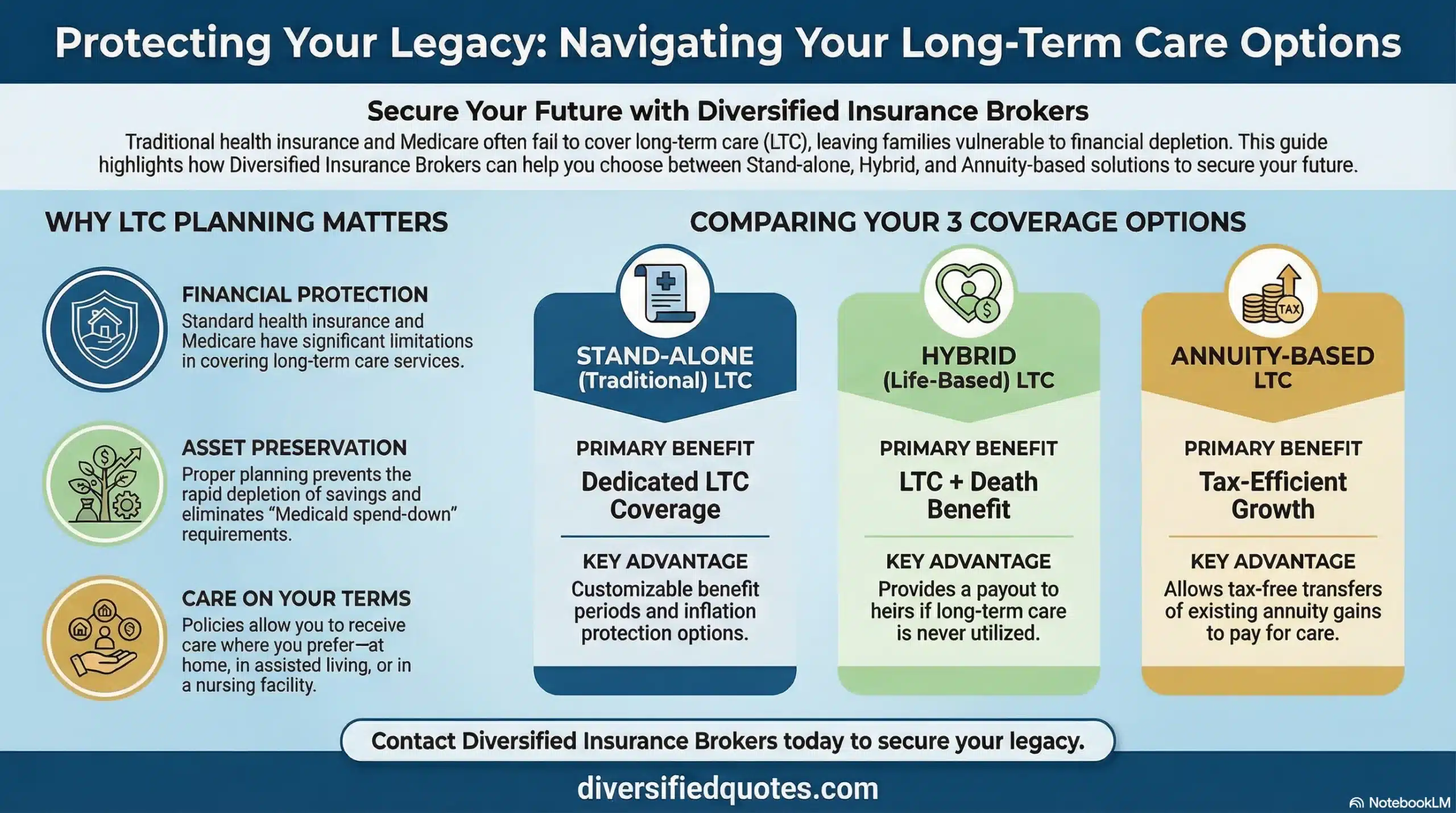
Traditional LTC vs. Hybrid vs. Annuity-Based: Different Cost Structures for Different Goals
One of the most important aspects of evaluating “is long term care insurance expensive?” is recognizing that there are multiple structures for obtaining long-term care protection, each with different cost logic and different value propositions. Comparing premium across structures without understanding the differences in what each one provides leads to comparisons that are structurally invalid.
Traditional long-term care insurance provides the most leverage — the highest benefit pool per premium dollar — for buyers who qualify. If the primary goal is maximizing care benefit per premium dollar and the buyer is willing to accept the “use it or lose it” structure (premiums paid may not produce any benefit if care is never needed), traditional LTC insurance is typically the most financially efficient option. The tradeoff is the possibility — acknowledged by most buyers but still psychologically challenging for some — that premiums are paid for decades and no claim is ever filed. Traditional LTC also carries the risk of future premium rate increases, which have occurred historically in some older policy blocks, though current pricing is more disciplined. For a full comparison, our guide to hybrid vs. traditional long-term care insurance provides a structured framework.
Hybrid life + LTC policies address the “use it or lose it” objection by combining a life insurance policy with an LTC benefit rider. If care is needed, the LTC benefit is paid. If care is never needed, a death benefit is paid to beneficiaries. If some LTC benefit is accessed, the remaining unused benefit continues as a death benefit. This structure eliminates the “money I’ll never see” concern and provides premium certainty — most hybrid policies have guaranteed premiums that cannot increase — in exchange for typically higher premium per dollar of LTC benefit than traditional insurance. Hybrid policies appeal to buyers who value premium stability, value-return features, and the assurance that the premium investment will produce a benefit for someone regardless of whether care is needed. For buyers who prefer not to fund LTC insurance purely on the possibility of a claim, hybrids address this preference at a cost that is higher per LTC benefit dollar but includes life insurance value in the package.
Annuity-based LTC solutions serve a different purpose than either traditional or hybrid LTC insurance — they are primarily an asset repositioning tool rather than a premium-for-benefit insurance mechanism. In an annuity-based LTC design, the buyer repositions existing assets (typically non-qualified money in low-yield accounts) into an annuity that creates a defined LTC benefit pool — often two to three times the premium — while also providing the annuity’s base value as a return of principal if LTC benefits are never needed. This approach appeals to buyers who have existing non-performing assets, who want to avoid the ongoing annual premium commitment of traditional or hybrid insurance, and who prefer a structure where the principal remains accessible or inheritable rather than being consumed by insurance premiums. The mechanics are explained in detail in our guide to non-qualified long-term care annuities.
Tax Advantages That Reduce the Net Cost of Long Term Care Insurance
Long-term care insurance has several favorable tax treatments that reduce the net premium cost for many buyers, and these tax benefits are often overlooked in the “is it expensive?” calculation. The most broadly applicable is the medical expense deduction for qualifying LTC premiums — for individuals who itemize deductions, age-based premium deductibility limits allow a portion of the annual LTC premium to be included in medical expenses, potentially generating an income tax deduction depending on the taxpayer’s total medical expenses relative to the AGI threshold. The eligible deductible amount increases with age and is indexed for inflation.
For self-employed individuals and business owners, the tax treatment is even more favorable. Self-employed individuals may be able to deduct qualifying LTC premiums as a self-employed health insurance deduction, providing above-the-line tax benefit regardless of itemization. C-corporations can deduct 100% of LTC premiums as a business expense for employee-shareholders when offered as a benefit. S-corporation shareholders and partnerships have intermediate rules that may still provide meaningful deductibility. The tax benefits of long-term care insurance and tax advantages of LTC and hybrid policies cover these treatments in detail, including the distinctions between qualified and non-qualified LTC policies and how each interacts with the tax code.
On the benefit side, qualified LTC insurance benefit payments — daily or monthly benefits up to IRS-defined amounts — are generally excludable from the recipient’s gross income, meaning the benefit received is not taxed as ordinary income in most cases. This tax-free benefit treatment applies to per-diem contracts up to the IRS daily benefit limit. When you combine the premium deduction (reducing the after-tax cost of the premium) with the tax-free nature of benefits received, the effective net cost of long-term care insurance is often meaningfully lower than the gross premium suggests — and the effective net benefit received in a claim is higher than a taxable income calculation would imply.
Does Medicare Cover Long-Term Care? Why Many Families Are Exposed Without Knowing It
One of the most significant reasons people underestimate the financial risk that long-term care insurance addresses is a persistent and consequential misunderstanding about Medicare. Many retirees believe — incorrectly — that Medicare provides substantial long-term care coverage. It does not. Medicare is a program designed for acute medical care and limited post-acute skilled care following a covered hospitalization, not for the extended custodial care that most long-term care needs involve.
Medicare’s skilled nursing facility benefit — which requires a qualifying hospital stay of at least three days before it activates — covers up to 100 days of skilled nursing care following a qualifying hospitalization. Days 1-20 are covered at 100% in 2025; days 21-100 require a significant daily copay; and coverage ends entirely after day 100. If care continues beyond day 100 — or if care begins without a qualifying hospital stay, as most home care and assisted living does — Medicare provides no coverage. Medicare does not cover custodial care, which includes assistance with activities of daily living (bathing, dressing, eating, toileting, transferring, and continence) that constitutes the bulk of what most people actually receive in long-term care settings. Our detailed resource on whether Medicare covers long-term care documents exactly where Medicare stops and where family financial exposure begins.
For retirees who believe Medicare will cover their long-term care needs, reviewing what Medicare actually covers and does not cover is an essential corrective step before deciding that long-term care insurance is too expensive. Many families find that once they understand the actual care coverage gap that Medicare leaves — meaning virtually all extended care needs — the question is not whether to address it but how. The choice between self-funding (liquidating retirement savings or real estate to pay for care), traditional LTC insurance, hybrid policies, annuity-based structures, or Medicaid planning is a legitimate planning decision. But it should be made with an accurate understanding of what Medicare provides, not under the misconception that Medicare will handle it.
How to Right-Size Long Term Care Coverage Without Overpaying
The most common design mistake in long-term care insurance is over-insuring — purchasing maximum benefit amounts, maximum benefit periods, and maximum inflation protection simply because these seem “safest,” without evaluating whether the premium for that combination is sustainable and whether the benefits match actual planning needs. A plan designed for maximum coverage may have premiums that feel manageable at purchase but become challenging to sustain over decades of fixed-income retirement. If a plan lapses because premiums are no longer affordable, the decades of premium payments produce no benefit — the worst possible outcome.
Right-sizing long-term care coverage means matching benefits to the actual financial gap rather than maximizing benefits in the abstract. The financial gap for most families is the difference between what long-term care costs and what the family’s income and liquid assets can absorb without catastrophic disruption. A family with substantial retirement income and liquid assets may need less insurance coverage because they can absorb more of the cost before insurance becomes critical. A family with more modest resources may need more coverage — and may also need to be more creative with the design to keep premiums within budget through tools like shared care for couples, longer elimination periods, or modest initial benefit amounts with inflation protection that builds the benefit over time.
The Long-Term Care Insurance Calculator allows you to test different benefit configurations in real time — adjusting monthly benefits, elimination periods, and inflation options to see how premiums change and where the best value point is for your specific situation. This tool, combined with a conversation with our LTC team who can compare carrier options and health-based pricing, produces a much more actionable and accurate picture than any general cost estimate.
For those evaluating whether the premium investment makes financial sense even if claims are never filed, is long-term care insurance worth the cost? provides a framework for the value analysis that goes beyond premium comparison to the full risk transfer calculus. And for those interested in partnership policies that coordinate with Medicaid planning to protect assets while keeping premiums efficient, our overview of Partnership-qualified long-term care insurance explains how these state-sponsored programs work and what they require.
Right-Size Your LTC Plan and Premium
We’ll test benefit amounts, elimination periods, and inflation options across carriers to find a plan you can keep long term.
Questions? Call 800-533-5969
Related Long-Term Care Reading
Deepen your understanding of value features, tax angles, shared benefits, and Partnership options.
Related Planning Pages
Helpful context for comparing solution types and understanding the Medicare coverage gap.
Talk With an Advisor Today
Choose how you’d like to connect—call or message us, then book a time that works for you.
Schedule here:
calendly.com/jason-dibcompanies/diversified-quotes
Licensed in all 50 states • Fiduciary, family-owned since 1980
FAQs: Is Long-Term Care Insurance Expensive?
Annual premiums for traditional long-term care insurance vary significantly based on age, health, benefit design, and the specific carrier — but as a general framework, individuals in their mid-50s purchasing a policy with a $3,000-$4,000 monthly benefit, a 90-day elimination period, a three-year benefit period, and 3% compound inflation protection often see premiums in the range of $2,000 to $3,500 per year. Couples purchasing simultaneously from the same carrier often receive a multi-life discount that meaningfully reduces the per-person cost. Premiums rise with age — individuals in their early 60s purchasing equivalent coverage often pay 30-60% more per year than those who purchased in their mid-50s. Richer benefit designs — higher monthly benefits, longer benefit periods, more comprehensive inflation protection — cost proportionately more.
These are general illustrations, not quotes — actual premiums depend on individual health underwriting, the specific carrier, the state of residence (which affects both premium levels and regulatory requirements), and the specific benefit configuration selected. The most useful way to understand what LTC coverage would actually cost in your specific situation is to request a comparison across carriers, which our advisors run using your age, health profile, and benefit priorities. The Long-Term Care Insurance Calculator also allows you to model premium estimates with different benefit configurations in real time, providing a useful starting point before a full carrier comparison.
The best age to buy long-term care insurance is earlier than most people act on — typically in the 50 to 60 age range, when health is generally favorable for underwriting, premiums are lower than they will be at older ages, and there is substantial time between purchase and the period when care is most statistically likely to be needed. Purchasing earlier than most people plan to has two compounding benefits: the annual premium is lower, and the premium is paid for more years before any potential claim, so the total accumulation of premiums is spread over a longer horizon. When combined with inflation protection that builds the benefit over time, early purchase means the policy has more time to grow its benefit to match escalating care costs.
Purchasing after age 65 is not impossible, but it becomes progressively more difficult from both an underwriting and a premium perspective. After age 65, the probability of having conditions that either disqualify the application or trigger higher-premium ratings increases meaningfully. After age 70, the carrier options narrow, premiums are substantially higher for equivalent coverage, and underwriting is significantly more selective. The most common regret expressed by families dealing with a long-term care event is that they knew they should have bought coverage earlier and did not. The second most common regret is that they thought about it and concluded they could wait “a few more years” — and then discovered at application that health changes had made it unavailable or unaffordable. Acting during the window when both health and premiums are most favorable is consistently the best financial decision for those who intend to protect against this risk.
Traditional long-term care insurance policies do not have level-premium guarantees — carriers can request rate increases on in-force policies with state insurance regulator approval. The traditional LTC market experienced significant rate increase activity in the 2000s and 2010s as earlier policy blocks were found to be underpriced relative to actual claims experience. Current carriers have incorporated these lessons into their pricing, making the risk of future increases on today’s policies lower than it was for older generation policies — but not zero. Rate increases on current policies are possible if the carrier’s claims experience deteriorates significantly from actuarial projections.
Hybrid life + LTC policies, by contrast, typically offer guaranteed premiums that cannot increase after issue — this premium certainty is one of the primary reasons many buyers prefer the hybrid structure despite its higher per-LTC-benefit cost. If premium stability is a paramount concern, a hybrid policy eliminates the rate increase risk entirely in exchange for the higher initial premium. For buyers who prefer traditional LTC insurance, understanding the carrier’s rate increase history and financial strength provides useful context for evaluating the risk of future increases, though past performance is not a guarantee of future behavior. Some traditional LTC policies also offer a “paid-up” option after a defined number of years, eliminating future premium obligations in exchange for a reduced benefit amount — which provides a middle path between continued premium exposure and full lapses.
Yes — qualifying long-term care insurance premiums may be tax-deductible under several provisions, though the applicability and extent of the deduction depend on individual circumstances. For individuals who itemize deductions, qualifying LTC premiums are deductible as medical expenses to the extent total medical expenses exceed 7.5% of adjusted gross income. The amount of premium eligible for inclusion as a medical expense is limited by age-based IRS caps that are adjusted annually — younger buyers can include a smaller amount, while older buyers can include more. Only premiums paid for qualified LTC insurance contracts — policies that meet specific IRS requirements for benefit triggers and other standards — are eligible for this treatment.
Self-employed individuals can deduct 100% of qualifying LTC premiums as a self-employed health insurance deduction, subject to the same age-based caps, without needing to itemize. This above-the-line deduction provides meaningful tax benefit for business owners and sole proprietors. C-corporations can deduct LTC premiums as a business expense when providing coverage for employees, and the premium is not considered taxable income to the employee — a favorable treatment that makes employer-sponsored LTC insurance particularly efficient for closely held corporations. The comprehensive breakdown of tax benefits of long-term care insurance covers these situations in detail and should be reviewed alongside a tax advisor who can confirm applicability to your specific situation.
For traditional long-term care insurance, premiums paid without a claim are not returned — the policy has no cash value or return-of-premium mechanism unless a specific return-of-premium rider was purchased at additional cost. This “use it or lose it” structure is the most significant psychological barrier for many potential buyers, and it is the primary motivation for considering hybrid or annuity-based alternatives. Traditional LTC is purchased for what it provides if a claim occurs, not for what it returns if one does not — similar to how auto insurance or homeowner’s insurance is purchased for protection against potential events, not as a savings vehicle. For many families, the risk being transferred is large enough and consequential enough that the “use it or lose it” structure is an acceptable trade-off for the premium efficiency that traditional LTC provides per dollar of potential benefit.
Hybrid life + LTC policies specifically address this concern by ensuring that the premium investment produces a benefit for someone regardless of whether care is needed. If care is needed, the LTC benefit is paid. If care is never needed and the insured passes away without having accessed the LTC benefit, a death benefit is paid to the named beneficiaries. If some LTC benefit is accessed, the remaining unused portion typically continues as a reduced death benefit. This “money for something” structure eliminates the psychological burden of the use-it-or-lose-it dynamic and makes the premium feel more like an asset repositioning than an insurance expense. Return-of-premium riders on some traditional LTC policies also address this concern by providing a lump sum return of premiums (often minus any claims paid) to beneficiaries upon the insured’s death. Our guide to long-term care insurance with return of premium explains how these features work and what they cost.
For most families who can qualify and afford the premium, long-term care insurance is worth the cost when evaluated against the alternative of self-funding the full risk of a multi-year care event. The “worth it” calculation is essentially a risk transfer analysis: how large is the potential financial liability the family faces from a long-term care event, what is the probability of experiencing such an event, and what is the annual premium to transfer some or all of that liability to an insurance carrier? When the potential liability is expressed in real numbers — $150,000 to $600,000 or more for moderate-duration care events — and compared against annual premiums in the $2,000 to $5,000 range for a buyer in their 50s, the leverage ratio is compelling in the scenarios where coverage is most needed.
The “worth it” question becomes more nuanced in several specific situations. For very high-net-worth families with substantial liquid assets who can comfortably self-fund any care event without threatening financial stability, the case for insurance is primarily about risk preference and lifestyle protection rather than financial necessity. For individuals in poor health who cannot qualify for coverage, the decision is made for them. For families who are choosing between using premium dollars for LTC insurance or for other financial priorities, the opportunity cost analysis depends on specific circumstances. The most useful resource for this evaluation is our dedicated page on whether long-term care insurance is worth the cost, which provides a structured framework for the analysis rather than a generic answer that cannot account for individual circumstances.
About the Author:
Jason Stolz, CLTC, CRPC, DIA, CAA and Chief Underwriter at Diversified Insurance Brokers (NPN 20471358), is a senior insurance and retirement professional with more than 25 years of real-world experience helping individuals, families, and business owners protect their income, assets, and long-term financial stability. As a long-time partner of the nationally licensed independent agency Diversified Insurance Brokers, Jason provides trusted guidance across multiple specialties—including fixed and indexed annuities, long-term care planning, personal and business disability insurance, life insurance solutions, Group Health, Travel Medical and Evacuation Insurance, and short-term health coverage. Diversified Insurance Brokers maintains active contracts with over 100 highly rated insurance carriers, ensuring clients have access to a broad and competitive marketplace.
His practical, education-first approach has earned recognition in publications such as VoyageATL, and contributions from his agency featured in Kiplinger and GoBankingRates— highlighting his commitment to financial clarity and client-focused planning. Drawing on deep product knowledge and years of hands-on field experience, Jason helps clients evaluate carriers, compare strategies, and build retirement and protection plans that are both secure and cost-efficient. Visitors who want to explore current annuity rates and compare options across multiple insurers can also use this annuity quote and comparison tool.
Explore More Long Term Care Insurance Options: Browse our complete guide to LTC Insurance Costs, Rates & Planning — covering how much it costs, best rates, calculators, planning strategies & is it worth it from top carriers.
Last Reviewed: June 13, 2026 |
Reviewed by: Jason Stolz, CLTC, CRPC, DIA, CAA
Chief Underwriter, Diversified Insurance Brokers, Inc. | NPN: 20471358 | Diversified Insurance Brokers, Inc. — Licensed in all 50 states
Fact Checked by: Tonia Pettitt, CMIP©
Medicare Specialist, Diversified Insurance Brokers, Inc. | NPN: 14374308 | Diversified Insurance Brokers, Inc. — Licensed in all 50 states
Did you find this content helpful? Leave us a Google review — it helps others find trustworthy guidance too.
Editorial Standards: Diversified Insurance Brokers maintains rigorous editorial standards to ensure accuracy, clarity, and independence in all content. Learn more about our editorial standards and commitment to transparency.
