
Mutual of Omaha MutualCare Long Term Care Insurance
As an Independent Long Term Care Insurance Broker, we compare traditional, hybrid, and partnership-qualified policies across dozens of carriers to find the structure that actually fits your situation.
Mutual of Omaha MutualCare Long Term Care Insurance
Most long-term care policies make a family wait through an elimination period and submit receipts before a single dollar is paid. Every Mutual of Omaha MutualCare policy includes a built-in Cash Benefit that works differently: it pays 25% of the home health care maximum monthly benefit, up to an initial maximum of $2,000 per month, in advance each month, with no elimination period to satisfy. That money can go toward any expense related to the insured’s care, from the first month a need arises. That single design choice, putting flexible money in a family’s hands at the moment the need for care first appears, is the most important thing to understand about MutualCare, and everything else on this page sits on top of it.

Jason Stolz, CLTC, CRPC, DIA, CAA, is Chief Underwriter at Diversified Insurance Brokers, and Mutual of Omaha’s MutualCare portfolio is one our office places regularly for clients who want a traditional long-term care policy they can shape around their own priorities. As an independent long-term care insurance broker representing Mutual of Omaha alongside more than one hundred other carriers, our office can walk you through the real differences between MutualCare Secure Solution and MutualCare Custom Solution and help you decide whether either one is the strongest fit for your situation, rather than assuming a familiar name is automatically the right answer.
Considering Mutual of Omaha long-term care coverage and want real numbers for your age and state?
Request Your LTC Quote
MutualCare Solutions at a Glance
| Feature | MutualCare Secure Solution | MutualCare Custom Solution |
|---|---|---|
| Issue Ages | 30 to 79 (30 to 75 in New York) | 30 to 79 (30 to 75 in New York) |
| How the Policy Limit Is Set | Benefit multiplier of 24, 36, or 48 months times the monthly benefit | Pool of dollars from $50,000 to $500,000 in $500 increments |
| Maximum Monthly Benefit | $1,500 to $15,000 in $1 increments; check local costs with our cost of care by state calculator | $1,500 to $15,000 in $50 increments, set at 1% to 4% of the policy limit |
| Elimination Period (Calendar Days) | 90, 180, or 365 days | 0, 30, 60, 90, 180, or 365 days |
| Built-In Cash Benefit | 25% of the home health care maximum monthly benefit, up to an initial $2,000 per month | 25% of the home health care maximum monthly benefit, up to an initial $2,000 per month |
| Home Health Care and Assisted Living | Your choice of 50%, 75%, or 100% of the maximum monthly benefit | Your choice of 50%, 75%, or 100% of the maximum monthly benefit |
| Inflation Protection | Lifetime 3%, 4%, or 5% compound; 20-year 3% or 5% compound; or none | 1% to 5% compound in 0.25% steps for lifetime, 20, 15, or 10 years, with a guaranteed buy-up option; or none |
| Partner Riders | Shared Care and Security Benefit | Shared Care, Security Benefit, Joint Waiver of Premium, and Survivorship |
| Return of Premium Options | Three times the initial monthly benefit, less claims | Three times the initial monthly benefit, full return at death, or return if death occurs before 65, each less claims |
| Partnership Qualified | Yes, based on state approval, age, and inflation option; see how LTC Partnership reciprocity works | Yes, based on state approval, age, and inflation option |
Two Policies, One Portfolio
MutualCare is not a single policy. It is a portfolio of two traditional, tax-qualified long-term care policies issued by Mutual of Omaha Insurance Company: MutualCare Secure Solution and MutualCare Custom Solution. Both reimburse the cost of qualified long-term care services in a nursing home, an assisted living facility, an adult day care center, or your own home, and both share the same core benefits, including the built-in Cash Benefit, waiver of premium, care coordination, hospice care, respite care, and an international benefit. Where they differ is in how much control you have over the design. You can read Mutual of Omaha’s own summary of the portfolio on its long-term care insurance plans page, and our long-term care insurance overview explains how traditional policies like these compare with hybrid designs.
Secure Solution is the simpler of the two. You pick a monthly benefit and a benefit multiplier of 24, 36, or 48 months, and the policy limit is the product of the two. Elimination period choices are limited to 90, 180, or 365 days, and the optional rider menu is shorter. It fits someone who wants a clean, traditional design, understands exactly what it pays, and does not want to make a dozen decisions to get there.
Custom Solution is built for people who want to shape the policy. Instead of a multiplier, you choose a pool of dollars anywhere from $50,000 to $500,000 in $500 increments, and a monthly benefit that falls between 1% and 4% of that pool. You get six elimination period choices, including zero days. Inflation protection can be tuned in quarter-percent steps with a choice of how long it lasts, and a guaranteed buy-up option lets you increase it later. Custom Solution also opens up riders that Secure Solution does not offer, including Joint Waiver of Premium, Survivorship, two additional return-of-premium options, and Professional Home Health Care. Those finer controls are especially useful when a client has a firm premium budget, because they make it possible to fit a meaningful benefit into a specific dollar amount rather than jumping between fixed benefit tiers.
Neither version is automatically better. Secure Solution rewards simplicity, and Custom Solution rewards precision. The right choice depends on how much you want to tailor the design and which riders matter to you, and our office illustrates both side by side whenever the choice is a close one.
Pool of Dollars vs. Benefit Multiplier
The biggest structural difference between the two policies is how the policy limit is built. On Secure Solution, the limit comes from a multiplier. A $5,000 monthly benefit with a 36-month multiplier creates a $180,000 policy limit. On Custom Solution, you choose the limit directly as a pool of dollars, and the monthly benefit must land between 1% and 4% of that pool. With a $300,000 pool, for example, the monthly benefit could be set anywhere from $3,000 to $15,000.
That 1% to 4% range matters more than it first appears. A low monthly benefit relative to the pool stretches coverage over a very long period, while a high monthly benefit relative to the pool pays more each month but exhausts the pool sooner. A $300,000 pool with a $3,000 monthly benefit would last 100 months if drawn at the maximum every month, while the same pool with a $7,500 monthly benefit would last 40 months. The policy limit is the total amount payable over the life of the policy, and every benefit paid reduces it, except care coordination and waiver of premium. If you add inflation protection, the remaining policy limit grows each year along with the monthly benefit.
Whether a pool or a multiplier fits better comes down to how you think about the risk. A multiplier is easy to picture as a number of months of full-time care. A pool is easier to budget against a total amount of savings you want to protect. Understanding how a benefit period actually works is the starting point, and because neither MutualCare policy offers unlimited lifetime benefits, it is also worth reading our comparison of limited versus lifetime LTC benefits before choosing a limit.
There are also limits on how much total coverage Mutual of Omaha will issue. Across all companies combined, an applicant’s traditional long-term care coverage cannot exceed a $15,000 maximum monthly benefit and a $500,000 maximum benefit limit. When traditional coverage and long-term care rider coverage on life insurance or annuities are counted together, the ceilings are a $50,000 monthly benefit and a $2,000,000 benefit limit. Our office reviews any existing coverage before illustrating, because those limits are based on current benefit amounts, not the amounts originally purchased.
The Built-In Cash Benefit
The Cash Benefit is included on both MutualCare policies at no extra charge, and it is designed to give a family room to explore care options when the need first arises. Instead of reimbursing specific bills, the policy pays a percentage of the home health care maximum monthly benefit in cash: 25%, up to an initial maximum of $2,000 per month. That cap can grow if inflation protection is added. The benefit is paid in advance each month, prorated on a 30-day month if you are eligible for only part of a month, and it can be used for any expense related to your long-term care needs.
The math is simple. With a $6,000 monthly home health care benefit, the Cash Benefit is $1,500 per month. With an $8,000 monthly benefit, it reaches the $2,000 initial cap, and any monthly benefit above $8,000 still produces $2,000 until inflation increases raise the cap. There is no elimination period for the Cash Benefit, and premiums are waived while you receive it, which means both the income and the premium relief begin right away.
The trade-offs are important, and Jason and our office walk through them before any application is submitted. While you are receiving the Cash Benefit, no other policy benefits are payable, so you are choosing cash in place of reimbursement, not in addition to it. You can switch from cash to reimbursement at any time by notifying Mutual of Omaha in writing, but once the Cash Benefit stops, you must then satisfy the elimination period before reimbursement benefits begin, and days spent on the Cash Benefit do not count toward that elimination period. The Cash Benefit is also not available for care received outside the United States, its territories, Canada, or the United Kingdom.
In practice, the Cash Benefit works best early in a care event, when a family is still arranging informal help, paying a relative or neighbor, or covering the scattered costs that reimbursement does not reach. When formal, paid care becomes steady and expensive, switching to reimbursement usually pays far more. Planning that switch in advance, including when to start the elimination period clock, is one of the ways our office helps clients get full value from the policy.
Where Care Happens and What Each Setting Pays
Nursing home care pays up to 100% of the maximum monthly benefit. For assisted living and home health care, you choose the percentage at issue: 100%, 75%, or 50% of the maximum monthly benefit. Adult day care pays up to 100% of the monthly home health care benefit. Hospice care pays up to the maximum monthly benefit with no elimination period. Respite care pays for one month per calendar year with no elimination period, giving an unpaid family caregiver a break. The bed reservation benefit pays up to 100% of the maximum monthly benefit for up to 30 days per calendar year to hold your place in a nursing home or assisted living facility while you are away, most often during a hospital stay.
The percentage choice for home health care and assisted living is where many buyers unintentionally weaken their coverage. Choosing 50% or 75% lowers the premium, but it also means the policy pays only half or three-quarters of your monthly maximum in the settings where most people actually receive care. Most people say they want to receive care at home for as long as possible, and a policy that pays full benefits only in a nursing home works against that preference. Our overview of what in-home care services include is useful context. Our office generally recommends keeping home health care and assisted living at 100% and finding savings elsewhere in the design, such as the elimination period or the policy limit, unless a client has a specific reason to expect facility care.
Custom Solution also offers an optional Professional Home Health Care rider. When home health care is provided by a nurse or by a skilled professional in physical, respiratory, occupational, or speech therapy, audiology, nutrition, or chemotherapy administration, and the cost exceeds the home health care maximum monthly benefit in a given month, the rider pays up to an additional 100% of that home health care maximum. The additional money for nursing services is limited to 365 days over the life of the policy, and the rider cannot be dropped after issue. It is a niche rider, but for someone whose health history suggests skilled care at home is a realistic possibility, it can matter a great deal.
Not sure whether Secure Solution or Custom Solution fits you better? Let our office illustrate both.
Compare Both Designs
Care Coordination and Stay-at-Home Benefits
Both MutualCare policies include access to a care coordinator, a licensed health care professional, typically a registered nurse, who assesses the insured’s needs, develops an individualized plan of care, and helps arrange long-term care services. There is no elimination period for care coordination, so the insured has immediate access to a professional who can help a family make sense of its options. Using a care coordinator is not required, and care coordination services do not reduce the policy limit.
The reason to use one anyway is that several benefits are available only when care coordination is used. On the recommendation of a care coordinator, the policy pays up to two times the home health care maximum monthly benefit for stay-at-home services: caregiver training, durable medical equipment, home modifications, and a medical alert system. These are the changes that often make it possible to stay at home safely, such as a ramp, a stair lift, grab bars, or training for a spouse who is suddenly helping with transfers and bathing. Stay-at-home benefits, like other paid benefits, reduce the policy limit.
The Alternate Care Benefit also depends on care coordination. It covers qualified treatments or services that are not specifically listed in the policy when a care coordinator recommends them, which helps keep a policy relevant as care delivery changes over the decades a policy may be in force. It can also cover the services of an accredited Christian Science nurse in a recognized Christian Science nursing facility when the insured is eligible for Alternate Care benefits. Our guide to how LTC care coordination benefits work explains why this feature matters so much at claim time, when families are often making decisions under stress.
How the Calendar-Day Elimination Period Works
The elimination period is the waiting period between the start of a care need and the start of reimbursement benefits. MutualCare uses a calendar-day elimination period, which is one of the more favorable ways to count it. The clock starts on the first day you are chronically ill and receive a covered long-term care service. After that, every subsequent day you remain chronically ill counts toward the elimination period, even on days when you do not receive a paid service. The elimination period is cumulative, and it only has to be satisfied once during the life of the policy.
That counting method is a real advantage for people who begin care at home. Under a service-day elimination period, a 90-day wait means 90 days on which paid care was actually received, which can take many months for someone getting home care two or three days a week. Under MutualCare’s calendar-day method, 90 days means 90 calendar days once the clock starts. Our guide to how LTC elimination periods are satisfied covers the difference in more detail.
Secure Solution offers 90, 180, or 365 days. Custom Solution adds 0, 30, and 60 days. Ninety days is the default on both, and applicants placed in the Class I or Class II health categories are limited to 90, 180, or 365 days. A longer elimination period lowers the premium, but it also means covering more of the early cost of care yourself, so the right choice depends on how much liquid savings you could comfortably spend before benefits begin. An optional Waiver of Elimination Period for Home Health Care rider lets home health care and adult day care benefits begin without satisfying the elimination period at all, while those days still count toward the elimination period for facility care. That rider cannot be dropped after issue and is not available for Class I or Class II health risks.
Waiver of Premium and Joint Waiver of Premium
Waiver of premium is included on both policies. Once the elimination period has been satisfied, premiums stop on the date benefits are first paid for nursing home care, assisted living, or at least eight days of home health care or adult day care in any continuous 30-day period. Premiums are also waived while you receive the Cash Benefit. If you have already paid premium beyond the waiver start date, it is not refunded but is credited toward future premiums. When the waiver ends, premium payments must resume to keep the policy in force. Mutual of Omaha asks insureds to keep paying until they are notified that no further premium is due, which is a detail our office reminds clients about at claim time so a policy is never put at risk during a care event.
The eight-days-in-30 threshold for home care is worth noting. Someone receiving home care only a few days a month may be receiving benefits without yet qualifying for the premium waiver, so the premium should stay budgeted during the early stages of a home care claim.
Custom Solution offers an optional Joint Waiver of Premium rider for partners. When one partner is on claim and his or her premium is being waived, the other partner’s premium is waived as well, for as long as the claiming partner’s waiver continues. Any premium increase after issue due to added coverage must be in effect for ten years before that increased amount is waived. Joint Waiver of Premium is not available with the Security Benefit or with the one-issued partner allowance, and it is not offered for Class I or Class II health risks.
Inflation Protection and the Buy-Up Option
Inflation protection is the rider that keeps a policy bought today relevant when a claim occurs twenty or thirty years from now. With it, the maximum monthly benefit and the remaining policy limit increase on each policy anniversary by the percentage you choose. Mutual of Omaha must offer every applicant the 5% compound lifetime option, and applicants who decline inflation protection must do so in writing on the application.
Secure Solution offers lifetime compound inflation at 3%, 4%, or 5%, or 20-year compound inflation at 3% or 5%. Custom Solution offers far more control: any compound rate from 1% to 5% in quarter-percent steps, lasting for the life of the policy or for 20, 15, or 10 years. Custom Solution also includes a guaranteed buy-up option. On or before each policy anniversary, the insured can elect in writing to increase the compound inflation percentage, up to a total of 5%, as long as the insured is not chronically ill and the election is made before the lesser of 20 years or age 75. The increase takes effect on the following anniversary, with benefit increases the anniversary after that. The premium for the buy-up is based on the insured’s age at the time of the buy-up, with a premium credit that reflects the type of coverage and how long the policy has been in force. The insured can also buy down to a lower percentage at any time and keep the inflation increases already applied.
The buy-up option is useful for younger buyers who want to start with a lower inflation rate and increase it when their income grows. One caution matters, though. Partnership qualification is determined by the inflation option in effect at issue, and it cannot be gained later by buying up. If Partnership asset protection matters to you, the inflation choice at issue must meet your state’s Partnership requirements for your age, which Jason confirms before an application is signed.
Partner Benefits: Shared Care, Security Benefit, and Survivorship
Mutual of Omaha defines a partner broadly. It includes legally married spouses, domestic or civil union partners, and adults in a serious, committed relationship intended to be lifelong who have shared a common residence for the most recent three years, are not married to or partnered with anyone else, and are not related in a way that would bar marriage. That broad definition opens partner allowances and partner riders to unmarried couples who qualify.
The Shared Care Benefit lets one partner access benefits under the other partner’s policy once his or her own benefits are exhausted and care is still needed, until a minimum of 12 times the current maximum monthly benefit remains in the other partner’s policy. If one partner dies while both policies are in force, the surviving partner receives the deceased partner’s remaining policy limit with no effect on the surviving partner’s premium, and if inflation protection was chosen, the combined amount continues to inflate. Both partners must apply at the same time and be issued identical policies. Shared Care is not available with the Security Benefit, the two return-of-premium options described below, or the one-issued partner allowance, and it is not offered for Class II health risks or when underwriting determines that either applicant presents greater than normal risk. For Class I risks, Secure Solution limits Shared Care to multipliers of 36 months or less and monthly benefits of $5,000 or less, while Custom Solution limits it to policy limits of $180,000 or less and monthly benefits of $5,000 or less. Our guide to how shared care riders work compares these designs across carriers.
The Security Benefit is one of the more distinctive riders in the market. It is designed for households where only one partner is insured. When the insured is receiving benefits and his or her partner is alive, the rider pays an additional 60% of the monthly reimbursement benefit, excluding any Cash Benefit, without reducing the policy limit. That money can help pay for care or living expenses for the uninsured partner, which addresses a real problem: when one spouse needs expensive care, the healthy spouse’s own finances often suffer most. The Security Benefit is available only with the one-issued partner allowance, and it is not offered for Class I or Class II health risks or for issue ages over 69. For a couple where one partner cannot qualify for coverage, it deserves a serious look.
The Survivorship Benefit, available on Custom Solution, makes the insured’s policy paid-up if his or her partner dies after the policy has been in force for ten years or more, so no further premium is due. Any premium increase after issue due to added coverage must be in effect for ten years before the increased amount is waived. Survivorship is not available with the Security Benefit or the one-issued partner allowance, and it is not offered for Class I or Class II health risks.
Return of Premium and Nonforfeiture Options
For buyers who dislike the idea of paying for coverage they may never use, MutualCare offers return-of-premium riders, each of which pays at death and subtracts any claims paid. Both policies offer a return equal to up to three times the maximum monthly benefit, minus claims paid, if the insured dies after the policy has been in force for ten years. For that rider, the monthly benefit used is the lesser of three times the initial or three times the current maximum monthly benefit, excluding inflation increases. Custom Solution adds a full return of premium at death, minus claims paid, and a return of premium, minus claims paid, if death occurs before age 65. All three are unavailable to applicants over age 64 and cannot be dropped after issue, and the three-times option and the full return option cannot be combined with Shared Care. Our overview of long-term care insurance with return of premium explains how to weigh the added cost against the benefit.
Nonforfeiture protection comes in two forms. Every policy includes a Contingent Nonforfeiture Benefit by default. It applies only if there is a substantial increase in the premium rate, and it lets the insured either reduce coverage without evidence of insurability so the premium does not rise, or convert the policy to paid-up status with a reduced policy limit. Mutual of Omaha must also offer an optional Nonforfeiture Shortened Benefit Period rider, which lets coverage continue on a reduced basis if the insured stops paying premiums after the policy has been in force for three years. If that rider is selected, it replaces the contingent nonforfeiture language. Most buyers decline the paid nonforfeiture rider because of its cost, but the contingent version is an important built-in safety valve if rates ever rise sharply.
Premium Allowances That Lower the Cost
Mutual of Omaha calls its discounts premium allowances, and several can combine. When both partners are issued MutualCare policies on the same policy form, each receives a 15% partner allowance. If only one partner is issued coverage, the applicant receives a 5% allowance, although that one-issued allowance is not available with Joint Waiver of Premium, Survivorship, or Shared Care. A 15% Preferred allowance is applied at the underwriter’s discretion for applicants in good health, and it can be combined with either partner allowance. That means a healthy couple who are both approved can see a meaningful reduction from standard pricing.
Two situational allowances may also apply. Members of a qualifying association group receive a 5% allowance that extends to the member’s partner. When five or more applicants who share a common employer apply together, each receives a 5% common employer allowance, which also extends to partners. The common employer allowance is individual coverage, not an employer-sponsored plan, and MutualCare is not designed for employer sponsorship such as payroll deduction or employer premium contributions. Neither situational allowance can be added after issue, so they must be identified when the application is taken. Jason’s team asks about association memberships and co-worker interest at the start of every case so no available allowance is missed.
International Coverage
Coverage is not limited to the United States. The policy groups Canada and the United Kingdom with the United States and its territories, and for care received anywhere else, the International Benefit applies. It covers confinement in a nursing home or assisted living facility, home health care, and adult day care outside the United States, its territories, Canada, and the United Kingdom, and it equals 12 times the maximum monthly benefit as a lifetime maximum. It is paid regardless of the actual expenses incurred in a given month, whether they are higher or lower than the maximum monthly benefit. The Cash Benefit cannot be used with the International Benefit.
A full year of benefits abroad is a generous provision compared with some traditional policies, which limit foreign care to Canada or to a single month of benefits per year. For clients who plan to spend long stretches abroad, who have children living overseas, or who may eventually relocate, it is a genuine differentiator. Our overview of using long-term care insurance overseas covers what else to plan for, because a lifetime maximum of twelve months is protection, not a complete plan for extended care abroad.
Want to know which premium allowances you would qualify for?
Check My Allowances
Who Qualifies and How Underwriting Works
Issue ages run from 30 through 79, or 30 through 75 in New York. Every applicant is individually underwritten, including each partner in a couple, and each approved partner receives his or her own policy. After the application is submitted, a representative contacts the applicant to schedule a telephone or face-to-face health interview, and medical records are reviewed. Answers on the application are verified through those records and the interview, and failing to disclose an existing condition can lead to denial of a future claim related to that condition. Complete, accurate answers protect you far more than they risk your approval.
There are also practical eligibility rules that surprise some applicants. You must be physically in the United States to sign the application, complete the health interview, and accept delivery of the policy, and you must have an established United States physician you have seen within the last 24 months. Foreign nationals must have lived in the United States for at least 36 continuous months and hold a valid permanent resident card. The policyowner must be the insured; a trust can pay the premium but cannot own the policy. Our overview of how to qualify for long-term care insurance covers the broader underwriting picture.
Underwriting places applicants in health categories that range from the Preferred allowance for good health through standard pricing to Class I and Class II for applicants with more significant health histories. Class I and Class II come with real design limits: a maximum monthly benefit of $5,000, a maximum 48-month multiplier on Secure Solution or a maximum $300,000 policy limit on Custom Solution, elimination periods of 90, 180, or 365 days only, and no access to the Security Benefit, Survivorship, Joint Waiver of Premium, or Waiver of Elimination Period for Home Health Care. Shared Care is restricted for Class I and unavailable for Class II. Our guide to LTC insurance with preexisting conditions explains how health history shapes these outcomes across carriers.
If an application is declined or issued differently than applied for, the applicant can appeal. A written notice of appeal with additional information, from the applicant or his or her physician, generally must be submitted within 30 days of receiving the decision letter, and a decision letter follows within 30 days of receiving the appeal information. This is where an experienced underwriter matters most. Jason reviews a client’s health history before an application is submitted so the design fits the likely outcome, and when a decision comes back differently than expected, our office knows what additional information tends to make a difference.
Competitive Pricing Scenarios
Pricing comparisons are only meaningful when every carrier is quoted on the same design, so here is scenario data built that way. The figures below were published by Thrivent in its own competitive pricing materials, and they compare MutualCare Custom Solution against Thrivent’s traditional long-term care policy on an identical design: a $4,500 monthly benefit (equivalent to $150 per day), a three-year benefit, 3% compound inflation protection, a 90-day elimination period, a waiver of the home care elimination period, and standard health. The figures are annual premiums, paid for life, rounded to the nearest dollar. Single applicants reflect a 5% allowance at both carriers, and couples reflect each carrier’s partner discount: 15% for Mutual of Omaha and 20% for Thrivent. These are illustrations of one design, not a quote for you.
| Scenario (Most States) | Age | Mutual of Omaha Annual Premium | Thrivent Annual Premium |
|---|---|---|---|
| Married man, one partner applying | 50 | $2,165 | $1,738 |
| Married man, one partner applying | 55 | $2,394 | $2,058 |
| Married man, one partner applying | 60 | $2,732 | $2,333 |
| Married man, one partner applying | 65 | $3,401 | $3,026 |
| Married woman, one partner applying | 50 | $3,548 | $2,927 |
| Married woman, one partner applying | 55 | $3,993 | $3,425 |
| Married woman, one partner applying | 60 | $4,639 | $3,932 |
| Married woman, one partner applying | 65 | $5,687 | $5,132 |
| Couple, both applying (combined) | 50 and 45 | $4,804 | $3,696 |
| Couple, both applying (combined) | 55 and 50 | $5,317 | $4,198 |
| Couple, both applying (combined) | 60 and 55 | $6,017 | $4,849 |
| Couple, both applying (combined) | 65 and 60 | $7,193 | $5,859 |
On this particular design in most states, MutualCare Custom Solution priced higher than Thrivent in every scenario, by $336 to $1,334 per year. We show that because a page that hides unfavorable numbers is not worth reading. But the comparison needs context. The scenario assumes standard health, so it does not reflect Mutual of Omaha’s 15% Preferred allowance for applicants in good health. And price is only one part of the decision. Thrivent sells insurance only to its members, and its membership requires Christian faith, while MutualCare has no membership requirement. Thrivent’s policy is not available in New York, while MutualCare is. MutualCare also offers features the comparison design does not capture, including the built-in Cash Benefit, a zero-day elimination period option, the Security Benefit, partner eligibility for unmarried couples, and the inflation buy-up option.
The gap widens in California and Florida, where the same scenario data shows higher MutualCare pricing. The comparison below adds National Guardian Life’s EssentialLTC, using the same design, standard health, and each carrier’s couples pricing, including joint pricing for National Guardian Life.
| State | Couple’s Ages | Mutual of Omaha | Thrivent | National Guardian Life |
|---|---|---|---|---|
| California | 50 and 45 | $5,928 | $3,696 | $4,157 |
| California | 55 and 50 | $6,563 | $4,198 | $4,716 |
| California | 60 and 55 | $7,425 | $4,849 | $5,323 |
| California | 65 and 60 | $8,877 | $5,859 | $6,825 |
| Florida | 50 and 45 | $6,630 | $3,696 | $5,270 |
| Florida | 55 and 50 | $7,337 | $4,198 | $5,986 |
| Florida | 60 and 55 | $8,303 | $4,849 | $6,767 |
| Florida | 65 and 60 | $9,926 | $5,859 | $8,670 |
For couples in California and Florida, the scenario data places MutualCare as the highest-priced of the three on this design, which is exactly why our office compares multiple carriers for every case rather than quoting a single company. A different benefit design, a Preferred health rating, or a situational allowance can reorder the results, so these tables are a starting point, not a verdict. Our guide to what long-term care insurance costs explains which design choices move premiums most.
How Your Payment Mode Changes What You Pay
MutualCare premiums are payable for life, and the payment mode you choose changes the total you pay each year. Mutual of Omaha calculates modal premiums from the annual premium using fixed factors: 0.09 of the annual premium each month, 0.26 each quarter, and 0.51 every six months. Multiply those out and paying monthly costs 8% more per year than paying annually, quarterly costs 4% more, and semiannual costs 2% more.
On a $4,000 annual premium, that is $4,320 per year paid monthly, $4,160 paid quarterly, $4,080 paid semiannually, or $4,000 paid annually. Over twenty years, the difference between monthly and annual payment on that premium adds up to $6,400 if the premium stays level. Monthly payment is available only by automatic bank draft when the application is taken, and all other modes are billed directly, although existing policyholders can set up automatic payment for any mode after issue. For clients who can comfortably pay annually, our office usually recommends it, and for clients who prefer monthly budgeting, we make sure they know what the convenience costs.
Rate History: The Honest Picture
Every traditional long-term care policy, MutualCare included, can have its premiums changed for an entire class of policyholders with state regulatory approval, though never for one person because of age, health, or claims. MutualCare does not carry the kind of multi-year initial rate guarantee that a few competing traditional policies offer, so this deserves a clear-eyed look before you buy.
Mutual of Omaha has filed rate increases on MutualCare policies issued before the product’s rate refresh, when it repriced the product for new buyers. According to a Maryland Insurance Administration rate filing summary, the filing for those earlier policies sought increases ranging from 1% to 50.3% nationwide, averaging 32.8%, citing higher claims incidence than anticipated, longer claim durations, and lower than expected mortality among policyholders not on claim. Actual approved increases vary by state. The filing states that the increase would bring those earlier policies to a rate level consistent with the rates currently marketed on the same form, which means the action targets older policies rather than resetting the price for new buyers.
That history is not unique to Mutual of Omaha; most carriers that have sold traditional long-term care insurance over the past few decades have raised rates on older blocks. The practical lessons are the same for any policy. Choose a design you could still afford if premiums rose meaningfully, and understand your options if they do. MutualCare policyholders facing an increase can reduce their benefit period or policy limit, lengthen the elimination period, lower the monthly benefit, or adjust inflation protection, and the built-in Contingent Nonforfeiture Benefit adds a paid-up option after a substantial increase. Jason reviews those options with clients before they buy, not just when a rate notice arrives.
Want to see how MutualCare compares with other carriers for your exact ages and state?
Run My Comparison
Financial Strength
Mutual of Omaha Insurance Company holds an A+ (Superior) financial strength rating from AM Best, an A+ (Strong) rating from S&P Global, and an A1 (Good) rating from Moody’s, as shown on Mutual of Omaha’s financial strength ratings page. Those are strong ratings from three major agencies, and our office confirms a carrier’s current ratings before finalizing any recommendation, because ratings reflect the agencies’ opinions of claims-paying ability and can change.
Mutual of Omaha is a mutual company, organized to serve its policyholders rather than outside shareholders, and its roots in Omaha, Nebraska, go back more than a century to its founding as a health and accident association. It has been in the long-term care market for decades and was among the first companies to offer supplemental coverage for people enrolled in Medicare. That depth of experience matters in long-term care, where a carrier is making promises that may not be tested for twenty or thirty years.
A long history in long-term care also cuts both ways. It means Mutual of Omaha has extensive claims data to price from, and it also means the company has lived through the industry-wide repricing described above. Both facts belong in an honest evaluation, and both are part of the conversation our office has with every client considering this coverage.
Tax Treatment and Partnership
Both MutualCare policies are tax-qualified only, which means benefits paid for qualified long-term care services are generally received income tax-free, and premiums may count as a medical expense deduction within IRS age-based limits if you itemize and your medical expenses exceed the required threshold. Self-employed individuals and business owners may have additional options depending on how their business is structured. Individual tax situations vary, so confirm the specifics with a qualified tax professional. Our guide to the tax advantages of long-term care insurance explains how these rules generally work.
Both policies can also be Partnership qualified, depending on state approval, the applicant’s age, and the inflation option selected at issue. In states with a Long-Term Care Partnership program, a qualifying policy can protect assets equal to the benefits the policy has paid if you ever exhaust your coverage and apply for Medicaid. Because Partnership status depends on the inflation option in effect at issue and cannot be gained later through the buy-up option, this is a decision to make carefully at the start.
After You Apply: Review Period, Changes, and Reinstatement
Once the policy is delivered, you have 30 days to review it. If you are not satisfied, you can return it within that period and all premiums paid are refunded, and the policy is treated as though it was never issued. The initial premium must be paid within 60 days of the original policy issue date or the policy lapses. On the application, you can also name a person to receive a notice if a premium becomes 30 days past due, which our office strongly recommends, particularly for older applicants.
Coverage can be adjusted after issue. Within 60 days of issue, you can apply to upgrade to a currently marketed option or benefit increase, priced at your original issue age, with a statement of good health. After 60 days, the usual approach is to keep the original policy and apply for a second policy priced at your current age. Decreases are allowed at any time: you can drop inflation protection, the nonforfeiture rider, Survivorship, Joint Waiver of Premium, Shared Care if the partner’s benefits have not been accessed, or the Security Benefit; reduce the inflation percentage, monthly benefit, or policy limit; or lengthen the elimination period. A decrease requested within 60 days of the original effective date applies from that date, and a later decrease takes effect on the next renewal date after approval.
If a policy lapses, reinstatement may be possible within 180 days if your attained age is still within the product’s issue ages. You will complete an application, and a telephone interview and medical records may be required at the underwriter’s discretion. If reinstatement is approved, all back premium must be paid within 35 days of approval, or you would need to reapply at your current age.
How a MutualCare Claim Works
When the need for care arises, the first step is to notify Mutual of Omaha’s claims department, either directly or through our office. A claims representative gathers information, sends a claims packet with a claim form and a list of required documentation, such as medical records and provider bills, and explains how the policy’s elimination period, care coordination, payment options, and waiver of premium apply. To qualify for benefits, a licensed health care practitioner generally must certify that you are chronically ill: for at least 90 days you need help with two or more of the six activities of daily living (bathing, dressing, eating, transferring, toileting, and continence), or you require continual supervision because of a severe cognitive impairment.
Mutual of Omaha states that eligibility decisions typically take about ten business days once it has the information it needs, and that approved expenses typically take about ten business days to pay after an eligible bill is received. Payments can go to the insured, to a representative or power of attorney, or directly to a care provider the insured designates, such as a nursing home. Each payment comes with an explanation of benefits showing how much of the policy limit has been paid to date, so you can track the remaining benefit.
If a claim is not approved at first, the insured’s condition may change, and a claim can be re-evaluated if needs increase. Because privacy rules require claims to be handled between Mutual of Omaha and the insured or his or her authorized representative, Jason encourages clients to put a power of attorney in place long before a claim, so a family member can act without delay when it matters.
Important Information About These Policies
MutualCare Secure Solution and MutualCare Custom Solution are tax-qualified long-term care insurance policies issued by Mutual of Omaha Insurance Company, Omaha, Nebraska. Benefits, riders, premium allowances, and availability vary by state, and not every option is available to every applicant. Coverage is subject to underwriting approval, and each policy’s benefits are subject to its definitions, elimination period, limitations, and exclusions, which are described in full in the policy itself.
Guarantees are based on the claims-paying ability of the issuing company. Premiums are not guaranteed and may change for an entire class of policyholders with regulatory approval. These policies are designed for individual purchase and are not designed for employer-sponsored plans. The pricing scenarios on this page illustrate one specific benefit design, using figures published by a competing carrier, and are not quotes. This information is educational and is not tax or legal advice, and you should consult your own tax or legal professional about your situation.
Who Fits MutualCare, and Who Does Not
MutualCare tends to fit people who want flexibility and control in a traditional long-term care policy. It stands out for buyers who value immediate cash at the start of a care need, couples who want Shared Care or Survivorship, households where only one partner can qualify and the Security Benefit can protect the other, unmarried partners who meet the partner definition, New York residents, and buyers who want a zero-day elimination period or finely tuned inflation protection through Custom Solution. It is also a natural fit for buyers who qualify for the Preferred allowance and can combine it with a partner allowance.
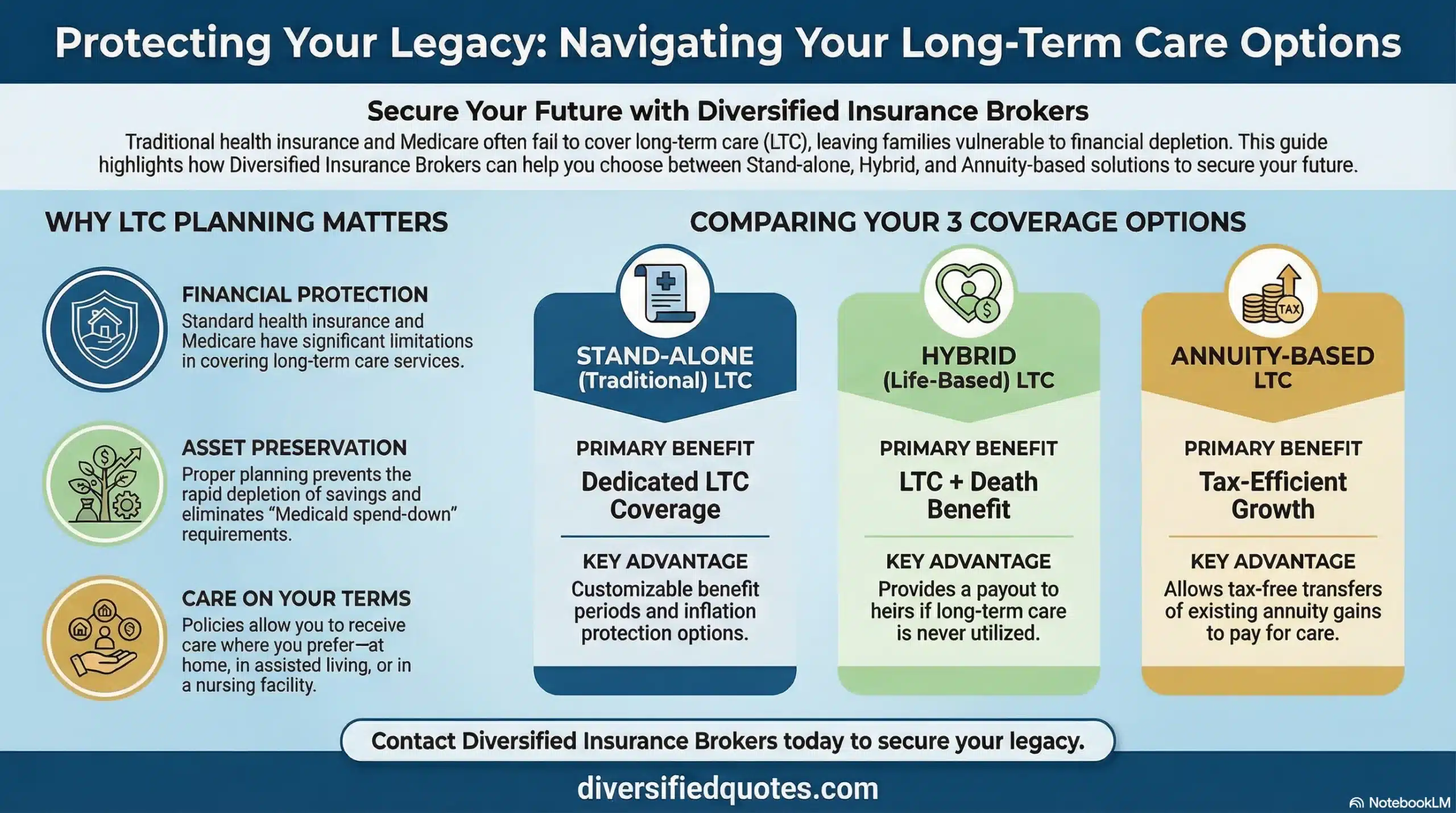
It is a weaker fit for buyers whose top priority is the lowest premium on a standard design, particularly in California and Florida, where the scenario data shows higher pricing. It is also limited for applicants in the Class I and Class II health categories, where benefit maximums are capped and several riders are unavailable, and for anyone who wants long-term care protection combined with a death benefit or cash value, which points toward a hybrid life or annuity design instead.
How We Help
Jason and our office help clients work through MutualCare from the first conversation through claim time. That starts with reviewing your health history so the design you are shown fits the underwriting outcome you are likely to receive, and identifying every premium allowance you may qualify for. From there, we illustrate Secure Solution and Custom Solution side by side where the choice is close, and compare MutualCare against the other traditional and hybrid carriers we represent so the final recommendation reflects the full market.
Because we are independent, we are not obligated to recommend Mutual of Omaha or any other carrier. If a different policy fits your health, your state, or your budget better, that is the policy we will recommend. Our guide to why an independent LTC broker matters explains why that independence is so valuable in a market where two policies from the same carrier can differ this much.
Ready to find out whether MutualCare is the right long-term care policy for you?
Start My LTC Review
Financial Protection Essentials
Explore self-funding, hybrid options, and the other planning decisions that pair with long-term care coverage.
Talk to an Advisor or Request Your Annuity Quote
Ready to explore this annuity in more detail—or compare it with other carriers to see if even higher rates are available? With guaranteed income, principal protection, and long-term growth potential on the line, making the right choice is essential. The experienced advisors at Diversified Insurance Brokers will guide you through the options and design a strategy tailored to your retirement goals.
Schedule here:
calendly.com/jason-dibcompanies/diversified-quotes
Licensed in all 50 states • Fiduciary, family-owned since 1980
Frequently Asked Questions
What is the difference between MutualCare Secure Solution and Custom Solution?
Secure Solution sets the policy limit with a 24, 36, or 48-month benefit multiplier and offers 90, 180, or 365-day elimination periods. Custom Solution lets you choose a pool of dollars from $50,000 to $500,000, adds 0, 30, and 60-day elimination periods, offers more flexible inflation protection with a buy-up option, and opens additional riders. Our guide to how to choose the right LTC policy covers how our office decides between designs like these.
Is MutualCare worth the cost?
It depends on your health, your state, and which features you value. On one standardized design, MutualCare priced higher than some competitors, but it offers features they do not, including a built-in Cash Benefit, the Security Benefit, and partner eligibility for unmarried couples. Our breakdown of whether LTC insurance is worth the cost helps frame that decision.
Can unmarried partners qualify for the partner allowance?
Yes, if they meet Mutual of Omaha’s partner definition, which includes adults in a serious, committed relationship intended to be lifelong who have shared a common residence for the most recent three years and are not married to or partnered with anyone else. Qualifying partners who are both issued coverage each receive a 15% allowance. See our guide to long-term care insurance for couples for how to plan two policies together.
Can I apply for MutualCare in my seventies?
Yes. Issue ages run through 79, or through 75 in New York. Underwriting becomes more detailed with age, and some riders have lower age limits, such as the return-of-premium riders, which are unavailable over age 64, and the Security Benefit, which is unavailable over age 69. Our guide to long-term care insurance for seniors covers what to expect.
Are MutualCare benefits taxable?
Both MutualCare policies are tax-qualified, so benefits paid for qualified long-term care services are generally received income tax-free, and premiums may be deductible within IRS age-based limits if you itemize. Individual situations vary, so confirm with a tax professional. Our overview of whether long-term care benefits are taxable explains the general rules.
Doesn’t Medicare cover long-term care?
No. Medicare covers only limited, short-term skilled care under specific conditions and does not pay for ongoing custodial care, which is what most long-term care consists of. That gap is the reason policies like MutualCare exist. Our guide to what Medicare covers for long-term care explains the details.
How large a policy limit should I choose?
Start with the cost of care where you expect to receive it, subtract what you could cover from income, and decide how much of your savings you want the policy to protect. On Custom Solution, remember that the monthly benefit must fall between 1% and 4% of the pool. Our guide to how much long-term care insurance you need walks through the sizing process our office uses.
I already have a MutualCare quote. Can your office review it?
Yes. Our office can review the design you were quoted, check whether every premium allowance you qualify for was applied, and compare it against other traditional and hybrid carriers on the same benefits. You can request a second opinion on your LTC quote before you apply.
About the Author:
Jason Stolz, CLTC, CRPC, DIA, CAA and Chief Underwriter at Diversified Insurance Brokers (NPN 20471358), is a senior insurance and retirement professional with more than 25 years of real-world experience helping individuals, families, and business owners protect their income, assets, and long-term financial stability. As a long-time partner of the nationally licensed independent agency Diversified Insurance Brokers, Jason provides trusted guidance across multiple specialties—including fixed and indexed annuities, long-term care planning, personal and business disability insurance, life insurance solutions, Group Health, Travel Medical and Evacuation Insurance, and short-term health coverage. Diversified Insurance Brokers maintains active contracts with over 100 highly rated insurance carriers, ensuring clients have access to a broad and competitive marketplace.
His practical, education-first approach has earned recognition in publications such as VoyageATL, and contributions from his agency featured in Kiplinger and GoBankingRates— highlighting his commitment to financial clarity and client-focused planning. Drawing on deep product knowledge and years of hands-on field experience, Jason helps clients evaluate carriers, compare strategies, and build retirement and protection plans that are both secure and cost-efficient. Visitors who want to explore current annuity rates and compare options across multiple insurers can also use this annuity quote and comparison tool.
Explore More Long Term Care Insurance Options: Browse our complete guide to LTC Insurance Costs, Rates & Planning — covering how much it costs, best rates, calculators, planning strategies & is it worth it from top carriers.
Last Reviewed: September 25, 2026 |
Reviewed by: Jason Stolz, CLTC, CRPC, DIA, CAA
Chief Underwriter, Diversified Insurance Brokers, Inc. | NPN: 20471358 | Diversified Insurance Brokers, Inc. — Licensed in all 50 states
Fact Checked by: Tonia Pettitt, CMIP©
Medicare Specialist, Diversified Insurance Brokers, Inc. | NPN: 14374308 | Diversified Insurance Brokers, Inc. — Licensed in all 50 states
Did you find this content helpful? Leave us a Google review — it helps others find trustworthy guidance too.
Editorial Standards: Diversified Insurance Brokers maintains rigorous editorial standards to ensure accuracy, clarity, and independence in all content. Learn more about our editorial standards and commitment to transparency.
