
Best Disability Insurance Companies
As an Independent Disability Insurance Broker, we have access to exclusive discounts and negotiated pricing most captive agents can’t offer — see the full breakdown near the end of this page.
Best Disability Insurance Companies

Jason Stolz CLTC, CRPC, DIA, CAA
There is no single best disability insurance company — and any page that claims otherwise is selling you something. The honest truth, after working with these carriers for years, is that the “best” disability insurer depends entirely on who you are: your occupation, your income, your health, and what you need the policy to do. A carrier that is the clear winner for a surgeon may be the wrong choice for a small-business owner, and a company that is perfect for a healthy attorney may not even be able to cover someone in a hazardous occupation or with a complicated medical history. At Diversified Insurance Brokers, we place income protection across all of the major carriers and the specialty markets, and our job is to match the person to the carrier rather than to push one company on everyone. This page explains where each of the strongest disability insurers genuinely excels, so you can understand why the right answer is a matching exercise, not a ranking.
Want to know which carrier is genuinely strongest for your occupation and situation? Let us compare them for you.
Compare Carriers for My Situation
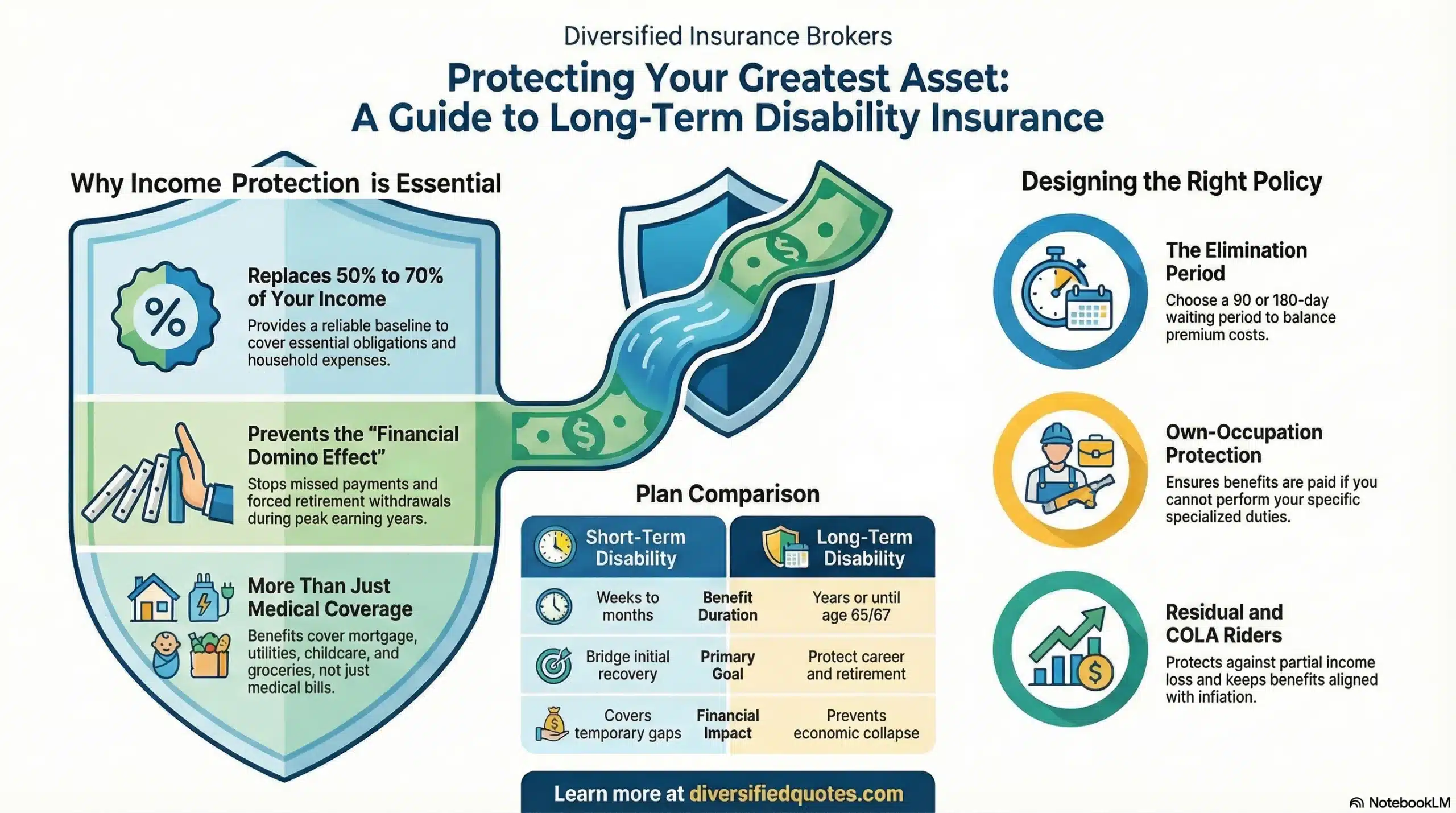
Before naming carriers, it helps to understand what actually separates a strong disability policy from a weak one, because the differences are in the contract language rather than the brand. The single most important feature is the definition of disability — specifically whether a policy offers true own-occupation coverage, which pays benefits if you cannot perform the duties of your specific occupation even if you can work in some other capacity. That definition is the heart of the policy, and how strongly each carrier writes it is a major part of what distinguishes them. Close behind sits the residual, or partial, disability benefit, which pays a proportional benefit when a disability reduces your income without stopping your work entirely, and the optional riders that tailor a policy to your career. The carriers below distinguish themselves on exactly these dimensions, plus their underwriting appetite for specific occupations and health situations.
The companies we focus on here are the ones that consistently earn a place in a serious comparison: Guardian, MassMutual, Principal, The Standard, Ameritas, Assurity, and the specialty market of Petersen International through Lloyd’s of London. Five of these are the major individual disability carriers that compete for professional and high-income cases; the other two fill gaps the majors cannot. Understanding what each does best is what turns a confusing field of options into a clear decision.
Guardian (Berkshire Life): The Contract-Strength Leader
Guardian, which issues its individual disability policies through its Berkshire Life subsidiary, is widely regarded as sitting at the very top of the individual disability market on the strength of its contract and its financial position. It is a policyholder-owned mutual company, and it consistently carries one of the highest composite financial strength profiles in the entire industry — a meaningful consideration for a product whose whole purpose is to still be there and paying claims decades from now.
Where Guardian genuinely stands out is contract language, particularly for medical and surgical professionals. Its own-occupation definition is among the strongest available, and it has historically been a leader in how it treats procedural and surgical specialties — the kind of distinction that matters enormously to a surgeon whose career depends on fine motor function. For physicians and dentists in procedural fields, Guardian’s enhanced contract language is frequently worth its typically higher premium, because in a claim the strength of the definition is what determines whether you are paid.
The honest trade-off is price. Guardian’s premiums for clean, healthy cases tend to be among the higher quotes at a given occupation class, which reflects both the stronger contract and the carrier’s top-tier position. For someone in a procedural specialty, that premium usually buys real value. For someone in a non-procedural profession without complicating factors, a comparably strong contract may be available for less elsewhere — which is exactly the kind of comparison worth running rather than assuming the strongest name is automatically the right buy.
MassMutual: Financial Strength and Lifetime Protection
MassMutual is the other premier mutual company in the individual disability market and, along with Guardian, one of the two carriers that win the majority of professional and physician cases on the combined strength of contract substance and underwriting. It is one of the largest life insurers in the country by assets, and it carries a financial strength profile near the very top of the industry — a genuine advantage for a long-duration promise.
MassMutual’s distinctive strengths include its treatment of mental and nervous conditions, where its parity coverage can be more favorable than competitors that limit benefits for those conditions — a meaningful consideration for many professionals. It is also known for lifetime own-occupation protection options and for riders that appeal to younger professionals building a long career, including catastrophic disability and student loan protection features. For a young professional who wants coverage engineered to protect a specific occupation for the long haul, MassMutual is frequently at or near the top of the list.
MassMutual also participates broadly in guaranteed-standard-issue programs for professionals, which allow eligible groups — such as medical residents and fellows — to obtain coverage with limited or no individual medical underwriting. For someone early in a medical career, that access can be extraordinarily valuable, because it locks in coverage before health issues have a chance to complicate future applications.
Principal: The Business Owner’s Carrier
Principal, the lead insurance subsidiary of a large publicly traded financial group, is a top-tier carrier with excellent financial strength that distinguishes itself in a specific and valuable way: it is frequently the strongest choice for business owners and the self-employed, and it often wins on price for particular occupation classes where other carriers are more expensive.
Principal’s real edge shows up in two situations. First, its business overhead expense coverage is a genuine strength — this is the coverage that reimburses the fixed costs of running a business (rent, utilities, staff salaries) while an owner is disabled, and Principal’s structure accommodates business owners particularly well. For the self-employed and small-business owners, this makes Principal a natural first call. Second, Principal frequently offers competitive pricing and a strong student loan rider for residents and non-surgical specialists, which makes it one of the most common alternatives to the two mutual leaders for those specific groups.
Principal also tends to have flexible policy design and strong residual disability provisions, which serve high earners and self-employed professionals whose income varies. It is often the right primary recommendation for professionals working part-time and for cases where its underwriting treats a specific situation more favorably than the mutual carriers do. In practice, Principal is the carrier we reach for when the case is about a business, variable income, or a pricing advantage in a particular class.
A business owner, a resident, a surgeon, and a tradesperson each need a different carrier. Which one is right for you?
Find My Best-Fit Carrier
The Standard: The Group and Business Suite Carrier
The Standard (Standard Insurance Company) is a leading provider of both individual and employer-sponsored disability coverage, and its distinctive strength is the breadth of its product suite. Where some carriers focus narrowly on individual policies, The Standard offers individual disability, group long-term and short-term disability, and business coverage under one roof — which makes it a natural one-stop carrier for employers building a comprehensive disability benefits program.
For businesses, that breadth is the point. An employer assembling a full benefits package — individual coverage for key people layered on top of group long-term disability for the broader workforce — can build the entire structure with a single carrier, which simplifies administration and coordination. The Standard’s group capabilities are a genuine strength, and it competes strongly in the employer-sponsored market that many individual-focused carriers do not prioritize.
On the individual side, The Standard is a solid, financially strong carrier with respectable contract language that belongs in many comparisons, even if it is not always the contract-strength leader for the most sought-after professional specialties. It frequently earns its place through competitive pricing in specific occupation classes and through the convenience of coordinating individual and group coverage. For the right case — particularly one involving an employer benefits program — it is often the most sensible answer.
Ameritas: Strong Residual Benefits and Value
Ameritas has built a strong disability insurance reputation among medical and dental professionals for its generous partial, or residual, disability benefits — an area where its rider is considered one of the most favorable in the industry. This is a genuinely important niche, and understanding it explains exactly who Ameritas is best for.
Residual disability is what pays when a condition reduces your capacity without eliminating it entirely — you can still work, but you cannot do as much, or you cannot perform the most valuable parts of your job, and your income drops as a result. Ameritas’s residual disability insurance rider pays proportional benefits based on that income loss, and it has historically featured a relatively favorable trigger, which makes it especially valuable for professionals whose likely disabilities are partial rather than total. For dentists, pharmacists, and similar professionals whose conditions may erode their capacity gradually, this strength is directly relevant.
Ameritas is also frequently among the most price-competitive of the major carriers for certain occupation classes, particularly physicians and dentists, and it has a reputation for a straightforward underwriting process. For a professional who wants true own-occupation protection with strong partial-disability coverage without paying the highest premiums in the market, Ameritas often represents excellent value — the carrier to compare when contract strength matters but budget is also a real consideration.
Assurity: Broad Acceptance Across Occupations and Health
Assurity occupies a different and valuable position in the market. Where the carriers above compete primarily for white-collar professionals and high earners, Assurity’s distinctive strength is breadth of acceptance — it writes a wide range of occupation classes and health situations that some of the premier carriers will not, which makes it one of the most versatile carriers for cases that fall outside the ideal professional profile.
Several things set Assurity apart. It writes down into blue-collar and skilled-trade occupation classes that the physician-focused carriers are not built for, making it a frequent answer for tradespeople and gray-collar workers. It offers simplified-issue underwriting at moderate benefit levels, which can mean no medical exam and a faster, easier application for the right case. And it has a genuine leg up in writing difficult medical conditions — including a graded benefit plan that functions as paycheck protection for people who cannot qualify for traditional coverage due to health. That combination makes Assurity, in many cases, the carrier most able to find a solution when health or occupation would otherwise be an obstacle.
Assurity also builds a number of benefits into its base disability insurance policy at no additional charge and offers a wide range of optional riders, and its pricing is competitive. Its financial strength rating is solid and sits a notch below the very top-rated mutual carriers, which is a fair consideration to weigh — but for the person who needs coverage that the premier carriers cannot or will not offer, Assurity’s ability to say yes is exactly what makes it valuable. It belongs in most comparisons precisely because it covers ground the others do not.
Petersen International / Lloyd’s of London: The Specialty Market
Petersen International Underwriters, operating as a coverholder for Lloyd’s of London, is not a traditional carrier and does not compete with the companies above on standard cases. It occupies the specialty and excess disability insurance market — the place brokers turn when the traditional carriers cannot or will not cover a situation. Its own tagline captures the role precisely: it exists for the cases regular markets can’t, or won’t, handle.
Petersen’s strengths address gaps the mainstream market leaves open. The most common is high-limit and excess disability coverage: traditional carriers cap how much monthly benefit they will issue and how much total coverage they will participate in, which leaves very high earners — physicians, executives, and business owners with substantial incomes — underinsured relative to their actual income. Petersen, backed by Lloyd’s, can layer supplemental coverage well beyond those traditional limits, providing benefit amounts far above what the standard market will issue. For anyone whose income has outgrown what the major carriers will cover, this is often the only way to protect it fully.
Its other specialties fill equally real gaps. Petersen writes impaired-risk coverage for people whose health conditions cause traditional carriers to decline or heavily exclude. It covers hazardous and unusual occupations — corporate pilots, professional athletes, offshore and other high-risk workers — that standard carriers avoid. It offers guaranteed-issue disability programs for groups and associations with no individual medical underwriting. And because its risks are underwritten by Lloyd’s syndicates, the financial backing is among the strongest in global insurance. Petersen is not the answer for a standard professional case, but for high-limit needs, impaired risk, and hazardous or unusual occupations, it is frequently the most important market a broker can access.
Which Carrier Is Best for You?
| Carrier | Where It Is Strongest | Best Fit For |
|---|---|---|
| Guardian (Berkshire) | Top-tier contract language and financial strength; strong on procedural specialties. | Physicians and surgeons in procedural fields. |
| MassMutual | Near-top financial strength; lifetime own-occ options; favorable mental/nervous terms. | Young professionals, residents, long-term guarantees. |
| Principal | Business owner design; strong overhead expense; competitive class pricing. | Business owners and the self-employed. |
| The Standard | Broad suite of individual, group, and business coverage under one roof. | Employers building a benefits program. |
| Ameritas | Among the most generous residual benefits; strong value. | Dentists, pharmacists, partial-disability risk. |
| Assurity | Broad occupation and health acceptance; simplified and graded options. | Blue-collar, trades, and difficult health cases. |
| Petersen / Lloyd’s | High-limit and excess, impaired-risk, hazardous occupations. | Very high earners and cases the majors decline. |
Why the “Best” Carrier Is Always a Matching Exercise
Step back from the individual carriers and the larger point comes into focus: every one of these companies is the best choice for someone, and the wrong choice for someone else. That is not a weakness in the market — it is how a well-functioning market works, with different carriers specializing in different risks. The task is not to crown a winner but to match your specific profile to the carrier whose strengths line up with your needs.
Consider how differently these carriers treat the same variables. A procedural surgeon is likely best served by Guardian’s enhanced contract; a resident early in training may be best served by MassMutual’s guaranteed-standard-issue access or Principal’s pricing; a dentist worried about partial disability may find Ameritas’s residual rider decisive; an electrician or contractor may find that only Assurity will write them well; a business owner needs Principal’s overhead structure; an employer building a benefits program needs The Standard’s suite; and a physician earning far more than the traditional carriers will cover needs Petersen to layer excess coverage on top. Same product category, seven very different right answers.
This is also why the occupation class and contract details matter more than the brand name. A strong contract in the right occupation class from a carrier that underwrites your situation favorably will serve you better than the most prestigious name attached to a policy that does not fit. Getting the benefit amount right, the definition right, the riders right, and the carrier’s underwriting appetite right — all matched to you — is the actual work of buying good income protection, and it is why what a policy costs is only meaningful in the context of what it actually covers.
How We Help You Choose
The reason an independent broker matters so much in disability insurance specifically is that no single carrier is right for everyone, and the differences between them are buried in contract language and underwriting guidelines that are genuinely hard to compare from the outside. Our entire value is that we represent all of these carriers and the specialty markets, and we have no reason to steer you toward any one of them except that it genuinely fits you best.
What we actually do is start with you — your occupation and its specific class, your income including whether it exceeds what traditional carriers will cover, your health history, whether you own a business, and what you most need to protect. From there we identify which carriers underwrite your situation most favorably and which contracts serve your needs, then compare the actual policies rather than the marketing. For a clean professional case, that might mean weighing Guardian against MassMutual against Ameritas on contract strength and price. For a business owner, it might center on Principal. For a difficult occupation or health situation, it might mean Assurity or Petersen. For a very high earner, it often means layering a traditional policy with Petersen excess coverage on top. The right answer emerges from your facts, not from a predetermined favorite.
Because we are independent and compensated comparably across carriers, that recommendation reflects what we actually find. If you already have a policy and want to know whether it is the right carrier and contract for your situation, our second-opinion review will tell you honestly — including when what you have is already an excellent fit. And if you are starting from scratch, our guidance on getting the best disability insurance rates reflects the same principle behind everything here: the best carrier is the one that best fits you, and finding it is a matching exercise we do for a living.
Ready to find out which of these carriers is genuinely strongest for your specific situation?
Get Your Carrier Comparison
Financial Protection Essentials
Explore income protection across the many occupations we serve.
Talk With an Advisor Today
Choose how you’d like to connect—call or message us, then book a time that works for you.
Schedule here:
calendly.com/jason-dibcompanies/diversified-quotes
Licensed in all 50 states • Fiduciary, family-owned since 1980
Which disability insurance company is the best?
There is no single best disability insurance company, and any source claiming otherwise is oversimplifying. The best carrier depends entirely on your occupation, income, health, and what you need the policy to do — a company that is the clear winner for a surgeon can be the wrong choice for a business owner, and a carrier perfect for a healthy attorney may not even be able to cover someone in a hazardous occupation or with a complicated medical history. Among the major individual carriers, Guardian and MassMutual generally lead on contract strength and financial position for professional and physician cases; Principal excels for business owners and the self-employed; The Standard stands out for employers building a group and individual benefits program; and Ameritas offers strong residual benefits and excellent value, particularly for dentists and pharmacists. Beyond the majors, Assurity is the versatile carrier for blue-collar occupations and difficult health situations that the premier companies will not write, and Petersen International through Lloyd’s of London is the specialty market for high-limit coverage, impaired risk, and hazardous occupations. Each is the best choice for someone and the wrong choice for someone else. The right approach is not to pick a winner from a list but to match your specific profile to the carrier whose strengths align with your needs, which is exactly what an independent broker does.
What makes one disability policy stronger than another?
The differences that matter are in the contract language, not the brand name. The single most important feature is the definition of disability — specifically whether a policy offers true own-occupation coverage, which pays benefits if you cannot perform the duties of your specific occupation even if you are able to work in some other capacity. That definition is the heart of the policy, because in a claim it determines whether you actually get paid, and how strongly each carrier writes it is a major part of what separates them. The second most important feature is the residual, or partial, disability benefit, which pays a proportional benefit when a disability reduces your income without stopping your work entirely — critical for professionals whose conditions may erode their capacity gradually rather than eliminating it all at once. Beyond those, the optional riders tailor a policy to your career: cost-of-living adjustments that grow your benefit during a long claim, future-increase options that let you raise coverage as your income rises without new medical underwriting, and catastrophic or student loan riders for specific needs. Financial strength matters too, since a disability policy is a promise to pay potentially decades in the future. When people compare carriers on price alone, they miss all of this — a cheaper policy with a weaker definition can be far more expensive in the only moment that counts, which is when you file a claim. Our overview of disability insurance riders covers how these features work.
Which carrier is best for physicians and dentists?
For medical and dental professionals, the strongest options are usually Guardian, MassMutual, Principal, and Ameritas — but which one is best depends on your specialty, stage, and priorities. Guardian, through its Berkshire Life subsidiary, is frequently the leader on contract strength, especially for procedural and surgical specialties where its enhanced own-occupation language is worth its typically higher premium, because a surgeon’s career depends on fine motor function that a strong definition specifically protects. MassMutual competes at the same top tier and is often preferred for its financial strength, lifetime own-occupation options, and more favorable treatment of mental and nervous conditions, as well as its access to guaranteed-standard-issue programs for residents and fellows. Principal is frequently the strongest alternative for residents and non-surgical specialists, often winning on pricing and offering a strong student loan rider, and it is a natural fit for physicians who own their practice because of its business overhead expense strength. Ameritas offers among the most generous residual disability benefits in the industry plus competitive pricing, making it especially attractive for dentists and others whose disabilities may be partial. The right choice among these comes down to your specific specialty, whether you own a business, your health history, and how you weigh contract strength against price — which is exactly the comparison to run before buying rather than defaulting to a single name.
What if I have a difficult occupation, a high income, or health issues?
These are exactly the situations where the specialty carriers earn their place, because the premier professional carriers are built for a specific profile and cannot serve everyone. If you work in a blue-collar or skilled-trade occupation, or you have a medical history that complicates underwriting, Assurity is frequently the answer — it writes a much broader range of occupation classes and health situations than the physician-focused carriers, offers simplified-issue underwriting at moderate benefit levels, and has a graded benefit plan that functions as paycheck protection for people who cannot qualify for traditional coverage due to health. If your income exceeds what traditional carriers will cover — they cap how much monthly benefit they will issue and how much total coverage they will participate in — Petersen International through Lloyd’s of London can layer high-limit excess coverage well beyond those traditional limits, which is essential for high-earning physicians, executives, and business owners who have maxed out the standard market. Petersen also specializes in impaired-risk coverage for people the traditional carriers decline, and in hazardous or unusual occupations such as pilots and professional athletes that standard carriers avoid. The key point is that a difficult occupation, a very high income, or a health issue is not a dead end for income protection — it simply means the right carrier is a specialty market rather than a mainstream one, and finding that market is a core part of what an independent broker does. Our overview of high-income disability insurance covers the excess-coverage approach.
Why use an independent broker instead of going to one carrier directly?
Because no single carrier is right for everyone, and the differences between them are buried in contract language and underwriting guidelines that are genuinely hard to compare from the outside. If you go directly to one company, you get that company’s product — whether or not it is the best fit for your occupation, income, health, and goals. A captive agent for a single carrier cannot tell you that a competitor writes your occupation more favorably, prices your class better, or offers a stronger residual rider for your situation, because they only sell one company’s policies. An independent broker represents all of the major carriers and the specialty markets and is compensated comparably across them, so the recommendation reflects what actually fits you rather than what one company needs to sell. This matters more in disability insurance than in almost any other product, because the carriers specialize so heavily: the right answer for a surgeon, a resident, a business owner, a tradesperson, and a very high earner are five different companies. An independent broker also handles the underwriting strategy — knowing which carrier will view your specific health history or occupation most favorably before you apply, which can be the difference between a standard offer and a rated one. If you already have coverage, an independent second opinion can tell you whether you have the right carrier and contract, and if you are starting out, it ensures you compare the full market rather than a single option. Our overview of getting the best disability rates explains how that comparison works in practice.
About the Author:
Jason Stolz, CLTC, CRPC, DIA, CAA and Chief Underwriter at Diversified Insurance Brokers (NPN 20471358), is a senior insurance and retirement professional with more than 25 years of real-world experience helping individuals, families, and business owners protect their income, assets, and long-term financial stability. As a long-time partner of the nationally licensed independent agency Diversified Insurance Brokers, Jason provides trusted guidance across multiple specialties—including fixed and indexed annuities, long-term care planning, personal and business disability insurance, life insurance solutions, Group Health, Travel Medical and Evacuation Insurance, and short-term health coverage. Diversified Insurance Brokers maintains active contracts with over 100 highly rated insurance carriers, ensuring clients have access to a broad and competitive marketplace.
His practical, education-first approach has earned recognition in publications such as VoyageATL, and contributions from his agency featured in Kiplinger and GoBankingRates— highlighting his commitment to financial clarity and client-focused planning. Drawing on deep product knowledge and years of hands-on field experience, Jason helps clients evaluate carriers, compare strategies, and build retirement and protection plans that are both secure and cost-efficient. Visitors who want to explore current annuity rates and compare options across multiple insurers can also use this annuity quote and comparison tool.
Explore More Disability Insurance Options: Browse our complete guide to Disability Insurance Planning & Education — covering how it works, riders, elimination periods, own occupation, costs & buying guides from 100+ carriers.
Last Reviewed: August 22, 2026 |
Reviewed by: Jason Stolz, CLTC, CRPC, DIA, CAA
Chief Underwriter, Diversified Insurance Brokers, Inc. | NPN: 20471358 | Diversified Insurance Brokers, Inc. — Licensed in all 50 states
Fact Checked by: Tonia Pettitt, CMIP©
Medicare Specialist, Diversified Insurance Brokers, Inc. | NPN: 14374308 | Diversified Insurance Brokers, Inc. — Licensed in all 50 states
Did you find this content helpful? Leave us a Google review — it helps others find trustworthy guidance too.
Editorial Standards: Diversified Insurance Brokers maintains rigorous editorial standards to ensure accuracy, clarity, and independence in all content. Learn more about our editorial standards and commitment to transparency.
