
Disability Insurance for Psychologists and Psychiatrists
As an Independent Disability Insurance Broker, we have access to exclusive discounts and negotiated pricing most captive agents can’t offer — see the full breakdown near the end of this page.
Disability Insurance for Psychologists and Psychiatrists

Jason Stolz CLTC, CRPC, DIA, CAA
Disability insurance for psychologists and psychiatrists is a critical but frequently underutilized financial protection for mental health professionals whose career is built on a paradox: they are the specialists called upon to manage the most severe mental and emotional health conditions in their patients, while operating in one of the highest-burnout, highest-secondary-traumatic-stress professional environments in all of healthcare. Psychologists and psychiatrists face an occupational risk profile that is distinctive from most healthcare professions — not primarily physical, not primarily related to infectious disease exposure, but centered on the cumulative psychological cost of sustained immersion in the mental suffering, trauma histories, suicidal ideation, and emotional crises of patients across a working lifetime. Research has found that in a medical center exclusively designated for healthcare professionals, 89% of psychiatrists struggled with mental health issues — making psychiatry one of the highest-risk physician specialties for burnout, depression, and the mental health conditions that constitute genuine occupational disability. Psychologists face similar documented rates of vicarious trauma, secondary traumatic stress, and compassion fatigue that, at clinical severity levels, impair the cognitive and relational functioning that therapy practice requires. Beyond the psychological risk, inpatient and institutional psychiatrists face a documented patient violence hazard that generates rates of workplace assault significantly higher than most other medical specialties. And for psychologists operating as licensed independent practitioners — often self-employed in private practice without any employer-sponsored safety net — the financial consequences of disability are immediate and complete. At Diversified Insurance Brokers, we help both psychologists and psychiatrists design disability coverage that addresses their specific occupational risks, income structures, and practice models with the precision that mental health professional careers require. For the foundational disability insurance framework before examining mental health profession-specific considerations, our disability insurance services overview and our resource on why people buy disability insurance provide essential context.
Protect Your Income as a Psychologist or Psychiatrist
Compare disability insurance options designed for mental health professionals across private practice, institutional, and academic settings.
Request Disability Insurance OptionsQuestions? Call 800-533-5969
Understanding the Two Professions: Shared Risks, Different Income Structures
Psychologists and psychiatrists practice in the same clinical domain — mental health assessment and treatment — but with important differences in training, scope of practice, income level, and disability planning considerations. Understanding these differences is the starting point for designing coverage that genuinely addresses each profession’s specific situation.
Psychiatrists are physicians who have completed medical school (four years), a psychiatry residency (four years), and in many cases a fellowship in a subspecialty such as child and adolescent psychiatry, geriatric psychiatry, forensic psychiatry, addiction psychiatry, or consultation-liaison psychiatry (one to two additional years). As physicians, psychiatrists can prescribe medications and perform medical procedures, giving them a broader treatment scope than psychologists in most states. Psychiatrist total compensation ranges from approximately $280,000 to $390,000 for employed positions, with private practice psychiatrists often exceeding these figures significantly — psychiatry is noted as one of the easiest specialties for independent practice ownership due to its minimal equipment and staffing requirements. Median psychiatrist salary per SalaryDr verified physician data is approximately $360,000 in 2026, with the highest earners exceeding $500,000 in high-demand markets. The BLS median was $269,120 in 2024, reflecting the lower end of the compensation range where employed academic and community mental health center positions are weighted heavily. The Doximity 2025 Physician Compensation Report places psychiatrist average compensation at $341,977 — situating the specialty in the lower third of physician specialties by income, above primary care but well below surgical and procedural fields.
Psychologists are doctoral-level mental health professionals who typically complete a doctoral degree (PhD, PsyD, or EdD — typically 4 to 7 years), a supervised internship year, and post-doctoral fellowship before obtaining licensure as a licensed psychologist. Psychologists practice assessment, diagnosis, and psychotherapy but in most states do not prescribe medications (exceptions exist in a small number of states with prescriptive authority laws). Psychologist income varies widely by practice setting and degree type: the BLS reports an average annual salary of $111,340 for all psychologists in 2024, but this average encompasses the full range from community mental health center positions at $65,000 to $85,000 through full-fee private practice clinical psychologists earning $150,000 to $250,000 or more annually. The income structure varies dramatically — salaried employment at hospitals, community mental health centers, VA facilities, schools, and universities versus fee-for-service or insurance-billing private practice with no salary floor and immediate income cessation when clinical work stops.
The Primary Disability Risk: Vicarious Trauma and Secondary Traumatic Stress
The defining occupational health challenge for psychologists and psychiatrists — the one that represents the primary disability risk pathway across the career span — is the cumulative psychological cost of sustained, repeated immersion in the traumatic experiences, severe mental illness, suicidal crises, and emotional suffering of their patients. This hazard goes by several overlapping names in the clinical and research literature: vicarious traumatization, secondary traumatic stress, compassion fatigue, and occupational death trauma. Each term captures a somewhat different dimension of the same underlying phenomenon: the psychological damage that accumulates when a mental health professional’s sustained, empathic engagement with their patients’ suffering is not adequately processed, counterbalanced, and supported over time.
Vicarious traumatization refers specifically to the transformation in the therapist’s cognitive schemas — their fundamental beliefs about safety, trust, power, esteem, and intimacy — that results from sustained empathic engagement with patients’ traumatic material. A psychologist who spends a career treating survivors of childhood abuse, combat trauma, sexual violence, and complex PTSD is not merely hearing difficult stories — they are engaging deeply with those experiences in a way that, over time, shifts how they perceive the world, their relationships, and themselves. When these shifts reach the level of clinical impairment — when the accumulated vicarious traumatization prevents the therapist from maintaining the therapeutic presence, professional boundaries, and clinical effectiveness that treatment requires — it constitutes a genuine occupational disability.
Secondary traumatic stress produces symptom presentations that mirror PTSD: intrusive thoughts about patient material, nightmares featuring clinical scenarios, hypervigilance, emotional numbing, and progressive difficulty engaging with the suffering dimensions of patient work that are the very foundation of the clinical role. Research has found that mental health professionals who work extensively with trauma survivors, suicidal patients, or severely mentally ill populations show elevated rates of PTSD-like symptom presentations. A 2025 study published in Frontiers in Psychiatry found that greater exposure to occupational death trauma — a particular category of traumatic experience common among mental health professionals working with suicidal patients — was significantly associated with higher burnout levels, with secondary traumatic stress mediating the relationship.
Compassion fatigue — the progressive emotional and physical exhaustion that results from the cumulative cost of caring — represents a clinical threshold state that directly impairs the therapist’s ability to provide effective treatment. When a psychologist or psychiatrist has developed significant compassion fatigue, they may experience difficulty concentrating during sessions, emotional detachment that prevents genuine therapeutic presence, cynicism about patient recovery, and a reduced capacity for the empathic attunement that effective psychotherapy and psychiatric care require. These functional impairments directly affect both the quality of care provided and the clinician’s ability to maintain a full clinical caseload — producing the partial disability scenario that residual disability coverage addresses through proportionate benefits that pay as income declines without requiring complete cessation of practice.
Burnout Among Psychiatrists: Among Medicine’s Highest-Risk Specialties
Psychiatry sits in a uniquely paradoxical position among medical specialties with respect to mental health and burnout: it is the specialty devoted to treating mental health conditions while simultaneously being among the specialties most severely affected by those same conditions in its own practitioners. Research findings in this area are striking. A study examining psychiatrists in a medical center exclusively designated for healthcare professionals found that 89% struggled with mental health issues — a prevalence so high it challenges the very concept of psychiatric practice as a protective or immunizing experience.
The Doximity 2025 Physician Compensation Report places psychiatry 31st of 37 specialties in compensation — well below the physician average — despite requiring 8 years of post-undergraduate training. This compensation-to-training-investment ratio is a documented driver of psychiatric burnout and career dissatisfaction: the specialty demands the full time investment of physician training but delivers below-average physician compensation, creating a financial stress dimension that compounds the occupational psychological stress of the clinical work. A 2024 Medscape survey placed about 45% of psychiatrists reporting burnout, while specialty-specific studies suggest higher rates in inpatient and institutional settings where the patient acuity and administrative burden are most concentrated.
The administrative burden dimension of psychiatric practice deserves specific emphasis because it represents a dominant burnout driver that is not unique to the clinical content of the work but is instead imposed by the healthcare system surrounding it: prior authorization requirements for psychiatric medications that create extended back-and-forth with insurers for treatments that are clinically clearly indicated, documentation burden that expands continuously without corresponding improvement in care quality, reimbursement rates for psychiatric services that lag behind other physician specialties despite equivalent training requirements, and the chronic shortage of psychiatric beds and community mental health resources that forces inpatient psychiatrists to manage patients in crisis with inadequate support infrastructure. These system-level stressors compound the clinical psychological burden to create a burnout environment of exceptional intensity for many psychiatrists.
When burnout in psychiatry progresses to clinical major depression — which research suggests occurs at elevated rates in this specialty — the functional implications for continued practice are direct and severe. A psychiatrist whose own depressive disorder impairs concentration, motivation, and the sustained engagement that both pharmacological management and psychotherapy require cannot continue clinical practice at full capacity. The very skills that their patients need — sustained attention, clinical judgment, emotional presence, and professional boundaries — are precisely the capabilities that depression impairs. Disability insurance that covers mental health conditions without restrictive 24-month benefit period limitations is not optional for psychiatrists — it is the foundational coverage requirement that addresses the primary disability pathway of the specialty. Our resource on own-occupation disability insurance explains how the definition language must protect a psychiatrist’s specific clinical functions, and our resource on disability insurance riders explained covers the mental health provision structures across different policy types.
Patient Violence: The Physical Disability Risk Unique to Psychiatric Practice
Inpatient psychiatrists, emergency psychiatrists, and psychologists working in institutional, correctional, and forensic settings face a documented occupational safety hazard that most mental health professionals do not prominently associate with their profession but that generates real and significant injury risk: patient violence. Psychiatric inpatient settings have documented rates of staff assault that are among the highest in any healthcare setting — substantially higher than emergency departments, general medical wards, or most other clinical environments.
Research on workplace violence in psychiatric settings consistently finds elevated assault rates. Studies have found that psychiatric nurses and psychiatric staff experience workplace violence at rates multiple times higher than other healthcare workers — and psychiatrists and psychologists working in acute inpatient units, emergency psychiatric settings, and forensic facilities share this elevated exposure. The assaults that psychiatric staff experience range from shoving, scratching, and hitting to weapon use in the most acute settings, and the injuries produced include musculoskeletal injuries from defensive responses, head injuries, and in severe cases permanent physical disability from violent patient encounters.
The nature of acute psychiatric presentations creates the physical risk: patients experiencing psychotic episodes with agitation, patients in acute substance intoxication, patients with impulse control disorders, and patients experiencing the terror and disorientation of acute psychiatric emergency may engage in physical aggression that staff in their environment cannot fully anticipate or prevent. A psychiatrist who sustains a significant musculoskeletal injury — a back injury from a patient encounter, a shoulder injury from a restraint situation, or a head injury from a physical assault — has experienced a genuine disability event that requires income replacement during recovery, exactly as a physical injury in any other occupational setting would. For psychiatrists and psychologists in correctional psychiatry, forensic settings, and maximum-security institutional contexts, this physical risk dimension is a daily occupational reality that disability insurance must address alongside the psychological risk that dominates the profession’s broader disability profile. Our resource on disability insurance for high-risk occupations provides context on how patient violence risk is evaluated in underwriting for mental health professional applicants.
Income Structure and Financial Exposure: The Critical Differences Between Psychologists and Psychiatrists
The income structures of psychologists and psychiatrists create meaningfully different disability exposure profiles that should inform coverage design for each profession.
For psychiatrists at physician-level compensation — typically $280,000 to $390,000 employed, with private practice extending significantly above — the disability exposure mirrors that of other physician specialties at comparable income levels. A disability occurring at any point in a career that began at age 30 to 32 after 12 years of undergraduate and medical training represents a foregoing of substantial lifetime income, compounded by the medical school debt typically exceeding $200,000 that continues regardless of practice status. The employer group disability coverage that most employed psychiatrists receive is subject to the same limitations that affect all employed physicians: monthly benefit caps that represent a small fraction of actual compensation, 24-month own-occupation to any-occupation definition transitions, and non-portable coverage that ends with employment. Individual disability insurance supplementing group coverage is essential for adequate income protection at psychiatrist compensation levels. Our resource on disability insurance for physicians covers the physician-specific planning considerations that apply to psychiatrists as MD or DO professionals.
For psychologists in private practice — a large and growing segment of the profession that includes licensed psychologists practicing independently — the disability exposure is more acute in some respects because there is no employer, no salary, no paid sick leave, and no group disability coverage. When a private practice psychologist cannot see patients, income stops immediately and completely. Fixed practice overhead — office lease, malpractice insurance, billing costs, liability coverage, professional memberships — continues. A psychologist earning $160,000 annually in a full-fee private practice who cannot see patients for 6 months due to burnout-driven major depression faces $80,000 in direct income loss plus ongoing overhead obligations that would rapidly deplete whatever savings the practice had accumulated. For self-employed psychologists specifically, our resource on getting disability insurance when self-employed covers the income documentation and coverage design considerations that apply to fee-for-service mental health practice. Our resource on disability business overhead expense coverage addresses the practice overhead protection layer that complements personal income replacement for private practice owners.
For psychologists in salaried institutional settings — VA, community mental health centers, hospitals, schools, and universities — the income level is lower but the burnout and secondary traumatic stress exposure is often highest, particularly in community mental health settings serving severely mentally ill and high-acuity patient populations with minimal resources and high caseloads. A psychologist earning $85,000 at a community mental health center who develops disabling compassion fatigue or secondary PTSD is experiencing a genuine disability event with income implications that, relative to their financial obligations, may be as severe as those of higher-income professionals. Our resource on whether disability insurance is worth it provides the value framework that applies at every income level, and our resource on how much disability insurance you need translates income level into specific coverage amounts.
The Own-Occupation Definition: Why It Is Uniquely Critical for Mental Health Professionals
For psychologists and psychiatrists, the own-occupation disability definition is critical in a way that is specific to the nature of their professional function. The disability pathways most likely to affect these professionals — burnout-driven mental health conditions, vicarious trauma, secondary traumatic stress — do not typically produce total incapacity for all work. A psychologist with compassion fatigue and developing depression may retain the ability to perform administrative work, write reports, teach, or perform assessment without direct therapy contact. A psychiatrist with burnout and anxiety may be able to function in a limited, less-demanding clinical role while unable to maintain a full inpatient or complex outpatient caseload.
Under an any-occupation standard, these realistic disability scenarios may fail to trigger benefits because the professional retains some theoretical capacity for work — even work at a fraction of their professional income and far below their trained specialty function. Under a true own-occupation definition, these same scenarios clearly trigger benefits because the professional cannot perform the material and substantial duties of their specific occupation: for a psychologist, that means the sustained therapeutic presence, active psychotherapy practice, and clinical caseload management that generate their income; for a psychiatrist, that means the prescribing, psychotherapy, diagnostic assessment, and complex case management that their physician training enables. Our resource on best disability insurance rates helps compare carrier-specific definition language alongside premium, and our resource on why working with an independent disability insurance broker matters explains how carrier-specific knowledge drives better coverage for mental health professionals whose primary risk pathway is psychological.
The 24-Month Mental Health Limitation: The Most Dangerous Policy Trap for This Profession
For mental health professionals — and particularly for psychologists and psychiatrists whose entire income-generating professional function depends on their own mental health and cognitive performance — the 24-month mental health benefit limitation in disability policies is not a minor technical detail. It is the most dangerous policy trap in the entire coverage landscape for this professional group.
Many standard disability insurance policies — including most employer group LTD policies and some individual policies — apply a benefit period limitation specifically to mental and nervous condition claims. Under this limitation, even when a policy covers mental health disabilities in principle, it terminates mental health benefits after 24 months regardless of whether the disability has resolved. For most occupations, this limitation is concerning. For psychologists and psychiatrists whose primary disability risk is mental health conditions, it is potentially catastrophic — it eliminates coverage for the exact disability scenario that is statistically most likely to affect this professional group.
A psychiatrist who develops disabling major depression from the occupational stress of their practice may require 3 to 5 years of treatment, recovery, and gradual return to practice before they can resume full clinical function — or may never return to full clinical capacity. A policy that caps mental health benefits at 24 months leaves the remaining recovery period completely unprotected at exactly the point when the long-term financial consequences of extended disability are most severe. Explicitly confirming that a policy does not apply a 24-month mental health benefit limitation — or understanding exactly what limitation does apply — is the single most important policy evaluation step for any mental health professional comparing disability coverage options. Our resource on disability insurance options for medical challenges covers what happens when mental health history already exists at the time of application, and why applying before any clinical documentation is the optimal approach for mental health professionals.
Practice Setting Variations and Their Disability Implications
Private practice psychologists who own and operate independent practices face maximum financial exposure from disability — immediate and complete income cessation combined with ongoing practice overhead. This group derives no benefit from employer sick leave, group coverage, or institutional support of any kind. Coverage priority: personal income replacement with own-occupation definition, residual disability rider for partial capacity scenarios, and BOE coverage for practice overhead protection. The future increase option is particularly valuable for psychologists building their private practices in their 30s whose income will grow substantially as caseload and fee structures develop. Our resource on disability insurance future insurability riders covers how this protection works for self-employed professionals with growing income trajectories.
Inpatient and emergency psychiatrists face the highest patient violence exposure in the specialty alongside elevated burnout from acute-care psychiatric work intensity. Coverage priority: own-occupation definition covering the acute care psychiatric function specifically, physical injury coverage from patient violence scenarios, and mental health provisions without 24-month limitations. The inpatient compensation premium relative to outpatient psychiatry — reflecting the intensity and call requirements of the work — should be reflected in the benefit amount documentation.
Psychologists and psychiatrists in academic settings typically receive employer benefits including group LTD coverage, but at compensation levels that are often lower than clinical counterparts and with coverage gaps from the standard group policy limitations. For academic psychiatrists whose income reflects the lower end of the physician compensation spectrum, filling the group coverage gap through individual supplemental coverage provides meaningful additional protection at relatively modest premium costs. Our resource on guaranteed issue group disability insurance explains how group coverage works in employer settings, providing context for identifying where individual coverage fills consistent gaps.
Forensic psychologists and forensic psychiatrists who work in correctional settings, court evaluation roles, and legal proceedings face a distinctive risk profile that combines the psychological demands of the broader specialty with the patient violence exposure of institutional psychiatry and the unique stress of operating at the intersection of mental health and legal systems. This subspecialty carries high burnout rates and represents one of the highest physical assault risk environments in the mental health professions. For professionals in these settings, our resource on disability insurance for high-risk occupations addresses how underwriting approaches institutional and correctional mental health work.
Designing Disability Coverage for Psychologists and Psychiatrists
For psychiatrists practicing at physician income levels, coverage design follows the high-income physician framework: maximum available benefit amount reflecting total compensation, own-occupation definition for the full benefit period, mental health coverage without 24-month limitation, to-age-65 benefit period, residual disability rider, COLA rider for inflation protection, and future increase option for career income growth. The benefit amount calculation must address the frequent gap between group policy caps and actual compensation — particularly important for private practice psychiatrists whose income significantly exceeds the standard employed compensation benchmarks that group policies reflect. Our resource on high income disability insurance covers the stacking and maximum benefit considerations for physician-level income.
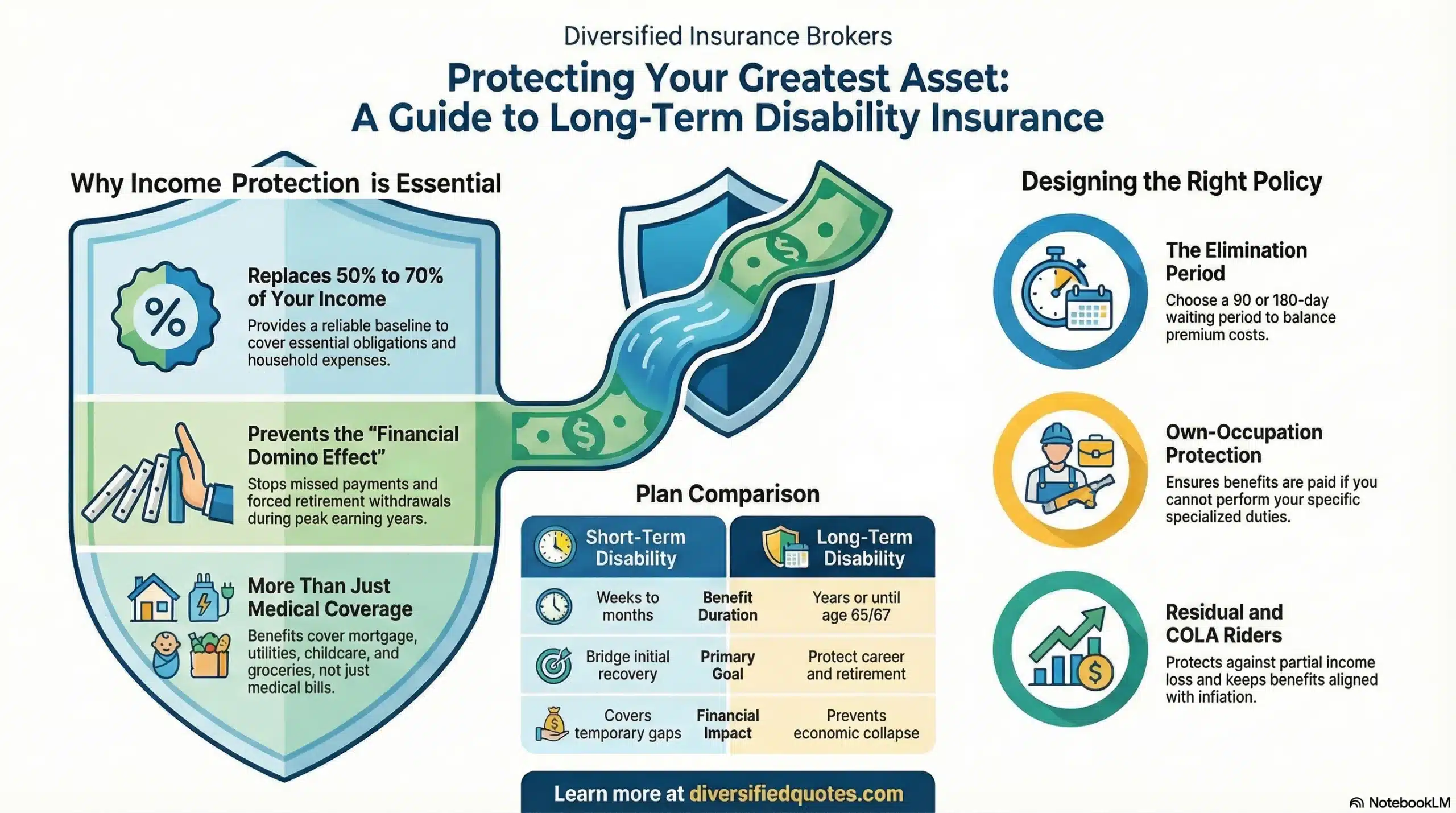
For psychologists across practice settings, coverage design must reflect the individual’s specific income structure: the self-employed private practice psychologist needs own-occupation coverage with BOE protection alongside personal income replacement; the salaried institutional psychologist needs own-occupation individual coverage to supplement and eventually replace group coverage when employment changes; the early-career psychologist building a caseload needs a future increase option to expand coverage as income grows. The elimination period choice is particularly important for psychologists with limited emergency reserves — a 30 or 60-day elimination period may be appropriate when no employer sick pay and no other income source provides any bridge between disability onset and benefits initiation. Our resources on no-exam disability insurance and disability insurance for new professionals address the coverage options and timing considerations for psychologists at different stages of training and career development.
Timing Considerations: When to Apply and Why Earlier Matters
For mental health professionals, the timing argument for early disability insurance application has a specific dimension that does not apply in the same way to other professions: the occupational health conditions most likely to produce exclusion riders or underwriting complications are mental health conditions, and mental health professionals — by nature of their work environment — are statistically more likely to have sought mental health treatment, documented mental health episodes, or been prescribed psychotropic medications than professionals in most other fields.
A psychologist or psychiatrist who applies for disability insurance after several years of clinical practice may have medical records documenting a treated depressive episode, anxiety treatment, or a consultation for burnout-related symptoms — all of which, depending on the carrier and the specifics of the documentation, could produce exclusion riders that limit coverage for the mental health disability pathway that is the professional’s primary occupational risk. A psychologist who applies during doctoral training, before any documented mental health treatment, obtains a clean policy covering the full range of mental health disability without limitation.
The premium advantage of early application — locked in at the younger age’s actuarial rate for the policy’s lifetime — compounds with the coverage comprehensiveness advantage to make early application the clear optimal approach for mental health professionals at any career stage who have not yet established coverage. Our resource on why young professionals need disability coverage addresses this timing argument, and our resource on how to get the best disability insurance rates explains the full set of factors that determine coverage quality and cost. For those who already have existing coverage and want an independent evaluation, our disability insurance second opinion service provides an unbiased review against the full market of available options.
Get Disability Insurance Quotes for Psychologists and Psychiatrists
We compare options across carriers for mental health professionals to find the right combination of mental health coverage, own-occupation definition, and benefit design.
Request Disability Insurance OptionsQuestions? Call 800-533-5969
Financial Protection Essentials
Income protection resources and disability insurance planning tools for mental health professionals and licensed independent practitioners.
Related Pages
Talk With an Advisor Today
Choose how you’d like to connect—call or message us, then book a time that works for you.
Schedule here:
calendly.com/jason-dibcompanies/diversified-quotes
Licensed in all 50 states • Fiduciary, family-owned since 1980
Frequently Asked Questions: Disability Insurance for Psychologists and Psychiatrists
The primary disability risk for mental health professionals is the cumulative psychological cost of sustained immersion in patients’ traumatic experiences, severe mental illness, suicidal crises, and emotional suffering — documented under overlapping clinical terms: vicarious traumatization, secondary traumatic stress, compassion fatigue, and occupational burnout. Research has found that in a medical center exclusively for healthcare professionals, 89% of psychiatrists struggled with mental health issues. Secondary traumatic stress produces symptom presentations mirroring PTSD — intrusive thoughts, emotional numbing, nightmares featuring clinical material, and progressive difficulty engaging with the suffering dimensions of patient work — that when they reach clinical severity, directly impair the sustained therapeutic presence and clinical effectiveness that psychotherapy and psychiatric care require.
When burnout, vicarious trauma, or secondary traumatic stress progresses to clinical major depression, anxiety disorder, or PTSD-spectrum conditions that impair professional functioning, it meets the functional limitation standard for disability. Mental health coverage without a 24-month benefit period limitation is the most important policy provision for this professional group — not an enhancement but a foundational requirement. Our resource on disability insurance with preexisting conditions explains why applying before any documented mental health treatment history produces the most comprehensive coverage for mental health professionals.
The 24-month mental health benefit limitation caps disability benefits for mental and nervous conditions at 24 months — even when the policy covers mental health disabilities in principle and even when physical disability benefits would continue for the full benefit period to age 65. Under this limitation, a psychologist or psychiatrist whose disabling major depression requires 3 to 5 years of treatment before return to full clinical practice would receive benefits for only 24 months, leaving the remaining recovery period completely unprotected at exactly the time when the long-term financial consequences of extended disability are most severe.
For mental health professionals, this limitation transforms a policy that appears comprehensive into one that fails for the primary disability risk their occupation presents. Most employer group LTD policies apply the 24-month mental health limitation as standard — which means a psychologist or psychiatrist relying on group coverage alone may discover this failure only at the 24-month claims mark. Explicitly confirming the absence of this limitation in any disability policy before purchase is the most critical policy evaluation step for this professional group. Our resource on why working with an independent disability insurance broker matters explains how carrier-specific knowledge of mental health provisions is one of the most valuable capabilities an experienced advisor brings to mental health professional coverage placement.
Yes — the coverage needs differ in important ways. A private practice psychologist who owns and operates an independent practice has no employer, no salary, no paid sick leave, and no group disability coverage of any kind. When a private practice psychologist cannot see patients, income stops immediately and completely while practice overhead — office lease, malpractice insurance, billing service costs, professional memberships — continues. Personal disability insurance that replaces the fee-for-service clinical income is the primary protection layer. Business overhead expense (BOE) disability insurance is a separate and complementary policy that reimburses documented fixed practice costs during a disability period, preventing the practice from collapsing financially while the psychologist is unable to generate clinical revenue.
An employed psychologist has different coverage priorities: supplementing and eventually replacing the employer group policy that provides baseline but inadequate protection. Group policies typically cap benefits far below actual income, transition to any-occupation definitions after 24 months, and apply the 24-month mental health limitation that directly fails the primary disability pathway. For self-employed psychologists, our resource on disability insurance for the self-employed covers the specific income documentation and design considerations for independent clinical practice, and our resource on disability insurance for independent contractors addresses contractual practice arrangements.
Research consistently indicates that psychiatrists face elevated rates of mental health conditions relative to both the general population and many other physician specialties. A study examining a medical center exclusively designated for healthcare professionals found that 89% of psychiatrists struggled with mental health issues. Psychiatry involves daily immersion in the most severe mental health presentations — acute psychosis, suicidal crises, severe depression, complex trauma — combined with administrative burden, below-average physician compensation relative to training requirements, and the ongoing challenge of maintaining the boundary between empathic patient engagement and self-protective emotional distance.
The disability insurance implication is that psychiatrists trained to diagnose the conditions that may be disabling them can create a pattern of late acknowledgment and delayed help-seeking that extends the functional impairment period. Earlier application for disability coverage, before any mental health treatment documentation exists, is particularly important — and confirming that the policy’s mental health provisions cover the primary disability pathway without the 24-month limitation is the essential validation step. Our resource on best disability insurance rates helps compare carrier-specific mental health provisions alongside premium for psychiatrist applicants.
Yes — injuries sustained from patient violence are covered under disability insurance policies that cover sickness and injury when those injuries produce qualifying disability under the policy definition. Inpatient psychiatric settings have documented rates of staff assault among the highest in any healthcare setting, significantly exceeding emergency departments and general medical wards. Psychiatrists and psychologists working in acute inpatient units, emergency psychiatric settings, forensic facilities, and correctional mental health programs share elevated physical assault risk that can produce musculoskeletal injuries, head injuries, and in severe cases permanent physical disability from patient encounters involving agitated, psychotic, or intoxicated patients.
A psychiatrist who sustains a significant back injury from a patient encounter has experienced a disability event that disability insurance addresses through the same income replacement mechanism as any other occupational injury. The most important planning consideration is that coverage must be in place before the injury occurs and that the policy’s own-occupation definition must protect the specific professional function — not just the general ability to work. For mental health professionals in high-risk institutional settings, our resource on disability insurance for high-risk occupations provides context on how institutional mental health work is evaluated in underwriting.
The optimal time for both psychologists and psychiatrists to apply is as early in their training or career as possible — ideally during doctoral training for psychologists, or during psychiatry residency for psychiatrists. For mental health professionals specifically, early application has a dimension of urgency beyond just premium savings: the occupational conditions most likely to generate exclusion riders are mental health conditions, and mental health professionals are statistically more likely to have sought mental health treatment themselves than professionals in most other fields. A psychologist who applies during their doctoral internship year, before any documented mental health treatment history exists, obtains a comprehensive policy covering the full range of psychological disability without limitation.
A psychologist or psychiatrist who applies after several years of clinical practice may have records documenting a treated depressive episode, anxiety treatment, or a burnout consultation — all of which can produce exclusion riders limiting coverage for the primary disability pathway. Our resource on disability insurance for new professionals addresses the specific planning considerations for mental health professionals at the beginning of their careers, and our resource on how to buy disability insurance walks through the application process from start to finish.
About the Author:
Jason Stolz, CLTC, CRPC, DIA, CAA and Chief Underwriter at Diversified Insurance Brokers (NPN 20471358), is a senior insurance and retirement professional with more than 25 years of real-world experience helping individuals, families, and business owners protect their income, assets, and long-term financial stability. As a long-time partner of the nationally licensed independent agency Diversified Insurance Brokers, Jason provides trusted guidance across multiple specialties—including fixed and indexed annuities, long-term care planning, personal and business disability insurance, life insurance solutions, Group Health, Travel Medical and Evacuation Insurance, and short-term health coverage. Diversified Insurance Brokers maintains active contracts with over 100 highly rated insurance carriers, ensuring clients have access to a broad and competitive marketplace.
His practical, education-first approach has earned recognition in publications such as VoyageATL, and contributions from his agency featured in Kiplinger and GoBankingRates— highlighting his commitment to financial clarity and client-focused planning. Drawing on deep product knowledge and years of hands-on field experience, Jason helps clients evaluate carriers, compare strategies, and build retirement and protection plans that are both secure and cost-efficient. Visitors who want to explore current annuity rates and compare options across multiple insurers can also use this annuity quote and comparison tool.
Explore More Disability Insurance Options: Browse our complete guide to Disability Insurance for Physicians & Medical Specialists — covering physicians, surgeons, anesthesiologists, radiologists, podiatrists & medical specialists from 100+ carriers.
Last Reviewed: September 23, 2026 |
Reviewed by: Jason Stolz, CLTC, CRPC, DIA, CAA
Chief Underwriter, Diversified Insurance Brokers, Inc. | NPN: 20471358 | Diversified Insurance Brokers, Inc. — Licensed in all 50 states
Fact Checked by: Tonia Pettitt, CMIP©
Medicare Specialist, Diversified Insurance Brokers, Inc. | NPN: 14374308 | Diversified Insurance Brokers, Inc. — Licensed in all 50 states
Did you find this content helpful? Leave us a Google review — it helps others find trustworthy guidance too.
Editorial Standards: Diversified Insurance Brokers maintains rigorous editorial standards to ensure accuracy, clarity, and independence in all content. Learn more about our editorial standards and commitment to transparency.
