
Disability Insurance for Landscapers
As an Independent Disability Insurance Broker, we have access to exclusive discounts and negotiated pricing most captive agents can’t offer — see the full breakdown near the end of this page.
Disability Insurance for Landscapers

Jason Stolz CLTC, CRPC, DIA, CAA
Disability insurance for landscapers is income protection built around one of the most physically demanding service trades in the American economy — a profession where workers lift, bend, dig, haul, and operate heavy equipment in outdoor conditions across every season, and where a disabling injury or illness removes the physical capacity that is the entire foundation of how income is earned. Professional landscapers, lawn care operators, hardscape contractors, irrigation technicians, and landscaping business owners earn their income through sustained physical labor: mowing and operating heavy vibrating equipment, planting and lifting materials weighing 50 pounds or more, pruning and trimming from elevated positions, installing retaining walls and patios that involve repeated heavy lifting and kneeling on hard surfaces, and maintaining the physical capacity to work through summer heat that creates its own distinct occupational health risk. When a back injury, a knee condition, a heat-related illness, or any other disabling event prevents a landscaper from performing that physical work, income stops — and for the self-employed landscaping business owner, overhead does not.
At Diversified Insurance Brokers, we help landscaping professionals across every specialty and employment structure — self-employed sole operators, small landscaping business owners, lawn care contractors, hardscape installers, and irrigation technicians — structure disability insurance coverage that reflects the genuine physical risks of their work and the financial vulnerability their self-employed structure creates. A well-structured policy provides income replacement from any qualifying disability, whether it originates from an acute injury on a job site, a cumulative musculoskeletal condition that develops from years of heavy physical labor, a heat-related illness, or a medical event entirely unrelated to the work itself. Our resource on what is the primary reason people buy disability insurance provides essential context on why individual coverage is the only meaningful financial protection available to the self-employed landscaper who has no employer safety net behind them.
Get Disability Insurance Quotes for Landscapers
We compare carriers, explain occupational class ratings, and structure policies built for the real physical risks and business exposures of professional landscaping work.
Request Disability Insurance OptionsWhat Landscapers Actually Do — and Why It Creates Real Disability Risk
The physical demands of professional landscaping work are sustained, varied, and cumulative across every working day and every season of an active career. A landscaper’s day involves constant transitions between physically demanding tasks: loading and unloading equipment from trucks and trailers, mowing large properties with walk-behind and ride-on mowers that generate significant whole-body vibration, using string trimmers and edgers that transmit vibration directly to the hands and arms, pruning trees and hedges from ladders and elevated positions, kneeling and squatting on hard surfaces while planting, weeding, and mulching, and carrying and positioning heavy materials — bags of mulch, sod, stone, and soil commonly exceed 40 to 50 pounds — across the breadth of a job site. Hardscape installation is among the most physically demanding specialties in the landscaping trades: cutting and laying pavers, building retaining walls from concrete block, installing steps and pathways from natural stone, and compacting gravel and sub-base material requires sustained heavy lifting, repetitive bending at the waist, and prolonged kneeling on unforgiving surfaces that produce the musculoskeletal loading patterns most directly associated with chronic back and knee disability.
Operating a landscaping business compounds the physical exposure of the work itself with the financial exposure of self-employment. The majority of solo operators and small landscaping business owners remain physically active in the field — performing labor alongside any crew members they employ — well into the growth of the business. When the owner is doing field work, the same physical risk exposure that applies to any crew member applies directly to the person whose disability would immediately threaten the financial stability of the entire operation. The Bureau of Labor Statistics recorded 102 fatal workplace injuries among landscaping and groundskeeping workers in 2023 alone — a profession that represents less than 1 percent of the U.S. workforce but accounts for a disproportionately high share of occupational fatalities. Non-fatal disabling injuries occur at rates far higher than fatalities, and the financial consequences of a non-fatal disabling event that prevents a self-employed landscaper from working for weeks or months are often more financially devastating than the acute event itself. Our resource on is disability insurance worth it frames exactly how income loss during disability accumulates into a crisis that even disciplined savings cannot absorb without income replacement in place.
The Most Common Disabling Conditions for Landscapers
Back injuries are the dominant disabling condition for professional landscapers, consistent with the occupational profile of a trade built around sustained heavy lifting, repetitive bending, and the operating of vibrating equipment across long working days. OSHA and NIOSH consistently identify overexertion — lifting, carrying, pushing, and pulling heavy materials — as the leading cause of serious injury among landscape workers. Lumbar strain, disc herniation, and degenerative spinal conditions develop from the cumulative loading that daily landscaping work imposes on the lower back across an entire career: every bag of mulch lifted from a truck bed, every bag of soil positioned in a planting area, every retaining wall block placed into position, and every hour spent operating vibrating mowers and compactors adds to the cumulative spinal loading that produces chronic back disability over time. A back condition serious enough to prevent sustained lifting, bending, and equipment operation can effectively end a landscaper’s ability to perform the core physical work of the trade — even when every other aspect of health is unaffected.
Knee injuries follow closely behind back injuries in the landscaping disability profile, developing from the sustained kneeling, squatting, and repetitive positional transitions that planting, mulching, edging, and hardscape installation require on a daily basis. Meniscus tears, patellar tendonitis, ligament damage, and chronic knee deterioration are documented occupational outcomes for workers who spend significant professional time on hard ground surfaces in kneeling and squatting positions. Shoulder injuries — including rotator cuff tears and shoulder impingement — develop from the overhead reach of tree and hedge trimming, the sustained equipment operation of mowers and trimmers, and the repetitive throwing and lifting mechanics of material placement. Heat-related illness represents a disability risk category that is specific to outdoor trades and is particularly acute for landscaping professionals who work through summer heat for extended hours: heat exhaustion and heat stroke are documented causes of serious health events and disability among landscape workers, and the cumulative physiological stress of repeated heat exposure across a summer career can produce cardiovascular and kidney conditions that develop long after the immediate heat event. Chemical exposure from pesticide and fertilizer application adds a long-term respiratory and systemic health risk for landscapers who handle these materials regularly. For additional context on how similar physically demanding outdoor trade occupations are evaluated for disability coverage, our resource on disability insurance for game wardens illustrates how outdoor physical occupations with mixed acute and cumulative risk profiles are structured across carriers.
Why Most Landscapers Have No Disability Safety Net
Approximately 25 percent of landscaping professionals in the United States are self-employed, and the proportion of small business owners who perform significant field labor themselves is even higher than that figure suggests. A sole operator or small crew owner who works alongside their employees has no employer providing sick pay, group disability benefits, or a salary that continues when they cannot work. When the owner is injured and cannot perform field work — or cannot manage job sites, client interactions, and crew supervision — revenue generation stops in a way that has no institutional buffer. The seasonal nature of landscaping income in northern markets amplifies this vulnerability: a landscaper who is disabled during the spring and summer peak season loses the income concentration that supports the entire year, with consequences that extend well beyond the weeks of recovery.
Workers’ compensation covers only work-related injuries for employees — it does not cover the self-employed owner and does not address the cumulative conditions that develop from years of repetitive physical labor. The back condition that develops from a decade of heavy lifting is not attributable to a single documented incident, which places it outside the scope of workers’ compensation regardless of its occupational origin. Social Security Disability Insurance requires demonstrating inability to perform virtually any gainful employment — a standard that would deny benefits to a landscaper who retains any capacity for sedentary activity even while being entirely unable to perform the physical labor their trade requires. Our resource on disability insurance for high-risk occupations provides important context on how carriers evaluate the disability risk profile of outdoor trades and what coverage remains available for workers whose professions carry documented elevated physical risk. For landscapers building a complete financial protection picture, our resource on income protection insurance covers the full spectrum of tools available alongside individual disability coverage.
How Disability Insurance Carriers Classify Landscapers
Disability insurance carriers assign occupational class ratings that reflect the estimated disability risk of each profession. Landscapers are generally classified in the lower occupational class tiers that reflect the heavy physical labor, equipment operation, outdoor hazard exposure, and injury rate data that characterize the profession. Within the landscaping category, how an individual’s specific duties are described to underwriters can affect the classification meaningfully. A landscaping business owner who spends substantial time managing crews, handling client relationships, estimating jobs, and overseeing operations rather than personally performing daily field labor may be classified more favorably than a sole operator who performs all physical work themselves. Presenting occupational duties accurately — including the specific percentage of time spent in direct field labor versus management, administration, and client-facing work — is an area where working with an experienced independent broker produces better classification outcomes than applying to a single carrier directly.
Specialty matters as well: hardscape contractors who regularly lift heavy stone and block materials, install retaining walls, and operate plate compactors carry a different physical risk profile than maintenance landscapers whose work is primarily mowing and trimming. Irrigation technicians whose work involves significant trench digging and pipe installation occupy a different duty profile than design-oriented landscape contractors whose field time is less physically intensive. Understanding how disability insurance elimination periods work is particularly important for landscaping business owners whose seasonal income patterns affect how long they can realistically sustain household and business expenses without income replacement during a disability. For additional cross-occupational perspective on how physically demanding trade occupations are classified, our resources on disability insurance for the woodworking industry and disability insurance for the automobile industry provide useful context on how manual trade classifications interact with benefit structure across carriers.
Case Study — Self-Employed Landscaping Business Owner, Back Injury
Consider a self-employed landscaping business owner operating a small crew and generating approximately $85,000 per year in personal income from a business producing $400,000 in annual revenue. After sustaining a lumbar disc herniation while lifting and positioning heavy retaining wall blocks on a commercial hardscape installation — a task performed personally because the crew was handling other site work simultaneously — this owner requires an epidural series and a minimum of three months during which sustained lifting, bending, and equipment operation are medically contraindicated. The table below illustrates the financial difference disability insurance makes in this specific scenario.
| Scenario | Without Disability Insurance | With Disability Insurance |
|---|---|---|
| Monthly Income During Recovery | $0 to near-$0 — field operations stall without owner oversight and labor | $3,500–$4,500 |
| 3-Month Income Total | $0 | $10,500–$13,500 |
| Client Relationships | Maintenance accounts at risk; clients contact competitors during service disruption | Financial stability supports managed communication and planned crew coverage during recovery |
| Business Overhead During Recovery | Truck payments, equipment leases, insurance, and fuel costs continue regardless | Monthly benefit offsets ongoing fixed business costs |
| Return-to-Work Pressure | Financial crisis forces early return to heavy lifting before medical clearance; re-injury and permanent disability risk | Full recovery on medical timeline without desperation driving a premature return |
Back injuries from heavy lifting are the most consistently documented serious occupational injury in landscaping, and hardscape installation work involving repeated lifting of heavy stone and block material is among the highest-risk specific tasks in the trade. Disability insurance for landscapers ensures that this predictable occupational health outcome does not simultaneously become a financial emergency that forces premature return to heavy field work and risks permanent career-altering re-injury. For additional context on how small trade business owners structure disability protection when their personal physical labor is the foundation of the operation, our resource on disability insurance for convenience store owners provides a useful parallel perspective on how owner-operators with high physical demand exposure evaluate income protection needs.
Key Policy Features That Matter Most for Landscapers
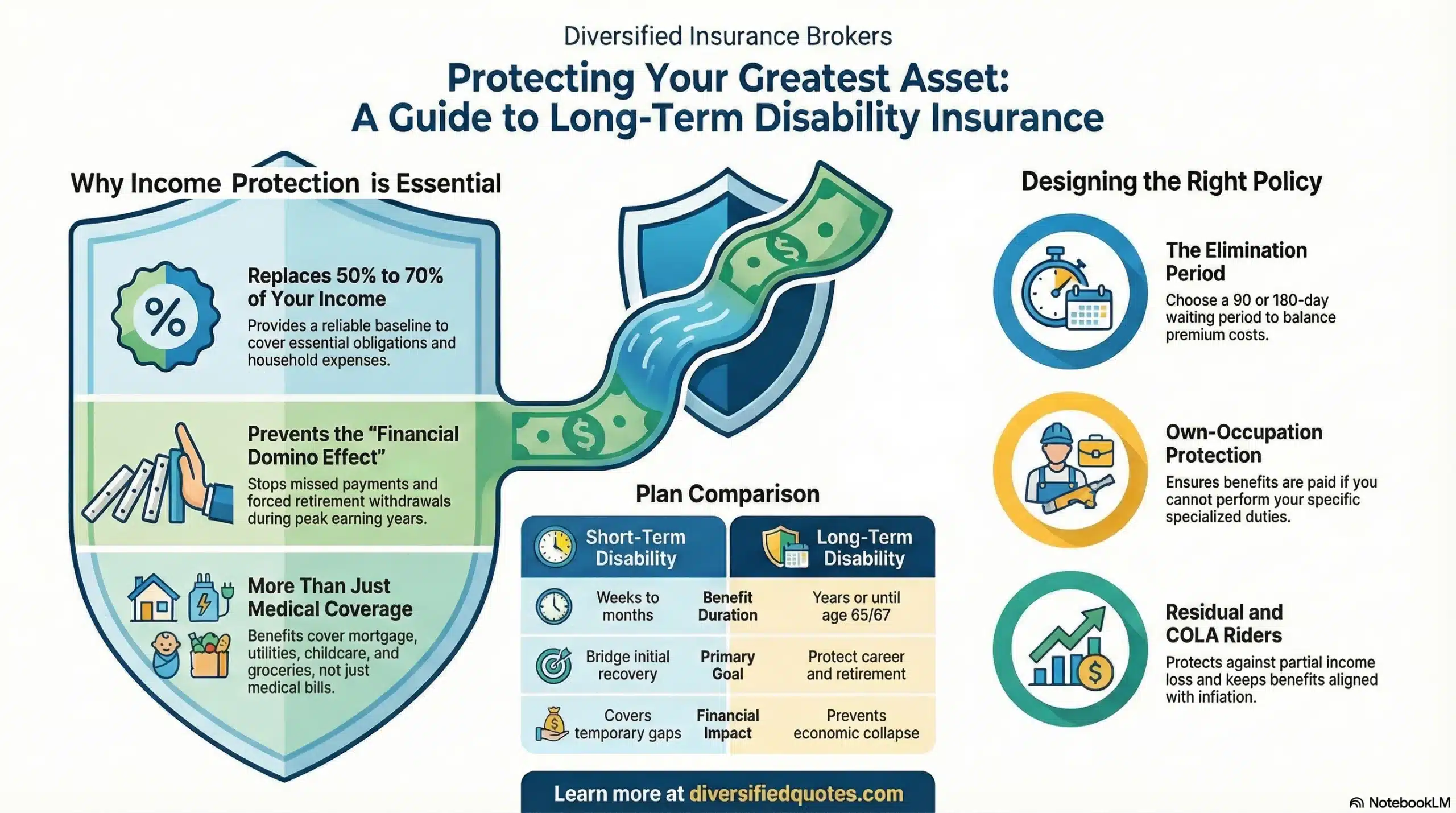
The own-occupation definition of disability is the most important policy feature for professional landscapers. Under an own-occupation definition, the policy pays benefits when a condition prevents the landscaper from performing the specific physical duties of their occupation — the sustained lifting, bending, equipment operation, and outdoor labor that generating income in the landscaping trade requires — regardless of whether they could theoretically perform some other type of lighter or sedentary work. A landscaper whose back injury prevents sustained lifting and bending may technically be able to perform desk-based administrative work, but an own-occupation policy recognizes the genuine inability to work as a landscaper and pays benefits accordingly. Without an own-occupation definition, a policy would only pay benefits if the insured could not perform virtually any gainful employment — denying benefits to an injured landscaper who retains any capacity for sedentary activity even though that activity bears no relationship to their profession or income. Our dedicated resource on own-occupation disability insurance explained covers exactly how this definition protects trade professionals in real disability scenarios and why it is the single most important feature to evaluate in any policy.
A residual disability rider is equally critical for landscapers whose recovery may involve a gradual return to work capacity. A landscaping business owner recovering from a back injury may be able to manage client communications, estimate jobs, and oversee crew operations while still unable to perform field labor — earning substantially reduced income compared to full operational capacity without being completely unable to work. A total-disability-only policy provides no benefits during this partial recovery period. A residual disability rider pays proportional benefits based on the percentage of income reduction, providing continuous financial support from the onset of disability through to full return to normal production. Our resource on how residual disability benefits work covers exactly how proportional benefit calculations function in practice. A cost-of-living adjustment rider maintains the purchasing power of the monthly benefit for landscapers facing long-term disability. Our resource on disability income insurance with a COLA rider explains when inflation protection produces the most meaningful financial benefit over a sustained claim period.
Income Documentation and Business Overhead Coverage for Landscaping Business Owners
Because the majority of active landscaping professionals who most need disability coverage are self-employed, disability insurance underwriting involves income documentation requirements that differ from W-2 employee applications. Carriers base benefit amounts on verified earned income using federal tax returns — typically two to three years of Schedule C net profit for self-employed applicants. For landscaping business owners who carry significant operating expenses — truck and trailer payments, mower and equipment leases, fuel costs, liability insurance, workers’ compensation premiums for employees, pesticide licensing fees, and marketing costs — the reported net profit may substantially understate the owner’s actual financial need during a disability, when household expenses continue regardless of what the tax return shows after all business deductions are applied. Working with an experienced broker who understands how to document landscaping business income accurately and present the full financial picture to underwriters is an important step in securing a benefit amount that meaningfully replaces actual income.
Landscaping business owners should also strongly consider business overhead expense coverage alongside personal income replacement disability insurance. Business overhead expense policies cover the fixed operating costs of keeping the business viable during a disability period when the owner cannot work in the field: truck and equipment loan payments, insurance premiums, fuel for crew vehicles, licensing fees, and any employee payroll costs for the owner’s core crew. These fixed costs continue regardless of whether the owner is healthy, and allowing them to lapse during a disability means losing the equipment, the crew, and the client relationships that took years to build. Our resource on how much disability insurance you need provides a practical framework for determining the right benefit amount and supplemental coverage structure when both personal income and business fixed costs both require protection simultaneously.
Why Independent Broker Access Matters for Landscaping Professionals
Not every disability insurance carrier classifies landscaping occupational classifications equally, and some carriers approach the heavy physical labor, outdoor hazard exposure, and equipment operation that characterizes the trade with conservative restrictions — exclusion riders, reduced benefit limits, or occupational class ratings that produce premium costs or coverage limitations that undermine the policy’s practical value. Other carriers write landscaping professional classifications more comprehensively when the health profile, income documentation, and duty description support a clean underwriting outcome. Identifying the carriers whose underwriting guidelines are most favorable for a given landscaping professional’s specific duty profile requires independent access to the full carrier marketplace.
At Diversified Insurance Brokers, we evaluate options across multiple carriers for every landscaping professional we serve. We understand how to present mixed field and management duty profiles accurately, how to document self-employment income effectively for variable-revenue businesses, and how to structure policy provisions — own-occupation definitions, residual disability riders, elimination period selection, and benefit period choices — that produce genuinely comprehensive income protection rather than a generic policy that falls short at the moment of a claim. Our resource on why independent disability insurance brokers matter explains the full value of this approach for self-employed trade professionals navigating the disability insurance marketplace.
When to Apply for Coverage
The best time for a landscaping professional to apply for disability insurance is as early as possible in their career — before any occupational health conditions from the physical demands of the work have accumulated in the medical record. Disability insurance premiums are based in part on age and health status at the time of application, and younger applicants in good health secure the most comprehensive coverage at the most favorable rates. Back conditions, knee deterioration, and shoulder problems that develop from years of sustained heavy landscaping work can result in exclusion riders that specifically eliminate coverage for exactly those conditions if they are already documented when the application is submitted. An exclusion rider eliminating back coverage is a particularly significant problem for a landscaper whose most probable disability scenarios involve exactly that area.
Applying before occupational conditions are documented — when health is good and the physical demands of landscaping work have not yet produced documented musculoskeletal issues — secures comprehensive coverage that remains in force as those conditions develop in subsequent years of work. That is exactly when comprehensive coverage matters most. For landscapers who have already developed some documented conditions and want to understand what coverage options remain available, our resource on disability insurance with preexisting conditions covers how underwriters approach existing health history. Our resource on how to buy disability insurance online provides practical guidance on the application process for self-employed trade professionals evaluating their options.
Request Disability Insurance Quotes for Landscapers
We compare carriers, explain how landscaping work is classified, and structure policies that protect the income your business depends on.
Get Disability Insurance QuotesRelated Disability Insurance Pages
Financial Protection Essentials
Talk With an Advisor Today
Choose how you’d like to connect—call or message us, then book a time that works for you.
Schedule here:
calendly.com/jason-dibcompanies/diversified-quotes
Licensed in all 50 states • Fiduciary, family-owned since 1980
Disability Insurance for Landscapers — FAQs
Yes — landscapers and landscaping business owners can obtain individual disability insurance, though the heavy physical labor, equipment operation, and outdoor hazard exposure that characterize the profession typically place it in a lower occupational class tier that reflects the documented injury risk. The specific classification an individual landscaper receives depends on how their duties are accurately described to underwriters — a landscaping business owner who spends meaningful time managing crews, estimating jobs, and overseeing client relationships rather than personally performing all field labor may receive a more favorable classification than a sole operator who performs all physical work themselves. Specialty matters as well: hardscape contractors who regularly lift heavy stone and operate plate compactors carry a different risk profile than maintenance landscapers focused primarily on mowing and trimming. Working with an independent broker who understands how to present landscaping duty profiles accurately produces consistently better terms than applying to a single carrier directly.
Back injuries are the dominant disabling condition for professional landscapers, consistent with the occupational profile of a trade built around sustained heavy lifting, repetitive bending, and operating vibrating equipment across long working days. OSHA and NIOSH consistently identify overexertion — lifting, carrying, pushing, and pulling heavy materials — as the leading cause of serious injury among landscape workers. Lumbar strain, disc herniation, and degenerative spinal conditions develop from the cumulative loading that daily landscaping work imposes across an entire career. Knee injuries follow closely, developing from sustained kneeling, squatting, and repetitive positional transitions during planting, mulching, and hardscape installation. Shoulder injuries including rotator cuff tears develop from overhead trimming work and equipment operation. Heat-related illness — heat exhaustion and heat stroke — represents a serious and often underappreciated disability risk for landscapers working through peak summer conditions. Chemical exposure from pesticide and fertilizer application adds long-term respiratory and systemic health risk for landscapers who handle these materials regularly. Hand-arm vibration syndrome from sustained mower and trimmer operation is an additional documented occupational health condition specific to the trade.
Own-occupation disability insurance pays benefits when a condition prevents the insured from performing the specific duties of their own occupation — regardless of whether they could theoretically perform different or lighter work. For a landscaper, this means benefits are paid when conditions prevent the sustained lifting, bending, equipment operation, and outdoor physical labor that generating income in the landscaping trade requires — even if the landscaper could hypothetically perform sedentary office work completely unrelated to their profession. Without an own-occupation definition, a policy would only pay benefits if the insured could not perform virtually any gainful employment, which would deny benefits to a landscaper whose back injury prevents all field work while leaving some capacity for desk activity. For a professional whose entire income depends on physical labor capacity that desk work cannot replicate, the own-occupation definition is the most consequential single feature in any disability policy.
No — workers’ compensation is structured for employer-employee relationships, and self-employed landscaping business owners typically have no workers’ compensation coverage for themselves at all. Even for employed landscapers, workers’ compensation covers only injuries that are directly and demonstrably work-related and occur during a specific documented work event. It does not cover the back condition that develops gradually from years of cumulative heavy lifting, the knee deterioration from years of sustained kneeling, or any medical event without a clear occupational connection — a cardiovascular event, a cancer diagnosis, or any disability that does not trace to a specific workplace incident. Individual disability insurance covers disability from any cause regardless of origin, providing comprehensive protection across the full range of events that could prevent a landscaper from working — not just the narrow subset of acute, clearly work-related injuries that workers’ compensation addresses.
Residual disability coverage pays proportional benefits when a disability reduces earning capacity without eliminating the ability to work entirely. A landscaping business owner recovering from a back injury may be able to manage client communications, estimate jobs, and oversee crew operations while still unable to perform field labor — earning substantially reduced income compared to full operational capacity without being completely unable to work. A total-disability-only policy provides no benefits during this partial recovery period, even though income is far below normal and a genuinely disabling condition is still being managed. A residual disability rider pays a proportional benefit based on the percentage of income reduction, providing continuous income support from disability onset through full return to normal production capacity. For landscaping business owners who rebuild their operational volume gradually after a disabling injury, this rider is essential protection across the entire recovery arc — and the period of partial recovery is often when financial pressure is most acute.
The appropriate benefit amount is generally 60 to 70 percent of gross monthly earned income, which reflects the standard underwriting guideline most disability insurance carriers apply. For self-employed landscaping business owners, this is calculated based on net earned income from Schedule C after business deductions — which can meaningfully understate actual financial need when significant operating expenses such as truck payments, equipment leases, fuel costs, insurance, and payroll reduce net profit well below gross revenue. The practical question is whether the benefit amount would actually cover household obligations during a disability: mortgage or rent, food, utilities, insurance, and loan payments do not decrease because field work has stopped. For landscaping business owners, pairing a personal income replacement policy with a business overhead expense policy that covers fixed operating costs produces the most complete financial protection when both personal income and business fixed costs are at risk simultaneously.
The elimination period — the waiting period between disability onset and when benefits begin — is a critical planning decision for self-employed landscaping professionals who have no employer sick pay and no organizational income buffer. Landscapers with limited cash reserves and a seasonal income pattern that concentrates earnings in the spring and summer months should strongly consider a 30- or 60-day elimination period, which minimizes the gap between disability onset and benefit arrival. For a landscaper disabled during peak season, every week without income during the elimination period represents a disproportionate share of annual earnings. Landscaping business owners with stronger cash reserves, household income from other sources, or a longer track record of savings may comfortably accept a 90-day elimination period to reduce the premium cost. The right choice depends on household financial resilience and how long the individual could realistically sustain both personal and business expenses from existing savings without benefit payments beginning.
Yes — health history affects both eligibility and the specific terms of coverage offered. Disability insurance underwriting evaluates the full health picture alongside occupational risk: musculoskeletal history, prior injuries, chronic conditions, and any documented history of the types of conditions most likely to produce a disability claim. For landscapers, existing back problems, knee conditions, or shoulder injuries already documented in the medical record at application can result in exclusion riders that specifically eliminate coverage for those conditions going forward. An exclusion rider removing back coverage is a particularly significant problem for a landscaper whose most probable disability scenarios involve exactly that area of the body. This is the most important reason to apply as early as possible in a landscaping career — before the physical demands of the work have produced documented conditions that underwriters will exclude from coverage.
Yes — for landscaping business owners with meaningful fixed ongoing operating costs, business overhead expense coverage is a valuable complement to personal income replacement disability insurance. Business overhead expense insurance covers the fixed costs of keeping the business operational during a disability period when the owner cannot generate field revenue: truck and trailer loan payments, mower and equipment lease costs, liability and workers’ compensation insurance premiums, pesticide licensing fees, fuel costs for crew vehicles, and any employee payroll for a core crew the owner has built. These costs continue regardless of whether the owner can work, and allowing them to lapse during a disability risks losing the equipment, the crew relationships, and the client accounts that took years to develop. A personal disability policy replaces household income. A business overhead expense policy preserves the business infrastructure that makes a return to full operation possible after recovery, rather than returning to find the business has effectively ceased and needing to rebuild from scratch.
The best time is as early as possible in a landscaping career — ideally when first going into business or beginning full-time professional work, before any occupational health conditions from the physical demands of the trade have appeared in the medical record. Premiums are based in part on age and health at application, and younger, healthier applicants secure the most comprehensive coverage at the most favorable rates. Back conditions, knee deterioration, and shoulder problems that develop from years of sustained heavy landscaping work appear in the medical record gradually over the course of a career. An exclusion rider removing back or knee coverage is devastating for a landscaper whose most probable disability scenarios involve exactly those structures. Applying before these conditions are documented secures comprehensive coverage that continues protecting against them as they develop in subsequent working years. The timing advantage of applying early cannot be recaptured once conditions have been documented and underwriters have assigned exclusion riders accordingly.
About the Author:
Jason Stolz, CLTC, CRPC, DIA, CAA and Chief Underwriter at Diversified Insurance Brokers (NPN 20471358), is a senior insurance and retirement professional with more than 25 years of real-world experience helping individuals, families, and business owners protect their income, assets, and long-term financial stability. As a long-time partner of the nationally licensed independent agency Diversified Insurance Brokers, Jason provides trusted guidance across multiple specialties—including fixed and indexed annuities, long-term care planning, personal and business disability insurance, life insurance solutions, Group Health, Travel Medical and Evacuation Insurance, and short-term health coverage. Diversified Insurance Brokers maintains active contracts with over 100 highly rated insurance carriers, ensuring clients have access to a broad and competitive marketplace.
His practical, education-first approach has earned recognition in publications such as VoyageATL, and contributions from his agency featured in Kiplinger and GoBankingRates— highlighting his commitment to financial clarity and client-focused planning. Drawing on deep product knowledge and years of hands-on field experience, Jason helps clients evaluate carriers, compare strategies, and build retirement and protection plans that are both secure and cost-efficient. Visitors who want to explore current annuity rates and compare options across multiple insurers can also use this annuity quote and comparison tool.
Explore More Disability Insurance Options: Browse our complete guide to Disability Insurance for Agriculture, Natural Resources & Outdoor Industries — covering farmers, ranchers, fishermen, foresters, miners, oil & gas workers & outdoor industries from 100+ carriers.
Last Reviewed: June 8, 2026 |
Reviewed by: Jason Stolz, CLTC, CRPC, DIA, CAA
Chief Underwriter, Diversified Insurance Brokers, Inc. | NPN: 20471358 | Diversified Insurance Brokers, Inc. — Licensed in all 50 states
Fact Checked by: Tonia Pettitt, CMIP©
Medicare Specialist, Diversified Insurance Brokers, Inc. | NPN: 14374308 | Diversified Insurance Brokers, Inc. — Licensed in all 50 states
Did you find this content helpful? Leave us a Google review — it helps others find trustworthy guidance too.
Editorial Standards: Diversified Insurance Brokers maintains rigorous editorial standards to ensure accuracy, clarity, and independence in all content. Learn more about our editorial standards and commitment to transparency.
