
Disability Insurance for Audiologists
As an Independent Disability Insurance Broker, we have access to exclusive discounts and negotiated pricing most captive agents can’t offer — see the full breakdown near the end of this page.
Disability Insurance for Audiologists

Jason Stolz CLTC, CRPC, DIA
Disability insurance for audiologists is income protection for a doctoral-level healthcare profession that carries a disability risk dimension unlike almost any other clinical specialty — the possibility that the very condition an audiologist diagnoses and treats in patients could become a disabling occupational condition for the clinician themselves. Audiologists hold Doctor of Audiology degrees, require state licensure in all 50 states, and earn a median annual wage of $92,120 according to the Bureau of Labor Statistics. They diagnose and treat hearing loss, balance disorders, tinnitus, and related auditory conditions using audiometric equipment, hearing aid technology, and clinical diagnostic skills that depend on sustained fine motor dexterity, precise auditory acuity, cognitive diagnostic precision, and the patient-facing communication capacity that audiological counseling requires. When any of those capabilities are impaired by a disabling condition — whether it is a fine motor condition limiting the manual work of hearing aid fitting, a cognitive condition affecting audiogram interpretation and differential diagnosis, a burnout-related psychiatric condition, or the occupational irony of an audiologist developing hearing loss — the income consequences are immediate and the professional consequences are compounding.
At Diversified Insurance Brokers, we help audiologists in every practice setting — clinical audiologists in hospital and ENT practice, private practice audiologists and clinic owners, school audiologists, VA and government-employed audiologists, and pediatric and balance subspecialists — structure disability insurance coverage that reflects the genuine professional risks of their work and the income a doctoral-level healthcare career generates. A well-structured policy provides income replacement from any qualifying disability, whether it originates from a fine motor condition preventing hearing aid work, a neurological event affecting clinical judgment, a psychiatric condition from the sustained emotional demands of audiological patient care, or any other medical event preventing professional practice. Our resource on what is the primary reason people buy disability insurance provides foundational context on why doctoral healthcare professionals need individual income protection regardless of employment setting or access to group benefits.
Get Disability Insurance Quotes for Audiologists
We compare carriers, explain how audiology is classified, and structure policies that protect the income and practice your doctoral-level career has built.
Request Disability Insurance OptionsWhat Audiologists Actually Do — and Why the Disability Risk Is More Nuanced Than It Appears
The professional profile of audiology is built around a combination of clinical diagnostic precision, fine manual dexterity, patient-facing communication skill, and — uniquely — an audiologist’s own auditory function as a tool of professional practice. A working audiologist’s clinical day involves conducting comprehensive audiometric evaluations using calibrated audiometers and acoustic testing equipment, interpreting audiograms and tympanometry results to diagnose the type, degree, and configuration of hearing loss, fitting and programming hearing aids and other amplification devices using real-ear measurement equipment and custom ear impressions, performing cochlear implant mapping and programming sessions with pediatric and adult patients, evaluating and treating balance disorders using videonystagmography and other vestibular assessment tools, and providing the counseling that patients with tinnitus, hearing loss, and balance disorders require across a spectrum of emotional and communicative needs.
The fine motor demands of audiology are specific and largely invisible to those outside the profession. Inserting ear impression material into the ear canal for custom hearing aid molds requires precise manual control in a confined space where movement must be careful and deliberate. Programming hearing aids and cochlear implant processors involves manipulating small equipment, connecting fine wires and probes, and making precise adjustments based on acoustic measurements. Pediatric audiology adds the challenge of working with small patients who require quick, precise probe placement and behavioral observation during testing. An audiologist who develops a hand tremor, a finger joint condition, or any fine motor limitation faces a professional impairment specific to these precise manual requirements — not the gross motor limitation that affects physical labor trades, but the precision motor limitation that affects delicate clinical work. Our resource on disability insurance for physicians provides useful parallel context on how doctoral clinical professionals with fine motor and cognitive disability risks approach income protection planning.
The Uniquely Ironic Disability Risk: What Happens When an Audiologist Develops Hearing Loss
The most distinctive disability risk in audiology has no parallel in almost any other healthcare specialty: the possibility that an audiologist — a professional who diagnoses hearing disorders and counsels patients about hearing loss — develops clinically significant hearing impairment affecting their own ability to practice. This is not a theoretical concern. Audiologists work in proximity to acoustic equipment that generates sounds across a wide frequency range during testing, hearing aid fitting, and equipment calibration. Industrial audiologists conducting occupational hearing conservation programs work in environments with elevated noise exposure. And like all people, audiologists can develop hearing loss from non-occupational causes — genetic factors, aging, infections, and the same presbycusis that affects the general population.
An audiologist with significant hearing loss faces a genuine professional challenge. Audiometric threshold testing requires the audiologist to detect patient responses — button presses, raised hands, verbal responses — during pure-tone testing. Counseling patients about hearing aids and hearing loss requires the communication clarity that untreated hearing loss can compromise. Hearing aid verification using real-ear measurement requires the audiologist to interpret acoustic output that their own hearing may perceive differently with audiometric impairment. Balance disorder evaluation requires communication with patients during testing procedures. The practical consequence is that hearing loss significant enough to affect an audiologist’s clinical function — their ability to accurately detect patient responses, communicate clearly with patients, and perform the full scope of audiological services — constitutes a genuine occupational disability under an own-occupation disability definition, even though the audiologist’s physical health is otherwise intact. This is precisely the type of disability scenario that any-occupation definitions miss entirely: an audiologist who can hear well enough to perform sedentary administrative work but cannot perform the specific auditory and clinical functions of their profession faces income loss that any-occupation coverage would not address. Our resource on own-occupation disability insurance explained covers how this definition protects clinical professionals in exactly the scenarios where the disability prevents specialty practice while leaving some general function intact.
The Full Spectrum of Disability Risks for Audiologists
Beyond the hearing-specific professional risk, audiologists face the same range of disability scenarios that affect all doctoral healthcare professionals whose income depends on sustained cognitive performance, clinical judgment, and patient-facing professional capability. Neurological events — stroke, traumatic brain injury, or progressive neurological conditions — represent the most acute disabling scenarios for clinical audiologists whose diagnostic work requires the cognitive precision to interpret complex audiometric patterns, differentiate audiological from neurological etiologies of hearing and balance dysfunction, and provide the clinical reasoning that underlies hearing aid prescription and cochlear implant programming decisions. A neurological event that impairs auditory processing, cognitive function, or communication can be professionally disabling for an audiologist even when physical mobility is preserved.
Psychiatric and burnout-related conditions represent a meaningful disability risk for audiologists who work in emotionally demanding clinical contexts. Audiologists who work primarily with pediatric patients with profound congenital hearing loss navigate the emotional weight of delivering life-altering diagnoses to families. Tinnitus patients — who suffer from a condition that is frequently distressing, poorly understood by the general public, and resistant to cure — represent a patient population that research identifies as among the most challenging to counsel due to the emotional intensity of their experience with a chronic, unresolvable condition. Audiologists in cochlear implant programs work with patients and families through the complex process of surgical candidacy evaluation, device activation, and the long rehabilitation process that follows implantation. The sustained emotional engagement of this clinical work creates the burnout exposure that, when progressing to clinically diagnosable psychiatric conditions, can prevent the professional functioning audiology practice requires. Fine motor conditions affecting the hands — tendinitis, carpal tunnel syndrome, or arthritic changes affecting finger dexterity — produce disabilities specific to the precise manipulation that hearing aid fitting, ear impression taking, and probe placement require. For context on how other doctoral-level healthcare professionals in primarily cognitive practice settings approach disability planning, our resource on disability insurance for dentists illustrates how fine motor and clinical precision demands create disability scenarios that weaker policy definitions consistently fail to address.
Why Audiologists Are Frequently Underinsured
Despite holding doctoral degrees and earning median incomes above $92,000 annually, many audiologists are meaningfully underinsured for disability — for reasons that follow directly from the employment structures common in the profession. Many audiologists work in physician-owned ENT practices, hospital systems, or specialty healthcare organizations that provide group disability benefits as part of a broader employee benefits package. These group plans typically replace 60 percent of base salary with monthly benefit caps that may fall well below what a practicing audiologist’s income requires for full household protection. Group plans also carry the same structural weaknesses that affect all employed professionals: they are not portable when employment changes, and many transition from own-occupation to any-occupation disability definitions after 24 months of a claim — potentially eliminating benefits for an audiologist with a long-term condition who retains some general work capacity.
Private practice audiologists — who own and operate independent audiology clinics — face an even more acute protection gap. A private practice audiologist who cannot work due to disability faces simultaneous loss of personal income and continuation of practice overhead: audiometric equipment maintenance costs, soundproof testing booth lease or service contracts, hearing aid inventory obligations, professional liability insurance premiums, ASHA and AAA membership fees, and state licensure renewal costs. Without a personal income replacement policy and a business overhead expense policy covering those fixed costs, a disability that prevents clinical practice for months or longer can simultaneously eliminate household income and threaten the viability of a practice that took years to build. Our resource on disability business overhead expense coverage explains how this supplemental coverage protects the practice infrastructure during the period when disability prevents revenue generation. For audiologists evaluating whether their current disability coverage is adequate, our resource on is disability insurance worth it provides the financial framework for understanding how income gaps during disability compound into consequences that even strong group coverage cannot prevent.
How Disability Insurance Carriers Classify Audiologists
Disability insurance carriers assign occupational class ratings that reflect the estimated disability risk of each profession. Audiologists generally receive favorable to moderate occupational class ratings reflecting the primarily clinical, cognitive, and precision-skilled nature of audiology work — better than physical labor classifications and comparable to other doctoral-level healthcare professionals in clinic-based practice. The specific classification an individual audiologist receives depends on how their practice duties are described to underwriters, particularly the balance between direct clinical work and administrative, supervisory, or management functions.
An audiologist in private practice whose duties include both full-time clinical work — patient testing, hearing aid fitting, cochlear implant programming — and significant practice management and business administration may receive a more favorable classification than one in a high-volume clinical setting with minimal administrative duties, when the duty split is accurately documented. Audiologists in primarily research or academic roles with limited direct patient care may receive more favorable classifications than full-time clinicians. The favorable occupational classification that audiology generally receives means the primary planning focus for most audiologists is not the classification challenge but rather the benefit amount sizing, the own-occupation definition quality, and the rider selection that creates comprehensive income protection calibrated to a doctoral healthcare income. Understanding how elimination periods work is particularly relevant for audiologists evaluating how to coordinate individual coverage with any existing employer group benefits — selecting the right waiting period relative to available sick leave can meaningfully reduce premium cost without creating financial vulnerability. For additional context on how other favorably classified clinical professions structure disability coverage, our resource on disability income insurance for accountants illustrates how professionals in favorable occupational classifications approach individual coverage structuring.
Case Study — Private Practice Audiologist, Fine Motor Condition
Consider a private practice audiologist who owns an independent audiology clinic, sees 25 patients weekly, and generates $110,000 annually in personal income from a practice producing $400,000 in gross revenue. After developing progressive bilateral hand tremor diagnosed as essential tremor — a condition preventing the precise ear impression taking, hearing aid probe placement, and fine manual manipulation that the clinical work of audiology requires — this audiologist cannot safely perform the procedures that generate the practice’s revenue for a period requiring extended medical management and potential surgical evaluation. The table below illustrates the financial stakes with and without comprehensive individual disability coverage.
| Scenario | Without Individual Disability Coverage | With Individual Disability + BOE Coverage |
|---|---|---|
| Monthly Personal Income During Disability | $0 — clinical practice generates no revenue without the audiologist performing procedures | $4,500–$6,000 from individual income replacement policy |
| Practice Overhead During Disability | Equipment maintenance, booth lease, liability insurance, and professional fees continue from savings | Business overhead expense policy covers fixed practice costs; personal income policy covers household |
| Disability Definition Test | N/A — no coverage in place | Own-occupation definition: tremor prevents audiology practice duties — benefits payable even if audiologist could perform administrative work |
| Return-to-Practice Pressure | Financial crisis forces premature return to clinical work before tremor management is complete; patient safety and quality of care risk | Recovery proceeds on medical timeline; return to clinical practice when medically appropriate |
| Practice Viability After Recovery | Equipment, staff, and patient relationships may have lapsed during unprotected absence | Practice infrastructure preserved; clinical return to a functioning operation rather than a rebuild |
Essential tremor and other fine motor conditions are particularly significant disability risks for audiologists precisely because the clinical work of audiology — unlike many healthcare roles — requires precision manual work with very small equipment in confined spaces where the margin for tremor or imprecision is functionally zero. A neurosurgeon, a dentist, and an audiologist share this fine motor dependency in different contexts — all face the scenario where a precision motor condition disables the specialty practice while leaving general health and cognitive function intact. Disability insurance built around an own-occupation definition addresses this scenario directly. For comparable perspective on how precision manual healthcare professionals structure income protection for fine motor disability risks, our resource on disability insurance for the woodworking industry illustrates how precision manual work creates disability scenarios that stronger definitions are specifically designed to capture.
Key Policy Features for Audiologists
The own-occupation definition of disability is the most consequential policy feature for audiologists — and the unique disability scenarios specific to this profession make the precision of that definition particularly important. Under a true own-occupation definition, a policy pays benefits when a condition prevents the audiologist from performing the material and substantial duties of their specific profession — clinical audiometric evaluation, hearing aid fitting and programming, balance disorder assessment, cochlear implant management, and the audiological counseling that each patient encounter requires — regardless of whether the audiologist could theoretically perform other work. A hand tremor that prevents hearing aid fitting, a hearing condition that prevents audiometric counseling and response detection, or a cognitive condition that prevents audiogram interpretation all qualify as own-occupation disabilities even when the audiologist remains physically mobile and could theoretically perform administrative or non-clinical work. Without this definition, any-occupation coverage would deny benefits to an audiologist who retains capacity for sedentary work but cannot safely practice audiology — leaving the profession-specific income loss entirely uninsured. Our resource on disability insurance riders explained covers the full range of provisions that accompany the own-occupation definition and how each affects real-world claim outcomes for clinical professionals.
A residual disability rider is equally important for audiologists whose conditions may produce a gradual return to practice rather than a complete recovery or complete disability. An audiologist recovering from a hand condition might be able to return to audiometric testing and counseling duties before being able to safely return to the manual fitting and impression work — earning reduced income on a modified clinical schedule without being completely unable to work. A total-disability-only policy provides no benefits during this partial recovery period. A residual rider pays proportional benefits based on the percentage reduction in earnings, supporting continuous income through the full recovery arc. Our resource on how residual disability benefits work covers the proportional mechanics. For audiologists evaluating long-term coverage against extended or permanent disability, our resource on disability income insurance with a COLA rider explains how inflation protection maintains purchasing power across multi-year claim periods — particularly relevant for a profession where the median income warrants serious long-term protection. A future increase option allows audiologists early in their careers to increase benefit amounts as income grows without new medical underwriting — our resource on the disability insurance future insurability rider explains how this provision locks in the right to coverage expansion at the original application’s health standard.
Income Documentation and Business Overhead for Private Practice Audiologists
For employed audiologists in hospital systems, ENT practices, or school settings, disability insurance underwriting involves straightforward W-2 income documentation. The primary planning questions are how to size the individual supplemental benefit to fill the gap between employer group coverage and actual income needs, and how to ensure the own-occupation definition holds through the full benefit period rather than converting to a weaker standard after 24 months. For private practice audiologists, underwriting involves Schedule C net profit documentation that may require working with a broker who understands how to present audiology practice income accurately — particularly when significant equipment, inventory, and professional costs reduce net income below gross revenue in ways that understate actual financial need during a disability.
Private practice audiologists carry fixed professional costs that continue during disability regardless of revenue: audiometric equipment calibration and maintenance service contracts, soundproof testing booth lease or maintenance costs, hearing aid manufacturer account minimums that maintain product access, professional liability insurance premiums, ASHA Certificate of Clinical Competence fees and continuing education requirements, state audiology licensure renewal fees, and any staff or office costs. Our resource on how much disability insurance you need provides a practical framework for determining the right benefit amount and supplemental coverage structure when both personal income and business fixed costs require protection simultaneously. For audiologists who want to understand how disability insurance fits within a broader financial protection strategy, our resource on income protection insurance covers the full spectrum of tools available alongside individual disability coverage.
Why Independent Broker Access Matters for Audiologists
Not every disability insurance carrier classifies audiology occupational profiles with equal sophistication, and some carriers evaluate the profession based on its healthcare category broadly rather than the specific clinical and fine motor demands that distinguish audiology from many other healthcare roles. An independent broker who understands how to present the audiologist’s specific duty profile — the fine motor component of hearing aid and cochlear implant work, the auditory function dependency, the cognitive diagnostic demands — and who can identify the carriers whose own-occupation definitions and occupational class ratings are most favorable for audiology specifically produces meaningfully better coverage outcomes than applying to a single carrier directly.
At Diversified Insurance Brokers, we evaluate options across multiple carriers for every audiologist we serve. We understand how to document the specific clinical duties that make audiology distinct from other allied health professions, how to present private practice income accurately for benefit amount calculations, and how to structure own-occupation definitions, residual disability riders, and future increase options that produce genuinely comprehensive income protection for a doctoral-level healthcare career. Our resource on why independent disability insurance brokers matter explains the full value of independent carrier access for clinical healthcare professionals whose coverage needs require expertise to address properly.
When to Apply — Timing Matters for Audiologists
The best time for an audiologist to apply for individual disability insurance is as early as possible in their career — ideally during or immediately following the Au.D. program or clinical fellowship year, before any occupational health conditions from clinical practice have accumulated in the medical record. Disability insurance premiums are based in part on age and health at the time of application, and younger applicants in good health secure the most comprehensive coverage at the most favorable rates. The Au.D. degree represents a four-year doctoral investment on top of undergraduate education — a significant professional and financial commitment that makes protecting the income that investment generates a planning priority from the earliest career stage, not an afterthought after other financial decisions have been made.
For audiologists who are already in practice and have not yet secured comprehensive individual coverage, the urgency of applying before any health conditions — hand conditions, hearing changes, cognitive concerns — appear in the medical record is genuine. The own-occupation coverage secured before these conditions develop is the comprehensive protection that remains in force as professional demands and health history accumulate across a career. For audiologists who already have documented health history and want to understand what coverage options remain available, our resource on disability insurance with preexisting conditions covers how underwriters approach existing health history. Our resource on how to buy disability insurance online provides practical guidance on the individual application process for healthcare professionals evaluating their options.
Request Disability Insurance Quotes for Audiologists
We compare carriers, explain how audiology is classified, and structure policies that protect the income your doctoral-level practice depends on.
Get Disability Insurance QuotesRelated Disability Insurance Pages
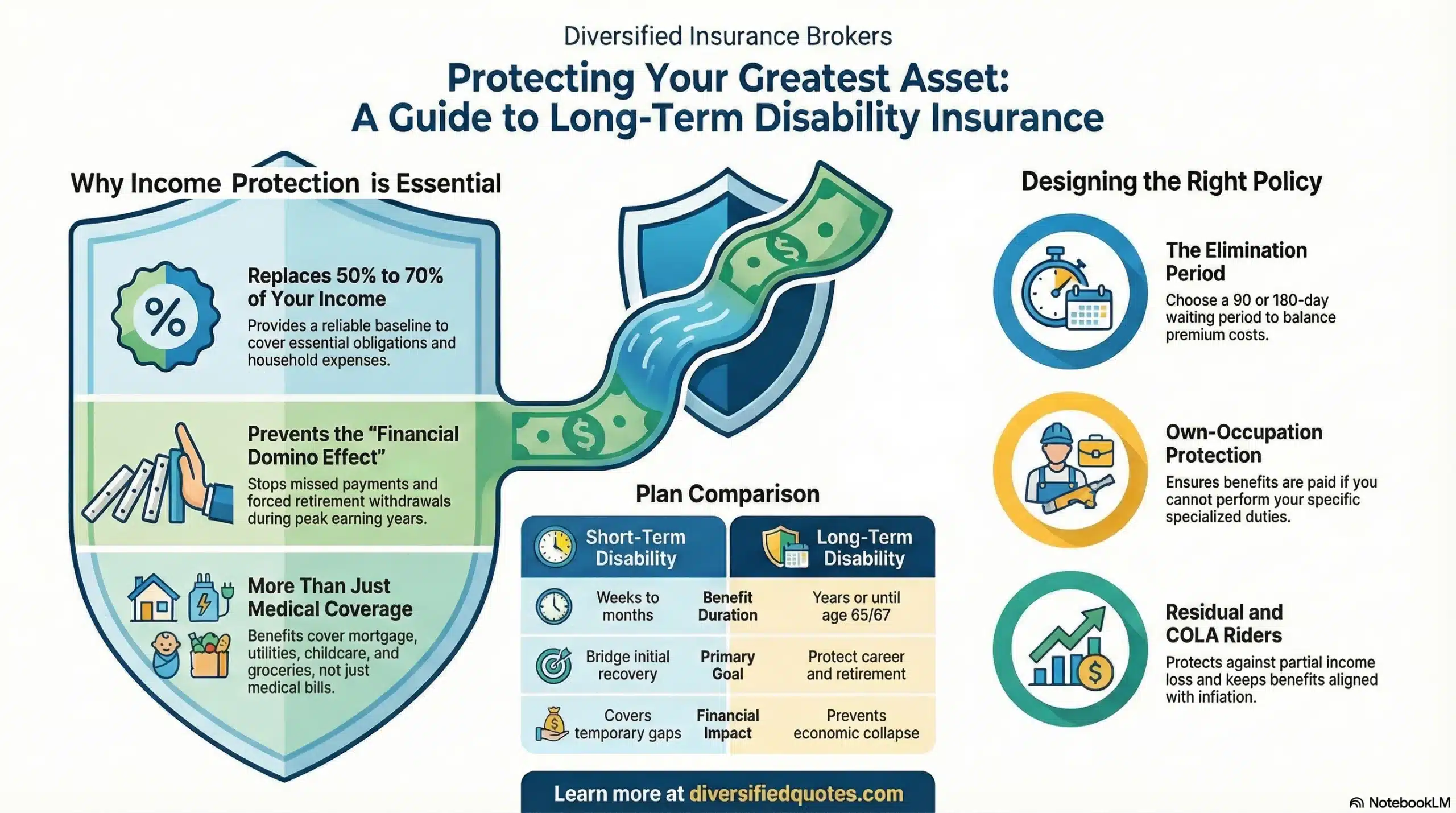
Talk With an Advisor Today
Choose how you’d like to connect—call or message us, then book a time that works for you.
Schedule here:
calendly.com/jason-dibcompanies/diversified-quotes
Licensed in all 50 states • Fiduciary, family-owned since 1980
Disability Insurance for Audiologists — FAQs
Audiology carries a disability risk dimension with almost no parallel in other clinical specialties: the possibility that an audiologist develops hearing loss significant enough to impair their clinical function — the very condition they diagnose and treat in patients. An audiologist’s own auditory acuity is a clinical tool. Conducting audiometric evaluations requires detecting patient behavioral responses during threshold testing. Counseling patients about hearing aids and hearing loss requires the communication clarity that significant, untreated hearing impairment can compromise. Hearing aid verification depends in part on the audiologist’s ability to interpret acoustic output. A progressive hearing condition that reaches the threshold of functional impairment in the clinical context — even if the audiologist could perform sedentary administrative work — constitutes an own-occupation disability that has no equivalent in most other healthcare specialties. Beyond this unique risk, audiologists also face fine motor disability risk from the precise manual work of hearing aid fitting and ear impression taking, cognitive disability risk from the diagnostic reasoning demands of audiogram interpretation and differential diagnosis, and psychiatric disability risk from the emotional demands of tinnitus counseling, pediatric hearing loss diagnosis, and cochlear implant rehabilitation.
Under a well-structured own-occupation disability policy, a hearing condition that impairs an audiologist’s ability to perform the material and substantial duties of their specific profession can qualify for benefits — even if the audiologist retains capacity for other types of work. The own-occupation disability definition asks whether the insured can perform the duties of their specific occupation, not whether they can perform any work. If progressive hearing impairment prevents an audiologist from accurately detecting patient audiometric responses, from counseling patients with the communication clarity audiology requires, or from performing the acoustic verification work that hearing aid fitting demands, those functional impairments to audiological practice constitute an own-occupation disability. A weaker any-occupation definition would deny benefits because the audiologist could theoretically perform sedentary administrative or non-clinical work. This is precisely the scenario where policy definition language determines whether coverage actually functions as income protection — and why the own-occupation definition is non-negotiable for audiologists evaluating disability insurance options.
The disability conditions most likely to affect a practicing audiologist span cognitive, fine motor, psychiatric, and auditory categories. Cognitive and neurological conditions — including stroke, traumatic brain injury, and neurological diseases affecting mental processing — impair the audiogram interpretation, differential diagnosis, and clinical reasoning that audiological practice requires. Fine motor conditions — essential tremor, carpal tunnel syndrome, arthritis affecting finger dexterity, and tendinitis — prevent the precise manual work of hearing aid fitting, ear impression taking, cochlear implant probe placement, and the small-scale equipment manipulation that audiology involves. Psychiatric conditions — including major depressive disorder, anxiety disorders, and burnout-related clinical diagnoses from working with emotionally challenging patient populations including tinnitus sufferers and families of children with profound hearing loss — can prevent the sustained patient-facing engagement and cognitive performance that clinical audiology demands. Progressive hearing impairment affecting clinical function is a uniquely audiological disability risk. Musculoskeletal conditions from sustained clinical positioning and the extended sedentary work of report writing and documentation round out the occupational health profile for this profession.
Most employer group disability plans leave material gaps for audiologists, even when the coverage is genuine and provided at no cost. The income gap is the most financially significant for audiologists earning at or above the $92,120 median: group plans typically replace 60 percent of base salary with monthly benefit caps — commonly $10,000 to $15,000 per month — that for higher-earning audiologists represent a meaningful shortfall from pre-disability income. The definition gap is equally important: many group plans transition from own-occupation to any-occupation or modified disability definitions after 24 months of a claim, which can eliminate benefits for an audiologist whose hearing loss or fine motor condition prevents audiology practice while leaving some sedentary work capacity intact. The portability gap means group coverage ends when employment ends — a real vulnerability for audiologists who move between practice settings, transition to private practice, or change healthcare employer organizations. Individual own-occupation supplemental coverage addresses all three gaps simultaneously.
For an audiologist, own-occupation disability insurance pays benefits when a condition prevents the specific duties of audiology practice — clinical audiometric evaluation, hearing aid fitting and programming, cochlear implant management, balance disorder assessment, and audiological counseling — regardless of whether the audiologist could perform other types of work. This definition matters most in the scenarios most specific to audiology: a hand tremor that prevents safe ear impression taking and hearing aid fitting; a hearing condition that impairs audiometric testing and patient counseling; a cognitive condition that prevents accurate audiogram interpretation and clinical diagnosis. In every one of those scenarios, the audiologist has lost the ability to generate income from their doctoral-level clinical specialty while retaining general function. An own-occupation policy recognizes that professional incapacity and pays benefits. An any-occupation policy denies them because the audiologist retains some general work capacity. For a professional who has invested four years in an Au.D. program specifically to practice this specialty, the own-occupation definition is the protection that makes the coverage meaningful.
Yes — for a private practice audiologist with meaningful fixed monthly operating costs, business overhead expense coverage is one of the most important financial protection decisions available alongside personal income replacement disability insurance. A private practice audiology clinic carries fixed costs that continue during a disability regardless of revenue: audiometric equipment calibration and maintenance contracts, soundproof testing booth lease or service costs, hearing aid manufacturer account minimums, professional liability insurance premiums, ASHA and AAA membership fees, state licensure renewal costs, and any staff or office costs. A personal income replacement policy covers the audiologist’s household expenses during disability. A business overhead expense policy covers the fixed practice costs that keep the clinic viable during the absence — so the audiologist returns to a functioning practice rather than a set of accumulated obligations that have collapsed the clinic infrastructure during the disability period. For a practice owner whose patient relationships, equipment contracts, and professional standing represent years of investment, preserving that infrastructure through disability is often as strategically important as replacing personal income.
Audiologists generally receive favorable to moderate occupational class ratings that reflect the primarily clinical, cognitive, and precision-skilled nature of the work — better than physical labor classifications and comparable to other doctoral-level healthcare professionals in clinic-based practice. The favorable classification means audiologists typically have access to own-occupation definitions, residual disability riders, and the fuller range of policy features that carriers reserve for better-classified occupations. The specific classification can vary slightly based on how the practice duty profile is described — an audiologist with significant administrative and practice management duties alongside clinical work may receive a more favorable classification than one in a purely high-volume clinical role. Compared to the nursing hierarchy (where CNAs receive lower physical-labor classifications and RNs receive mid-tier classifications), audiologists with doctoral credentials in a primarily clinical and cognitive specialty generally receive classification treatment comparable to other advanced-degree healthcare practitioners in non-surgical clinical settings.
The standard underwriting guideline targets 60 to 70 percent of gross monthly earned income as the appropriate individual disability benefit amount. For an audiologist earning the $92,120 BLS median, that produces a target benefit of approximately $4,600 to $5,400 per month. For audiologists earning above the median — particularly in private practice or high-demand markets — the benefit need is correspondingly higher. For employed audiologists with existing group disability coverage, the individual policy supplements the group plan to close the income gap between the capped group benefit and the actual income replacement target. For private practice audiologists without group coverage, the individual policy provides the full income replacement benefit as primary coverage, often complemented by a separate business overhead expense policy that covers fixed clinic costs. The right benefit amount is ultimately determined by actual monthly household obligations — not just a percentage applied to income — and ensuring that fixed expenses including any Au.D. student loan payments are fully covered during a disability period is an important sizing consideration.
It is one of the highest-impact financial planning decisions an audiologist can make at the early career stage — and the case for early application is stronger than it appears for reasons beyond just lower premium cost. Disability insurance premiums are based in part on age and health at the time of application, and younger applicants in good health secure the most comprehensive coverage at the most favorable rates. More specifically for audiologists, the conditions most likely to create occupational disability claims — hand conditions from clinical work, hearing changes from acoustic exposure or aging, cognitive and psychiatric conditions from demanding clinical environments — develop gradually over a career and appear in the medical record progressively rather than suddenly. An exclusion rider applied to a hand tremor that appears in the medical record at 45 eliminates coverage for exactly the disability scenario the audiologist most needs protection against. The own-occupation coverage secured at 30, before any of those conditions have been documented, remains comprehensive and fully applicable as those conditions develop in subsequent clinical years. The Au.D. degree represents a meaningful educational investment — protecting the income that investment generates should be a priority from the moment clinical practice begins.
Individual disability insurance for audiologists differs from employer group coverage in three dimensions that matter meaningfully in real claims. Definition strength: individual own-occupation policies maintain the stronger disability definition — paying benefits when audiology practice is impossible regardless of other work capacity — for the full benefit period. Group plans frequently weaken their definition after 24 months, potentially eliminating benefits for audiologists with long-term or permanent conditions who retain some general work capacity. Income replacement completeness: individual policies can be sized to approach the audiologist’s actual income, while group plans typically cap at a fixed monthly maximum that understates actual income for higher earners. Portability: individual policies travel with the audiologist through every career transition — from hospital employment to private practice, from one health system to another, through any employment change — while group coverage ends when the employment relationship ends. For audiologists whose careers are likely to involve transitions between settings over a 30-year practice horizon, the portability of individual coverage is not a minor technical feature but a fundamental protection that group coverage structurally cannot provide.
About the Author:
Jason Stolz, CLTC, CRPC, DIA, CAA and Chief Underwriter at Diversified Insurance Brokers (NPN 20471358), is a senior insurance and retirement professional with more than 25 years of real-world experience helping individuals, families, and business owners protect their income, assets, and long-term financial stability. As a long-time partner of the nationally licensed independent agency Diversified Insurance Brokers, Jason provides trusted guidance across multiple specialties—including fixed and indexed annuities, long-term care planning, personal and business disability insurance, life insurance solutions, Group Health, Travel Medical and Evacuation Insurance, and short-term health coverage. Diversified Insurance Brokers maintains active contracts with over 100 highly rated insurance carriers, ensuring clients have access to a broad and competitive marketplace.
His practical, education-first approach has earned recognition in publications such as VoyageATL, and contributions from his agency featured in Kiplinger and GoBankingRates— highlighting his commitment to financial clarity and client-focused planning. Drawing on deep product knowledge and years of hands-on field experience, Jason helps clients evaluate carriers, compare strategies, and build retirement and protection plans that are both secure and cost-efficient. Visitors who want to explore current annuity rates and compare options across multiple insurers can also use this annuity quote and comparison tool.
Explore More Disability Insurance Options: Browse our complete guide to Disability Insurance for Nursing, Therapy & Allied Health — covering nurses, therapists, dental hygienists, pharmacists, lab techs & allied health professionals from 100+ carriers.
Last Reviewed: May 9, 2026 |
Reviewed by: Jason Stolz, CLTC, CRPC, DIA, CAA
Chief Underwriter, Diversified Insurance Brokers, Inc. | NPN: 20471358 | Diversified Insurance Brokers, Inc. — Licensed in all 50 states
Fact Checked by: Tonia Pettitt, CMIP©
Medicare Specialist, Diversified Insurance Brokers, Inc. | NPN: 14374308 | Diversified Insurance Brokers, Inc. — Licensed in all 50 states
Did you find this content helpful? Leave us a Google review — it helps others find trustworthy guidance too.
Editorial Standards: Diversified Insurance Brokers maintains rigorous editorial standards to ensure accuracy, clarity, and independence in all content. Learn more about our editorial standards and commitment to transparency.
