
Minimum Group Health Employer Contribution
As an Independent Group Health Insurance Broker, we compare fully insured, level-funded, and self-funded options across carriers to find the lowest cost coverage for your business.
Minimum Group Health Employer Contribution

Jason Stolz CLTC, CRPC, DIA, CAA
If you are a business owner trying to set up group health insurance, one of the first questions a carrier will ask is how much you intend to contribute toward your employees’ premiums — and the answer is not entirely up to you. Insurance carriers impose a minimum employer contribution requirement, and meeting it is a condition of getting a group plan approved at all. At Diversified Insurance Brokers, we walk employers through this requirement constantly, because it catches people off guard and it directly shapes what a plan will cost your business. The short version is this: most carriers require the employer to pay at least half of the employee-only premium, and that requirement exists alongside a separate participation rule for a specific reason. Understanding both — what the minimum actually is, why it exists, what it does and does not apply to, and how it interacts with participation — is what lets you plan your benefits budget accurately rather than discovering a problem after you have already made promises to your team.
Setting up group coverage and need to know what you’ll be required to contribute? Let us map it out for your business.
Request a Group Health Review
The minimum employer contribution is one of two gatekeeping requirements that carriers use to decide whether a group qualifies for coverage, the other being minimum participation. They work as a pair, and neither makes complete sense without the other. The contribution requirement sets a floor on how much of the premium the employer must pay; the participation requirement sets a floor on how many eligible employees must actually enroll. Both exist to solve the same underlying problem, and both are conditions you have to satisfy to get and keep a group plan. This page focuses on the contribution side while explaining how it connects to participation, because in practice you cannot plan around one without understanding the other.
Throughout, one caveat applies and it is important: the specific percentages and rules vary by carrier and by state, and they can change. The figures on this page reflect the common industry standards, but your actual requirement depends on the carriers available in your state and the specific plans you are considering. Treat what follows as the framework for understanding how this works, and confirm the exact numbers for your situation before you build your budget around them. That verification is a normal part of setting up a plan, and it is one of the things a broker handles for you.
What the Minimum Contribution Actually Is
The most common minimum employer contribution requirement is that the employer pays at least fifty percent of the cost of employee-only coverage. That is the figure you will encounter most often across carriers and states, and it is the reasonable default to plan around unless you have confirmed otherwise.
Two details in that sentence carry a lot of weight and are worth pulling apart carefully. First, the requirement is generally based on the employee-only premium — the cost of covering the individual worker, not the cost of covering their family. This distinction matters enormously for your budget, and we cover its implications in the dependent section below. Second, fifty percent is a common floor, not a universal rule. Some carriers require more, and some states set their own minimums. In the other direction, some carriers offer more flexible arrangements, occasionally allowing an employer to satisfy the requirement by contributing a fixed dollar amount per employee rather than a strict percentage, which can be a useful structure for certain businesses. The specific options open to you depend on which carriers operate in your market.
It is also worth understanding that the contribution requirement is a minimum, not a target. Many employers choose to contribute well above fifty percent — sometimes covering the entire employee-only premium — because a stronger contribution is a powerful recruiting and retention tool and because it directly affects whether employees actually enroll, which ties back to the participation requirement. How much to contribute above the minimum is a genuine strategic decision that balances your benefits budget against your ability to attract and keep good people, and it is one of the core questions we help employers think through. Our overview of group health insurance cost for small business covers how contribution levels flow through to your total expense.
Why the Requirement Exists
The minimum contribution requirement can feel like an arbitrary imposition when you first encounter it, but it exists to solve a real and specific problem, and understanding that problem makes the whole structure of group insurance clearer.
The problem is called adverse selection. Insurance works by spreading risk across a broad pool of people — the healthy and the sick together — so that the premiums of the many cover the claims of the few. That math only works if the pool actually contains a representative mix of health profiles. The danger is a scenario where only the employees who expect to have high medical costs bother to enroll, while the healthy ones opt out. A pool made up disproportionately of people who need expensive care is financially unsustainable, and it would drive premiums to levels that would collapse the plan.
The employer contribution is one of the main tools that prevents this. When the employer pays a substantial share of the premium, coverage becomes affordable enough that healthy employees enroll too, not just those anticipating large claims. A meaningful contribution effectively lowers the price to the employee to the point where signing up is an easy decision for everyone, which keeps the risk pool balanced. If the employer contributed nothing or very little, only the employees who were certain they would use the coverage would pay for it, the pool would skew toward high claims, and the carrier’s pricing assumptions would break down.
This is also why the contribution requirement is inseparable from the participation requirement. The two are the carrier’s paired defenses against adverse selection: the contribution ensures coverage is affordable enough to attract a broad group, and the participation threshold confirms that a broad group actually enrolled. One without the other does not accomplish the goal, which is why carriers check both before approving a plan and why understanding them together is essential. Our discussion of the primary reasons to buy group health insurance touches on how this risk-pooling logic benefits everyone in the group.
Contribution and Participation Requirements Compared
| Requirement | Common Standard | What It Measures | Why It Matters |
|---|---|---|---|
| Minimum Contribution | Often at least 50% of the employee-only premium. | How much of the premium the employer pays. | Keeps coverage affordable so healthy employees enroll. |
| Minimum Participation | Commonly around 70% of eligible employees. | How many eligible employees enroll. See the employee minimum. | Confirms a broad group actually signed up. |
| Applies To Dependents? | Contribution generally not required for dependents. | Coverage cost for spouses and children. | Employer can choose whether to contribute for family. |
| Waiver Handling | Those with other coverage usually excluded from the count. | Employees who decline for a valid reason. | Makes participation easier to meet than it first appears. |
| Annual Relief Window | A year-end window often waives both requirements. | A special enrollment period late in the year. | Lets groups that fall short still obtain coverage. |
Not sure whether your business meets the contribution and participation thresholds? We’ll check before you commit.
Check Your Eligibility
The Dependent Distinction That Protects Your Budget
One of the most important and most reassuring facts about the minimum contribution requirement is what it does not cover: dependents. The requirement to contribute at least half of the premium generally applies only to the employee’s own coverage, not to coverage for their spouse or children. Whether you contribute anything toward dependent premiums is typically your choice.
This distinction has real financial consequences, because family coverage is substantially more expensive than employee-only coverage. If the contribution requirement applied to full family premiums, the cost of offering group health would be dramatically higher and would put coverage out of reach for many small businesses. Because it applies only to the employee-only tier, you can offer a compliant, attractive group plan while retaining control over the much larger question of how much, if anything, to contribute toward dependents.
In practice this gives employers a valuable lever. A business can meet its obligation by covering the required share of employee-only premiums, and then decide separately — based on its budget and its benefits strategy — whether to contribute toward dependent coverage as well. Some employers contribute generously toward family coverage as a competitive benefit; others cover only the employee and let employees pay the full additional cost to add family members. Both approaches are compliant, and the right choice depends on your workforce and your goals. This flexibility is one of the reasons group coverage remains achievable for smaller employers, and it is a key part of the planning we do when helping a business structure its group health plan for employees.
How Contribution and Participation Work Together
Because these two requirements are so tightly linked, it is worth walking through exactly how they interact, since this is where employers most often get tripped up and where a knowledgeable broker adds the most value.
The participation requirement — commonly that around seventy percent of eligible employees enroll — is directly affected by how much you contribute. The reason is simple: the more you contribute, the less each employee pays, and the more likely they are to enroll. A generous contribution makes signing up easy, which pushes your participation rate up and helps you clear that threshold comfortably. A minimal contribution makes coverage expensive for employees, which suppresses enrollment and can leave you failing to meet participation even if you technically satisfied the contribution minimum. In other words, contributing only the bare minimum can create a participation problem, and the two requirements have to be planned together rather than in isolation.
There is an important piece of relief built into the participation math that makes it more achievable than it first appears. Employees who decline coverage because they already have other qualifying coverage — most commonly through a spouse’s employer plan, or through Medicare or Medicaid — are typically excluded from the participation calculation. They do not count against you. This means the seventy percent threshold is generally measured against the employees who genuinely need your coverage, not against your entire headcount, which makes it considerably easier to meet than a raw percentage of all employees would suggest. Understanding this exclusion correctly is often the difference between a business believing it cannot qualify and discovering that it comfortably can. Our overview of the minimum employees required for group health insurance covers how these layered qualifications work in detail.
There is also a valuable annual exception worth knowing about. Many carriers observe a special enrollment window late in the calendar year during which groups that cannot meet the standard participation and contribution requirements are permitted to enroll anyway. For a business that falls just short of the thresholds during the rest of the year, this window can be the path to getting coverage in place. It is exactly the kind of timing detail that a broker tracks and that an employer navigating this alone would rarely know to look for.
What Happens If You Cannot Meet the Requirement
Not every business can comfortably meet the minimum contribution and participation requirements, and if that describes your situation, it is genuinely useful to know that a traditional group plan is not your only option. The requirements exist for traditional group insurance specifically, and there are alternatives structured entirely differently.
The most significant alternatives replace the traditional group model with an arrangement in which the employer reimburses employees for individual coverage rather than purchasing a single group policy. Because employees obtain their own individual plans, these arrangements are not bound by the same participation and contribution thresholds that govern traditional group insurance — the adverse-selection concern is managed differently. For a business that cannot meet the traditional requirements, or that simply wants more control over its costs, these can be a compelling path. Our overview of ACA alternatives for company healthcare covers the landscape of options beyond traditional group coverage.
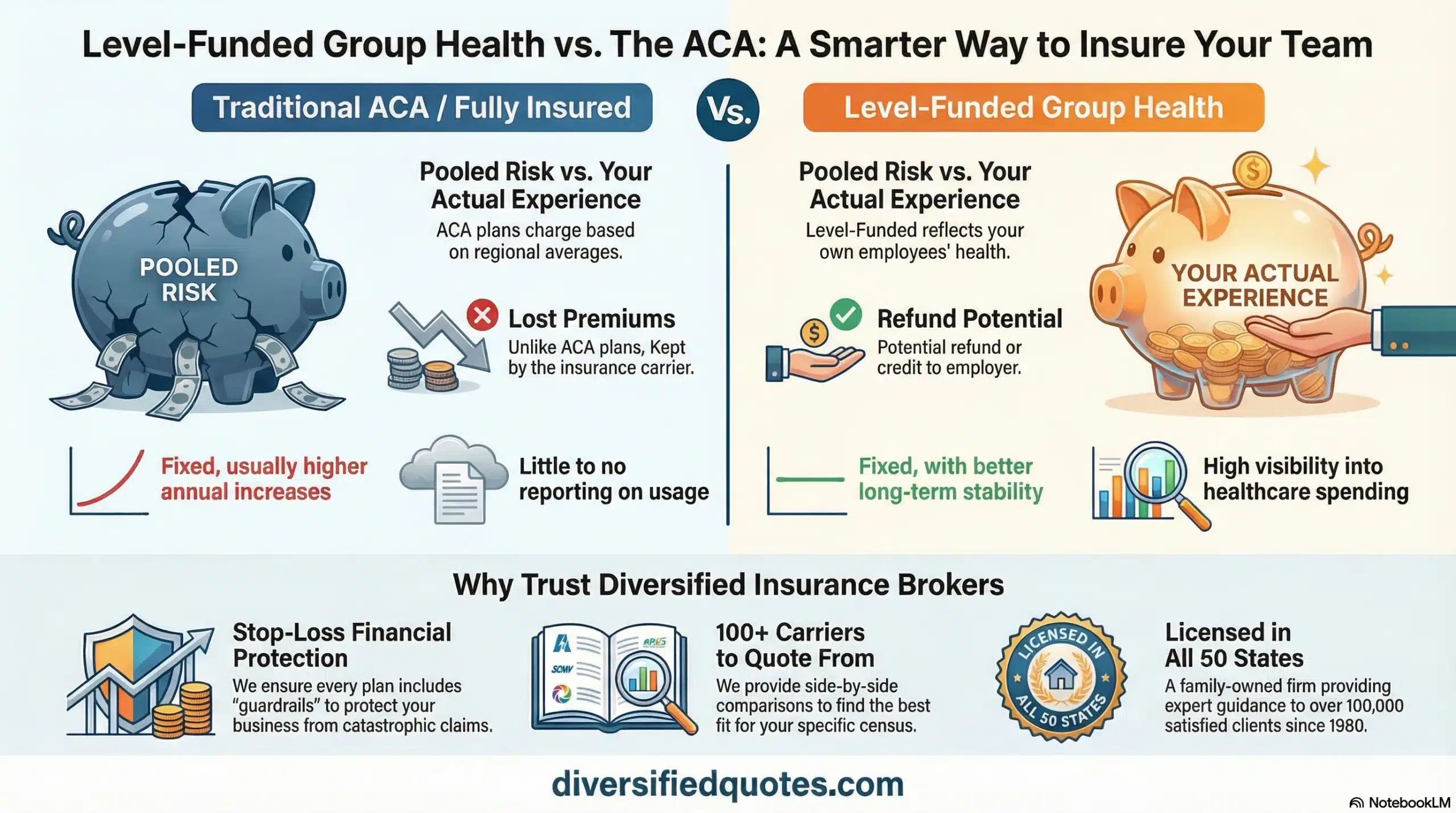
There are also different funding structures within the group world worth understanding. Level-funded plans and self-funded group health arrangements approach the economics of covering a workforce differently from a fully-insured group plan, and for some employers they offer both cost advantages and more flexibility. And for temporary gaps — a business in transition, or an employee waiting for coverage to begin — short-term health insurance can bridge the interval. The point is that a difficulty meeting traditional group requirements is a reason to explore the alternatives, not a dead end, and identifying the right structure for a specific business is precisely what an independent broker does.
Planning Your Contribution Strategically
Once you understand the mechanics, the minimum contribution stops being a compliance hurdle and becomes a strategic decision. The question is not merely “what is the least I can pay,” but “what contribution level actually serves my business,” and those can be very different answers.
Contributing only the minimum keeps your immediate benefits cost as low as possible, but it carries hidden costs. It raises the price to employees, which can suppress participation and jeopardize the plan, and it makes your benefits package less competitive at a time when health coverage is one of the most valued things a job can offer. Contributing above the minimum costs more up front but tends to drive higher enrollment, strengthen your participation position, and make your business more attractive to the people you are trying to hire and keep. For many employers, a contribution somewhat above the floor is the sweet spot — high enough to drive strong participation and serve as a genuine recruiting tool, without overextending the budget.
The right level depends on your specific circumstances: your budget, your workforce, the local labor market you are competing in, and your broader benefits strategy. A business competing hard for skilled talent may contribute generously as a deliberate advantage; a business with tight margins may contribute closer to the minimum and rely on other strengths. There is no universally correct answer, which is exactly why this is a decision worth making deliberately rather than defaulting to the minimum because it is the number the carrier put in front of you. Our guidance on choosing the right group health plan and on getting the best group health rates works through how contribution fits into the larger picture of building a plan that fits both your budget and your goals.
How We Help Employers Get This Right
The minimum contribution requirement is one of those things that seems simple on the surface — pay at least half — but has enough moving parts underneath that getting it wrong can cost you a plan or a budget. That is where working with an independent broker earns its value.
What we actually do is start with your specific situation: your headcount, how many employees have other coverage, your budget, and what you are trying to accomplish with benefits. From there we confirm the actual contribution and participation requirements of the carriers available in your state — not the general figures on this page, but the specific numbers that apply to your plans — so you are planning against reality. We model how different contribution levels affect both your cost and your likely participation, so you can see the trade-off clearly rather than guessing. And we flag the details that matter: the dependent distinction that protects your budget, the waiver exclusions that make participation easier to meet, and the annual enrollment window that can rescue a group that falls short.
When a traditional group plan is not the best fit — because you cannot comfortably meet the requirements, or because a different structure would serve you better — we tell you that and show you the alternatives, whether that is a reimbursement-based arrangement, a level-funded or self-funded structure, or another approach entirely. Because we are independent and represent many carriers and options rather than being tied to one, our recommendation reflects what genuinely fits your business, which is the core of why working with an independent group health broker produces better outcomes. And if you already have a plan and want to know whether your contribution strategy is serving you well, our second-opinion review will tell you honestly. Our answers to the top questions employers ask about group health insurance cover the rest of what comes up when setting up coverage.
Ready to build a contribution strategy that meets the requirements and fits your budget?
Get Your Free Group Health Review
Financial Protection Essentials
Explore ancillary employee benefits and specialty coverage across occupations we serve.
Talk With an Advisor Today
Choose how you’d like to connect—call or message us, then book a time that works for you.
Schedule here:
calendly.com/jason-dibcompanies/diversified-quotes
Licensed in all 50 states • Fiduciary, family-owned since 1980
What is the minimum an employer has to contribute to group health insurance?
The most common requirement is that the employer pays at least fifty percent of the cost of employee-only coverage. That is the figure you will encounter most often across carriers and states, and it is the reasonable default to plan around unless you have confirmed otherwise. Two details in that carry real weight. First, the requirement is generally based on the employee-only premium — the cost of covering the individual worker, not the cost of covering their family — which protects your budget considerably, since family coverage is much more expensive. Second, fifty percent is a common floor rather than a universal rule: some carriers require more, some states set their own minimums, and in the other direction some carriers offer flexibility, occasionally allowing an employer to satisfy the requirement with a fixed dollar amount per employee rather than a strict percentage. The specific options open to you depend on the carriers operating in your market. It is also important to understand that the contribution requirement is a minimum, not a target — many employers contribute well above fifty percent, sometimes covering the entire employee-only premium, because a stronger contribution drives higher enrollment and serves as a powerful recruiting and retention tool. Because the exact percentages and rules vary by carrier and state and can change, confirm the specific requirement for your situation before building your budget around it. Our overview of group health cost for small business covers how contribution flows through to your total expense.
Why do carriers require a minimum employer contribution?
The requirement exists to prevent a problem called adverse selection. Insurance works by spreading risk across a broad pool that includes both healthy and sick people, so that the premiums of the many cover the claims of the few — but that math only works if the pool contains a representative mix of health profiles. The danger is a scenario where only the employees who expect high medical costs enroll while the healthy ones opt out, producing a pool skewed toward expensive claims that would drive premiums to unsustainable levels. The employer contribution is one of the main tools that prevents this. When the employer pays a substantial share of the premium, coverage becomes affordable enough that healthy employees enroll too, not just those anticipating large claims, which keeps the risk pool balanced. If the employer contributed little or nothing, only employees certain they would use the coverage would pay for it, and the carrier’s pricing assumptions would break down. This is also why the contribution requirement is inseparable from the participation requirement: the two are the carrier’s paired defenses against adverse selection. The contribution ensures coverage is affordable enough to attract a broad group, and the participation threshold confirms that a broad group actually enrolled. One without the other does not accomplish the goal, which is why carriers check both before approving a plan. Our discussion of the primary reasons to buy group health insurance covers how this risk-pooling benefits everyone.
Does the employer have to contribute toward dependents and family coverage?
Generally no, and this is one of the most important and most reassuring facts about the requirement. The obligation to contribute at least half of the premium typically applies only to the employee’s own coverage, not to coverage for their spouse or children. Whether you contribute anything toward dependent premiums is usually your choice. This distinction has real financial consequences, because family coverage is substantially more expensive than employee-only coverage. If the contribution requirement applied to full family premiums, the cost of offering group health would be dramatically higher and would put coverage out of reach for many small businesses. Because it applies only to the employee-only tier, you can offer a compliant, attractive group plan while retaining control over the much larger question of how much, if anything, to contribute toward dependents. In practice this gives employers a valuable lever: you can meet your obligation by covering the required share of employee-only premiums, then decide separately — based on your budget and benefits strategy — whether to contribute toward dependent coverage. Some employers contribute generously toward family coverage as a competitive benefit; others cover only the employee and let workers pay the full additional cost to add family members. Both approaches are compliant, and the right choice depends on your workforce and goals. This flexibility is a key part of what we plan when helping a business structure its group health plan for employees.
How does the contribution requirement relate to participation?
They are tightly linked and have to be planned together. The participation requirement — commonly that around seventy percent of eligible employees enroll — is directly affected by how much you contribute. The more you contribute, the less each employee pays, and the more likely they are to enroll. A generous contribution makes signing up easy, which pushes participation up and helps you clear the threshold comfortably. A minimal contribution makes coverage expensive for employees, suppresses enrollment, and can leave you failing to meet participation even if you technically satisfied the contribution minimum. In other words, contributing only the bare minimum can create a participation problem. There is important relief built into the participation math, though: employees who decline coverage because they already have other qualifying coverage — most commonly through a spouse’s employer plan, or through Medicare or Medicaid — are typically excluded from the participation calculation and do not count against you. This means the seventy percent threshold is generally measured against the employees who genuinely need your coverage, not your entire headcount, which makes it much easier to meet than a raw percentage would suggest. There is also a valuable annual exception: many carriers observe a special enrollment window late in the calendar year during which groups that cannot meet the standard participation and contribution requirements are permitted to enroll anyway. Our overview of the minimum employees for group health insurance covers these layered qualifications in detail.
What if my business cannot meet the minimum contribution requirement?
A traditional group plan is not your only option, and a difficulty meeting the requirements is a reason to explore alternatives rather than a dead end. The most significant alternatives replace the traditional group model with an arrangement in which the employer reimburses employees for individual coverage rather than purchasing a single group policy. Because employees obtain their own individual plans, these arrangements are not bound by the same participation and contribution thresholds that govern traditional group insurance — the adverse-selection concern is managed differently. For a business that cannot meet the traditional requirements, or that simply wants more control over costs, these can be a compelling path, and our overview of ACA alternatives for company healthcare covers the landscape. There are also different funding structures within the group world worth understanding: level-funded plans and self-funded group health arrangements approach the economics of covering a workforce differently from a fully-insured plan, and for some employers they offer both cost advantages and more flexibility. For temporary gaps — a business in transition, or an employee waiting for coverage to begin — short-term health insurance can bridge the interval. The point is that the requirements exist for traditional group insurance specifically, and identifying the right structure for a particular business is exactly what an independent broker does. If the traditional route is genuinely a poor fit for you, there is very likely a better one.
About the Author:
Jason Stolz, CLTC, CRPC, DIA, CAA and Chief Underwriter at Diversified Insurance Brokers (NPN 20471358), is a senior insurance and retirement professional with more than 25 years of real-world experience helping individuals, families, and business owners protect their income, assets, and long-term financial stability. As a long-time partner of the nationally licensed independent agency Diversified Insurance Brokers, Jason provides trusted guidance across multiple specialties—including fixed and indexed annuities, long-term care planning, personal and business disability insurance, life insurance solutions, Group Health, Travel Medical and Evacuation Insurance, and short-term health coverage. Diversified Insurance Brokers maintains active contracts with over 100 highly rated insurance carriers, ensuring clients have access to a broad and competitive marketplace.
His practical, education-first approach has earned recognition in publications such as VoyageATL, and contributions from his agency featured in Kiplinger and GoBankingRates— highlighting his commitment to financial clarity and client-focused planning. Drawing on deep product knowledge and years of hands-on field experience, Jason helps clients evaluate carriers, compare strategies, and build retirement and protection plans that are both secure and cost-efficient. Visitors who want to explore current annuity rates and compare options across multiple insurers can also use this annuity quote and comparison tool.
Explore More Group Health Insurance Options: Browse our complete guide to Small Business Group Health Insurance — covering getting started, costs, how to set up, best rates & working with a broker from 100+ carriers.
Last Reviewed: July 27, 2026 |
Reviewed by: Jason Stolz, CLTC, CRPC, DIA, CAA
Chief Underwriter, Diversified Insurance Brokers, Inc. | NPN: 20471358 | Diversified Insurance Brokers, Inc. — Licensed in all 50 states
Fact Checked by: Tonia Pettitt, CMIP©
Medicare Specialist, Diversified Insurance Brokers, Inc. | NPN: 14374308 | Diversified Insurance Brokers, Inc. — Licensed in all 50 states
Did you find this content helpful? Leave us a Google review — it helps others find trustworthy guidance too.
Editorial Standards: Diversified Insurance Brokers maintains rigorous editorial standards to ensure accuracy, clarity, and independence in all content. Learn more about our editorial standards and commitment to transparency.
