
How to get the Best Group Health Insurance Rates
As an Independent Group Health Insurance Broker, we compare fully insured, level-funded, and self-funded options across carriers to find the lowest cost coverage for your business.
How to get the Best Group Health Insurance Rates

Jason Stolz CLTC, CRPC, DIA, CAA
Getting the best group health insurance rates requires understanding that “best rates” is not synonymous with “lowest premium.” A fully insured plan with a low renewal quote that hides poor plan design, limited network access, and no claims transparency can cost an employer far more over a three-year period than a level-funded plan with a slightly higher initial quote that provides refund potential, data visibility, and genuine carrier competition at renewal. The strategies that produce the most favorable long-term group health economics involve funding structure selection, proactive workforce management, competitive carrier placement, and ongoing plan governance — not simply price shopping at renewal time. At Diversified Insurance Brokers, Jason Stolz, CLTC, CRPC, DIA, CAA, works with employers across all fifty states and more than one hundred carrier relationships to apply each of these strategies systematically, producing results that employers who work with single-carrier captive agents or who renew passively year over year consistently cannot achieve.
The scale of the rate challenge is clear from the data. According to KFF’s 2025 Employer Health Benefits Survey, the average premium for family coverage reached $26,993 annually, a six percent increase over the prior year — and a twenty-four percent increase over five years. Early market forecasts suggest further increases ahead, driven by prescription drug cost escalation, GLP-1 medication coverage expansion, and persistent hospital pricing pressures. Employers who approach this environment without a proactive cost strategy will absorb these increases passively. Employers who implement the strategies in this guide can structurally reduce their exposure to the annual renewal cycle and build a more predictable, defensible health benefits cost structure over time.
Get a Competitive Group Health Insurance Rate Comparison
See what multiple carriers actually quote for your group — with full plan design, funding structure, and renewal stability comparison.
Strategy One: Switch to Level Funding
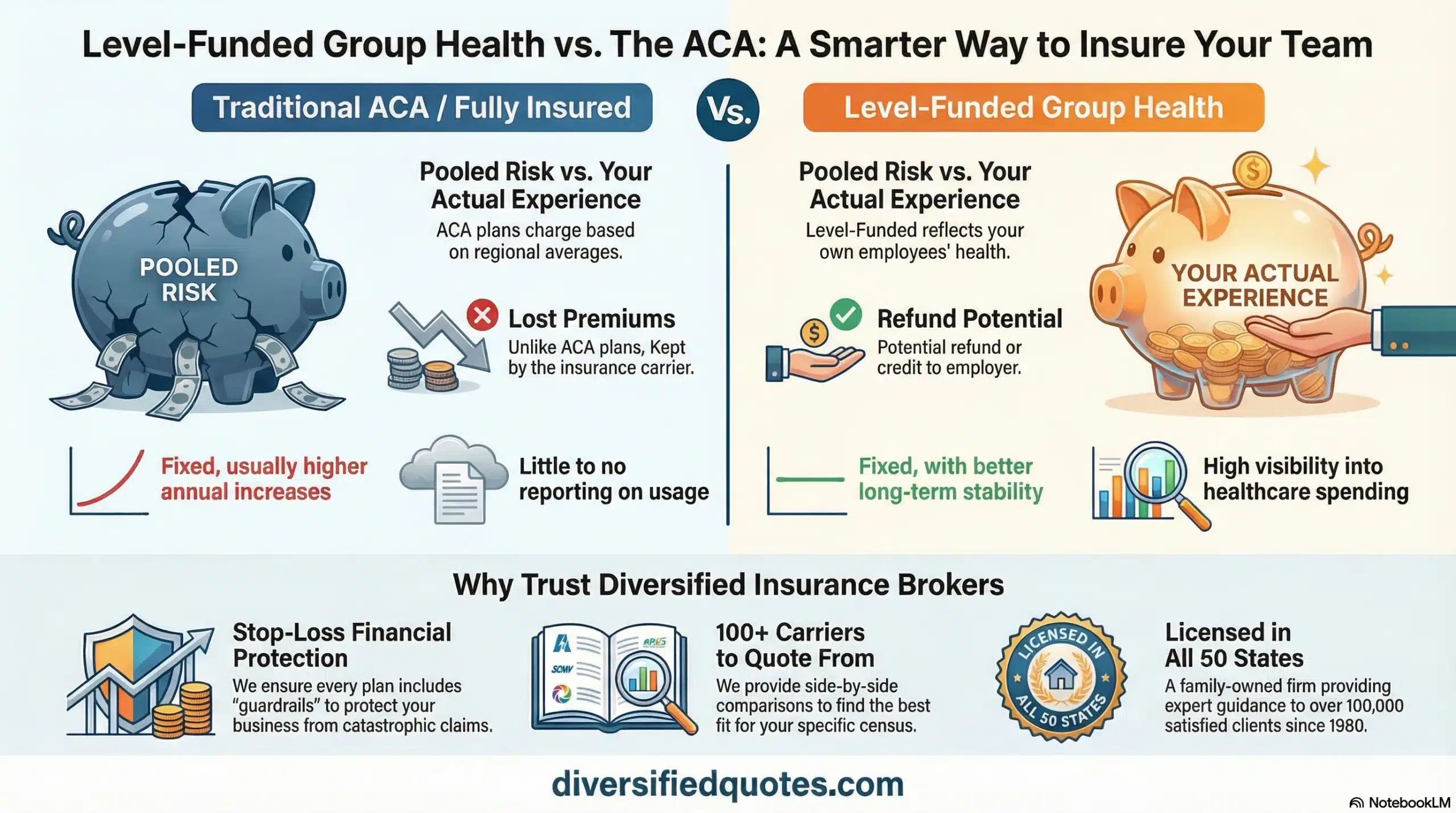
The single most impactful rate strategy available to most small and mid-size employers is moving from a fully insured plan to a level-funded structure. This is not a minor administrative change — it is a structural shift in who bears the financial risk of employee health claims and who benefits when a group has a good health year. In a fully insured plan, the carrier captures the upside of a healthy year. In a level-funded plan, the employer captures it as a year-end refund. According to UnitedHealthcare data, employers on level-funded structures paid an average of approximately nineteen percent less than comparable fully insured groups — representing real, recurring savings that compound over multiple plan years for groups that maintain favorable claims experience.
Level funding produces three distinct rate advantages. First, underwriting is group-specific rather than community-rated — a group with a healthy workforce is priced on that group’s actual expected claims, not on an average that includes unhealthy groups in the same rating pool. Second, ERISA preemption of state insurance law exempts level-funded plans from certain state premium taxes and state-mandated benefit requirements that apply to fully insured plans, directly reducing the cost base. Third, claims data transparency allows the employer to identify specific cost drivers — high-cost specialty drugs, emergency room over-utilization, specific chronic condition populations — and implement targeted interventions that reduce future claims and therefore future renewal rates. Our resource on why group level funding works covers the mechanics in full, and the resource on whether small groups can get health insurance refunds addresses the refund potential specifically. According to KFF’s 2025 survey, thirty-seven percent of covered workers at small firms with ten to one hundred ninety-nine employees are now enrolled in level-funded arrangements — a dramatic increase from seven percent in 2019 that reflects genuine market adoption rather than a niche strategy.
Strategy Two: Run a True Competitive Market Comparison
Renewal pricing from a current carrier is not a market rate — it is a renewal quote from one provider that has been managing your group for at least a year. Carriers consistently price renewals higher than competitive new business quotes for the same coverage specifications, because they know that switching costs and inertia favor the incumbent. An employer who accepts a renewal without running a competitive market analysis is almost certainly overpaying relative to what the same or better coverage would cost from a competitive carrier at new business rates.
A genuine competitive market analysis requires submitting the same benefit specifications — identical plan design, deductible structures, network type, and contribution strategy — to multiple carriers simultaneously and comparing the results on a truly apples-to-apples basis. The challenge for most employers is that running this analysis requires access to multiple carriers, knowledge of which carriers price favorably for specific group demographics, and the ability to evaluate not just current premium but renewal history, financial strength, and claims administration quality. This is precisely what an independent broker provides that a captive agent or single-carrier platform cannot. Our resource on finding the best independent group health broker explains the broker selection criteria, and the second opinion on group health insurance service applies this market analysis to any employer’s existing coverage situation.
Strategy Three: Optimize Workforce Participation
Group health insurance pricing is partly a function of who enrolls. Carriers require minimum participation thresholds — typically seventy percent of eligible employees — before issuing a group policy, because plans with low participation tend to experience adverse selection: primarily the employees who most need coverage enroll, which drives up the group’s average claims cost. But participation also affects the per-employee economics of premium allocation. A group with high participation spreads fixed administrative costs and stop-loss premiums across more members, reducing the effective cost per enrolled employee.
Strategies that drive participation include employer contribution levels that make the employee’s cost-share genuinely affordable (a $0 or near-$0 employee-only premium produces near-universal participation), simplified enrollment processes that reduce administrative friction, clear communication of benefit value that helps employees understand what they are receiving, and plan designs with low-cost primary care access that make the coverage immediately useful rather than only valuable in emergencies. Wellness program integration can also support participation by making the health plan feel like an active health investment rather than a passive insurance product. According to KFF’s 2025 survey, seventy-six percent of eligible employees at offering firms enrolled in coverage — a rate that can meaningfully differ across groups based on contribution strategy and plan design.
Rate Optimization Strategies: What Each Lever Actually Delivers
| Strategy | Mechanism | Typical Impact | Best For |
|---|---|---|---|
| Switch to level funding | Risk-specific underwriting replaces community rating; year-end refund replaces carrier profit on low-claim years | ~19% savings vs. fully insured (UHC data); refund potential up to 30% of claims fund in good years | Groups with 5–200 employees; relatively healthy workforce demographics |
| Competitive market comparison | New business pricing from competing carriers typically undercuts incumbent renewal by 10–20% | 10–20% premium reduction in first year; ongoing leverage at renewal prevents compounding increases | Any group that has not run a multi-carrier comparison in the past 12–18 months |
| Increase workforce participation | Broader risk pool lowers average claims per enrolled member; reduces adverse selection penalty | Improves underwriting favorability; reduces per-member cost allocation | Groups with participation below 80%; groups with high employee cost-share creating enrollment barriers |
| Wellness and preventive care programs | Reduced chronic condition prevalence and emergency utilization lowers claims; improves renewal experience | $2,400+ per employee annually in reduced claims and productivity improvement (high-engagement programs) | Groups with level-funded or self-funded arrangements where claims data enables targeted programs |
| Plan design calibration | Higher deductible or HDHP structures reduce premium while preserving catastrophic protection; HSA integration adds tax benefit | 5–15% premium reduction; HSA contributions create additional tax advantage offsetting higher cost-share | Younger, healthier workforces; employers seeking to share cost responsibility with employees without eliminating coverage |
| Renewal timing and preparation | Beginning renewal evaluation 90–120 days before expiration gives time to run competitive analysis and negotiate from information advantage | Prevents forced acceptance of incumbent renewal under time pressure; enables carrier switching if warranted | All groups; most valuable for groups that have historically renewed at the last minute |
Strategy Four: Use Claims Data to Drive Renewal Leverage
For employers on level-funded or self-funded arrangements, monthly claims data is the most valuable tool in renewal rate negotiation. When a group’s actual claim experience is better than the carrier’s initial underwriting assumptions — which happens regularly for healthy groups — that data provides concrete justification for a flat renewal or a rate reduction rather than accepting the carrier’s default renewal increase request. An employer who arrives at renewal knowing their loss ratio, their high-cost claimant activity, their emergency versus preventive care split, and their prescription drug cost drivers is in a fundamentally different negotiating position than an employer who simply receives a renewal notice with a twelve percent rate increase and accepts or rejects it.
This claims data advantage is one of the structural benefits of level funding that fully insured employers never access. Fully insured carriers hold the claims data and are not required to share it with the employer in meaningful detail. A level-funded employer receives monthly reports and can track the claims performance metrics that matter for renewal: medical loss ratio, high-cost claimant count and trend, pharmacy utilization, and emergency room versus urgent care split. When this data shows favorable experience, it supports a data-backed case for competitive renewal pricing that neither the incumbent carrier nor competing carriers can easily refute. Our resource on what self-funded group health insurance is covers the data transparency advantage in detail, and the resource on the pros and cons of self-funded group health addresses when this approach is most appropriate.
Strategy Five: Calibrate Plan Design for Cost-Efficiency
Plan design calibration — adjusting deductibles, copayment structures, out-of-pocket maximums, and network configuration — is a direct premium lever that employers often overlook because they are focused on the contribution percentage rather than the underlying plan structure. Moving from a plan with a $750 individual deductible to one with a $1,500 individual deductible typically produces a five to ten percent premium reduction while maintaining the same catastrophic protection ceiling through the out-of-pocket maximum. That premium reduction may represent several hundred dollars per employee per year — and if it is paired with an employer-funded Health Savings Account contribution that offsets most of the incremental deductible exposure for employees, the net employee experience is similar or better while the employer’s total cost is lower.
Network configuration is the other significant plan design lever. Narrow network plans — which restrict provider access to a smaller set of high-efficiency providers — typically carry premiums ten to twenty percent lower than broad PPO networks covering the same benefit design. For workforces concentrated in geographic areas with strong narrow-network options, this can be a meaningful savings lever without materially reducing the access employees actually use. Our resource on how to choose the right group health plan covers plan design decision-making in detail, and the resource on group health insurance cost for small business provides benchmarks for evaluating whether current plan design costs are in line with market alternatives.
Strategy Six: Time the Market Strategically
Renewal timing is a rate strategy that most employers ignore. Carriers price group health renewals based on the group’s current experience, current market conditions, and the carrier’s own book of business dynamics. Beginning the renewal evaluation process ninety to one hundred twenty days before the plan’s expiration date — rather than the typical thirty to sixty days — provides the time needed to run a genuine competitive market analysis, obtain new-business quotes from multiple carriers, and present the incumbent with a credible alternative that motivates competitive renewal pricing rather than default increases.
Employers who initiate renewal review in the final thirty days before expiration have almost no leverage. The administrative lead time required to switch carriers, process new enrollment, and communicate plan changes to employees makes a last-minute switch impractical — a fact the incumbent carrier knows and relies on. Building a twelve-month planning calendar that puts the renewal evaluation on the agenda four months before expiration, assigns responsibility for document gathering and carrier outreach, and establishes a decision timeline with adequate implementation runway gives the employer genuine options rather than a forced choice. For groups at different size bands, the specific timing and documentation requirements vary — resources including thirty employees, fifty employees, and one hundred employees cover the market dynamics and renewal considerations specific to each size range.
How Workforce Demographics Affect Your Rate
Group health insurance pricing in the small group market under ACA community rating rules is based on limited demographic factors — primarily age distribution, tobacco use status, and geographic location. In level-funded markets, the underwriting is more granular: the carrier’s risk model incorporates current medical conditions, prescription drug profiles, and claims history for the specific group. This creates meaningful premium variation based on workforce demographics, and it creates a strategic advantage for employers with younger, healthier workforces who are paying community-rated prices that subsidize older, sicker groups in a fully insured pool.
Employers with demonstrably healthy workforces are the strongest candidates for level funding precisely because risk-specific underwriting recognizes and prices their favorable demographics more accurately than community rating does. Conversely, groups with older average age, higher chronic disease prevalence, or documented high-cost conditions may find that level-funded underwriting produces higher prices than community rating, and may be better served by fully insured options that average their risk across a broader pool. Understanding where your specific workforce’s demographics sit relative to the market average is essential for choosing the right funding model and predicting renewal trajectory. Our industry-specific resources — including law firms, construction firms, physician practices, and consulting firms — address how industry-specific demographic patterns affect rate positioning in each sector.
Use the options below to jump to the group health page that matches your workforce size.
Talk With an Advisor Today
Choose how you’d like to connect—call or message us, then book a time that works for you.
Schedule here:
calendly.com/jason-dibcompanies/diversified-quotes
Licensed in all 50 states • Fiduciary, family-owned since 1980
Frequently Asked Questions: How to Get the Best Group Health Insurance Rates
Why does my group health insurance cost increase every year even when my employees barely used it?
In a fully insured group health plan, your renewal rate is based on a combination of your group’s specific claim experience and the carrier’s broader book of business trends — not solely on what your employees actually spent. Even if your group had an excellent year with minimal claims, the carrier’s renewal calculation incorporates systemwide trends including prescription drug cost escalation, hospital price increases, and the experience of all the other groups in its risk pool. Fully insured pricing is fundamentally a pooled product, which means your low-claim year subsidizes other groups that had high-claim years. This is the structural flaw that level funding corrects: in a level-funded arrangement, your claims experience and yours alone determines your year-end refund and your renewal position. If your group had a favorable year, you receive a refund and your renewal negotiating position reflects that performance. Our resource on why group level funding works explains this structural difference in detail.
What is the fastest way to reduce group health insurance costs for my business?
The fastest cost reduction available to most employers is a competitive market comparison using an independent broker who can simultaneously access multiple carriers at new business pricing. Carriers consistently price new business lower than incumbent renewals for the same group because they are competing to win the account. Employers who accept the incumbent’s renewal without running a competitive analysis are almost always leaving savings on the table. A genuine multi-carrier comparison — where all carriers are quoting identical benefit specifications — typically reveals a ten to twenty percent premium difference between the best and worst available options for the same group. If your current plan is fully insured and your group has favorable demographics, the fastest additional savings comes from evaluating level-funded alternatives, which can reduce total cost by a further ten to twenty percent through risk-specific underwriting and the elimination of the carrier’s profit margin on unused claims. The combination of competitive carrier selection and the right funding structure produces the largest first-year impact. See our second opinion on group health insurance service for a current market analysis on your existing plan.
How does increasing my employee participation rate affect my health insurance costs?
Higher participation improves group health plan economics through two mechanisms. First, it broadens the risk pool — when more employees enroll, the group’s average claims experience becomes more statistically stable, reducing the probability that a few high-cost individuals dominate the total claims picture. Carriers price more favorably for groups with high participation because the spread of risk is better. Second, in level-funded and self-funded arrangements, fixed administrative costs and stop-loss insurance premiums are spread across more enrolled members, reducing the per-member cost of these fixed components. Low participation creates adverse selection risk — primarily the employees who most need coverage enroll, while healthier employees waive — which drives up the group’s average claim cost and, over time, its renewal rate. Strategies that increase participation include reducing the employee’s required premium contribution, simplifying enrollment, and communicating the benefit value clearly so healthy employees understand the financial risk of remaining uninsured. KFF’s 2025 survey found seventy-six percent enrollment among eligible employees at offering firms — groups with higher rates than this tend to experience more favorable underwriting treatment. Our resource on how to set up group health insurance for employees covers enrollment mechanics and participation strategies.
Does changing plan design really affect my premium significantly?
Yes — plan design changes are one of the most direct premium levers available to employers, though they involve trade-offs in employee cost-sharing that must be managed carefully. Moving from a plan with a $750 individual deductible to one with a $1,500 individual deductible typically reduces premium five to ten percent. Moving to an HDHP design with a $3,000 individual deductible can reduce premium fifteen to twenty-five percent relative to a traditional low-deductible plan, and this reduction can be meaningfully offset by pairing the plan with employer-funded Health Savings Account contributions that reduce employees’ net out-of-pocket exposure. Network design also affects premium materially: narrow network plans that restrict providers to a smaller high-efficiency set typically cost ten to twenty percent less than broad PPO networks. The trade-off is employee access — employees in geographically dispersed workforces or those with established specialist relationships may resist narrow network designs. The key is calibrating these changes against your specific workforce’s utilization patterns and preferences, which requires the claims data that level-funded and self-funded employers have and fully insured employers typically lack. Our resource on how to choose the right group health plan addresses plan design calibration for different workforce profiles.
When should I start the group health insurance renewal process?
Begin the renewal evaluation process ninety to one hundred twenty days before your plan’s expiration date — not the standard sixty or thirty days most employers use. Early initiation serves two critical functions. First, it provides adequate time to run a genuine competitive market analysis: collecting current census data and claims experience reports, submitting specifications to multiple carriers, receiving and evaluating competitive quotes, and making a fully informed decision before the incumbent’s renewal deadline. Second, it provides implementation time if switching carriers is warranted — new carrier onboarding, enrollment communications to employees, benefit guide preparation, and payroll deduction changes all take time that does not exist if the decision is made two to three weeks before the renewal date. Employers who begin the renewal process at the last minute are effectively forced to accept the incumbent’s renewal regardless of whether better options exist, because switching is logistically impractical on a short timeline. Building a twelve-month benefits calendar that places the renewal evaluation four months before expiration is the most effective administrative change many employers can make to their group health cost management. For employers whose renewal is coming up, our second opinion service begins with a full competitive market analysis that provides the information needed to make a well-informed renewal decision.
How does a wellness program reduce my group health insurance rates?
Wellness programs reduce group health insurance costs through two mechanisms: direct claims reduction and renewal rate negotiation leverage. On the direct side, well-designed wellness programs with meaningful participation reduce emergency room utilization by directing employees toward preventive and primary care, reduce the progression of chronic conditions through early identification and management, and improve medication adherence rates that prevent costly acute care events. Research suggests high-engagement wellness programs deliver over $2,400 per employee annually in reduced healthcare claims and productivity improvement, though actual results depend heavily on program design and participation rates. On the renewal leverage side, employers on level-funded or self-funded plans who can document a favorable trend in preventive care utilization, biometric improvement, and reduced high-cost claimant activity have concrete evidence to support flat renewal rates or rate reductions rather than accepting default trend increases. The combination of direct claims reduction and renewal negotiation advantage makes wellness programs most valuable for employers who have the claims data transparency to measure and demonstrate the impact — which is another advantage level-funded arrangements provide over fully insured coverage. For more on the data transparency advantage, see our resource on what self-funded group health insurance is.
Why do independent brokers get better group health insurance rates than going directly to a carrier?
Independent brokers access multiple carriers simultaneously at competitive new business pricing, which carriers are motivated to offer because they are competing for the account. A captive agent or direct-to-carrier application presents one carrier’s pricing with no competitive pressure to be favorable. Independent brokers also have carrier-specific knowledge about which insurers price most favorably for specific group demographics — a law firm with predominantly older professionals, a construction company with manual labor workforce, a technology firm with young high earners — and can direct submissions to the carriers whose actuarial models produce the most favorable treatment for that specific demographic profile. Additionally, experienced independent brokers understand which carriers have the most favorable stop-loss structures for level-funded arrangements, which carriers have the most stable renewal track records, and which carriers’ claims administration creates the least friction at benefit utilization time. All of these qualitative factors affect the total value delivered, not just the first-year premium. Independent brokers are compensated by carriers in the same way captive agents are — there is no additional cost to the employer for accessing this broader market coverage. Our resources on finding the best independent group health broker and why an independent broker matters explain how this selection and placement process works.
What is stop-loss insurance and why does it matter for my group health rates?
Stop-loss insurance is the mechanism that makes level-funded and self-funded health plans viable for employers who cannot absorb catastrophic health claim exposure. It comes in two forms in level-funded arrangements. Specific stop-loss protects against any individual employee’s claims exceeding a defined threshold — commonly $20,000 to $50,000 per person — meaning the stop-loss carrier absorbs all claims above that amount. Aggregate stop-loss provides a ceiling on the group’s total annual claims across all members, protecting against the scenario where multiple employees have high-cost events simultaneously and the cumulative claims exceed the funded budget. Together, these protections ensure that even in a worst-case health year, the employer’s maximum financial exposure is known and bounded in advance — which is what makes the fixed monthly cost of a level-funded plan genuinely predictable despite the self-funded claims structure. The stop-loss premium is one of the three components included in the level-funded monthly payment. For employers evaluating level funding, the specific and aggregate stop-loss attachment points and the stop-loss carrier’s financial strength are important considerations alongside the claims fund pricing. Our dedicated resource on stop-loss insurance in level-funded plans covers the mechanics and selection criteria in detail.
About the Author:
Jason Stolz, CLTC, CRPC, DIA, CAA and Chief Underwriter at Diversified Insurance Brokers (NPN 20471358), is a senior insurance and retirement professional with more than 25 years of real-world experience helping individuals, families, and business owners protect their income, assets, and long-term financial stability. As a long-time partner of the nationally licensed independent agency Diversified Insurance Brokers, Jason provides trusted guidance across multiple specialties—including fixed and indexed annuities, long-term care planning, personal and business disability insurance, life insurance solutions, Group Health, Travel Medical and Evacuation Insurance, and short-term health coverage. Diversified Insurance Brokers maintains active contracts with over 100 highly rated insurance carriers, ensuring clients have access to a broad and competitive marketplace.
His practical, education-first approach has earned recognition in publications such as VoyageATL, and contributions from his agency featured in Kiplinger and GoBankingRates— highlighting his commitment to financial clarity and client-focused planning. Drawing on deep product knowledge and years of hands-on field experience, Jason helps clients evaluate carriers, compare strategies, and build retirement and protection plans that are both secure and cost-efficient. Visitors who want to explore current annuity rates and compare options across multiple insurers can also use this annuity quote and comparison tool.
Explore More Group Health Insurance Options: Browse our complete guide to Small Business Group Health Insurance — covering getting started, costs, how to set up, best rates & working with a broker from 100+ carriers.
Last Reviewed: June 11, 2026 |
Reviewed by: Jason Stolz, CLTC, CRPC, DIA, CAA
Chief Underwriter, Diversified Insurance Brokers, Inc. | NPN: 20471358 | Diversified Insurance Brokers, Inc. — Licensed in all 50 states
Fact Checked by: Tonia Pettitt, CMIP©
Medicare Specialist, Diversified Insurance Brokers, Inc. | NPN: 14374308 | Diversified Insurance Brokers, Inc. — Licensed in all 50 states
Did you find this content helpful? Leave us a Google review — it helps others find trustworthy guidance too.
Editorial Standards: Diversified Insurance Brokers maintains rigorous editorial standards to ensure accuracy, clarity, and independence in all content. Learn more about our editorial standards and commitment to transparency.
