
Disability Insurance for Hotel, Motel and Hospitality Industry
As an Independent Disability Insurance Broker, we have access to exclusive discounts and negotiated pricing most captive agents can’t offer — see the full breakdown near the end of this page.
Disability Insurance for Hotel, Motel and Hospitality Industry

Jason Stolz CLTC, CRPC, DIA, CAA
Disability insurance for hotel, motel, and hospitality industry workers is essential income protection for one of the largest and most injury-intensive employment sectors in the American economy — a workforce whose daily occupational demands produce documented injury rates substantially above the national average across nearly every job category, and whose employment structure spans everything from large hotel corporations with group benefit programs to small independent motels, family-owned bed and breakfasts, and self-employed hospitality operators with no institutional income protection of any kind. Whether you work as a hotel housekeeper managing a room-cleaning quota across physically demanding daily shifts, as a kitchen worker or food service professional in a hotel restaurant, as a front desk agent or hotel manager, as a maintenance engineer keeping a hotel property operational, as a banquet and events staff member in convention and meeting service, or as the owner of an independent motel, inn, or bed and breakfast — your income depends on your physical and professional capacity to perform demanding hospitality industry work in an occupational environment whose injury statistics are among the most compelling in the service sector.
Bureau of Labor Statistics data documents that hotel workers experience an injury rate of 4.3 cases per 100 full-time workers — higher than the overall rate of 3.1 for all private industries. Published peer-reviewed research documents that hotel workers are nearly 40% more likely to sustain an occupational injury than other service sector workers, and that the nonfatal injury and illness rate for hotel and motel workers is 5.4 — significantly higher than the 3.5 rate for all industries. Hotel housekeepers — the single largest worker category in most hotel operations — experience the highest overall injury rate across all hotel job categories at 7.9 per 100 worker-years, with 77 to 91% of housekeepers self-reporting pain in the low back, upper back, and shoulders that they attribute directly to their work activities. Published occupational research documents that housekeepers suffer the highest rate of musculoskeletal injuries among all studied occupational groups, a finding significant enough that California enacted the first ergonomic standard specifically designed for hotel housekeeping staff.
At Diversified Insurance Brokers, we help hospitality industry workers across all roles — housekeeping, food service, front desk, maintenance, management, and independent hotel and motel operators — structure disability insurance coverage that reflects the specific occupational injury and illness risks of their role, their employment status, and the income protection gaps that their current benefit structure leaves open.
Protect Your Hospitality Industry Income
Compare disability insurance options designed for hotel and motel workers, housekeeping professionals, hospitality industry employees, and independent hotel and motel owners.
Request Disability Insurance OptionsHotel Housekeeping — The Highest-Injury Role in the Industry
Hotel housekeeping staff experience the highest injury rate of any job category within hotel operations — 7.9 per 100 worker-years overall — and specifically the highest rate of musculoskeletal disorders at 3.2 per 100 worker-years among all hotel non-supervisory positions studied in published research. The physical demands that generate these injury rates are inherent and unavoidable features of the room-cleaning function: turning mattresses that can weigh over 100 pounds, pulling and making beds that require sustained awkward trunk flexion, scrubbing bathroom fixtures in confined spaces with demanding body mechanics, pushing and maneuvering heavy housekeeping carts through corridors across full shifts, vacuuming large carpet areas with repetitive pushing motions, and performing all of these physically demanding tasks sequentially across a full room quota with time pressure that prevents adequate recovery between rooms.
Published research documents that 40% of musculoskeletal disorders in hotel workers involve the back, 22% the distal upper extremity, and 13% the shoulder — with acute trauma constituting 52% of all injuries and musculoskeletal disorders 39%. The back, upper extremity, and shoulder pattern directly reflects the biomechanical demands of bed-making, mattress turning, and bathroom cleaning. A hotel housekeeper who develops a serious lumbar disc herniation from sustained bed-making mechanics, a rotator cuff tear from repeated mattress turning, or a shoulder impingement from sustained overhead cleaning faces a genuine occupational disability that prevents return to full housekeeping duties — and individual disability insurance covers that income loss regardless of whether the employer’s workers’ compensation adequately bridges the gap. The musculoskeletal disability risk profile of hotel housekeeping parallels that documented for other sustained physically demanding institutional cleaning roles, including commercial cleaners and dry cleaning workers managing musculoskeletal disability risk from sustained repetitive physical cleaning work and custodians and institutional maintenance workers managing the injury burden of sustained physical facility maintenance.
Kitchen and Food Service Workers — The Acute Injury Risk Profile
Kitchen workers in hotel food service operations — line cooks, prep cooks, dishwashers, and banquet kitchen staff — experience the highest rate of acute trauma injuries among all hotel worker categories at 4.0 per 100 worker-years, driven by the concentrated acute hazard environment of commercial kitchen operations. Burns from hot surfaces, steam, hot liquids, and open flames represent the most distinctively kitchen-specific acute injury category. Lacerations from knife work, food processing equipment, and broken service ware constitute the second major acute injury mechanism. Slip and fall injuries on wet commercial kitchen floors — where the combination of grease, cleaning solutions, and constant liquid spillage creates persistent hazard — produce serious orthopedic injuries for kitchen workers across the full span of hotel food service operations.
Hotel food service workers also face the same sustained physical demands that create cumulative disability in restaurant kitchen contexts — sustained standing across full shifts on hard concrete or tile floors, repeated heavy lifting of food product, supply deliveries, and commercial kitchen equipment, and the sustained upper extremity physical demands of high-volume food preparation work. The acute and chronic disability risk profile of hotel kitchen and food service workers is directly parallel to that of the broader restaurant industry, including restaurant workers and servers managing acute injury and cumulative physical disability risk in commercial food service environments and chefs and bakers whose sustained commercial kitchen physical demands create the same burn, laceration, and musculoskeletal disability risk in hotel food service contexts.
Maintenance and Engineering Staff — The Skilled Trade Disability Profile
Hotel maintenance engineers and engineering staff perform the skilled trade work that keeps hotel properties operational — electrical systems, plumbing, HVAC, structural repairs, pool and spa maintenance, and the full range of building systems that a hotel property requires for safe and functional guest service. The disability risk profile for hotel maintenance staff combines the physical injury risks of general construction and skilled trade work with the specific contexts of working in an occupied building with operational systems, guest safety obligations, and 24-hour service demands that add operational complexity to standard maintenance work.
Falls from ladders and elevated access equipment during maintenance operations, electrical exposure risks from working in active hotel electrical systems, chemical exposure from pool maintenance chemicals and HVAC refrigerants, musculoskeletal injuries from sustained lifting and physical trade work, and the confined space risks of mechanical room operations all contribute to the disability risk profile of hotel maintenance professionals. For hotel maintenance staff whose trade skills represent years of specialized training, own-occupation disability insurance that specifically protects the ability to perform skilled maintenance work is the coverage provision that makes disability insurance genuinely meaningful. The trade skill disability risk for hotel maintenance engineers parallels that documented for other skilled building trade professionals, including construction workers and building maintenance professionals managing skilled trade disability risk in physical facility operations.
Banquet, Events, and Food and Beverage Service Staff
Banquet servers, food and beverage service staff, and hotel event service workers perform demanding physical service work that combines the sustained standing and carrying demands of restaurant service with the specific physical loads of banquet setup, breakdown, and equipment management. Setting up and breaking down banquet tables, chairs, staging equipment, and audio-visual systems involves heavy lifting and repetitive physical assembly work that creates musculoskeletal injury risk above and beyond the service demands of the event itself. A banquet server who develops a serious back injury while moving banquet furniture or a food and beverage staff member who sustains a shoulder injury from sustained tray carrying across long event shifts faces the same career-disrupting injury consequences as any other physically demanding service professional.
The bartender disability profile within hotel food and beverage service includes the sustained upper extremity loading of commercial bartending — repetitive shaking, stirring, pouring, and glass handling across high-volume hotel bar operations — and the slip and fall risk of bar service environments. Our dedicated resource on disability insurance for bartenders covers the specific occupational disability risks and income protection considerations of professional bar service work in hotel and hospitality contexts.
Independent Hotel, Motel, and Bed and Breakfast Owners
The hospitality industry includes not only large hotel chains with professional HR and benefits departments but also the substantial population of independent motel operators, small hotel owners, and bed and breakfast proprietors who own and operate their own hospitality businesses as self-employed entrepreneurs. For these independent operators, disability insurance planning takes on the same acute urgency that characterizes all self-employed business owners — when a disability prevents active participation in running the property, the business operation that depends on the owner’s daily involvement is immediately at risk along with their personal income.
An independent motel owner who personally manages front desk operations, property maintenance, guest relations, and housekeeping oversight faces a disability scenario where incapacity eliminates both their personal income and the effective management of the property itself — with business continuity at risk from an extended disability period. Business overhead expense coverage alongside personal disability income insurance provides the most comprehensive protection for hospitality business owners whose property operations depend on their active personal management. Our resource on disability insurance for bed and breakfast owners covers the specific planning considerations for smaller independent hospitality property operators. The self-employment disability vulnerability of independent hotel and motel operators parallels that facing other small business hospitality operators, including independent contractors and self-employed business operators managing income protection without institutional employer safety nets.
The Group Disability Plan Gap for Hotel Industry Employees
Large hotel chains and major hospitality groups typically offer employee group long-term disability plans as part of their benefits packages — providing a foundational income protection layer for career hotel employees. However, these group plans carry the same structural limitations that affect employer group disability coverage across all industries: benefits typically calculate at 60% of base pay while excluding tips, service charges, and overtime that represent meaningful portions of total compensation for many hospitality workers; own-occupation definitions commonly convert to any-occupation standards after two years of disability, which may be inadequate for workers whose specific physical role requirements are what creates the disability; and the benefit period may be limited in ways that fall short of what extended career-ending musculoskeletal conditions require.
For hotel workers who receive a portion of their compensation through tips — front desk agents, bellmen, concierge staff, room service servers, and others in client-facing service roles — the tip income component of total compensation is typically excluded entirely from the group disability benefit calculation, leaving that income entirely unprotected. Individual supplemental disability insurance that covers total compensation including documented tip income fills this specific group plan gap for tipped hospitality workers. The group plan gap analysis for hospitality workers parallels that applicable to other physically demanding service industry employees, including domestic service workers managing group disability plan income gaps and self-employment income protection needs and agricultural and rural business operators managing disability planning without adequate institutional coverage frameworks.
Case Study: Hotel Housekeeper Earning $41,000 Per Year
Consider a hotel housekeeper with 11 years of service at a large full-service hotel, earning $41,000 annually including base pay and shift differentials. During a room cleaning assignment, this housekeeper sustains a serious lumbar disc injury from turning a heavy hotel mattress — requiring surgical intervention and seven months of recovery during which active room cleaning duties are medically prohibited.
| Scenario | Group Plan Only | Group Plan + Individual Supplement |
|---|---|---|
| Monthly Benefit During Recovery | ~$1,710 (60% of base salary only) | ~$1,710 group + $700–$900 individual supplement |
| Shift Differential Protected | $0 — excluded from group benefit calculation | Individual policy calibrated to total compensation |
| 7-Month Total Income | ~$11,970 | ~$16,870–$18,270 |
| Own-Occupation After Year 2 | Converts to any-occupation — housekeeper with limited mobility may not qualify | Individual own-occupation definition protects housekeeping-specific work capacity for full benefit period |
Mattress-turning injuries are among the most specifically documented occupational injury mechanisms for hotel housekeepers, prompting California to mandate ergonomic programs and mattress-turning equipment specifically because of the documented injury burden from this single task. Disability insurance for hotel workers ensures that the financial consequences of an industry-specific injury do not compound the physical and medical challenges of recovery.
Key Policy Features for Hospitality Industry Disability Insurance
Disability insurance for hotel, motel, and hospitality industry workers should incorporate policy provisions appropriate to the specific role — the physical labor demands of housekeeping and kitchen work, the mixed physical and management demands of hotel maintenance and supervisory roles, and the business ownership considerations for independent hotel and motel operators. The own-occupation definition is foundational — ensuring that a hospitality worker who cannot perform the specific physical or professional demands of their hotel industry role receives disability benefits regardless of theoretical capacity for other less demanding work. Our comprehensive resource on own-occupation disability insurance explained covers how this definition protects hospitality worker income from the conditions most likely to prevent return to active hospitality duty.
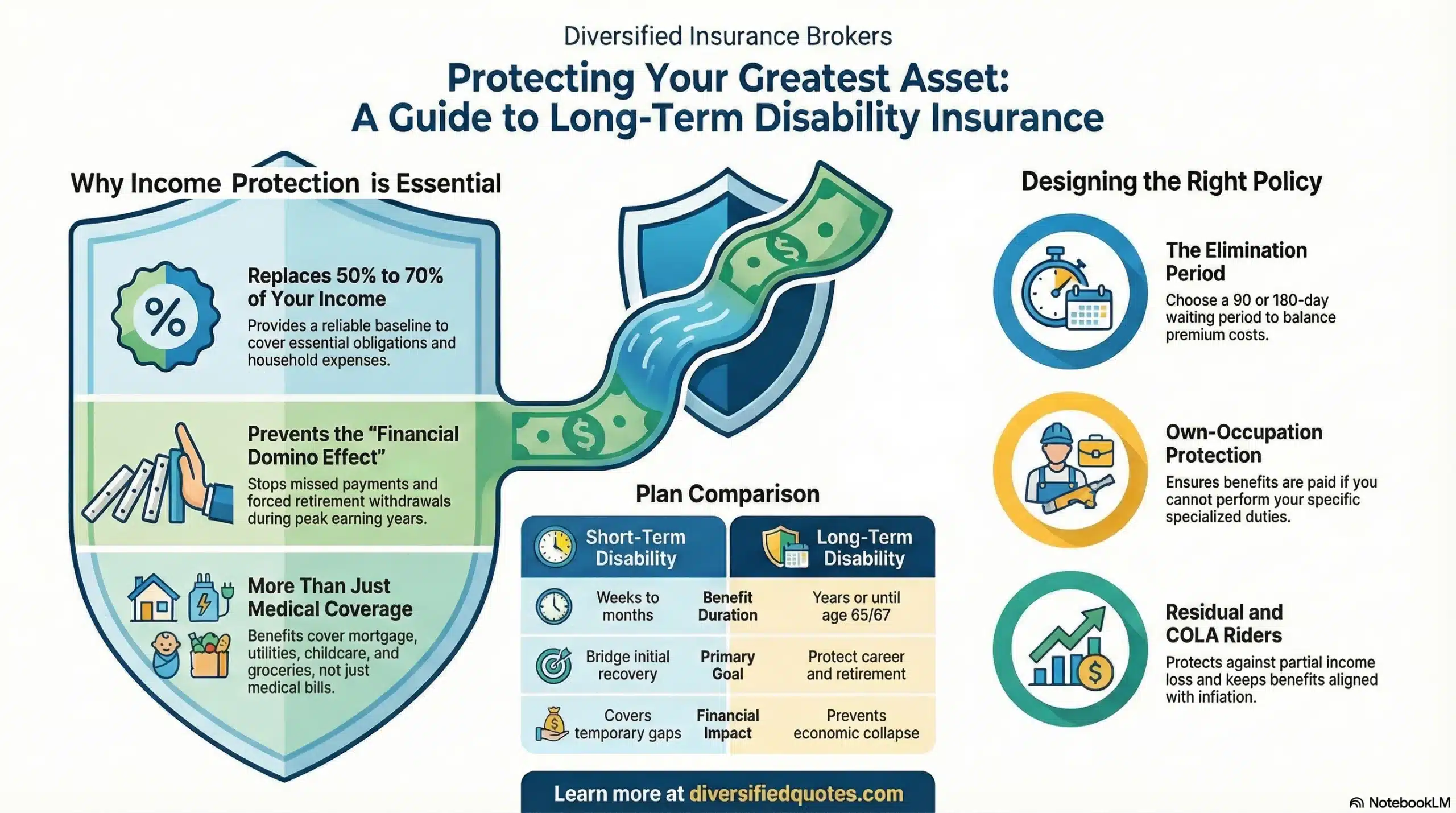
A residual disability rider is particularly important for hospitality workers whose musculoskeletal conditions may reduce physical capacity without eliminating it entirely — a housekeeper who can manage a reduced room quota but cannot sustain a full room assignment earns reduced income without being totally disabled. Our resource on how residual disability insurance benefits work explains how partial disability coverage supports hospitality workers through graduated return-to-duty. The elimination period should account for workers’ compensation availability for work-related injuries and available sick leave — our guide on how disability insurance elimination periods work provides the complete framework. A cost-of-living adjustment rider preserves real benefit value across potentially extended disability periods from progressive musculoskeletal conditions — our resource on disability income insurance with a COLA rider explains this protection. For hospitality workers exploring short-term coverage options, our guide on how to buy short-term disability insurance covers the complete short-term income protection picture.
Why Hospitality Industry Workers Need an Independent Disability Insurance Broker
Disability insurance for hotel, motel, and hospitality industry workers spans multiple occupational contexts — from employed hotel workers supplementing employer group plans to self-employed independent property owners with no institutional coverage — and requires expertise in occupational classification for physical service industry work, knowledge of group plan coordination for employed hospitality workers, understanding of tip income documentation for tipped hospitality employees, and experience with self-employed hospitality business operator income structures. A standard retail application or a single-carrier approach will not optimize coverage for the specific occupational profile and income structure of each hospitality professional.
At Diversified Insurance Brokers, we work with hotel and motel workers across all roles and employment structures to structure disability coverage that addresses the specific injury risks of their hospitality role, accurately documents their total compensation including tips and differentials, coordinates effectively with any employer group plan coverage, and provides the own-occupation protection and residual disability coverage that the physical demands and progressive injury risks of hospitality work specifically require. The disability insurance planning needs of independent motel and hospitality operators parallel those of other self-employed service business owners, including independent contractors and self-employed service business operators managing income protection without employer-provided benefits.
Final Thoughts on Disability Insurance for Hotel, Motel, and Hospitality Industry Workers
Hotel, motel, and hospitality industry workers power one of the largest sectors of the American service economy — providing the room cleaning, food service, maintenance, guest services, and property management that makes hospitality operations function for millions of guests annually. The documented injury rates of this workforce — 40% higher than other service sector workers, with housekeepers sustaining the highest musculoskeletal injury rate of any studied occupational group — reflect the genuine physical demands and health consequences of sustained hospitality industry work. Whether employed by a major hotel chain with a group disability plan that leaves meaningful income gaps, or operating an independent hospitality property with no institutional protection whatsoever, hospitality industry professionals deserve income protection planning that reflects the real physical risks and real financial consequences of disability in this demanding profession.
Related Pages
Talk With an Advisor Today
Choose how you’d like to connect—call or message us, then book a time that works for you.
Schedule here:
calendly.com/jason-dibcompanies/diversified-quotes
Licensed in all 50 states • Fiduciary, family-owned since 1980
Disability Insurance for Hotel, Motel, and Hospitality Industry Workers FAQs
Hotel and hospitality work is substantially more hazardous than most service sector positions. Bureau of Labor Statistics data documents that hotel workers experience an injury rate of 4.3 cases per 100 full-time workers — higher than the 3.1 overall rate for all private industries. The nonfatal injury and illness rate for hotel and motel workers was documented at 5.4 — significantly higher than the 3.5 rate for all industries. Compared to other service sector workers, hotel workers are nearly 40% more likely to sustain an occupational injury or illness. Hotel housekeepers — the highest-injury role in the industry — experience an overall injury rate of 7.9 per 100 worker-years, with 77 to 91% of housekeepers self-reporting pain in the low back, upper back, and shoulders they attribute to their work activities. Published occupational research documents that housekeepers suffer the highest rate of musculoskeletal injuries among all studied occupational groups — a finding significant enough that California enacted the first ergonomic standard in the United States specifically designed for hotel housekeeping staff. Annual costs from unscheduled absenteeism of hospitality workers reach $8.5 billion, reflecting the enormous injury burden this workforce carries. For context on disability insurance for other high-injury service sector workers, see our page on disability insurance for movers and moving companies managing some of the highest nonfatal injury rates in the service sector.
The disability risk profile for hotel workers varies significantly by role but shares common themes across the workforce. Musculoskeletal disorders — lower back injuries, shoulder conditions, upper extremity disorders, and knee problems — are the most prevalent and most career-disabling conditions across hotel job categories, with published research documenting that 40% of hotel musculoskeletal disorders involve the back, 22% the distal upper extremity, and 13% the shoulder. Acute trauma injuries constitute 52% of all hotel worker injuries, with burns from hot surfaces, lacerations from kitchen work, and fractures from falls representing the leading acute categories. For hotel housekeepers specifically, mattress turning, bed making, and bathroom scrubbing in confined spaces produce the characteristic upper back, lower back, and shoulder injury patterns documented in occupational research. Kitchen workers face the highest acute trauma rate at 4.0 per 100 worker-years from burns, lacerations, and slip and fall injuries in wet commercial kitchen environments. Slip and fall injuries affect housekeeping staff from wet bathroom floors they clean and kitchen staff from grease and liquid on commercial kitchen floors. Chemical exposure from cleaning products used in housekeeping operations produces respiratory conditions and dermatological disease. Maintenance workers face the trade-specific injury risks of electrical exposure, falls from elevated access, and heavy equipment and confined space hazards.
Many hotel employees at large chains and major hospitality groups have access to employer group long-term disability coverage as part of their benefits package — but those group plans typically carry limitations that leave meaningful income protection gaps. Group disability plans generally calculate benefits at 60% of base salary, explicitly excluding tips, service charges, overtime, and shift differentials that represent a meaningful portion of total compensation for many hospitality workers. Own-occupation definitions in group plans commonly convert to any-occupation standards after two years of disability, which may eliminate benefits for workers whose specific physical role requirements — room cleaning, commercial kitchen work, maintenance — are what creates the disability in the first place. For hotel workers who rely on tipped income — front desk agents, bellmen, concierge, room service staff — the tip income component is typically excluded entirely from group disability benefit calculations, leaving that income unprotected. Small independent hotels, motels, and bed and breakfast operations may offer little or no disability coverage at all. Individual supplemental disability insurance fills the specific gaps between group plan coverage and total income protection for employed hospitality workers, and serves as the primary protection for those with no group plan.
Own-occupation disability insurance pays benefits when a disabling condition prevents a hotel worker from performing the specific duties of their own hotel industry role — the sustained physical room cleaning demands of housekeeping, the burn and laceration hazard environment of commercial kitchen work, the skilled trade physical demands of hotel maintenance, or any other specific occupational role — regardless of whether they could theoretically perform other less physically demanding or less hazardous work. Any-occupation coverage only pays if the worker cannot perform virtually any gainful employment. A hotel housekeeper whose serious lumbar spine injury prevents return to active room cleaning but who could theoretically perform sedentary administrative work would receive no any-occupation benefits — while an own-occupation policy recognizes the genuine inability to continue housekeeping duties and pays accordingly. The own-occupation distinction is particularly important for hospitality workers because the most common disabling conditions in this industry — musculoskeletal disorders — are specifically and directly connected to the physical demands of the hotel role, and those conditions often leave intact many general-function capacities while eliminating the specific physical capacity for the demanding hospitality work. For context on own-occupation coverage for physical service workers, see our page on disability insurance for service industry professionals managing own-occupation protection needs.
For individual disability insurance purposes, verifiable tip income that is documented on tax returns — reported on W-2 forms or through Schedule C self-employment income — can be included in the insurable income base for benefit calculation. This is an important planning consideration for hotel workers in tipped positions — front desk agents, bellmen, concierge staff, valet attendants, room service servers, and food and beverage service staff — whose total annual compensation may include significant tip income above their base pay. Employer group disability plans typically exclude tip income from benefit calculations, leaving that income entirely unprotected. Individual disability insurance structured to include documented tip income in the benefit calculation provides complete compensation protection. The key requirement is adequate documentation — tip income that has been consistently reported on tax returns and is verifiable through W-2s or tax records supports benefit calculation. Tip income that has not been consistently reported creates documentation challenges that make it difficult to include in benefit amount calculations. Working with an independent broker who understands how to properly document and present tip income for disability insurance underwriting is important for hospitality workers whose tipped compensation is a meaningful portion of their total professional income.
Independent motel and hotel owners — operating their own hospitality properties as self-employed business operators rather than as employees of larger hotel companies — face the most acute version of the disability insurance need in the hospitality industry. Their personal income stops when disability prevents active property management, and the business operations that depend on their daily involvement are also at risk during an extended disability period. Individual disability income insurance addresses the personal income replacement need, while business overhead expense coverage addresses the fixed costs of the hotel or motel property operation that continue during a disability — mortgage or lease payments, property insurance, utilities, and any staff the owner maintains. For independent hospitality property owners, both coverage components together provide the most complete financial protection against the dual income and business threat that disability creates. The income documentation for self-employed hospitality property operators uses Schedule C for active management income and potentially Schedule E for rental property income, with the earned active management income being the insurable portion. Self-employment income averaging across multiple years addresses the variable year-to-year performance that hospitality property revenue typically produces. For context on disability insurance for independent hospitality business owners, see our page on disability insurance for self-employed service business operators managing both personal income and business continuity disability planning.
Residual disability coverage pays proportional benefits when a disabling condition reduces a hotel worker’s professional capacity without completely eliminating the ability to work. A hotel housekeeper recovering from a shoulder injury may be medically cleared for modified light duty — lighter cleaning assignments, fewer rooms, restrictions on overhead reaching — months before being cleared for a full room quota with no restrictions. A maintenance engineer recovering from back surgery may be cleared for some lighter maintenance tasks before full return to all trade duties. During these graduated return-to-work periods, the worker earns reduced wages without being totally disabled. Without a residual disability rider, a total-disability-only policy pays nothing during these partial capacity periods. A residual rider supplements reduced hospitality worker income proportionally throughout the graduated return — if capacity and income are reduced by 40%, the rider pays approximately 40% of the full disability benefit. For hotel workers whose most common disabling conditions — musculoskeletal disorders, post-surgical recoveries, progressive joint conditions — typically follow extended modified duty and return-to-work timelines rather than sudden binary recovery, the residual rider is the policy feature that makes disability insurance function as genuine income protection across the full recovery arc from injury onset through complete return to full hospitality duty. For context on residual coverage for physical service industry workers, see our page on disability insurance for physical service industry workers managing residual disability coverage needs during graduated return-to-work.
Elimination period selection for hotel and hospitality workers should account for the workers’ compensation coverage available for work-related injuries — which hotel workers typically have access to as employees of a hotel property — and any employer short-term disability coverage and sick leave accumulation that provides income during the waiting period before long-term disability benefits activate. Employed hotel workers with meaningful workers’ compensation coverage for work-related injuries and some sick leave accumulation can typically manage a 90-day elimination period on an individual supplemental policy, using workers’ compensation wage replacement and available sick leave to bridge the waiting period. For non-work-related disabilities — illness, off-duty injuries, conditions that workers’ compensation does not cover — only sick leave provides bridge income, making the available sick leave bank the critical determining factor. Hotel workers with limited sick leave accumulation should consider 30 or 60-day elimination periods for faster benefit access when non-work-related disability produces immediate income interruption without workers’ compensation or other bridge income. For independent motel and hotel owners with no workers’ compensation for themselves and no employer sick leave, the elimination period must match genuinely available personal savings — with a shorter period more appropriate for operators without substantial liquid financial reserves to sustain during the waiting period.
The best time is as early as possible in a hospitality career — ideally when first entering hotel employment or establishing an independent hospitality business, before any occupational health consequences from the specific demands of the worker’s hotel role have accumulated in the medical record. The published statistic that 77 to 91% of hotel housekeepers self-report work-related pain in the back and shoulders is a direct indicator of how quickly the physical demands of housekeeping produce medically documented conditions that can affect disability insurance underwriting. Any prior history of back conditions, shoulder problems, knee issues, upper extremity conditions, or respiratory symptoms from chemical exposure documented in the medical record at application can result in exclusion riders for those specific conditions — which are precisely the conditions most likely to produce long-term disability in hospitality work. The non-cancelable and guaranteed renewable provision locks in the early-career health rating for the policy’s entire duration. A future increase option rider allows benefit amounts to grow with career income increases — raises, additional tip income, advancement to supervisory or management roles — without requiring new medical underwriting when health may have changed from years of physically demanding hospitality industry work.
About the Author:
Jason Stolz, CLTC, CRPC, DIA, CAA and Chief Underwriter at Diversified Insurance Brokers (NPN 20471358), is a senior insurance and retirement professional with more than 25 years of real-world experience helping individuals, families, and business owners protect their income, assets, and long-term financial stability. As a long-time partner of the nationally licensed independent agency Diversified Insurance Brokers, Jason provides trusted guidance across multiple specialties—including fixed and indexed annuities, long-term care planning, personal and business disability insurance, life insurance solutions, Group Health, Travel Medical and Evacuation Insurance, and short-term health coverage. Diversified Insurance Brokers maintains active contracts with over 100 highly rated insurance carriers, ensuring clients have access to a broad and competitive marketplace.
His practical, education-first approach has earned recognition in publications such as VoyageATL, and contributions from his agency featured in Kiplinger and GoBankingRates— highlighting his commitment to financial clarity and client-focused planning. Drawing on deep product knowledge and years of hands-on field experience, Jason helps clients evaluate carriers, compare strategies, and build retirement and protection plans that are both secure and cost-efficient. Visitors who want to explore current annuity rates and compare options across multiple insurers can also use this annuity quote and comparison tool.
Explore More Disability Insurance Options: Browse our complete guide to Disability Insurance for Food, Hospitality, Arts & Entertainment — covering chefs, musicians, actors, bartenders, hospitality workers & entertainment professionals from 100+ carriers.
Last Reviewed: June 8, 2026 |
Reviewed by: Jason Stolz, CLTC, CRPC, DIA, CAA
Chief Underwriter, Diversified Insurance Brokers, Inc. | NPN: 20471358 | Diversified Insurance Brokers, Inc. — Licensed in all 50 states
Fact Checked by: Tonia Pettitt, CMIP©
Medicare Specialist, Diversified Insurance Brokers, Inc. | NPN: 14374308 | Diversified Insurance Brokers, Inc. — Licensed in all 50 states
Did you find this content helpful? Leave us a Google review — it helps others find trustworthy guidance too.
Editorial Standards: Diversified Insurance Brokers maintains rigorous editorial standards to ensure accuracy, clarity, and independence in all content. Learn more about our editorial standards and commitment to transparency.
