
Disability Insurance for Movers and Moving Companies
As an Independent Disability Insurance Broker, we have access to exclusive discounts and negotiated pricing most captive agents can’t offer — see the full breakdown near the end of this page.
Disability Insurance for Movers and Moving Companies

Jason Stolz CLTC, CRPC, DIA, CAA
Disability insurance for movers and moving companies is essential income protection for one of the physically demanding labor industries in the American economy — and one where the gap between occupational injury risk and actual income protection coverage is among the widest of any working population. Whether you work as a professional mover for a residential or commercial moving company, operate your own independent moving business as a self-employed owner-operator, manage a moving crew as a working foreman or crew lead, or run a moving company with employees whose physical labor directly generates your business revenue — the disability risk in this profession is real, well-documented, and financially consequential when it strikes.
Bureau of Labor Statistics data for laborers and material movers — the closest occupational category to professional movers — documents an incidence rate of 289.8 nonfatal injury and illness cases per 10,000 full-time equivalent workers, with tens of thousands of cases involving days away from work annually. The transportation and warehousing sector, which includes moving and storage operations, records the highest back injury rate of any industry sector in BLS data. Overexertion — the primary mechanism of moving industry injury, produced by lifting, carrying, and maneuvering heavy furniture and appliances — accounts for 33% of all workplace injuries across the labor sector, and sprains, strains, and tears that are the physical consequence of overexertion make up 30% of all occupational injury cases. These are not peripheral risk statistics. They describe the daily physical reality of professional moving work.
At Diversified Insurance Brokers, we help professional movers, moving company employees, independent moving business owners, and moving crew operators structure disability insurance coverage that reflects the genuine physical hazards of moving work, the income structure of moving industry employment, and the specific conditions most likely to interrupt or end a moving career.
Protect Your Moving Industry Income
Compare disability insurance options designed for professional movers, moving company employees, independent moving business owners, and moving crew operators.
The Physical Demands and Documented Injury Profile of Professional Moving
Disability insurance for movers and moving companies begins with an honest accounting of what professional moving work actually involves physically — because the occupational injury profile of this industry is far more serious than the moving truck and uniformed crew image suggests to the average household client watching from their front door.
A professional mover’s working day involves sustained heavy manual labor across varying and unpredictable physical environments. Unlike warehouse workers who lift and move loads in a controlled environment with consistent floor surfaces, established equipment pathways, and predictable item weights, professional movers work in environments that change with every job — different floor surfaces, different stair configurations, different doorway widths, different furniture weight and balance characteristics, and different access challenges. A three-story walkup apartment building with a narrow staircase and a curved landing creates an entirely different biomechanical challenge from a ranch-style home with wide doorways and a loading dock — and a mover completes multiple of these distinct environments in a single working day.
The loads that movers handle are among the heaviest in any labor industry. Sofas, refrigerators, pianos, gun safes, library bookshelves fully loaded with books, filing cabinets, and commercial office equipment all routinely exceed 100 pounds and often exceed 200 or 300 pounds when moved with team lift techniques. These loads must be maneuvered through doorways, around corners, down stairs, across yards, and into trucks — with body mechanics that are not always favorable, in time-pressured service contexts that create production pressure, and across a full day of work that accumulates the physical toll of each individual lift across every move on the schedule.
The physical loading that professional movers accumulate across a career is directly reflected in the industry’s injury statistics. The BLS specifically documents that laborers and material movers record nonfatal injury incidence rates nearly three times the private industry average, with back injuries, shoulder injuries, and lower extremity injuries dominating the injury profile. The transportation and warehousing sector — which encompasses moving and storage companies — consistently ranks among the highest injury rate sectors in BLS data. This documented injury burden creates exactly the disability risk that individual income protection is designed to address. The occupational injury profile of professional movers reflects the same heavy manual labor injury dynamics documented in other construction and heavy manual trade contexts, including construction workers whose sustained heavy manual labor creates comparable back and musculoskeletal injury rates.
Back Injuries — The Defining Disability Risk for Professional Movers
Back injuries are the single most consequential disability risk category for professional movers — both in terms of the frequency with which they occur and the severity of the career disruption they produce. The lumbar spine bears the primary mechanical burden of the lifting and carrying work that professional moving requires, and the sustained heavy load demands of a full moving career produce the disc pathology, facet joint degeneration, and ligamentous injury that together make lumbar spine conditions the leading cause of extended disability in heavy labor occupations.
Lumbar disc herniation — the most common serious back injury in heavy labor workers — occurs when the nucleus pulposus of an intervertebral disc is forced through a tear in the outer annulus fibrosus, typically during a heavy lift or a sudden load shift, and compresses a lumbar nerve root. The symptoms — severe radiating pain down one or both legs, motor weakness, and reduced function — can be immediate and incapacitating. Surgical treatment may be required for severe herniations, with recovery timelines measured in weeks to months during which any heavy lifting is medically prohibited. For a professional mover who earns their income specifically from heavy lifting, a serious lumbar disc herniation is a complete occupational disability event that eliminates all moving income until recovery is achieved — and some herniations produce permanent functional limitations that prevent full return to heavy moving work.
Chronic lower back pain from cumulative lumbar loading — the gradual development of degenerative disc disease, facet arthritis, and lumbar instability from years of sustained heavy work — produces a different disability pattern that is more insidious and ultimately more career-limiting than acute disc herniation. A mover who can perform heavy work at 30 with mild soreness managed by rest may find by their mid-40s that the same loads produce persistent pain that prevents sustained heavy lifting and reduces their effective work capacity below what full professional moving service requires. This graduated reduction in physical capacity — producing partial rather than total disability — is precisely the scenario that residual disability riders in disability insurance policies are designed to address. The back injury disability risk profile of professional movers is among the most thoroughly documented in any heavy manual trade, parallel to that documented in drywall installers and other sustained heavy manual labor tradespeople whose cumulative back loading produces career-limiting degenerative spinal conditions.
Shoulder, Knee, and Upper Extremity Injuries in Moving Work
Beyond lumbar spine injury, professional movers face significant disability risk from shoulder injuries, knee conditions, and upper extremity musculoskeletal pathology that develops from the specific physical demands of heavy furniture and appliance moving. Shoulder injuries in movers arise from the overhead lifting and sustained arm loading required to move furniture into elevated truck compartments, maneuver items over obstacles, and perform the carrying work that transfers loads from the building to the truck and back.
Rotator cuff injuries — tears and tendinopathy of the supraspinatus, infraspinatus, teres minor, and subscapularis tendons — are among the most common serious shoulder conditions in heavy manual workers and represent a genuine occupational disability risk for professional movers. A severe rotator cuff tear requiring surgical repair produces a recovery timeline of four to six months during which overhead arm work is medically prohibited — directly eliminating the ability to perform the truck loading and unloading that is central to professional moving work. Some rotator cuff injuries produce permanent functional limitations in shoulder strength and range of motion that prevent full return to the overhead demands of professional moving.
Knee injuries from sustained stair climbing and crouching during moves — particularly the repetitive stair descent under load that moving work requires — produce the patellofemoral pain, meniscal tears, and degenerative knee arthritis that accumulate over a moving career. A mover whose knee condition prevents sustained stair work under load has a functional limitation that directly impairs the most physically demanding and recurring aspect of residential moving service. Hand and wrist injuries from grip demands, crush injuries from shifting loads, and repetitive strain conditions from sustained heavy grip work add to the upper extremity disability risk profile of professional moving work. The shoulder, knee, and upper extremity disability risks facing movers parallel those documented in other sustained overhead and heavy manual load contexts, including bricklayers and masons managing sustained upper body and lower extremity injury risk from heavy construction work.
Slip, Fall, and Acute Injury Risk in Moving Operations
Beyond the cumulative musculoskeletal injury profile, professional movers face significant acute injury risk from slips, falls, and dropped load incidents that occur during the physical transfer of heavy items through variable and often challenging physical environments. Slips and trips account for 27% of all occupational injury cases in labor industries, and the specific conditions of moving work — wet surfaces when loading in rain, uneven yard terrain, slick truck ramp surfaces, debris-covered moving paths, and the visual obstruction of carrying large items that prevent clear sight of the floor ahead — create slip and fall hazards that are significantly more acute than in controlled warehouse environments.
Stairway falls under load are among the most serious acute injury events in moving work. A mover carrying a heavy item on a staircase who loses footing or balance can fall an entire flight of stairs with a heavy load, producing fractures, head trauma, and spinal injuries that require extensive medical treatment and produce recovery timelines measured in months. The load itself — whether a piece of furniture or an appliance — adds kinetic energy and crush injury risk to the fall that multiplies the severity of any stairway fall incident.
Dropped load injuries — when a piece of heavy furniture or an appliance is dropped or slips during team carries — produce crush and impact injuries to the feet, ankles, and lower legs that can cause fractures and soft tissue injuries requiring surgical treatment and extended recovery. The physical environment of moving work — which frequently includes navigating through tight spaces, over thresholds, and around corners with limited visibility of foot placement — creates the conditions for dropped load incidents at rates substantially higher than controlled warehouse work. The acute injury risk profile of professional movers from slip, fall, and dropped load incidents parallels that documented in other physically demanding heavy load operations, including dock workers managing acute injury risk from heavy load handling in variable physical environments.
The Workers’ Compensation Gap for Moving Industry Workers and Owners
Workers’ compensation is required for employees of moving companies in all states and provides a meaningful baseline of injury protection — medical treatment coverage and partial wage replacement — for mover employees who sustain work-related injuries. However, workers’ compensation carries the same structural limitations that affect all workers’ compensation systems and leave meaningful income protection gaps for moving industry workers across all employment categories.
Workers’ compensation replaces only two-thirds or less of average weekly wages and explicitly excludes overtime pay, tips, and other supplemental earnings that moving industry workers may receive. It covers only work-related injury events — a mover who develops a serious cardiovascular condition, is injured in an off-duty accident, or gradually develops a disabling back condition from cumulative loading rather than a single identifiable injury event may find that workers’ compensation provides no benefit. And workers’ compensation ends at maximum medical improvement, which may occur long before the mover has regained the physical capacity for sustained heavy lifting that professional moving requires.
For self-employed owner-operators of independent moving businesses — the growing segment of the moving market that operates under gig economy platforms and independent contractor arrangements — workers’ compensation coverage for the owner is typically absent entirely. Self-employed moving operators have no employer to provide workers’ compensation and typically have not elected state self-employment workers’ compensation coverage. Individual disability insurance is the only meaningful income protection available to this population, covering disability from any cause regardless of origin, for the full benefit period, without the maximum medical improvement termination that limits workers’ compensation duration. The workers’ compensation gap and self-employment financial vulnerability facing moving industry workers and operators parallels that documented in other heavy labor independent contractor contexts, including independent contractors managing self-employment income protection without employer-provided workers’ compensation.
Disability Insurance for Moving Company Owners — A Dual Exposure
Moving company owners who work as active members of their moving crews face a dual financial exposure during any disability — the loss of their personal moving income and the continuation of business fixed costs that persist regardless of whether they can work. Commercial vehicle payments on the moving truck fleet, liability insurance premiums, commercial auto insurance, equipment maintenance and replacement costs, warehouse or storage facility rent, dispatch and scheduling software costs, and any employee payroll for permanent staff all continue during a disability regardless of whether the owner can perform moves.
Personal disability income insurance replaces the owner’s earned income during a disability period — but it does not cover these business fixed costs, which must be paid from personal disability benefits or from business reserves that were not intended to sustain a moving company during the owner’s absence. Business overhead expense insurance covers these fixed business costs during a disability period, helping to preserve the moving operation, the commercial vehicle fleet, the business licenses and authority, and the client relationships that the owner has built. For a moving company owner who has spent years building a client base, online reputation, and operational infrastructure, maintaining that business infrastructure during recovery is essential to any meaningful return to operation after a serious injury.
The seasonal nature of moving demand adds a specific financial urgency dimension to disability planning for moving company owners. The peak moving season — summer months when residential moves are most concentrated, and year-end when commercial clients commonly relocate — represents the period of highest revenue concentration for most moving companies. A moving company owner disabled during peak moving season faces income loss that is disproportionately large relative to its duration, because the bookings missed during peak season cannot be recovered during slower periods. The dual disability exposure of moving company owner-operators mirrors that of other capital-intensive self-employed trade business owners, including crane operators and heavy equipment owner-operators managing both personal and business fixed cost exposure during disability.
Case Study: Moving Company Owner-Operator Earning $85,000 Per Year
Consider a self-employed moving company owner who operates two trucks with a regular crew, earning $85,000 annually in net business income. During a commercial office move, this owner-operator sustains a severe lumbar disc herniation while maneuvering a heavy filing cabinet, requiring microdiscectomy surgery and six months of rehabilitation during which heavy lifting and any active moving work is medically prohibited.
| Scenario | Without Disability Insurance | With Disability Insurance |
|---|---|---|
| Monthly Income During Recovery | $0 personal income | $3,500–$4,250 individual benefit |
| 6-Month Total Income | $0 | $21,000–$25,500 |
| Business Fixed Costs During Disability | Truck payments, insurance, and overhead continue with no owner income | Disability benefit plus BOE coverage addresses personal and business obligations |
| Financial Outcome | Savings depleted; truck obligations at risk; pressure to return before surgical healing | Full recovery on medical timeline; business preserved; return supported |
Lumbar disc herniation from heavy lifting is among the most predictable and most frequently documented occupational injuries in professional moving work. Disability insurance for movers and moving companies ensures that this career-disrupting but medically manageable injury does not simultaneously become a financial catastrophe that pressures premature return to heavy moving before surgical healing is complete — which would risk re-injury, re-herniation, and a permanently worse outcome for both the spine and the moving career.
Key Policy Features for Mover Disability Insurance
Disability insurance for movers and moving companies should incorporate specific policy provisions that address the heavy manual labor demands, variable income structures, and self-employment realities of moving industry work. The own-occupation definition is foundational — paying benefits when a condition prevents a mover from performing the specific physical demands of moving work regardless of whether they could theoretically perform other less physically demanding work. Our comprehensive resource on own-occupation disability insurance explained covers how this definition protects moving income from the conditions most likely to disable a working mover.
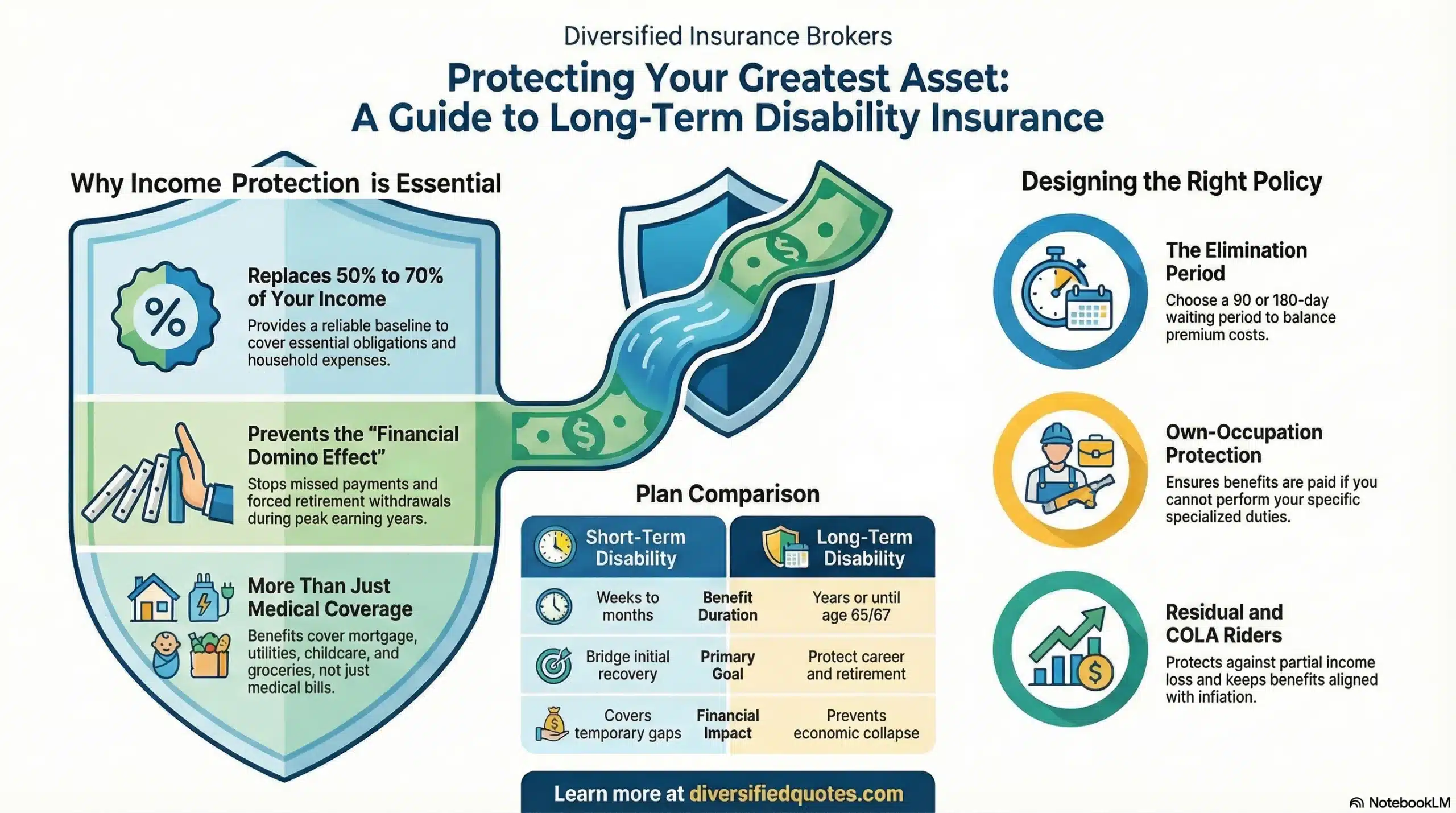
A residual disability rider is particularly important for movers whose conditions — cumulative back degeneration, chronic knee conditions, shoulder injuries in recovery — may reduce physical capacity without eliminating it entirely. A mover who can perform lighter moving tasks or crew supervision but cannot perform heavy lifts earns reduced income without being totally disabled. Our resource on how residual disability insurance benefits work explains how partial disability coverage sustains movers through graduated recovery. The elimination period should be calibrated to available savings and any workers’ compensation bridge income for employed movers — our guide on how disability insurance elimination periods work provides the complete framework. A cost-of-living adjustment rider preserves real benefit value across extended claims from progressive back conditions — our resource on disability income insurance with a COLA rider explains this protection. For movers exploring short-term coverage alongside long-term disability insurance, our guide on how to buy short-term disability insurance covers the complete income protection picture.
Income Documentation for Self-Employed Moving Business Owners
Disability insurance carriers base benefit amounts on verified earned income — using federal tax returns with Schedule C net profit for sole proprietors and K-1 income for partnership or LLC structures. For moving company owners whose gross revenue runs through the business and is substantially reduced by truck operating costs, fuel, equipment, crew payroll, and business expenses before net profit is calculated, the Schedule C net profit may significantly understate the owner’s actual financial need during a disability.
A moving company owner whose gross moving revenue is $320,000 but whose Schedule C net profit after truck costs, crew payroll, fuel, insurance, and equipment is $80,000 can only insure based on the net figure — which may be substantially below what the household actually needs during a disability. Working with an independent broker who understands moving business income documentation and how to present moving company financials to underwriters most effectively is essential for securing a benefit amount that reflects genuine earning capacity. Moving company income seasonality — with peak summer months generating disproportionate annual revenue — also affects how multiple-year income averaging is best presented to underwriters. The income documentation challenge facing moving business owners mirrors that of other seasonal transportation and service business owners, including farmers managing seasonal self-employment income documentation for disability insurance underwriting.
The Gig Economy and Independent Contractor Dimension
A growing segment of the professional moving market operates through gig economy platforms and independent contractor arrangements — movers who contract their labor through app-based moving platforms, work as independent moving contractors accepting jobs through marketplace services, or operate as solo owner-operator moving businesses without the formal employment structure of a traditional moving company. This population faces the sharpest version of the moving industry disability protection gap: no workers’ compensation, no group disability plan, no employer sick pay, and income that stops on the day a disabling injury prevents them from working.
For gig economy moving contractors and independent moving operators, individual disability insurance is not supplemental coverage to employer-provided protection — it is the only income protection that exists. The financial consequences of a serious back injury for a solo independent moving contractor are immediately catastrophic in ways that an employed mover with workers’ compensation partially avoids. The disability insurance planning needs of gig economy moving contractors are identical to those of any other self-employed physical labor operator, and the urgency is amplified by the complete absence of any institutional safety net. Our dedicated resource on disability insurance for independent contractors provides the foundational planning context for this growing segment of the professional moving workforce.
Why Movers and Moving Companies Need an Independent Disability Insurance Broker
Disability insurance for movers and moving companies involves occupational classification nuances — the physical labor intensity of moving work, the variable income structures of moving industry employment and self-employment, the workers’ compensation coordination considerations for employed movers, and the self-employment income documentation challenges for owner-operators — that require experienced independent broker expertise to navigate effectively. A standard retail disability insurance application is not optimized for the moving industry context, and a general insurance agent unfamiliar with heavy manual labor occupational classifications and moving business income structures will not produce the most comprehensive available coverage for a moving professional’s individual situation.
At Diversified Insurance Brokers, we work with professional movers, moving company employees, and moving business owners across all moving industry segments — residential movers, commercial moving specialists, long-distance moving operations, and independent gig economy contractors — to structure disability coverage that accurately reflects how movers earn, what injuries would actually prevent them from working, and what policy features provide the most meaningful financial protection for moving industry income and business operations. Our dedicated resource on why independent disability insurance brokers matter explains the full value of this approach. For movers evaluating the foundational financial case for disability insurance in one of the highest-injury labor industries in the country, our resource on whether disability insurance is worth the investment provides the complete financial picture of what is at stake without adequate income protection in place.
Final Thoughts on Disability Insurance for Movers and Moving Companies
Professional movers and moving company operators perform physically demanding work that sustains one of the most essential service industries in the American economy — enabling people to relocate their homes, businesses, and lives with the heavy-lifting expertise and equipment that households and companies cannot provide for themselves. The documented injury rates in this industry reflect the genuine physical toll of that work, and the financial consequences of a disabling back injury, shoulder injury, or serious fall for a moving professional without adequate income protection can be immediate and severe.
Disability insurance for movers and moving companies is the financial tool that ensures a workplace injury does not become a financial crisis — providing the income replacement that allows a mover to recover completely, the business overhead coverage that keeps a moving operation viable during the owner’s recovery, and the long-term own-occupation protection that ensures a mover who cannot return to heavy work is not forced to choose between their physical recovery and their household’s financial survival.
Related Pages
Talk With an Advisor Today
Choose how you’d like to connect—call or message us, then book a time that works for you.
Schedule here:
calendly.com/jason-dibcompanies/diversified-quotes
Licensed in all 50 states • Fiduciary, family-owned since 1980
Disability Insurance for Movers and Moving Companies FAQs
Yes, professional movers can obtain individual disability insurance. The occupational classification reflects the heavy manual physical labor demands of professional moving work and places movers in a classification tier that accounts for the physical intensity and injury risk of the occupation. The most important planning considerations for movers are securing a benefit amount that reflects actual moving income — including tips and supplemental pay that workers’ compensation and employer group plans typically exclude — and ensuring that the policy definition of disability will respond to the most likely disability scenarios for heavy manual labor work. Working with an independent broker who understands heavy labor occupational classifications and moving industry income structures produces materially better coverage outcomes than a standard retail application or enrollment through an employer group plan that may not cover total compensation. For context on disability insurance for other physically intensive labor occupations, see our page on disability insurance for boilermakers and other heavy manual labor trade workers.
Bureau of Labor Statistics data consistently identifies laborers and material movers — the occupational category that includes professional movers — as having some of the highest nonfatal injury and illness incidence rates in any labor sector, with an incidence rate of 289.8 cases per 10,000 full-time equivalent workers. Back injuries from heavy lifting and carrying are the most prevalent and financially consequential disability category — lumbar disc herniations from acute heavy lift events and cumulative degenerative disc disease from sustained career loading both produce extended disability and in some cases permanent functional limitations. Shoulder injuries — particularly rotator cuff tears and tendinopathy from overhead truck loading work — represent the second major disability category. Knee injuries from sustained stair climbing under load accumulate over a moving career and eventually limit the stair-intensive work that residential moving requires. Slip and fall injuries from wet ramps, debris-covered pathways, and stairway incidents produce fractures, head injuries, and spinal trauma. Dropped load crush injuries to feet, ankles, and lower legs add to the acute injury profile. Each of these categories can produce weeks to months of inability to perform heavy moving work — and without disability insurance, each produces the same immediate and complete income interruption.
Workers’ compensation provides a meaningful baseline for moving company employees who sustain work-related injuries, but its limitations are significant for most movers. Workers’ compensation replaces only two-thirds or less of average weekly wages and explicitly excludes overtime pay, tips, and other supplemental earnings that many movers depend on for a meaningful portion of total income. Workers’ compensation covers only work-related injury events — a mover who develops a disabling cardiovascular condition, is injured off the job, or develops a gradually progressive back condition from cumulative career loading rather than a single identifiable incident may receive nothing. Workers’ compensation also ends at maximum medical improvement — which may occur before the mover has fully regained the heavy lifting capacity that professional moving requires — leaving a gap between when benefits end and when the mover can safely return to full duty. For self-employed moving contractors and independent moving operators, workers’ compensation for the owner is typically absent entirely, making individual disability insurance the only available income protection. For parallel context on workers’ compensation limitations, see our resource on disability insurance for heavy labor operators managing workers’ compensation coverage gaps.
Own-occupation disability insurance pays benefits when a disabling condition prevents a mover from performing the specific physical duties of professional moving work — heavy lifting and carrying, stair work under load, truck loading and unloading, furniture assembly and disassembly — regardless of whether they could theoretically perform other less physically demanding work. Any-occupation coverage only pays if the mover cannot perform virtually any gainful employment. A professional mover whose back injury prevents sustained heavy lifting and stair work but who could theoretically perform a sedentary desk job would receive no any-occupation benefits, while an own-occupation policy recognizes the genuine inability to perform moving work and pays accordingly. For a mover whose entire income depends on their specific physical capacity for sustained heavy labor, the any-occupation definition provides almost no meaningful income protection for the conditions most likely to disable a working mover. Own-occupation coverage is the only policy definition that genuinely protects moving industry income when the most predictable occupational disabilities occur.
Residual disability coverage pays proportional benefits when a disabling condition reduces a mover’s physical work capacity and income without completely eliminating the ability to work. A professional mover recovering from back surgery or a serious shoulder injury may be medically cleared for light-duty work — perhaps crew supervision, driving, or lighter residential moves — months before they can safely return to the full heavy lifting demands of commercial and long-distance moving. During this graduated return period, moving income is significantly reduced without being fully eliminated. Without a residual disability rider, a total-disability-only policy pays nothing during this partial capacity period because the mover can technically perform some work in some limited capacity. A residual rider supplements reduced moving income proportionally throughout the return-to-full-capacity arc, providing continuous financial support from the onset of disability through complete return to full heavy moving work. For professional movers whose most likely disabling conditions — progressive back degeneration, shoulder recovery, knee conditions — typically produce graduated functional limitations over extended recovery timelines, this rider is essential for the disability policy to function as genuine income protection across the full recovery period. For context on how residual riders function for heavy labor professionals, see our resource on disability insurance for physically demanding trade workers requiring partial disability protection.
Yes, strongly — and the case is particularly compelling for moving company owners whose fixed business costs represent significant ongoing financial obligations that continue during a disability regardless of whether the owner can work. Commercial truck loan or lease payments, liability and commercial auto insurance premiums, equipment maintenance costs, storage facility rent, and any permanent employee payroll all continue whether the owner-operator is physically able to perform moves or not. Personal disability income insurance replaces the owner’s earned income but does not cover these business costs, which must be paid from personal disability benefits or from business reserves not intended to sustain a moving company during the owner’s absence. Business overhead expense insurance covers these fixed operating costs during a disability period, helping to preserve the truck fleet, business licenses, and the client relationships and reputation that the owner has built. For a moving company owner who has invested in vehicles, equipment, and years of building a client base, maintaining the business infrastructure during recovery protects the future of the business in ways that personal disability income insurance alone cannot. For context on how business overhead expense coverage works for self-employed trade business owners, see our resource on disability insurance for self-employed trade and hazmat operators managing dual personal and business disability exposure.
Seasonal income concentration is a planning consideration for moving company owners in two important dimensions: income documentation for underwriting and elimination period selection based on when a disability is most financially damaging. The moving industry is strongly seasonal — summer months generate the highest residential move volumes, and year-end commercial moves create secondary peaks — meaning that a disability during peak moving season has financial consequences far larger than the annualized income figures would suggest. A moving company owner disabled in June loses peak-season revenue that cannot be recovered during the slower winter months, creating a financial impact disproportionate to the duration of the disability. For disability insurance underwriting, a weighted average of recent income years may produce a more favorable benefit calculation than a single low-volume year snapshot. The elimination period selection should account for whether savings can realistically bridge the household and business through the waiting period when the disability occurs during the highest-revenue months of the operating year. An experienced independent broker who understands moving business seasonality structures both the benefit amount and the elimination period to reflect the actual financial vulnerability pattern of the specific business.
The elimination period selection depends on whether the mover is employed or self-employed and on their available financial reserves. For employed movers who have workers’ compensation coverage activating for work-related injuries, the workers’ compensation income bridge may support a 90-day elimination period on an individual supplemental policy — using workers’ compensation income during the waiting period before individual long-term disability benefits activate. For movers with disabling conditions that are not work-related — and therefore receive no workers’ compensation income — and for self-employed moving contractors with no workers’ compensation, a 30 or 60-day elimination period provides faster benefit access that better matches the financial urgency of a disability that produces immediate and complete income interruption. For moving company owners whose fixed business costs — truck payments, insurance, payroll — continue during disability regardless of moving revenue, the elimination period selection must account for whether business cash reserves can sustain both household obligations and business fixed costs throughout the waiting period without depleting savings needed for the recovery period ahead.
The best time is as early as possible in a moving career — ideally when first entering the profession, before back conditions, shoulder injuries, knee problems, or other occupational health consequences from moving work have accumulated in the medical record. Disability insurance premiums are based in part on age and health status at the time of application, and younger movers in excellent physical condition secure the most comprehensive coverage at the most favorable rates. Back conditions from cumulative heavy lifting, rotator cuff pathology from sustained overhead load work, and knee degeneration from stair climbing under load all develop predictably over a moving career and can result in exclusion riders or restricted terms if documented at the time of application. Applying before these occupational health consequences develop ensures they are covered under an existing policy when they eventually appear — as they predictably do over a sustained moving career. A future increase option rider secured early also allows benefit amounts to grow with moving business revenue as the career or business develops, without requiring new medical underwriting when health conditions may have changed from years of physically demanding moving work.
An independent broker accesses multiple disability insurance carriers and compares occupational class assignments, own-occupation definition language, residual disability provisions, income documentation approaches for moving business income, and premium structures across the full marketplace. For movers and moving company owners whose income includes variable seasonal revenue, significant business expense deductions that affect the insurable income base, workers’ compensation coordination considerations, and occupational duties that vary between heavy crew work and owner-operator management functions, the differences between carriers in how they evaluate moving industry employment and income produce meaningfully different real-world coverage outcomes. A captive agent representing a single carrier can only present that company’s approach. At Diversified Insurance Brokers, we evaluate the full competitive landscape for every moving industry professional we work with and structure coverage that is genuinely calibrated to how movers earn, what injuries would actually prevent them from working, and what policy features provide the most meaningful financial protection for moving industry careers and businesses.
About the Author:
Jason Stolz, CLTC, CRPC, DIA, CAA and Chief Underwriter at Diversified Insurance Brokers (NPN 20471358), is a senior insurance and retirement professional with more than 25 years of real-world experience helping individuals, families, and business owners protect their income, assets, and long-term financial stability. As a long-time partner of the nationally licensed independent agency Diversified Insurance Brokers, Jason provides trusted guidance across multiple specialties—including fixed and indexed annuities, long-term care planning, personal and business disability insurance, life insurance solutions, Group Health, Travel Medical and Evacuation Insurance, and short-term health coverage. Diversified Insurance Brokers maintains active contracts with over 100 highly rated insurance carriers, ensuring clients have access to a broad and competitive marketplace.
His practical, education-first approach has earned recognition in publications such as VoyageATL, and contributions from his agency featured in Kiplinger and GoBankingRates— highlighting his commitment to financial clarity and client-focused planning. Drawing on deep product knowledge and years of hands-on field experience, Jason helps clients evaluate carriers, compare strategies, and build retirement and protection plans that are both secure and cost-efficient. Visitors who want to explore current annuity rates and compare options across multiple insurers can also use this annuity quote and comparison tool.
Explore More Disability Insurance Options: Browse our complete guide to Disability Insurance for Transportation, Maritime & Hazardous Occupations — covering truck drivers, flight attendants, merchant marines, divers, chauffeurs & drivers from 100+ carriers.
Last Reviewed: June 8, 2026 |
Reviewed by: Jason Stolz, CLTC, CRPC, DIA, CAA
Chief Underwriter, Diversified Insurance Brokers, Inc. | NPN: 20471358 | Diversified Insurance Brokers, Inc. — Licensed in all 50 states
Fact Checked by: Tonia Pettitt, CMIP©
Medicare Specialist, Diversified Insurance Brokers, Inc. | NPN: 14374308 | Diversified Insurance Brokers, Inc. — Licensed in all 50 states
Did you find this content helpful? Leave us a Google review — it helps others find trustworthy guidance too.
Editorial Standards: Diversified Insurance Brokers maintains rigorous editorial standards to ensure accuracy, clarity, and independence in all content. Learn more about our editorial standards and commitment to transparency.
