
Disability Insurance for Restaurant Workers and Servers
As an Independent Disability Insurance Broker, we have access to exclusive discounts and negotiated pricing most captive agents can’t offer — see the full breakdown near the end of this page.
Disability Insurance for Restaurant Workers and Servers

Jason Stolz CLTC, CRPC, DIA, CAA
Restaurant workers — servers, cooks, line cooks, bartenders, food preparation workers, and the managers and owners who run food service operations — work in an occupational environment that the Bureau of Labor Statistics specifically identifies as producing one of the highest rates of injuries and illnesses of all occupations in the American workforce. BLS data documents that food service managers and food preparation workers each rank among the occupational categories with the highest injury and illness incidence rates, that workers in full-service restaurants report nearly 94,000 nonfatal injuries and illnesses annually, and that 31 percent of reported injuries in food service establishments result in days away from work — a measure of disability impact that reflects the genuine physical consequence of the industry’s hazard profile. AmTrust’s 2024 Restaurant Risk Report, analyzing workers’ compensation claims from 2018 through 2023, documents that while cuts and punctures account for the highest volume of claims in restaurant settings, strains and sprains carry an average cost per claim of $10,672 — nearly 500 percent more expensive than cuts — because strains sideline workers for weeks or months rather than days, directly producing the extended income interruption that disability insurance is specifically designed to replace. A peer-reviewed study examining restaurant worker occupational health found an 84 percent prevalence of work-related injuries and a 70 percent prevalence of musculoskeletal disorders among those surveyed, with cuts and lacerations as the most common injuries followed by burns, falls, slips, and trips. The combination of hot surfaces exceeding 400 degrees Fahrenheit, sharp tools, wet floors, heavy lifting, and sustained awkward postures creates what industry safety researchers specifically describe as a “perfect storm” of workplace injury conditions. Despite this extensively documented hazard profile, most restaurant workers — servers, cooks, and bartenders in particular — receive minimal employer-provided disability benefits, rely on self-employed or 1099 income structures that eliminate even the limited employer benefit baseline that full-time W-2 employment sometimes provides, and work with tipped income structures that create specific documentation complexity for disability benefit sizing.
At Diversified Insurance Brokers, Jason Stolz, CLTC, CRPC, DIA, CAA works with food service professionals across the full spectrum of the restaurant industry — servers and waitstaff whose income depends on tips reported on IRS Form 4137 and W-2 Box 1, whose physical demands include sustained standing, heavy tray carrying, and constant movement on the wet floors that produce the slip-and-fall injuries BLS documents at elevated rates in this sector, and whose employer benefit access is frequently minimal or nonexistent; line cooks and kitchen staff whose burn, cut, and strain exposure represents the documented hazard core of food service injury statistics; bartenders who combine the physical service demands of drink preparation and bar operations with the chemical exposure of cleaning products and the late-hour schedule that adds fatigue to physical risk; restaurant managers who operate in the kitchen environment with the same physical hazard exposure and add the institutional stress of food service operations; and restaurant owners whose disability creates both personal income loss and the business overhead crisis that threatens the operation itself. The income documentation complexity of tipped and variable food service income and the self-employment structure of many restaurant owners require specific attention in disability insurance planning — and the independent contractor framework applies to many bartenders and service professionals who work at multiple venues on a contract basis rather than as permanent employees at a single establishment.
Compare Disability Coverage for Restaurant and Food Service Workers
We review coverage options across 100+ carriers and identify the policy structure, tipped income documentation approach, and business overhead coverage that fits your specific food service role and income level.
Request Disability Insurance OptionsRestaurant Worker Disability Risk — Documented Hazards, Income Structure, and the Coverage Gap
| Risk Category | Research and Work Context | Resulting Disability Risk | Coverage Status | Income Protection Gap |
|---|---|---|---|---|
| Strains, sprains, and musculoskeletal disorders | AmTrust 2024 Restaurant Risk Report (analyzing workers’ comp claims 2018–2023) documents strains and sprains as the highest-cost restaurant injury category at $10,672 average per claim — nearly 500% more than cuts — because they sideline workers for weeks or months; a peer-reviewed occupational health study found 70% prevalence of musculoskeletal disorders among restaurant workers; sustained standing, heavy tray and pot carrying, repetitive preparation motions, and awkward kitchen postures produce cumulative MSD loading documented across the food service sector | Back strain or disc injury from heavy lifting during service; wrist and knee repetitive stress conditions from sustained prep and service motions; shoulder conditions from sustained tray carrying — the highest-cost and longest-duration disability pathway in restaurant work | Workers’ comp for documented acute incidents; cumulative MSD attribution disputed; minimal group LTD for most food service workers; individual DI covers all qualifying MSD causes | Significant gap for cumulative MSD conditions; individual DI fills where workers’ comp attribution fails and employer LTD is absent |
| Slips, trips, and falls on wet floors | BLS specifically identifies slips, trips, and falls on greasy, wet, or cluttered floors as contributing to a significant percentage of workplace accidents in food service; BLS documents food service managers and food preparation workers as having one of the highest rates of injuries and illnesses of all occupations; restaurant kitchen and dining room floors are perpetually exposed to water, grease, and food debris — the conditions that produce the slip-and-fall injury rate the BLS data specifically documents for this sector | Fractures, head injuries, spinal trauma, or serious soft tissue injuries from falls on wet kitchen or dining room surfaces — acute injuries requiring extended recovery periods that eliminate the ability to stand, serve, or work in a kitchen environment | Workers’ comp for documented acute falls at employer facilities; self-employed and contract service workers entirely unprotected; many restaurant workers have no employer LTD | Significant gap; individual DI or accident-only coverage provides the income floor during recovery from fall injuries regardless of workers’ comp status |
| Burns from hot surfaces, oil, and steam | BLS specifically identifies contact with hot oil, boiling water, and open flames as a common hazard for restaurant workers; cooks regularly interact with grills, fryers, ovens, and steam tables that can exceed 400 degrees Fahrenheit according to industry safety analysis; serious burns to hands, forearms, and face can produce scarring, nerve damage, and recovery timelines that prevent kitchen work for extended periods; BLS documents burns as a primary restaurant injury category | Serious burn injuries requiring extended treatment and recovery; nerve damage or scarring preventing the precision hand function that kitchen work requires; burns to hands and forearms eliminating the ability to handle hot equipment safely | Workers’ comp for documented acute burn incidents at employer facilities; extended recovery burns can produce disability extending beyond workers’ comp recovery assumptions | Recovery gap for serious burns; individual DI provides ongoing income replacement when recovery extends beyond what workers’ comp anticipates or covers |
| Mental health, burnout, and occupational stress | The restaurant industry carries documented elevated rates of occupational stress, burnout, and substance use relative to the general workforce; the combination of demanding physical work, service pressure, irregular scheduling, late-night shifts, low base wages with income-affecting tip volatility, and high turnover creates an occupational stress profile that contributes to the mental health burden the industry carries; 31% of reported food service injuries resulted in days away from work, reflecting the genuine disability impact of the sector’s stress and physical hazard combination | Disabling anxiety, depression, or burnout from sustained service work and operational stress preventing continued employment; mental health conditions that eliminate the sustained physical and interpersonal performance that restaurant service requires | Workers’ comp does not cover mental health; most food service workers have no group LTD mental health coverage; individual DI with unlimited mental health benefit period provides comprehensive protection | Complete gap for most restaurant workers; unlimited mental health benefit period in individual DI fills where no other coverage exists |
| Tipped income documentation gap | Server and bartender compensation depends heavily on tip income that may be partially unreported — creating a specific disability insurance documentation problem where the policy is sized to reported W-2 income alone but the worker’s actual financial obligations are based on total compensation including unreported tips; disability insurance benefit calculation from reported income understates actual household financial need when tip income is a substantial portion of total compensation | Not a disability risk itself — but a disability insurance sizing risk: a server earning $55,000 total compensation (base + tips) with only $28,000 reported on W-2 may receive disability benefits sized to the $28,000 only — providing a benefit that cannot sustain the household that was budgeted to the full $55,000 | Standard underwriting uses reported income only; maximizing tip reporting on IRS Form 4137 and W-2 Box 1 is the most effective strategy for sizing disability benefits to actual compensation | Planning gap closed through complete tip reporting on tax records and documentation of total compensation in disability insurance application |
The table documents a risk profile that is both extensively researched — BLS specifically names food service as a high-injury-rate industry, and AmTrust’s 2024 Restaurant Risk Report provides granular claim cost data confirming that strains and sprains are the highest-financial-consequence injury category — and comprehensively unprotected for most food service workers, who work with minimal employer benefit access, variable tipped income that complicates documentation, and self-employment or contract structures that eliminate even the workers’ compensation baseline that W-2 employment in this industry sometimes provides. Why restaurant and food service workers prioritize income protection is answered by a simple calculation: at BLS-documented median wages of $31,740 for servers and $37,010 for cooks, even a three-month income interruption from a back strain or fall injury — the type of event the AmTrust data documents as averaging $10,672 in workers’ comp claims — represents a severe household financial disruption without any income floor in place.
Tipped Income and Disability Insurance — The Documentation Imperative
The tipped income structure of server and bartender compensation creates the most important and most commonly overlooked disability insurance planning complication in the food service industry. A server or bartender whose total annual compensation of $50,000 consists of $15,000 in reported base wages and $35,000 in tip income that is partially or largely unreported on W-2 records has created a fundamental mismatch between the income that disability insurance underwriting will use to size the benefit and the actual financial obligations the household carries. Disability insurance benefit calculations use documented, tax-reported income as the basis — typically an average of two to three years of W-2 wages, 1099 income, or Schedule C net self-employment income. Tips that are not reported to the IRS on Form 4137 and not reflected in W-2 Box 1 simply do not appear in the documentation and do not contribute to the benefit basis regardless of how much the worker actually earns from them.
The practical consequence is significant: a server who reports only their $15,000 base wage and qualifies for a disability benefit of $750 per month at 60 percent replacement has a policy that pays barely anything when disability eliminates the $50,000 total income the household actually depends on. The solution is straightforward in concept — complete, accurate tip reporting on IRS Form 4137 across multiple years builds the documented income record that produces a meaningful disability benefit — but it requires disciplined, consistent tip reporting practice that many restaurant workers do not maintain. For restaurant workers who are considering disability insurance, maximizing the documented income record through complete tip reporting in the years before application is the single most effective income protection planning step available, because the benefit ceiling is determined by the income the carrier can verify in tax records, not by what the worker actually earns. How much disability income a server or bartender actually needs is calculated from total compensation including verified tip income — and for most food service workers, ensuring the tip income appears in the documentation record is the prerequisite for any meaningful disability benefit amount.
The Physical Hazard Dimension — Slips, Burns, Cuts, and the Sustained Demands of Service Work
The physical hazard environment of food service work encompasses both acute injury risks — the slip on a wet floor, the grease burn from a fryer splash, the laceration from a broken glass — and cumulative musculoskeletal loading from the sustained physical demands of standing for eight to twelve hours per shift, carrying heavy trays and stock, and performing the repetitive preparation and service motions that restaurant work requires throughout the entire shift without significant rest periods. BLS occupational health data specifically documents the food preparation and service sector as having elevated injury and illness incidence rates, with slips, trips, and falls, cuts and lacerations, burns and scalds, and overexertion injuries all identified as documented primary hazard categories. The AmTrust 2024 Restaurant Risk Report’s finding that strains and sprains — the musculoskeletal injury category most associated with the cumulative physical demands of restaurant work — carry the highest average claim cost of any restaurant injury category at $10,672 per claim reflects the extended income interruption that soft tissue injuries of the back, shoulder, and knee produce when a server, cook, or food preparation worker cannot sustain the physical demands of their shift.
For food service workers, the disability insurance planning implication is that the physical injuries most likely to produce extended income interruption — back strains requiring physical therapy, shoulder injuries from tray carrying, knee conditions from sustained standing on hard floors — are precisely the cumulative MSD conditions that workers’ compensation handles most poorly, requiring a specific datable incident and occupational causation attribution that gradual wear injuries rarely satisfy. Individual disability insurance covers qualifying disability from any musculoskeletal cause regardless of whether the disabling condition arose from a specific incident or from cumulative physical loading — providing the income floor that workers’ comp’s incident attribution requirement fails to deliver for the most common actual disability pathway in food service. Long-term disability income coverage addresses extended recovery periods from serious injuries. Short-term disability coverage addresses the immediate income gap from the first day of disability through the long-term coverage activation point — particularly important in an industry where most workers have no employer-paid sick leave adequate for extended recovery. Accident-only disability income insurance provides a lower-cost entry point for restaurant workers who want targeted coverage for the acute physical injury scenarios their work environment creates — the slip-and-fall, the burn injury, the acute strain from a sudden heavy lift — while building toward comprehensive illness-inclusive protection. How disability insurance works specifically for high-injury-rate occupations frames the coverage architecture for food service workers within the broader high-risk occupational context that BLS data specifically establishes for this industry. How short-term and long-term disability structures interact maps the complete coverage architecture from day one of a qualifying disability through the full benefit period for any restaurant worker.
Restaurant Owners — The Business Overhead Layer
Restaurant owners who operate their own establishments face the same two-layer disability exposure as any service business owner: personal income loss from the owner’s inability to work, and simultaneous unmet business overhead obligations that continue regardless of operating revenue. A restaurant with a five-year lease, kitchen equipment under financing, a payroll obligation to line staff, utility contracts, food vendor accounts, and liability insurance premiums carries fixed monthly overhead that does not pause because the owner is disabled. A restaurant owner whose disability prevents them from managing operations — purchasing, scheduling, supervising, and maintaining the operational continuity that the business requires — faces both personal income loss and business financial crisis simultaneously.
Business overhead expense disability coverage specifically addresses the restaurant’s fixed operating costs during the owner’s qualifying disability — lease payments, equipment financing, staff wages, utility commitments, food vendor account minimums, and insurance premiums — all paid during the disability period to preserve the business as a viable going concern while the owner recovers or arranges management transition. The BOE structure is sized to documented monthly fixed overhead rather than to restaurant revenue, covering what the operation costs to maintain rather than what it generates. Together, personal disability income and BOE coverage create the complete protection architecture for a restaurant owner — household financial floor and business continuity floor, each addressing the distinct financial layer that a disability simultaneously threatens. Self-employed restaurant owners and operators access disability insurance through the same Schedule C income documentation framework as any self-employed professional, with the BOE policy addressing the business overhead layer that personal disability income does not reach.
Policy Design, Occupational Class, and Planning for Food Service Workers
Food service workers receive occupational class assignments in the Class A to Class B range from most disability insurance carriers — reflecting the physical demands, the documented elevated injury rate, and the kitchen and dining room hazard environment. This classification produces higher premiums than top-tier professional occupations but does not prevent meaningful individual disability insurance coverage. Own-occupation disability coverage for a server or cook should encompass the physical service or kitchen preparation functions that generate the worker’s income — the sustained standing, tray carrying, and physical service demands for servers; the knife work, hot surface handling, and sustained kitchen operation for cooks — not merely generic inability to perform any work. Residual disability coverage addresses the partial disability scenario — a server who can work limited shifts at reduced capacity during recovery from a back injury — paying proportionally based on actual income reduction rather than requiring total inability to work as the only benefit trigger. The elimination period reflects actual reserves — for food service workers with minimal savings, a 30 or 60-day elimination period rather than 90 days reduces the out-of-pocket exposure during the wait period. The rider options relevant for food service workers include the future increase option for workers whose income and career are building toward higher levels. The cost of living adjustment rider is relevant for permanent disability scenarios where the benefit must maintain purchasing power. Coverage for food service workers with prior back, knee, or wrist conditions from service work is available through independent broker comparison. Specialty and modified options address workers whose documented conditions create standard underwriting complexity. No-exam disability coverage provides streamlined approval for healthy food service workers at appropriate benefit amounts. Getting the best available rates as a food service worker means comparing across the full carrier market through an independent broker who knows which carriers’ Class A and B underwriting guidelines are most favorable for food service occupations. Why young food service workers need income protection from career start is answered by the BLS injury data: the elevated injury and illness incidence rates documented for this sector exist for workers at all ages and experience levels, not only for older workers in physical decline. Whether disability insurance is worth the cost for a food service worker is answered by calculating what three months of lost income represents against the household’s financial obligations — and at BLS-documented median wages for servers and cooks, a three-month income gap without a floor is a severe financial disruption by any measure. Whether disability benefits are taxable for a food service worker who purchases individually with after-tax income: generally tax-free — the full monthly benefit reaches the worker without income tax reduction during the disability period. Guarantee issue disability insurance provides a last-resort access point for food service workers whose health history creates standard underwriting challenges. A second opinion on any disability insurance proposal for a restaurant or food service worker confirms whether the tipped income documentation approach, the own-occupation definition, and the benefit amount are appropriate for the worker’s specific role and total compensation before any premium commitment is made.
Get Your Food Service Coverage Review
We compare tipped income documentation strategies, occupational class assignments, and business overhead structures across 100+ carriers to build the disability protection that fits your specific food service role and income level.
Request Disability Insurance Options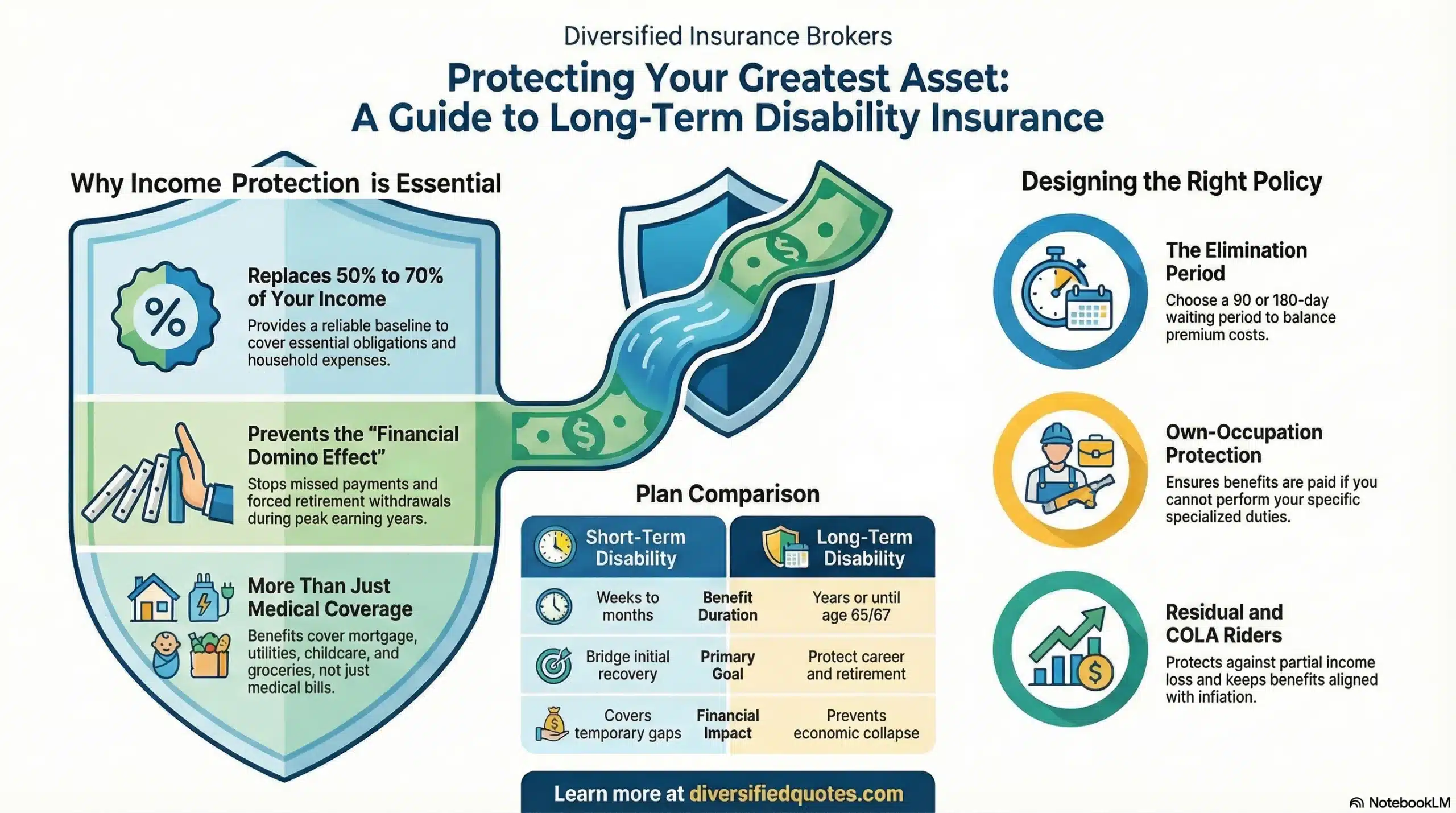
Talk With an Advisor Today
Choose how you’d like to connect—call or message us, then book a time that works for you.
Schedule here:
calendly.com/jason-dibcompanies/diversified-quotes
Licensed in all 50 states • Fiduciary, family-owned since 1980
FAQs: Disability Insurance for Restaurant Workers and Servers
I’m a server and most of my income is tips — can I get disability insurance based on my real total income?
Yes — but the benefit amount you can qualify for depends directly on the income you can document in tax records. Disability insurance benefit calculations use tax-reported income as the basis. Tip income reported on IRS Form 4137 and reflected in W-2 Box 1 as taxable wages becomes part of the documented income basis that determines your maximum approvable monthly benefit. Tip income that is not reported — cash tips never disclosed to the IRS — does not appear in any documentation and cannot be used in the benefit calculation regardless of how much you actually earned from tips. The practical planning implication is straightforward but important: the most effective way to maximize the disability benefit available to a server or bartender is complete, accurate tip reporting on tax records across two to three years before applying for disability insurance.
A server whose total compensation is genuinely $55,000 annually — $15,000 base wage plus $40,000 in actual tip income — but who reports only the $15,000 base wage can qualify for a disability benefit sized to only $15,000 in annual income: approximately $750 per month at standard replacement rates. That $750 cannot sustain the household that the full $55,000 was funding. The same server who accurately reports all $55,000 in total compensation can qualify for a benefit sized to that full documented income: approximately $2,750 per month — enough to genuinely replace the income the household depends on. For servers and bartenders who have historically underreported tips, beginning complete reporting in the years before a disability insurance application is the most important income protection planning step available. A second opinion from an independent broker who has placed coverage for tipped food service workers specifically addresses the income documentation approach appropriate for the specific compensation structure before any application is submitted.
I hurt my back lifting a heavy stock order at the restaurant — won’t workers’ comp cover that?
Workers’ compensation covers acute, documentable, work-related incidents for employed restaurant workers — and a back injury from a specific documented lifting event at a documented time and location at the employer’s facility is exactly the type of claim workers’ comp is designed to address. If you reported the injury immediately, documented the incident through the employer’s reporting process, and sought prompt medical treatment, the workers’ compensation system can provide medical coverage and partial income replacement during the recovery period. Workers’ comp is worth filing when it applies — it represents a legitimate benefit that should be utilized when an acute work-related incident meets the documentation requirements.
Where workers’ compensation specifically fails restaurant workers is in covering the back conditions that don’t arise from a single identifiable incident: the chronic lumbar disc deterioration that develops from years of sustained heavy tray carrying and awkward kitchen postures; the repetitive stress wrist or knee condition that accumulates across thousands of shifts of repetitive food preparation and service motions; the back condition that has been quietly worsening for a year before a specific event makes it impossible to continue working. These conditions — which AmTrust’s Restaurant Risk Report documents as the highest-cost and longest-duration restaurant injury category — require the attribution of a specific workplace incident to receive workers’ comp benefits, and gradual cumulative conditions frequently fail that attribution requirement. Individual disability insurance covers qualifying disability from any musculoskeletal cause regardless of whether the disabling condition arose from a specific incident or from cumulative loading — filling the gap where workers’ comp fails precisely the most financially consequential restaurant injury category. Accident-only disability income insurance is an accessible lower-cost option that specifically addresses the acute incident scenario for food service workers who want targeted coverage at lower premium cost.
I own a restaurant — what disability coverage do I need as the owner?
As a restaurant owner, your disability exposure has two distinct layers that require two coordinated coverage responses. Personal disability income insurance replaces your earned income from the restaurant when a qualifying disability prevents you from working — managing operations, purchasing, scheduling, and the hands-on work that your personal involvement in the business generates. This policy addresses your household financial obligations during the disability period. Business overhead expense disability coverage addresses the restaurant’s fixed operating costs: the monthly lease payment, equipment financing, utility contracts, staff wages, food vendor minimums, insurance premiums, and all other fixed costs that continue whether you are managing the restaurant or not.
A disability that keeps you away from the restaurant for two to four months creates both personal income loss and simultaneous overhead obligations accumulating against whatever reduced revenue the restaurant generates without your management. For most owner-operated restaurants where the owner’s presence is central to daily operations — managing suppliers, supervising staff, handling customer relationships, overseeing quality — a disability produces meaningful revenue reduction alongside the overhead obligation, creating the two-layer financial exposure that can threaten the business’s survival during a disability period that would otherwise be recoverable with appropriate coverage in place. BOE disability coverage pays documented fixed monthly restaurant overhead during qualifying disability, preserving the operation during recovery. The BOE benefit is sized to actual documented monthly overhead — not to restaurant revenue — covering what the operation costs to maintain. The combination of personal disability income and BOE creates the complete protection architecture for a restaurant owner, addressing both the household financial floor and the business continuity floor that a disability simultaneously threatens.
Are disability insurance benefits taxable for a restaurant worker or server?
For restaurant workers who purchase individual disability insurance personally and pay premiums with after-tax personal income — which applies to any server, cook, or bartender who buys their own policy independently — monthly disability benefits received during a qualifying disability are generally received income-tax-free. The full benefit amount reaches the worker without income tax reduction during the disability period when no shift income is being generated. Understanding the full tax treatment of disability insurance benefits matters for sizing the policy correctly: a tax-free individually purchased benefit should cover actual after-tax take-home income including tips, ensuring genuine replacement of what was lost rather than a further tax-reduced benefit on top of the income interruption.
This tax-free character of personally purchased disability benefits is particularly valuable for tipped food service workers because their income tax burden — while calculated on all reported income — may produce a relatively modest marginal rate at the lower income levels where many servers and bartenders operate, meaning the full tax-free monthly benefit genuinely represents the household’s replacement income need. For restaurant owners whose businesses pay disability insurance premiums at the entity level, the tax treatment is more complex — BOE premiums paid by the restaurant entity may be deductible as business expenses, but resulting BOE benefits are typically taxable, creating a roughly neutral net tax impact. Personal disability income policies purchased by restaurant owners with personal after-tax funds deliver tax-free benefits at the household level regardless of the business entity’s treatment of the premium.
I have a prior back or knee condition from restaurant work — can I still get disability insurance?
Yes — though the underwriting outcome depends on the severity, current clinical status, and documentation of the prior condition. For most documented prior back or knee conditions that are currently stable — a prior lumbar strain that was treated and resolved, a managed knee condition with documented stable current function and no ongoing functional limitation — the standard underwriting outcome is a partial exclusion rider for that specific documented condition, providing full coverage for all other disability causes: acute fall injuries at other body sites, illness-based disability, burn injuries, and all other qualifying conditions outside the excluded area. The policy with a lumbar exclusion rider still provides genuine protection for the slip-and-fall, the burn injury, the illness-based disability, and every other qualifying cause outside the excluded back condition.
The practical implication is that the most favorable time to purchase disability insurance as a food service worker — specifically the time when comprehensive back and knee coverage without exclusion riders is available — is at career start before the physical demands of restaurant work have produced any documented musculoskeletal health history. A young server or cook beginning their first food service position with no documented prior conditions can purchase disability insurance with comprehensive back, knee, wrist, and shoulder coverage that the mid-career route cannot replicate once the physical demands of restaurant service have produced occupational health records. Coverage for food service workers with prior musculoskeletal conditions is available through independent broker comparison across carriers whose guidelines for restaurant work MSD histories vary meaningfully — some carriers take a narrower, joint-specific exclusion approach that is less restrictive than the broader regional exclusions others apply for the same documented condition.
I work at multiple restaurants as a contract bartender — how does that affect my disability coverage?
A contract bartender who works at multiple venues on a 1099 or cash basis rather than as a permanent W-2 employee at a single establishment is, for disability insurance purposes, fully self-employed — and individual disability insurance is the entire income protection system with no employer benefit baseline of any kind. The income documentation follows the same Schedule C framework as any self-employed professional: all bartending income from all venues, documented across two to three years of federal tax returns and 1099 forms, establishes the average annual self-employment income that forms the benefit calculation basis. Reported tip income from bartending work — documented on Form 4137 and W-2 or in Schedule C for self-employed contract bartenders — should be included in the income documentation to produce the most complete and accurate benefit basis.
The multi-venue contract structure also means there is no single employer to file a workers’ compensation claim with when an injury occurs — a contract bartender who slips on a wet floor at a venue where they were working that night may have workers’ comp coverage through the venue’s policy, or may not, depending on how the venue classifies their independent contractor relationship. Individual disability insurance provides the income floor that functions regardless of the venue, the employment classification, and the workers’ comp situation — paying the monthly benefit whenever a qualifying disability prevents bartending work regardless of where or how the disability event occurred. The 1099 income documentation framework for contract food service workers covers how all bartending income from all venues should be captured in the tax record to produce the most favorable benefit basis for the disability insurance application.
About the Author:
Jason Stolz, CLTC, CRPC, DIA, CAA and Chief Underwriter at Diversified Insurance Brokers (NPN 20471358), is a senior insurance and retirement professional with more than 25 years of real-world experience helping individuals, families, and business owners protect their income, assets, and long-term financial stability. As a long-time partner of the nationally licensed independent agency Diversified Insurance Brokers, Jason provides trusted guidance across multiple specialties—including fixed and indexed annuities, long-term care planning, personal and business disability insurance, life insurance solutions, Group Health, Travel Medical and Evacuation Insurance, and short-term health coverage. Diversified Insurance Brokers maintains active contracts with over 100 highly rated insurance carriers, ensuring clients have access to a broad and competitive marketplace.
His practical, education-first approach has earned recognition in publications such as VoyageATL, and contributions from his agency featured in Kiplinger and GoBankingRates— highlighting his commitment to financial clarity and client-focused planning. Drawing on deep product knowledge and years of hands-on field experience, Jason helps clients evaluate carriers, compare strategies, and build retirement and protection plans that are both secure and cost-efficient. Visitors who want to explore current annuity rates and compare options across multiple insurers can also use this annuity quote and comparison tool.
Explore More Disability Insurance Options: Browse our complete guide to Disability Insurance for Food, Hospitality, Arts & Entertainment — covering chefs, musicians, actors, bartenders, hospitality workers & entertainment professionals from 100+ carriers.
Last Reviewed: June 8, 2026 |
Reviewed by: Jason Stolz, CLTC, CRPC, DIA, CAA
Chief Underwriter, Diversified Insurance Brokers, Inc. | NPN: 20471358 | Diversified Insurance Brokers, Inc. — Licensed in all 50 states
Fact Checked by: Tonia Pettitt, CMIP©
Medicare Specialist, Diversified Insurance Brokers, Inc. | NPN: 14374308 | Diversified Insurance Brokers, Inc. — Licensed in all 50 states
Did you find this content helpful? Leave us a Google review — it helps others find trustworthy guidance too.
Editorial Standards: Diversified Insurance Brokers maintains rigorous editorial standards to ensure accuracy, clarity, and independence in all content. Learn more about our editorial standards and commitment to transparency.
