
Disability Insurance for Cooks
As an Independent Disability Insurance Broker, we have access to exclusive discounts and negotiated pricing most captive agents can’t offer — see the full breakdown near the end of this page.
Disability Insurance for Cooks

Jason Stolz CLTC, CRPC, DIA, CAA
Cooks working in commercial kitchens face one of the most injury-dense occupational environments in American food service — a fact confirmed by Bureau of Labor Statistics data and peer-reviewed occupational health research that documents burns, cuts, slips, and musculoskeletal strain as the four dominant injury pathways in kitchen work, all occurring at rates that substantially exceed the general workforce averages. BLS data specifically documents that restaurant and food service workers experience burns at a rate nearly seven times higher than workers across all private industries, and cuts and lacerations at a rate more than three times the all-industry average. A study of cooks in commercial kitchens found that burns and scalds accounted for 24 percent of reported occupational injuries, with nearly half of all burn injuries involving hot oil — one of the highest-temperature and most penetrating burn agents in kitchen environments. Slips and falls, wrist and shoulder injuries from repetitive motion, and the cumulative musculoskeletal loading of full-shift standing and heavy lifting each contribute additional injury probability to what occupational data consistently classifies as a high physical risk working environment. For the approximately 14 million workers employed in the U.S. food service industry, most of whom earn wages that leave minimal financial reserve, a disability event that eliminates kitchen income — even for weeks — produces an immediate household financial crisis that workers’ compensation alone cannot fully address and that most cooks have no individual income protection to prevent. The coverage options available to food service workers through parallel physical service professions provide a useful framework for understanding how individual disability coverage can be built at accessible cost for the food service income level.
At Diversified Insurance Brokers, Jason Stolz, CLTC, CRPC, DIA, CAA works with line cooks, prep cooks, head cooks, and sous chefs across the range of employment and income structures the food service industry encompasses — full-time employed kitchen staff at restaurants and institutions who may have limited group benefit access, catering cooks who earn from event and contract work as independent contractors, private household cooks employed directly by families, and personal chefs who operate as self-employed culinary professionals. The coverage that serves an employed restaurant cook with irregular group plan access differs structurally from what a 1099-earning catering contractor who earns entirely from event-based contracts needs — and both require specific attention to the burn, cut, and musculoskeletal injury pathways that kitchen work specifically and consistently creates.
Compare Disability Coverage for Cooks
We review coverage options across 100+ carriers and identify the policy structure that fits your kitchen income, employment setting, and occupational risk profile.
Cook Disability Risk — Burns, Cuts, Physical Demands, and the Income Protection Gap
| Risk Category | BLS / Research Documentation | Resulting Disability Risk | Workers’ Comp Coverage | Income Protection Gap |
|---|---|---|---|---|
| Burns and thermal injuries | BLS data documents restaurant workers experience burns at a rate of 10.2 per 10,000 workers — nearly seven times the all-industry rate of 1.5; peer-reviewed research on commercial kitchen cooks finds burns and scalds account for 24% of occupational injuries with nearly half involving hot oil; the food industry’s thermal injury rate substantially exceeds the all-industry average at 8.9 vs. 1.4 | Severe burns requiring extended medical treatment, skin graft surgery, and the extended recovery during which hand and arm function — essential for kitchen work — may be substantially limited; serious hot oil burns can produce permanent scarring affecting hand dexterity | Workers’ comp covers employed cooks for documented acute burn incidents; self-employed catering and personal chef cooks entirely unprotected; workers’ comp pays approximately two-thirds of wages to state caps | Income gap above workers’ comp cap; full gap for self-employed cooks; individual LTD covers extended burn recovery beyond workers’ comp adequacy |
| Cuts and lacerations from knife and equipment work | BLS data documents restaurant workers experience cuts and lacerations at 23.6 per 10,000 workers — more than three times the all-industry rate of 7.1; within a 12-month period, 8,110 cuts and lacerations resulting in missed work were recorded in full-service restaurants alone; the food industry’s cuts rate of 17.0 compares to an all-industry rate of 9.0 | Serious lacerations requiring surgical repair, tendon damage affecting hand function, or nerve damage from deep cut injuries — conditions that can extend beyond short recovery periods and in serious cases limit the fine motor function kitchen work requires | Covers employed cooks for documented acute incidents; catering and contract cooks unprotected; workers’ comp adequacy dependent on state caps and benefit period limitations | Gap for extended recovery from serious cuts or tendon/nerve damage; individual DI covers income loss from qualifying hand injuries regardless of workers’ comp status |
| Slips and falls on kitchen surfaces | Commercial kitchen floors — wet from dishwashing, greasy from cooking operations, cluttered during peak service — are among the most slip-hazardous surfaces in the food service work environment; kitchen occupational health research documents slips and falls as accounting for approximately 18% of reported cook injuries in one study | Fractures, spinal injuries, head injuries, and knee damage from kitchen floor falls — injuries that can require months of recovery and in serious cases produce permanent limitations preventing return to physically demanding kitchen work | Covers employed cooks for documented on-duty slip incidents; self-employed catering cooks operating in client kitchens face more complex coverage questions; income gap above state workers’ comp caps | Full gap for self-employed; income gap above workers’ comp ceiling; individual DI fills extended recovery and permanent disability scenarios |
| Musculoskeletal strain from repetitive motion and lifting | Kitchen occupational health research documents forearm and shoulder injury from repetitive motion at 19% of reported injuries; heavy lifting of supply deliveries, large stockpots, and full sheet pans creates the same lumbar loading documented across all heavy-lifting occupations; full-shift standing on hard kitchen floors contributes lower extremity and spinal loading | Chronic lower back syndrome, shoulder conditions, wrist tendinitis, and knee degeneration — progressive musculoskeletal conditions from sustained kitchen work that can eventually prevent continued full-schedule cooking employment | Acute incidents covered for employees; cumulative conditions disputed as non-occupational; gradual onset complicates workers’ comp attribution | Significant gap for chronic conditions; individual DI covers disability from any qualifying cause without incident documentation requirement |
| Burnout, mental health, and occupational stress | Peer-reviewed research documents that burns and cuts in kitchen workers are associated with higher job demands and psychological stress, with job stress increasing burn and cut injury odds ratios of 2.56 and 2.72 respectively; the food service industry has among the highest worker turnover rates of any industry, reflecting the sustained occupational stress of commercial kitchen employment | Disabling anxiety, depression, or burnout preventing sustained kitchen work — the high-pressure, high-pace commercial kitchen environment creates documented elevated occupational stress that can produce genuine disabling mental health events | Not covered by workers’ comp; group plans cap mental/nervous benefits at 24 months where available; most cooks have no group plan | Full gap for most kitchen workers; individual DI with unlimited mental health benefit period provides the only comprehensive protection |
| Illness-based disability (non-occupational) | Cancer, cardiac events, neurological conditions — health events independent of kitchen work that eliminate the physical and cognitive capacity for sustained commercial cooking | Extended inability to perform the physical kitchen work — standing, lifting, high-precision knife and heat work — that cooking employment requires | Not covered by workers’ comp; most cooks have no group plan; approximately 90% of long-term disabling conditions are illness-based | Complete gap for most cooks; individual DI to age 65 is the only income floor available for the dominant disability probability category |
The table documents what makes the cook’s disability planning situation both urgent and underserved: an occupational injury rate for burns that is nearly seven times the all-industry average, cuts at more than three times the all-industry average, and a workforce where most workers earn wages that make any extended disability period a household financial crisis — but where group benefit access in the restaurant and food service industry is significantly lower than in most other employment sectors. Income protection for high physical-risk food service workers is both more needed and less commonly held in the cook population than in virtually any comparable income bracket across the American workforce.
Burns, Cuts, and the Kitchen Injury Record — What the BLS Data Shows
The Bureau of Labor Statistics data on food service worker injuries is among the most consistently documented in the occupational health literature — and the burn and cut rates it documents for restaurant and kitchen workers stand out against the all-industry average in a way that reflects the specific thermal and sharp hazard density of commercial kitchen work. Restaurant workers experience burns at nearly seven times the private industry average rate, cuts and lacerations at more than three times the all-industry average, and the food industry’s overall thermal injury rate is more than six times the comparable all-industry figure. Peer-reviewed occupational health research on commercial kitchen cooks specifically confirms burns and scalds as the single most common injury category at 24 percent of reported incidents, with nearly half of all burn injuries involving hot oil — one of the most difficult burn agents to manage given its high temperature, penetrating nature, and the speed with which oil splash injuries occur during high-volume cooking service.
The disability implication of a serious burn injury extends well beyond the immediate pain and medical treatment. A cook who sustains a deep hot oil burn to the dominant hand or forearm faces a recovery timeline measured in weeks to months during which the hand function required for knife work, precision cooking techniques, and the sustained manual demands of kitchen employment may be substantially limited. For catering cooks, personal chefs, or any cook with upcoming contracted events during the recovery period, the income loss from a serious burn is immediate and total. Long-term disability income replacement addresses the extended recovery and any permanent limitations from serious kitchen burn or cut injuries. Short-term disability coverage fills the immediate income gap from the day of injury through the acute recovery period. For cooks on tight budgets who want immediate protection for the kitchen’s most likely injury scenarios, accident-only disability income insurance provides an accessible entry-level option covering accidental injury disability specifically — a lower-cost starting point while comprehensive coverage is built as income and savings allow.
Workers’ Compensation and Its Limits for Kitchen Workers
Workers’ compensation provides the baseline protection for employed cooks — covering documented acute on-duty injuries at approximately two-thirds of wages up to state caps for the qualifying recovery period. For the burn injury from a cooking accident, the slip on a wet kitchen floor, and the acute back strain from lifting a heavy stockpot, workers’ comp provides what it was designed to provide. But three structural limitations leave significant income protection gaps for the cooking profession specifically. First, the benefit ceiling: at restaurant cook wages, the state workers’ comp maximum may provide full replacement through the benefit calculation, but the elimination of overtime, tips, and any secondary cooking income creates a practical shortfall for workers whose total compensation exceeds base wage. Second, the illness gap: the cardiac event, cancer diagnosis, and neurological condition that drive approximately 90 percent of long-term disabling conditions are entirely outside workers’ comp. Third, the self-employment gap: catering cooks, personal chefs, and independent cooking contractors carry zero automatic workers’ comp protection.
Why kitchen workers choose to add individual coverage alongside workers’ comp comes down to these three gaps — and particularly the illness gap, which represents the overwhelming statistical majority of long-term disability events. Whether individual disability insurance is worth the cost for a cook earning at food service wages is answered by the same household financial calculation that applies to any worker: the income the household would lose without it versus the annual premium of the policy that prevents that loss.
Self-Employed and Catering Cooks — The Complete Coverage Gap
Self-employed personal chefs and catering cooks who earn from contract cooking events, private household agreements, and catering engagements face the same complete coverage gap as any self-employed service worker — zero workers’ comp for their own injuries, no employer group plan, and no income floor when a burn, cut, back injury, or illness eliminates their ability to work. The income documentation for self-employed cooking professionals uses Schedule C from federal tax returns, capturing contract cooking income, catering event fees, and any other earned cooking-related income as the basis for the maximum approvable monthly benefit. Protection for high-risk physical service workers specifically addresses the scenario where occupational injury probability is high and employer protection is entirely absent.
The own-occupation insurance standard for a professional cook specifically covers the inability to perform cooking work — sustained standing, knife work, heat management, physical kitchen demands — rather than requiring inability to perform any sedentary work before benefits activate. A cook whose burn injuries prevent hand function adequate for professional cooking has experienced a genuine occupational disability, and the policy definition should reflect that. Residual disability coverage addresses the partial recovery scenario — a cook who can return to limited kitchen duties but cannot sustain full-shift professional cooking output — with proportional benefits based on actual income reduction rather than forcing total disability as the only benefit-triggering standard. How short-term and long-term disability structures interact is important for cooks whose injury scenarios range from recoverable — a burn requiring six weeks of healing — to career-altering, where serious tendon or nerve damage from a deep laceration permanently limits the fine motor precision that skilled cooking requires.
Policy Design, Affordability, and Timing for Food Service Workers
Cooks receive lower to middle occupational class assignments from most disability insurance carriers, reflecting the documented physical hazard, burn and cut risk, and manual labor demands of kitchen work. This classification produces premiums that are higher per dollar of benefit than white-collar professional occupations — but at cook income and benefit amount levels, absolute dollar premiums remain meaningful and accessible for workers committed to protecting their kitchen income.
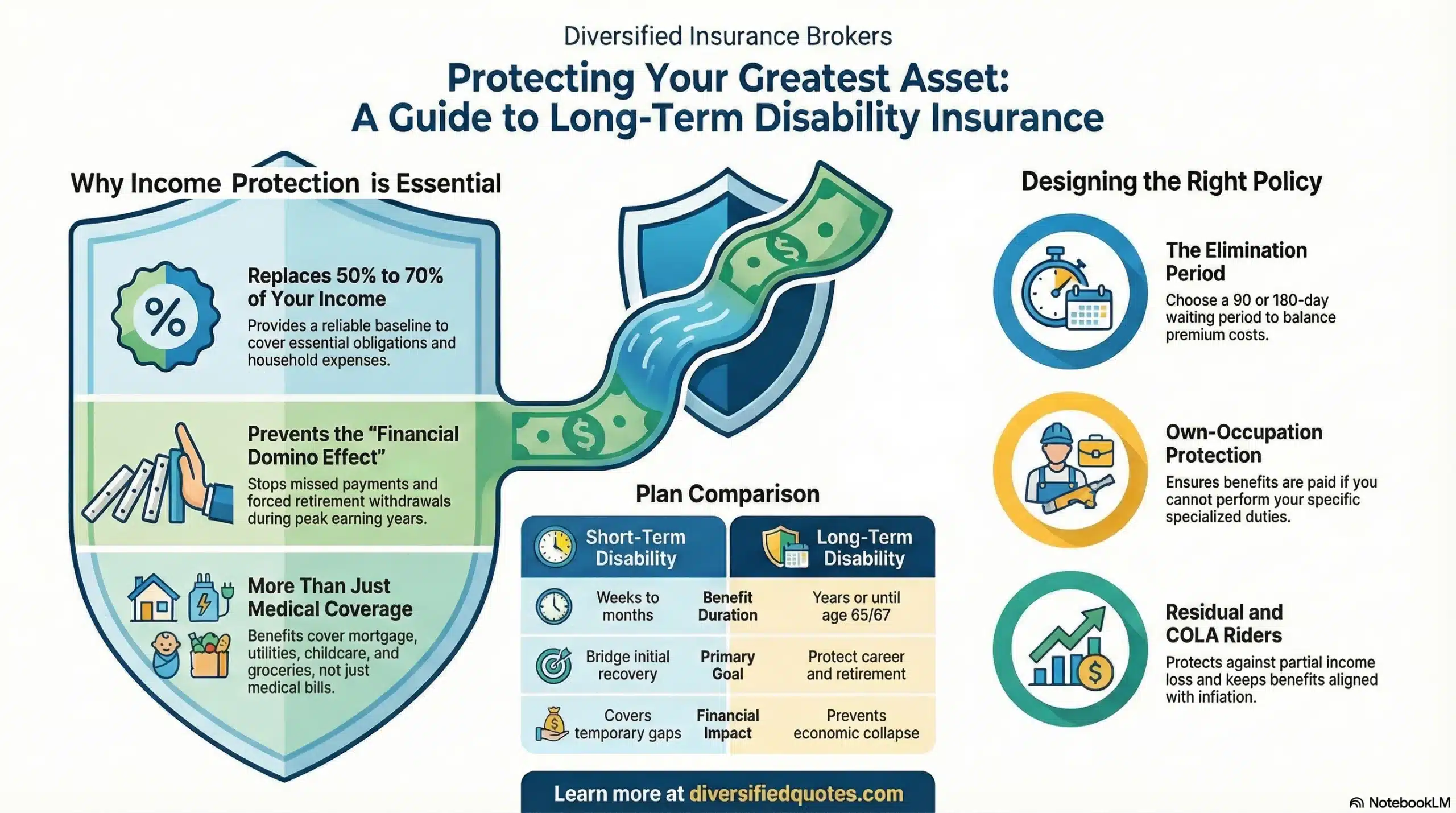
How much disability income protection a cook needs depends on documented wages, household financial obligations, and how long the household could sustain expenses without income before a disability produced a financial crisis. The elimination period should reflect actual reserves — a 90-day period is appropriate for cooks with three months of emergency savings, producing lower premiums than a 30-day period without leaving the household unprotected through the elimination window. The future increase option allows benefit increases as income grows without new medical underwriting — important for cooks building toward head cook or sous chef income levels. Cost of living adjustment protects real purchasing power across a multi-year disability period. Coverage for cooks with prior burn, cut, or back histories is available through independent broker channels; partial exclusion riders for specific documented conditions leave full coverage in place for all other disability causes. Specialty and modified options address cooks whose occupational injury history creates standard underwriting complexity. No-exam coverage provides streamlined approval for healthy cooks at lower benefit amounts. Getting the best rates means applying while the occupational injury record is clean, at the youngest available age. Why young kitchen workers need coverage before burn and cut histories accumulate is answered by the burn rate statistics: nearly seven times the all-industry average means the kitchen produces occupational injury events that the general workforce does not. Guaranteed issue group coverage through culinary worker unions or employer group programs may provide an additional access point. Buying disability insurance online makes the process accessible for cooks whose kitchen schedules make traditional appointments difficult. Guarantee issue individual coverage provides access for cooks with documented injury histories that standard underwriting handles with exclusions. Coverage for other physically demanding care and service workers provides useful parallel structures for understanding how coverage is built at service worker income levels. Whether disability benefits are taxable for a cook: personally purchased after-tax premiums generally produce tax-free disability benefits, delivering the full monthly benefit to the household without income tax reduction.
Get Your Cook and Kitchen Worker Coverage Review
We compare coverage options across 100+ carriers and identify the policy structure that actually fits kitchen income and food service employment realities.
Talk With an Advisor Today
Choose how you’d like to connect—call or message us, then book a time that works for you.
Schedule here:
calendly.com/jason-dibcompanies/diversified-quotes
Licensed in all 50 states • Fiduciary, family-owned since 1980
FAQs: Disability Insurance for Cooks
I got burned at work and workers’ comp is covering it — why would I also need disability insurance?
Workers’ compensation and individual disability insurance address different parts of the financial protection picture for kitchen workers, and the gaps workers’ comp leaves open are the ones that produce the most serious long-term financial consequences. For a documented acute burn injury that occurred on the job and was reported immediately, workers’ comp should cover medical treatment and approximately two-thirds of wages up to the state maximum during the recovery period. For many cooks, this provides reasonable immediate coverage — assuming the injury is clearly documented, the claim is not disputed, and recovery stays within the workers’ comp system’s timeline expectations.
The gaps that matter most for cooks appear in three scenarios workers’ comp does not address. First: if a burn or cut injury produces complications — skin graft failure requiring re-treatment, infection, nerve damage requiring extended rehabilitation — that extend the recovery beyond what workers’ comp benefit duration or state caps fully fund, individual LTD provides the income continuation that workers’ comp has ended. Second: the musculoskeletal back and shoulder conditions that accumulate from years of kitchen work — heavy lifting, sustained standing, repetitive prep motions — develop gradually without a single dated incident and are frequently disputed in workers’ comp as non-occupational degeneration. Third: the cancer diagnosis, cardiac event, or neurological condition that accounts for approximately 90 percent of long-term disabling conditions generates zero workers’ comp benefit regardless of how many years of kitchen work preceded it. Individual disability insurance fills all three gaps simultaneously. A second opinion on any disability insurance option for a kitchen worker confirms whether the specific coverage being considered addresses the right combination of gaps relative to whatever workers’ comp access the cook has.
I’m a catering cook who earns from events — is disability insurance available for my type of work?
Yes — individual disability insurance is fully available for catering cooks and independent culinary contractors, and for self-employed kitchen professionals it is the entire protection system rather than a supplement. As a self-employed catering cook, you carry no workers’ comp protection for your own injuries, no employer group disability plan, and no income floor when a burn, back injury, or illness eliminates your ability to work and fulfill contracted events. Individual disability insurance specifically serves the self-employed structure — the policy is purchased directly, documented from your own income records, and is not dependent on any employer’s group plan participation.
Income documentation for catering cooks uses Schedule C from federal tax returns or business income records capturing catering event fees, per-event contract income, and any other earned cooking income across a two to three year average. The variable nature of event-based catering income — higher in busy seasons, lower in slower periods — is addressed through the multi-year averaging approach rather than a single peak-year figure. Whether disability insurance benefits are taxable for a catering cook: premiums paid personally with after-tax income generally produce tax-free disability benefits, delivering the full monthly benefit without income tax reduction during the period when event bookings have been eliminated by the disability. The own-occupation definition for a catering cook should specifically cover the physical cooking work — sustained kitchen labor, knife work, heat management — that defines catering employment rather than defaulting to a generic characterization that a carrier might use to argue that sedentary work is possible.
How much disability insurance can I realistically get on a cook’s wages?
Individual disability insurance benefit amounts are calculated as approximately 60 percent of documented earned income — so the benefit available directly reflects actual kitchen wages rather than an external cap. A cook earning $40,000 annually qualifies for approximately $2,000 per month in disability benefit; a head cook or sous chef earning $60,000-$75,000 qualifies for $3,000-$3,750 per month. These benefit amounts are modest in absolute dollar terms but are sized to the actual household financial obligations they need to address — and when they arrive tax-free to a household budgeted to those income levels, they cover the essentials during a disability period that could otherwise produce a complete financial crisis within weeks of the disability starting.
The premium cost for a policy sized to cook income levels is proportionally lower than for higher-income professional policies, because both the benefit amount and the age-rated premium are smaller. A cook in their twenties or early thirties who is in good health will find that a policy providing $2,000-$2,500 in monthly benefit costs a small fraction of that monthly benefit in annual premium — a favorable ratio regardless of income level. Getting the best available rates means comparing across carriers rather than accepting the first premium quoted, and for cooks on tight budgets, the most effective cost management tools are the 90-day elimination period — which reduces annual premiums meaningfully compared to a 30-day period — and applying before any burn, cut, or back injury history narrows the available coverage terms and potentially raises premiums. Guarantee issue coverage options provide an access point when standard underwriting would apply exclusions that limit the most relevant coverage areas.
I have a prior back injury from lifting at my last restaurant job — can I still get disability coverage?
Yes — though the underwriting outcome depends on the severity, current clinical status, and documentation of the prior back injury. For most documented prior back conditions that are currently stable — a prior lumbar strain that was treated and has not recurred, a managed chronic condition that is stable and not limiting current work capacity — the standard underwriting outcome is a partial exclusion rider for that specific documented back condition. The exclusion rider limits coverage specifically attributable to the prior back condition while leaving full coverage in place for all other disability causes: burn injuries, cut injuries, other musculoskeletal conditions at different body sites, serious illness, and any other qualifying event outside the excluded back area.
The challenge for kitchen workers is that back conditions are among the most realistic disability pathways in the occupation — from heavy lifting, sustained standing, and the physical demands of commercial cooking. A prior back exclusion may limit coverage precisely where the occupational risk is concentrated. This is the strongest argument for early purchase — before the back conditions that kitchen work can produce over years have time to appear in medical records. Coverage for cooks with prior injury histories is available through independent broker comparison across carriers with varying back condition guidelines. Specialty and modified market options address cooks whose documented history creates standard underwriting complexity. Carrier guidelines for kitchen worker musculoskeletal histories vary meaningfully — the same documented condition can receive a narrow, specific exclusion at one carrier and a broader exclusion at another — making independent comparison the most effective approach for identifying the best available terms for a specific back history.
I’m just starting in the kitchen — why should I get disability insurance this early in my career?
The beginning of a kitchen career is the most advantageous time to establish disability insurance for two reasons that are more specifically urgent in food service than in many other occupations. First: premiums are age-rated, meaning earlier purchase locks in lower annual premiums for the full policy duration. A cook who purchases at 22 or 24 pays substantially less per year than one who purchases at 35 — for the same coverage protecting the same income. The cumulative premium savings from early purchase over a full kitchen career can be significant relative to a food service income.
Second: the burn histories, cut injury records, and back conditions that kitchen work can produce have not yet had time to develop at the beginning of a cooking career. A new cook whose hands are undamaged, whose back is healthy, and whose health record is clean can purchase comprehensive disability insurance — including full coverage for burn injuries, cuts, back conditions, and all other qualifying events — without the exclusion riders that documented kitchen injury histories generate at underwriting. Every year in a commercial kitchen is a year during which that record potentially builds: the burn from hot oil, the laceration from a knife slip, the back tweak from an awkward pot lift. The window to purchase comprehensive coverage without those exclusions is early, before the kitchen has produced its occupational health record. Why young kitchen workers need income protection before injury records accumulate is answered directly by the BLS burn rate: nearly seven times the all-industry average means the kitchen produces occupational injury events at a documented rate that makes clean-health early purchase the most financially sound decision for any cook at the beginning of their culinary career. The future increase option on early-career policies allows benefit increases as income grows — from line cook to head cook to sous chef wages — without new medical underwriting, preserving favorable early-career health terms through the full income trajectory.
Does disability insurance cover mental health or burnout for a cook?
Yes — individual disability insurance covers qualifying disability from mental health conditions including anxiety disorders, depression, and burnout when those conditions meet the policy’s disability definition. The occupational stress dimension of commercial kitchen work is documented in peer-reviewed research: one study found that higher psychological stress scores in kitchen workers were associated with significantly increased odds of sustaining burn and cut injuries — job demands and psychological stress independently increasing injury probability at odds ratios above 2.5. The high-pace, high-pressure commercial kitchen environment creates documented occupational stress conditions that can produce genuine disabling mental health events independent of the physical injury risk the kitchen also carries.
For cooks who work in institutional settings or larger restaurant groups with some group plan access, the 24-month mental health benefit cap that most group plans impose limits coverage for long-term mental health disability at exactly the point when a serious psychiatric condition has proven itself persistent. Individual disability insurance with unlimited mental health benefit periods provides coverage that continues beyond 24 months when a mental health condition requires extended treatment before the cook can return to the demands of commercial kitchen work. For the majority of cooks who work at smaller establishments without group plan access at all, individual disability insurance with unlimited mental health coverage is the only protection structure available. Coverage structures for other high-stress service workers provide useful parallels for how mental health disability coverage is incorporated into policies designed for physically and emotionally demanding service occupations.
About the Author:
Jason Stolz, CLTC, CRPC, DIA, CAA and Chief Underwriter at Diversified Insurance Brokers (NPN 20471358), is a senior insurance and retirement professional with more than 25 years of real-world experience helping individuals, families, and business owners protect their income, assets, and long-term financial stability. As a long-time partner of the nationally licensed independent agency Diversified Insurance Brokers, Jason provides trusted guidance across multiple specialties—including fixed and indexed annuities, long-term care planning, personal and business disability insurance, life insurance solutions, Group Health, Travel Medical and Evacuation Insurance, and short-term health coverage. Diversified Insurance Brokers maintains active contracts with over 100 highly rated insurance carriers, ensuring clients have access to a broad and competitive marketplace.
His practical, education-first approach has earned recognition in publications such as VoyageATL, and contributions from his agency featured in Kiplinger and GoBankingRates— highlighting his commitment to financial clarity and client-focused planning. Drawing on deep product knowledge and years of hands-on field experience, Jason helps clients evaluate carriers, compare strategies, and build retirement and protection plans that are both secure and cost-efficient. Visitors who want to explore current annuity rates and compare options across multiple insurers can also use this annuity quote and comparison tool.
Explore More Disability Insurance Options: Browse our complete guide to Disability Insurance for Food, Hospitality, Arts & Entertainment — covering chefs, musicians, actors, bartenders, hospitality workers & entertainment professionals from 100+ carriers.
Last Reviewed: June 8, 2026 |
Reviewed by: Jason Stolz, CLTC, CRPC, DIA, CAA
Chief Underwriter, Diversified Insurance Brokers, Inc. | NPN: 20471358 | Diversified Insurance Brokers, Inc. — Licensed in all 50 states
Fact Checked by: Tonia Pettitt, CMIP©
Medicare Specialist, Diversified Insurance Brokers, Inc. | NPN: 14374308 | Diversified Insurance Brokers, Inc. — Licensed in all 50 states
Did you find this content helpful? Leave us a Google review — it helps others find trustworthy guidance too.
Editorial Standards: Diversified Insurance Brokers maintains rigorous editorial standards to ensure accuracy, clarity, and independence in all content. Learn more about our editorial standards and commitment to transparency.
