
Disability Insurance for Bookkeepers
As an Independent Disability Insurance Broker, we have access to exclusive discounts and negotiated pricing most captive agents can’t offer — see the full breakdown near the end of this page.
Disability Insurance for Bookkeepers

Jason Stolz CLTC, CRPC, DIA, CAA
Bookkeepers occupy one of the more favorable positions in the disability insurance market — a sedentary, office-based occupation that typically receives top-tier or near-top-tier occupational class assignments, producing lower premiums per dollar of monthly benefit and higher maximum benefit ceilings than physical trades or production-based occupations. But favorable occupational class does not mean the disability risk is low. Bureau of Labor Statistics data places the median annual wage for bookkeeping, accounting, and auditing clerks at $49,210, with experienced full-charge bookkeepers and self-employed bookkeeping professionals frequently earning considerably more — and every dollar of that income depends on the cognitive capacity, manual fine motor function, and sustained mental and physical health that bookkeeping work requires. When disability strikes a bookkeeper, the income disappears regardless of how favorably the carrier classified the occupation. Disability insurance is what remains between the household and financial disruption when the health event that eliminates income arrives — as it does, statistically, for approximately one in four workers before retirement age.
At Diversified Insurance Brokers, Jason Stolz, CLTC, CRPC, DIA, CAA works with bookkeepers across the full spectrum of professional settings the occupation encompasses — employed full-charge bookkeepers at small and mid-size businesses, bookkeeping clerks at larger organizations with employer-provided benefits, and the substantial population of self-employed bookkeeping professionals who operate independent practices serving multiple clients, manage their own overhead, and carry no employer-provided disability plan as a baseline. The income protection structure appropriate for a bookkeeper employed at a company with group long-term disability coverage differs significantly from what an independent bookkeeping practice owner requires — and getting the structure right requires understanding both what the existing coverage actually covers and what gaps remain unaddressed.
Compare Disability Insurance for Bookkeepers
We review coverage options across 100+ carriers and identify the policy structure that fits your bookkeeping income, practice structure, and occupational risk profile.
Bookkeeper Disability Risk — Work Profile, Hazard Pathways, and the Income Protection Gap
| Risk Category | Source | Resulting Disability Risk | Workers’ Comp Coverage | DI Coverage Gap |
|---|---|---|---|---|
| Repetitive strain — wrist, hand, forearm | Thousands of daily keystrokes during data entry, reconciliation, and reporting; sustained mouse use; prolonged fine motor loading of the hand and wrist structures | Carpal tunnel syndrome, De Quervain’s tenosynovitis, tendinitis — conditions that develop gradually from cumulative loading and can require surgical intervention and extended recovery | Acute work incidents covered for employees; cumulative repetitive strain conditions frequently disputed as occupational versus personal; self-employed bookkeepers entirely excluded | Significant gap for self-employed practitioners; chronic RSI outside illness-based workers’ comp even for employees |
| Sedentary posture — back, neck, shoulder | Extended daily seated work at workstations; fixed neck and shoulder posture during screen work; prolonged static loading of the lumbar and cervical spine | Chronic lower back syndrome, herniated disc, cervical disc disease, postural shoulder impingement — conditions accumulating over years of sustained desk work | Rarely covered — sedentary posture conditions are classified as degenerative rather than acute occupational injury; disputed routinely in workers’ comp | Full gap for degenerative spinal and postural conditions; individual DI covers disability from any qualifying cause |
| Mental health and cognitive disability | Occupational stress from accuracy demands, client financial responsibility, deadline pressure, and the cognitive load of managing multiple client records and regulatory requirements simultaneously | Disabling anxiety, depression, burnout — conditions that impair the sustained concentration and cognitive accuracy that bookkeeping work requires | Not covered — mental health disability falls entirely outside the workers’ comp framework for virtually all occupational contexts | Full gap; most group plans cap mental/nervous benefits at 24 months; individual DI with unlimited periods fills this gap |
| Vision and eye strain | Extended daily screen time during data entry, reconciliation review, and financial reporting work; frequent switching between paper documents and digital displays | Computer vision syndrome, accelerated myopia progression, eye conditions requiring treatment that limit sustained screen work capacity | Not covered as occupational disease for vision conditions resulting from screen work; self-employed unprotected entirely | Gap when vision conditions become severe enough to prevent sustained bookkeeping work; illness-based vision conditions outside workers’ comp |
| Sedentary-lifestyle cardiovascular risk | Published research documents that occupational sedentary behavior increases risk of intermediate and severe mental health issues by approximately 34 percent; associated with elevated cardiovascular risk from sustained physical inactivity during work | Cardiac events, metabolic conditions, and serious illness enabled or accelerated by sustained occupational sedentary behavior | Not covered — illness resulting from lifestyle factors is outside workers’ comp entirely regardless of occupational origin | Full gap; approximately 90% of long-term disabilities are illness-based; complete gap for all workers |
| Illness-based disability (non-occupational) | Cancer, neurological conditions, serious illness — health events entirely independent of professional activity | Extended inability to perform the sustained cognitive and technical work that bookkeeping requires | Not covered — workers’ comp applies only to work-related injury and occupational disease | Complete gap for all workers; dominant disability risk category by statistical probability |
The table establishes that the disability risk landscape for bookkeepers is primarily cognitive and cumulative rather than acute and dramatic — the carpal tunnel condition that develops over years of daily keyboard work, the back condition that accumulates from years of sedentary desk posture, the anxiety disorder that develops from sustained accuracy and deadline pressure, and the serious illness that arrives independently of professional activity and eliminates work capacity regardless of how favorable the occupational class is. Disability insurance by occupation recognizes that bookkeepers’ favorable occupational class reflects the absence of physical hazard risk — not the absence of disability risk — and that the income protection gap for a bookkeeper whose disability eliminates their ability to work is just as financially significant as for any other professional whose income is interrupted by health.
The Physical Disability Pathways of Desk-Based Bookkeeping Work
Bookkeeping is classified by the Bureau of Labor Statistics as a sedentary occupation — one that involves extended periods of sitting and relatively minor physical activity. The sedentary classification is accurate, but it does not mean the work is physically harmless. Canadian Centre for Occupational Health and Safety documentation on office ergonomics specifically identifies that activities such as typing, data entry, and sitting-based work become serious occupational health concerns when performed for long periods every working day — and that musculoskeletal injuries from this pattern of work rarely originate from a single event but develop over time from the cumulative effect of fixed constrained postures and repetitive fine motor movements performed thousands of times daily.
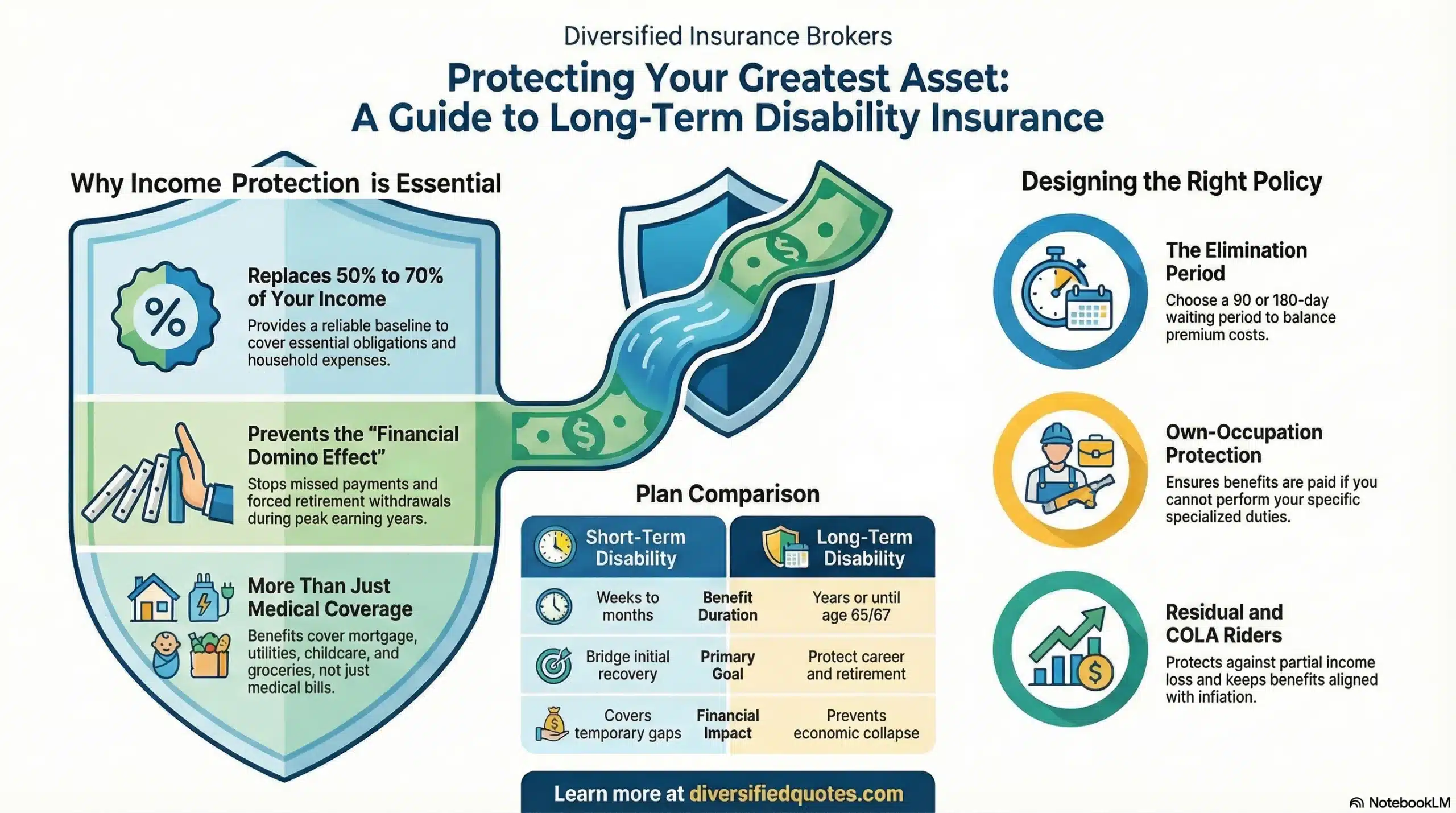
For a full-charge bookkeeper who spends a working day entering transactions, reconciling accounts, processing payroll, and generating financial reports, the keyboard and mouse represent the primary tools of the trade — and those tools load the wrist, forearm, and hand structures in a high-repetition pattern that the Canada Centre for Occupational Health and Safety specifically identifies as capable of causing carpal tunnel syndrome, tendinitis, and similar repetitive motion injuries when maintained hour after hour, day after day, year after year. A bookkeeper who develops carpal tunnel syndrome severe enough to require surgical intervention faces a recovery period during which sustained keyboard and mouse use is impossible — precisely the activity the work requires. The recovery timeline following carpal tunnel release surgery is typically measured in weeks to months of reduced or eliminated work capacity, with some cases requiring longer rehabilitation before full keyboard productivity returns. Long-term disability insurance addresses the scenarios where that recovery extends into the months that erode savings and interrupt client service continuity for an independent practice. Short-term disability insurance fills the immediate recovery window between injury onset and the point at which long-term coverage activates — the gap that most bookkeepers discover only after the condition has already occurred.
The sedentary posture dimension of bookkeeping creates a parallel spinal and postural disability pathway that develops more slowly and receives less immediate attention. Extended daily sitting in fixed positions — the neck and shoulders held in a forward position during screen work, the lower back loaded against a chair without adequate movement breaks — creates cumulative stress on the cervical and lumbar structures that occupational health literature consistently associates with the development of disc conditions, postural shoulder impingement, and chronic back syndromes over the course of a sustained desk career. A bookkeeper who develops a disabling disc herniation requiring surgical intervention or a chronic lower back condition that prevents the sustained seated work that bookkeeping demands faces an income disruption that is no less complete than any physical trade worker facing a work-related injury — and far more likely to be excluded from workers’ compensation coverage, since sedentary posture conditions are almost universally classified as degenerative rather than acute occupational injuries by the workers’ comp framework.
The Mental Health and Cognitive Disability Risk for Bookkeeping Professionals
Bookkeeping carries a cognitive and mental health disability risk that the favorable occupational class assignment does not capture — because occupational class reflects physical hazard, not the psychological demands of accuracy-critical financial work under deadline pressure. Bookkeepers bear professional responsibility for the financial accuracy of the records they maintain — errors in account reconciliation, payroll processing, or financial reporting have direct consequences for clients and employers, creating a sustained accuracy burden that generates occupational stress in a way that lower-stakes administrative work does not. Published research documents that occupational sedentary behavior — the work pattern that defines bookkeeping — increases the risk of mental health issues by approximately 34 percent compared to more physically active work patterns, an association that reflects both the psychological effects of physical inactivity during the workday and the stress characteristics of the cognitive work that sedentary occupations typically involve.
For bookkeepers, an anxiety disorder or depressive condition severe enough to impair the sustained concentration, attention to detail, and cognitive processing that accurate financial record maintenance requires represents a genuine occupational disability — one that prevents the performance of the material duties of the specific occupation just as effectively as a physical injury. The disability insurance planning implication is direct: most group long-term disability plans cap mental and nervous condition benefits at 24 months, meaning that a bookkeeper who develops a disabling anxiety or depressive disorder receives at most two years of benefit for a condition that may require significantly longer treatment before remission and return to full professional functioning. Individual disability insurance policies with unlimited benefit periods for all qualifying causes — including mental and nervous conditions — address this gap directly, providing protection that extends to age 65 regardless of the cause of disability. Disability insurance for white-collar professionals covers the specific policy design considerations that apply to knowledge-based, cognitively demanding occupations where mental and nervous conditions represent one of the most significant disability pathways alongside physical conditions.
Workers’ Compensation and the Bookkeeper — What It Covers and Where It Fails
Workers’ compensation provides the baseline income protection for employed bookkeepers — covering approximately two-thirds of wages up to state maximums for work-related injuries and occupational diseases. For an employed bookkeeper who sustains a documented acute injury in the workplace, workers’ comp provides what it is designed to provide. But for bookkeeping professionals, workers’ comp fails in three significant ways that make individual disability insurance the practical income protection structure rather than a supplement to an existing system.
The first failure is the self-employment gap. A substantial and growing proportion of experienced bookkeepers operate as independent practitioners — running their own bookkeeping practices, serving multiple business clients on contract arrangements, and earning income as self-employed professionals without employer-provided workers’ comp coverage. Independent bookkeeping practitioners who have not specifically elected workers’ comp coverage for themselves — most do not — carry zero workers’ comp protection for their own health events. The person whose disability would eliminate the practice’s revenue and leave clients without service has no workers’ comp floor. Understanding why bookkeepers buy disability insurance begins with recognizing this structural reality: for the independent bookkeeping practitioner, individual disability insurance is the entire protection system, not an addition to one.
The second failure is structural and applies to all bookkeepers regardless of employment status: workers’ compensation covers only work-related injuries and occupational diseases attributable to specific workplace incidents. It does not cover disability from illness — the cardiac event, the cancer diagnosis, the neurological condition, the serious health event that arrives without warning from sources entirely unrelated to the workplace. Since approximately 90 percent of long-term disabling conditions are illness-based, workers’ comp is structurally designed to address a minority of the disability risk that any bookkeeper actually carries. Whether disability insurance is worth it for a bookkeeper is most simply answered by calculating what an extended period of eliminated bookkeeping income would cost the household against the annual premium of the policy that replaces it.
The third failure applies to employed bookkeepers who have group long-term disability coverage: the most common group plan limitations directly affect bookkeepers’ primary disability pathways. The 24-month mental and nervous condition cap limits protection for the anxiety and depressive disorders that represent the most common cognitive disability pathway in desk-based financial work. The 24-month own-to-any transition shifts the benefit standard from own-occupation to any-occupation at exactly the point where a disability has proven itself to be long-term. And group plan coverage ends when employment ends — a risk that is particularly relevant for bookkeeping clerks whose positions are at elevated risk of technological displacement, as Bureau of Labor Statistics projections document a 6 percent decline in bookkeeping, accounting, and auditing clerk employment through 2034 driven by the efficiency of advanced accounting software.
Own-Occupation Coverage — The Definition That Determines What Gets Paid
The disability definition in a policy is the contractual language that determines whether a carpal tunnel condition that prevents sustained keyboard work but theoretically permits other employment generates a benefit payment or a denial. For a bookkeeper whose professional income derives from the sustained ability to accurately process financial data — a function that requires both manual fine motor capacity and cognitive precision — the disability definition is the policy’s most consequential provision.
A true own-occupation disability insurance policy pays benefits when the insured cannot perform the material and substantial duties of their specific occupation — bookkeeping — even if theoretically capable of some other gainful work. A bookkeeper who develops bilateral carpal tunnel syndrome requiring surgical intervention, followed by a recovery that prevents sustained keyboard use for months, receives benefit payments under an own-occupation policy regardless of whether they could theoretically answer a phone or perform other non-keyboard work. The policy recognizes that the bookkeeper’s income derives from a specific professional capacity — accurate, sustained financial data management — and that the loss of that capacity represents a genuine economic disability.
An any-occupation definition applies a fundamentally different and more restrictive standard: benefits are paid only when the insured cannot perform any gainful work for which they are reasonably suited by education, training, or experience. A bookkeeper who cannot process financial data due to wrist and hand conditions but who could theoretically work in a non-computer-based role would likely receive no benefit under an any-occupation standard. Understanding how short-term and long-term disability definitions interact — and specifically the 24-month transition that most group plans make from own-occupation to any-occupation — is essential for any bookkeeper evaluating whether existing coverage actually protects their specific professional income source.
Business Overhead Expense Coverage for Independent Bookkeeping Practice Owners
Independent bookkeeping practitioners who run their own practices face the same two-layer financial exposure that any small professional services business owner faces when disability strikes. The personal layer is the loss of the practitioner’s earned income. The business layer is the continuation of practice overhead — office space, software subscription costs for accounting platforms, professional liability insurance premiums, advertising and client communication costs, and any employee or contractor wages for support staff — that does not pause because the bookkeeper is disabled. A personal disability income policy addresses the personal income layer. Business overhead expense disability insurance addresses the practice overhead layer.
The BOE structure pays a monthly benefit calibrated to the actual fixed operating costs of the bookkeeping practice during the owner’s qualifying disability — preserving the practice infrastructure and client relationships during the disability period rather than allowing them to dissolve under unmet overhead against zero revenue. For an independent bookkeeping practitioner whose practice represents years of built client relationships and professional reputation, maintaining that infrastructure during a disability period can mean the difference between a temporary interruption and a permanent loss of the professional service capacity that took years to build.
Occupational Class, Income Documentation, and Policy Design for Bookkeepers
Bookkeepers’ top-tier or near-top-tier occupational class produces the most favorable combination of premium rates and maximum benefit ceilings in the disability insurance market — a direct financial benefit from the sedentary, non-hazardous nature of the work. For bookkeeping professionals with clean health histories, individual disability insurance can provide comprehensive coverage at genuinely competitive premium levels that represent a small fraction of the protected annual income. Income documentation for employed bookkeepers follows the standard W-2 and pay stub process. For 1099-earning independent bookkeeping practitioners, income documentation uses Schedule C and business financials, with the maximum approvable monthly benefit calculated as a percentage of documented net earned income. How much disability insurance a bookkeeper needs depends on this income level, the household’s financial obligations during a disability period, and for independent practitioners, the overhead obligations that BOE coverage addresses separately.
The elimination period should be calibrated to real financial reserves — the trade-off between premium cost and income floor activation speed is a personal financial decision rather than a generic default. The elimination period choice for a bookkeeper with adequate savings to cover 90 days of expenses is different from the right choice for one with limited reserves. The benefit period should extend to age 65 for most active bookkeeping professionals — the carpal tunnel condition, the back condition, the serious illness, and the mental health event most likely to end a bookkeeping career are not short-term recoverable events. The riders worth evaluating include the future insurability option — allowing benefit increases as practice or career income grows without new medical underwriting — and the cost of living adjustment rider that protects real purchasing power across a multi-year disability period. No-exam disability insurance options may serve bookkeepers whose health history makes traditional underwriting uncertain — providing meaningful coverage through simplified underwriting without full paramedical examination.
Working with an independent disability insurance broker who accesses the full market — rather than a single carrier’s product line — is the structure that identifies the carrier whose classification, product terms, and premium produce the strongest outcome for any specific bookkeeper’s profile, employment structure, and income level.
Get Your Bookkeeper Disability Insurance Review
We compare occupational class assignments, policy definitions, and benefit structures across 100+ carriers to identify the coverage architecture that fits your bookkeeping income and practice structure.
Talk With an Advisor Today
Choose how you’d like to connect—call or message us, then book a time that works for you.
Schedule here:
calendly.com/jason-dibcompanies/diversified-quotes
Licensed in all 50 states • Fiduciary, family-owned since 1980
FAQs: Disability Insurance for Bookkeepers
What occupational class does bookkeeping receive and why does it matter?
Bookkeeping typically receives a top-tier or near-top-tier occupational class assignment from most disability insurance carriers — a favorable classification that produces the lowest premium rates per dollar of monthly benefit and the highest maximum benefit ceilings available in the individual disability insurance market. This classification reflects the sedentary, office-based, non-hazardous nature of bookkeeping work compared to physical trades and production occupations whose elevated injury risk produces lower classification and higher premiums. For bookkeepers, this means individual disability insurance is genuinely affordable relative to protected income — a small annual premium percentage of the annual income being protected.
The favorable occupational class does not mean bookkeepers face low disability risk — it means they face low physical hazard risk specifically. The cumulative repetitive strain pathways from sustained keyboard and mouse use, the spinal and postural conditions from extended sedentary work, the mental health conditions associated with high-accuracy financial responsibility, and the illness-based conditions that affect all workers at population-average rates still represent significant disability probability over a career. A residual disability benefit provision is particularly worth including for bookkeepers, because the realistic disability scenarios in this profession — carpal tunnel recovery, partial return to work after a back condition, reduced cognitive capacity from mental health treatment — frequently produce partial rather than total disability outcomes. A policy with residual benefits pays a proportional benefit based on actual income loss from partial disability, addressing these realistic scenarios rather than only the total disability endpoint.
Are disability insurance benefits taxable for a bookkeeper?
Tax treatment depends on how the premiums are paid — a particularly relevant question for bookkeepers who are themselves professionals with financial literacy and who appreciate understanding the true after-tax economics of their coverage. When an independent bookkeeping practitioner or self-employed bookkeeper purchases individual disability insurance and pays premiums with after-tax personal income, the monthly benefits received during a qualifying disability are generally received income-tax-free. This means the full benefit amount reaches the household without income tax reduction. Whether disability insurance payments are taxable is an important planning input when calculating how large a benefit amount is actually needed to replace real take-home income — because a tax-free benefit replaces take-home pay directly, while a taxable benefit must be sized larger to deliver the same net household income.
For employed bookkeepers whose employer pays some or all of disability insurance premiums through a group plan, the resulting benefits during a disability claim are typically taxable as ordinary income, reducing effective purchasing power. This effectively means a group plan paying 60 percent of salary may deliver a net benefit closer to 40 to 45 percent of actual take-home pay after taxes — a gap that frequently surprises bookkeeping professionals who assumed the stated coverage percentage was the effective replacement rate. Self-employed bookkeepers who deduct disability insurance premiums as a business expense should confirm the specific tax treatment with a tax professional, as the deduction may affect benefit taxability when a claim occurs.
Can carpal tunnel syndrome from keyboard work qualify as a disability insurance claim?
Yes — individual disability insurance covers disability arising from carpal tunnel syndrome and other repetitive strain injuries when the condition meets the policy’s definition of disability. For a bookkeeper whose professional function requires sustained keyboard and mouse use, a carpal tunnel condition severe enough to prevent that sustained fine motor work qualifies as a disabling condition under an own-occupation policy — even if the bookkeeper could theoretically perform some other non-keyboard work. Workers’ compensation, by contrast, frequently struggles to compensate bookkeepers’ repetitive strain injuries because cumulative conditions that develop gradually from sustained work patterns are disputed as occupational versus personal — far more difficult to document than a single acute workplace incident.
The practical implication for bookkeepers is that individual disability insurance is the more reliable protection structure for the primary physical disability pathway the profession faces — not workers’ comp, which may deny or dispute cumulative keyboard injury claims, but individual DI, which requires only that the condition meets the disability definition. Pre-existing wrist or hand conditions should be disclosed accurately during the underwriting process; carriers typically respond with a partial exclusion rider for the specific condition rather than a full decline, meaning all other causes of disability remain covered. High-risk disability insurance options serve bookkeepers with documented wrist or hand histories where standard underwriting produces challenging outcomes.
I run my own bookkeeping practice — what disability insurance structure do I need?
An independent bookkeeping practice owner typically needs two layers of disability protection working in coordination. The first layer is personal disability income coverage — a policy that replaces the owner’s earned income from the practice during a qualifying disability, covering household living expenses, personal obligations, and the financial needs the practice revenue normally funds. The second layer is business overhead expense coverage — a policy that funds the fixed operating costs of the practice during the owner’s disability period, covering software subscription costs, professional liability insurance premiums, office space if applicable, and any contractor or support staff costs that continue whether the owner is working or not.
A single personal disability income policy addresses the household but leaves the practice overhead unaddressed, potentially allowing client relationships and practice infrastructure to erode while the owner is disabled. A single BOE policy covers the practice overhead but leaves the owner’s personal income unaddressed. Having both layers evaluated together — with benefit amounts coordinated to the actual financial structure of the specific practice — produces the most complete income and practice protection picture. For independent bookkeeping practitioners who also employ or contract support staff whose own disability would create business disruption, evaluating a second opinion on the full coverage structure is advisable to confirm all relevant layers are adequately addressed.
I’m a younger bookkeeper early in my career — is it worth buying disability insurance now?
Early career is not just a reasonable time to purchase disability insurance — it is the most financially optimal time, for reasons that compound over a full bookkeeping career. Disability insurance premiums are age-rated, meaning the younger the applicant at issue, the lower the annual premium locked in for the policy’s duration. A bookkeeper who purchases coverage at 26 pays a premium rate that is substantially lower than one who waits until 40, for a policy that protects income all the way to age 65. The cumulative premium savings over a career of holding the coverage at the younger purchase rate frequently exceed the total premiums paid during the early career period. Why young and healthy bookkeepers need disability insurance is most directly answered by noting that the ability to purchase comprehensive coverage without pre-existing condition restrictions exists only while health is genuinely clean — and for a bookkeeper spending hours each day at a keyboard, the wrist and back conditions that develop over a career have not yet had time to develop at the beginning of it.
The future insurability rider available on most individual disability policies allows a bookkeeper to increase their benefit amount as career income grows — from entry-level to experienced to senior bookkeeper or practice owner — without undergoing new medical underwriting. This means the favorable health-based underwriting terms of early-career purchase are preserved and extended through the full income trajectory, allowing benefit capacity to scale alongside earnings without the health restrictions that later purchase after conditions have developed would impose. Disability insurance for new professionals in financial and business occupations covers how early-career policies should be sized and structured to serve both current and future income levels effectively.
I received a disability insurance quote — how do I know if I’m getting the best available terms as a bookkeeper?
A single quote from a single carrier tells you that carrier’s price for that carrier’s product at that carrier’s classification of bookkeeping — it does not tell you what the full market offers. Even within the favorable top-tier occupational class, premium rates and policy terms vary between carriers in ways that make genuine comparison the only accurate method of identifying the best available option. The disability definition language, the residual benefit provision, the mental and nervous condition benefit period, the available elimination and benefit period options, the rider selection, and the premium rate itself can all differ meaningfully across carriers for the same bookkeeper applicant. A carrier whose policy is priced competitively but whose disability definition is more restrictive than a competitor’s is not offering the same value as the competitor’s policy at the same or slightly higher premium.
The most effective approach to confirming competitive terms is submitting simultaneously to multiple carriers through an independent broker who accesses the full market — a process that produces actual comparative quotes on equivalent coverage terms rather than a single data point presented as though it represents the market. For bookkeepers who already have a disability insurance quote in hand, requesting a second opinion on the disability insurance quote through an independent broker costs nothing and frequently reveals either more favorable premium rates, better policy terms, or both. The difference between accepting a first quote and comparing the market can represent thousands of dollars in premium over the life of a career-spanning policy, or meaningfully better coverage terms that determine whether a real disability claim generates a benefit payment or a dispute.
About the Author:
Jason Stolz, CLTC, CRPC, DIA, CAA and Chief Underwriter at Diversified Insurance Brokers (NPN 20471358), is a senior insurance and retirement professional with more than 25 years of real-world experience helping individuals, families, and business owners protect their income, assets, and long-term financial stability. As a long-time partner of the nationally licensed independent agency Diversified Insurance Brokers, Jason provides trusted guidance across multiple specialties—including fixed and indexed annuities, long-term care planning, personal and business disability insurance, life insurance solutions, Group Health, Travel Medical and Evacuation Insurance, and short-term health coverage. Diversified Insurance Brokers maintains active contracts with over 100 highly rated insurance carriers, ensuring clients have access to a broad and competitive marketplace.
His practical, education-first approach has earned recognition in publications such as VoyageATL, and contributions from his agency featured in Kiplinger and GoBankingRates— highlighting his commitment to financial clarity and client-focused planning. Drawing on deep product knowledge and years of hands-on field experience, Jason helps clients evaluate carriers, compare strategies, and build retirement and protection plans that are both secure and cost-efficient. Visitors who want to explore current annuity rates and compare options across multiple insurers can also use this annuity quote and comparison tool.
Explore More Disability Insurance Options: Browse our complete guide to Disability Insurance for Legal, Finance & White Collar Professionals — covering attorneys, accountants, bankers, executives, financial planners & business professionals from 100+ carriers.
Last Reviewed: June 7, 2026 |
Reviewed by: Jason Stolz, CLTC, CRPC, DIA, CAA
Chief Underwriter, Diversified Insurance Brokers, Inc. | NPN: 20471358 | Diversified Insurance Brokers, Inc. — Licensed in all 50 states
Fact Checked by: Tonia Pettitt, CMIP©
Medicare Specialist, Diversified Insurance Brokers, Inc. | NPN: 14374308 | Diversified Insurance Brokers, Inc. — Licensed in all 50 states
Did you find this content helpful? Leave us a Google review — it helps others find trustworthy guidance too.
Editorial Standards: Diversified Insurance Brokers maintains rigorous editorial standards to ensure accuracy, clarity, and independence in all content. Learn more about our editorial standards and commitment to transparency.
