
What is a Disability Insurance Benefit Period
As an Independent Disability Insurance Broker, we have access to exclusive discounts and negotiated pricing most captive agents can’t offer — see the full breakdown near the end of this page.
What is a Disability Insurance Benefit Period

Jason Stolz CLTC, CRPC, DIA, CAA
A disability insurance benefit period is the maximum length of time your policy will pay you monthly benefits while you remain disabled — in other words, it defines how long the money keeps coming once a claim is approved. At Diversified Insurance Brokers, we help people choose the benefit period that actually matches the income they need to protect, because no other single feature of a disability policy has a larger effect on both your premium and your total protection. Put simply: if you become too sick or injured to work and your claim is approved, the benefit period is the outer boundary of your coverage. A two-year benefit period stops paying after two years even if you never recover; a to-age-65 benefit period keeps paying until you reach 65 or return to work, whichever comes first. Choosing the right one is one of the most consequential decisions you make when you buy a policy, and getting it wrong can leave a hard cap on your coverage that expires years — sometimes decades — before you need it to.
Not sure which benefit period fits your income and career stage?
Request Your Personalized Disability Insurance Analysis
It is important not to confuse the benefit period with the elimination period, because the two describe opposite ends of a claim. The elimination period is how long you must wait after becoming disabled before benefits begin — commonly 90 days. The benefit period is how long benefits continue paying once that waiting period is over. A policy described as “90-day elimination, to-age-65 benefit period” means you wait 90 days after your disability begins, then receive monthly benefits until age 65 or recovery. The two provisions work together to define the shape of your coverage, and our companion guide on disability insurance elimination periods covers the waiting-period side of that equation in full. Understanding both is essential to reading any policy correctly, and understanding how they interact is central to choosing the right disability insurance policy for your situation.
This guide explains the standard benefit period options, how the choice affects your total lifetime protection and your premium, the “gap risk” a short benefit period creates, and the situations where a shorter or longer period makes sense. Whether you are comparing short-term versus long-term disability insurance or fine-tuning an individual long-term disability policy, the benefit period is the feature that determines how much income you are truly protecting.
Standard Benefit Period Options
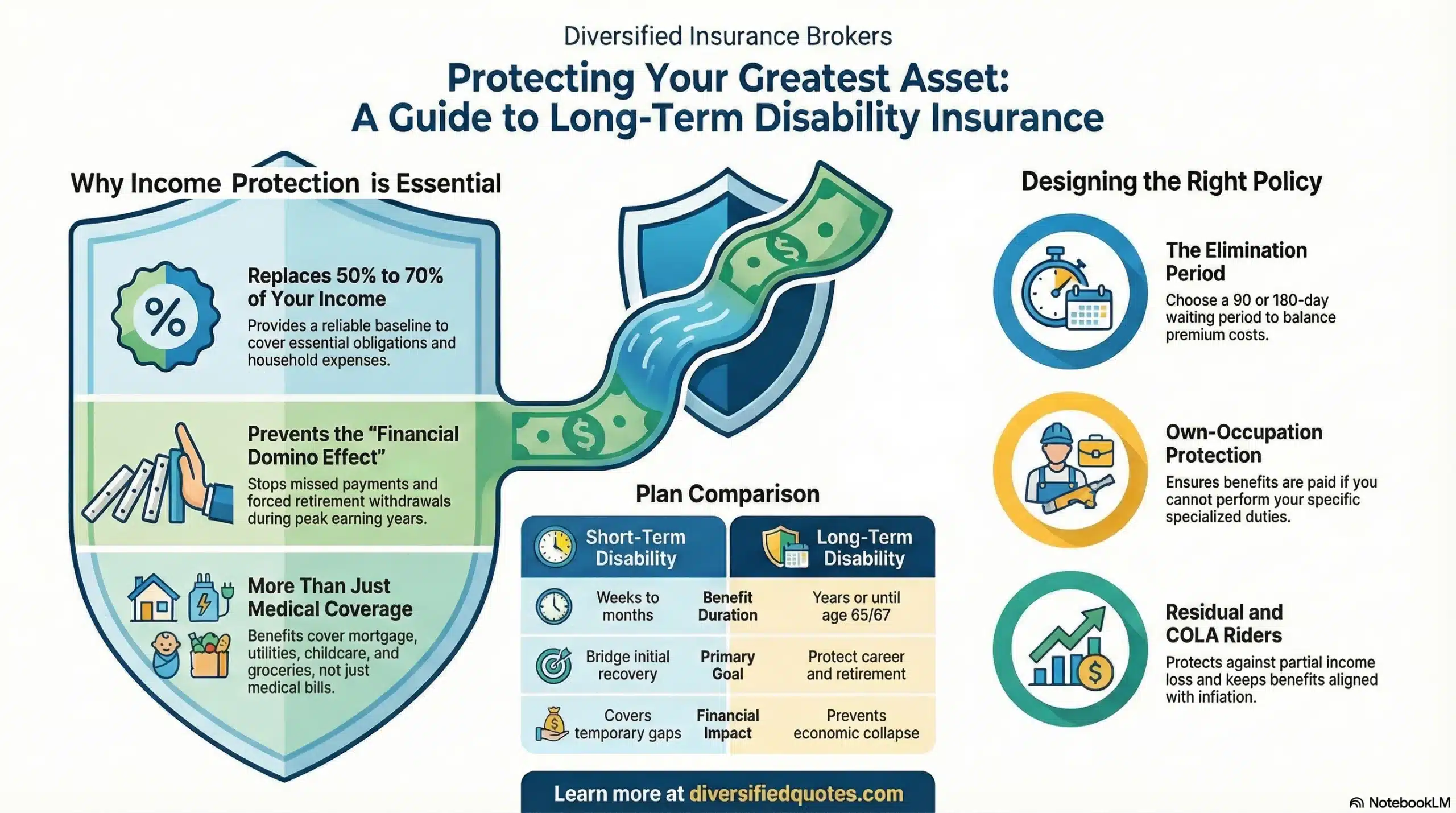
Disability insurance benefit periods fall into two broad families: those measured in a fixed number of years, and those that run to a specific age. Short-term disability insurance uses the shortest periods — typically 3 to 6 months, and almost never more than a year — and is designed to bridge the gap immediately after a disabling event. Long-term disability insurance, where the benefit period decision really matters, offers periods stated in years or tied to retirement age. The standard year-based choices are 2 years, 5 years, and 10 years. The standard age-based choices are to-age-65 and to-age-67, with a few carriers offering to-age-70 to reflect the trend toward longer careers. True lifetime benefit periods once existed but are now rare and, where still offered as graded lifetime benefits, have become cost-prohibitive for most buyers. The general principle is straightforward: a longer benefit period provides more protection but costs more — though, as explained below, the added cost of extending to retirement age is often surprisingly modest. Each option fits a different profile, and the right choice depends on your age, your income, your savings, your occupation, and how much risk you are comfortable carrying yourself. Our overview of disability insurance by occupation shows how the right structure varies by profession, and whether disability insurance is worth it for your circumstances often comes down to matching the benefit period to your real exposure.
Benefit Period Options Compared
| Benefit Period | What It Covers | Relative Premium | Best Suited For |
|---|---|---|---|
| 2 Years | Only short-duration disabilities; benefits end after two years even if you remain disabled. | Lowest. | Supplemental coverage layered over a longer policy, or those very near retirement. Generally inadequate as sole protection — see short-term disability. |
| 5 Years | Covers the majority of claims, which resolve within five years, but leaves a long gap if you never recover. | Moderate. | Professionals in their late 50s bridging to retirement; budget-limited buyers who cannot afford a to-age period. |
| 10 Years | Protects against all but the most extended disabilities; still leaves a gap if disabled young. | Moderate to higher. | A middle-ground choice for those wanting more than five years without full to-age cost. Weigh against overall policy cost. |
| To Age 65 | Pays until age 65 or recovery — full income protection through working years to Social Security. | Higher, but often only modestly above shorter periods. | Most professionals under 50; anyone protecting long-term earning power. See high-income disability insurance. |
| To Age 67 / 70 | Extends protection to later Social Security full retirement age for those working past 65. | Highest of the common options. | Those planning to work past 65, or aligning coverage with a later retirement date and Social Security timing. |
Why the Benefit Period Has the Biggest Impact on Your Total Protection
Of every feature in a disability policy, the benefit period has the single largest effect on how much income you can ultimately protect — because it multiplies your monthly benefit across time. Consider a professional with a $15,000 monthly benefit. With a 2-year benefit period, the maximum lifetime payout is roughly $360,000. With a 5-year period, it is about $900,000. With a 10-year period, roughly $1.8 million. And with a to-age-65 period for someone disabled at 35 — thirty years of coverage — the maximum protection reaches about $5.4 million. Those figures are illustrative rather than a quote, but they show why the benefit period is not a detail to treat as an afterthought: the difference between a short and a long benefit period can be measured in millions of dollars of potential lifetime benefits for a high earner. This is also why the benefit period drives premium more than almost any other single provision, and it is the first place to look when you are trying to understand what disability insurance costs. When you are deciding how much disability insurance you need, the benefit period and the monthly benefit amount together define the ceiling on your protection.
The “Gap Risk” of a Short Benefit Period
The central danger of a limited benefit period is what happens if your disability outlasts it. A professional disabled at 40 who holds a 5-year benefit period is covered only through age 45 — and if the disability persists, benefits simply stop, leaving potentially two decades without income before retirement. The same person with a 10-year period loses coverage at 55, still a decade short of typical retirement. This is the “gap risk,” and it is the reason short benefit periods are generally inadequate as sole protection for anyone with many working years ahead. Serious conditions such as stroke, traumatic brain injury, chronic autoimmune disease, and progressive neurological conditions frequently produce disabilities lasting far longer than two or even five years, and the whole purpose of disability insurance is to protect against exactly the severe, extended scenarios that savings cannot absorb. There is one more subtlety worth understanding: a to-age benefit period does not guarantee a long payout if you become disabled late. Because a to-age-65 policy pays only until 65, someone disabled at 60 receives just five years of benefits, not a fresh full term. The benefit period defines an endpoint, not a fixed duration, which is why aligning it with your actual working horizon matters. This kind of structural detail is exactly what disability insurance riders and provisions are designed to address, and why young, healthy workers benefit most from locking in a long benefit period early.
Choosing the Right Benefit Period
The right benefit period depends on your age, income, occupation, savings, and risk tolerance. A widely used guideline is to choose the longest benefit period you can reasonably afford, because the greatest financial danger is a long-term disability early in your career that a short period fails to cover. A frequently overlooked point strengthens that case: extending from a 5-year period to a to-age-65 period often costs proportionally little. Insurers know that most claims resolve within five years, so the added premium to extend coverage across the less-likely long-tail scenarios is relatively modest — meaning a much larger amount of protection can sometimes be secured for a small premium increase. This is why advisors so often recommend, and clients so often choose, the longest available benefit period. That said, a shorter period has legitimate uses: professionals in their late 50s may find a 5-year period bridges the gap to retirement adequately, and a 2-year period can serve as inexpensive supplemental coverage layered on top of a longer policy. Some carriers even allow a split benefit period — a different length for disabilities caused by illness versus those caused by accident — which can fit specific risk profiles. It is also worth knowing that a benefit period is sometimes limited by the underwriter rather than chosen; a medical history involving elevated cholesterol, a mental or nervous history, or other factors can lead an insurer to cap the available benefit period. Working through these trade-offs with an expert who can shop the full market is the surest way to land on the right structure. For guidance tailored to your situation, our resources on own-occupation coverage, the residual disability benefit, the future insurability rider, and cost-of-living adjustment coverage explain the provisions that work alongside the benefit period, and our overview of how Social Security disability interacts with retirement benefits covers an important coordination consideration.
Not sure which benefit period fits your income and career stage?
Request Your Personalized Disability Insurance Analysis
Financial Protection Essentials
Explore disability coverage tailored to a wide range of occupations and industries.
Talk With an Advisor Today
Choose how you’d like to connect—call or message us, then book a time that works for you.
Schedule here:
calendly.com/jason-dibcompanies/diversified-quotes
Licensed in all 50 states • Fiduciary, family-owned since 1980
What is the difference between the benefit period and the elimination period?
These two provisions describe opposite ends of a disability claim, and confusing them is one of the most common mistakes buyers make. The elimination period is the waiting time between when your disability begins and when benefits start — commonly 90 days, though it can range from a few weeks to longer. During the elimination period you receive nothing, which is why an emergency fund matters for bridging that stretch. The benefit period, by contrast, is how long benefits continue to be paid once the elimination period ends and your claim is approved. So a policy written as “90-day elimination period, to-age-65 benefit period” means you wait 90 days after becoming disabled, and then receive monthly benefits until you reach 65 or recover, whichever comes first. In short: the elimination period is how long you wait; the benefit period is how long you get paid. Both are set when you buy the policy, and both affect your premium — a longer elimination period lowers your premium (because you are self-insuring the early months), while a longer benefit period raises it (because the insurer is potentially on the hook for many more years). Our full guide to disability insurance elimination periods covers the waiting-period side in detail, and together the two provisions define the practical shape of your coverage.
Which benefit period should I choose?
The widely recommended approach is to choose the longest benefit period you can reasonably afford, because the financial danger disability insurance exists to protect against is a serious, long-lasting disability — and short benefit periods leave that exact scenario uncovered. For most professionals under 50, a to-age-65 (or to-age-67) benefit period is the appropriate choice, because a disability early in a career could otherwise cost decades of income. A powerful and often-overlooked factor makes this easier: extending from a 5-year to a to-age-65 benefit period frequently costs proportionally little, because insurers know most claims resolve within five years, so the added premium for the long-tail protection is relatively modest. That said, shorter periods have legitimate roles. Someone in their late 50s might find a 5-year period adequately bridges the gap to retirement. A 2-year period can work as inexpensive supplemental coverage on top of a longer policy. Your savings and liquidity also matter — substantial liquid assets give you more flexibility to accept a shorter period, while limited savings argue for a longer one. Your occupation matters too: highly specialized professionals who depend on specific physical or cognitive skills, and those in higher-risk jobs, generally benefit from the longest available period. Because the right answer depends on balancing all of these factors, working through how to choose the right disability insurance policy with a broker who can compare the full market is the surest path to the correct structure.
Does a “to age 65” benefit period always mean I get benefits for a long time?
No — and this is an important subtlety. A to-age-65 benefit period pays benefits until you reach age 65 or recover, whichever comes first. That means the actual length of payments depends entirely on how old you are when you become disabled. If you become disabled at 35, a to-age-65 period could pay for up to 30 years. But if you become disabled at 60, that same to-age-65 policy pays only up to five years, because it stops at 65 regardless of when the disability began. The benefit period defines an endpoint, not a guaranteed fixed duration. This is why matching the benefit period to your actual working horizon matters, and why the value of a long benefit period is greatest for younger workers who have the most earning years to protect. It is also a reason some people approaching retirement choose a shorter, fixed-year period instead — if you are 62 and plan to retire at 65, a to-age-65 period and a 5-year period would pay a similar amount, but the fixed period may cost less. Understanding this distinction helps you avoid overpaying for coverage you cannot fully use, or underestimating how much protection you need when you are young. Our resource on how much disability insurance you need works through matching the benefit period and monthly benefit to your real income-protection goal.
Can mental health conditions be limited to a shorter benefit period?
Yes, and this is an important limitation to check in any policy. Many disability insurance policies cap benefits for mental and nervous conditions — such as depression, anxiety, and certain behavioral health disorders — at a maximum of two years, even when the policy’s overall benefit period is much longer, such as to age 65. In other words, a policy might pay to age 65 for a physical disability but only two years for a disability caused by a mental health condition. This limitation is common enough that anyone for whom mental health coverage is a priority should confirm exactly how their policy treats these conditions before buying. Some carriers offer policies without this limitation or with a longer mental-health benefit period, though they may cost more or require specific underwriting. A related point: a history of mental or nervous conditions can also lead an underwriter to limit the benefit period offered on the whole policy, or to add an exclusion, which is one reason honest and well-prepared applications placed with the right carrier matter so much. Because the treatment of mental health conditions varies significantly between insurers, this is an area where working with a broker who knows the market — and reviewing the actual policy language rather than relying on a summary — protects you from an unwelcome surprise at claim time. Our guide to disability insurance with pre-existing conditions covers how histories like these are underwritten and placed.
How does the benefit period differ between short-term and long-term disability insurance?
The benefit period is the defining difference between the two types of coverage. Short-term disability insurance uses very short benefit periods — typically 3 to 6 months, and almost never more than a year — paired with a short elimination period, often just a few days to two weeks. It is designed to replace income immediately after a disabling event, covering temporary conditions and the recovery window. Long-term disability insurance uses much longer benefit periods stated in years or tied to retirement age — 2 years, 5 years, 10 years, to age 65, or to age 67 — paired with a longer elimination period, often around 90 days. It is designed to take over when short-term benefits run out and to protect against serious, extended disabilities that could otherwise cost years or decades of income. The two are designed to work together: short-term coverage bridges the immediate aftermath of an illness or injury, and long-term coverage maintains income replacement if the condition keeps you out of work past the end of the short-term benefit period. Because the long-term benefit period is where the largest financial exposure lies — a permanent disability could cost millions in lost lifetime income — it is the more critical of the two decisions for most people. Our comparison of short-term versus long-term disability insurance covers how to layer the two, and our overview of long-term disability insurance details the benefit period options that matter most for lasting income protection.
About the Author:
Jason Stolz, CLTC, CRPC, DIA, CAA and Chief Underwriter at Diversified Insurance Brokers (NPN 20471358), is a senior insurance and retirement professional with more than 25 years of real-world experience helping individuals, families, and business owners protect their income, assets, and long-term financial stability. As a long-time partner of the nationally licensed independent agency Diversified Insurance Brokers, Jason provides trusted guidance across multiple specialties—including fixed and indexed annuities, long-term care planning, personal and business disability insurance, life insurance solutions, Group Health, Travel Medical and Evacuation Insurance, and short-term health coverage. Diversified Insurance Brokers maintains active contracts with over 100 highly rated insurance carriers, ensuring clients have access to a broad and competitive marketplace.
His practical, education-first approach has earned recognition in publications such as VoyageATL, and contributions from his agency featured in Kiplinger and GoBankingRates— highlighting his commitment to financial clarity and client-focused planning. Drawing on deep product knowledge and years of hands-on field experience, Jason helps clients evaluate carriers, compare strategies, and build retirement and protection plans that are both secure and cost-efficient. Visitors who want to explore current annuity rates and compare options across multiple insurers can also use this annuity quote and comparison tool.
Explore More Disability Insurance Options: Browse our complete guide to Disability Insurance Planning & Education — covering how it works, riders, elimination periods, own occupation, costs & buying guides from 100+ carriers.
Last Reviewed: July 8, 2026 |
Reviewed by: Jason Stolz, CLTC, CRPC, DIA, CAA
Chief Underwriter, Diversified Insurance Brokers, Inc. | NPN: 20471358 | Diversified Insurance Brokers, Inc. — Licensed in all 50 states
Fact Checked by: Tonia Pettitt, CMIP©
Medicare Specialist, Diversified Insurance Brokers, Inc. | NPN: 14374308 | Diversified Insurance Brokers, Inc. — Licensed in all 50 states
Did you find this content helpful? Leave us a Google review — it helps others find trustworthy guidance too.
Editorial Standards: Diversified Insurance Brokers maintains rigorous editorial standards to ensure accuracy, clarity, and independence in all content. Learn more about our editorial standards and commitment to transparency.
