
Disability Insurance for Mechanics
As an Independent Disability Insurance Broker, we have access to exclusive discounts and negotiated pricing most captive agents can’t offer — see the full breakdown near the end of this page.
Disability Insurance for Mechanics

Jason Stolz CLTC, CRPC, DIA, CAA
Disability insurance for mechanics is income protection for one of America’s largest and most physically demanding skilled trade categories — a profession that the Bureau of Labor Statistics confirms has one of the highest rates of injuries and illnesses of all occupations, and that encompasses hundreds of thousands of automotive technicians, diesel mechanics, aircraft mechanics, HVAC technicians, heavy equipment mechanics, and the independent shop owners who serve every sector of the transportation, commercial, and industrial economy. Mechanics earn median incomes ranging from $49,670 for automotive service technicians to $78,680 for aircraft mechanics and above, depending on specialty, credentials, and experience — but the physical demands and documented injury rates that accompany the work are consistent across all mechanic types: sustained awkward positions under vehicles and equipment, heavy lifting, chemical and fluid exposure, tool contact injuries, and the cumulative wear on backs, hands, and knees that decades of turning wrenches produce. When a disabling condition removes a mechanic from the shop floor — a back injury from years of working under vehicles, a hand or shoulder condition from sustained tool use, a respiratory condition from chemical exposure, or any other medical event requiring extended recovery — income stops. For mechanics paid on flat-rate systems, it stops the moment they cannot complete jobs. For independent shop owners, it stops alongside the business overhead that continues regardless of whether the owner can work.
At Diversified Insurance Brokers, we help mechanics across every specialty — automotive service technicians and ASE-certified technicians, diesel mechanics, aircraft mechanics and AMTs, HVAC mechanics, heavy equipment service technicians, motorcycle and marine mechanics, industrial maintenance mechanics, and independent repair shop owners — structure disability insurance coverage that reflects the documented injury profile of hands-on mechanical work and fills the income gap that workers’ compensation, flat-rate pay structures, and employer group coverage consistently leave open. Our resource on what is the primary reason people buy disability insurance provides foundational context on why skilled trades workers whose income depends entirely on their physical ability to perform technical work need income protection that institutional programs structurally cannot provide.
Get Disability Insurance Quotes for Mechanics
We compare carriers across automotive, diesel, aircraft, HVAC, and heavy equipment specialties, and structure policies that fill the income gaps your specialty faces.
Request Disability Insurance OptionsThe Mechanic Trade Spans Multiple Specialties — Each With Its Own Income and Risk Profile
Understanding disability insurance for mechanics requires recognizing that the category encompasses distinct professional specialties with meaningfully different income levels, employment structures, credentialing requirements, and specific disability risk profiles — even as they share the fundamental physical demands and chemical exposure realities of hands-on mechanical repair work. Automotive service technicians — the largest group at over 805,600 employed nationally — diagnose, maintain, and repair cars and light trucks in dealerships, independent shops, and fleet maintenance operations, earning a median of $49,670 annually with experienced technicians at specialist dealerships earning substantially more. Diesel mechanics, serving the heavy trucking and commercial transportation sector, earn a median of $60,640 and work on engines and systems that are substantially larger and heavier than automotive work involves — with correspondingly heavier physical demands. Aircraft mechanics and service technicians — who hold FAA Airframe and Powerplant (A&P) certificates — earn a median of $78,680 and work to the strictest safety standards of any mechanic specialty, in positions that require sustained overhead work, confined space access, and the precision that aviation safety demands.
HVAC mechanics and installers — a large group of approximately 425,200 employed — earn a median of $59,810 and work in environments that add electrical hazard, chemical refrigerant exposure, and extreme temperature conditions to the standard mechanic injury profile. The BLS specifically notes HVAC technicians have one of the highest rates of injuries and illnesses of all occupations, alongside automotive mechanics, reflecting the genuine severity of both professions’ hazard profiles. Heavy vehicle and mobile equipment mechanics — serving construction, mining, agriculture, and industrial sectors — work on equipment whose scale creates injury risks beyond what automotive and diesel shop work involves; farm equipment mechanics in this category are specifically identified by BLS as having one of the highest injury and illness rates of all occupations. For additional context on how physical trade professions with documented high injury rates approach disability income protection, our resource on disability insurance for the automobile industry covers how the broader automotive sector structures income protection around the documented physical risks of this trade.
What the BLS Says: Mechanics and the Documented Injury Rate
The Bureau of Labor Statistics makes an unusually direct statement about automotive service technicians and mechanics in the Occupational Outlook Handbook: these workers “have one of the highest rates of injuries and illnesses of all occupations.” This is not a general observation — it is a specific federal characterization placing automotive mechanics in the category of occupations with the most severe documented occupational injury profiles in the American economy. The BLS identifies the specific injury mechanisms: contact with equipment, falls, and overexertion. For diesel mechanics, the BLS notes that “sprains and cuts are common” from regularly lifting heavy parts and working with greasy equipment in uncomfortable positions. For HVAC technicians, the BLS again specifically characterizes this group as having “one of the highest rates of injuries and illnesses of all occupations,” citing burns from electrical parts or chemicals and muscle strains from handling heavy equipment. For farm equipment and mobile heavy equipment mechanics, the same characterization — one of the highest rates of injuries and illnesses — appears again, reflecting the weight and scale of the equipment these mechanics service.
The pattern across mechanic specialties is consistent: the BLS characterizes multiple mechanic categories as among the highest injury-rate occupations in the entire economy. This federal documentation is not the product of anecdote — it is the output of systematic employer-reported injury and illness data collected annually across hundreds of thousands of establishments. For disability insurance planning purposes, this documented injury profile means that the statistical probability of a disabling event occurring during a mechanic’s career is meaningfully higher than the general workforce baseline, making the financial consequences of being uninsured during a disability event more likely to materialize and more severe when they do. Our resource on is disability insurance worth it provides the financial framework for understanding how the income-stops-obligations-continue dynamic that disability creates is especially acute for mechanics whose income depends entirely on their physical capacity to perform technical work each day.
The Flat-Rate Pay Structure: Why Mechanics Face a Unique Income Vulnerability
One of the most financially consequential features of the automotive mechanic trade is a compensation structure that most disability insurance planning resources fail to address directly: flat-rate pay. Many automotive technicians and diesel mechanics are paid not by hours present in the shop but by book hours completed — the manufacturer-standard time allowance for each repair procedure, multiplied by the technician’s hourly rate. A skilled technician who completes jobs faster than book time earns effectively more than their posted hourly rate; a slower or less experienced technician earns less. The fundamental consequence of this pay structure for disability income planning is stark: a mechanic on flat-rate pay who cannot complete jobs earns nothing from the moment they are unable to work. There is no partial pay for showing up. There is no hourly wage accumulating while waiting for parts or performing light duties. If the mechanic cannot turn wrenches, the flat-rate clock stops.
This creates two specific problems that compound the flat-rate mechanic’s disability income vulnerability. First, workers’ compensation wage replacement calculations based on average weekly wages may understate actual earning capacity for a productive flat-rate technician — because a mechanic who consistently beats book time earns significantly more than a straight hourly calculation would reflect. Sizing individual disability benefits to reflect actual weekly production earnings rather than base hourly rates is an important step in ensuring coverage genuinely replaces income rather than providing a fraction of it. Second, any employer sick leave or short-term disability benefit structured around standard hourly pay similarly understates the productive flat-rate technician’s real income loss. For flat-rate mechanics, individual disability insurance sized to actual average weekly earnings — documented through tax returns and pay history — is the only mechanism that genuinely replaces income during a disability event. Our resource on how much disability insurance you need provides the framework for calculating correct benefit amounts for mechanics whose compensation structure requires a more careful income documentation approach than salaried professionals face.
The Most Common Disabling Conditions for Mechanics
Back injuries are the dominant disabling condition for mechanics across every specialty — and the sustained awkward positions that mechanical repair requires are the documented causal mechanism. A mechanic’s workday involves time under vehicles on creepers, crouching and kneeling alongside equipment, reaching overhead into engine bays, contorting into confined spaces to access components, and lifting heavy parts including tires, engines, transmissions, and drive shafts in positions that generate enormous lumbar loading. The BLS specifically highlights that automotive mechanics “work with greasy parts and tools, sometimes in uncomfortable positions” and “may need to lift and maneuver heavy objects, such as tires” — confirming the physical demand profile that produces the back conditions most common among mechanics seeking disability benefits. A lumbar disc herniation, spinal stenosis from decades of mechanical work, or an acute back injury from overexertion lifting a heavy component can prevent a mechanic from sustaining the physical positions that under-vehicle work requires — creating an own-occupation disability even when the mechanic can stand, sit, or walk normally.
Hand, wrist, and shoulder injuries represent the second most significant disability pathway for mechanics, reflecting the sustained tool use and repetitive upper extremity demands of mechanical work. Air-powered impact wrenches, breaker bars and torque wrenches, pliers and screwdrivers used in sustained awkward reaches — all generate the repetitive mechanical loading on the mechanic’s hands, wrists, elbows, and shoulders that produces carpal tunnel syndrome, rotator cuff conditions, elbow tendinitis, and hand arthritis across a mechanical career. For aircraft mechanics who must frequently work in overhead positions reaching into aircraft structures, shoulder conditions are particularly prevalent. Chemical and fluid exposure represents a chronic disability risk pathway — engine oil, brake fluid, transmission fluid, coolant, solvents, and for HVAC mechanics, refrigerants including older refrigerants with documented health consequences. Contact dermatitis from repeated skin exposure to automotive fluids is a documented occupational condition for mechanics. Noise-induced hearing loss from sustained exposure to air tools, running engines, and impact equipment accumulates progressively across a mechanical career. Electrical burns and shock injuries are documented for mechanics working on electrical systems, and thermal burns from hot exhaust components and coolant are acute injury risks across all mechanic specialties. For context on how other physical trades with comparable multi-hazard occupational profiles approach disability income protection, our resource on disability insurance for the woodworking industry provides cross-trade perspective on how precision tool trades structure income protection against documented physical and chemical hazards.
Aircraft Mechanics: The Highest-Stakes Specialty
Among mechanic specialties, aircraft mechanics and service technicians occupy a unique position — earning significantly higher incomes (median $78,680, with top earners above $120,000), working to FAA regulatory standards that allow no tolerance for error, and carrying the professional weight that aviation safety imposes on every repair decision they make. FAA Airframe and Powerplant certification requires years of documented training and testing that represents a meaningful professional investment — comparable in educational commitment, if not duration, to some advanced degree programs. The income that A&P certificate holders earn in commercial aviation, military contract maintenance, corporate aviation, and MRO facilities reflects both their skill and the safety-critical nature of their work.
For aircraft mechanics, disability insurance planning carries additional considerations that general automotive mechanic planning does not. The FAA medical certificate requirements that govern some aviation industry roles, the strict safety standards that require physical and cognitive fitness for return to maintenance work, and the career consequences of a disability that produces any FAA-reportable condition all affect the professional landscape around disability for aircraft mechanics in ways that automotive repair does not replicate. An aircraft mechanic who develops a hand condition affecting fine motor precision faces not just the physical inability to perform maintenance but potentially the regulatory inability to return to certificated maintenance work — a professional consequence that own-occupation disability coverage is specifically designed to address. The income level that aircraft mechanics earn also makes the group plan income gap more financially consequential: at $78,680 median, a 60 percent group plan replacement leaving $31,472 per year in unprotected income represents a meaningful household budget shortfall. Our resource on disability insurance for pilots provides useful parallel context on how aviation professionals approach disability planning in a field where regulatory and physical requirements intersect with income protection in ways unique to aviation careers.
Why Workers’ Compensation Leaves Mechanics Underprotected
Workers’ compensation is the institutional income safety net that most employed mechanics know — and it provides its intended benefits for acute, documented workplace injuries. But the most prevalent disability conditions mechanics actually face are precisely those that workers’ compensation most consistently fails to cover. The back condition that develops from a decade of working under vehicles in lumbar-loading positions does not trace to a single documented incident — it traces to cumulative occupational exposure that gradual-onset claims attributing mechanisms resist. The carpal tunnel syndrome that develops from years of sustained air tool use is cumulative and bilateral — difficult to attribute to a single workplace event in the way workers’ compensation claims require. The noise-induced hearing loss from shop environments builds over years of daily exposure to a level that conventional workers’ compensation attribution cannot establish cleanly. The contact dermatitis from chronic automotive fluid skin exposure develops from thousands of daily contacts rather than from one documented spill.
Workers’ compensation also does not cover any disability unrelated to the workplace — a cardiovascular event in a mechanic whose sustained physical exertion and stress create elevated cardiovascular risk, a cancer diagnosis, an off-the-job accident. It does not address the income gap between workers’ compensation wage replacement and actual flat-rate production earnings for productive mechanics whose compensation exceeds straight hourly calculations. And it ends — providing no income replacement once the covered condition is resolved, even if permanent functional limitations prevent full return to mechanical work. Individual disability insurance covers qualifying disability from any cause regardless of origin or how it developed, providing the continuous income replacement that workers’ compensation’s gaps leave open for mechanics across every specialty. Our resource on short-term vs. long-term disability insurance covers how different duration coverages address different phases of a disability event — relevant for mechanics who face both acute injury scenarios requiring short-term income replacement and chronic condition scenarios requiring long-term protection.
Independent Shop Owners: The Compounded Disability Exposure
A significant portion of the automotive repair industry consists of independent shop owners — mechanics who have built their own businesses and serve local customers as independent repair operations. These shop owners face the compounded disability exposure that all self-employed trade business owners face: personal income stops at the same moment that business overhead continues. When an independent shop owner cannot work — due to a back injury, a hand condition, or any other disabling event — the shop’s primary productive mechanic is unable to generate revenue while lease payments, equipment costs, insurance premiums, tool financing, employee wages (if the owner has hired additional mechanics), and supply costs continue creating financial obligations that savings must absorb without income coming in.
For independent shop owners, disability insurance planning requires two coordinated components: a personal income replacement policy covering household obligations during a disability, and a business overhead expense policy covering the fixed costs of keeping the shop viable during the owner’s absence. Without the business overhead policy, a disability that prevents the owner from working risks the shop losing its lease, falling behind on equipment financing, or losing employees who cannot be paid — threatening the business infrastructure that years of customer relationships and tool investment have built. Our resource on disability business overhead expense coverage explains how these policies work and how they coordinate with personal income replacement disability insurance for trade business owners. For independent mechanics whose income flows through self-employment rather than W-2 wages, our resource on disability insurance for the self-employed covers how income documentation and benefit structuring work for non-W-2 mechanics.
How Disability Insurance Carriers Classify Mechanics
Disability insurance carriers assign occupational class ratings reflecting the estimated disability risk of each profession. Mechanics receive lower to moderate occupational class ratings that reflect the documented injury profile across mechanic specialties — better than the most physically hazardous outdoor trades like logging or roofing, but reflecting the genuine BLS-documented injury rates that the multiple “highest rates of injuries and illnesses” characterizations confirm. Within the broad mechanic category, classification can vary meaningfully by specialty and role.
Aircraft mechanics typically receive more favorable classifications than automotive mechanics, reflecting the primarily precision-technical rather than heavy-physical nature of much aircraft maintenance work, the higher income justifying stronger policy investment, and the credentialed professional nature of FAA-certificated maintenance. A shop foreman, service manager, or master technician whose role has shifted substantially toward diagnosis, consultation, and supervision rather than hands-on bench work may receive a more favorable classification than a general service mechanic performing full physical repair work daily. A mechanic who has transitioned primarily to emissions diagnostics, computer-based vehicle diagnosis, or service writing carries a different physical demand profile than a heavy-duty transmission rebuilder. Presenting the actual duty profile accurately — rather than accepting a generic mechanic classification — is where an experienced independent broker produces better coverage outcomes. Understanding how elimination periods work is particularly relevant for mechanics evaluating how to coordinate individual coverage waiting periods with available employer sick leave or workers’ compensation that might apply for work-related events.
Case Study — Automotive Mechanic, Back Condition From Under-Vehicle Work
Consider an experienced automotive technician at a franchise dealership, earning $72,000 annually on a flat-rate compensation system, with an employer group disability plan that replaces 60 percent of base hourly rate after a 90-day elimination period. After developing a lumbar disc herniation requiring surgical intervention — attributed to years of sustained awkward positioning during under-vehicle repair work — this technician cannot perform the sustained floor-level work of automotive repair for a minimum recovery period of five months, with uncertain return-to-full-capacity timeline. The table below illustrates the financial stakes.
| Scenario | Group Coverage Only | Group + Individual Supplement |
|---|---|---|
| Flat-Rate Income During Disability | $0 — flat-rate pay stops immediately when mechanic cannot complete jobs | Individual supplement begins after elimination period; combined with group plan approaches functional income replacement |
| Group Plan Calculation Issue | Group plan replacement based on base hourly rate — may understate actual flat-rate production earnings for productive technicians | Individual supplement sized to actual documented annual earnings closes the gap between group benefit and real income replacement need |
| 90-Day Elimination Gap | $0 from group plan for first 90 days if sick leave is exhausted; car payments, rent, and obligations continue | Individual policy with shorter elimination period begins benefits before group plan activates |
| Annual Income Gap | ~$28,800 annual gap between group benefit and $72K earnings even if group benefit is not understated by flat-rate structure | Individual supplement closes the gap; household obligations remain covered through recovery |
| Return-to-Work Pressure | Financial gap drives premature return to under-vehicle work before surgical recovery is complete — re-injury risk | Income replacement supports full recovery on medical timeline; return to bay when medically cleared |
Back injuries from the sustained awkward positions of under-vehicle repair work are the most documented disabling condition in the automotive mechanic occupation — and the flat-rate pay structure that many automotive technicians work under compounds the income disruption by eliminating every dollar of income the moment the mechanic cannot complete jobs. Individual supplemental disability coverage addresses both the income gap the group plan leaves and the flat-rate pay structure’s immediate income elimination, while the own-occupation definition ensures that a mechanic whose back condition prevents sustained floor-level mechanical work qualifies for benefits regardless of what other activities they might theoretically perform. Our resource on how residual disability benefits work covers how proportional benefits function when a mechanic can return to some service work before reaching full under-vehicle repair capacity — important for recovery scenarios involving gradual return to full mechanical work.
Key Policy Features for Mechanics
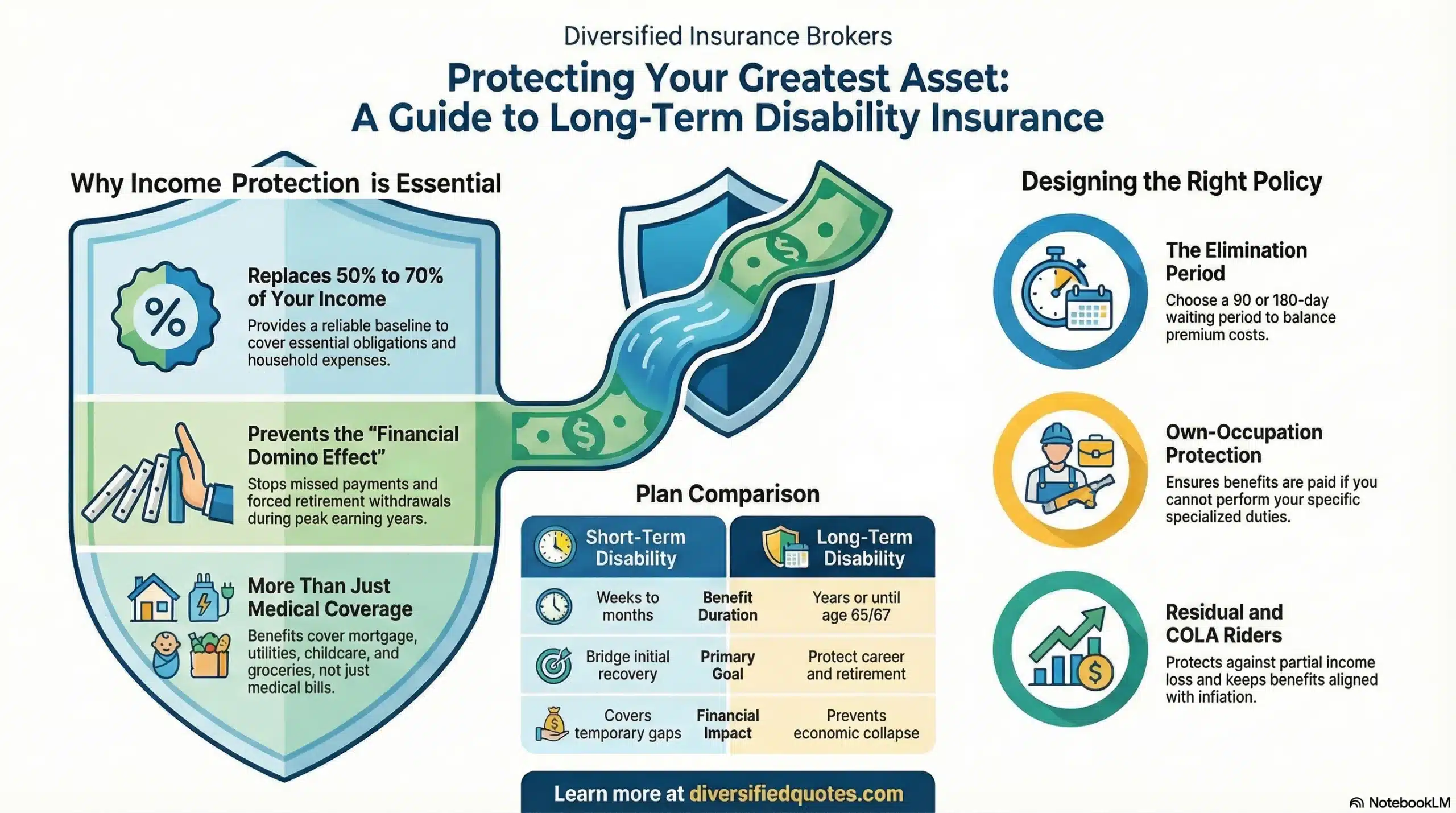
The own-occupation definition of disability is the most consequential policy feature for mechanics — and the specific physical demands that distinguish skilled mechanical work from general labor make this definition essential. Under an own-occupation definition, a policy pays benefits when a condition prevents the mechanic from performing the material and substantial duties of their specific trade — the under-vehicle work, heavy component lifting, sustained tool use, and physical positioning that automotive, diesel, HVAC, or aircraft mechanical repair requires — regardless of whether they could theoretically perform other types of lighter or sedentary work. A back condition preventing sustained under-vehicle positioning, a shoulder condition preventing overhead aircraft work, a hand condition preventing precision tool use, or a respiratory condition preventing work in a shop chemical environment all qualify as own-occupation disabilities even when the mechanic retains capacity for general activities. Without this definition, a group plan converting to any-occupation at 24 months could eliminate benefits for a mechanic who can walk and sit normally but cannot perform the physical demands of their trade. Our resource on own-occupation disability insurance explained covers how this definition operates across the physical disability scenarios most likely to affect skilled trades professionals.
A residual disability rider is particularly important for mechanics whose recovery may involve a gradual return to full mechanical capacity — returning to light diagnostic and service work before returning to heavy repair, or working reduced hours while still unable to sustain a full production schedule. A total-disability-only policy provides no benefits during this partial recovery phase. The residual rider pays proportional benefits based on the percentage income reduction through the full recovery arc. Our resource on how residual disability benefits work covers the proportional mechanics. For mechanics earlier in their careers who expect income growth through additional ASE certifications, specialty training, or advancement to master technician or service management roles, the future increase option allows coverage to grow with income without new medical underwriting. Our resource on the disability insurance future insurability rider explains how this provision locks in the right to coverage expansion at the original application’s health standard.
Why Independent Broker Access Matters for Mechanics
Not every disability insurance carrier classifies mechanic specialties with equal sophistication — and for a trade where the specific physical demands, chemical exposures, and income structures vary significantly between an automotive diagnostics specialist and a heavy diesel mechanic or an FAA-certificated aircraft technician, presenting the specific role accurately to the right carrier matters significantly. Some carriers apply exclusion riders targeting the back, shoulder, and hand conditions that are the documented dominant disability pathways for mechanical work, substantially reducing the practical value of any individual policy for mechanics whose most probable disability scenarios involve exactly those body parts. Other carriers write mechanical trade classifications more comprehensively when the health profile, specific role duties, and employment structure support favorable underwriting.
At Diversified Insurance Brokers, we evaluate options across multiple carriers for every mechanic and mechanical trades professional we serve — automotive and diesel technicians, aircraft mechanics, HVAC technicians, heavy equipment mechanics, and independent shop owners. We understand how to distinguish the physical profiles of different mechanic specialties for underwriters, how to document flat-rate production earnings accurately for benefit amount calculations, how to structure business overhead expense coverage alongside personal income replacement for shop owners, and how to select own-occupation definitions and residual disability riders that produce genuinely comprehensive protection for the specific disability scenarios mechanics actually face. Our resource on why independent disability insurance brokers matter explains the full value of this approach for skilled trades workers in high-injury-rate occupations where carrier selection meaningfully determines coverage quality.
Apply Early — Before the Shop Floor Accumulates in the Medical Record
The best time for a mechanic to apply for individual disability insurance is at the beginning of their career — when completing vocational training, apprenticeship, or entering their first mechanic employment, before the occupational health conditions that mechanical work produces over time have accumulated in the medical record. Back conditions from years of under-vehicle positioning, shoulder conditions from sustained overhead work, hand and wrist conditions from repetitive tool use, and hearing changes from shop noise can all begin developing during the early career years and appear in the medical record progressively across a mechanical career. An exclusion rider applied because early back symptoms are already documented at application eliminates protection for the most common disability pathway the mechanic profession faces.
Applying at the beginning of a mechanical career secures comprehensive own-occupation coverage at the lowest available premium, with terms that remain in force as occupational conditions potentially accumulate across subsequent working years. The future increase option available to early-career mechanics allows benefit amounts to grow with career income as additional ASE certifications, specialty qualifications, and seniority increase earnings — without additional medical underwriting at each income milestone. For mechanics who already have documented health conditions, our resource on disability insurance with preexisting conditions covers what coverage options remain available. For mechanics evaluating the application process for the first time, our resource on does disability insurance require a medical exam explains what individual disability underwriting involves.
Request Disability Insurance Quotes for Mechanics
We compare carriers across all mechanic specialties, explain how flat-rate pay affects coverage sizing, and structure policies built for the real risks of hands-on mechanical work.
Get Disability Insurance QuotesRelated Disability Insurance Pages
Talk With an Advisor Today
Choose how you’d like to connect—call or message us, then book a time that works for you.
Schedule here:
calendly.com/jason-dibcompanies/diversified-quotes
Licensed in all 50 states • Fiduciary, family-owned since 1980
Disability Insurance for Mechanics — FAQs
The Bureau of Labor Statistics makes a notably direct statement in its Occupational Outlook Handbook about automotive service technicians and mechanics: these workers “have one of the highest rates of injuries and illnesses of all occupations.” The same characterization appears for HVAC technicians and for farm equipment and heavy vehicle mechanics — multiple mechanic specialties are grouped among the highest injury-rate occupations in the entire American economy. This is federal documentation from systematic employer-reported injury and illness data, not anecdote. The specific injury mechanisms cited include contact with equipment, falls, and overexertion for automotive mechanics; burns from electrical parts or chemicals and muscle strains for HVAC technicians; and the sustained heavy part handling that diesel and equipment mechanics perform. For disability insurance planning, this federal documentation means the statistical probability of a disabling event occurring during a mechanic’s career is meaningfully higher than the general workforce baseline — making the financial consequences of being uninsured more likely to materialize and more severe when they do. A mechanic whose occupation carries federal documentation as a highest-injury-rate profession faces both a higher probability and a longer potential disability duration than the general working population averages would suggest.
Flat-rate pay creates two specific problems that standard disability insurance planning may fail to address. First, income replacement: many group disability plans and workers’ compensation calculations are based on hourly wage rates rather than flat-rate production earnings. A skilled automotive technician who consistently beats book time — completing jobs faster than the manufacturer standard and effectively earning above the posted hourly rate — has actual annual income that a straight hourly calculation significantly understates. Sizing disability benefits to actual documented annual earnings rather than base hourly rates is essential for flat-rate technicians to ensure that benefits actually replace real income rather than a fraction of it. Second, income elimination: flat-rate pay stops immediately when a technician cannot complete jobs — there is no hourly wage accumulating while a disabled mechanic rests, waits, or performs light duties. The income disruption on day one of disability is total, not partial. For mechanics on flat-rate systems, this makes a shorter elimination period and accurate benefit sizing the two most financially consequential decisions in disability insurance planning.
Back injuries are the dominant disabling condition across mechanic specialties — and the sustained awkward positions of under-vehicle repair work, combined with heavy lifting of tires, engines, transmissions, and other components, are the documented causal mechanism. The BLS confirms that automotive mechanics work in “uncomfortable positions” and “may need to lift and maneuver heavy objects” — a description that encompasses the lumbar-loading postures that produce disc conditions, spinal stenosis, and acute back injuries across a mechanical career. A lumbar disc herniation or chronic back condition that prevents sustained floor-level under-vehicle work creates a genuine own-occupation disability even when the mechanic can walk normally. Shoulder and upper extremity conditions from sustained overhead work (especially for aircraft mechanics), repetitive impact tool use, and heavy torque application produce the rotator cuff, carpal tunnel, and elbow conditions that represent the second most common disability pathway. Chemical and fluid exposure — engine oil, brake fluid, solvents, refrigerants — produces skin conditions and respiratory conditions with sustained contact. Noise-induced hearing loss from air tools, running engines, and impact equipment accumulates progressively. Electrical burns and thermal burns from exhaust and cooling systems represent acute injury risks across all mechanic specialties.
Workers’ compensation covers acute, documented work-related injuries but consistently fails for the most prevalent disability conditions mechanics actually face. The back condition that develops from years of under-vehicle positioning, the carpal tunnel syndrome from sustained air tool use, the hearing loss from shop noise, and the skin or respiratory conditions from chronic chemical exposure are all gradual-onset conditions without a single documented triggering incident — exactly the attribution pattern that workers’ compensation claims require but that cumulative occupational conditions cannot provide. Workers’ compensation also does not cover any disability unrelated to the workplace: a cardiac event, a cancer diagnosis, an off-the-job injury. For flat-rate technicians, workers’ compensation wage replacement calculations may understate actual production earnings. Individual disability insurance covers qualifying disability from any cause regardless of origin — providing continuous income protection across the full range of health events that can prevent a mechanic from working, including the cumulative occupational conditions that workers’ compensation most consistently misses.
Aircraft mechanics typically receive more favorable occupational classifications than automotive mechanics, reflecting the primarily precision-technical rather than heavy-physical nature of much aircraft maintenance work, the higher income levels that FAA-certificated mechanics earn, and the credentialed professional nature of A&P maintenance. An aircraft mechanic earning at or above the $78,680 BLS median is in a meaningfully different income tier than an automotive technician at the $49,670 median — and the favorable classification means aircraft mechanics access better premium terms for comparable coverage amounts. The disability risk profile also differs: aircraft mechanics face more overhead and confined-space positioning demands but generally less under-vehicle heavy lifting than automotive mechanics. The FAA certification dimension adds a regulatory consideration that automotive mechanic disability planning does not include — medical or physical conditions that affect FAA-reportable fitness may have professional consequences beyond the physical inability to work that own-occupation disability coverage specifically addresses. Sizing coverage to the aircraft mechanic’s actual income, which can exceed $100,000 at senior levels and in commercial aviation maintenance, is an important step in ensuring individual coverage genuinely replaces income rather than providing inadequate protection for a high-income skilled professional.
Yes — for an independent shop owner with meaningful fixed monthly operating costs, business overhead expense coverage is one of the most important financial protection decisions alongside personal income replacement disability insurance. An independent auto repair shop carries fixed costs that continue during a disability regardless of whether the owner can work: shop lease payments, equipment financing for lifts, diagnostic equipment, and specialty tools, liability insurance premiums, employee wages for any hired mechanics or service advisors, supply accounts, and administrative costs. A personal income replacement policy covers the shop owner’s household expenses — mortgage, family obligations, personal insurance — during the disability period. A business overhead expense policy covers the fixed costs keeping the shop viable, so the owner returns to a functioning repair operation rather than a set of accumulated obligations that have compromised the lease, equipment relationships, and customer base that years of trade work built. For a shop owner whose customer relationships and reputation represent the primary business asset, maintaining operations continuity during disability is often as financially important as replacing personal income.
For employed mechanics with group disability coverage and meaningful sick leave accrual, coordinating the individual supplement’s elimination period with available institutional income creates the best protection-to-premium ratio. A mechanic whose group plan has a 90-day elimination period and who has strong sick leave reserves may accept a 60- or 90-day individual supplement elimination period without meaningful financial vulnerability, since accumulated sick leave bridges much of the early disability period. For flat-rate mechanics with limited sick leave — where income stops on day one and sick leave may be minimal — a 30- or 60-day elimination period on the individual policy ensures benefits arrive before household financial pressure forces premature return to under-vehicle work. For independent shop owners with no employer sick leave and no group plan, a 30- or 60-day elimination period is typically most appropriate, since there is no institutional income bridge during the elimination window and the shop’s fixed costs continue accumulating from disability onset. The right choice depends on what financial resources the mechanic has available to bridge the gap between disability onset and benefit payment — a calculation that is more urgent for flat-rate workers than for salaried employees.
The own-occupation definition pays benefits when a condition prevents the mechanic from performing the material and substantial duties of their specific trade — the under-vehicle work, heavy component lifting, sustained tool use, physical positioning, and chemical environment exposure that automotive, diesel, HVAC, or aircraft mechanical repair requires — regardless of whether they could perform other types of work. A back condition preventing sustained floor-level under-vehicle positioning qualifies as an own-occupation disability even if the mechanic can stand, sit, and walk normally. A shoulder condition preventing overhead aircraft maintenance work qualifies even if the mechanic can use their arm for lighter activities. A respiratory condition preventing work in a shop chemical environment qualifies even if the mechanic could perform desk work in a different setting. Without this definition, a group plan converting to any-occupation at 24 months could eliminate benefits for a mechanic who can perform non-mechanical work but cannot safely return to the physical demands of their trade — denying benefits at exactly the point when the disability is most clearly established as a career-altering event rather than a temporary recovery situation.
The standard underwriting target is 60 to 70 percent of gross monthly earned income — which at the $49,670 median automotive mechanic income produces a target monthly benefit of approximately $2,480 to $2,895, and at the $78,680 aircraft mechanic median produces approximately $3,930 to $4,590. For flat-rate mechanics whose actual annual earnings exceed what a base hourly calculation would suggest, accurately documenting two to three years of actual W-2 earnings is the starting point for establishing the right income basis for benefit calculations. For employed mechanics with existing group coverage, the individual supplement targets the gap between what the group plan pays and the total replacement target — typically $1,000 to $2,000 per month for mechanics at median income levels. For independent shop owners without group coverage, the individual policy provides the full income replacement benefit as primary coverage, alongside a business overhead expense policy covering shop fixed costs. The practical sizing goal is ensuring that the combined monthly benefit covers all actual monthly household obligations — rent or mortgage, vehicle payments, family expenses — that continue at full pre-disability levels when a mechanic cannot work.
The best time is at the beginning of a mechanical career — when completing vocational training or entering first mechanic employment, before the occupational health conditions that hands-on mechanical work produces over time have accumulated in the medical record. The BLS’s documentation of highest injury rates across multiple mechanic specialties reflects conditions that accumulate across a career: back conditions from years of under-vehicle positioning, shoulder conditions from overhead work, carpal tunnel from sustained tool use, and hearing changes from shop noise can all begin appearing in the medical record during the early career years. An exclusion rider eliminating back or shoulder coverage — applied because symptoms from mechanical work are already documented at application — eliminates protection for the most common disability pathways the mechanic profession faces. Applying at career entry captures the lowest available premium, the most comprehensive available coverage terms, and the future increase option that allows benefit amounts to grow with career income as credentials, experience, and specialty qualifications increase earnings over a working lifetime. The years of vocational training and apprenticeship that develop mechanical expertise represent a real investment in a skilled trade career — protecting the income that investment generates from the documented disability risks of shop floor work should be a priority from the first day under a vehicle.
About the Author:
Jason Stolz, CLTC, CRPC, DIA, CAA and Chief Underwriter at Diversified Insurance Brokers (NPN 20471358), is a senior insurance and retirement professional with more than 25 years of real-world experience helping individuals, families, and business owners protect their income, assets, and long-term financial stability. As a long-time partner of the nationally licensed independent agency Diversified Insurance Brokers, Jason provides trusted guidance across multiple specialties—including fixed and indexed annuities, long-term care planning, personal and business disability insurance, life insurance solutions, Group Health, Travel Medical and Evacuation Insurance, and short-term health coverage. Diversified Insurance Brokers maintains active contracts with over 100 highly rated insurance carriers, ensuring clients have access to a broad and competitive marketplace.
His practical, education-first approach has earned recognition in publications such as VoyageATL, and contributions from his agency featured in Kiplinger and GoBankingRates— highlighting his commitment to financial clarity and client-focused planning. Drawing on deep product knowledge and years of hands-on field experience, Jason helps clients evaluate carriers, compare strategies, and build retirement and protection plans that are both secure and cost-efficient. Visitors who want to explore current annuity rates and compare options across multiple insurers can also use this annuity quote and comparison tool.
Explore More Disability Insurance Options: Browse our complete guide to Disability Insurance for Trades, Construction & Industrial — covering contractors, electricians, plumbers, welders, roofers, machinists & skilled trades from 100+ carriers.
Last Reviewed: September 13, 2026 |
Reviewed by: Jason Stolz, CLTC, CRPC, DIA, CAA
Chief Underwriter, Diversified Insurance Brokers, Inc. | NPN: 20471358 | Diversified Insurance Brokers, Inc. — Licensed in all 50 states
Fact Checked by: Tonia Pettitt, CMIP©
Medicare Specialist, Diversified Insurance Brokers, Inc. | NPN: 14374308 | Diversified Insurance Brokers, Inc. — Licensed in all 50 states
Did you find this content helpful? Leave us a Google review — it helps others find trustworthy guidance too.
Editorial Standards: Diversified Insurance Brokers maintains rigorous editorial standards to ensure accuracy, clarity, and independence in all content. Learn more about our editorial standards and commitment to transparency.
