
Disability Insurance for HVAC Installation and Repair
As an Independent Disability Insurance Broker, we have access to exclusive discounts and negotiated pricing most captive agents can’t offer — see the full breakdown near the end of this page.
Disability Insurance for HVAC Installation and Repair

Jason Stolz CLTC, CRPC, DIA, CAA
Disability insurance for HVAC installation and repair professionals is essential income protection for technicians and contractors the Bureau of Labor Statistics specifically identifies as having one of the highest rates of injuries and illnesses of all occupations in the United States — a direct institutional statement that places HVAC work among the most hazardous skilled trades in the American workforce. Whether you work as an HVAC technician employed by a mechanical contractor or service company, operate as a self-employed HVAC contractor running your own installation and repair business, specialize in residential system installation and replacement, focus on commercial refrigeration and climate system maintenance, work in industrial HVAC and building automation systems, or provide emergency HVAC service across a service territory that keeps you on the road and on job sites year-round — your income depends on your physical capacity to perform demanding skilled trade work in conditions the Department of Labor has documented as producing more than 37,000 separate accidents annually across the HVAC and plumbing trades combined.
The HVAC profession’s injury profile spans a remarkable range of hazard categories — electrical shock and burns from high-voltage system components, falls from roofs and ladders during rooftop system installation and service, musculoskeletal disorders from sustained heavy lifting and awkward confined-space body positions, refrigerant chemical exposure, heat stress from working in extreme thermal environments, asbestos and mold exposure in older building systems, amputation injuries from rotating fan and blower components, and vehicle accidents during travel between the multiple job sites that service-call-driven HVAC work demands. OSHA specifically identifies HVAC workers as at high risk for musculoskeletal disorders from lifting heavy items, bending, and reaching overhead — the physical demands that define HVAC installation and service work across every job category in the profession.
At Diversified Insurance Brokers, we help HVAC technicians, HVAC service technicians, HVAC installation contractors, self-employed HVAC business operators, and HVAC apprentices and journeymen structure disability insurance coverage that reflects the genuine multi-hazard occupational profile of heating, ventilation, air conditioning, and refrigeration work, the mixed employed and self-employed income structure of the HVAC industry, and the policy features that provide the most meaningful financial protection when an electrical injury, fall, musculoskeletal condition, or other HVAC-related disability prevents continued skilled trade work.
Protect Your HVAC Professional Income
Compare disability insurance options designed for HVAC technicians, installation contractors, service specialists, and self-employed HVAC business operators.
Request Disability Insurance OptionsBLS Documents HVAC Among the Highest-Injury Occupations
The Bureau of Labor Statistics Occupational Outlook Handbook is direct and unambiguous in its characterization of HVAC occupational hazard: HVAC technicians have one of the highest rates of injuries and illnesses of all occupations. This is not a qualified or hedged statistical comparison — it is an institutional statement that places HVAC alongside mining, logging, fishing, and roofing in the tier of American occupations whose injury burden is documented as most severe. For disability insurance planning purposes, this BLS characterization establishes that HVAC technicians are not choosing a marginally hazardous profession but one that belongs among the highest-risk occupational categories in the American workforce — with income protection planning needs that must reflect that documented reality.
The DOL’s documentation of more than 37,000 separate accidents in HVAC and plumbing trades in a single year provides the scale context for understanding why individual disability insurance is not an optional financial product for HVAC professionals but a foundational income protection necessity. An HVAC technician who sustains a career-disrupting injury from any of the well-documented hazard categories that characterize the profession — electrical events, falls, musculoskeletal injuries, chemical exposure — faces immediate and complete income loss if self-employed, or significant income gaps if employed, without disability insurance in place. The documented injury profile that generates the BLS’s high-injury designation parallels that of other high-hazard skilled trades in the electrical and mechanical systems category, including electricians whose high-voltage system work creates the same documented electrical injury and fall disability risk profile and plumbers and pipefitters managing the documented musculoskeletal and confined-space disability risk of mechanical systems installation and repair.
Electrical Injury — The Most Dangerous HVAC Hazard
HVAC systems operate on high-voltage electrical components — compressors, capacitors, contactors, transformers, and control systems — whose electrical energy levels are sufficient to produce severe electrical burns, cardiac arrhythmia, neurological damage, and death. HVAC technicians install electrical components and wiring as a core function of installation and service work, placing them in sustained proximity to energized system components across every working day. Published HVAC safety resources document that electrical injuries in the skilled trades cause roughly 1,000 deaths annually and account for 5% of burn ward admissions — statistics that reflect the severity of electrical injury consequences across the trades, including HVAC.
The specific electrical hazard of HVAC work that makes it uniquely dangerous is the capacitor — a component found in virtually every HVAC system that stores electrical charge even after power has been disconnected from the unit. A capacitor that has not been discharged before service access can deliver a severe electrical shock even when the technician has taken appropriate lockout steps, creating an injury risk that persists after the expected safety precautions have been completed. An HVAC technician who sustains a serious electrical event — arc flash burn, severe electrical shock producing cardiac effects, electrical contact injury requiring surgical management — faces a recovery period measured in weeks to months during which active HVAC service work is medically impossible. The electrical injury disability risk for HVAC technicians parallels the documented hazard profile of other high-voltage electrical system professionals, including welders and thermal joining professionals managing documented electrical and thermal injury disability risk in sustained high-energy work environments.
Falls From Roofs, Ladders, and Elevated Access — The Acute Catastrophic Risk
Commercial and industrial HVAC systems are commonly installed on rooftops — requiring HVAC technicians to perform installation, service, and replacement work at elevation on surfaces that may present fall hazards from edges, skylights, unstable roofing materials, and the uneven walking surfaces of mechanical equipment areas. Published HVAC safety incident documentation includes multiple cases of HVAC professionals who fell through skylights during rooftop installation work — one falling 15 feet to concrete after losing balance while freeing a saw from a metal roof, another stepping onto a skylight whose glass was obscured by a dust layer that made it visually indistinguishable from solid roofing material. Both cases resulted in fatal injuries.
Falls from ladders during residential HVAC work — accessing attic units, rooftop condensers, and elevated system components — produce serious orthopedic, spinal, and head injuries that represent some of the most career-disruptive disability events in the HVAC profession. OSHA consistently identifies lack of fall protection as the most common OSHA violation across construction and maintenance trades, reflecting the pervasive nature of fall hazard exposure in the environments where HVAC installation and service work occurs. An HVAC technician who sustains a serious spinal injury from a roof fall, a traumatic brain injury from a ladder fall, or significant lower extremity fractures from a fall during equipment installation faces recovery timelines measured in months and permanent functional consequences that can prevent return to active HVAC field work. The fall from elevation catastrophic disability risk for HVAC technicians parallels that documented for other elevated work skilled trade professionals, including chimney sweepers and elevated access service professionals managing falls-from-height disability risk in rooftop service work and cell tower workers and elevated access maintenance professionals managing documented falls-from-height catastrophic disability risk.
Musculoskeletal Disorders — The Most Prevalent Career-Wear Disability
OSHA specifically identifies HVAC workers as at high risk for musculoskeletal disorders from the combination of heavy equipment lifting, sustained awkward position work in confined spaces, overhead reaching, and the whole-body vibration of sustained equipment operation — physical demands that define HVAC installation and service work across every system category and job type. The musculoskeletal disability risk of HVAC work reflects the physical reality of the profession: HVAC equipment is heavy, the spaces where it must be installed and serviced are often confined and awkwardly configured, and the body mechanics required to access, lift, position, and connect HVAC system components routinely place HVAC technicians in the postures most likely to produce cumulative spinal, shoulder, and upper extremity disorders.
Concrete unit handlers for rooftop equipment installations can weigh hundreds of pounds — requiring coordinated heavy lifting that creates acute overexertion injury risk alongside the chronic cumulative loading that produces progressive lumbar disc disease over HVAC careers. Attic and crawl space work for residential furnace and air handler installation requires sustained awkward positions — crouching, crawling, reaching — that create the specific movement patterns most associated with musculoskeletal disorder development in occupational health research. Overhead ductwork installation in commercial mechanical rooms requires sustained overhead arm positioning that produces shoulder impingement and rotator cuff conditions over the accumulated volume of overhead work that HVAC installation careers involve. Published injury resources document that HVAC musculoskeletal injuries include carpal tunnel syndrome, bulging discs causing back pain, and hernias from the sustained heavy lifting demands of the trade. The musculoskeletal career-wear disability risk for HVAC technicians parallels that documented for other sustained heavy mechanical systems installation trades, including boilermakers and industrial mechanical system workers managing documented musculoskeletal disability risk from sustained heavy systems installation and confined space work and well drillers and mechanical installation professionals managing the documented musculoskeletal and physical strain disability risk of sustained heavy equipment work.
Chemical Exposure — Refrigerants, Asbestos, Mold, and Carbon Monoxide
HVAC technicians work with and around a range of chemical and biological hazards that create both acute illness disability risk and long-latency occupational illness consequences across HVAC careers. Refrigerant chemicals — required for proper handling under EPA regulations and subject to specific recovery, recycling, and containment protocols — can cause toxic, flammable, and asphyxiation hazards when mishandled or when system failures produce uncontrolled releases in enclosed spaces. Brazing and welding operations during refrigerant line installation deplete oxygen levels and produce toxic fume exposures that create acute chemical hazard risk in the confined space environments where HVAC work frequently occurs.
HVAC technicians servicing older buildings regularly encounter asbestos-containing materials in ductwork insulation, boiler insulation, and pipe wrap — creating asbestos fiber inhalation risk whose long-latency consequences include mesothelioma, asbestosis, and lung cancer with latency periods of 20 to 50 years. Dirty air filter systems and failed HVAC equipment can expose technicians to bacteria, mold, and fungus during service operations — creating respiratory sensitization and allergic disease disability risk from biological agent inhalation. Faulty furnace and heat exchanger service can expose HVAC technicians to carbon monoxide in enclosed spaces. Each of these chemical and biological exposures creates documented occupational health consequences whose disability-producing effects may manifest acutely during a specific service call or develop progressively over an HVAC career. The chemical and biological exposure disability risk for HVAC technicians parallels that documented for other mechanical systems service professionals in legacy building environments, including alarm installers and building systems professionals managing chemical and biological exposure disability risk in legacy building mechanical environments.
Heat Stress and Extreme Environmental Exposure
HVAC technicians service and repair heating and air conditioning systems precisely when those systems are most stressed by extreme weather conditions — in the hottest summer days when air conditioning systems are failing and in the coldest winter periods when heating systems require emergency repair. This demand-driven service timing places HVAC professionals in the most extreme thermal environments at the moments when heat stress and cold exposure risk are highest: attics in July that may reach 150 degrees Fahrenheit, rooftop mechanical areas in August heat with no shade, and outdoor refrigeration systems in January conditions. The BLS documents the heat stress risk of HVAC work explicitly in the occupational profile, and the broader occupational research literature documents thousands of work-related heat injuries annually across trades that share the extreme thermal exposure profile of HVAC service work.
Heat exhaustion and heat stroke events during HVAC service work in extreme summer conditions can produce disability consequences including neurological effects, cardiovascular impacts, and the acute injuries that result when a heat-impaired technician loses situational awareness and coordination in an elevated or electrically hazardous environment. The heat stress occupational disability risk for HVAC technicians is compounded by the physical exertion of heavy equipment work in hot conditions — a combination that creates more severe physiological heat stress than sedentary heat exposure alone. The extreme environmental disability risk for HVAC technicians in thermal extreme service conditions parallels that documented for other skilled trade professionals in demanding outdoor and enclosed environmental conditions.
Self-Employed HVAC Contractors — The Acute Income Protection Need
The HVAC industry includes a substantial population of self-employed contractors who operate their own HVAC service and installation businesses — running service vans, maintaining customer relationships, and generating professional income entirely through their personal physical capacity to perform HVAC work on a service-call and installation-contract basis. For these self-employed HVAC business operators, the disability insurance need is the most acute form of the income protection problem: no employer sick pay, no group disability plan, and no workers’ compensation for self-employed operators who have not specifically elected it. When a disability prevents HVAC work, the service revenue stops immediately and completely while business fixed costs — van payments, tool financing, license and insurance costs — and household financial obligations continue regardless.
A self-employed HVAC contractor who sustains a serious back injury from lifting a commercial RTU during a rooftop installation, or a significant electrical burn requiring surgical management and weeks of wound care, faces zero service revenue during recovery with no institutional mitigation. The service schedule that sustains the business cannot be maintained without the contractor’s personal physical participation — and the customer relationships built over years of local HVAC service can be lost to competitors during an extended unplanned absence. Individual disability insurance is the only meaningful income protection available for self-employed HVAC contractors — and the elimination period, benefit amount, and own-occupation definition of that coverage are the provisions that determine whether it actually functions as financial protection when the disability occurs. The self-employment income protection need for HVAC contractors parallels that facing other self-employed skilled trade operators, including independent contractors and self-employed trade operators managing income protection without any institutional employer safety net and self-employed business owners managing the complete absence of employer-provided disability coverage.
Case Study: HVAC Installation Technician Earning $72,000 Per Year
Consider an HVAC installation technician employed by a mechanical contractor, earning $72,000 annually including base pay, overtime, and tool allowance. While installing a commercial rooftop unit, this technician slips on a wet rooftop surface near a roof edge and sustains a lumbar spine fracture and significant lower extremity injuries requiring surgical intervention and eight months of recovery during which all field HVAC work is medically prohibited.
| Scenario | Workers’ Comp + Group Plan Only | Workers’ Comp + Group Plan + Individual Supplement |
|---|---|---|
| Monthly Benefit During Recovery | Workers’ comp at ~66% of regular wages; group LTD at 60% of base pay only after 90 days | Workers’ comp + individual supplement covering overtime and tool allowance gap |
| Overtime and Supplemental Pay Protected | $0 — group LTD excludes overtime; workers’ comp calculates on regular rate only | Individual policy calibrated to total documented W-2 compensation |
| Own-Occupation After Year 2 | Group LTD converts to any-occupation — HVAC tech with limited mobility may lose benefits | Individual own-occupation definition protects HVAC-specific work capacity for full benefit period |
| Long-Term Career Protection | Any-occupation conversion risk eliminates benefits if technician could theoretically perform sedentary work | Full benefit period own-occupation protection ensures HVAC field capacity specifically protected |
Rooftop installation slip and fall injuries are among the most specifically documented disability scenarios in HVAC professional safety literature — and the spinal and orthopedic injuries they produce are career-critical for technicians whose HVAC field work demands the full range of physical capability including heavy lifting, confined space access, and ladder work. Disability insurance for HVAC professionals ensures that the institutional coverage gaps — overtime exclusion from group plan calculations, any-occupation conversion after two years — do not leave the technician financially exposed during an extended recovery from the most serious injuries the profession produces.
Key Policy Features for HVAC Professional Disability Insurance
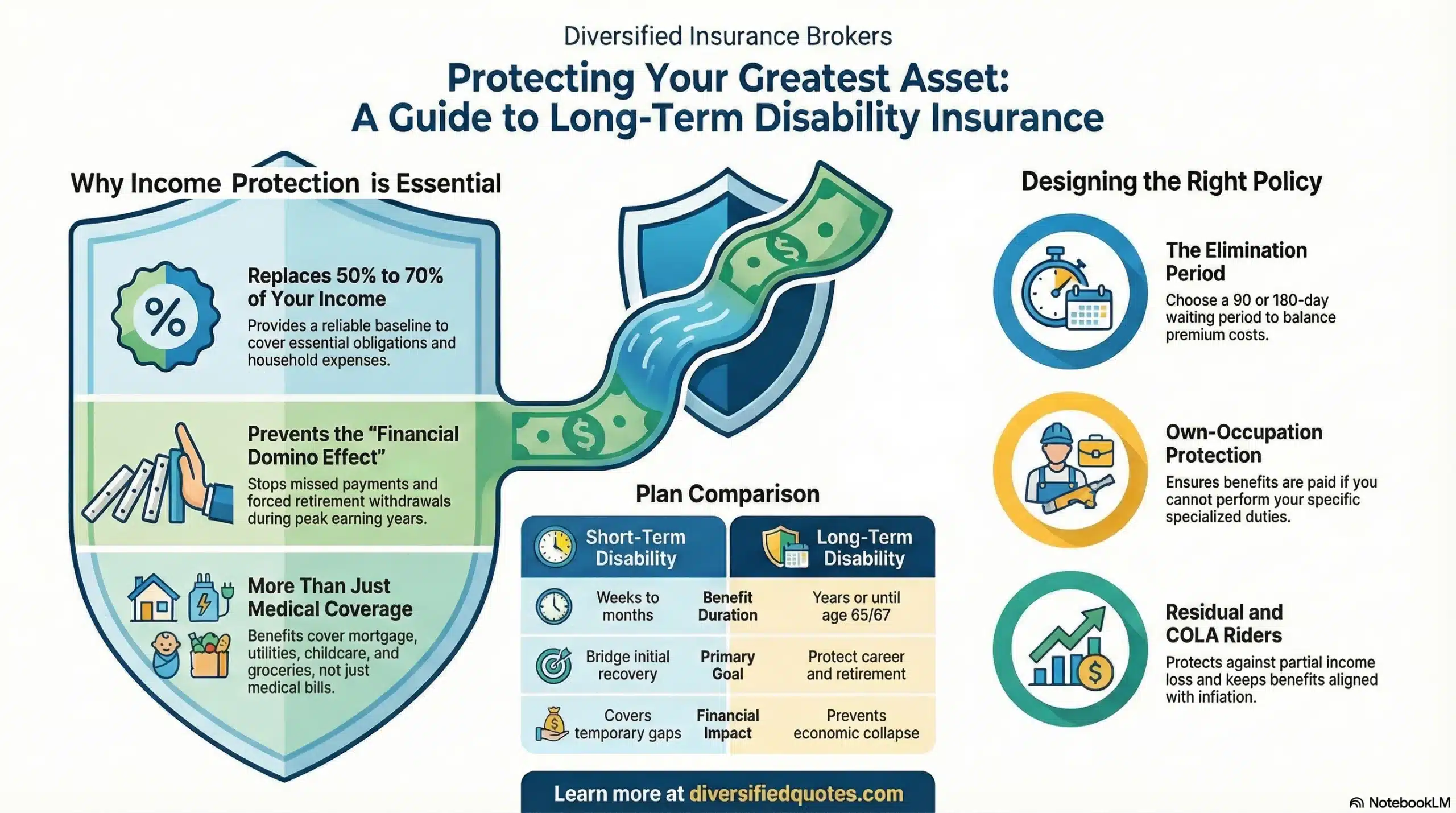
Disability insurance for HVAC installation and repair professionals should incorporate specific policy provisions that address the multi-hazard occupational profile, the mixed employed and self-employed income structures of the HVAC industry, and the group plan limitations that affect employed HVAC workers. The own-occupation definition is foundational — ensuring that an HVAC professional who cannot perform the specific physical field demands of HVAC installation and service work — heavy lifting, confined space access, elevated rooftop work, electrical system service, ladder climbing — receives disability benefits regardless of theoretical capacity for other less physically demanding work. Our comprehensive resource on own-occupation disability insurance explained covers how this definition protects HVAC professional income from the physical injury conditions most likely to prevent continued field HVAC work.
A residual disability rider is important for HVAC professionals whose musculoskeletal conditions may reduce field capacity without eliminating it entirely — a technician cleared for light residential service but not heavy commercial installation earns reduced income without being totally disabled. Our resource on how residual disability insurance benefits work explains how partial disability coverage supports HVAC workers through graduated return-to-field. The elimination period should account for workers’ compensation coverage available to employed technicians and the complete absence of bridge income for self-employed operators — our guide on how disability insurance elimination periods work provides the complete framework. A cost-of-living adjustment rider preserves real benefit value across extended disability periods from serious spinal or orthopedic injuries — our resource on disability income insurance with a COLA rider explains this protection. Our guide on how to buy short-term disability insurance covers short-term coverage options for HVAC professionals.
Why HVAC Professionals Need an Independent Disability Insurance Broker
Disability insurance for HVAC installation and repair professionals requires knowledge of occupational classification for high-hazard mechanical systems trade work, expertise in documenting total compensation including overtime for employed HVAC technicians, understanding of group plan gap analysis for the own-occupation to any-occupation conversion issue, and experience with self-employed HVAC contractor income documentation for Schedule C income underwriting. A standard retail application is not optimized for the HVAC professional occupational classification context, and a general agent unfamiliar with skilled trade disability insurance will not identify the most favorable carriers or structure the most meaningful coverage for HVAC field professionals.
At Diversified Insurance Brokers, we work with HVAC technicians, installation contractors, service specialists, and self-employed HVAC business operators to structure disability insurance that accurately reflects the documented injury profile of the profession, captures total compensation including overtime and supplemental pay in benefit calculations, maintains own-occupation protection for HVAC field-specific duties throughout the benefit period, and accesses carriers whose underwriting most favorably accommodates HVAC trade occupational profiles. The disability insurance considerations for HVAC professionals parallel those applicable to other skilled trade mechanical systems professionals, including welders managing similar occupational classification and group plan gap analysis for skilled industrial trade disability insurance.
Final Thoughts on Disability Insurance for HVAC Installation and Repair Professionals
HVAC technicians and contractors perform essential skilled trade work that keeps American homes, businesses, hospitals, and industrial facilities at the temperatures and air quality conditions that health, comfort, and productivity require. The Bureau of Labor Statistics has documented that this essential work places HVAC professionals among those with the highest rates of injuries and illnesses of all occupations — a designation that reflects the genuine multi-hazard reality of electrical systems, elevated work, heavy equipment, confined spaces, chemical exposure, and extreme thermal environments that define HVAC professional practice. Individual disability insurance that reflects this documented hazard reality, captures total HVAC professional compensation, maintains own-occupation protection throughout the benefit period, and activates without a work-relatedness requirement provides the financial protection that HVAC professionals whose essential work carries documented high risk genuinely deserve.
Related Pages
Talk With an Advisor Today
Choose how you’d like to connect—call or message us, then book a time that works for you.
Schedule here:
calendly.com/jason-dibcompanies/diversified-quotes
Licensed in all 50 states • Fiduciary, family-owned since 1980
Disability Insurance for HVAC Installation and Repair Professionals FAQs
The Bureau of Labor Statistics makes an unusually direct statement about HVAC occupational hazard in its official Occupational Outlook Handbook: HVAC technicians have one of the highest rates of injuries and illnesses of all occupations. This institutional classification places HVAC alongside the most hazardous skilled trades in the American workforce — a designation that reflects the documented multi-hazard profile of HVAC work across electrical injury, falls from elevation, musculoskeletal disorders, chemical exposure, and extreme environmental conditions. The Department of Labor documented more than 37,000 separate accidents in HVAC and plumbing trades in a single year, establishing the scale of injury frequency that underlies the BLS’s high-injury classification. OSHA specifically identifies HVAC workers as at high risk for musculoskeletal disorders from the combination of heavy equipment lifting, confined space work, overhead reaching, and whole-body vibration that characterize HVAC installation and service work. Electrical injuries across the skilled trades cause roughly 1,000 deaths annually and account for 5% of burn ward admissions, reflecting the severity of the electrical hazard category that HVAC technicians navigate in every high-voltage system they service. For context on disability insurance for other BLS-documented high-injury skilled trades, see our page on disability insurance for construction workers managing BLS-documented high-injury trade occupational risk.
The disability risk profile for HVAC technicians spans multiple distinct injury categories that reflect the multi-hazard nature of heating, ventilation, air conditioning, and refrigeration work. Musculoskeletal disorders — back injuries from sustained heavy equipment lifting, shoulder and rotator cuff conditions from overhead ductwork and equipment installation, hernias from heavy unit handling, carpal tunnel syndrome from sustained tool use, and bulging discs from the cumulative spinal loading of trade work — are the most frequently occurring career-disrupting conditions across the HVAC workforce. Falls from rooftops, skylights, and ladders during elevated installation and service work produce serious spinal, orthopedic, and head injuries that are among the most catastrophically disabling events in the profession, with documented fatalities from HVAC rooftop work accidents including skylight fall-throughs. Electrical injuries from capacitor discharge, arc flash events, and high-voltage system contact produce burns, cardiac effects, and neurological consequences. Chemical exposure from refrigerants in enclosed spaces, asbestos in legacy building systems, mold and biological agents in failed HVAC systems, and brazing and welding fumes creates both acute and long-latency occupational illness disability risk. Heat stress injuries during extreme summer service conditions, vehicle accidents during travel between job sites, and amputation injuries from fan and blower component contact round out the comprehensive disability risk profile of active HVAC professional work.
Many HVAC technicians employed by mechanical contractors, HVAC service companies, and building management firms have access to employer group long-term disability coverage — but those plans carry limitations that are particularly significant for HVAC workers. Group disability plans typically calculate benefits at 60% of base salary while excluding overtime compensation, which for HVAC technicians working emergency service calls, seasonal demand periods, and extended installation projects can represent a meaningful portion of total annual compensation. The any-occupation conversion that most group long-term disability plans impose after two years of benefits is especially consequential for HVAC technicians whose common disabling conditions — spinal injuries, shoulder conditions, musculoskeletal disorders — may prevent the specific physical demands of HVAC field work while theoretically allowing sedentary alternative employment. An HVAC technician who cannot climb ladders, lift heavy equipment, or work in confined spaces but could theoretically do office work would lose group LTD benefits after two years under most group plan terms. Individual supplemental disability insurance that maintains own-occupation protection for HVAC field-specific physical duties throughout the benefit period is the coverage provision that prevents this specific group plan gap from producing premature benefit termination. Self-employed HVAC contractors typically have no group disability coverage at all, making individual disability insurance the entirety of their income protection rather than a supplement to institutional coverage.
Own-occupation disability insurance pays benefits when a disabling condition prevents an HVAC professional from performing the specific physical and technical demands of HVAC installation and repair work — heavy equipment lifting, ladder and rooftop access, confined space work, electrical system service, ductwork installation, and all other specific physical demands of active HVAC field work — regardless of whether they could theoretically perform other less physically demanding work. Any-occupation coverage only pays if the HVAC professional cannot perform virtually any gainful employment. An HVAC technician whose serious lumbar spine injury from a rooftop fall prevents ladder climbing, heavy lifting, and confined space HVAC work — but who could theoretically perform sedentary office work — would receive no any-occupation benefits after two years, while an own-occupation policy maintains full disability benefits for the inability to continue active HVAC field work. For HVAC professionals whose career value lies in their licensed technical skills and physical field capability, the own-occupation definition is the provision that makes disability insurance genuinely protective for the spinal, orthopedic, and physical conditions most likely to prevent continued HVAC professional work without completely preventing all employment. For context on own-occupation coverage for high-hazard skilled trade professionals, see our page on disability insurance for crane operators and heavy equipment professionals requiring own-occupation protection for specialized physical skilled trade work.
Yes — individual disability insurance covers disability resulting from electrical injuries when the resulting condition prevents performing the specific professional demands of HVAC work. An HVAC technician who sustains a serious arc flash burn requiring surgical management and extended wound care, a severe electrical shock producing cardiac effects and neurological consequences that prevent active field work, or an electrical contact injury requiring amputation — all qualify for disability benefits under a well-structured own-occupation policy when the resulting condition prevents continued HVAC professional field work. Individual disability insurance has no work-relatedness requirement as workers’ compensation does — it covers any qualifying disability from any cause as long as the condition prevents the professional work that generates the insured’s income. For HVAC technicians, this means that both work-related electrical injuries covered by workers’ compensation and any non-work-related disabling conditions are covered under individual disability insurance, making it both a supplement to workers’ compensation for work-related events and the only protection for conditions outside workers’ compensation coverage scope. Workers’ compensation provides only partial wage replacement at 60-66% and covers only work-related conditions — individual disability insurance fills both the wage replacement gap and the non-work-related disability gap.
Elimination period selection for HVAC professionals differs meaningfully between employed technicians and self-employed contractors. Employed HVAC technicians who have workers’ compensation coverage for work-related injuries — which provides wage replacement from relatively early in a disability period — and who have accumulated some sick leave can typically manage a 90-day elimination period on an individual supplemental policy, using workers’ compensation and sick leave to bridge the waiting period before individual benefits activate. For work-related injuries, workers’ compensation wage replacement provides income continuity during the elimination period; for non-work-related conditions not covered by workers’ compensation, only sick leave bridges the wait. Self-employed HVAC contractors who have not elected workers’ compensation for themselves and have no employer sick leave face the sharpest version of the elimination period challenge — zero institutional income from day one of disability — making a shorter 30 or 60-day elimination period more appropriate unless substantial liquid savings can sustain both household expenses and ongoing business fixed costs throughout the full waiting period. The business overhead expense dimension is also relevant for self-employed HVAC operators carrying vehicle payments, tool financing, and licensing costs that continue regardless of service revenue — making the financial reserves needed to bridge an elimination period higher than personal living expenses alone. For context on elimination period selection for skilled trade professionals, see our page on disability insurance for high-hazard skilled trade workers managing elimination period selection without adequate institutional income bridges.
For individual disability insurance purposes, verifiable documented earned income including overtime compensation that is reflected on W-2 tax forms can be included in the insurable income base for benefit calculation. This is an important planning consideration for HVAC technicians whose total annual W-2 compensation — including overtime from emergency service calls, seasonal demand surges during heat waves and cold snaps, and extended installation project hours — may substantially exceed their base salary alone. Employer group disability plans typically calculate benefits exclusively on base salary while explicitly excluding overtime, leaving the overtime component of HVAC worker compensation entirely unprotected. Individual disability insurance structured to include documented total W-2 income including verified overtime provides complete compensation protection. The key requirement is documentation — overtime income consistently reflected on W-2 forms and verifiable through tax records supports benefit calculation at the higher total compensation level. For HVAC technicians working in emergency service roles where overtime is structural and recurring rather than occasional, the difference between a benefit based on base salary alone and one based on total documented W-2 compensation including overtime can represent a meaningful difference in actual monthly benefit amounts during a disability period.
The best time for an HVAC professional to apply for disability insurance is as early as possible in their HVAC career — ideally when first entering the trade as an apprentice or newly licensed technician, before any occupational health consequences from HVAC trade work have accumulated in the medical record. Disability insurance premiums are based in part on age and health status at the time of application, and younger HVAC technicians in excellent health secure the most comprehensive coverage at the most favorable rates that will be locked in for the policy’s entire duration. Any prior back injuries from heavy lifting, shoulder conditions from overhead work, electrical burn incidents, or other documented health consequences of HVAC trade work can result in exclusion riders for those specific conditions at application. The non-cancelable and guaranteed renewable provision locks in the early-career health rating regardless of what occupational health developments occur during subsequent years of HVAC field work. A future increase option rider secured early allows benefit amounts to grow with career income advancement — from apprentice wages through journeyman to master HVAC contractor income levels — without requiring new medical underwriting when health may have changed from years of high-hazard HVAC trade work. The urgency of early application for HVAC professionals is reinforced by the profession’s BLS-documented high-injury status — every year of HVAC field work accumulates the occupational exposure that increases the probability of documented injuries appearing in the medical record. For context on early application timing for high-hazard trade professionals, see our page on disability insurance for skilled trade repair professionals managing early career disability insurance application decisions.
An independent broker with skilled trade disability insurance expertise compares occupational class assignments for HVAC trade work across multiple carriers, evaluates own-occupation definition language for physical field trade occupations, analyzes group plan gap analysis for the any-occupation conversion issue specific to HVAC technicians, assesses overtime and supplemental pay income documentation approaches, and compares premium structures and residual disability rider provisions across the full competitive marketplace. Different carriers classify HVAC trade work differently and approach the multi-hazard occupational profile with different underwriting guidelines — some carriers produce more favorable classifications for residential HVAC technicians than commercial installation specialists, some are more favorable to self-employed HVAC contractors than employed technicians, and some have more competitive premium structures for the HVAC occupational classification tier. At Diversified Insurance Brokers, we evaluate the full competitive landscape for every HVAC professional we work with — identifying which carriers most favorably classify the specific HVAC work type, ensuring overtime and total compensation is properly documented for benefit calculation, structuring own-occupation protection that specifically covers HVAC field physical demands through the full benefit period, and providing the broker expertise that the multi-hazard, multi-income-structure disability insurance planning needs of HVAC installation and repair professionals specifically require.
About the Author:
Jason Stolz, CLTC, CRPC, DIA, CAA and Chief Underwriter at Diversified Insurance Brokers (NPN 20471358), is a senior insurance and retirement professional with more than 25 years of real-world experience helping individuals, families, and business owners protect their income, assets, and long-term financial stability. As a long-time partner of the nationally licensed independent agency Diversified Insurance Brokers, Jason provides trusted guidance across multiple specialties—including fixed and indexed annuities, long-term care planning, personal and business disability insurance, life insurance solutions, Group Health, Travel Medical and Evacuation Insurance, and short-term health coverage. Diversified Insurance Brokers maintains active contracts with over 100 highly rated insurance carriers, ensuring clients have access to a broad and competitive marketplace.
His practical, education-first approach has earned recognition in publications such as VoyageATL, and contributions from his agency featured in Kiplinger and GoBankingRates— highlighting his commitment to financial clarity and client-focused planning. Drawing on deep product knowledge and years of hands-on field experience, Jason helps clients evaluate carriers, compare strategies, and build retirement and protection plans that are both secure and cost-efficient. Visitors who want to explore current annuity rates and compare options across multiple insurers can also use this annuity quote and comparison tool.
Explore More Disability Insurance Options: Browse our complete guide to Disability Insurance for Trades, Construction & Industrial — covering contractors, electricians, plumbers, welders, roofers, machinists & skilled trades from 100+ carriers.
Last Reviewed: June 8, 2026 |
Reviewed by: Jason Stolz, CLTC, CRPC, DIA, CAA
Chief Underwriter, Diversified Insurance Brokers, Inc. | NPN: 20471358 | Diversified Insurance Brokers, Inc. — Licensed in all 50 states
Fact Checked by: Tonia Pettitt, CMIP©
Medicare Specialist, Diversified Insurance Brokers, Inc. | NPN: 14374308 | Diversified Insurance Brokers, Inc. — Licensed in all 50 states
Did you find this content helpful? Leave us a Google review — it helps others find trustworthy guidance too.
Editorial Standards: Diversified Insurance Brokers maintains rigorous editorial standards to ensure accuracy, clarity, and independence in all content. Learn more about our editorial standards and commitment to transparency.
