
Disability Insurance for Courier and Parcel Delivery
As an Independent Disability Insurance Broker, we have access to exclusive discounts and negotiated pricing most captive agents can’t offer — see the full breakdown near the end of this page.
Disability Insurance for Courier and Parcel Delivery

Jason Stolz CLTC, CRPC, DIA, CAA
Courier and parcel delivery workers carry a physical occupational risk profile documented in Bureau of Labor Statistics data as substantially exceeding the average for all private industry workers — driven by the combination of delivery driving hazards, repetitive heavy lifting, package handling musculoskeletal strain, dog bites, slip and fall incidents at delivery locations, and the cardiovascular stress of the demanding pace that modern delivery operations require. BLS data places fatal injuries in transportation and material moving occupations — the category encompassing delivery drivers — among the elevated-risk categories in the American workforce, with roadway incidents consistently representing the leading cause of fatal injuries. Research specifically on couriers documents that parcel delivery and collection couriers face a statistically significantly higher risk of occupational stress than other courier types, and a peer-reviewed cohort study found that couriers had a standardized incidence ratio for stroke of 1.84 compared to male total wage workers — a 84 percent higher stroke incidence that directly reflects the occupational stress and physical intensity of sustained delivery work. Bureau of Labor Statistics data places the median annual wage for light truck or delivery service drivers in a range that makes the income meaningful and the absence of occupation-appropriate income protection a genuine financial risk for the household. The gig economy’s expansion of same-day delivery through app-based platforms has simultaneously expanded the delivery workforce and expanded the unprotected population — delivery drivers who carry their income from these platforms operate as independent contractors with no employer benefit of any kind, making individual disability coverage not a supplement but the entire protection system.
At Diversified Insurance Brokers, Jason Stolz, CLTC, CRPC, DIA, CAA works with courier and parcel delivery professionals across the full range of employment structures the delivery industry encompasses — employed drivers for regional and national carriers with potential group benefit access, independent owner-operator delivery contractors who have their own route or territory agreements, and gig-economy delivery workers who earn from app-based platforms as self-employed independent professionals. The coverage architecture for an employed carrier driver with group benefits access is structurally different from what a 1099-earning independent delivery contractor who owns their vehicle and route needs — and both require specific attention to the physical injury, driving accident, and cardiovascular disability pathways that the occupational health research on delivery workers has documented.
Compare Disability Coverage for Couriers and Delivery Drivers
We review coverage options across 100+ carriers and identify the policy structure that fits your delivery income, employment structure, and occupational risk profile.
Courier and Delivery Worker Disability Risk — Physical Hazards, Vehicle Accidents, and the Income Protection Gap
| Risk Category | BLS / Research Documentation | Resulting Disability Risk | Workers’ Comp Coverage | Income Protection Gap |
|---|---|---|---|---|
| Motor vehicle accidents | BLS data documents transportation incidents as the leading cause of fatal injuries in delivery and driving occupations; approximately 70% of fatal injuries to delivery truck drivers are roadway incidents; vehicle collision injuries represent the highest-severity disability risk for a profession that spends the majority of working time operating vehicles on public roads | Spinal fractures, traumatic brain injury, limb injuries, and other catastrophic crash injuries producing extended or permanent disability — crash severity in commercial vehicle incidents is disproportionately high | Workers’ comp covers employed drivers for documented on-duty vehicle accidents at approximately two-thirds of wages to state caps; independent contractors and gig drivers unprotected without specific election | Income gap above workers’ comp cap; full gap for gig and contractor drivers; individual LTD extends to-age-65 coverage beyond workers’ comp limitations |
| Musculoskeletal injuries from package handling | BLS data documents that overexertion and bodily reaction — lifting, pushing, carrying — is the single largest cause of serious nonfatal occupational injuries across the U.S. workforce; delivery work involves sustained repetitive heavy lifting multiple times per hour throughout a full delivery day, with individual packages regularly exceeding safe lift weight thresholds | Chronic lower back syndrome, herniated discs, shoulder tears, knee injuries from repetitive heavy lifting and the physical demands of sustained delivery route operation | Acute incidents covered for employed drivers; cumulative and chronic conditions disputed as non-occupational; gig and contractor drivers entirely unprotected | Significant gap for chronic musculoskeletal conditions; full gap for gig workers; individual DI covers all qualifying causes regardless of gradual onset |
| Cardiovascular and stroke risk from occupational stress | Peer-reviewed cohort research documents that couriers had a standardized incidence ratio for stroke of 1.84 compared to male total wage workers — an 84% higher incidence; ischemic heart disease SIR was 1.54 for couriers vs. 1.08 for office workers; long working hours (over 14 hours per day commonly documented), high-volume demands, and sustained physical stress drive this elevated cardiovascular risk | Disabling cardiac event or stroke with extended recovery or permanent functional limitation — the cardiovascular risk profile of courier work is specifically documented as exceeding the general working population at a statistically significant level | Not covered by workers’ comp as an occupational incident; gig workers entirely unprotected; illness-based disability falls outside the workers’ comp framework regardless | Full gap for cardiovascular disability; individual DI to age 65 covers all illness-based disability including the elevated cardiovascular risk documented in courier research |
| Slips, falls, and delivery-site injuries | BLS data documents falls, slips, and trips as the second largest category of serious nonfatal occupational injuries after overexertion; delivery drivers encounter diverse delivery surfaces — residential steps, commercial loading docks, uneven terrain, wet and icy conditions — on every route, creating sustained daily slip and fall exposure that varies by season and location | Fractures, sprains, and back injuries from delivery-location falls that require extended recovery or produce chronic conditions preventing continued delivery route work | Covers employed drivers for documented on-duty falls; gig and contractor drivers unprotected; states vary in workers’ comp adequacy for delivery-related fall injuries | Full gap for gig and contractor drivers; income gap above workers’ comp ceiling for employed drivers; individual DI covers all qualifying fall injury disability |
| Gig economy and contractor employment gap | A large and growing share of parcel delivery volume is handled by independent contractors and app-based gig delivery workers who operate personal vehicles and carry no employer benefit baseline; the expansion of e-commerce delivery demand has created an equally large expansion of the unprotected gig delivery workforce | Any qualifying disability produces complete income loss with no floor — vehicle accident, back injury, cardiac event, or any other health event eliminates income entirely with nothing in place | Zero employer coverage; zero workers’ comp without specific election; individual DI is the complete protection system | Complete gap; individual coverage is foundational for gig and contractor delivery workers, not supplemental |
The table maps what distinguishes courier and delivery worker disability planning: a profession where documented research finds an 84 percent higher stroke incidence than the general working population — reflecting occupational stress and physical intensity — combined with the daily intersection of vehicle accident risk, repetitive heavy lifting, and the delivery-site fall exposure that makes overexertion and falls the two largest injury categories in the American workforce collectively. Income protection for physically demanding delivery occupations addresses a risk profile that is underestimated by the courier profession’s general public perception as a lower-hazard service job.
Vehicle Accident Risk — The Leading Disability Cause for Delivery Drivers
BLS research on transportation and delivery worker hazards specifically documents that transportation incidents account for approximately 70 to 81 percent of fatal injuries to delivery truck drivers — a fatality distribution that reflects the simple reality of a profession where the majority of working hours are spent operating a vehicle on public roads in traffic. Beyond fatalities, non-fatal vehicle crash injuries produce the most catastrophic disability scenarios in delivery work: the spinal cord injury, the traumatic brain injury, and the multi-fracture injuries that arise from commercial vehicle incidents at road speeds produce the permanent or multi-year disabilities that are financially most consequential and for which individual disability insurance provides the most critical income floor.
The disability dimension of a delivery driver vehicle accident extends beyond the immediate recovery from the physical injury. A delivery driver injured in a crash may face months of rehabilitation, potential surgical intervention, permanent functional limitations affecting their ability to safely operate a commercial vehicle, and the possibility that a licensing or DOT medical certification consequence of the injury eliminates their ability to return to delivery driving specifically. Long-term disability income coverage provides income replacement across the full recovery or permanent disability period — from the accident through the extended rehabilitation timeline and any subsequent period when medical limitations prevent return to delivery work. Short-term disability coverage addresses the immediate income loss in the weeks and early months following an accident before long-term coverage activates, filling the period when workers’ comp may be disputed or inadequate. Accident-only disability income insurance provides an accessible lower-cost entry point for delivery drivers who want targeted protection for the vehicle and physical accident risk specifically, as a foundation for or complement to comprehensive coverage.
Gig Economy Delivery Workers — Building the Entire Protection System from Scratch
The app-based gig delivery economy — platform delivery through companies that classify drivers as independent contractors — has created the largest unprotected workforce expansion in the American service economy. A gig delivery driver who earns from app-based platform deliveries has no workers’ comp protection for on-duty injuries, no employer group disability plan, and no income protection of any kind other than what they individually arrange. The physical risk profile of delivery work — vehicle accidents, heavy lifting injuries, delivery-site falls — is identical whether the driver is an employed carrier employee or an independent gig contractor. The financial consequence of a disability event is not — the employed driver at least has a workers’ comp floor for documented on-duty injuries; the gig contractor has nothing.
Income protection for independent delivery contractors and disability coverage for self-employed gig delivery workers is fully available through individual disability insurance — the same policies available to any self-employed professional, documented through Schedule C or income records from the delivery platforms. The gig delivery worker’s variable income — daily and weekly fluctuation based on delivery volume, platform availability, and seasonal demand — is addressed through the same multi-year average income documentation that applies to any variable-income self-employed professional. The parallel situation of rideshare drivers provides a useful comparison: gig driving work across all platforms creates the same self-employment coverage gap, and the individual disability insurance solution is the same foundational structure regardless of whether the platform is delivering passengers or packages.
Policy Design, Occupational Class, and Affordability for Delivery Workers
Courier and parcel delivery workers receive lower-middle to middle occupational class assignments from most disability insurance carriers — classifications reflecting the documented vehicle accident risk, the physical lifting and fall hazards of delivery route work, and the overall risk profile the research supports. This classification produces higher premiums per dollar of benefit than sedentary professional occupations, but absolute dollar premiums sized to delivery worker income levels remain meaningful and accessible for workers committed to protecting their earned income.
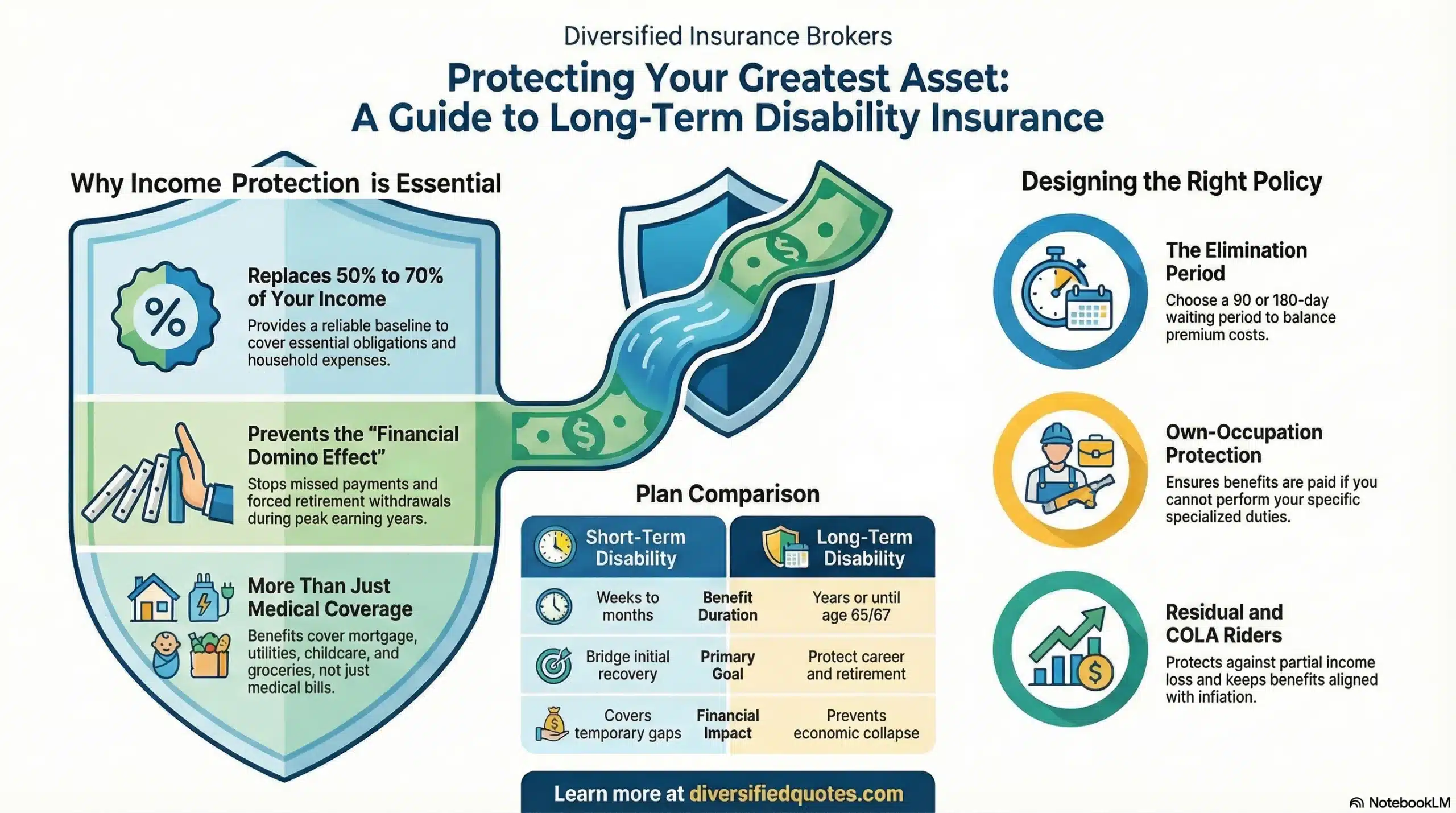
How much income protection a delivery driver actually needs depends on documented income, household obligations, and the gap between workers’ comp coverage where it applies and actual household financial requirements during a disability. The elimination period should reflect actual emergency reserves — a 90-day elimination period for a driver with three months of saved reserves produces lower annual premiums without leaving the household unprotected. An own-occupation definition covering delivery driving as the specific occupation protects against the any-occupation transition that could deny benefits when a delivery driver cannot drive but could theoretically perform a desk job. The residual disability benefit addresses partial disability — a back condition allowing some but not full driving days during recovery. The interaction between short and long-term structures is important for delivery workers whose vehicle accident scenarios range from recoverable fractures to permanent spinal disability. The future increase option protects coverage growth as income grows. Cost of living adjustment maintains real purchasing power across a multi-year disability. Coverage for drivers with prior back or injury histories is available through independent broker channels. High-risk and modified coverage options serve drivers whose health history creates underwriting complexity. No-exam coverage provides a streamlined path for healthy drivers who prefer rapid approval. Getting the best available rates means applying before back or injury histories accumulate. Why early-career delivery drivers need income protection is answered by the daily vehicle accident exposure: every shift on the road is a shift during which a crash could produce a disability — and the younger and healthier the driver when coverage is established, the lower the premium and the broader the terms. Why delivery drivers ultimately choose to act comes down to a simple calculation: the annual cost of the policy against the income the household would lose without it. Whether coverage is worth the cost for any delivery worker is answered by calculating how many delivery shifts the annual premium represents — typically a matter of days — versus the months or years of income the policy protects. Guarantee issue coverage provides an access point for delivery workers whose health history creates standard underwriting challenges.
Get Your Courier and Delivery Driver Coverage Review
We compare occupational class assignments, vehicle accident coverage, and delivery income documentation across 100+ carriers to identify the protection that fits your delivery career.
Talk With an Advisor Today
Choose how you’d like to connect—call or message us, then book a time that works for you.
Schedule here:
calendly.com/jason-dibcompanies/diversified-quotes
Licensed in all 50 states • Fiduciary, family-owned since 1980
FAQs: Disability Insurance for Courier and Parcel Delivery Workers
I deliver for a gig app — does any disability coverage apply to me if I’m hurt on the job?
Generally no — and this is one of the most significant protection gaps in the modern American workforce. App-based delivery platforms classify their drivers as independent contractors rather than employees, which means the platform’s workers’ compensation obligations — in the vast majority of states — do not extend to gig delivery drivers for their own injuries or illnesses. If you are in a vehicle accident while on a delivery run, develop a back condition from sustained heavy package lifting, or experience a health event that prevents continued delivery work, your platform affiliation provides no income replacement of any kind. The income loss is complete, with no automatic floor.
For gig delivery workers, individual disability insurance — purchased personally and documented from platform delivery income records — is not a supplement to something else. It is the entire income protection system. The income basis for underwriting uses documented earnings from 1099-reported platform income or business income records across two to three years, and the maximum approvable monthly benefit is calculated from that average. Whether disability insurance payments are taxable for a gig delivery worker: premiums paid personally with after-tax income generally produce tax-free disability benefits — the full monthly benefit reaches the household without income tax reduction during a disability period when platform income has stopped completely.
Does disability insurance cover a back injury from lifting packages on a delivery route?
Yes — individual disability insurance covers disability arising from back injuries, including both acute injuries from a specific lifting incident and the chronic cumulative back conditions that develop from years of repetitive heavy package lifting on delivery routes. BLS data documents overexertion — lifting, pushing, carrying — as the single largest cause of serious nonfatal occupational injuries in the American workforce, and delivery driving is among the occupations most heavily exposed to this mechanism. The disability insurance policy covers qualifying disability from back conditions regardless of whether the condition arose from a single dated incident or from the gradual cumulative loading of delivery route lifting over years of service.
The distinction between individual disability insurance and workers’ compensation for chronic back conditions is important for delivery workers: workers’ comp frequently disputes the occupational causation of gradual-onset back conditions on the grounds that the condition cannot be tied to a specific datable incident, even when daily heavy lifting has obviously contributed. Individual disability insurance pays when the qualifying medical condition prevents the driver from performing the material duties of delivery work — regardless of how or when the condition developed. The residual disability benefit specifically addresses the scenario where a back condition limits a delivery driver to fewer hours or lighter route work during recovery — partial disability producing partial income loss that a residual benefit compensates proportionally, rather than requiring complete inability to work before any benefit activates. A second opinion on any disability insurance offer confirms whether the policy’s own-occupation language and residual benefit provisions are structured appropriately for the specific physical demands of delivery route work.
I work for a carrier with group disability insurance — is individual supplemental coverage still worthwhile?
Employer group disability coverage for delivery carrier employees — where it exists — provides a benefit baseline but typically with the same structural limitations that affect all group plan participants. The monthly benefit cap is the most common inadequacy: group plans typically cap benefits at a fixed dollar ceiling — often $5,000 to $10,000 per month — that may leave a shortfall for drivers earning above the cap level, and all group plans calculate their stated replacement percentage from base wages, excluding overtime and any supplemental pay that may represent a meaningful portion of actual delivery worker take-home income. Overtime pay is particularly relevant for delivery workers whose actual gross income regularly exceeds base wage through overtime hours, and that overtime income receives zero protection from a standard group LTD plan.
The 24-month any-occupation definition transition in most group plans is also consequential for delivery workers: a driver whose back condition prevents delivery driving but who could theoretically perform a desk job may lose group plan benefits at the 24-month mark on the grounds that alternative employment is theoretically possible. An individual own-occupation policy maintaining the delivery driving occupation standard through age 65 prevents this transition from terminating benefits for a driver who cannot perform their specific delivery work. The mental health benefit cap — typically 24 months in group plans — matters specifically for delivery workers given the documented elevated occupational stress rates in courier research. Individual supplemental coverage addresses all three of these structural limitations: benefit amount gap, definition transition, and mental health cap, together filling the spaces the group plan’s design specifically leaves open. Why delivery workers supplement group coverage with individual policies is answered by mapping these three specific gaps against the household’s actual financial obligations during a disability period.
How does my variable delivery income get documented for disability insurance?
Income documentation for delivery workers varies depending on employment structure. Employed carrier drivers use W-2 records and may be able to include documented overtime pay in the income basis for their benefit calculation, depending on the carrier’s guidelines for variable W-2 income documentation. Independent delivery contractors who receive 1099 income from carrier contracts use Schedule C and business income records to establish net earned delivery income. Gig delivery workers who earn from app-based platforms document income from platform payment records, 1099-K forms where applicable, and bank records showing platform income deposits — establishing the annual average earned from delivery work as the benefit calculation basis.
The multi-year averaging approach — using two to three years of income documentation rather than a single year — is particularly important for delivery workers with seasonal volume patterns or income that fluctuates based on platform availability, delivery demand, or route assignments. A single exceptional year should not be used as the sole basis for benefit sizing, because the carrier will average it against other years in any event. Documenting all earned delivery income comprehensively and consistently — including all platform income from any delivery services, fuel reimbursements that represent taxable income, and any route contract income — produces the most complete and accurate income basis rather than inadvertently understating the benefit ceiling available. Coverage for delivery workers with prior injury histories is available through independent broker channels; prior back or vehicle accident injury histories generate exclusion riders for specific documented conditions but do not prevent coverage for all other disability causes.
I’m a new delivery driver starting my career — is there a best time to get disability insurance?
Early in a delivery driving career — before the back conditions, cumulative musculoskeletal histories, and vehicle accident records that delivery work can produce over years of driving accumulate — is the most financially advantageous time to establish disability insurance. Premium rates are age-rated, meaning earlier purchase locks in lower annual premiums for the full duration of the policy. A driver who purchases at 22 or 25 locks in a substantially lower premium rate than one who waits until 35 or 40 — for a policy that protects delivery income through the full working career to age 65.
The health record dimension adds equal urgency: a delivery driver whose back, spine, and body are genuinely healthy at career start can purchase comprehensive disability insurance — including full coverage for back injuries, vehicle accident injuries, and all other qualifying conditions — without the exclusion riders that documented prior injuries generate at underwriting. Every year of delivery driving is a year during which the occupational health record potentially builds; the window to purchase comprehensive coverage without musculoskeletal exclusions closes as that record accumulates from daily lifting and driving demands. Why early-career delivery workers need income protection before injuries accumulate is answered by the statistics: BLS documents overexertion and vehicle accidents as the two largest injury categories in the American workforce. Starting coverage early — before either category has produced a claim history — is when the broadest possible protection is available at the lowest possible cost. The future increase option allows benefit increases as delivery income grows without new medical underwriting, preserving the favorable early-career health-based terms through the full income trajectory.
Does disability insurance cover health conditions that aren’t directly from a delivery accident?
Yes — and this is one of the most important coverage dimensions for delivery workers to understand, because the majority of long-term disabling conditions are illness-based rather than accident-caused. Individual disability insurance covers qualifying disability from any medical cause — including cancer, cardiac events, stroke, neurological conditions, and any other serious health event that prevents the insured from performing delivery work — regardless of whether the condition is related to delivery driving. This is particularly relevant for courier and delivery workers given the peer-reviewed research specifically documenting an elevated cardiovascular and stroke risk profile for the courier occupation compared to both office workers and the general working population.
Workers’ compensation provides zero coverage for illness-based disability regardless of employment history — the cardiac event that prevents a delivery driver from working is entirely outside the workers’ comp framework. For gig and independent delivery workers with no employer benefits, illness-based disability produces complete income loss with no floor of any kind. For employed delivery carrier workers with group LTD access, the group plan provides the standard illness coverage baseline but with the definition transition, benefit cap, and mental health limitations discussed elsewhere. Options for delivery workers with prior health conditions — prior cardiac history, treated hypertension, managed conditions — are available through independent broker comparison of carrier underwriting guidelines. Prior health conditions that fall into the elevated risk categories documented in courier research may receive specific scrutiny at underwriting, but most managed and currently stable conditions produce partial exclusion riders rather than outright declines, making coverage availability broader than many delivery workers assume.
About the Author:
Jason Stolz, CLTC, CRPC, DIA, CAA and Chief Underwriter at Diversified Insurance Brokers (NPN 20471358), is a senior insurance and retirement professional with more than 25 years of real-world experience helping individuals, families, and business owners protect their income, assets, and long-term financial stability. As a long-time partner of the nationally licensed independent agency Diversified Insurance Brokers, Jason provides trusted guidance across multiple specialties—including fixed and indexed annuities, long-term care planning, personal and business disability insurance, life insurance solutions, Group Health, Travel Medical and Evacuation Insurance, and short-term health coverage. Diversified Insurance Brokers maintains active contracts with over 100 highly rated insurance carriers, ensuring clients have access to a broad and competitive marketplace.
His practical, education-first approach has earned recognition in publications such as VoyageATL, and contributions from his agency featured in Kiplinger and GoBankingRates— highlighting his commitment to financial clarity and client-focused planning. Drawing on deep product knowledge and years of hands-on field experience, Jason helps clients evaluate carriers, compare strategies, and build retirement and protection plans that are both secure and cost-efficient. Visitors who want to explore current annuity rates and compare options across multiple insurers can also use this annuity quote and comparison tool.
Explore More Disability Insurance Options: Browse our complete guide to Disability Insurance for Transportation, Maritime & Hazardous Occupations — covering truck drivers, flight attendants, merchant marines, divers, chauffeurs & drivers from 100+ carriers.
Last Reviewed: June 8, 2026 |
Reviewed by: Jason Stolz, CLTC, CRPC, DIA, CAA
Chief Underwriter, Diversified Insurance Brokers, Inc. | NPN: 20471358 | Diversified Insurance Brokers, Inc. — Licensed in all 50 states
Fact Checked by: Tonia Pettitt, CMIP©
Medicare Specialist, Diversified Insurance Brokers, Inc. | NPN: 14374308 | Diversified Insurance Brokers, Inc. — Licensed in all 50 states
Did you find this content helpful? Leave us a Google review — it helps others find trustworthy guidance too.
Editorial Standards: Diversified Insurance Brokers maintains rigorous editorial standards to ensure accuracy, clarity, and independence in all content. Learn more about our editorial standards and commitment to transparency.
