
Disability Insurance for Brewmasters and Brewery Professionals
As an Independent Disability Insurance Broker, we have access to exclusive discounts and negotiated pricing most captive agents can’t offer — see the full breakdown near the end of this page.
Disability Insurance for Brewmasters and Brewery Professionals

Jason Stolz CLTC, CRPC, DIA, CAA
Brewing is widely understood as a craft — but inside any working brewery, from a small taproom operation to a regional production facility, it is also a physically demanding manufacturing environment that OSHA specifically identifies as highly hazardous due to the use of hot liquids, pressurized vessels, caustic chemicals, CO2 and nitrogen gas accumulation in confined spaces, fast-moving machinery, and persistently wet and slippery floors. Bureau of Labor Statistics data places brewery injury rates among the elevated categories of food and beverage production, and for brewmasters, head brewers, cellar operators, and packaging professionals whose careers depend on the physical capacity to lift, clean, operate, and troubleshoot complex brewing systems, a disability event does not only interrupt work — it eliminates the specialized income that may have taken years of apprenticeship and craft development to build. Disability insurance for brewery professionals is the income protection structure that fills the gap between the occupational risk of daily brewing operations and the workers’ compensation and group plan coverage that most craft brewery environments provide inadequately or not at all.
At Diversified Insurance Brokers, Jason Stolz, CLTC, CRPC, DIA, CAA works with brewmasters, head brewers, assistant brewmasters, cellar managers, brewery owners, and other craft beverage professionals to build income protection structures that reflect the real financial architecture of craft brewing careers — from the entry-level brewer learning the trade at a small operation with no employer-provided disability plan, to the experienced brewmaster at a regional craft brewery whose knowledge and recipe development are irreplaceable to the business, to the brewery owner whose personal disability would simultaneously eliminate their income and threaten the overhead structure of the entire operation. Brewery professionals occupy a unique position in the disability insurance market: their work combines the physical hazards of food and beverage manufacturing with the creative and intellectual value of highly specialized craft expertise — a combination that requires careful policy design to protect comprehensively.
Compare Disability Insurance for Brewmasters and Brewery Professionals
We review coverage options across 100+ carriers and identify the policy structure that fits your brewing income, business structure, and occupational risk profile.
Request Disability Insurance OptionsBrewery Occupational Hazards, Disability Risk, and the Income Protection Gap
| Hazard Category | Primary Source | Resulting Disability Risk | Workers’ Comp Coverage | DI Coverage Gap |
|---|---|---|---|---|
| Heavy lifting and ergonomic strain | Kegs (full half-barrel kegs weigh approximately 160 lbs), grain sacks, heavy brewing vessels, and packaging materials handled repeatedly throughout production | Herniated disc, chronic lower back syndrome, rotator cuff tear, knee strain from sustained physical production work | Covers employees for acute work incidents; owner-operators excluded unless specifically elected; cumulative conditions frequently disputed | Full gap for brewery owners; significant gap for chronic and degenerative musculoskeletal conditions for all workers |
| CO2 and confined space hazards | CO2 produced during fermentation accumulates in tanks, cellars, and low-lying spaces; permit-required confined space entry into fermentation vessels and grain silos | Asphyxiation risk, hypoxic brain injury, neurological disability from oxygen-deficient atmosphere exposure | Acute work incidents covered for employees; owner-operators excluded; neurological disability from exposure is illness-based | Full gap for owner-operators; permanent neurological disability from exposure outside illness-based workers’ comp coverage |
| Caustic chemical and thermal burns | Caustic soda (NaOH) and other cleaning agents used for vessel and line cleaning; hot wort and steam during brewing operations | Chemical burns to skin and airways, hot liquid burns, respiratory sensitization from cleaning agent vapors | Acute chemical burn incidents covered for employees; chronic respiratory sensitization from cleaning agent exposure disputed | Significant gap for gradual-onset respiratory sensitization; owner-operators unprotected entirely |
| Noise-induced hearing loss | OSHA-regulated noise levels from brewing equipment, CO2 carbonation systems, packaging lines, and refrigeration systems operating above 85 decibels | Permanent occupational hearing loss; tinnitus; audiological disability affecting work performance and communication | Occupational disease provisions for employees; gradual-onset hearing loss often falls outside acute-incident workers’ comp claims framework | Gap for hearing loss-based disability; illness-based audiological conditions outside workers’ comp for owners |
| Slip, fall, and wet floor incidents | Persistently wet brewery floors from hose-down cleaning, spills, and condensation; OSHA-identified as a primary brewery hazard | Head trauma, spinal fracture, limb fractures, shoulder and wrist injuries from falls on production floors | Covers employees for acute work-related falls; owner-operators excluded without specific election | Full gap for brewery owner-operators; LTD gap for employees during extended recovery exceeding group plan benefit period |
| Illness-based disability (non-occupational) | Cancer, cardiac events, neurological conditions, and other serious health events unrelated to any specific workplace incident | Extended inability to perform production brewing, cellar management, quality control, and physical brewery operations | Not covered — workers’ comp applies only to work-related injury and occupational disease | Approximately 90% of long-term disabilities are illness-based; complete gap for all workers |
The table maps the disability exposure landscape for brewery professionals across physical, chemical, atmospheric, and illness-based pathways — establishing that the disability risk in a working brewery extends well beyond the dramatic events that workplace safety discussions tend to focus on. The approximately 90 percent of long-term disabling conditions that are illness-based apply to brewmasters and brewery professionals at the same population rates as any other worker, meaning the most probable disability pathway by statistical likelihood is not a CO2 incident or a chemical burn but a cancer diagnosis, a cardiac event, or a serious degenerative condition. Disability insurance by occupation provides the framework for evaluating both the occupational-specific hazards and the population-baseline illness risk that every brewery professional carries simultaneously.
The Physical Demands of Craft Brewing and Their Long-Term Disability Implications
The physical demands of brewing production — particularly at the craft and small-regional brewery level where automation is limited and manual labor is central to daily operations — create a musculoskeletal loading profile that is more comparable to a manufacturing trade than to a food science or culinary occupation. Brewers spend production days lifting and maneuvering kegs that weigh approximately 160 pounds when full, carrying and cutting open grain sacks weighing 50 pounds or more, cleaning vessels and tanks in repetitive scrubbing and hosing operations, and maintaining production equipment in conditions that frequently involve crouching, overhead work, and sustained standing on concrete brewery floors. OSHA specifically identifies ergonomic hazards as a recognized hazard in breweries under the General Duty Clause, and brewery operators have received citations for failure to mitigate the dangers associated with heavy lifting and improper lifting tasks.
The cumulative consequence of this physical loading across a brewing career is the same category of musculoskeletal pathology that affects any worker in a physically demanding manual production role: herniated discs, chronic lower back syndrome, rotator cuff conditions, and knee degeneration that develop progressively and eventually reach a threshold at which continued production work is physically impossible without surgical intervention. A brewmaster who undergoes lumbar surgery following years of keg and grain handling faces a recovery period measured in months — a period during which the brewing operation is disrupted, the specialized expertise the brewmaster represents is unavailable, and the income that production generates is interrupted. Long-term disability insurance addresses the scenarios where that recovery extends beyond weeks and months into a period that requires sustained income replacement. Short-term disability addresses the acute recovery window following injury or surgery before long-term coverage would activate — filling the gap that most brewery professionals discover only after the disability has already occurred.
Bureau of Labor Statistics data documented a non-fatal injury rate of approximately 4.4 injuries per 100 employees in breweries in recent tracking periods — a rate elevated above the national average for all industries and reflective of the genuinely hazardous physical environment that brewing operations represent. For the approximately 60,000 employees in the U.S. beer industry at that time, this translated to thousands of documented workplace injuries annually. For brewmasters and brewery owners operating smaller craft operations where a single injury affecting the key production professional has outsized consequences for the entire business, the disability risk is not a remote statistical abstraction but a realized financial event that the craft brewing industry experiences regularly.
CO2, Confined Spaces, and the Chemical Hazards of Brewery Operations
Brewing operations produce carbon dioxide as a natural byproduct of fermentation — CO2 that accumulates in fermentation tanks, cellar areas, low-lying floor spaces, and any enclosed areas where fermentation is active. OSHA’s brewery safety documentation specifically addresses permit-required confined spaces in brewing operations, including fermentation vessels and grain silos, requiring written confined space entry programs, atmospheric monitoring, and emergency rescue planning before any entry. The CO2 hazard in a brewing environment is insidious because CO2 is colorless and odorless, making its accumulation invisible and the transition from safe to dangerous atmosphere rapid and without warning. Brewery professionals who work in or near fermentation areas are routinely exposed to an atmospheric hazard that most other occupations do not encounter.
The chemical hazard profile of brewery cleaning and sanitation operations is a separate and equally significant disability pathway. Caustic soda solutions used for vessel and line cleaning, acidic cleaning agents, and the peracetic acid-based sanitizers standard in craft brewing all carry skin and respiratory exposure risks that can produce chemical burns, airway sensitization, and in cases of chronic repeated exposure, occupational respiratory conditions. OSHA’s hazardous chemical regulations apply to brewery cleaning chemical storage and handling, reflecting the seriousness of the chemical exposure risk that daily sanitation work creates for brewery production professionals. A brewer who develops occupational asthma or respiratory sensitization from repeated cleaning chemical vapor exposure faces a disability that is entirely illness-based under the workers’ comp framework — generating no benefit despite its clear occupational origin, and potentially eliminating the ability to continue working in the chemical environment that every brewery requires. This is precisely the category of disability that disability insurance for high-risk occupations is designed to address — conditions that arise from occupational exposure but fall outside the workers’ comp system because they develop gradually rather than from a single discrete incident.
Workers’ Compensation and Brewery Professionals — The Coverage That Falls Short
Workers’ compensation provides the baseline income protection for employed brewers — covering approximately two-thirds of wages up to state maximums for work-related injuries and occupational diseases. For a cellar operator or packaging employee at a brewery who sustains an acute keg-handling back injury, workers’ comp activates as intended. But for the significant portion of the craft brewing workforce whose employment structure or health event does not fit cleanly within the workers’ comp framework, the gaps are substantial.
The first gap is the ownership and self-employment gap. The craft brewing industry has a significant population of owner-operators — people who founded their brewery, own the business entity, and perform production work alongside any employees they may have. Sole proprietors and LLC members who have not specifically elected workers’ comp coverage for themselves carry zero workers’ comp protection for their own injuries. The person whose disability most threatens the brewery’s survival — the founding brewmaster whose recipes, customer relationships, and institutional knowledge represent the brewery’s core value proposition — is frequently the most unprotected person in the operation. Understanding why brewery professionals buy disability insurance begins with this structural reality.
The second gap applies universally: workers’ compensation covers only work-related injuries and occupational diseases, not illness-based disability. The cardiac event, the cancer diagnosis, the neurological condition — the health events that account for approximately 90 percent of long-term disabling conditions — generate no workers’ comp benefit regardless of how comprehensive the employer’s policy is. Whether disability insurance is worth the cost for a brewery professional is most directly answered by calculating what twelve months of eliminated brewing income would cost the household against the annual premium of the policy designed to replace it.
The third gap affects employed brewery professionals who have group long-term disability coverage through their employer: most group plans cap mental and nervous condition benefits at 24 months, transition from own-occupation to any-occupation definitions after 24 months, end entirely when employment ends, and cap monthly benefits at levels that may not reflect a senior brewmaster’s actual earnings. Individual disability insurance addresses all four of these structural group plan limitations — providing own-occupation protection that persists beyond 24 months, portable coverage that follows the professional rather than the employer, and benefit capacity calibrated to actual income rather than a plan formula. For self-employed brewery owners with no group plan baseline at all, individual disability insurance is the entire protection structure rather than a supplement.
Own-Occupation Coverage — Why the Definition Matters for Brewmasters
The disability definition in a policy determines whether a back condition that prevents the physical demands of production brewing but theoretically permits a desk job generates a benefit payment or a claim denial. For a brewmaster whose career value derives from a combination of specialized brewing knowledge and the physical capacity to perform hands-on production work, this distinction is not theoretical — it is the policy language that determines real-world financial protection when a claim occurs.
A true own-occupation disability insurance policy pays benefits when the insured cannot perform the material and substantial duties of their specific occupation — brewmaster or brewery professional — even if theoretically capable of other work. A brewmaster who sustains a serious back injury preventing the lifting, tank work, and physical production operations the role requires receives benefit payments under an own-occupation policy regardless of whether they could theoretically work in a sedentary role. The policy recognizes the economic reality that a brewmaster’s income derives from a specific set of skills and knowledge that the disability has compromised, and that this represents a genuine economic disability independent of what other employment might theoretically be possible.
Understanding how short-term and long-term disability interact within a complete coverage architecture is equally important for brewery professionals evaluating their overall protection. The 24-month own-to-any transition common in group plans is a particularly dangerous provision for a brewmaster who sustains a serious spinal injury — at exactly the point where the disability has proven long-term, the benefit standard shifts to one requiring near-total incapacity to continue paying.
Business Overhead Expense Coverage for Brewery Owners
A brewery owner-operator who becomes disabled faces a two-layer financial crisis that personal income replacement alone cannot address. The personal layer is the loss of the owner’s earned income. The business layer is the continuation of fixed overhead obligations — brewery lease or mortgage, equipment financing and maintenance contracts, employee payroll for any staff, utilities and refrigeration costs, supply and ingredient commitments, licensing fees, and marketing obligations — that do not pause because the founding brewer is injured or ill. Business overhead expense disability insurance is the policy structure specifically designed to fund this second layer during the owner’s qualifying disability.
The BOE structure pays a monthly benefit calibrated to the actual fixed operating costs of the brewery during the disability period — preserving the business infrastructure, paying the staff, and meeting the overhead obligations that allow the brewery to resume operations when the owner recovers. For a craft brewery that has built customer relationships, distribution accounts, taproom revenue, and a brand identity around its founding brewer’s expertise and recipes, maintaining that infrastructure during a disability period is the difference between a temporary setback and a permanent business failure. The appropriate BOE benefit amount is determined by analyzing the actual monthly overhead structure of the specific operation — a number that varies enormously from a small taproom brewery with minimal staff and modest fixed costs to a regional production brewery with significant equipment financing and multiple employees.
Occupational Class, Income Documentation, and Policy Design for Brewery Professionals
Brewery professionals occupy a middle tier in most disability insurance carriers’ occupational class schedules — a classification reflecting the physical demands, chemical exposure, and hazardous environment of brewing production, balanced against the supervisory and technical knowledge components of brewmaster and head brewer roles. The specific classification varies by carrier and by the specific role being insured: a brewmaster whose work is primarily technical and supervisory may receive a more favorable class than a production brewer or cellar operator whose work is primarily physical. Identifying which carriers classify brewery roles most favorably for the specific position being insured is one of the most important functions of working with an independent broker who accesses the full market rather than a single carrier’s classification schedule.
For brewery owners and 1099-earning brewing professionals, income documentation through tax returns and business financials establishes the income basis for underwriting. Brewmasters’ compensation varies significantly by brewery size — Brewers Association salary data places brewmaster compensation at approximately $112,000 annually at larger production breweries and significantly lower at smaller operations, while head brewers and assistant brewmasters typically earn in the $50,000 to $75,000 range. How much disability insurance a brewery professional actually needs depends on this documented income level, the overhead obligations requiring BOE coverage, and the household’s financial obligations during a disability period.
The elimination period, benefit period, and rider selections follow the same framework that applies to any production professional. The elimination period should reflect actual financial reserves — a 90-day elimination period suits those with adequate savings to cover three months of expenses, while a shorter period provides faster income floor activation for those with limited liquidity. The rider package available on individual policies — including the future insurability option that allows benefit increases as career income grows without new medical underwriting, and the cost of living adjustment rider that protects real purchasing power across a multi-year disability — represents meaningful additions to the core policy structure for a brewing career with income growth potential.
Pre-Existing Conditions and Coverage Options for Brewery Professionals With Prior Injuries
Brewery professionals who approach the disability insurance market with a prior back injury, a documented respiratory condition, or a history of chemical exposure treatment will find that underwriting outcomes vary significantly by carrier. The standard outcome for most documented prior conditions is a partial exclusion rider — coverage provided for all causes of disability except the specifically excluded pre-existing condition — a structure that still delivers meaningful protection against the full range of health events a brewery professional faces. Disability insurance with pre-existing conditions is available through independent broker channels, and no-exam disability insurance options serve brewery professionals whose health history makes traditional fully underwritten applications uncertain. Working with an independent disability insurance broker who understands how brewery occupation health histories are evaluated across the carrier market consistently produces better coverage outcomes than a direct single-carrier application for any brewery professional with a complex health or occupational history.
Get Your Brewery Professional Disability Insurance Review
We compare occupational class assignments, benefit structures, and BOE options across 100+ carriers to identify the coverage architecture that fits your brewing income and business obligations.
Request Disability Insurance Options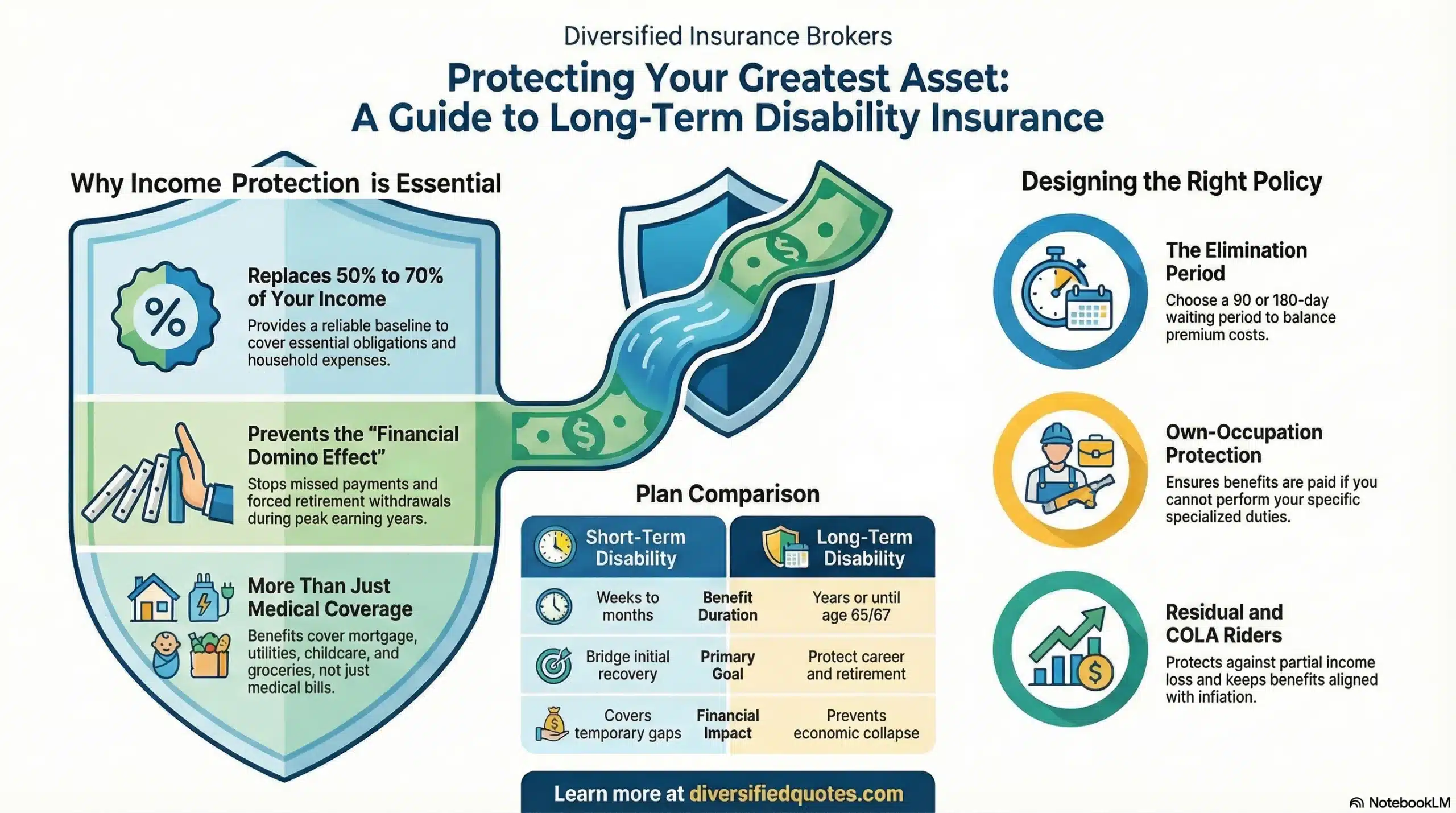
Talk With an Advisor Today
Choose how you’d like to connect—call or message us, then book a time that works for you.
Schedule here:
calendly.com/jason-dibcompanies/diversified-quotes
Licensed in all 50 states • Fiduciary, family-owned since 1980
FAQs: Disability Insurance for Brewmasters and Brewery Professionals
Can a brewmaster qualify for individual disability insurance given the physical hazards of brewery work?
Yes — brewmasters and brewery professionals can qualify for individual disability insurance through carriers that underwrite production-based occupations in the food and beverage manufacturing sector. The occupational class assigned to brewery work reflects the physical demands, chemical exposure, and environmental hazards of the role — placing most production brewing positions in the middle tiers of most carriers’ classification schedules. Brewmasters and head brewers with significant supervisory and technical components to their roles may receive more favorable classifications at some carriers than purely production-focused cellar or packaging roles, because the blend of physical production work and technical expertise affects how carriers evaluate the overall occupational risk profile.
The key is that occupational class classifications for brewing occupations vary between carriers — meaning one carrier’s assessment of a brewmaster’s risk profile may produce meaningfully different premium rates and maximum benefit amounts than another carrier’s assessment of the same role. A residual disability benefit provision is particularly valuable for brewery professionals, because the realistic disability scenarios in brewing — a back surgery requiring reduced production hours during recovery, a shoulder condition limiting lifting capacity — frequently result in partial rather than total disability. A policy with residual benefits pays a proportional benefit based on actual income loss from partial disability, addressing the most common realistic recovery trajectory rather than only the total disability endpoint.
Are disability insurance benefits taxable for a brewmaster or brewery owner?
Tax treatment depends on how premiums are paid. For brewery owners, founding brewmasters, and other self-employed brewing professionals who purchase individual disability insurance and pay premiums with after-tax personal income, the monthly benefits received during a qualifying disability are generally received income-tax-free. This means the full benefit amount reaches the household without income tax reduction — making the coverage financially more effective than a gross benefit comparison suggests. Whether disability insurance payments are taxable is a meaningful planning consideration when determining how large a benefit amount is needed to replace actual take-home income during a disability period.
For brewery employees whose employer pays some or all of disability insurance premiums — as may be the case for brewmasters at larger regional or national craft operations that offer benefits packages — the benefits received during a disability claim are typically taxable as ordinary income, effectively reducing the real purchasing power of the benefit by the applicable tax rate. Self-employed brewery owners who deduct disability insurance premiums as a business expense should also confirm the specific tax treatment with a tax professional, as this deduction may affect the taxability of benefits at claim time. Planning the correct benefit amount requires accounting for the actual after-tax income that will be received during a disability period, not just the gross benefit specified in the policy.
If I develop a respiratory condition from brewery cleaning chemicals, does disability insurance cover it?
Yes — individual disability insurance covers disability arising from respiratory illness, including conditions that developed from occupational chemical exposure, as long as the condition meets the policy’s definition of disability and no specific pre-existing respiratory exclusion applies. The fundamental advantage of individual disability insurance over workers’ compensation for this specific scenario is that individual DI does not require the condition to have arisen from a single discrete workplace incident — it requires the condition to meet the disability definition, which an occupational respiratory condition severe enough to prevent continued work in a chemical-exposure environment typically does.
Workers’ compensation, by contrast, often struggles to compensate gradually developing occupational diseases like chemical sensitization and occupational asthma because these conditions develop cumulatively over time rather than from a specific dated incident — making causation difficult to establish and claims frequently disputed. Brewery cleaning chemicals including caustic soda, sanitizing acid solutions, and peracetic acid carry documented respiratory exposure risks that OSHA addresses under its hazardous chemical standards. A brewer who has never had a formal respiratory diagnosis but who is beginning to experience symptoms should discuss this with a healthcare provider and should prioritize securing disability insurance before any formal diagnosis is documented — because a formal respiratory diagnosis may trigger an exclusion rider for that condition at underwriting, reducing the coverage available. High-risk disability insurance options exist for those with existing documented respiratory histories.
I am the head brewmaster at our craft brewery — am I considered a key person for insurance purposes?
In most craft brewery operations, the head brewmaster or founding brewer is precisely the kind of key person that key person disability insurance is designed to protect. A key person is an employee or owner whose disability would create a financial loss to the business beyond their personal income loss — because their skills, knowledge, relationships, or production capacity are not readily replaceable in the short term without significant cost and disruption to the operation. For a craft brewery whose recipes, production quality, taproom reputation, and distribution relationships are tied to the founding brewer’s expertise, a disability event creates a business financial loss that extends well beyond any individual salary.
Key person disability insurance pays a benefit to the business entity rather than to the individual — providing the business with capital to hire interim production help, compensate for revenue disruption, or maintain operations during the brewmaster’s disability period. This is structurally different from the personal disability income policy that replaces the brewmaster’s personal income: key person coverage addresses the business impact, while personal DI addresses the household impact. For craft breweries where the brewmaster is both an owner and the primary production driver, both layers of coverage are typically warranted and should be evaluated together to ensure the overall protection architecture is complete.
I’m a younger brewer just starting my career at a small craft operation — is it too early to think about disability insurance?
It is never too early in a brewing career to purchase disability insurance — and early-career purchase is actually the most financially advantageous timing for three compounding reasons. First, disability insurance premiums are age-rated, meaning the younger the applicant at issue, the lower the annual premium locked in for the policy’s full duration. A brewer who purchases coverage at 26 locks in a substantially lower premium rate for a policy that can protect their income all the way to age 65 compared to one who waits until 38. Second, early-career purchase occurs when health history is cleanest — before the back injuries, shoulder conditions, and cumulative health events that a physically demanding brewing career produces over time. Securing coverage before those histories develop means no exclusion riders, no table ratings, and no restricted benefit terms. Why young and healthy workers need disability insurance is most simply answered by noting that the ability to buy comprehensive coverage without health restrictions exists only while the health is genuinely clean — and in a physically demanding trade, that window is finite.
Third, the future insurability rider available on most individual disability policies allows a brewer to increase their benefit amount as their career and income grow without new medical underwriting. An entry-level brewer earning modestly at a small operation today can purchase a modest benefit now at excellent health-based terms — and increase it to match the income of a senior brewmaster or head of brewing operations later, without submitting to new health screening at that stage. This rider effectively locks in the underwriting advantage of early purchase and carries it forward through the entire career income trajectory.
I got a disability insurance quote for my brewing role — how do I know if it is competitive?
A single quote from a single carrier tells you one carrier’s pricing for one occupational class assignment on one product structure — it does not tell you what the full market offers for the same coverage. Disability insurance premiums for production-oriented food and beverage occupations like brewery work vary across carriers because occupational classifications differ and product structures differ in ways that affect both premium cost and policy terms. A carrier that classifies a brewmaster role more favorably than another carrier produces lower premiums for identical benefit terms — and that difference is only discoverable through comparison, not through a single direct application.
Beyond pricing, the policy terms most worth comparing for brewery professionals are the disability definition — own-occupation versus modified — the residual benefit structure, the mental and nervous condition benefit period, the available benefit period options, and the elimination period flexibility. A policy that appears inexpensive but uses an any-occupation definition or lacks a residual benefit is not equivalent to one that costs more but provides genuine own-occupation protection and a residual benefit that addresses the partial disability scenarios most common in production brewing. A second opinion on your disability insurance quote through an independent broker who accesses the full carrier market costs nothing and regularly reveals either more competitive pricing, better policy terms, or both. The cost of being underinsured or uninsured at a disabling event exceeds any premium savings from accepting the first quote without comparison.
About the Author:
Jason Stolz, CLTC, CRPC, DIA, CAA and Chief Underwriter at Diversified Insurance Brokers (NPN 20471358), is a senior insurance and retirement professional with more than 25 years of real-world experience helping individuals, families, and business owners protect their income, assets, and long-term financial stability. As a long-time partner of the nationally licensed independent agency Diversified Insurance Brokers, Jason provides trusted guidance across multiple specialties—including fixed and indexed annuities, long-term care planning, personal and business disability insurance, life insurance solutions, Group Health, Travel Medical and Evacuation Insurance, and short-term health coverage. Diversified Insurance Brokers maintains active contracts with over 100 highly rated insurance carriers, ensuring clients have access to a broad and competitive marketplace.
His practical, education-first approach has earned recognition in publications such as VoyageATL, and contributions from his agency featured in Kiplinger and GoBankingRates— highlighting his commitment to financial clarity and client-focused planning. Drawing on deep product knowledge and years of hands-on field experience, Jason helps clients evaluate carriers, compare strategies, and build retirement and protection plans that are both secure and cost-efficient. Visitors who want to explore current annuity rates and compare options across multiple insurers can also use this annuity quote and comparison tool.
Explore More Disability Insurance Options: Browse our complete guide to Disability Insurance for Food, Hospitality, Arts & Entertainment — covering chefs, musicians, actors, bartenders, hospitality workers & entertainment professionals from 100+ carriers.
Last Reviewed: June 7, 2026 |
Reviewed by: Jason Stolz, CLTC, CRPC, DIA, CAA
Chief Underwriter, Diversified Insurance Brokers, Inc. | NPN: 20471358 | Diversified Insurance Brokers, Inc. — Licensed in all 50 states
Fact Checked by: Tonia Pettitt, CMIP©
Medicare Specialist, Diversified Insurance Brokers, Inc. | NPN: 14374308 | Diversified Insurance Brokers, Inc. — Licensed in all 50 states
Did you find this content helpful? Leave us a Google review — it helps others find trustworthy guidance too.
Editorial Standards: Diversified Insurance Brokers maintains rigorous editorial standards to ensure accuracy, clarity, and independence in all content. Learn more about our editorial standards and commitment to transparency.
