
Disability Insurance for Tavern and Bar Owners
As an Independent Disability Insurance Broker, we have access to exclusive discounts and negotiated pricing most captive agents can’t offer — see the full breakdown near the end of this page.
Disability Insurance for Tavern and Bar Owners

Jason Stolz CLTC, CRPC, DIA, CAA
Tavern and bar owners are among the most financially exposed business owners in America when disability strikes — and one of the groups least likely to have adequate protection in place. The business model of a neighborhood bar or tavern is built almost entirely around the owner’s daily presence, personality, client relationships, supplier negotiations, and hands-on operational decisions that cannot be delegated to a manager without material revenue loss. When the owner becomes disabled, the business does not run itself. Revenue typically declines within weeks, while the fixed costs that define a liquor-licensed establishment — rent, payroll, license fees, equipment, utilities — continue at full rate regardless of what is happening at the front of house.
Unlike an office-based professional practice that can be partially run through delegation during an owner’s absence, a bar’s revenue depends on the regulars who come because of the owner’s presence, the relationships that generate private events and group bookings, and the quality standards and operational attention that distinguish a thriving neighborhood establishment from a struggling one. A general manager hired to cover a disability can maintain basic operations — serving drinks, managing shifts, ordering inventory — but will rarely sustain the customer relationships and supplier negotiations that drive profitability. Businesses primarily engaged in hospitality services related to alcohol are among those with consistently elevated workers’ compensation exposure, reflecting the physical demands and hazard environment of the work environment.
At Diversified Insurance Brokers, we help bar and tavern owners build disability income strategies that address both dimensions of this risk: the personal income that disappears when the owner cannot work, and the business overhead that continues to accumulate regardless. Our resource on disability insurance for the self-employed covers the foundational income documentation and underwriting context that applies to all owner-operators, and our overview of disability insurance for high-risk occupations explains how the carrier market approaches elevated-risk occupational classifications like bar and tavern ownership.
Disability Insurance for Bar and Tavern Owners
Personal income protection and business overhead coverage for hospitality business owners who cannot afford extended absence.
Request a Disability Insurance QuoteCall 800-533-5969
The Physical Reality of Bar and Tavern Ownership
Most tavern and bar owners are not office-based business owners who happen to own a drinking establishment. They are physically present, physically active business operators who lift kegs, stock coolers, move furniture, stand on hard floors for 10 to 14 hour shifts, manage equipment malfunctions personally, and operate in an environment where slip-and-fall hazards are genuinely elevated by the combination of wet floors, alcohol service, and customer traffic at all hours. The disability risk for a bar owner is therefore not just the kind of illness or injury that disables anyone — it is concentrated in the specific physical and operational demands of the job.
Back injuries from repeated keg lifting are among the most common disabling events for bar owners, with a single keg weighing approximately 160 pounds and a busy establishment moving multiple kegs per shift. Shoulder injuries, knee injuries from extended standing on concrete floors, and slip-and-fall injuries from the wet and frequently congested floor environment are all legitimate and common disability scenarios for hands-on bar operators. Beyond the acute physical injury risk, bar owners also face the cumulative health effects of late-night shift work, noise exposure from music and crowd noise, secondhand smoke exposure in jurisdictions where indoor smoking is permitted, and the physical toll of sustained high-activity work schedules without the recovery time that most salaried workers receive.
There is also a genuine liability and stress dimension to bar ownership that creates elevated risk for mental health conditions. Managing staff, handling difficult customers, navigating liquor licensing compliance, and operating under the constant awareness of dram shop liability — the legal exposure for alcohol-related incidents involving customers who were served at the establishment — creates a sustained stress profile that contributes to anxiety disorders, burnout, and cardiovascular stress. A disability that originates in any of these physical or mental health pathways produces the same financial consequence: the owner cannot work, the business loses its driving force, and income stops while overhead does not.
Occupational Classification and What It Means for Bar Owners
Disability insurance carriers assign occupational classifications based on the nature of the work, the physical demands, and the injury and illness risk profile. Bar and tavern owners who are actively involved in daily operations — the norm for independent neighborhood establishments — typically receive Class 2 or Class 3 occupational ratings. This is meaningfully less favorable than the Class 4 or Class 5 ratings that office-based professionals receive, and it translates into higher premiums per dollar of monthly benefit and more limited access to certain policy provisions that are available at higher classes.
However, Class 2 and Class 3 disability insurance is not an unworkable product — it means thoughtful carrier selection and prioritization of the most important provisions for the specific risk profile matters more, not that adequate coverage is unavailable. Carriers vary significantly in how they underwrite bar and tavern owners specifically: some are more favorable on premium rates, others offer better provision access, and others specialize in hospitality business owner coverage with more competitive terms than the standard market rate suggests. This is precisely the scenario where working with an independent broker who can compare the full market — rather than a captive agent limited to a single carrier — produces materially better outcomes. Our resource on best independent disability insurance broker explains why carrier access matters most when occupational classifications constrain options.
The Two-Policy Solution: Personal Income and Business Overhead
| Coverage Type | What It Replaces | Typical Benefit Period | Who Receives Payment |
|---|---|---|---|
| Personal Disability Insurance | Owner’s personal income: mortgage, living expenses, family obligations, personal financial commitments | To age 65 or 67 depending on policy | Individual owner personally |
| Business Overhead Expense (BOE) | Fixed business operating costs: rent, staff wages, license fees, equipment leases, utilities, insurance premiums | 12–24 months — bridges recovery or orderly transition | Business entity — reimburses actual expenses |
| Without either policy | Owner chooses between funding personal bills or keeping business open — often cannot do both from reserves alone | Personal savings typically exhausted within 3–6 months | Crisis-driven choice with poor outcome either way |
For a bar or tavern owner, Business Overhead Expense (BOE) disability insurance can be as important as personal income replacement — possibly more so in the short term. A bar that closes during a disability because the owner cannot pay the staff or rent can lose its regulars, its licenses can lapse, and its neighborhood market position can erode permanently within the months it takes to recover and reopen. BOE coverage is specifically designed to prevent this scenario by reimbursing the eligible fixed operating costs during the disability period, keeping the business’s infrastructure intact and its staff employed while the owner recovers.
The BOE benefit period — typically 12 to 24 months — is designed around the realistic recovery timeline for most disabilities, not as a permanent revenue replacement. It is the bridge that preserves the business through the acute disability period so the owner returns to a functioning establishment rather than a closed or deteriorating one. For our full explanation of how BOE policies are structured and what expenses they reimburse, see our resource on disability business overhead expense coverage.
Income Documentation for Bar Owners
Bar and tavern owners face the same income documentation challenge as all self-employed business owners — insurable income for disability underwriting is calculated from documented net taxable income on personal and business tax returns, not from gross revenue or economic cash flow. For a bar with strong cash revenue, the documentation challenge can be amplified: carriers are only able to insure the income that appears on filed tax returns. An owner who reports conservative taxable income may find available benefit amounts limited relative to actual financial exposure.
Income structure also matters. Owners who take a formal salary from the business entity and also receive owner distributions may find that carriers calculate insurable income differently depending on whether the business is structured as a sole proprietorship, S-corporation, partnership, or LLC. Understanding which income components the specific carrier includes in their insurable income calculation — and ensuring that income is properly documented before application — prevents discovering these limitations after the fact. The alternative is applying without understanding the mechanics, receiving a lower benefit than expected, and discovering the gap at the worst possible moment. Our resource on disability insurance for 1099 workers covers the documentation mechanics for self-employed owner-operators.
Elimination Period Selection for Hospitality Business Owners
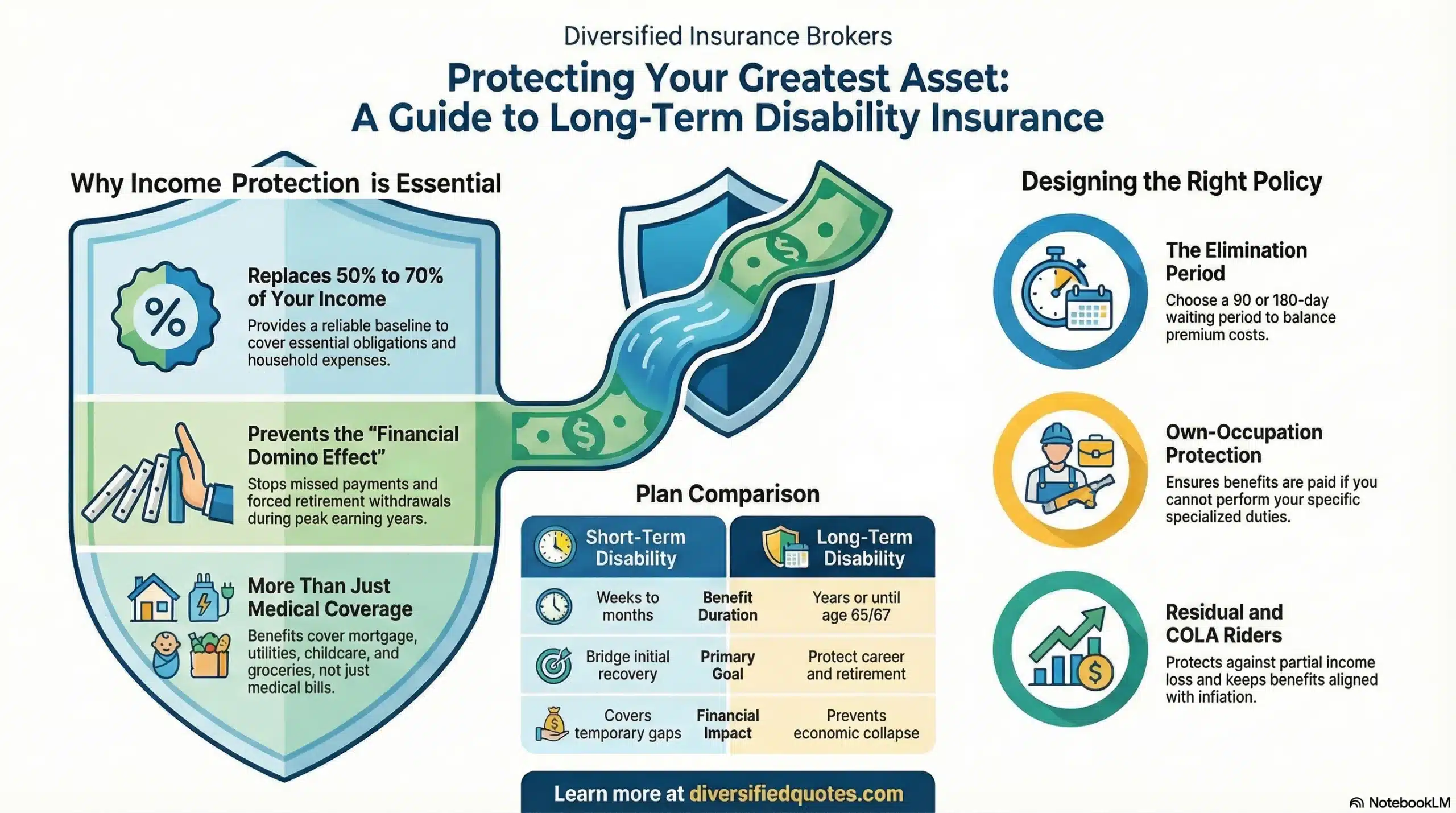
The elimination period — the waiting period between disability onset and first benefit payment — should be matched to actual business and personal cash reserves rather than selected by default. The standard 90-day elimination period works well for bar owners who maintain adequate liquid reserves covering three months of both personal obligations and business fixed costs. For owners with thinner reserves — a common situation in a cash-intensive, high-fixed-cost business model — a 60-day elimination period reduces the waiting period at higher premium cost, which may be a worthwhile trade-off when the alternative is a financial crisis during the first three months of disability.
Some bar owners use the BOE policy’s more immediate benefit (some BOE designs have shorter elimination periods than the personal DI policy) to cover the critical early weeks of a disability, then rely on the personal DI policy for the longer-duration income replacement. This coordination between the two policies’ elimination periods and benefit timing is worth thinking through at purchase rather than after a claim begins. Our resource on disability insurance elimination periods explained covers the decision framework across different reserve levels and risk tolerances.
The Residual Rider for Bar Owners Who Return at Reduced Capacity
A bar owner who returns to work after a disability — but at reduced capacity due to a back injury, a chronic condition, or a mental health recovery process — faces a real income reduction that the residual disability rider is specifically designed to address. If the owner can work four days per week instead of seven, or can manage the business but cannot perform the physical lifting and restocking duties that previously were part of the daily routine, income typically falls proportionally. The residual rider pays partial benefits based on the actual income reduction, bridging the gap between reduced working capacity and full previous income until the owner either fully recovers or the disability stabilizes.
For hospitality business owners whose income scales directly with the hours and quality of personal presence in the establishment, partial disability is arguably more likely as a first disability experience than complete inability to work. A back injury, a cardiac event during early recovery, or a significant mental health condition may all produce a partial disability scenario rather than total incapacity. Without the residual rider, these scenarios produce no benefit payment despite genuine financial harm. Our resource on residual disability insurance benefits explained explains the proportional calculation and why this provision is among the most frequently claimed in small business owner disability policies.
Workers’ Compensation Is Not Disability Insurance
Many bar and tavern owners assume that workers’ compensation covers their personal income if they are injured on the job. It does not — workers’ compensation covers employee injuries and illnesses, not owner income. Even in states where sole proprietors can elect to be covered under workers’ compensation, the benefit structure and benefit amounts are designed around employee wage replacement formulas, not business owner income protection. And workers’ compensation only covers work-related injuries and illnesses — heart disease, cancer, non-occupational injuries, and the full range of disabling conditions that are not caused by a specific workplace incident are entirely outside workers’ compensation coverage.
Personal disability insurance covers the bar owner’s income regardless of whether the disability is work-related, filling the critical non-occupational disability gap that workers’ compensation cannot reach. For bar owners who have also suffered injuries in the past that might create pre-existing condition exclusion riders in individual disability underwriting, our resource on high-risk disability insurance for those with medical challenges explains the impaired-risk placement process and what options typically remain available when health history complicates standard individual underwriting.
Protect Your Bar, Your Business, and Your Household
We build complete disability strategies for hospitality business owners — personal income protection and business overhead coverage coordinated into one complete plan.
Get Your Disability Insurance QuoteCall 800-533-5969
Related Disability Insurance Pages
Business continuity and income protection resources for hospitality business owners and self-employed operators.
Financial Protection Essentials
Business continuity tools, life insurance for business owners, and income protection resources for hospitality and food service operators.
Talk With an Advisor Today
Choose how you’d like to connect—call or message us, then book a time that works for you.
Schedule here:
calendly.com/jason-dibcompanies/diversified-quotes
Licensed in all 50 states • Fiduciary, family-owned since 1980
FAQs: Disability Insurance for Tavern and Bar Owners
What occupational class do bar and tavern owners receive?
Bar and tavern owners who are actively involved in daily operations typically receive Class 2 or Class 3 occupational ratings from disability insurance carriers. This reflects the manual duties, physical activity, lifting demands, and elevated injury environment of hands-on bar operation. Less favorable classifications mean higher premiums per dollar of benefit and more limited access to some of the strongest policy provisions available to higher-class professionals. However, Class 2 and Class 3 coverage is available and meaningful — carrier selection matters significantly at this occupational level since carriers vary in how favorably they price and provision coverage for hospitality business owners. Working with an independent broker who can compare across the full market produces materially better outcomes than being limited to one company’s product.
Do I need both personal disability insurance and BOE coverage as a bar owner?
Yes — they are not substitutes for each other, they serve completely different purposes that both matter in a disability scenario. Personal disability insurance replaces your household income during a disability: the funds covering your mortgage, living expenses, and personal financial obligations. Business overhead expense (BOE) disability insurance reimburses the bar’s fixed operating costs — rent, staff wages, license fees, equipment leases, utilities — that continue regardless of whether you are working. Without both, a disabled bar owner must choose between funding personal bills or keeping the business operational, and neither choice alone produces a sustainable outcome. The combination is the complete protection structure for an owner-operated hospitality business — personal income covered, business infrastructure preserved.
Can a bar owner with prior back injuries get disability insurance?
Often yes, though prior injuries may result in exclusion riders — provisions that exclude the specific pre-existing condition from coverage — rather than outright policy denial in many cases. Some conditions may also result in premium loadings. The most common outcome for a bar owner with a prior back injury history is an individual disability policy with a back disorder exclusion rider, covering all other conditions for the full benefit amount. This provides meaningful protection for the cancer, cardiac, or other non-back disability scenarios that are statistically more likely to produce a long-duration disability than the prior injury category. Working with an independent broker who can pre-screen the health history across multiple carriers’ underwriting guidelines before any formal application identifies the most favorable available outcome without triggering unnecessary MIB records. Our resource on high-risk disability insurance for those with medical challenges covers the impaired-risk placement process in detail.
What elimination period should a bar owner choose?
The right elimination period depends on actual cash reserves rather than a default assumption. A 90-day elimination period — the most common choice — assumes the owner can fund approximately three months of both personal obligations and business fixed costs before disability benefits begin. For bar owners with thin operating reserves, this assumption may not hold, and a 60-day elimination period provides earlier protection at higher premium cost. Some owners coordinate the BOE policy’s elimination period (which can sometimes be set at 30 days) to provide earlier business protection while the longer elimination period on the personal policy keeps personal premiums lower. The right structure depends on realistic reserves and cash flow — our resource on disability insurance elimination periods explained provides the full decision framework.
Does workers’ compensation cover a bar owner’s personal income?
No. Workers’ compensation covers employee injuries, not business owner personal income. Even in states where sole proprietors can elect workers’ compensation coverage, the benefit formulas are designed for employee wage replacement and do not reflect owner income levels or business overhead exposure. Workers’ compensation also covers only work-related injuries and illnesses — heart disease, cancer, strokes, and the full range of medical conditions not caused by a specific workplace incident are entirely outside workers’ compensation coverage. Individual disability insurance fills the personal income gap that workers’ compensation cannot reach, covering disability from any cause regardless of where or how it occurred.
About the Author:
Jason Stolz, CLTC, CRPC, DIA, CAA and Chief Underwriter at Diversified Insurance Brokers (NPN 20471358), is a senior insurance and retirement professional with more than 25 years of real-world experience helping individuals, families, and business owners protect their income, assets, and long-term financial stability. As a long-time partner of the nationally licensed independent agency Diversified Insurance Brokers, Jason provides trusted guidance across multiple specialties—including fixed and indexed annuities, long-term care planning, personal and business disability insurance, life insurance solutions, Group Health, Travel Medical and Evacuation Insurance, and short-term health coverage. Diversified Insurance Brokers maintains active contracts with over 100 highly rated insurance carriers, ensuring clients have access to a broad and competitive marketplace.
His practical, education-first approach has earned recognition in publications such as VoyageATL, and contributions from his agency featured in Kiplinger and GoBankingRates— highlighting his commitment to financial clarity and client-focused planning. Drawing on deep product knowledge and years of hands-on field experience, Jason helps clients evaluate carriers, compare strategies, and build retirement and protection plans that are both secure and cost-efficient. Visitors who want to explore current annuity rates and compare options across multiple insurers can also use this annuity quote and comparison tool.
Explore More Disability Insurance Options: Browse our complete guide to Disability Insurance for Food, Hospitality, Arts & Entertainment — covering chefs, musicians, actors, bartenders, hospitality workers & entertainment professionals from 100+ carriers.
Last Reviewed: May 18, 2026 |
Reviewed by: Jason Stolz, CLTC, CRPC, DIA, CAA
Chief Underwriter, Diversified Insurance Brokers, Inc. | NPN: 20471358 | Diversified Insurance Brokers, Inc. — Licensed in all 50 states
Fact Checked by: Tonia Pettitt, CMIP©
Medicare Specialist, Diversified Insurance Brokers, Inc. | NPN: 14374308 | Diversified Insurance Brokers, Inc. — Licensed in all 50 states
Did you find this content helpful? Leave us a Google review — it helps others find trustworthy guidance too.
Editorial Standards: Diversified Insurance Brokers maintains rigorous editorial standards to ensure accuracy, clarity, and independence in all content. Learn more about our editorial standards and commitment to transparency.
