
Disability Insurance for the Liquor Industry
As an Independent Disability Insurance Broker, we have access to exclusive discounts and negotiated pricing most captive agents can’t offer — see the full breakdown near the end of this page.
Disability Insurance for the Liquor Industry

Jason Stolz CLTC, CRPC, DIA, CAA
Disability insurance for the liquor industry is income protection for a sector that employs millions of Americans across physically demanding roles that carry well-documented occupational injury risks — and where employer-provided income protection is far less common than in many other industries of comparable scale. Bartenders, bar owners, liquor store operators, craft distillery workers, cellar masters, wine and spirits sales representatives, and distribution professionals earn their livelihoods through work that ranges from highly repetitive fine motor activity to sustained heavy lifting, and they do it in environments where slippery floors, sharp glassware, heavy kegs and cases, and the physical demands of sustained standing produce the musculoskeletal conditions and acute injuries that disability insurance is designed to address. When a wrist condition sidelines a bartender who shakes hundreds of cocktails per shift, a back injury puts a liquor store owner out of commission for months, or a shoulder injury prevents a distillery worker from handling production equipment, income stops — and for the significant portion of the liquor industry that operates through self-employment or works in establishments that don’t offer group disability benefits, it stops completely.
At Diversified Insurance Brokers, we help liquor industry professionals across every role — bartenders and bar managers, bar owners and independent tavern operators, liquor store owners, craft distillers, winery and cellar staff, wine and spirits sales representatives, and beverage distribution professionals — structure disability insurance coverage that reflects the genuine physical risks of their work and the financial vulnerability their employment structure creates. A well-structured individual policy provides income replacement from any qualifying disability, whether it originates from a repetitive strain condition that develops from years of bartending work, an acute back injury from lifting production materials, a cardiovascular condition, or any other medical event that prevents professional activity in the industry. Our resource on what is the primary reason people buy disability insurance provides the financial framework for understanding why individual coverage matters in an industry where employer safety nets are frequently absent or inadequate.
Get Disability Insurance Quotes for Liquor Industry Professionals
We compare carriers, explain how bartending and liquor industry occupations are classified, and build policies that protect the income your career in the industry depends on.
Request Disability Insurance OptionsThe Physical Demands Across the Liquor Industry — and Why They Matter for Disability Risk
The liquor industry encompasses a wide range of physically demanding occupations, each carrying its own distinct disability risk profile. Bartenders operate in one of the most physically intensive service roles in the American economy: standing on hard floors for shifts lasting 8 to 12 hours, executing hundreds of repetitive cocktail-shaking motions per night that occupational therapists have compared in their physical demands to a tennis serve or a baseball pitch, lifting full kegs weighing 160 pounds and cases of spirits, beer, and ice weighing up to 50 pounds or more, bending and twisting constantly to retrieve bottles from low shelves and reach equipment across the bar, and working in wet, cluttered environments where slips and falls on spilled liquids and broken glass are documented occupational hazards. The cumulative physical loading that bartending imposes across a career — particularly on the wrists, elbows, shoulders, and lower back — produces the musculoskeletal conditions that disability insurance is specifically designed to replace income through.
Liquor store owners and operators face their own daily physical exposure: repeatedly lifting and restocking cases and bottles across floor-level and overhead shelving throughout each shift, managing inventory and receiving deliveries that involve sustained heavy material handling, and performing the sustained customer service work that independent retail demands. Craft distillery workers and cellar staff operate in environments involving heavy equipment, lifting grain sacks and barrel materials, working in high-temperature production areas with chemical exposure from ethanol and cleaning compounds, and navigating the slip hazards endemic to production facilities. Wine and spirits sales representatives spend professional days loading and unloading samples and product displays, managing accounts across territories that involve sustained driving, and the physical demands of trade show and event work. Distribution professionals roll kegs and move pallets of product in physically demanding warehouse and delivery environments. Across every role, the physical demands are real — and for the self-employed operator or the bartender working for an establishment that provides no group benefits, so is the financial exposure when a disability occurs. Our resource on is disability insurance worth it puts the specific financial stakes in plain terms.
The Most Common Disabling Conditions in the Liquor Industry
Repetitive strain injuries — particularly affecting the wrists, elbows, and shoulders — are the dominant occupational health concern for bartenders and represent a serious disability risk for anyone whose professional income depends on the fine motor function that bar work requires. Carpal tunnel syndrome from the sustained repetitive wrist motion of cocktail shaking, pouring, and mixing; lateral epicondylitis (tennis elbow) from the torsional forces of shaking and lifting; and tendinitis throughout the forearm and wrist from sustained repetitive service work are consistently documented occupational outcomes for bartenders who perform these motions hundreds of times per shift across a career. A wrist or elbow condition serious enough to make the repetitive motions of bartending medically contraindicated can effectively end a bartending career even when every other aspect of health is intact — and for the bartender who has no disability income protection when that happens, income stops immediately with no institutional bridge.
Shoulder injuries represent a particularly serious disability risk for bartenders and craft production workers. The shaking mechanics of cocktail preparation impose substantial rotational force on the shoulder joint — one documented case describes a professional bartender developing a shattered sternoclavicular joint attributed directly to years of one-sided high-force cocktail shaking. Rotator cuff tears, shoulder impingement, and joint damage from sustained overhead reach and repetitive forceful movements are documented outcomes for long-career bartenders and distillery workers whose production roles involve sustained lifting and reaching. Back injuries from keg-handling — full kegs weigh approximately 160 pounds — lifting cases, restocking, and the sustained bent and twisted postures of bar and retail work are among the most common acute disability events in the industry. Slips and falls on wet surfaces behind bars and in production facilities produce fractures, sprains, and head injuries as acute events. For liquor store owners and distribution workers, the back injury risk from sustained case-handling follows patterns similar to those documented in retail and warehouse populations generally. Our resource on disability insurance for the woodworking industry provides useful perspective on how precision manual trade occupations with comparable repetitive strain and heavy-lifting risk profiles are evaluated and structured across carriers.
Why the Liquor Industry Has a Disability Safety Net Problem
The liquor industry has a well-documented gap between the physical risks its workers face and the income protection they have access to. Bars and restaurants — the largest employers of bartenders — rarely provide comprehensive group disability benefits, and when they do, coverage is often limited, definition-based, or tied to full-time employment status that part-time and tipped workers may not meet. A substantial proportion of working bartenders have no employer-provided disability coverage at all, meaning the only financial protection between a disabling wrist condition and complete income loss is what the bartender has personally arranged. Craft distilleries, independent wineries, and small liquor retail operations — the growing entrepreneurial end of the industry — are almost universally self-employed or owner-operated, with no institutional income protection of any kind.
Workers’ compensation addresses only work-related acute injuries for employees — it does not cover the carpal tunnel syndrome that develops gradually from years of bartending, the back condition that accumulates from a career of keg-handling, or any disability unrelated to a specific documented workplace incident. Self-employed liquor store owners and bar operators have no workers’ compensation access at all. Social Security Disability Insurance imposes a standard so high — inability to perform virtually any gainful employment — that it would deny benefits to a bartender whose wrist condition prevents bartending while leaving some theoretical capacity for sedentary work intact. Individual disability insurance fills this gap with a defined monthly benefit, a defined elimination period, and a coverage framework that pays when the professional cannot perform the specific work their career requires. Our resource on disability insurance for high-risk occupations provides important context on how carriers evaluate the physical risk profiles of service industry occupations and what coverage is available across the spectrum of liquor industry roles.
How Disability Insurance Carriers Classify Liquor Industry Occupations
Disability insurance carriers assign occupational class ratings that reflect the estimated disability risk of each profession, and the liquor industry spans a meaningful range of classifications depending on the specific role. Bartenders are typically classified in lower occupational class tiers that reflect the physical demands, repetitive strain exposure, and injury risk of bar work. Liquor store owners who perform significant physical stocking and handling work receive similar lower-tier classifications, while those whose operations are more management-intensive may receive more favorable ratings when duties are accurately documented. Craft distillers and production workers in wineries and distilleries typically receive lower-tier classifications reflecting the physical production demands of their work. Wine and spirits sales representatives whose work is primarily client-facing and office-to-field professional activity may receive more favorable classifications than production and service roles.
Across all roles, how duties are accurately described to underwriters matters significantly. A bar owner who spends meaningful time on management, marketing, and customer relations alongside physical service work carries a different occupational profile than a solo bartender whose entire shift is physical service. A craft distillery owner whose role combines production work with business management and administrative functions presents a different picture than a production-only distillery worker. Working with an experienced independent broker who understands how to present liquor industry duty profiles accurately — and how to identify the carriers whose underwriting guidelines are most favorable for each specific role — consistently produces better classification outcomes and more comprehensive coverage than applying to a single carrier. Understanding how elimination periods work is especially relevant for self-employed liquor industry operators whose business overhead continues from day one of any disability, making the timing of benefit onset directly tied to financial survival. For perspective on how other physically demanding hospitality and service occupations are structured, our resource on disability insurance for cosmetologists illustrates how service professionals with comparable repetitive strain exposure are evaluated across carriers.
Case Study — Bar Owner and Head Bartender, Wrist and Elbow Condition
Consider a self-employed bar owner who works the bar themselves four nights per week, generating approximately $85,000 per year in combined salary and owner distributions from a bar producing $350,000 in annual revenue. After developing bilateral tendinitis in both wrists and lateral epicondylitis in the dominant elbow — conditions attributable to years of high-volume cocktail shaking, keg-changing, and bar work — this owner requires cortisone treatment and a minimum of three months during which shaking, pouring, keg-handling, and the sustained physical demands of bartending are medically contraindicated. The table below illustrates the financial difference disability insurance makes.
| Scenario | Without Disability Insurance | With Disability Insurance |
|---|---|---|
| Monthly Personal Income During Recovery | $0 from personal labor — bar operates at reduced capacity without the owner on the floor | $3,500–$4,500 |
| 3-Month Income Total | $0 | $10,500–$13,500 |
| Bar Overhead During Recovery | Lease, liquor license fees, insurance, and staff costs continue regardless of owner availability | Business overhead expense policy covers fixed operating costs; personal benefit covers household |
| Return-to-Work Pressure | Financial desperation forces early return to bartending before tendons heal; risk of chronic injury and permanent damage | Recovery proceeds on medical timeline; return to full bar work when cleared, not when desperate |
| Staff and Customer Relationships | Staff instability during owner absence; regular customers drift to other establishments | Financial stability supports managed operations and planned communication through recovery |
Wrist and elbow tendinitis from high-volume cocktail shaking is among the most consistently documented occupational outcomes for bartenders with substantial career tenure — the repetitive rotational forces involved in shaking hundreds of cocktails per shift, repeated across years of professional work, produce exactly the tendon damage that gradually disables the precise physical function bartending requires. Disability insurance for liquor industry professionals ensures that this predictable occupational health outcome doesn’t simultaneously collapse the business the owner spent years building. For additional context on how bar and hospitality business owners structure income protection alongside business overhead coverage, our resource on disability insurance for convenience store owners provides useful parallel perspective on how self-employed retail and service operators evaluate disability protection for both personal income and business continuity.
Key Policy Features That Matter Most Across Liquor Industry Roles
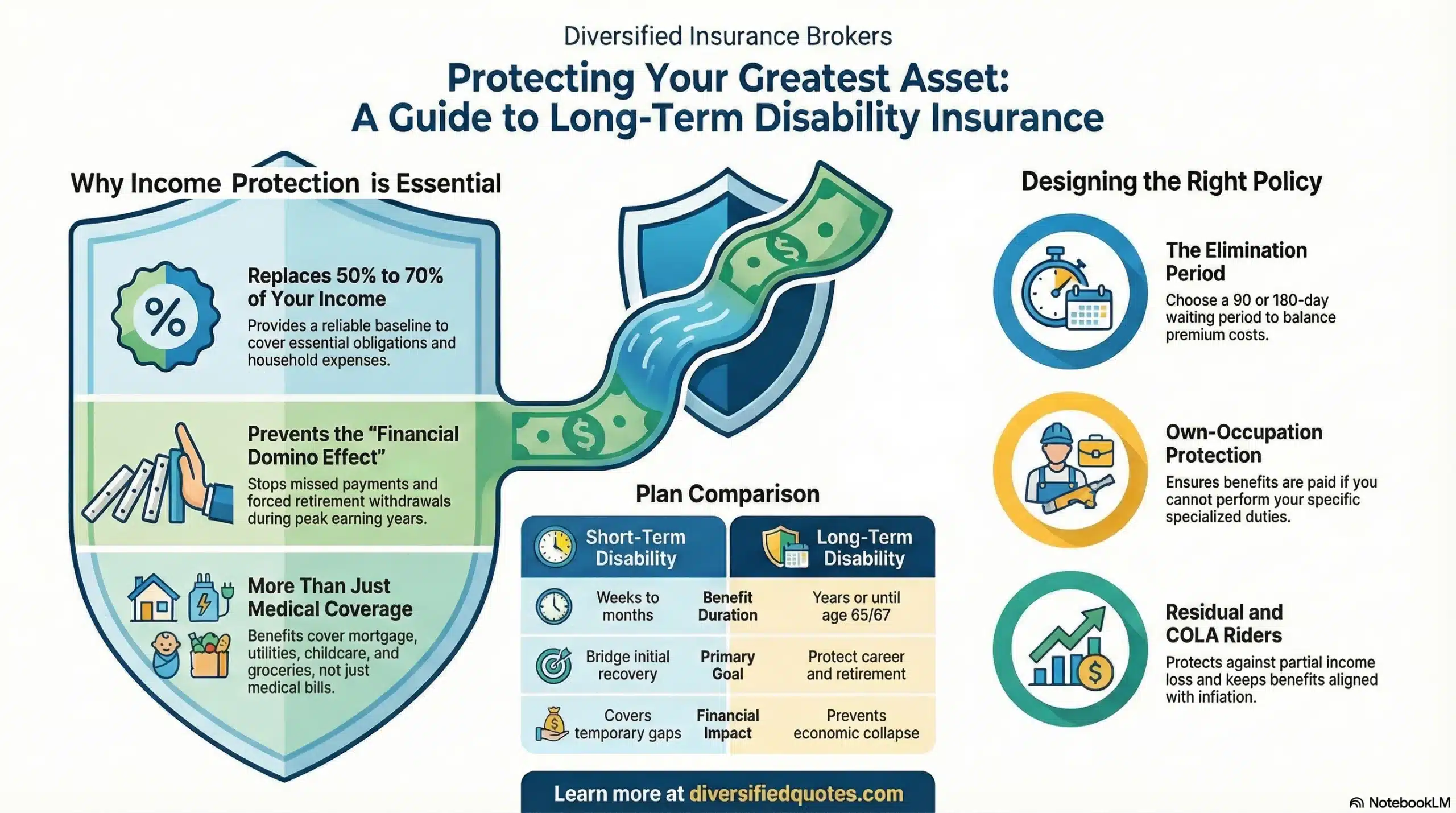
The own-occupation definition of disability is the most important policy feature for liquor industry professionals across every role. Under an own-occupation definition, a policy pays benefits when a condition prevents the professional from performing the specific duties of their own occupation — the repetitive bar work of a bartender, the physical production work of a distiller, the stocking and retail operations of a liquor store owner — regardless of whether they could theoretically perform some other type of unrelated sedentary work. For a bartender whose carpal tunnel or tennis elbow prevents bartending, the ability to hypothetically perform administrative work is irrelevant to the income loss they are experiencing. An own-occupation policy recognizes the genuine professional incapacity and pays benefits accordingly. Without this definition, many liquor industry professionals would find their disability insurance providing no practical benefit in the exact scenarios most likely to actually disable them. Our dedicated resource on own-occupation disability insurance explained covers how this definition operates in real claim scenarios and why it is the single most consequential feature to evaluate in any policy.
A residual disability rider is equally critical across liquor industry roles where recovery is likely to be gradual rather than binary. A bartender recovering from a shoulder condition may be able to return to limited, lighter bar duties — managing, consulting, or working reduced shifts — while still unable to return to the full physical demands of a high-volume bar shift, earning significantly reduced income without being completely unable to work. A residual disability rider pays proportional benefits based on the percentage of income reduction, providing continuous financial support from disability onset through full return to professional capacity. Our resource on how residual disability benefits work covers the proportional benefit mechanics. For self-employed bar owners and liquor store operators facing long-term conditions, our resource on disability income insurance with a COLA rider explains how inflation protection preserves purchasing power across an extended claim period.
Business Overhead Coverage for Bar Owners, Distillers, and Liquor Store Operators
For self-employed bar owners, craft distillery operators, and independent liquor store owners, disability insurance planning must address two separate but simultaneous financial exposures: personal income replacement and business overhead continuity. A personal income replacement policy covers the owner’s household obligations — mortgage, food, personal insurance, loan payments — when the disability prevents them from generating professional income. But the business doesn’t pause during the owner’s disability: bar lease payments, liquor license fees, commercial insurance premiums, equipment maintenance, and any employee payroll continue generating fixed obligations that drain cash reserves regardless of whether the owner is behind the bar or the distillery is producing.
Business overhead expense coverage specifically addresses this second layer — covering the fixed costs of keeping the business operational during a disability period so the owner returns to a functioning enterprise rather than a collapsed one. For a bar owner whose personal brand, regulars, and reputation are the business’s primary asset, the ability to maintain operations through a disability recovery period is often as strategically important as replacing personal income. Our resource on disability business overhead expense coverage explains exactly what these policies cover and how they coordinate with personal income replacement disability insurance. Our resource on how much disability insurance you need provides a practical framework for sizing both coverage needs simultaneously.
Why Independent Broker Access Matters for Liquor Industry Professionals
The liquor industry spans occupational classifications that range from moderately favorable (wine sales professionals, management-focused bar owners) to lower-tier physical service (production bartenders, distillery workers, delivery professionals), and not every carrier approaches every liquor industry role equally. Some carriers apply conservative restrictions to bar and hospitality occupational classifications that produce exclusion riders targeting the wrist, elbow, and shoulder conditions most likely to disable a bartender — eliminating practical protective value for exactly the scenarios most probable for that worker. Others write these classifications more comprehensively when the health profile and duty description support a favorable underwriting outcome. Identifying which carriers offer the best terms for a specific liquor industry role requires independent access to the full carrier marketplace — not the products of a single company.
At Diversified Insurance Brokers, we evaluate options across multiple carriers for every liquor industry professional we serve. We understand how to present duty profiles across the full range of liquor industry roles, how to document both self-employment income and tipped wage income accurately, and how to structure policy provisions that produce genuinely comprehensive protection rather than coverage that fails in the scenarios that matter. Our resource on why independent disability insurance brokers matter explains why independent carrier access produces better outcomes for professionals whose occupational classification requires expertise to place well.
Apply Early — Before the Occupational Conditions of Industry Work Accumulate
The single most important timing decision available to any liquor industry professional evaluating disability insurance is applying as early as possible in their career — before the wrist, elbow, shoulder, and back conditions that industry work produces over time have been documented in the medical record. Premiums are based in part on age and health at application, and younger applicants in good health secure the most comprehensive coverage at the most favorable rates. An exclusion rider eliminating wrist and elbow coverage — applied because carpal tunnel or tennis elbow is already documented when the application is submitted — substantially undermines the practical value of any policy for a bartender whose most probable disability scenarios involve exactly those structures.
Applying at the beginning of a bartending career, when opening a bar, or when launching a craft distillery — before industry-specific health conditions accumulate — secures comprehensive coverage that remains in force as those conditions develop in subsequent working years. For liquor industry professionals who already have documented occupational conditions, our resource on disability insurance with preexisting conditions covers what coverage options remain available and how underwriters approach existing health history. Our resource on how to buy disability insurance online provides practical guidance on the application process for employed and self-employed professionals across every liquor industry role.
Request Disability Insurance Quotes for Liquor Industry Professionals
We compare carriers, explain occupational class ratings for every role in the industry, and structure policies that protect the income your career depends on.
Get Disability Insurance QuotesRelated Disability Insurance Pages
Financial Protection Essentials
Talk With an Advisor Today
Choose how you’d like to connect—call or message us, then book a time that works for you.
Schedule here:
calendly.com/jason-dibcompanies/diversified-quotes
Licensed in all 50 states • Fiduciary, family-owned since 1980
Disability Insurance for the Liquor Industry — FAQs
Every role in the liquor industry with meaningful physical demands and limited or absent employer disability benefits has a strong case for individual disability insurance — which covers the majority of the industry. Bartenders who shake hundreds of cocktails per shift, lift kegs and cases, and stand for 8 to 12 hours are among the most physically exposed workers in the service sector, and bars rarely provide comprehensive group disability coverage. Bar owners and independent tavern operators who work the floor themselves combine the physical risks of bartending with the financial exposure of self-employment — when they cannot work, overhead continues. Craft distillery and winery production workers handle heavy production materials in industrial environments without the group benefit infrastructure of large manufacturing employers. Liquor store owners and operators lift and stock cases repeatedly through long shifts. Wine and spirits sales representatives who load and unload product samples, drive territories, and manage event logistics face the back, shoulder, and driving-related injury risks of field sales work. Across every role, what they share is a combination of documented physical risk and limited institutional income protection — which is exactly what individual disability insurance addresses.
Occupational therapists and sports medicine researchers have compared the force of cocktail shaking to a tennis serve or a baseball pitch — and noted that while major league pitchers throw no more than 100 pitches per game, bartenders perform the same rotational force dozens of times per hour, every hour of every shift, across an entire career. The cumulative result is a predictable pattern of wrist tendinitis, lateral epicondylitis (tennis elbow), carpal tunnel syndrome, and shoulder joint damage that develops across years of high-volume bar work. These conditions are particularly disabling for bartenders because the injury specifically prevents the fine motor activity — shaking, pouring, and precise wrist work — that bartending requires, while leaving general physical function intact. A bartender with severe tennis elbow cannot bartend even when they are otherwise healthy enough to walk, talk, and perform any sedentary activity — which is why an own-occupation disability definition is so critical for this profession.
Workers’ compensation and individual disability insurance address different and largely non-overlapping risks. Workers’ compensation covers acute injuries that are directly and demonstrably work-related and occur during a specific documented incident. It does not cover the carpal tunnel syndrome, tennis elbow, or shoulder condition that develops gradually from years of cumulative bartending work — because gradual-onset conditions are frequently difficult to attribute to a single documented incident and are routinely excluded from or contested in workers’ compensation claims. Workers’ compensation also does not cover any disability that originates outside the workplace: a cardiovascular event, a cancer diagnosis, a neurological condition, or an off-the-job accident that prevents professional work. Individual disability insurance covers disability from any cause regardless of origin or timing — including the cumulative occupational conditions that workers’ compensation typically does not address and the off-work events that have nothing to do with the bar at all.
For self-employed bar owners, independent tavern operators, and liquor store owner-operators, disability insurance underwriting uses federal tax return documentation to establish an income base for benefit calculations — typically Schedule C net profit over two to three years. The seasonal and variable nature of food and beverage business revenue is accounted for through this multi-year averaging approach, which tends to smooth out strong and slow periods into a more representative annual figure. The challenge for many liquor business owners is that Schedule C net profit after deducting lease costs, inventory, staff, licensing, and insurance may significantly understate actual financial need during a disability — household expenses continue at their pre-disability level regardless of what the business’s tax return looks like after deductions. Working with a broker who understands how to document food and beverage business income accurately, and how to present the full financial picture to underwriters, is an important step in securing a benefit amount that genuinely replaces the income the owner needs rather than an artificially reduced figure.
Most bars and hospitality establishments either offer no group disability benefits at all or provide basic short-term coverage with significant limitations that make it inadequate for a professional bartender’s real income protection needs. Where group plans exist, they typically replace 60 percent of base salary — which for a bartender whose total compensation includes substantial tips may substantially understate actual income — and carry disability definitions that weaken from own-occupation to any-occupation after 24 months, potentially eliminating benefits for a bartender who retains any capacity for non-bar work even if they cannot bartend professionally. Individual own-occupation disability insurance maintains the stronger definition for the full benefit period, covers the gap between actual tipped income and base salary, is portable when employment changes, and provides coverage from any qualifying cause rather than only work-related events. For a professional whose career is built on specific physical skills that take years to develop and cannot be replaced by generic sedentary work, the own-occupation definition is the difference between coverage that functions as intended and coverage that exists largely on paper.
A craft distillery owner faces the same dual financial exposure that every self-employed professional in a physical business does — personal income stops and business overhead continues simultaneously when a disability occurs. An employee who becomes disabled loses their paycheck but retains the employer’s group coverage (if any) and has no business overhead continuing in their name. The distillery owner loses personal income, continues paying the production facility lease, equipment maintenance contracts, licensing fees, and any staff payroll, and faces the additional risk that a prolonged absence from the hands-on production work that a craft operation depends on may damage the product quality, customer relationships, and regulatory standing the business has built. Comprehensive disability planning for a craft distillery owner involves both a personal income replacement policy — sized to cover household needs during recovery — and a business overhead expense policy that covers the fixed operating costs of keeping the distillery viable and license-compliant during the disability period. Without both, returning from disability can mean returning to a failed business rather than a functioning one.
Yes — and getting the benefit amount right for tipped workers requires some care in the documentation process. Disability insurance carriers base benefit amounts on verified earned income, which for tipped employees means both reported W-2 wages and documented tip income. Bartenders who accurately report their tip income on their tax returns have a documented income basis that carriers can use to calculate an appropriate benefit amount. Bartenders who under-report tip income — a common industry practice — will find that the benefit amount available to them reflects only the documented income, which may be substantially lower than their actual earnings and actual financial need during a disability. Working with a broker who understands how to navigate tipped income documentation honestly and accurately is an important planning step for bartenders who want disability insurance that actually replaces their real income rather than a fraction of it.
The optimal moment is as early as possible — ideally at the beginning of a serious bartending career, when opening a bar, or when launching a craft distillery or liquor retail operation. This is when premiums are lowest, health is typically cleanest, and no occupational conditions have yet accumulated in the medical record. The wrist, elbow, and shoulder conditions that define the bartending disability profile develop progressively over a career — they appear in the medical record gradually, not suddenly. Every documented occupational condition that exists at application time is a candidate for an exclusion rider that eliminates coverage for exactly the injuries most likely to disable a working bartender. Applying before those conditions develop captures the most comprehensive coverage available at the most favorable rates, and that coverage remains in force and pays benefits on those conditions as they develop in subsequent years. The professional who waits until they have elbow pain to evaluate disability insurance is buying coverage with an elbow exclusion — which defeats much of the purpose. Early application is not a planning nicety for liquor industry professionals; it is the core strategy that determines whether the coverage actually works.
This is precisely the scenario where the own-occupation definition earns its value — and where any-occupation policies fail liquor industry professionals in practice. A bartender whose wrist tendinitis prevents bartending but leaves them able to sit at a computer is, under an any-occupation policy, potentially ineligible for benefits because they retain theoretical capacity for sedentary employment. Under an own-occupation policy, the relevant question is not what work they could hypothetically do, but whether they can perform the specific duties of their own profession — and a bartender who cannot shake cocktails, pour, lift kegs, or manage the fine motor demands of bar work cannot practice their profession, regardless of what else they might be capable of. The own-occupation definition treats the professional’s actual career as the standard for disability, not an abstract ability to do any work of any kind. For the significant portion of liquor industry professionals whose specific physical skill set is their income-generating asset, this distinction is not technical — it is the entire practical question of whether coverage pays when it should.
About the Author:
Jason Stolz, CLTC, CRPC, DIA, CAA and Chief Underwriter at Diversified Insurance Brokers (NPN 20471358), is a senior insurance and retirement professional with more than 25 years of real-world experience helping individuals, families, and business owners protect their income, assets, and long-term financial stability. As a long-time partner of the nationally licensed independent agency Diversified Insurance Brokers, Jason provides trusted guidance across multiple specialties—including fixed and indexed annuities, long-term care planning, personal and business disability insurance, life insurance solutions, Group Health, Travel Medical and Evacuation Insurance, and short-term health coverage. Diversified Insurance Brokers maintains active contracts with over 100 highly rated insurance carriers, ensuring clients have access to a broad and competitive marketplace.
His practical, education-first approach has earned recognition in publications such as VoyageATL, and contributions from his agency featured in Kiplinger and GoBankingRates— highlighting his commitment to financial clarity and client-focused planning. Drawing on deep product knowledge and years of hands-on field experience, Jason helps clients evaluate carriers, compare strategies, and build retirement and protection plans that are both secure and cost-efficient. Visitors who want to explore current annuity rates and compare options across multiple insurers can also use this annuity quote and comparison tool.
Explore More Disability Insurance Options: Browse our complete guide to Disability Insurance for Food, Hospitality, Arts & Entertainment — covering chefs, musicians, actors, bartenders, hospitality workers & entertainment professionals from 100+ carriers.
Last Reviewed: June 8, 2026 |
Reviewed by: Jason Stolz, CLTC, CRPC, DIA, CAA
Chief Underwriter, Diversified Insurance Brokers, Inc. | NPN: 20471358 | Diversified Insurance Brokers, Inc. — Licensed in all 50 states
Fact Checked by: Tonia Pettitt, CMIP©
Medicare Specialist, Diversified Insurance Brokers, Inc. | NPN: 14374308 | Diversified Insurance Brokers, Inc. — Licensed in all 50 states
Did you find this content helpful? Leave us a Google review — it helps others find trustworthy guidance too.
Editorial Standards: Diversified Insurance Brokers maintains rigorous editorial standards to ensure accuracy, clarity, and independence in all content. Learn more about our editorial standards and commitment to transparency.
