
What is an Income Annuity
What is an Income Annuity

Jason Stolz CLTC, CRPC, DIA, CAA
An income annuity is a contract with an insurance company that converts a lump sum of money into a guaranteed stream of income — most often for the rest of your life. At Diversified Insurance Brokers, we help retirees and near-retirees use income annuities to build a guaranteed income floor they cannot outlive. The concept is simple and, in a sense, ancient: you hand an insurer a single premium, and in return the insurer promises to send you regular payments — monthly, quarterly, or annually — either for a set number of years or for as long as you live. It is the financial mirror image of a savings product. Where a savings or accumulation product exists to grow a balance, an income annuity exists to do the opposite: it turns an existing balance into predictable, paycheck-style income. This is why an income annuity is often described as a personal pension, and why it functions as longevity insurance — the one private-market instrument that guarantees income for life regardless of how long you live or what happens in the markets.
Income annuities matter because they solve a problem no other financial product solves as directly: the risk of outliving your money. A diversified investment portfolio can grow your wealth, but it cannot promise you a paycheck for life, and a bad sequence of market returns early in retirement can permanently damage a portfolio you are drawing income from. An income annuity removes that uncertainty for the portion of your assets you place in it, transferring both the investment risk and the longevity risk to the insurance company. Understanding the full pros and cons of annuity structures is essential before committing, because the guarantee comes with a genuine trade-off in liquidity that this page explains in full. The central idea, though, is straightforward: an income annuity buys certainty. For retirees who want to know exactly how much income will arrive every month for the rest of their lives, no matter what the stock market does, that certainty is the entire point.
This guide explains what an income annuity is, the two main types and how they differ, how the insurance company calculates your payment, the payout options that determine what happens at your death, how these annuities are taxed, and how to decide whether one fits your retirement plan. Whether you are exploring lifetime income annuity strategies for the first time or comparing an income annuity against other guaranteed-income tools, understanding the mechanics puts you in a position to decide clearly.
Ensure you are receiving the absolute top rates
Current Fixed Annuity Rates
Compare today’s best fixed annuity rates from top carriers.
Current Bonus Annuity Rates
See which annuities offer the highest upfront bonus today.
Request an Annuity Quote
Submit our annuity request form to get personalized rate options.
Lifetime Income Calculator
Use our calculator to see how much guaranteed income your annuity can provide.
The Two Main Types — Immediate vs. Deferred Income Annuities
Income annuities come in two fundamental varieties, and the only real difference between them is when the income starts. A Single Premium Immediate Annuity, or SPIA, begins paying income almost right away — typically within 30 days of purchase, and by definition within one year. It is the tool for someone who is already retired or about to retire and needs income now. A Deferred Income Annuity, or DIA, is funded today but begins paying at a future date you choose — often several years or even decades later. Because the insurer holds and invests your premium during the deferral period before any payments begin, a DIA produces a meaningfully higher monthly payment than a SPIA purchased with the same premium. The two products share the exact same underlying structure; the deferral is the only distinction. A useful rule of thumb from the industry: if you are already retired and need income within the next year, a SPIA is the right tool; if you are still some years from needing income and want to lock in a higher future payment, a DIA generates significantly more monthly income for the same premium because the insurer has years to invest your money before payments begin.
A Qualified Longevity Annuity Contract, or QLAC, is a special type of DIA held inside a qualified retirement account such as an IRA, designed specifically to guard against outliving your savings by deferring income to an advanced age — and with the added benefit of reducing the account balance used to calculate your required minimum distributions until the income begins. A related but distinct option is a Fixed Indexed Annuity with an income rider, which is not a pure income annuity but can produce guaranteed lifetime income while preserving access to an account value — a structure that trades some income efficiency for liquidity and a death benefit. Understanding how these options compare is central to using annuities as pension alternatives, and each fits a different retirement profile.
Income Annuity Types Compared
| Type | When Income Begins | Best Suited For | Relative Income Per Dollar | Liquidity |
|---|---|---|---|---|
| SPIA (Immediate) | Within 30 days to 12 months of purchase. | Those already retired who need guaranteed income now to cover essential expenses. | Solid — no deferral, so payment reflects current rates and your age at purchase. | Generally none once annuitized; some contracts offer a commutation or refund feature. |
| DIA (Deferred) | At a future date you select, often several years or decades out. | Those planning ahead who want to lock in higher future income now. | Higher — the deferral period lets the insurer offer a larger payment for the same premium. | Limited during deferral; some allow rescission before income starts. |
| QLAC (DIA in an IRA) | At an advanced future age you select, within IRS limits. | IRA holders wanting late-life income and a lower RMD base during deferral. | Higher — long deferral to an advanced age maximizes the payment. | Limited; premium is committed to the future income stream. |
| FIA + Income Rider | On demand once the rider is activated, per contract terms. | Those wanting guaranteed income plus account-value access and a death benefit. | Lower income per dollar than a SPIA, in exchange for liquidity and legacy. | Retains account value within the free withdrawal provision — the key advantage. |
How the Insurance Company Calculates Your Payment
The amount an income annuity pays you is not arbitrary — it is calculated from a handful of specific factors, and understanding them helps you see why the same premium can produce different payments for different people. The insurer bases your payment on your age (older buyers receive higher payments because the insurer expects to make fewer total payments), your gender in most cases, the amount of your premium, current interest rates at the time of purchase, and the payout option you select. A larger premium, an older age, a higher interest rate environment, and a payout option with fewer guarantees all push the payment higher. What is genuinely distinctive about an income annuity — and the reason it can produce more income per dollar than a bond ladder or a systematic withdrawal from a portfolio — is that each payment is funded by three sources working together: interest the insurer earns on its investment portfolio, a gradual return of your own original premium, and something called mortality credits. Mortality credits are the mechanism at the heart of how income annuities work: because the insurer pools many annuitants together, the premiums of those who die earlier than expected help fund the continued payments of those who live longer than expected. This pooling of longevity risk is what allows an income annuity to guarantee lifetime income efficiently — it is a benefit no individual investment portfolio can replicate, because no portfolio can pay you mortality credits. Understanding how the resulting income is taxed completes the picture, and it depends on how you funded the annuity, as explained further below.
Payout Options — What Happens at Your Death
When you purchase an income annuity, you choose a payout structure, and this choice determines both the size of your payments and what happens to the money when you die. The trade-off is consistent: the more you guarantee for beneficiaries, the lower your monthly payment, because the insurer is on the hook for more. A single-life (or life-only) option pays the largest monthly amount and continues for as long as you live, but payments stop entirely at your death, leaving nothing to heirs — it is best suited for those maximizing income with no legacy concern tied to this asset. A joint-and-survivor option continues payments for as long as either you or your spouse (or other co-annuitant) is living, making it the common choice for married couples who want to protect the surviving spouse, at the cost of a somewhat lower payment. A life-with-period-certain option guarantees payments for your lifetime but also for a minimum number of years — commonly 10 or 20 — so that if you die during that period, your beneficiary receives the remaining payments; for example, a life-with-20-year-period-certain purchased at 65 guarantees payments to a beneficiary through your age 85 if you die early. A cash refund or installment refund option guarantees that if you die before receiving back your original premium, the remaining balance goes to your beneficiaries. Optional riders can further customize the contract — a cost-of-living adjustment (COLA) rider increases payments by a set percentage each year to help offset inflation, though it lowers the starting payment. Understanding how these options interact with annuity beneficiary and death benefit rules is essential to choosing the structure that fits your family’s needs, and the same payout logic applies when evaluating a pension’s annuity options.
Want to see how much guaranteed income your savings could produce?
Request Your Personalized Income Annuity Quote
How Income Annuities Are Taxed
The taxation of an income annuity depends entirely on how it was funded, and the distinction is important for planning. If you fund the annuity with qualified (pre-tax) money — such as a rollover from a Traditional IRA or a 401(k) — then every payment you receive is fully taxable as ordinary income, exactly as any withdrawal from those accounts would be. If you fund the annuity with non-qualified (after-tax) money — such as savings, a maturing CD, or a brokerage account — then the exclusion ratio applies: because you already paid tax on the principal, only the earnings portion of each payment is taxable, and part of each payment is treated as a tax-free return of your own premium. This exclusion ratio spreads the return of your principal across the payment period and results in a lower effective tax rate on non-qualified annuity income than a fully-taxable qualified payment carries. Understanding how 72(q) rules apply to non-qualified annuity distributions matters if you access funds early, and understanding how RMDs work under SECURE 2.0 matters for qualified income annuities, where the payments can help satisfy required minimum distribution obligations. One important note confirmed across the industry: purchasing an income annuity inside an IRA or other qualified account provides no additional tax deferral beyond what the account already offers, so the decision to use an annuity in a qualified plan should rest on the annuity’s guaranteed-income features, not on any tax-deferral benefit it does not add.
When an Income Annuity Makes Sense — and When It Does Not
An income annuity is a powerful tool for the right situation, and the clearest use case is covering the gap between your essential expenses and your existing guaranteed income. A practical framework used by planners: add up your essential monthly expenses — housing, food, healthcare, insurance, utilities — then subtract your guaranteed income from Social Security and any pension. The remaining shortfall is the income gap, and an income annuity sized to cover that gap creates a guaranteed floor that pays for your essentials for life, no matter what the markets do. This is the core of the strategy — cover the income gap, not the entire portfolio — leaving your remaining assets available for growth, discretionary spending, and emergencies. An income annuity makes particular sense when you want to eliminate the risk of outliving your money, when you want to remove sequence-of-returns risk from your essential-expense coverage, when you want to simplify your finances with a predictable paycheck, when you have sufficient liquidity elsewhere for emergencies, and when you are in reasonable health so that a lifetime income benefit delivers its full value. It makes less sense when you lack other liquid assets and might need the principal for emergencies, when you have a shorter life expectancy that would limit the value of lifetime payments, or when guaranteed income is not a priority for your situation. Because the purchase of a SPIA is generally irrevocable once the free-look period ends, it should never consume money you may need for unexpected costs. Weighing whether an annuity is a good investment for your circumstances, and whether an annuity is worth it relative to the alternatives, is the final step. For those comparing income annuities against accumulation-focused products, our guides to the MYGA, the fixed versus fixed indexed annuity comparison, annuity laddering, the guaranteed growth annuity, and choosing the correct indexes in an annuity cover the accumulation side, while our resource on how to transfer a 401(k) to an annuity and our note on how surrender charges work cover the mechanics.
Ready to find out whether an income annuity fits your retirement plan?
Request Your Personalized Income Annuity Analysis
Financial Protection Essentials
Explore disability coverage, life insurance, and specialty protection options across a wide range of occupations and industries.
Explore Annuity Rollover Options by Account Type
Every retirement account rolls over differently. Choose your plan type below to see the specific rules, tax treatment, and best annuity strategies for your situation.
Talk With an Advisor Today
Choose how you’d like to connect—call or message us, then book a time that works for you.
Schedule here:
calendly.com/jason-dibcompanies/diversified-quotes
Licensed in all 50 states • Fiduciary, family-owned since 1980
What is the difference between an income annuity and other annuities like a MYGA or FIA?
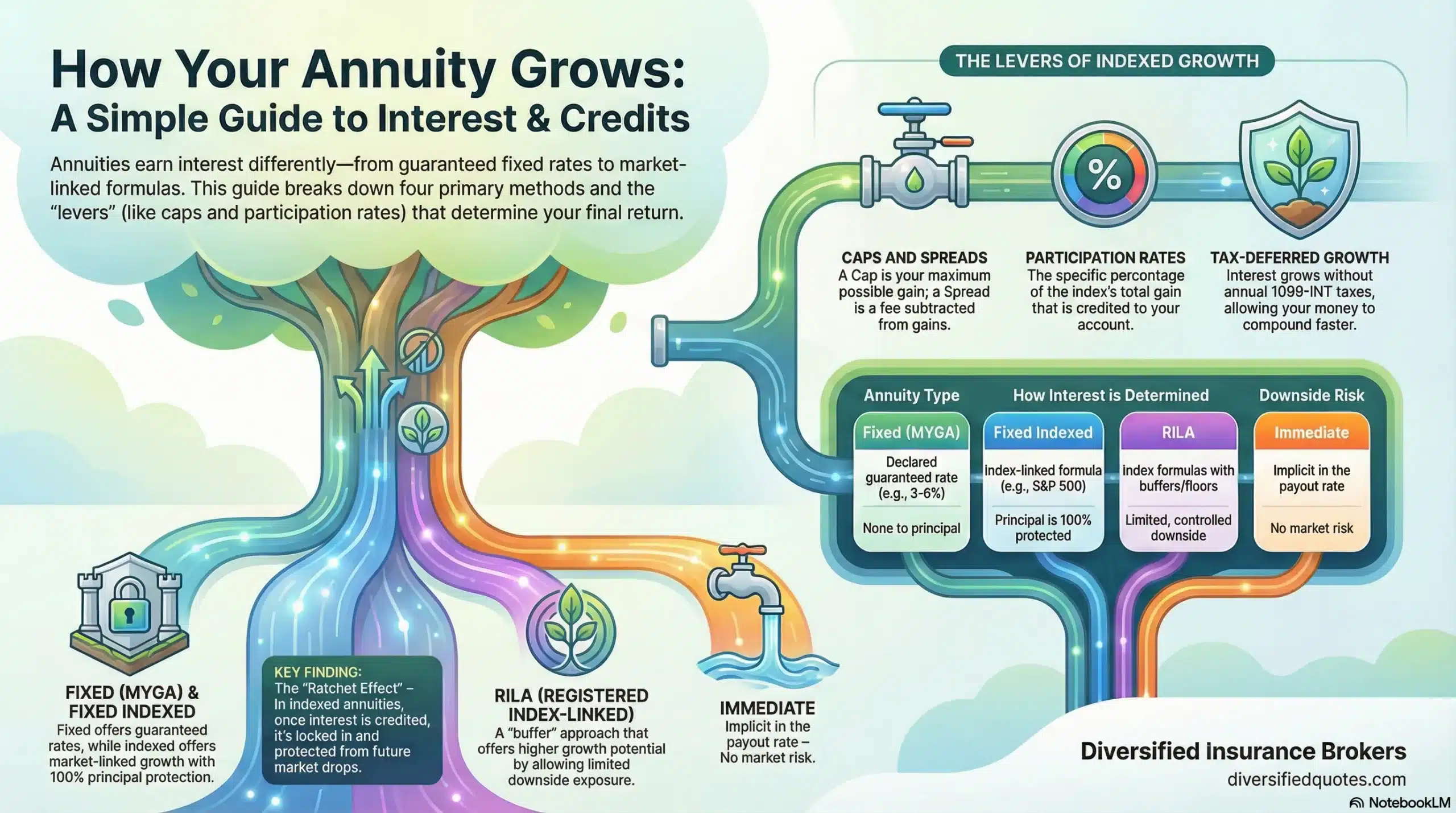
The difference comes down to purpose: income annuities are built to distribute money as guaranteed lifetime income, while products like MYGAs and FIAs are built primarily to accumulate money. An income annuity (a SPIA or DIA) converts a lump sum into a guaranteed stream of payments — its job is to pay you income you cannot outlive. A Multi-Year Guaranteed Annuity (MYGA) locks in a declared interest rate for a set term and grows your principal, functioning much like a CD with tax deferral — its job is accumulation, not income. A Fixed Indexed Annuity (FIA) grows your principal with market-linked interest subject to a 0% floor, protecting against loss while offering growth potential — again primarily accumulation, though an FIA can add an income rider to produce guaranteed lifetime withdrawals later. The key trade-off between a pure income annuity and an FIA with an income rider is efficiency versus flexibility: a SPIA typically produces more guaranteed income per dollar because it commits the principal entirely to the income stream and benefits from mortality credits, while an FIA with a rider produces somewhat less income per dollar but preserves an account value you can access and pass to heirs. Our comparison of fixed versus fixed indexed annuities covers the accumulation side in depth. Which tool fits depends on your goal: if you need guaranteed income now or at a set future date, an income annuity is the direct solution; if you want to grow and protect principal with flexibility, a MYGA or FIA is the better starting point. Many retirees use both — a MYGA or FIA for the accumulation and growth portion of their assets, and an income annuity for the guaranteed-income floor.
Can I access my money after I buy an income annuity?
Generally, no — and this is the single most important trade-off to understand before buying an income annuity. When you purchase a SPIA, you exchange your lump sum for a guaranteed income stream, and this exchange is typically irrevocable once the contract’s free-look period ends. You give up access to the principal in return for income you cannot outlive. This is the fundamental bargain of an income annuity, and it is why you should never place money in one that you might need for emergencies, healthcare costs, or other unexpected expenses. That said, the picture is not entirely rigid. Many insurers now offer a commutation benefit on certain income annuities, which allows you to withdraw a lump sum representing a portion — sometimes up to 90% — of the present value of your remaining payments, though exercising it reduces or ends your future income. Some contracts offer a cash refund or installment refund feature that guarantees any unpaid portion of your original premium goes to beneficiaries if you die early. And payout options like life-with-period-certain provide a guarantee that payments continue to a beneficiary for a minimum number of years. But none of these features restore full liquidity — they are limited safety valves, not open access. The correct way to plan around this is to annuitize only the portion of your assets you are comfortable committing to income for life, and to keep sufficient liquid assets elsewhere for emergencies and discretionary needs. Understanding how annuity free withdrawal provisions work on accumulation-style annuities helps clarify why income annuities are different — a deferred accumulation annuity typically offers a 10% annual free withdrawal, while a fully annuitized income annuity generally does not.
How much income will an income annuity pay me?
The exact amount depends on several factors specific to you, so any figure quoted without your details would be a guess — but the factors that determine it are clear. Your payment is calculated from your age at purchase (older buyers receive higher payments because the insurer expects to make fewer total payments over a shorter remaining lifespan), your gender in most cases, the premium amount you contribute, the current interest rate environment at the time you buy, and the payout option you select. A larger premium, an older purchase age, higher prevailing interest rates, and a payout option with fewer beneficiary guarantees all increase the monthly payment. Because interest rates shift continuously and every carrier prices differently, the only reliable way to know your actual payment is to run current quotes across multiple carriers for your specific age, premium, and payout structure — which is exactly what a broker does, and what the lifetime income calculator on this page is designed to illustrate. One important concept in evaluating income annuity quotes: the payout rate is expressed as the annual income you receive as a percentage of your premium, and it is not the same as an interest rate or a rate of return. A payout rate includes the return of your own principal alongside interest and mortality credits, so it should not be compared directly against a bond yield or CD rate. To compare income annuities meaningfully, compare the actual guaranteed monthly income each carrier will pay for the same premium, age, and payout option. Because rates change daily, obtaining fresh multi-carrier illustrations at the time you are ready to buy is essential rather than relying on any figure you saw previously.
Is an income annuity the same as a pension?
An income annuity is not technically a pension, but it serves a very similar purpose and is often described as a personal pension — because it provides the same thing a pension does: regular, guaranteed payments you can count on for life. The key difference is who sets it up and funds it. A traditional pension is a defined benefit plan established and funded by an employer, who bears the investment and longevity risk and pays you a monthly benefit in retirement based on a formula. An income annuity is something you purchase yourself from an insurance company with your own lump sum, choosing the premium, payout structure, and timing that fit your needs. In an era when fewer employers offer traditional pensions, an income annuity lets you create your own pension-like income stream from your accumulated savings or retirement account. This is why income annuities are central to pension alternative planning — they replicate the guaranteed lifetime income that a pension would have provided but that most modern workers, who saved in 401(k)s and IRAs instead, never received through employment. If you do have a pension and are weighing whether to take its monthly annuity or a lump sum, the analysis parallels the income annuity decision closely; our resources on the best annuities for a pension rollover and the best annuities for a defined benefit rollover cover that decision in depth, including when a private-market income annuity can produce more monthly income than the pension’s own annuity option.
What happens to my income annuity if the insurance company fails?
An income annuity’s guarantee rests on the financial strength and claims-paying ability of the issuing insurance company — it is not FDIC-insured, because it is an insurance product rather than a bank deposit. This makes the insurer’s financial strength a genuinely important part of your decision, since you are relying on that company to make payments for potentially decades. There are two layers of protection worth understanding. First, insurance companies are regulated at the state level and are required to maintain reserves sufficient to meet their obligations, and the largest income annuity carriers carry high financial-strength ratings from independent rating agencies precisely because they must demonstrate the ability to pay claims over the long term. Choosing a highly-rated carrier is the primary way to manage this risk, and it is a core reason to work with a broker who can place your annuity with financially strong companies rather than chasing the highest quoted payment from a weaker insurer. Second, every state has a guaranty association that provides a layer of protection for annuity owners if a member insurer becomes insolvent, up to coverage limits that vary by state. These limits are set by each state and can change, so if guaranty association coverage is a significant factor in your decision, confirm your state’s current limits at the time of purchase rather than relying on a figure that may be outdated. The practical guidance is straightforward: prioritize insurers with strong independent financial-strength ratings, understand that your state guaranty association provides a backstop up to its limits, and consider spreading a very large premium across more than one highly-rated carrier if your intended premium would exceed your state’s coverage limit. Understanding how insurer strength factors into whether an annuity is a sound choice is part of the due diligence that protects a lifetime income stream.
About the Author:
Jason Stolz, CLTC, CRPC, DIA, CAA and Chief Underwriter at Diversified Insurance Brokers (NPN 20471358), is a senior insurance and retirement professional with more than 25 years of real-world experience helping individuals, families, and business owners protect their income, assets, and long-term financial stability. As a long-time partner of the nationally licensed independent agency Diversified Insurance Brokers, Jason provides trusted guidance across multiple specialties—including fixed and indexed annuities, long-term care planning, personal and business disability insurance, life insurance solutions, Group Health, Travel Medical and Evacuation Insurance, and short-term health coverage. Diversified Insurance Brokers maintains active contracts with over 100 highly rated insurance carriers, ensuring clients have access to a broad and competitive marketplace.
His practical, education-first approach has earned recognition in publications such as VoyageATL, and contributions from his agency featured in Kiplinger and GoBankingRates— highlighting his commitment to financial clarity and client-focused planning. Drawing on deep product knowledge and years of hands-on field experience, Jason helps clients evaluate carriers, compare strategies, and build retirement and protection plans that are both secure and cost-efficient. Visitors who want to explore current annuity rates and compare options across multiple insurers can also use this annuity quote and comparison tool.
Explore More Lifetime Income Options: Browse our complete guide to How Retirement Accounts & Annuities Work — covering how IRAs, 401ks, annuities, pensions, GLWBs & fixed indexed annuities work from 100+ carriers.
Last Reviewed: July 8, 2026 |
Reviewed by: Jason Stolz, CLTC, CRPC, DIA, CAA
Chief Underwriter, Diversified Insurance Brokers, Inc. | NPN: 20471358 | Diversified Insurance Brokers, Inc. — Licensed in all 50 states
Fact Checked by: Tonia Pettitt, CMIP©
Medicare Specialist, Diversified Insurance Brokers, Inc. | NPN: 14374308 | Diversified Insurance Brokers, Inc. — Licensed in all 50 states
Did you find this content helpful? Leave us a Google review — it helps others find trustworthy guidance too.
Editorial Standards: Diversified Insurance Brokers maintains rigorous editorial standards to ensure accuracy, clarity, and independence in all content. Learn more about our editorial standards and commitment to transparency.
