
Pension Alternatives
Pension Alternatives

Jason Stolz CLTC, CRPC, DIA, CAA
For decades, traditional pensions were the backbone of retirement income in the United States. Workers spent their careers with one employer and, in return, received a guaranteed monthly payment for life after retirement. Today, however, pensions are far less common in the private sector. Many companies have shifted to defined contribution plans such as 401(k)s, leaving individuals responsible for creating their own retirement income strategies. Because of this shift, many retirees and pre-retirees now search for pension alternatives that can recreate the predictable income once provided by employer-sponsored pension plans. One of the most effective tools for building a pension-like income stream is an annuity — specifically, income annuities and fixed indexed annuities with guaranteed lifetime withdrawal benefit riders that contractually guarantee income for life regardless of how long the owner lives. Annuity options for retirees without pensions covers how different annuity structures serve the income replacement role that defined benefit plans once filled for most working Americans. Guaranteed income from annuities covers how different income designs produce different payout amounts and tax characteristics across the full range of available structures.
Ensure you are receiving the absolute top rates
Current Fixed Annuity Rates
Compare today’s best fixed annuity rates from top carriers.
Current Bonus Annuity Rates
See which annuities offer the highest upfront bonus today.
Request an Annuity Quote
Submit our annuity request form to get personalized rate options.
Lifetime Income Calculator
Use our calculator to see how much guaranteed income your annuity can provide.
Annuities are insurance contracts designed to convert savings into guaranteed income, either immediately or at a future date. When structured correctly, annuities can function much like a private pension — providing reliable monthly income that cannot be outlived. This is why annuities are frequently discussed as one of the most practical pension alternatives available to individuals who want income stability during retirement. Unlike market-based withdrawal strategies that rely on investment returns, annuities provide contractually defined income backed by the financial strength of the issuing insurance company. Current income annuity rates provides the rate benchmarks that help retirees evaluate what level of guaranteed income a given premium amount can produce at current market conditions. Lifetime income annuity quotes covers current payout levels across carrier structures so income planning can be grounded in real contract numbers rather than hypothetical illustrations.
Many retirees begin evaluating pension alternatives when they realize that Social Security alone may not be sufficient to cover living expenses. While Social Security provides a valuable foundation of income, it was never designed to replace a full working income. Retirees often need additional income sources to maintain their lifestyle, cover healthcare expenses, and manage the financial uncertainty that comes with an open-ended retirement horizon. Annuities fill this gap by transforming accumulated assets — such as 401(k) balances, IRAs, or other retirement savings — into a steady stream of income payments that are contractually guaranteed to continue regardless of market conditions, interest rate environments, or how long the owner lives. The combination of Social Security and annuity income creates the two-pillar guaranteed income foundation that traditional pensions provided as a single benefit, and that most retirees working from defined contribution plans must now build themselves. Lifetime income annuity strategies covers how annuity income and Social Security can be sequenced to maximize total household guaranteed income across the full retirement horizon.
Understanding how annuities work is an important step in evaluating pension alternatives. At their core, annuities operate on a simple principle: you deposit money with an insurance company, and in return the insurer promises to provide income payments according to the terms of the contract. These payments can begin immediately or after a deferral period that allows the income base or account value to grow before income activation. Because these payments are guaranteed by the issuing insurance company, they offer a level of income certainty that market-based portfolios cannot always provide — particularly in years when markets decline and portfolio withdrawals would otherwise lock in losses while simultaneously depleting the assets needed for future growth. Guaranteed lifetime withdrawal benefits explained provides the broader framework for how GLWB riders operate across different carrier designs and what criteria distinguish the most competitive income guarantees from average market offerings. How a GLWB works covers the income base mechanics, rollup rates, payout percentages, and the critical distinction between account value and income value that every buyer of a fixed indexed annuity with an income rider needs to understand before committing premium.
Request Pension Alternative Income Options
Types of Annuities Used as Pension Alternatives
There are several types of annuities that retirees use as pension alternatives, and the structure that works best depends on whether the priority is maximizing immediate income, maintaining growth potential during a deferral period, or preserving flexibility alongside guaranteed income. Each product category addresses a different dimension of the pension replacement problem, and for many retirees the optimal solution combines elements of more than one structure across different portions of the retirement asset base.
Single premium immediate annuities convert a lump sum into guaranteed income payments that begin within thirty days of purchase. They produce the highest guaranteed payout rate for a given premium because no deferral period is involved and the carrier immediately begins assuming longevity risk. They are the structural equivalent of a pension annuity buyout — the premium is irrevocably committed in exchange for guaranteed income that continues for a defined period or for life. They are the most appropriate tool when the primary objective is maximizing guaranteed monthly income starting now, and when liquidity from the committed premium is not needed.
Deferred income annuities allow the owner to commit premium today in exchange for guaranteed income that begins at a future date — often five to fifteen or more years out. Because the income start is deferred, the payout rate at activation is significantly higher than what an immediate annuity would provide for the same premium, reflecting the compound effect of the deferral period on the carrier’s pricing. DIAs are particularly valuable for retirees who want to create a future income floor — for example, a 65-year-old who wants guaranteed income beginning at 75 or 80 to cover late-retirement expenses — while managing the early retirement years through portfolio withdrawals or other income sources. What is a deferred income annuity covers the mechanics and payout structure in detail.
Fixed indexed annuities with guaranteed lifetime withdrawal benefit riders represent the most flexible pension alternative structure because they combine indexed growth potential during a deferral phase with a guaranteed income floor that activates on the owner’s schedule. The GLWB rider creates a separate income base that grows at a guaranteed rollup rate — sometimes 6%, 7%, or 8% annually — during the deferral years, independent of the contract’s actual account value performance. When income is activated, a guaranteed withdrawal percentage tied to the owner’s age at activation is applied to the income base to determine the annual guaranteed income amount. That income continues for life regardless of what happens to the account value — even if the account value reaches zero, the carrier is contractually obligated to continue payments. This structure allows the owner to benefit from potential indexed growth on the account value while never risking the income floor below the guaranteed withdrawal percentage. Best fixed indexed annuities for income covers the specific products that combine indexed growth potential with contractually guaranteed lifetime income. Best fixed indexed annuities with lifetime income riders covers how income-focused FIA selection differs from accumulation-focused selection and what criteria drive the most favorable long-term income outcomes. Best annuity for lifetime income covers how the comparison between these structures is made when maximizing guaranteed lifetime income is the primary planning objective.
Pension Alternative Comparison: Key Structural Differences
| Feature | Traditional Pension | Income Annuity (SPIA / DIA) | FIA with GLWB Rider | Portfolio Withdrawals |
|---|---|---|---|---|
| Income guarantee | Lifetime — employer and plan sponsor guaranteed | Lifetime — carrier guaranteed by contract | Lifetime — guaranteed withdrawal percentage applied to income base regardless of account value | Not guaranteed — depends on market returns and sequence of withdrawals |
| Principal risk | None — employer bears all investment risk | None — carrier assumes longevity risk; premium converted to income stream | Principal protected from market loss; income base may continue growing even if account value declines | Full market risk — portfolio can decline permanently if withdrawals continue during downturns |
| Flexibility and liquidity | None — fixed payment after retirement, no lump sum access | Low — premium irrevocably committed; some products offer commutation | Moderate — free withdrawal provisions allow account value access; income rider provides guaranteed floor | High — full portfolio access at any time; complete flexibility |
| Spouse / survivor benefit | Joint and survivor options at reduced payout | Joint lifetime income option available | Joint GLWB options on most carriers — income continues after first death at same or reduced rate | Remaining portfolio passes to heirs; no guaranteed income continuation |
| Longevity protection | Complete — income continues regardless of lifespan | Complete — carrier assumes full longevity risk | Complete — guaranteed withdrawal percentage paid for life even after account value reaches zero | Uncertain — portfolio may deplete before death depending on returns and withdrawal rate |
| Growth potential | None — fixed payment; some plans include COLA | Fixed payments — inflation-adjusted options available at reduced initial payout | Index-linked growth during deferral; rollup rates increase future guaranteed income base | Full market upside — portfolio grows with markets; withdrawal rate adjustable |
| Tax treatment of income | 100% ordinary income — fully taxable | Exclusion ratio applies for non-qualified; 100% taxable for qualified funding | Same as income annuity — exclusion ratio for non-qualified; ordinary income for qualified | Capital gains rates possible on appreciated assets; ordinary income on IRA/401k withdrawals |
How Guaranteed Lifetime Withdrawal Benefits Work
The GLWB rider is the mechanism that most directly replicates a pension inside a fixed indexed annuity. Understanding exactly how it functions — and how it differs from simply drawing down an account balance — is essential for evaluating whether a specific contract delivers the income guarantee its marketing promises. A GLWB operates on two distinct values that exist simultaneously inside the same contract: the account value and the income base. The account value is the actual cash value of the contract — what would be available for surrender or death benefit purposes, subject to surrender charges and applicable adjustments. The income base is a separate, notional value used exclusively to calculate guaranteed withdrawal amounts. It is not accessible as a lump sum; it exists only to determine the income floor.
During the deferral phase, the income base grows at a guaranteed rollup rate — typically a fixed annual percentage that applies regardless of index performance. Some carriers use simple interest rollup rates and others use compound rollup rates, which produces meaningfully different income bases over a ten- to fifteen-year deferral period. The account value grows separately based on indexed crediting — the positive performance of an external index like the S&P 500 subject to caps, participation rates, or spreads — and is protected from negative index performance by the contract’s floor, typically 0%. On each contract anniversary, some GLWB designs apply a step-up feature: if the account value has grown to exceed the income base, the income base is reset to the higher account value, permanently locking in that new floor for future income calculations. This ratchet mechanism means strong market years can increase the guaranteed income base beyond what the rollup rate alone would have produced.
When the owner elects to begin income, the payout percentage applied to the income base is determined by their age at activation. This payout percentage increases with each year income is deferred — rewarding owners who wait to activate and reflecting the actuarial reality that a shorter expected remaining lifespan justifies a higher annual withdrawal percentage. The resulting annual guaranteed income amount is then paid for life, regardless of whether the account value continues to support those withdrawals or eventually reaches zero. If the account value reaches zero because withdrawals have exceeded credited interest over time, the carrier continues making the guaranteed payments from its own resources — this is the longevity insurance function that makes GLWBs valuable, and it is the same risk transfer that makes a traditional pension function.
Guaranteed income at age 60, guaranteed income at age 65, and guaranteed income at age 70 cover what level of guaranteed income is currently achievable at different retirement ages — the benchmarks that make income planning concrete rather than theoretical, so retirees can evaluate whether a given premium amount produces sufficient income for their specific expenses before committing to any structure.
Addressing Longevity Risk and Sequence of Returns Risk
Two of the most significant financial risks in retirement are longevity risk — the possibility of outliving savings — and sequence of returns risk — the danger that early market downturns permanently impair a portfolio that is simultaneously being drawn down for income. Annuities address both risks directly through structural design rather than through diversification or withdrawal rate discipline, which are the tools available to portfolio-based strategies. These risks are not hypothetical — they represent the two most common pathways through which retirement income plans that appeared adequate during the accumulation phase fail to deliver during the distribution phase when it matters most.
Longevity risk is addressed by the guarantee itself: income continues for life regardless of how long the owner lives, transferring the financial consequence of living longer than expected to the carrier. This risk transfer is the core function of any pension — the employer or carrier pools the longevity risk across a large population, allowing each individual to receive guaranteed income without the uncertainty of self-insuring against an unknown lifespan. Sequence of returns risk is addressed by eliminating the dependence on market performance for essential income. When a portion of essential income is covered by annuity payments, the investment portfolio does not need to be liquidated during market downturns to generate living expenses. The portfolio can remain invested, recover with the market, and continue compounding — a structural separation between guaranteed income and investment growth that is unavailable when the portfolio serves both functions simultaneously.
Joint Lifetime Income and Spousal Coverage
Couples often consider joint lifetime income options when evaluating pension alternatives because the financial consequence of the first spouse’s death is one of the most significant and most underplanned events in retirement income design. When one spouse dies, Social Security income typically drops to the higher of the two individual benefits, eliminating one of the two Social Security payments the household was receiving. If the only guaranteed income source beyond Social Security was the deceased spouse’s pension or annuity, and that income stops at death, the surviving spouse may face a significant income reduction at exactly the time when managing a household alone has become more challenging.
A joint income annuity or a joint GLWB rider ensures that guaranteed income continues for the lifetime of both spouses — either at the same level or at a defined reduced level after the first death, depending on the election made at purchase. The joint and survivor election is a direct parallel to the traditional pension joint and survivor option, and the trade-off is identical: higher single-life income versus lower joint income that continues protecting both spouses. What is a joint lifetime income annuity covers how joint income structures differ from single-life designs and what the payout reduction trade-off typically looks like when survivor coverage is added. How a joint lifetime income annuity works covers the contractual mechanics across different carrier designs and how the survivor continuation percentage is determined.
Tax Treatment of Pension Alternative Annuity Income
Tax treatment is an important consideration when evaluating pension alternatives because it affects the net income the retiree actually receives after taxes — and because the tax character of annuity income differs based on how the annuity was funded. When a fixed indexed annuity or income annuity is funded through an IRA rollover, 401(k) distribution, or other pre-tax qualified account, 100% of every income payment is taxable as ordinary income in the year received — the same tax treatment as a traditional pension payment. There is no cost basis to recover because the original contributions were made with pre-tax dollars.
When a non-qualified annuity is funded with after-tax dollars outside of a qualified retirement account, the exclusion ratio applies to income annuity payments — each payment is partially a return of the original after-tax premium (tax-free) and partially taxable earnings. This produces a lower effective tax rate on annuity income compared to qualified plan distributions, which is one reason non-qualified annuities can be more income-tax efficient in retirement than equivalent IRA assets. The GLWB withdrawals from a non-qualified FIA follow LIFO treatment before annuitization — earnings come out first as ordinary income — but once the earnings layer is exhausted, remaining withdrawals return the original premium tax-free. How annuities are taxed in retirement covers both qualified and non-qualified tax treatment across different income distribution structures and helps retirees understand the net income impact of different funding source decisions.
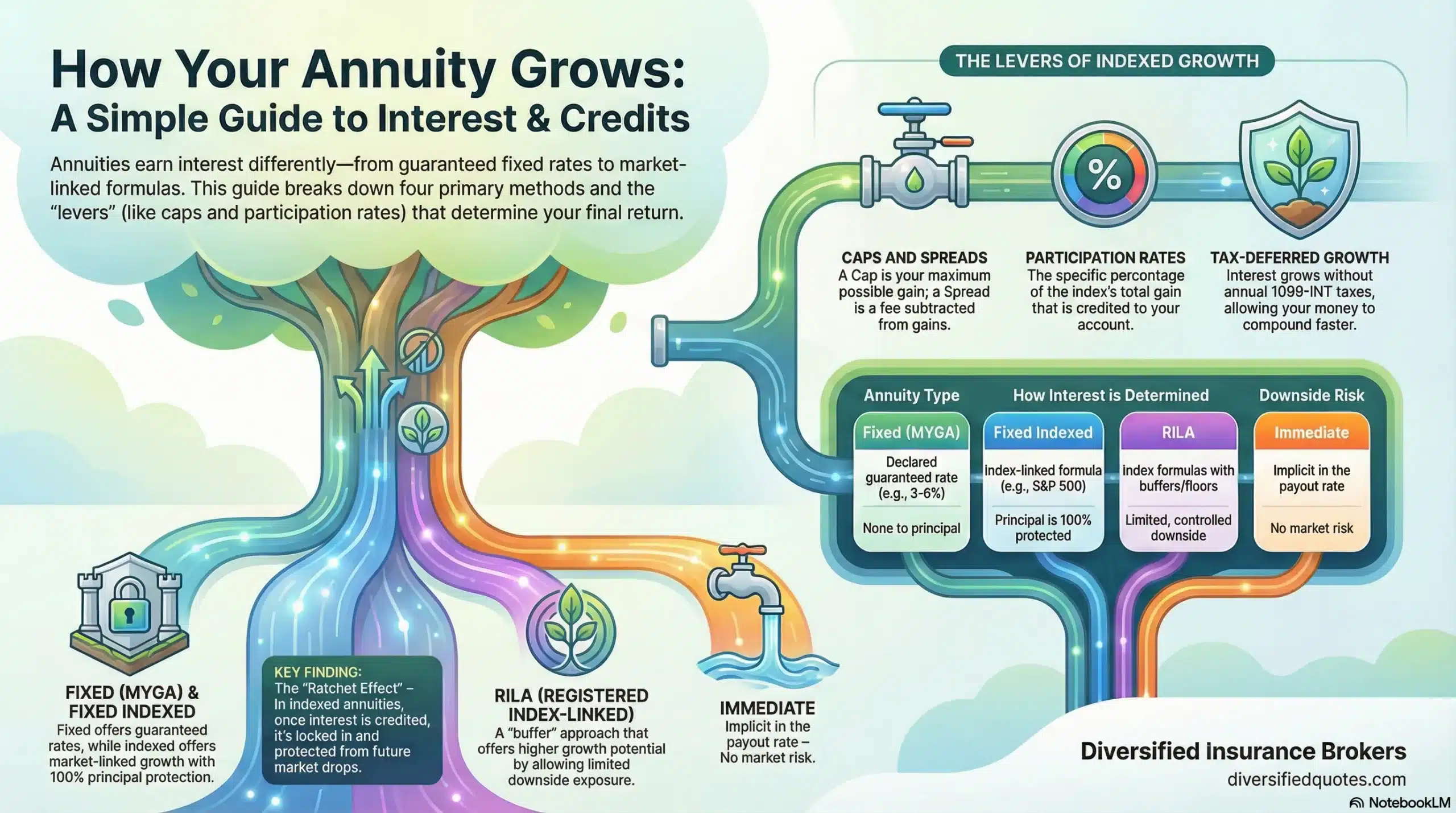
Cap Rates, Participation Rates, and Indexed Growth Potential
Many individuals exploring pension alternatives also want to preserve growth potential alongside guaranteed income. Fixed indexed annuities are frequently used in these situations because they combine principal protection with the ability to earn interest based on market index performance during the deferral phase. The indexed crediting mechanics — cap rates, participation rates, and spreads — determine how much of positive index performance is credited to the contract value. What is an annuity cap rate covers how cap rates limit upside crediting and how they compare across carriers and contract designs. What is an annuity participation rate covers how participation rates work as an alternative crediting structure and how a high participation rate without a cap differs from a cap-based design in terms of long-term accumulation potential.
Understanding that negative market performance does not reduce the principal value of a fixed indexed annuity is fundamental to understanding why these contracts work as pension alternatives rather than simply as market-linked investments. The floor — typically 0% minimum credited interest in a down market year — means that while the upside is capped or participation-limited, the downside is eliminated entirely. The index credits what it credits in positive years, and in negative years the contract simply credits 0% rather than reflecting the market loss. This asymmetry between protected downside and capped upside is precisely what allows fixed indexed annuities to accumulate an income base over time without the volatility that makes portfolio-based accumulation feel unreliable in years approaching income activation.
Carrier Selection and Financial Strength
When evaluating pension alternatives, the financial strength of the insurance carrier issuing the annuity is a foundational consideration — because a lifetime income guarantee is only as reliable as the company standing behind it. A carrier that commits to paying guaranteed income for the remainder of a 65-year-old’s life may be making payments for thirty or more years, across multiple economic cycles, interest rate environments, and investment market conditions. The carrier’s financial reserves, surplus ratios, investment portfolio quality, and AM Best financial strength rating all speak to its ability to fulfill that obligation across those timeframes. What an insurance company’s AM Best rating means covers how to interpret carrier financial strength ratings and what they indicate about a company’s ability to fulfill long-term income guarantees. Working with a brokerage that shops across many carriers allows individuals to compare multiple options and select annuity products issued by financially strong companies rather than being limited to a single carrier’s available products or a captive agent’s limited menu.
Coordinating Annuity Income With Social Security and the Overall Income Plan
Modern retirement planning emphasizes diversification not only across asset classes but also across income sources — and the most resilient retirement income plans combine multiple guaranteed income streams rather than relying on any single source for essential expense coverage. By combining Social Security benefits, annuity income from one or more contracts, and investment portfolio withdrawals for discretionary spending, retirees can build a balanced financial strategy that protects against multiple types of financial risk simultaneously. In this context, annuities serve as the foundational layer of income security — the guaranteed floor that does not depend on market conditions, portfolio performance, or withdrawal rate discipline.
The sequencing decision — when to activate annuity income relative to Social Security claiming and relative to the beginning of portfolio withdrawals — is one of the most consequential tactical decisions in the pension alternative strategy. Many retirees use annuity income during the gap between early retirement and Social Security claiming to bridge income needs while allowing Social Security to grow through delayed claiming credits, which increase the Social Security benefit by a defined percentage for each year claiming is deferred beyond the earliest eligibility age. Others choose to activate annuity income and Social Security simultaneously at retirement to immediately establish a fully guaranteed income floor that covers all essential expenses, leaving the investment portfolio entirely available for discretionary spending, long-term growth, and legacy planning without any withdrawal pressure. How Social Security and annuities work together covers the coordination framework that produces the most efficient combined income outcome across both sources.
Evaluating Pension Alternatives: What to Look For
While annuities are powerful pension alternatives, they should be evaluated carefully within the context of an overall retirement plan. Factors such as liquidity needs, retirement age, health status, tax situation, legacy goals, and the existing guaranteed income from Social Security or any remaining defined benefit pension all influence which annuity strategies may be appropriate and how much premium should be committed to guaranteed income versus retained in the investment portfolio for flexibility and growth. The objective is not to maximize the annuity’s income guarantee in isolation — it is to build a retirement income plan in which every component serves a defined role and the combined income structure covers essential expenses with guaranteed income while preserving growth and flexibility for discretionary needs.
Carrier financial strength, GLWB rollup rates and payout percentages, cap rates and participation rates on the indexed crediting, surrender charge schedules, free withdrawal provisions, return of premium death benefit options, and joint income continuation percentages are the primary contract-level variables that differentiate one pension alternative annuity from another. No single variable determines the best choice — the comparison must integrate all of these dimensions against the specific income need, time horizon, and flexibility requirement of the individual retirement plan. How to transfer a pension to an annuity covers the specific mechanics for retirees repositioning defined benefit lump sums. How to transfer a retirement account to an annuity covers the rollover process for 401(k), IRA, and other qualified plan assets. About Diversified Insurance Brokers covers our independent brokerage model and how working across more than 100 carriers allows the full competitive market comparison that produces the most appropriate contract for each client’s specific situation.
Compare Pension Alternative Income Strategies
Related Pages
Explore additional retirement income planning and annuity strategy resources.
Financial Protection Essentials
Income planning tools and protection strategies designed to strengthen long-term retirement security.
Talk With an Advisor Today
Choose how you’d like to connect—call or message us, then book a time that works for you.
Schedule here:
calendly.com/jason-dibcompanies/diversified-quotes
Licensed in all 50 states • Fiduciary, family-owned since 1980
Frequently Asked Questions: Pension Alternatives
How does an annuity replicate a traditional pension?
An annuity replicates a traditional pension by converting accumulated savings into a contractually guaranteed stream of income payments that continue for life — the same core function a defined benefit pension serves. With an income annuity, premium is exchanged for guaranteed monthly payments that begin immediately or at a future date, and the carrier assumes full longevity risk. With a fixed indexed annuity and a GLWB rider, the owner retains the account value during a deferral phase while earning indexed growth, then activates guaranteed lifetime withdrawals at a defined percentage of the income base — payments that continue for life even if the contract account value reaches zero. The key structural parallel to a pension is that the carrier assumes longevity risk: income payments continue regardless of how long the owner lives, just as a pension does, without the owner needing to self-insure against an unknown lifespan.
What is a Guaranteed Lifetime Withdrawal Benefit and how does it work?
A GLWB is a rider added to a fixed indexed annuity that creates a separate income base — sometimes called a withdrawal base or benefit base — that grows at a guaranteed rollup rate during the deferral years before income starts, independent of the contract’s actual account value performance. When income is elected, a guaranteed withdrawal percentage determined by the owner’s age at activation is applied to the income base to calculate the annual guaranteed income amount. That income payment continues for life regardless of what happens to the contract’s account value — even after the account value has been fully depleted, the carrier is contractually obligated to continue payments. Some designs include annual step-up features that lock in higher account values as a new income base when positive index performance has credited additional growth, permanently increasing the future income calculation floor.
What is the difference between an income annuity and a GLWB rider on a fixed indexed annuity?
An income annuity — whether a single premium immediate annuity or a deferred income annuity — exchanges premium for guaranteed income payments and typically does not retain an account value accessible outside of income payments. The premium is irrevocably committed in exchange for the income guarantee. A fixed indexed annuity with a GLWB rider retains the account value during a deferral phase, allows free withdrawals up to the contractual limit, and activates guaranteed income when elected — while the account value remains available for surrender or death benefit purposes subject to surrender charges. The income annuity typically produces a higher payout rate for the same premium because less flexibility is retained. The FIA with GLWB preserves more optionality, provides indexed growth potential before income begins, and retains an account value that can be accessed or left as a death benefit.
How does annuity income coordinate with Social Security as a pension alternative strategy?
Annuity income and Social Security serve complementary roles in a pension alternative income strategy. Social Security provides an inflation-adjusted lifetime income foundation that begins at the elected claiming age. Annuity income provides a second guaranteed layer that covers essential expenses Social Security alone may not fully address. The sequencing decision — when to activate annuity income relative to Social Security claiming — is one of the most important tactical decisions in the strategy. Many retirees use annuity income during the gap between retirement and Social Security claiming to bridge income needs while allowing Social Security to grow through delayed claiming credits. Others activate both simultaneously to immediately establish a fully guaranteed income floor that covers all essential expenses, leaving investment portfolios entirely available for discretionary spending, growth, and legacy planning without any withdrawal pressure.
How do I evaluate which pension alternative annuity is right for me?
Evaluating pension alternative annuity options starts with defining the primary objective — maximum immediate income, income with growth potential during a deferral period, or a combination of guaranteed income and retained liquidity. Income annuities produce the highest guaranteed payout for a given premium when maximum income is the priority and liquidity is not needed. Fixed indexed annuities with GLWB riders produce somewhat lower initial income but provide indexed growth potential, free withdrawal access, and death benefits during the deferral phase. The carrier’s financial strength rating, the GLWB rollup rate and payout percentages, the cap and participation rate structure, the free withdrawal provisions, and the joint income continuation percentage all affect the comparison. Working with an independent brokerage that shops across more than 100 carriers allows the comparison to cover the full competitive market rather than being limited to what a single carrier can offer.
About the Author:
Jason Stolz, CLTC, CRPC, DIA, CAA and Chief Underwriter at Diversified Insurance Brokers (NPN 20471358), is a senior insurance and retirement professional with more than 25 years of real-world experience helping individuals, families, and business owners protect their income, assets, and long-term financial stability. As a long-time partner of the nationally licensed independent agency Diversified Insurance Brokers, Jason provides trusted guidance across multiple specialties—including fixed and indexed annuities, long-term care planning, personal and business disability insurance, life insurance solutions, Group Health, Travel Medical and Evacuation Insurance, and short-term health coverage. Diversified Insurance Brokers maintains active contracts with over 100 highly rated insurance carriers, ensuring clients have access to a broad and competitive marketplace.
His practical, education-first approach has earned recognition in publications such as VoyageATL, and contributions from his agency featured in Kiplinger and GoBankingRates— highlighting his commitment to financial clarity and client-focused planning. Drawing on deep product knowledge and years of hands-on field experience, Jason helps clients evaluate carriers, compare strategies, and build retirement and protection plans that are both secure and cost-efficient. Visitors who want to explore current annuity rates and compare options across multiple insurers can also use this annuity quote and comparison tool.
Explore More Annuity Options: Browse our complete guide to Annuities 101 — covering annuity education, planning guides, pros & cons, how to choose & buy from 100+ carriers.
Explore More: Browse our complete Lifetime Income Planning guide — covering retirement income strategies, account transfers & annuity income solutions from 100+ carriers.
Last Reviewed: June 16, 2026 |
Reviewed by: Jason Stolz, CLTC, CRPC, DIA, CAA
Chief Underwriter, Diversified Insurance Brokers, Inc. | NPN: 20471358 | Diversified Insurance Brokers, Inc. — Licensed in all 50 states
Fact Checked by: Tonia Pettitt, CMIP©
Medicare Specialist, Diversified Insurance Brokers, Inc. | NPN: 14374308 | Diversified Insurance Brokers, Inc. — Licensed in all 50 states
Did you find this content helpful? Leave us a Google review — it helps others find trustworthy guidance too.
Editorial Standards: Diversified Insurance Brokers maintains rigorous editorial standards to ensure accuracy, clarity, and independence in all content. Learn more about our editorial standards and commitment to transparency.
