
American Equity AssetShield 10 Annuity – Market Growth Without Market Risk
As an Independent Annuity Broker, we compare rates across 100+ carriers and 1,000 different annuities— not just one company’s product offerings — to find the best fit for your goals.
American Equity AssetShield 10 Annuity – Market Growth Without Market Risk
The American Equity AssetShield 10 is a flexible premium deferred fixed indexed annuity issued by American Equity Investment Life Insurance Company — one of the largest fixed indexed annuity issuers in the United States. It is built for savers who want long-term accumulation without exposing principal to stock market volatility — combining a 10-year surrender period, 24 crediting strategy options across seven indices, principal protection from negative market returns, optional performance enhancement through the Performance Rate Rider, and health-based liquidity provisions through the Enhanced Benefit Rider. At Diversified Insurance Brokers, Jason Stolz, CLTC, CRPC, DIA, CAA helps pre-retirees and retirees evaluate whether AssetShield 10’s index breadth, no-bonus accumulation structure, and liquidity features fit their specific planning timeline and income objectives — and compares it against competing FIA designs and the American Equity AssetShield Bonus series when overall outcome matters more than any single product feature.

Market cycles are unpredictable. Many investors nearing retirement discover that preserving gains becomes more important than chasing returns. Large market losses late in the accumulation phase can significantly reduce sustainable retirement income. A fixed indexed annuity addresses that concern by providing a 0% floor against market declines (subject to contract terms), while still allowing interest credits tied to external index performance. Over time, avoiding losses can be just as powerful as capturing gains because compounding works best when principal is not repeatedly reduced during downturns. Our resource on sequence of returns risk covers the specific vulnerability that makes early-retirement market declines permanently damaging — and why the 0% floor on each indexed crediting period removes the most financially destructive scenario for accounts that begin withdrawals within a few years of market corrections. Our resource on how a fixed indexed annuity works covers the foundational mechanics — how interest is credited based on index performance without direct market investment, how the annual reset locks in gains, and how the protection-first framework differs structurally from variable annuities and direct market accounts.
Ensure you are receiving the absolute top rates
Current Fixed Annuity Rates
Compare today’s best fixed annuity rates from top carriers.
Current Bonus Annuity Rates
See which annuities offer the highest upfront bonus today.
Request an Annuity Quote
Submit our annuity request form to get personalized rate options.
Lifetime Income Calculator
Use our calculator to see how much guaranteed income your annuity can provide based on your age and premium amount.
AssetShield 10 — Product Specifications at a Glance
The table below summarizes the confirmed contract parameters for the American Equity AssetShield 10 based on official product documentation and third-party reviews reflecting the rate sheet. Crediting rates, participation rates, cap rates, and spreads are subject to carrier adjustment and vary by state. Contact us for the current rate sheet and complete product details before any purchase decision.
| Feature | Details |
|---|---|
| Contract Type | Flexible Premium Deferred Fixed Indexed Annuity — accumulation-focused |
| Issuer | American Equity Investment Life Insurance Company, West Des Moines, Iowa |
| Surrender Period | 10 years; surrender charges apply to withdrawals exceeding the free withdrawal amount — verify current schedule with carrier documentation |
| Premium Bonus | None — base AssetShield 10 has no premium bonus. The AssetShield 10 Bonus version provides a 14% first-year premium bonus with a different crediting rate structure. |
| Minimum Guaranteed Interest Rate (MGIR) | 2.65% — used for surrender value calculation; establishes the contractual floor on what is received if the contract is surrendered during the surrender period |
| Index Options | 7 indices: S&P 500®; NYSE Premier Index; Nasdaq Premier Index; BlackRock Adaptive U.S. Equity 7% Index; BNPP Patriot Technology Index; S&P 500 Dividend Aristocrats® Daily RC 5% ER Index; S&P 500 Advantage 15% VT TCA Index |
| Total Crediting Strategies | 24 total: 23 indexed + 1 fixed rate. Strategy counts per index: S&P 500 (4), NYSE Premier (4), Nasdaq Premier (4), BlackRock Adaptive (2), BNPP Patriot (2), Dividend Aristocrats (2), S&P 500 Advantage 15% VT TCA (5) |
| Crediting Formula Types | Participation rates, cap rates, spread-based strategies, and replacement rate strategies — varies by index and strategy option selected |
| Free Withdrawal Allowance | 10% of contract value annually (noncumulative); begins in year 2. Systematic withdrawal of interest only from the Fixed Value account available after 30 days from contract issue. |
| Market Value Adjustment (MVA) | Applies to partial withdrawals exceeding the free withdrawal amount and to surrenders during the surrender charge period; can be positive or negative depending on interest rate environment at time of withdrawal |
| Performance Rate Rider (PRR) | Optional rider that increases cap rate, participation rate, or replacement rate on elected indexed crediting strategies. Rider fee locked in for the surrender charge period and deducted on the last day of each crediting term regardless of index performance. |
| Enhanced Benefit Rider | Provides penalty-free access to the full contract value upon qualifying nursing home confinement or terminal illness diagnosis |
| Death Benefit | Full contract value paid to beneficiaries without surrender charges; bypasses probate in most states |
| Qualified Funding Sources | Traditional IRA, Roth IRA, 401(k) rollover, 403(b) rollover, and other qualified plan assets; non-qualified funds accepted. Non Qualified sources also accepted. |
| California Availability | A California-specific product option is available with state-specific form series; California contract features may differ — verify with current documentation |
The No-Bonus Architecture — Why It Matters for Crediting Rates
The base AssetShield 10 carries no premium bonus — a structural choice that directly affects crediting rates. When a carrier offers a premium bonus, they typically offset the cost of that bonus by reducing the participation rates, cap rates, or crediting rate quality available on the indexed strategies. The AssetShield 10 Bonus version provides a 14% first-year premium bonus but with a correspondingly adjusted crediting rate structure. The base AssetShield 10 redirects that cost savings directly into stronger indexed crediting rates, making it typically more competitive for accumulation-focused investors who expect to hold the full 10-year period and want to maximize index-linked growth potential rather than receiving an upfront credit that is partially offset by reduced crediting over the contract term. For investors weighing the bonus vs. no-bonus decision, our resource on what is a bonus annuity vesting schedule covers how premium bonuses are structured, when they vest fully, and how to evaluate the true economic value of a bonus relative to the surrender period commitment and the crediting rate comparison it requires.
Index Strategy Breadth — 24 Options Across Seven Indices
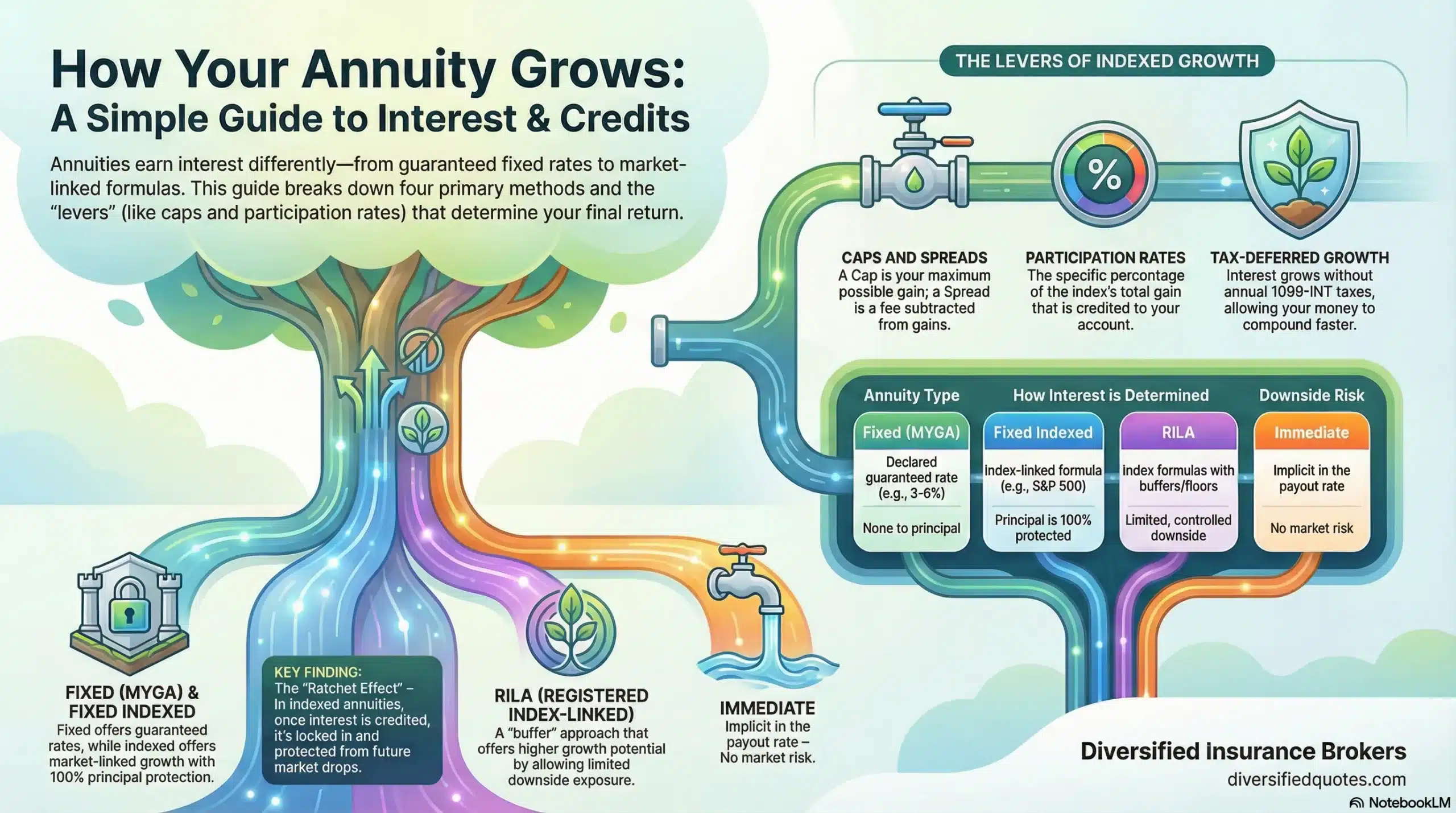
One of AssetShield 10’s most distinctive competitive features is its index strategy breadth. Most FIA products offer 3–5 indexed strategies; the AssetShield 10 offers 24 (23 indexed plus one fixed rate) built across seven different index methodologies. This breadth allows meaningful diversification within a single contract — allocating premium across different index philosophies, crediting structures, and volatility profiles rather than concentrating on a single index and crediting method. Our resource on index annuity crediting methods covers the mechanics of participation rates, cap rates, spreads, and replacement rates — essential context for evaluating which of the 24 strategies best fits a specific accumulation timeline and risk preference.
The S&P 500® Index needs little introduction — tracking 500 large-cap U.S. publicly traded stocks (excluding dividends), it provides the most direct broad-market exposure and the longest historical performance record available in an FIA context. AssetShield 10 offers four distinct S&P 500 strategies, giving investors multiple entry points for S&P 500 exposure within a single contract. The NYSE Premier Index and Nasdaq Premier Index similarly offer four strategies each — providing exposure to NYSE-listed and Nasdaq-listed companies through structured, rules-based index designs. These three broad-market indices represent the majority of the contract’s strategy count and typically serve as the primary allocation options for investors who want familiar, well-understood market exposure as the foundation of their indexed crediting.
The BlackRock Adaptive U.S. Equity 7% Index, available in two strategies, is a risk-controlled index developed by BlackRock that dynamically adjusts exposure to market conditions using adaptive allocation models designed to manage volatility around a 7% annualized target. The dynamic adjustment is designed to reduce the impact of extreme volatility events on the index level — producing smoother performance patterns compared to a static equity index. The BNPP Patriot Technology Index, available in two strategies, provides exposure to innovative sectors within a rules-based framework developed by BNP Paribas. Technology and innovation-economy sectors have been among the strongest performers over multi-decade periods, but they also exhibit higher short-term volatility than broad market indices. The FIA contract’s 0% floor removes the downside volatility that makes direct technology-sector investment challenging for risk-averse retirement savers, while the participation-rate-based crediting captures a defined portion of the sector’s upside.
The S&P 500 Dividend Aristocrats® Daily Risk Control 5% ER Index, available in two strategies, focuses on companies within the S&P 500 that have increased dividends for at least 25 consecutive years — typically representing financially stable, large-cap companies with consistent earnings. The daily risk control mechanism and 5% excess return targeting build in volatility management that limits both upside capture and downside exposure compared to the broader S&P 500. The S&P 500 Advantage 15% VT TCA Index, available in five strategies — the largest single-index strategy count in the contract — provides the highest number of crediting options for a single index methodology. The VT (Volatility Target) and TCA (Total Control Account) components represent volatility targeting and allocation control mechanisms designed to manage the index level within defined volatility parameters. Five separate strategy options built on this single index allow investors to fine-tune their participation rate, crediting term, and strategy type within the VT TCA methodology.
The Performance Rate Rider — Enhanced Crediting at a Fee
The Performance Rate Rider (PRR) is an optional enhancement that can materially change the crediting outcome of the indexed strategies. When selected, it provides higher participation rates, higher cap rates, or higher replacement rates on the elected indexed strategies — effectively increasing the amount of index performance that translates into credited interest. The tradeoff is a rider fee that is locked in for the full surrender charge period and deducted on the last day of each crediting term. The fee applies regardless of whether any interest was credited in that term — meaning in a year where the index performs negatively and the contract credits 0%, the PRR fee still reduces the contract value. Growth in PRR-enabled strategies must exceed the rider fee for the account value to increase in a given term. The economic decision to elect the PRR depends on whether the crediting rate enhancement is large enough and the expected frequency of positive index years sufficient to produce a higher net accumulated value over the full 10-year period compared to the base strategy rates without the fee. Reviewing the PRR and base strategy rates side by side with current carrier documentation — and modeling scenarios across different market environments — is the appropriate way to evaluate whether the fee is justified for a specific investor’s return expectations and time horizon. Our resource on fixed indexed annuity pros and cons covers the broader tradeoff framework for evaluating optional riders and features against their cost and expected benefit.
Minimum Guaranteed Interest Rate and Surrender Value
The AssetShield 10 includes a Minimum Guaranteed Interest Rate of 2.65%, which is used specifically for the surrender value calculation during the surrender charge period. If the contract is surrendered before the 10-year period ends, the surrender value is calculated as though a 2.65% interest rate had been applied to premiums since contract issue — then adjusted for the applicable surrender charge and any MVA. The MGIR creates a contractual floor for the surrender value: the contract holder will receive at least this calculated minimum regardless of actual index performance. This is distinct from the Accumulated Value (which reflects actual credited interest) and provides a defined worst-case scenario for early surrender planning. For a comprehensive explanation of how surrender charge schedules decline over time and how MVA interacts with early surrenders, our resource on annuity surrender charges explained covers the full mechanics.
Liquidity Provisions — Free Withdrawals and Health-Based Access
Beginning in the second contract year, up to 10% of the contract value may be withdrawn annually without surrender charges or MVA (noncumulative — unused allowance does not roll over). For systematic income needs in the first year, interest credited to the Fixed Value account may be withdrawn without charges after 30 days from contract issue. The Enhanced Benefit Rider provides more significant liquidity access: in the case of qualifying nursing home confinement or terminal illness, the full contract value becomes accessible without surrender charges. This addresses the two scenarios where a retiree’s financial needs most likely exceed the annual 10% provision. For details on how the annual free withdrawal provision works operationally — including how the 10% is calculated, when it resets, and how multiple withdrawals in a single year are treated — our resource on annuity free withdrawal rules covers the standard mechanics. For clients who may need a shorter commitment period, our resource on short-term annuity options for retirees covers FIA designs with 5-to-7-year surrender schedules that may better fit a specific timeline.
Tax Deferral and Distribution Planning
Non-qualified annuities grow without annual taxation on credited interest, potentially accelerating compounding compared to taxable accounts. Withdrawals from non-qualified contracts are taxed on a last-in, first-out basis, meaning earnings are withdrawn first. For qualified accounts, taxation occurs upon distribution as ordinary income, consistent with standard IRA and qualified plan distribution rules. Coordinating withdrawals with Social Security timing, pension income, and Required Minimum Distributions can improve long-term tax efficiency. Reviewing broader legislative developments, including recent federal adjustments discussed in our resource on current tax law changes, can help retirees understand how evolving policies may affect retirement income planning. Our resource on are annuities worth it covers the evidence-based evaluation of when the tax-deferred accumulation advantage translates into a meaningfully better after-tax outcome relative to alternatives.
Rollover Strategy — Funding AssetShield 10 With Qualified Assets
AssetShield 10 accepts rollovers and direct transfers from traditional IRAs, Roth IRAs, 401(k) plans, 403(b) plans, and other qualified retirement plan assets, in addition to non-qualified premium contributions. For individuals transferring retirement funds, proper rollover execution ensures tax deferral is preserved and no unintended distribution occurs. The direct trustee-to-trustee transfer mechanism avoids the 60-day rollover window and the 20% mandatory withholding that applies to indirect rollovers. Our resource on how to transfer an IRA to an annuity covers the specific steps, documentation, and timing considerations. Our resource on how to transfer a 401(k) to an annuity covers the equivalent process for employer plan rollovers. For clients comparing multiple carriers’ FIA products before committing to AssetShield 10, our resource on how to pick the right annuity covers the objective-first decision framework that consistently produces better match quality than selecting a product and fitting a goal to it afterward. Our resource on working with an independent annuity broker covers why comparing multiple carriers simultaneously — rather than working with a single carrier — produces better outcomes for any given premium amount and time horizon.
Who AssetShield 10 Is Designed For
AssetShield 10 is designed for long-term accumulators who have a genuine 10-year time horizon for the allocated funds, want the breadth of 24 crediting strategies across seven indices, prefer no upfront premium bonus in exchange for stronger crediting rates, and value principal protection from market losses above growth maximization. It fits pre-retirees and retirees repositioning assets from maturing CDs, equity-heavy portfolios approaching a deleveraging phase, or shorter-surrender FIAs that have completed their surrender period. AssetShield 10 can function as part of a layered retirement approach — some retirees combine Social Security, pension income (our resource on how defined benefit plans function explains why that guaranteed income floor is so valuable), and annuity-based accumulation to build toward future income while keeping discretionary spending in a market-based portfolio. Our resource on who is best suited for an indexed annuity covers the investor profile characteristics that most consistently align with FIA design. The death benefit pays the full contract value to beneficiaries outside of probate in most states, making AssetShield 10 both a retirement accumulation vehicle and a structured estate planning component.
Some policyholders evaluate liquidity alternatives — such as selling an existing life insurance policy — to redeploy capital into income-generating strategies, or assess whether protection products like term life insurance better address their current goal versus accumulation. For clients interested in understanding how guaranteed lifetime income riders work alongside or instead of accumulation-focused FIAs, our resource on guaranteed lifetime withdrawal benefits explained covers the income rider mechanics relevant when evaluating whether to add a lifetime income layer alongside AssetShield 10’s accumulation strategy. Our resource on what is a Pension Protection Act PPA annuity covers the adjacent structure for clients who want to coordinate their FIA allocation with potential tax-free long-term care benefit payments.
Request a Personalized AssetShield 10 Comparison
We compare AssetShield 10 against other carriers and the AssetShield Bonus series — current crediting rates, surrender schedules, and long-term accumulation projections matched to your timeline and premium.
Request a Comparison Call 800-533-5969Related Pages to Explore
Rollover mechanics, defined benefit plan context, life settlement education, and foundational retirement planning resources.
Talk to an Advisor or Request Your Annuity Quote
Ready to explore this annuity in more detail—or compare it with other carriers to see if even higher rates are available? With guaranteed income, principal protection, and long-term growth potential on the line, making the right choice is essential. The experienced advisors at Diversified Insurance Brokers will guide you through the options and design a strategy tailored to your retirement goals.
Schedule here:
calendly.com/jason-dibcompanies/diversified-quotes
Licensed in all 50 states • Fiduciary, family-owned since 1980
FAQs: American Equity AssetShield 10
What is American Equity AssetShield 10?
AssetShield 10 is a flexible premium deferred fixed indexed annuity issued by American Equity Investment Life Insurance Company with a 10-year surrender period. It focuses on long-term accumulation through principal protection and index-linked crediting strategies — offering 24 total crediting options (23 indexed strategies across 7 indices, plus one fixed rate account). The contract carries no premium bonus in the base version, which typically results in more competitive indexed crediting rates compared to the bonus version. It includes an optional Performance Rate Rider for enhanced crediting at a fee, and an Enhanced Benefit Rider for health-based full-value access.
How does AssetShield 10 credit interest?
Interest is credited based on the performance of the selected index and crediting strategy. The crediting formula type varies by strategy: some use participation rates (a percentage of the index return is credited), some use cap rates (interest is credited up to a maximum cap), and some use spread-based methods (the index return minus a defined spread is credited). A replacement rate method is also available on certain strategies. The specific participation rates, caps, and spreads for each strategy are declared by American Equity periodically and are subject to change at renewal within contractual limits. Regardless of which strategy is selected and regardless of index performance, if the index declines in a given crediting period, the credit for that period is 0% — not negative — ensuring principal protection from market losses.
Are there any upfront bonuses with AssetShield 10?
No — the base AssetShield 10 does not include a premium bonus. This is a deliberate design choice that typically allows American Equity to offer stronger indexed crediting rates on the base contract compared to the AssetShield 10 Bonus version, which provides a 14% first-year premium bonus but at correspondingly adjusted crediting rates. Whether the bonus or no-bonus structure produces better long-term accumulation depends on the specific crediting rate differentials, the length of time the contract is held, and how much of the premium is expected to remain in the contract through the full 10-year period. For investors who value maximum accumulation potential over the full term rather than an upfront credit, the base AssetShield 10 is typically the stronger choice. For investors who value the immediate boost to accumulated value from day one, the Bonus version may better fit their planning approach.
Can I make penalty-free withdrawals?
Yes. Beginning in the second contract year, up to 10% of the contract value may be withdrawn annually without surrender charges or Market Value Adjustment. This allowance is noncumulative — unused amounts do not carry over to subsequent years. Systematic withdrawal of interest only from the Fixed Value account is available after 30 days from contract issue. Withdrawals that exceed the free withdrawal amount during the 10-year surrender period are subject to surrender charges and potentially MVA. The Enhanced Benefit Rider provides an exception: if a qualifying nursing home confinement or terminal illness occurs, the full contract value becomes accessible without surrender charges regardless of where the contract is in the surrender period.
What is the Minimum Guaranteed Interest Rate and how does it affect me?
The Minimum Guaranteed Interest Rate (MGIR) of 2.65% is used to calculate the surrender value during the surrender charge period. If the contract is surrendered before the 10-year period ends, the surrender value is calculated as if the premium had been credited at 2.65% since issue — then adjusted for the applicable surrender charge and any Market Value Adjustment. This creates a contractual floor: even if surrendered early, the contract holder receives at least the value implied by 2.65% annual crediting minus the surrender charge and MVA, not zero. In practice, if the indexed strategies have credited meaningful interest, the Accumulated Value will typically be significantly above the MGIR-based floor — but understanding the floor provides clarity on the worst-case early surrender scenario.
What is the Performance Rate Rider and should I elect it?
The Performance Rate Rider (PRR) is an optional feature that increases the participation rate, cap rate, or replacement rate on selected indexed crediting strategies. The enhancement is meaningful — it can significantly increase the amount of index performance that translates into credited interest in positive market years. The tradeoff is a rider fee that is locked in for the full surrender charge period and deducted on the last day of each crediting term, regardless of whether any interest was credited in that term. In zero-credit years (when the index performs negatively), the PRR fee reduces the contract value without any offsetting interest credit. Whether to elect the PRR depends on the specific fee amount, the size of the crediting rate enhancement, and the expected frequency of positive crediting years over the 10-year period. Reviewing the current PRR fee and both the base and PRR-enhanced crediting rates side by side — and stress-testing across different market return scenarios — is the appropriate evaluation process before electing or declining this rider.
Is AssetShield 10 a good option for retirement income?
AssetShield 10 is primarily built for accumulation rather than immediate income generation. It does not include a guaranteed lifetime withdrawal benefit (GLWB) income rider as a standard or optional feature. Income can be taken through the 10% annual free withdrawal provision, through structured withdrawals after the surrender period ends, or through annuitization. For clients whose primary objective is guaranteed lifetime income, comparing AssetShield 10 against FIA designs that include built-in lifetime income riders will likely produce better income outcomes for the same premium. AssetShield 10 is most effective as the accumulation layer in a broader retirement income strategy — growing protected assets during the pre-income phase and then being repositioned or annuitized at the end of the 10-year period when income is needed. Combining it with other guaranteed income sources (Social Security, pension if available, or a separate income annuity) aligns with strategies described in our resource on retirement income annuity options.
What are the drawbacks or trade-offs?
The primary trade-offs of AssetShield 10 are the 10-year surrender period commitment, the crediting method limitations (caps, participation rates, and spreads limit upside in strong bull markets compared to direct equity investment), and the optional Performance Rate Rider fee that reduces accumulated value in flat or negative years if elected. The 10-year commitment means significant early surrender will trigger surrender charges and MVA, making AssetShield 10 inappropriate for funds that may be needed within the surrender period beyond the annual 10% free withdrawal. The crediting method limitations are the direct tradeoff for principal protection — the same features that prevent losses also cap or limit gains relative to what unrestricted market participation would produce in strong bull markets. The MVA can be negative in rising interest rate environments, reducing the surrender value below the Accumulated Value if the contract is surrendered early in a rising rate environment. These tradeoffs are not defects — they are the expected characteristics of a principal-protection accumulation structure — but they require clear-eyed evaluation to ensure the product fits the specific planning situation.
How many index strategy options does AssetShield 10 offer?
AssetShield 10 offers 24 total crediting strategies: 23 indexed strategies across seven indices, plus one fixed rate account. The seven indices are the S&P 500®, NYSE Premier Index, Nasdaq Premier Index, BlackRock Adaptive U.S. Equity 7% Index, BNPP Patriot Technology Index, S&P 500 Dividend Aristocrats® Daily Risk Control 5% ER Index, and S&P 500 Advantage 15% VT TCA Index. Strategy counts per index: S&P 500 (4 strategies), NYSE Premier (4), Nasdaq Premier (4), BlackRock Adaptive (2), BNPP Patriot (2), S&P 500 Dividend Aristocrats (2), and S&P 500 Advantage 15% VT TCA (5). This breadth of options is among the largest in the FIA market and allows meaningful diversification within a single contract across different index philosophies, crediting structures, and volatility profiles. Premium may be allocated across multiple strategies simultaneously in any proportion.
Who should consider AssetShield 10?
AssetShield 10 is best suited for conservative to moderate savers, pre-retirees, or retirees who have a genuine 10-year time horizon for the allocated funds and want a combination of principal protection, tax-deferred accumulation, and the potential upside of indexed crediting — without an upfront bonus. The no-bonus structure is most advantageous for investors who intend to hold the full term and want the highest possible crediting rates on the indexed strategies rather than an upfront credit that adjusts those rates downward. It is particularly well suited for investors who value the breadth of 24 crediting strategies across seven indices, allowing meaningful diversification within a single contract. It is not the right fit for clients who need significant liquidity beyond the annual 10% free withdrawal during the 10-year period, clients who prioritize immediate guaranteed income (this is accumulation-focused), or clients who want unrestricted market participation without any crediting caps or participation rate limitations.
How can I compare AssetShield 10 with other annuities?
A meaningful comparison of AssetShield 10 against competing FIA products should include: crediting strategy details (current participation rates, cap rates, and spreads on each strategy), the Performance Rate Rider’s fee and enhancement at current rates, the surrender charge schedule for the full 10-year period, the MGIR and how it compares across carriers, the Enhanced Benefit Rider terms and qualifying conditions, and historical renewal rate performance. Many carriers advertise attractive first-year rates that reset to lower levels at renewal — understanding the carrier’s renewal rate history and the contractual minimum parameters is as important as the initial crediting rates. Our resource on current annuity rates provides a benchmark for comparing rate environments across carriers. Working with an independent broker who accesses multiple carriers simultaneously and can run side-by-side illustrations with current rate sheets produces consistently better comparison quality than evaluating any single carrier’s positioning of its own product.
Can I fund AssetShield 10 with IRA or 401(k) assets?
Yes. AssetShield 10 accepts direct rollovers and transfers from traditional IRAs, Roth IRAs, 401(k) plans, 403(b) plans, SEP IRAs, and other qualified retirement plan assets, as well as non-qualified (after-tax) premium contributions. The direct trustee-to-trustee transfer method preserves tax deferral and avoids both the 60-day rollover window and the 20% mandatory withholding that applies to indirect rollovers. The contract code (qualified vs. non-qualified) affects how distributions are taxed at withdrawal — qualified annuity distributions are taxed as ordinary income in full, while non-qualified annuity distributions use the last-in-first-out method where earnings are taxed first. Confirming the correct contract coding and understanding the tax implications before initiating a transfer — with both the existing custodian and your tax advisor — prevents errors that cannot be easily corrected once the transfer is complete.
About the Author:
Jason Stolz, CLTC, CRPC, DIA, CAA and Chief Underwriter at Diversified Insurance Brokers (NPN 20471358), is a senior insurance and retirement professional with more than 25 years of real-world experience helping individuals, families, and business owners protect their income, assets, and long-term financial stability. As a long-time partner of the nationally licensed independent agency Diversified Insurance Brokers, Jason provides trusted guidance across multiple specialties—including fixed and indexed annuities, long-term care planning, personal and business disability insurance, life insurance solutions, Group Health, Travel Medical and Evacuation Insurance, and short-term health coverage. Diversified Insurance Brokers maintains active contracts with over 100 highly rated insurance carriers, ensuring clients have access to a broad and competitive marketplace.
His practical, education-first approach has earned recognition in publications such as VoyageATL, and contributions from his agency featured in Kiplinger and GoBankingRates— highlighting his commitment to financial clarity and client-focused planning. Drawing on deep product knowledge and years of hands-on field experience, Jason helps clients evaluate carriers, compare strategies, and build retirement and protection plans that are both secure and cost-efficient. Visitors who want to explore current annuity rates and compare options across multiple insurers can also use this annuity quote and comparison tool.
Explore More Annuity Options: Browse our complete guide to Best Fixed Indexed Annuity Products — covering individual fixed indexed annuity product reviews from top-rated carriers from 100+ carriers.
Last Reviewed: September 19, 2026 |
Reviewed by: Jason Stolz, CLTC, CRPC, DIA, CAA
Chief Underwriter, Diversified Insurance Brokers, Inc. | NPN: 20471358 | Diversified Insurance Brokers, Inc. — Licensed in all 50 states
Fact Checked by: Tonia Pettitt, CMIP©
Medicare Specialist, Diversified Insurance Brokers, Inc. | NPN: 14374308 | Diversified Insurance Brokers, Inc. — Licensed in all 50 states
Did you find this content helpful? Leave us a Google review — it helps others find trustworthy guidance too.
Editorial Standards: Diversified Insurance Brokers maintains rigorous editorial standards to ensure accuracy, clarity, and independence in all content. Learn more about our editorial standards and commitment to transparency.
