
American Equity AssetShield 10 Bonus Annuity – 14% Premium Bonus With Protected Growth
As an Independent Annuity Broker, we compare rates across 100+ carriers and 1,000 different annuities— not just one company’s product offerings — to find the best fit for your goals.
American Equity AssetShield 10 Bonus Annuity – 14% Premium Bonus With Protected Growth
At Diversified Insurance Brokers, we help clients build retirement strategies where growth potential and principal protection work together rather than in opposition. The AssetShield 10 Bonus Fixed Index Annuity, issued by American Equity Investment Life Insurance Company, is a flexible-premium deferred FIA built around a 14% upfront premium bonus and a diversified index menu — with one important structural characteristic that sets it apart from many competing bonus FIAs: this is an accumulation-focused contract with no built-in income rider. For buyers whose primary objective is growing a protected retirement asset base over a 10-year period — rather than converting that base into guaranteed lifetime withdrawals through a built-in rider — the AssetShield 10 Bonus eliminates the income rider fee drag entirely, keeping all credited interest working in the accumulation value. Investors comparing this structure against products with mandatory income riders should also review how annuities compare to 401(k)s in retirement to understand where this type of accumulation vehicle fits within a broader asset allocation.

Ensure you are receiving the absolute top rates
Current Fixed Annuity Rates
Compare today’s highest fixed annuity rates from top-rated carriers.
Current Bonus Annuity Rates
See which annuities offer competitive upfront premium bonuses.
Request an Annuity Quote
Submit our annuity request form to get personalized rate options.
Lifetime Income Calculator
Estimate how much guaranteed income your annuity could provide in retirement.
American Equity AssetShield 10 Bonus: Key Product Features at a Glance
| Product Feature | Details |
|---|---|
| Issuing Carrier | American Equity Investment Life Insurance Company. West Des Moines, Iowa. Founded 1995. AM Best: A (Excellent). Over $61.1 billion in total assets. Not FDIC insured. All guarantees backed by claims-paying ability of American Equity Investment Life Insurance Company. |
| Product Type | Flexible-premium deferred fixed index annuity. 10-year surrender charge period. MVA applies on excess withdrawals. Accumulation-focused — no built-in guaranteed lifetime income rider. No mandatory income rider fee. Additional premiums accepted at any time without extending the surrender charge period. Not available in California under this form; CA has a separate version. Availability varies by state. |
| 14% Premium Bonus | 14% of all first-year premium payments credited to the contract value at issue. Vesting schedule: beginning in Year 2, 10% of the bonus becomes guaranteed annually until 100% vested at end of Year 10. In the event of death, 100% of the bonus is vested as of the contract date regardless of where the buyer is in the vesting schedule — the full contract value including the entire bonus passes to beneficiaries. Excess withdrawals or surrender before the vesting schedule completes result in forfeiture of unvested bonus amounts. Note: cap and participation rates may be lower on the Bonus version than on the non-bonus AssetShield 10 — the bonus is economically offset through crediting rate adjustments. |
| Optional Enhanced Bonus & Liquidity Rider (EBLR) | Optional rider (fee applies) that replaces the standard 14% bonus with a 21% premium bonus. Also modifies the liquidity structure: standard contract allows interest-only withdrawals from the fixed account in Year 1 (after 30 days) then 10% of contract value annually from Year 2; EBLR allows 2% in Year 1 and 12% of contract value annually from Year 2 onward. EBLR withdrawals within the 2%/12% provision do not impact the vesting schedule for the bonus. Evaluate whether the higher bonus and enhanced liquidity justify the additional rider fee compared to the standard 14% bonus version. |
| Free Withdrawal Provision | Standard contract: Year 1 — interest-only withdrawals from the fixed account available after 30 days. Year 2 and beyond — up to 10% of contract value annually, non-cumulative, without surrender charges. RMDs from qualified accounts are penalty-free. MVA applies on withdrawals above the free amount during the surrender period. With EBLR: 2% in Year 1 and 12% annually from Year 2. |
| Optional Performance Rate Rider (PRR) | Optional rider that increases the cap, participation rate, or replacement rate on elected index-linked crediting strategies. Rider fee: 1.5% for monthly and annual point-to-point strategies; 3% for 2-year point-to-point strategies (applied to the strategy value on the first day of each term). The rider fee is locked in for the entire surrender charge period and cannot change. Maximum rider fee: 3%. Fee is deducted on the last day of each indexed strategy term from each strategy to which the rider is applied. Buyers who apply the PRR to high-participation-rate strategies should model whether the higher credited interest offsets the rider fee on a net basis before committing. |
| Surrender Charges and MVA | 10-year surrender charge period. Surrender charges apply to withdrawals above the free amount and full surrenders. MVA also applies on excess withdrawals — may increase or decrease amount received based on interest rate changes since issue. Surrender charges and MVA reach zero at end of the 10-year period. Guaranteed Minimum Contract Surrender Value (GMCSV) grows at a set interest rate on 87.5% of premium — this is the contractual floor below which the surrender value cannot fall. Surrender charges may be higher in bonus contracts than in non-bonus versions of the same product family. |
| Enhanced Benefit Rider (Health Waivers) | Included at no cost for owners age 75 and under at issue. Qualified Nursing Care Benefit: after the first contract year, one additional free withdrawal of up to 100% of contract value is allowed if confined to a qualified care facility for a minimum of 90 consecutive days. Confinement must begin after the contract issue date; written proof required from the qualified care facility and recommending physician. Terminal Illness Benefit: after the first contract year, one additional free withdrawal of up to 100% of contract value if diagnosed with terminal illness. Both benefits are one-time provisions — each may only be exercised once during the life of the contract. |
| Index Crediting Strategies | Multiple index options including: BlackRock Adaptive U.S. Equity 7% Index; BNPP Patriot Technology Index; S&P 500 Dividend Aristocrats Daily Risk Control 5% ER Index; NYSE Premier Index; Nasdaq Premier Index; and S&P 500 strategies. Crediting methods: annual point-to-point (cap or participation rate); monthly point-to-point; 2-year point-to-point; fixed interest account. Zero floor: if the selected index declines during a crediting period, credited interest is 0% — contract value does not decline due to market performance. Gains locked in annually and protected from future negative index periods through the annual reset. |
| Death Benefit | Full contract value paid to named beneficiaries with no surrender charges. 100% of the premium bonus is vested at death regardless of where the buyer is in the vesting schedule. Spousal continuation available — the surviving spouse may take over the contract and continue accumulation or access without triggering immediate distribution. Death benefit passes outside of probate in most cases when beneficiary designations are properly completed. |
| Tax Treatment | Interest grows tax-deferred until withdrawal. Non-qualified: LIFO — earnings distributed first, taxed as ordinary income; cost basis returned tax-free. Qualified accounts: full distributions taxed as ordinary income. Withdrawals before age 59½ subject to 10% IRS early withdrawal penalty. Funding accepted: Non-Qualified, Traditional IRA, IRA Rollover, IRA Transfer, SEP IRA, IRA-Roth, 1035 Exchange, Inherited IRA, TSP, Roth Conversion (partial and full). Not FDIC insured. |
The 14% Bonus: What It Does and What It Costs
The 14% premium bonus is the most visible feature of the AssetShield 10 Bonus and the starting point for any honest evaluation of whether this contract is the right choice. On a $100,000 premium, American Equity credits $14,000 to the contract value at issue — the accumulated value becomes $114,000 on day one, and that entire $114,000 participates in index crediting from the start. The compounding effect of beginning from a higher base is real and meaningful over a 10-year accumulation period. The economic reality behind the bonus is equally important to understand: the bonus version of the AssetShield 10 carries lower cap and participation rates than the non-bonus AssetShield 10. American Equity funds the bonus through modestly reduced crediting rates over the surrender period, which means the bonus is not free money — it is a front-loaded credit against future credited interest, structured to be economically neutral or advantageous over the full 10-year term for buyers who stay through the complete period. The vesting schedule reinforces this: 10% of the bonus vests each year beginning in Year 2, reaching 100% at the end of Year 10. A buyer who exits in Year 5 has only 40% of the bonus vested — the remaining 60% is subject to forfeiture on any excess withdrawal or surrender. For buyers who hold the full 10 years, the full bonus is retained and the compounding on the higher starting base produces the intended economic advantage. For buyers who exit early, the vesting forfeiture can materially reduce the net value of the bonus relative to what a non-bonus FIA with higher crediting rates would have produced over the same period.
Accumulation-Only Design: No Income Rider, No Mandatory Fee
The absence of a built-in income rider is one of the most important structural characteristics of the AssetShield 10 Bonus — and it cuts both ways. The benefit is straightforward: there is no annual rider fee deducted from the contract value year after year. On income-rider FIAs, annual fees of 0.70% to 1.25% compound against the accumulation value over a 10-year period, meaningfully reducing the terminal accumulated value available for withdrawal, lump-sum repositioning, or death benefit. The AssetShield 10 Bonus keeps all credited interest working in the contract value with no income-rider fee drag. The trade-off is equally clear: if the buyer eventually wants guaranteed lifetime income from this contract, there is no built-in mechanism to provide it. Income can be accessed through annual free withdrawals, systematic withdrawals, or formal annuitization through American Equity’s settlement options — but there is no GLWB structure that guarantees a minimum income payment for life regardless of account value performance. Buyers who are certain they want guaranteed lifetime income built into the contract should evaluate American Equity’s IncomeShield 10 or other income-rider FIAs instead. The AssetShield 10 Bonus is the right product for buyers whose 10-year objective is accumulation — growing a protected retirement base that they will manage through withdrawals or reposition into an income strategy at maturity, rather than committing now to a specific income structure.
The Performance Rate Rider: Optional Amplification at a Defined Cost
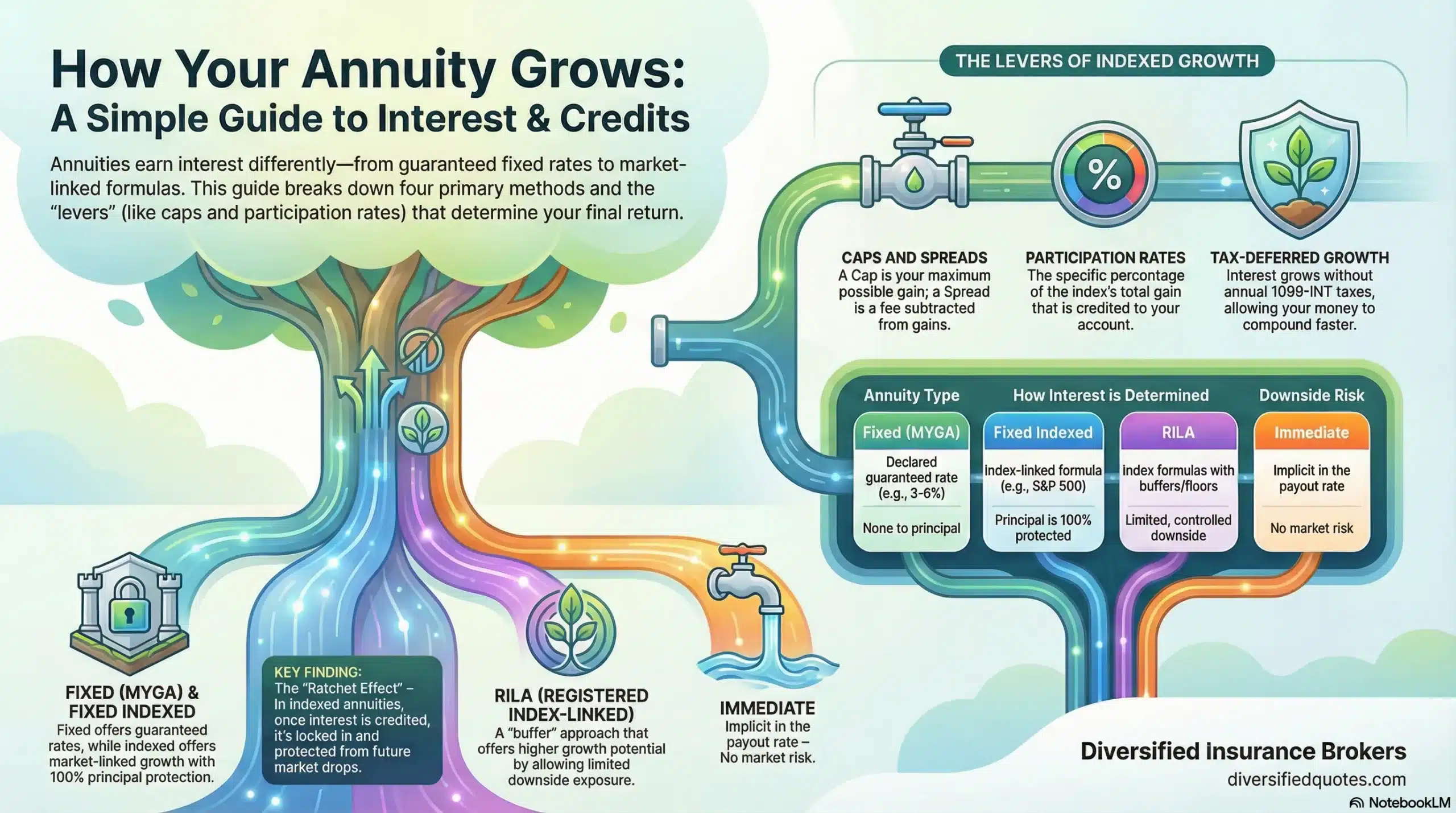
The Performance Rate Rider is the most nuanced optional feature of the AssetShield 10 Bonus. In exchange for a fixed fee — 1.5% on annual and monthly point-to-point strategies, 3% on 2-year point-to-point strategies — the PRR increases the cap or participation rate on the strategies to which it is applied. The fee is locked in for the entire 10-year surrender period and cannot increase. This locked-in fee structure is a meaningful buyer protection: unlike some riders where fees can adjust at renewal, PRR buyers know exactly what they are paying for the credit rate enhancement from day one. The practical evaluation is whether the higher credited interest generated by the enhanced rates exceeds the rider fee on a net basis over the surrender period. In strong index years, a higher participation rate can produce credited interest that comfortably exceeds the fee. In flat or zero-credit years, the fee is deducted regardless, creating a net drag. Buyers who apply the PRR selectively — only to strategies where they have a reasoned basis for expecting the enhanced rate to exceed the fee over a multi-year crediting horizon — use it more efficiently than buyers who apply it broadly to all strategies. Understanding how index annuity crediting methods interact with participation rates and spread rates is the prerequisite for that evaluation.
Flexible Premium: Adding Without Extending the Surrender Period
AssetShield 10 Bonus is a flexible-premium contract — a structural feature worth highlighting because many competing bonus FIAs are single-premium only. Additional premiums can be added at any time after issue without extending or restarting the surrender charge period. This matters for buyers who anticipate multiple funding events over time: a maturing CD, a 401(k) rollover processed in stages, an inheritance, or ongoing IRA contributions. Each additional deposit participates in index crediting from its addition date, and the first-year premium bonus applies to all first-year premium payments — meaning buyers who fund in multiple tranches within the first contract year still receive the 14% bonus on each deposit made during that year. After the first contract year, additional deposits go in at the then-current crediting rates without the bonus, but still without extending the surrender schedule. This flexibility makes the AssetShield 10 Bonus more adaptable to real-world funding timelines than competitors requiring a single lump sum at issue. For buyers rolling over IRA or 401(k) assets — where custodian-to-custodian transfers may arrive in stages — reviewing how to transfer an IRA to an annuity clarifies timing, tax treatment, and how to coordinate multiple incoming transfers without IRS complications.
Index Menu: Proprietary Strategies and the Zero Floor
The AssetShield 10 Bonus index menu leans heavily on proprietary and volatility-controlled strategies rather than plain S&P 500 cap strategies. The BlackRock Adaptive U.S. Equity 7% Index dynamically adjusts its equity allocation using a risk control mechanism targeting 7% annualized volatility — it reduces equity exposure in high-volatility environments and increases it when volatility is low, which tends to produce steadier but more moderate credits than an unconstrained broad equity index. The BNPP Patriot Technology Index concentrates on technology sector exposure through a BNP Paribas-developed methodology — technology sector concentration means higher potential credits during technology bull cycles and more sensitivity to technology-specific corrections. The S&P 500 Dividend Aristocrats Daily Risk Control 5% ER Index applies a 5% volatility target to a dividend-growth equity universe, with excess return calculation structure that factors in embedded costs — the participation rate applies to the fee-reduced index return, not the raw equity return. All of these strategies share the zero-floor guarantee: if the selected index produces a negative return during any crediting period, credited interest is 0% and the contract value does not decrease due to market performance. Gains credited at the end of each term are locked in and protected from future negative periods through the annual reset mechanism. For buyers weighing how participation rates and spread structures affect actual credited interest across these strategies, that resource covers the mechanics before any allocation decision. For buyers concerned about the limited publicly available performance history on some proprietary indices, S&P 500 strategies with cap or participation rate structures are available as a simpler, more historically transparent alternative within the same contract.
The Enhanced Benefit Rider: One-Time Full Access Under Qualifying Events
The Enhanced Benefit Rider is included in every AssetShield 10 Bonus contract for owners age 75 and under at issue — at no additional cost. It provides two separate one-time provisions. The Qualified Nursing Care Benefit allows one additional free withdrawal of up to 100% of the contract value if the owner is confined to a qualified care facility for a minimum of 90 consecutive days after the first contract year. Written proof from both the care facility and the recommending physician is required. The Terminal Illness Benefit allows one additional free withdrawal of up to 100% of the contract value if the owner is diagnosed with a qualifying terminal illness after the first contract year. Each of these provisions is a one-time benefit — it can only be exercised once during the life of the contract, and exercising one does not restore or replenish the other. Combined with the standard 10% annual free withdrawal, these waivers provide meaningful liquidity coverage for the most common scenarios in which a buyer might need to access more than the standard free amount: a qualifying health event or end-of-life circumstance. For buyers whose broader planning includes evaluating dedicated care coverage alongside the annuity, reviewing how an annuity with a nursing home care rider differs in scope from the AssetShield’s Enhanced Benefit Rider clarifies the appropriate role of each provision in a complete retirement plan.
Principal Protection, Sequence of Returns, and Where This Contract Fits
The fundamental value proposition of the AssetShield 10 Bonus — as with all FIAs — is the elimination of sequence of returns risk for the portion of retirement assets allocated to the contract. In a direct equity portfolio, a sharp early-retirement loss that occurs while the portfolio is also funding withdrawals creates permanent impairment that compounds negatively over the remaining retirement horizon. In the AssetShield 10 Bonus, a negative index year produces 0% credited interest — not a loss — and the next crediting period begins from the same protected base. Over a 10-year period that includes multiple market cycles, this stair-step compounding — capturing positive years, locking them in, and starting each new period from the same protected base regardless of what the index did in negative years — can produce a materially different accumulated value than a direct equity portfolio that absorbs full drawdowns. The 14% bonus amplifies this effect by raising the starting compounding base on day one. For conservative savers who are specifically concerned about volatility’s impact on their retirement savings but still want growth potential beyond traditional fixed rates, this combination of principal protection and bonus-amplified compounding addresses the core problem directly. For buyers evaluating how this accumulation-only structure compares to income-focused FIAs and what the right role of each is in a complete retirement plan, reviewing QLACs and deferred income strategies provides useful context for the distribution side of the retirement planning equation. Estate considerations are equally straightforward — at death, the full contract value including 100% of the vested bonus passes to named beneficiaries without surrender charges, and proper beneficiary designation allows those assets to transfer outside of probate in most cases. For families evaluating beneficiary options and the tax treatment of inherited annuity proceeds, reviewing annuity beneficiary death benefits covers the landscape of payout elections, spousal continuation, and tax treatment for non-spouse beneficiaries.
Related Pages
Explore additional American Equity products and annuity planning resources.
Financial Protection Essentials
Annuity education resources covering bonus structures, crediting mechanics, and retirement accumulation planning.
Talk to an Advisor or Request Your Annuity Quote
Ready to explore this annuity in more detail—or compare it with other carriers to see if even higher rates are available? With guaranteed income, principal protection, and long-term growth potential on the line, making the right choice is essential. The experienced advisors at Diversified Insurance Brokers will guide you through the options and design a strategy tailored to your retirement goals.
Schedule here:
calendly.com/jason-dibcompanies/diversified-quotes
Licensed in all 50 states • Fiduciary, family-owned since 1980
FAQs: American Equity AssetShield 10 Bonus
Should I choose the standard 14% bonus or pay for the 21% Enhanced Bonus & Liquidity Rider?
The decision comes down to two variables: how much you value the higher bonus versus how much you value the enhanced liquidity the EBLR provides alongside it. The standard 14% bonus gives you a stronger starting accumulation base with no additional rider cost, 10% annual free withdrawals from Year 2, and the standard vesting schedule. The EBLR replaces the 14% with a 21% bonus and changes the liquidity structure to 2% in Year 1 and 12% annually from Year 2 — while also ensuring those higher withdrawals do not trigger vesting forfeiture on the bonus itself, which the standard contract’s vesting schedule would otherwise require for excess withdrawals. The EBLR is worth evaluating if two things are true simultaneously: you want the higher bonus, and you genuinely anticipate needing more than 10% in annual access during the 10-year period. If you expect to take only the standard free withdrawal amount annually, the EBLR’s enhanced liquidity feature goes unused and you are paying a fee for a benefit you are not exercising. If you are unlikely to take withdrawals beyond the standard amount and your focus is purely on accumulation, the standard 14% bonus version with no additional fee is typically the stronger structure. A side-by-side illustration at your specific premium and anticipated withdrawal pattern is the most reliable basis for this comparison — the net accumulated value at Year 10 under realistic withdrawal assumptions determines which version produces better outcomes for your situation.
Is the Performance Rate Rider worth the fee?
The PRR charges 1.5% annually on annual and monthly point-to-point strategies, or 3% for 2-year point-to-point strategies, in exchange for higher cap or participation rates on the strategies you apply it to. Whether the fee is worth it depends entirely on whether the enhanced crediting rate produces more credited interest than the fee costs over the surrender period. The math is straightforward in principle: if the PRR increases your participation rate from, say, 100% to 150% on an index strategy, and the index credits 8% in that year, you receive 12% instead of 8% — a 4% advantage that more than covers the 1.5% fee. In a year where the index credits 2%, the 150% participation produces 3% credited interest versus 2% without the PRR, while the fee still costs 1.5% — a marginal 0.5% net advantage. In a year where the index credits 0%, you pay the fee with no credited interest to offset it, producing a net drag. The PRR makes economic sense over a full 10-year period if the strategies to which it is applied produce enough credited interest in the positive years to cover the fee in zero-credit years and still deliver net benefit. Buyers with a positive long-term outlook on the specific index strategies they are selecting are better candidates for the PRR than buyers who expect moderate or variable returns. The fee being locked in for the entire surrender period is a genuine protection — you will never pay more than the stated rate — but it also means you cannot remove the rider mid-contract if your outlook changes. Request a current crediting rate comparison with and without the PRR before applying it.
How does the AssetShield 10 Bonus compare to the non-bonus AssetShield 10?
American Equity’s AssetShield 10 without the bonus is the most direct comparison. The non-bonus version carries higher cap and participation rates on its index strategies than the Bonus version — American Equity offsets the cost of the 14% bonus through modestly lower crediting rates. This creates a specific planning question: over a full 10-year period, does the compounding on the bonus-amplified starting base outperform the higher crediting rates on the non-bonus version? The answer depends on the magnitude of the crediting rate difference and the index performance over the period. When index credits are strong and consistent, the non-bonus version’s higher rates can compound to catch or exceed the bonus version’s lower-rate compounding from a higher base. When index performance is moderate or mixed, the bonus-amplified base tends to maintain an advantage because the higher starting point compounds efficiently even at lower rates. The only reliable way to answer this for your specific premium and outlook is a side-by-side illustration comparing both versions at current declared crediting rates over a projected 10-year term. Diversified Insurance Brokers can run this comparison at no cost before any application decision.
What happens to the bonus if I die before the vesting schedule completes?
At death, 100% of the premium bonus is vested as of the contract issue date — regardless of where the owner is in the 10-year vesting schedule at the time of death. This means your beneficiaries receive the full contract value including the entire 14% bonus, with no surrender charges applied. If you pass away in Year 3, when only 20% of the bonus has vested through the living vesting schedule, the death benefit still pays the full contract value including 100% of the bonus. This is a buyer-favorable feature that eliminates the most adverse outcome of the vesting schedule — the scenario where a buyer dies before completing the vesting period and loses the unvested portion of the bonus. Spousal continuation is also available: a surviving spouse may elect to continue the contract as the new owner, maintaining the accumulation value, the vesting schedule (now moot since the death trigger has vested the full bonus), and the ongoing index crediting without triggering an immediate distribution event. For families evaluating the legacy and estate planning dimensions of the AssetShield 10 Bonus, reviewing annuity beneficiary death benefits covers the full range of payout options, spousal continuation mechanics, and tax treatment for non-spouse beneficiaries in detail.
This product has no income rider — how do I plan for income when the time comes?
The AssetShield 10 Bonus is designed for the accumulation phase, with income planning addressed separately — either through the contract’s built-in withdrawal provisions or through a subsequent product decision at the end of the 10-year surrender period. During the accumulation phase, the 10% annual free withdrawal from Year 2 (or 12% annually with EBLR) provides managed access for supplemental income, RMDs, or planned distributions without triggering surrender charges. For buyers who want systematic income from the contract, American Equity also offers systematic withdrawal arrangements at a minimum of $100 per disbursement. At the end of the 10-year surrender period, the full accumulated value — bonus, credited interest, and all — is available penalty-free for repositioning. At that point, many buyers execute a 1035 exchange into an income-focused FIA with a built-in GLWB, using the accumulated base from the AssetShield 10 Bonus as the premium for a new income contract. This two-stage approach — accumulate in a fee-free bonus FIA, then convert to a GLWB product at the point when income is actually needed — can produce better combined outcomes than committing to an income rider structure 10 years before income begins. For buyers who want guaranteed lifetime income built into the contract from day one, the American Equity IncomeShield 10 is the income-focused product within the same carrier family — it includes a built-in Lifetime Income Benefit Rider with optional Wellbeing Benefit for healthcare-related income enhancement. The right structure depends entirely on whether the buyer’s income start date is certain enough to justify paying an income rider fee from day one, or whether accumulating in a fee-free vehicle and converting later is the more efficient path.
About the Author:
Jason Stolz, CLTC, CRPC, DIA, CAA and Chief Underwriter at Diversified Insurance Brokers (NPN 20471358), is a senior insurance and retirement professional with more than 25 years of real-world experience helping individuals, families, and business owners protect their income, assets, and long-term financial stability. As a long-time partner of the nationally licensed independent agency Diversified Insurance Brokers, Jason provides trusted guidance across multiple specialties—including fixed and indexed annuities, long-term care planning, personal and business disability insurance, life insurance solutions, Group Health, Travel Medical and Evacuation Insurance, and short-term health coverage. Diversified Insurance Brokers maintains active contracts with over 100 highly rated insurance carriers, ensuring clients have access to a broad and competitive marketplace.
His practical, education-first approach has earned recognition in publications such as VoyageATL, and contributions from his agency featured in Kiplinger and GoBankingRates— highlighting his commitment to financial clarity and client-focused planning. Drawing on deep product knowledge and years of hands-on field experience, Jason helps clients evaluate carriers, compare strategies, and build retirement and protection plans that are both secure and cost-efficient. Visitors who want to explore current annuity rates and compare options across multiple insurers can also use this annuity quote and comparison tool.
Explore More Annuity Options: Browse our complete guide to Best Fixed Indexed Annuity Products — covering individual fixed indexed annuity product reviews from top-rated carriers from 100+ carriers.
Last Reviewed: June 22, 2026 |
Reviewed by: Jason Stolz, CLTC, CRPC, DIA, CAA
Chief Underwriter, Diversified Insurance Brokers, Inc. | NPN: 20471358 | Diversified Insurance Brokers, Inc. — Licensed in all 50 states
Fact Checked by: Tonia Pettitt, CMIP©
Medicare Specialist, Diversified Insurance Brokers, Inc. | NPN: 14374308 | Diversified Insurance Brokers, Inc. — Licensed in all 50 states
Did you find this content helpful? Leave us a Google review — it helps others find trustworthy guidance too.
Editorial Standards: Diversified Insurance Brokers maintains rigorous editorial standards to ensure accuracy, clarity, and independence in all content. Learn more about our editorial standards and commitment to transparency.
