
Atlantic Coast Life Safe Haven Bonus Guarantee Annuity – First-Year Boost With Long-Term Stability
As an Independent Annuity Broker, we compare rates across 100+ carriers and 1,000 different annuities— not just one company’s product offerings — to find the best fit for your goals.
Atlantic Coast Life Safe Haven Bonus Guarantee Annuity – First-Year Boost With Long-Term Stability
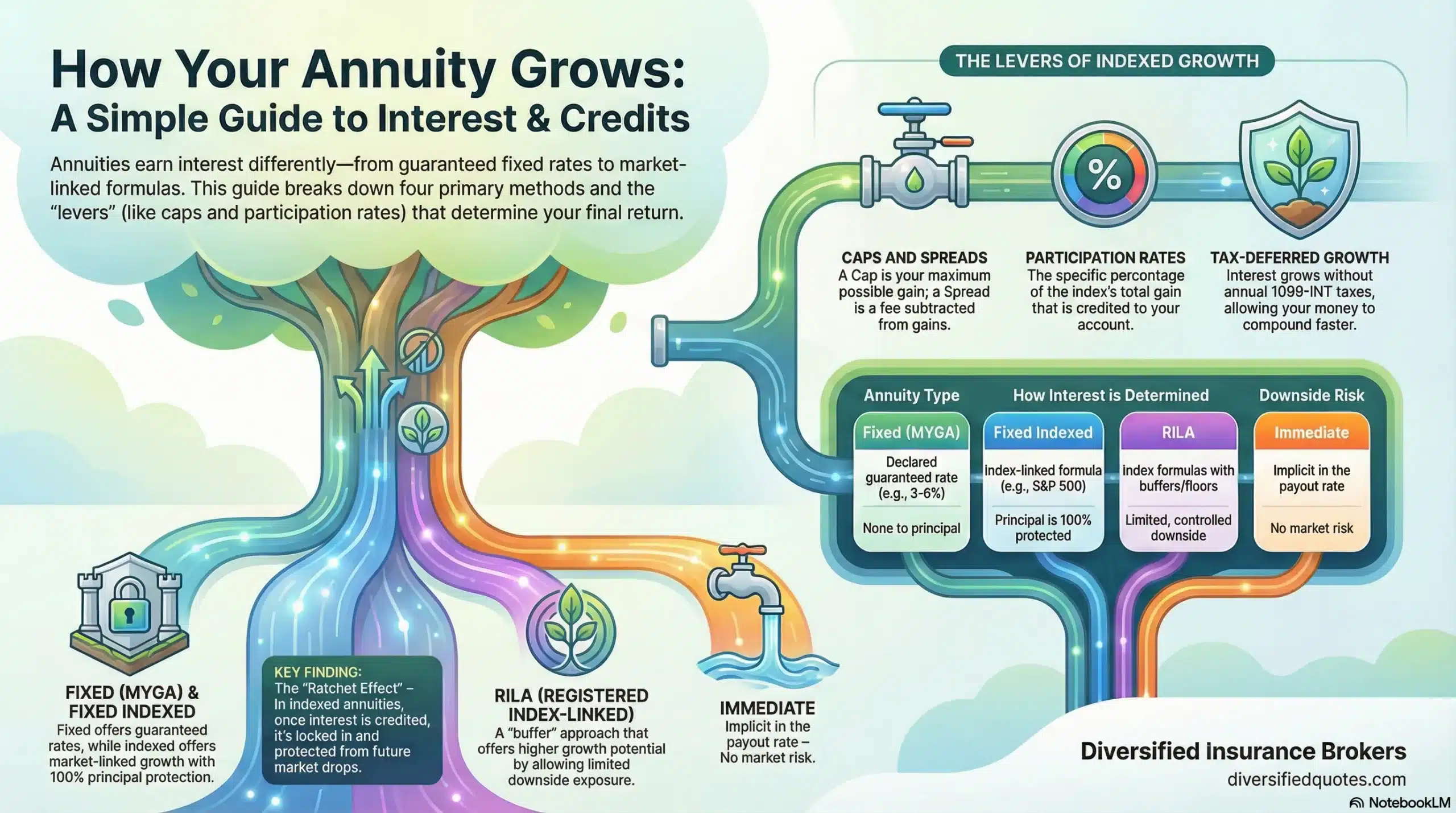
At Diversified Insurance Brokers, we guide individuals toward annuity strategies that emphasize certainty, tax efficiency, and long-term income confidence. The Safe Haven Bonus Guarantee Annuity, issued by Atlantic Coast Life Insurance Company, is a single-premium deferred fixed annuity available in 3, 5, 6, 7, 10, and 20-year guarantee periods. It delivers declared, market-free growth combined with a first-year compound interest bonus on all terms except the 20-year, and a highly customizable optional rider structure that allows buyers to select exactly the liquidity and death benefit provisions they need — paying only for the features they actually want. That build-your-own-access design is Safe Haven’s structural differentiator from most MYGAs: standard liquidity provisions that would be automatic at other carriers are optional riders here, each with a small, transparent cost in the form of a rate reduction. Buyers who don’t need ongoing withdrawals maximize yield by skipping the riders; buyers who need periodic access elect the relevant riders and accept the corresponding rate reduction. For buyers comparing MYGA structures and the current rate environment, reviewing current fixed annuity rates benchmarks this product against competing carriers, and reviewing current bonus annuity rates adds context on how first-year enhancements compare across the market.

Ensure you are receiving the absolute top rates
Current Fixed Annuity Rates
Compare today’s best fixed annuity rates from top carriers.
Current Bonus Annuity Rates
See which annuities offer the highest upfront bonus today.
Request an Annuity Quote
Submit our annuity request form to get personalized rate options.
Lifetime Income Calculator
Use our calculator to see how much guaranteed income your annuity can provide.
Atlantic Coast Life Safe Haven Bonus Guarantee: Key Product Features at a Glance
| Product Feature | Details |
|---|---|
| Issuing Carrier | Atlantic Coast Life Insurance Company. Charleston, South Carolina. Founded 1925. Part of the A-CAP family. AM Best: B++ (Good) — below the A-tier carrier benchmark. Available in approximately 35 states — not all states; confirm availability at application. NAIC Complaint Index: higher than expected for its market share — a service quality signal to weigh alongside the financial strength rating. Not FDIC insured. All guarantees backed solely by claims-paying ability of Atlantic Coast Life Insurance Company. |
| Product Type and Terms | Single-premium deferred fixed annuity (MYGA). Available in 3-year, 5-year, 6-year, 7-year, 10-year, and 20-year guarantee periods. Declared fixed interest rate locked for the full term. No market exposure. No index links. Tax-deferred compound growth. MVA applies on excess withdrawals. Qualified and non-qualified funding accepted. Spousal continuation available. |
| Minimum Premium | $5,000 minimum initial premium. No stated maximum. Single premium only. Issue ages: up to 85 for most terms; ages 86–90 accepted but require the Death Benefit Rider. 20-year term: ages 70–75 require the Death Benefit Rider. Florida: Death Benefit Rider is mandatory on all contracts and priced into Florida rates. |
| First-Year Interest Bonus | A 1% compound interest bonus is credited in the first contract year on all terms except the 20-year. This bonus applies to the accumulation value and enhances early compounding by boosting the Year 1 credit above the standard declared rate. The bonus is in addition to the declared rate — not a replacement for it. Confirm whether the bonus applies to your specific term at application; the 20-year term does not include the first-year bonus. |
| Liquidity — Optional Rider Structure | No standard penalty-free withdrawal is included in the base contract. Liquidity provisions are optional riders, each reducing the annual declared rate: (1) Accumulated Interest Withdrawal Rider (−0.05%): allows periodic withdrawals of accumulated interest without surrender charges or MVA — the interest earned is accessible without penalty; principal is not. (2) Preferred 10% Free Withdrawal Rider (−0.15%): waives surrender charges and MVA for one withdrawal per year up to 10% of contract value or the RMD amount, whichever is greater. (3) Death Benefit Rider (−0.25%): waives surrender charges and MVA at death, ensuring full account value passes to beneficiaries without charges. Riders can be combined; each adds to the total rate reduction. Once selected at issue, riders cannot be removed during the guarantee period. |
| Surrender Charges and MVA | Surrender charge schedule starts at 9% across all terms — among the steeper starting charges in the MYGA market. Market Value Adjustment (MVA) also applies on excess withdrawals and surrenders during the guarantee period. Both the surrender charge and MVA are waived on withdrawals within the Preferred 10% Rider provision, at death (if Death Benefit Rider is elected), and during the 30-day penalty-free window at the end of each term. |
| At End of Guarantee Period | 30-day penalty-free window at the end of each term. Options: (1) Withdraw or transfer the full account value without surrender charges or MVA. (2) Renew for a new guarantee period — new rates and new surrender charges apply. (3) Annuitize — convert accumulated value into a fixed income stream for 3–20 years (period-certain only; no guaranteed lifetime option without annuitization). If no action is taken within 30 days, a new term begins with new surrender charges. Actively managing the maturity window is essential. |
| Death Benefit | With Death Benefit Rider elected (−0.25% rate reduction): full account value passed to beneficiaries with no surrender charges or MVA; bypasses probate when properly structured. Without the rider: standard death benefit terms apply — surrender charges and MVA may reduce the amount payable at death. The Death Benefit Rider is required for buyers ages 86–90 on most terms and for 20-year term buyers ages 70–75. All Florida contracts automatically include the rider. Spousal continuation available. |
| Tax Treatment | Interest grows tax-deferred — no annual 1099 forms during accumulation. Non-qualified: LIFO — earnings distributed first, taxed as ordinary income; cost basis returned tax-free. Qualified accounts: full distributions taxed as ordinary income. No additional tax deferral for qualified accounts beyond the plan itself. Withdrawals before age 59½ subject to 10% IRS early withdrawal penalty. Not FDIC insured. |
The Optional Rider Model: Pay Only for the Features You Actually Need
The Safe Haven’s rider structure is its most distinctive characteristic and the one that most frequently surprises buyers who come to it from other MYGA products. Most MYGAs bundle a 10% annual free withdrawal provision and sometimes health event waivers into the standard contract without separate fee structures — you receive the liquidity features at no stated cost, but the cost is actually embedded in the carrier’s pricing. Atlantic Coast Life takes a transparent modular approach: the base Safe Haven contract has no standard penalty-free withdrawal provision, and every liquidity feature is explicitly priced as a named rider with a stated rate reduction. The Accumulated Interest Withdrawal Rider costs 0.05% per year in rate reduction and allows interest-only withdrawals without surrender charges or MVA — providing access to earned interest while preserving the principal. The Preferred 10% Free Withdrawal Rider costs 0.15% and allows one withdrawal per year up to 10% of contract value or the RMD amount, whichever is greater — the same provision that competing MYGAs typically include automatically. The Death Benefit Rider costs 0.25% and ensures the full account value passes to beneficiaries without surrender charges at death. Buyers can elect any combination: some elect all three and accept the combined 0.45% rate reduction; others elect none and maximize the declared rate. The rider structure also means buyers who genuinely won’t take withdrawals during the term — pure accumulation buyers with separate liquidity elsewhere — aren’t paying for features they don’t use, which is a genuine advantage over MYGAs that price those features into the base rate regardless. For buyers comparing the Safe Haven against MYGAs that include these provisions automatically — such as the United of Omaha Ultra-Secure Plus with 10 hardship waivers included at no cost, or the Nationwide Secure Growth with health waivers built in — the comparison must adjust for the stated rider costs on the Safe Haven versus the implied costs in those carriers’ base rates. The net declared rate after electing equivalent riders is the correct comparison point.
The 9% Starting Surrender Charge: Context and Planning Implications
The Safe Haven’s 9% starting surrender charge across all terms is one of the steeper entry-year charges in the MYGA market. Most competing MYGAs start surrender charges at 7%–9% and decline to zero over the term. The 9% figure applies in Year 1 to any withdrawals above the elected rider’s free provision — meaning a buyer who surrenders the entire contract in Year 1 for a non-qualifying reason would face a 9% charge on the excess, plus MVA. The safe haven design works best for buyers who genuinely intend to hold through the full term and have confirmed separate liquidity reserves for any foreseeable needs outside the annuity. Understanding how surrender charges work and aligning the chosen term with the actual planning horizon for that capital is the prerequisite for an appropriate Safe Haven allocation. The high starting charge is partly the mechanism that enables ACL’s competitive declared rates — it creates a stronger pool of assets that remain invested for the full duration, supporting higher yields. Buyers who are rate-maximizing and genuinely committed to holding through the term benefit from this; buyers with any meaningful probability of mid-term access face a material cost from this charge structure. For buyers evaluating alternatives with lower starting surrender charges alongside comparable rates, reviewing the best MYGA rates from A-rated carriers at the same terms provides the full competitive landscape.
Term Selection, the First-Year Bonus, and Safe Haven vs. Safe Harbor
The 6-term menu — 3, 5, 6, 7, 10, and 20 years — gives Safe Haven unusual term flexibility compared to most MYGAs that offer 3, 5, and 7 years. The 6-year and 10-year options fill gaps in most competing product lineups. The 20-year term is particularly distinctive — almost no other MYGA carrier offers a 20-year declared-rate product — and targets buyers with very long planning horizons or who want to lock in today’s rates for an extended period. Note that the 20-year term does not include the first-year bonus, and requires the Death Benefit Rider for buyers ages 70–75 at issue. The first-year compound interest bonus (1% on all terms except 20-year) applies to the accumulation value and enhances compounding from the outset. For buyers comparing the Safe Haven against the closely related Atlantic Coast Life Safe Harbor Bonus Guarantee: both products share the same ACL carrier and similar term structure, but Safe Harbor uses simple interest (not compound), offers higher stated rates (because simple interest is less valuable at the same rate), and includes no withdrawal riders at all — it’s designed purely for accumulation buyers who will never access the funds mid-term. Safe Haven, with compound interest and optional withdrawal riders, is designed for buyers who may want periodic access to interest income during the term. The distinction matters: a 7.0% simple interest Safe Harbor rate and a 6.5% compound Safe Haven rate can produce similar or different terminal values depending on the term length — always compare on accumulated dollar value, not stated rate. ACL also offers the Accumulation Protector Plus for buyers who want index-linked growth potential, and the Income Navigator with a 7% bonus and optional GLWB for buyers whose primary objective is guaranteed lifetime income.
Tax Deferral, RMDs, and the CD Comparison
Like all MYGAs, the Safe Haven’s central advantage over taxable CDs is tax deferral: interest compounds without annual taxation, while CD interest generates a 1099 each year it accrues. For buyers in higher marginal tax brackets, this deferral advantage produces a materially higher after-tax accumulated value over the full term even at the same nominal rate. Reviewing fixed annuities vs. CDs covers the full side-by-side accumulated value comparison across tax brackets. For buyers repositioning maturing CDs, reviewing how to transfer a CD into an annuity covers the process before initiating any transfer. For qualified account holders, the base Safe Haven contract includes no standard RMD waiver — a critical planning point. If the buyer is subject to required minimum distributions and does not elect the Preferred 10% Free Withdrawal Rider, RMD withdrawals from the Safe Haven contract will trigger surrender charges and MVA in Years 1 through the end of the term. Buyers with qualified IRA funds who anticipate annual RMD obligations must elect the Preferred 10% Free Withdrawal Rider — confirming that the RMD amount will not exceed the 10% free withdrawal limit each year — or face surrender charges on those mandatory distributions. This is a planning step that differentiates the Safe Haven from MYGAs that automatically waive RMD charges without requiring a separate rider election.
Income Planning, Legacy, and the Safe Haven’s Place in a Portfolio
The Safe Haven does not include a GLWB or income rider. Guaranteed lifetime income from this product is available only through annuitization — an irrevocable conversion of the accumulated value into a period-certain income stream for 3–20 years. For buyers evaluating whether to annuitize versus use an income rider on a separate product, our resource on whether to annuitize or use an income rider covers the structural comparison. For buyers whose primary objective is guaranteed lifetime income from the outset, the ACL Income Navigator includes an optional GLWB. Many buyers use the Safe Haven as a pure accumulation vehicle for the chosen term, then reposition at maturity via 1035 exchange into a SPIA or income-focused FIA for the distribution phase. The fixed annuity ladder strategy works well with Safe Haven’s 6-term menu — funding 3-year, 5-year, and 7-year contracts simultaneously creates staggered maturity windows for rolling liquidity and rate capture. For buyers coordinating Safe Haven income timing with Social Security claiming decisions, reviewing how Social Security and annuities work together before structuring withdrawal timing reduces bracket surprises. Whether the Safe Haven belongs in a specific plan depends on the buyer’s rate-versus-rating evaluation and their liquidity profile — and reviewing how fixed indexed annuities work provides the structural contrast for buyers comparing the Safe Haven against ACL’s own FIA products. The full case for whether any annuity belongs in a retirement plan is covered in whether annuities are worth it, and annuity beneficiary death benefits covers estate transfer mechanics and how inherited annuity proceeds are taxed for heirs.
Related Pages
Explore additional Atlantic Coast Life products and MYGA planning resources.
Financial Protection Essentials
Fixed annuity and MYGA education resources covering product mechanics, tax treatment, and retirement income planning.
Talk to an Advisor or Request Your Annuity Quote
Ready to explore this annuity in more detail—or compare it with other carriers to see if even higher rates are available? With guaranteed income, principal protection, and long-term growth potential on the line, making the right choice is essential. The experienced advisors at Diversified Insurance Brokers will guide you through the options and design a strategy tailored to your retirement goals.
Schedule here:
calendly.com/jason-dibcompanies/diversified-quotes
Licensed in all 50 states • Fiduciary, family-owned since 1980
FAQs: Atlantic Coast Life Safe Haven Bonus Guarantee Annuity
Which riders should I elect — and what does each one actually cost?
The rider election is the most consequential product decision for Safe Haven buyers because it determines both the effective yield and the liquidity structure for the full term. Three optional riders are available, each reducing the declared annual rate by a fixed amount. The Accumulated Interest Withdrawal Rider (−0.05%) allows periodic withdrawals of accumulated interest without surrender charges or MVA — the interest earned is accessible; principal is not. This is the appropriate election for buyers who want to use the Safe Haven as an interest-income vehicle, collecting earned interest periodically while the principal compounds. The Preferred 10% Free Withdrawal Rider (−0.15%) allows one annual withdrawal up to 10% of contract value or the RMD amount — the standard MYGA liquidity provision that most competing products include automatically. Buyers with qualified IRA funds who are subject to RMDs must elect this rider; without it, RMD withdrawals trigger surrender charges and MVA. Buyers who need access to principal amounts beyond earned interest should elect this rider. The Death Benefit Rider (−0.25%) ensures the full account value passes to beneficiaries without surrender charges or MVA at death. Without this rider, the death benefit is subject to standard surrender charge and MVA provisions, potentially reducing what beneficiaries receive if death occurs during the early years of a long-term contract. All three elected together cost −0.45% in annual rate. Once elected at issue, no rider can be removed during the term. For buyers comparing this modular approach against MYGAs like the United of Omaha Ultra-Secure Plus — which bundles 10 hardship waivers and 10% free withdrawal at no stated additional cost — the net declared rate after electing equivalent riders is the correct comparison point, not the base rate before rider elections.
How does the Safe Haven compare to the Safe Harbor — and which one should I choose?
The Safe Haven and Safe Harbor Bonus Guarantee are both ACL MYGAs with the same term menu and the same 1% first-year bonus (on terms other than 20-year), but they differ in two fundamental ways. First, interest type: Safe Haven uses compound interest; Safe Harbor uses simple interest. Safe Harbor typically states a higher rate than Safe Haven for the same term — but because Safe Harbor’s interest credits are calculated on the original premium every year (not on the grown balance), a higher simple rate may produce less total accumulated value than a lower compound rate over multi-year terms. Comparing on accumulated value at maturity is essential; stated rate comparison between simple and compound products is misleading. Second, liquidity: Safe Haven offers optional withdrawal riders for buyers who want access. Safe Harbor offers no withdrawal riders at all — it’s a pure accumulation product with no mid-term access provision other than RMDs (which are confirmed as surrender-free on Safe Harbor). The decision: if you want any possibility of accessing funds mid-term for income supplementation or non-RMD withdrawals, Safe Haven is the appropriate product. If you have no need for mid-term access and want to maximize yield for a pure accumulation objective, Safe Harbor may produce more accumulated value — but verify this with side-by-side accumulated value illustrations adjusted for simple vs. compound interest at your specific premium and term. Neither product has health event waivers; this remains a gap relative to competing MYGAs like the Lincoln MYGuarantee Plus or Pacific Guardian Life Diamond Head, which include nursing home and terminal illness waivers at no stated cost from A-rated carriers.
Atlantic Coast Life is B++ rated — how should I weigh that against its competitive rates?
AM Best B++ (Good) is two notches below A- and three below A. ACL’s B++ rating means AM Best assesses its financial strength as adequate but below the Excellent tier held by A-, A, and A+ carriers. Atlantic Coast Life has operated since 1925 and is part of the A-CAP family, so it is not a new company. However, the B++ rating does mean the financial cushion between ACL and insolvency is assessed as thinner than at A-tier carriers. The practical comparison: ACL’s Safe Haven rates are consistently among the highest available in the MYGA market across its terms — often meaningfully higher than what A-rated carriers like Midland National (A+), Nationwide (A+), or Pacific Guardian Life (A) offer at the same terms and premium. Whether that rate premium justifies the B++ vs. A rating difference is buyer-specific. For buyers allocating within state guaranty association limits (typically $100,000–$250,000 depending on state), the secondary protection layer reduces the financial exposure. For buyers allocating above those limits, the B++ vs. A distinction carries more meaningful practical risk. An additional service quality signal: ACL’s NAIC Complaint Index is notably higher than expected for its market share — relevant when evaluating the post-sale service experience, particularly for buyers who elect riders and may need to interact with the carrier to process withdrawals. Reviewing safe fixed annuity options from A-rated carriers at the same terms and premium provides the direct rate-vs-rating comparison.
Which term should I choose — and what makes the 20-year and 6-year options unique?
The 6-term menu — 3, 5, 6, 7, 10, and 20 years — gives the Safe Haven more granularity than most competing MYGAs which typically offer 3, 5, and 7 years only. The 6-year term fills a gap common in the MYGA market where buyers who want something between 5 and 7 years have had limited options; 6 years at Safe Haven’s rates may align well with buyers who are 59 years old and targeting a term that ends at 65 with no early withdrawal penalty risk. The 10-year term, similarly, is less common among high-rate MYGAs and positions well for buyers with a confirmed decade-long accumulation horizon — perhaps a 55-year-old targeting retirement at 65. The 20-year term is exceptional in the MYGA market: almost no other carrier offers a 20-year declared-rate product. It targets buyers who want to lock in today’s rates for a very long horizon — perhaps a 50-year-old who doesn’t anticipate needing access to this capital for two decades. Key 20-year distinctions: no first-year bonus, Death Benefit Rider required for buyers ages 70–75 at issue, and the surrender charge period extends for the full 20 years. The standard term decision logic applies to the shorter options: match the maturity date to the planning horizon, compare the rate differential between terms (longer typically pays more), and confirm the declared rate for your specific term and rider elections before any commitment. Reviewing current best MYGA rates across the market establishes whether ACL’s rate at each term is sufficiently above competing A-rated alternatives to justify the B++ carrier and the 9% starting surrender charge at that term length. Many buyers use the ladder strategy across 3, 5, and 7-year Safe Haven contracts simultaneously, creating staggered maturity windows while capturing different declared rates.
The Safe Haven has no GLWB — how does income planning work with this product?
The Safe Haven does not include a Guaranteed Lifetime Withdrawal Benefit or any income rider. Lifetime income from this product requires annuitization — an irrevocable election that converts the accumulated value into a period-certain payment stream for 3–20 years. Period-certain annuitization pays guaranteed amounts for the selected period but does not guarantee payments for life beyond that period; once the selected income period ends, payments stop. This is meaningfully different from a GLWB, which guarantees withdrawals for life regardless of how long the owner lives. For buyers whose primary objective is guaranteed lifetime income, the Safe Haven is the wrong product structure — the ACL Income Navigator Annuity includes an optional GLWB alongside a 7% premium bonus. Outside the ACL family, income-focused FIAs like the National Life Group Zenith Income 10 or the Athene Ascent Pro 10 Bonus include built-in lifetime income riders from A+ carriers. The most common planning approach for Safe Haven buyers who eventually need income is to use it as a pure accumulation vehicle for the chosen term, then 1035-exchange into a SPIA or income-focused FIA at maturity — capturing ACL’s competitive yield during accumulation and then accessing a lifetime income structure at the transition point. Reviewing whether to annuitize or use an income rider covers the structural comparison that should precede that election at maturity.
About the Author:
Jason Stolz, CLTC, CRPC, DIA, CAA and Chief Underwriter at Diversified Insurance Brokers (NPN 20471358), is a senior insurance and retirement professional with more than 25 years of real-world experience helping individuals, families, and business owners protect their income, assets, and long-term financial stability. As a long-time partner of the nationally licensed independent agency Diversified Insurance Brokers, Jason provides trusted guidance across multiple specialties—including fixed and indexed annuities, long-term care planning, personal and business disability insurance, life insurance solutions, Group Health, Travel Medical and Evacuation Insurance, and short-term health coverage. Diversified Insurance Brokers maintains active contracts with over 100 highly rated insurance carriers, ensuring clients have access to a broad and competitive marketplace.
His practical, education-first approach has earned recognition in publications such as VoyageATL, and contributions from his agency featured in Kiplinger and GoBankingRates— highlighting his commitment to financial clarity and client-focused planning. Drawing on deep product knowledge and years of hands-on field experience, Jason helps clients evaluate carriers, compare strategies, and build retirement and protection plans that are both secure and cost-efficient. Visitors who want to explore current annuity rates and compare options across multiple insurers can also use this annuity quote and comparison tool.
Explore More Annuity Options: Browse our complete guide to What Is a Fixed Annuity? — covering fixed annuities, MYGAs, laddering strategies & conservative growth options from 100+ carriers.
Last Reviewed: June 24, 2026 |
Reviewed by: Jason Stolz, CLTC, CRPC, DIA, CAA
Chief Underwriter, Diversified Insurance Brokers, Inc. | NPN: 20471358 | Diversified Insurance Brokers, Inc. — Licensed in all 50 states
Fact Checked by: Tonia Pettitt, CMIP©
Medicare Specialist, Diversified Insurance Brokers, Inc. | NPN: 14374308 | Diversified Insurance Brokers, Inc. — Licensed in all 50 states
Did you find this content helpful? Leave us a Google review — it helps others find trustworthy guidance too.
Editorial Standards: Diversified Insurance Brokers maintains rigorous editorial standards to ensure accuracy, clarity, and independence in all content. Learn more about our editorial standards and commitment to transparency.
